"There! See the line of lights, A chain of stars down either side the street, Why can't you lift the chain and give it to me..."
'A November Night' is a romantic poem by American Lyric poet Sara Teasdale that was first published in 1916. The verses vividly describe the magic and wonder latent in a frosty winter night. The speaker guides us, melodically, though a "line of lights" where everything is capable of inspiring passions in the embers of our hearts.
This work presents Sara's dreamy, amorous walk, now visually reimagined. This fully illustrated book brings those exquisite words to life, following the unbroken verses that lead the narrator through an evening where everything is made magical by her romantic mood.
Sara Teasdale (1884–1933) was an American lyrical poet whose most popular works today include The Collected Poems (1937), Love Songs (for which she won a Pulitzer Prize in 1918), and Flame and Shadow. Her works have cemented her legacy as a poetical force to be reckoned, inspiring countless artistic projects in the years since her tragic and untimely death by the hand of sleeping pills in 1933.
Sara Teasdale was an American lyrical poet. She was born Sara Trevor Teasdale in St. Louis, Missouri, and after her marriage in 1914 she went by the name Sara Teasdale Filsinger.
Teasdale's first poem was published in Reedy's Mirror, a local newspaper, in 1907. Her first collection of poems, Sonnets to Duse and Other Poems, was published that same year.
Teasdale's second collection of poems, Helen of Troy and Other Poems, was published in 1911. It was well received by critics, who praised its lyrical mastery and romantic subject matter.
In the years 1911 to 1914, Teasdale was courted by several men, including poet Vachel Lindsay, who was absolutely in love with her but did not feel that he could provide enough money or stability to keep her satisfied. She chose instead to marry Ernst Filsinger, who had been an admirer of her poetry for a number of years, on December 19, 1914.
Teasdale's third poetry collection, Rivers to the Sea, was published in 1915 and was a best seller, being reprinted several times. A year later, in 1916 she moved to New York City with Filsinger, where they resided in an Upper West Side apartment on Central Park West.
In 1918, her poetry collection Love Songs (released 1917) won three awards: the Columbia University Poetry Society prize, the 1918 Pulitzer Prize for poetry and the annual prize of the Poetry Society of America.
Filsinger was away a lot on business which caused a lot of loneliness for Teasdale. In 1929, she moved interstate for three months, thereby satisfying the criteria to gain a divorce. She did not wish to inform Filsinger, and only did so at the insistence of her lawyers as the divorce was going through - Filsinger was shocked and surprised.
Post-divorce, Teasdale remained in New York City, living only two blocks away from her old home on Central Park West. She rekindled her friendship with Vachel Lindsay, who was by this time married with children.
In 1933, she committed suicide by overdosing on sleeping pills. Her friend Vachel Lindsay had committed suicide two years earlier. She is interred in the Bellefontaine Cemetery in St. Louis.
The two previous Obvious State illustrated poems I've read were by Walt Whitman and T.S. Eliot; this Sara Teasdale poem isn't quite the heavy hitter that "Song of Myself" and Prufrock are, but it's sweet, charming, and spirits-lifting, and the illustrations are characteristically beautiful and intricate. I read it twice and can imagine going back to it again, soon.
"There! See the line of lights, A chain of stars down either side the street -- Why can't you lift the chain and give it to me, A necklace for my throat? I'd twist it round And you could play with it. You smile at me As though I were a little dreamy child Behind whose eyes the fairies live. . . . And see, The people on the street look up at us All envious. We are a king and queen, Our royal carriage is a motor bus, We watch our subjects with a haughty joy. . . . How still you are! Have you been hard at work And are you tired to-night? It is so long Since I have seen you -- four whole days, I think.
My heart is crowded full of foolish thoughts Like early flowers in an April meadow, And I must give them to you, all of them, Before they fade. The people I have met, The play I saw, the trivial, shifting things That loom too big or shrink too little, shadows That hurry, gesturing along a wall, Haunting or gay -- and yet they all grow real And take their proper size here in my heart When you have seen them. . . . There's the Plaza now, A lake of light! To-night it almost seems That all the lights are gathered in your eyes, Drawn somehow toward you. See the open park Lying below us with a million lamps Scattered in wise disorder like the stars.
We look down on them as God must look down On constellations floating under Him Tangled in clouds. . . . Come, then, and let us walk Since we have reached the park. It is our garden, All black and blossomless this winter night, But we bring April with us, you and I; We set the whole world on the trail of spring.
I think that every path we ever took Has marked our footprints in mysterious fire, Delicate gold that only fairies see.
When they wake up at dawn in hollow tree-trunks And come out on the drowsy park, they look Along the empty paths and say, "Oh, here They went, and here, and here, and here! Come, see, Here is their bench, take hands and let us dance About it in a windy ring and make A circle round it only they can cross When they come back again!" . . . Look at the lake -- Do you remember how we watched the swans That night in late October while they slept? Swans must have stately dreams, I think. But now The lake bears only thin reflected lights That shake a little. How I long to take One from the cold black water -- new-made gold To give you in your hand! And see, and see, There is a star, deep in the lake, a star! Oh, dimmer than a pearl -- if you stoop down Your hand could almost reach it up to me. . . .
There was a new frail yellow moon to-night -- I wish you could have had it for a cup With stars like dew to fill it to the brim. . . .
How cold it is! Even the lights are cold; They have put shawls of fog around them, see! What if the air should grow so dimly white That we would lose our way along the paths Made new by walls of moving mist receding The more we follow. . . . What a silver night! That was our bench the time you said to me The long new poem -- but how different now, How eerie with the curtain of the fog Making it strange to all the friendly trees! There is no wind, and yet great curving scrolls Carve themselves, ever changing, in the mist.
Walk on a little, let me stand here watching To see you, too, grown strange to me and far. . . .
I used to wonder how the park would be If one night we could have it all alone -- No lovers with close arm-encircled waists To whisper and break in upon our dreams.
And now we have it! Every wish comes true! We are alone now in a fleecy world; Even the stars have gone. We two alone!"
The poem itself is obviously beautiful, but the artwork in this Obvious State edition is outstanding. They did such a masterful job of subtle changes in shading to make the nighttime come through the pages. A wonderful gift (or book to keep for yourself).
Another truly gorgeous production by Obvious State. I have really loved wandering down the pathways of these tiny collections and see all the glorious art they've created to evoke the words and feelings of the poem.
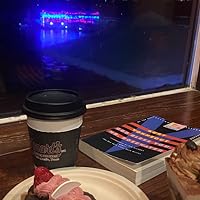
a lovely little book of sara teasdale’s poem, A November Night + striking black and white illustrations by evan robertson • “I used to wonder how the park would be if we could have it all alone—“ • instagram book reviews @brettlikesbooks
This edition is rather small - it fits nicely in your hand. Perfect for taking along when you're out and about. Otherwise, lovely poem and lovely, interesting illustrations.
Do you know what I want? I want to come back and find everything as it was. I want to walk into my kitchen, and take out my kettle, and make myself a cup of tea, as if I never left.
"Sara Teasdale" masterfully connects individual psychology to institutional control in "We Two Alone: A November Night". It opens your eyes to the subtle tricks used to steer the crowd. "Sara Teasdale" put together a mature and highly effective piece.
Romantic illustrations enhance the romance of this poem. I have not read a lot of Sara Teasdale’s work, but after reading this one, I plan to read more.