Jump to ratings and reviews
Rate this book
Rate this book

Jupiter: The Ruthless One – Mars: The Doomed One – Sun: The Fiery One – Saturn: The Beautiful One – Pluto: The Mysterious One

Professor Brian Cox is back with another insightful and mind-blowing exploration of space. This time he shows us our solar system as we've never seen it before.

We’re living through an extraordinary time of exploration. A fleet of space probes are continually beaming data back to Earth. Hidden in this stream of code are startling new discoveries about the worlds we share with the Sun. We will piece together these remarkable findings to tell the greatest science story of them all – the life and times of the Solar System.

What emerges is a dramatic tale of planetary siblings. Born from violence, they grow up together, in time becoming living, breathing worlds, only to fade away one by one as they age. Along the way we will meet all eight of the major planets, plus a supporting cast of moons, asteroids and comets, and a mysterious as yet unseen world way out beyond the Kuiper belt.

602 pages, Kindle Edition

First published February 7, 2019

979 people are currently reading
3387 people want to read

About the author

Brian Cox

106 books2,077 followers
Not to be confused with actor [Author: Brian Cox].

Brian Edward Cox, OBE (born 3 March 1968) is a British particle physicist, a Royal Society University Research Fellow, PPARC Advanced Fellow and Professor at the University of Manchester. He is a member of the High Energy Physics group at the University of Manchester, and works on the ATLAS experiment at the Large Hadron Collider (LHC) at CERN, near Geneva, Switzerland. He is working on the R&D project of the FP420 experiment in an international collaboration to upgrade the ATLAS and the CMS experiment by installing additional, smaller detectors at a distance of 420 metres from the interaction points of the main experiments.

He is best known to the public as the presenter of a number of science programmes for the BBC, boosting the popularity of subjects such as astronomy; so is a science popularizer, and science communicator. He also had some fame in the 1990s as the keyboard player for the pop band D:Ream.

Ratings & Reviews

What do you think?
Rate this book

Friends & Following

Create a free account to discover what your friends think of this book!

Community Reviews

5 stars
1,545 (55%)
4 stars
980 (35%)
3 stars
228 (8%)
2 stars
22 (<1%)
1 star
4 (<1%)
Displaying 1 - 30 of 248 reviews
Profile Image for Greta G.
337 reviews319 followers
July 6, 2021
When I watched Professor Brian Cox’s fascinating television series “The Planets” (BBC) some time ago, I realized how little I know about our solar system and I was keen to learn more.
I was somewhat hesitant to read the companion book to the series, expecting it to be dry and possibly beyond my capabilities as a complete novice in space science. I needn’t have worried though because the book not only was comprehensible ; it was utterly exhilarating!
The authors take the reader on a grand tour of the solar system and explain the science of and latest insights about the planets and some of their moons in an accessible and absorbing way.
They also tell the amazing stories of the space exploration missions, sometimes of many years, to these wondrous, alien worlds.
This high quality book also offers excellent photographs on every page.
This is space exploration at its finest!
Profile Image for Muhammad Abdullah.
92 reviews73 followers
April 30, 2023


This is an amazing book which take its readers to a dramatic journey through the eight majestic worlds along with the Kuiper's Belt objects that make up our Solar System. The journey of discovery start with the hottest planet Mercury and goes on from rocky planets (Mercury, Venus, Earth & Mars) to gas giants (Jupiter & Saturn ) and then to frozen wonderlands (Uranus & Neptune). This book is full of epic stories of solar system and its marvelous beauty which attact the readers to fall in love with these Heavenly marbles (plantets and their moons) and their inter-planetary systems. I enjoy an love this book a lot.

Now I will give overview of our Solar System.

Earth sits a mere 150 million kilometers from the Sun - not to hot, not to cold, with surface temperatures ranging from minus 88 to plus 58 degrees Celsius. This Goldilocks location has created a stability of climate that has allowed life to maintain an unbroken chain for nearly 4 billion years. But this cannot last forever.

MERCURY

Mercury is the smallest of four rock worlds and is the most nearest planet to Sun. The first probe that sent to Mercury was Mariner 10 spacecraft which used Venus slingshot to enter Mercury orbit. The first detailed picture of Mercury was taken by Mariner 10 over 200 miles above the planet's surface.

Mercury takes 88-days to complete its orbit around the Sun. But the most bizzare thing about Mercury is its lopsided, elliptical orbit which takes it as close as 46 million kilometers to Sun or as far as 70 million kilometers. The temperature during day rises to 170 degrees Celsius and at night it falls to minus 170 degrees Celsius due to absence of atmosphere and small in size.

The day at Mercury is twice in length than its year. It has to go around the Sun twice to have one complete solar day on the planet.

VENUS

The next rocky planet is Venus which lies 50 million kilometers beyond Mercury. This is the most mysterious planet in the solar system and it lies at the inner edge of habitable zone. There were many conspiracies about the nature of environment on Venus but the true nature was revealed for the first time in 1950s that the planet was engulfed in a blanket of carbon dioxide instead of water and oxygen.

In 1960s, Soviet launched a program named Venera to explore the atmosphere and surface of Venus. After a few failed attempts, Venera 9 successfully touched down to the Venusian surface, operated for 53 minutes in October 1975 and sent back useful images. Is Venus once a waterland world? This seems to be an important question. Cosmochemist Larry Nittler described all this in a beautiful way:

"Scientists believe that Venus once had a lot of water in its oceans, but lost it over time, and perhaps from its oceans as recently as a billion years ago. The reason we can tell this is from the isotopic composition of hydrogen measured in its atmosphere by spacecraft. Now, hydrogen has two flavors of isotopes. Whereas most hydrogen atoms are just a single proton in the nucleus, some, a small fraction, are what we call deuterium, that have a proton and a neutron, so they weigh twice as much as the regular hydrogen. What happens when you have evaporation of water from a planet, or the atmosphere, is that the water molecules that contain hydrogen are much lighter than the water molecules that contain deuterium, so they evaporate more easily, and can be lost more easily. So, over time, as you evaporate water, more deuterium bearing molecules stay behind relative to the regular ones, and you build up a big deuterium to normal hydrogen ratio. And by back-calculating from the measured ratio today, we can figure out how much water has been lost over billions of years of evolution, and it's quite a lot."

Further, the author tells us about the rotation and day length on Venus. Venus has the slowest rotation among the planets in the solar system. It takes 243 Earth days (sidereal day) to complete its one rotation around its own axis. So, one Venusian year is shorter than one day and night on Venus. One solar day on Venus lasts for 116.75 Earth days. Its orbital period is 225 days (w.r.t Earth day). Venus rotates from east to west whereas, all other planets in solar system rotates from west to east except Uranus.

MARS

Mars is the most popular planet. It is discussed in sci-fi movies, books, news channels, tv programs etc. We all heard about this planet in our daily routine many times. Photographs from first flyby of Mars was taken by NASA's Mariner 4 spacecraft on July 15, 1965. NASA's Mars Global Surveyor spacecraft spent four and a half years mapping the Mars in late 1990s.The highest elevations on Mars are found on the Tharsis Rise which is a great volcanic plateau and home to the largest volcano in the solar system, Olympus Mons. Its height is about 25 kilometers. The lowest point on Mars is found on Hellas impact basin. Hellas is over 9 kilometers deep and it could contain Mount Everest.

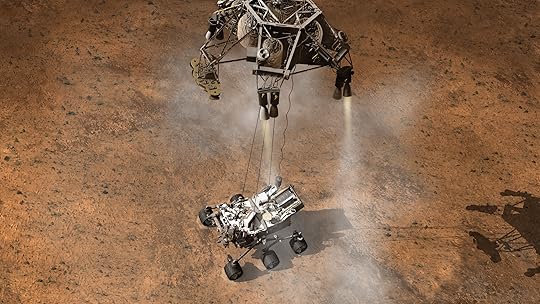
Mars is the one of the nearest planets to Earth. Mars Reconnaissance Orbits (MRO) is working as a bridge of communication between the two worlds. NASA landed several rovers on Mars to explore it. The most famous are Opportunity and Curiosity. (Perseverance is landed on Mars recently on February, 2021.So, its landing is not mentioned in the book). Opportunity landed on the Meridiani Planum close to Martian equator on 25 January 2004, with a planned life of 90 Earth days. But it remained operational for over 14 years and a journey of 45 kilometers on the surface of Mars. It was finally declared dead on 13 February 2019 as its solar panels were covered in a dust storm. Curiosity is the most advanced spacecraft that ever to touch down another planet surface. The mission was landed on 5 August 2012. The mission costs more than $2.5 billion.


Landing scene of Curiosity rover on Mars

The enormity of the mission is best described through the words of Allen Chen, Operation Leader, who watched the landing at Jet Propulsion Laboratory (JPL) along with team.

Seven Minutes of Terror - in the words of Curiosity mission's Leader Allen Chen

Things are looking good. Coming up on entry
Vehicle reports entry interface
We're beginning to feel the atmosphere as we go in here
Alright, it is reporting that we are seeing Gs on the order of 11 or 12 Earth Gs
Bank reversal 2 is starting
We are now getting telemetry from Odyssey
We should have parachute deploy around Mach 1.7
Parachute has deployed
We are declining
Heat shield has separated, we are locked on the ground
We're down to 90 meters per second at an altitude of 6.5 kilometers and descending
Standing by for backshell separation
We are in powered flight
We are at altitude 1 kilometer and descending
Standing by for sky crane
Sky crane is starting
Signal from Odyssey remains strong
Touchdown confirmed! We're safe on Mars!
(cheering, applause)
We got thumbnails. It's a wheel! It's a wheel!
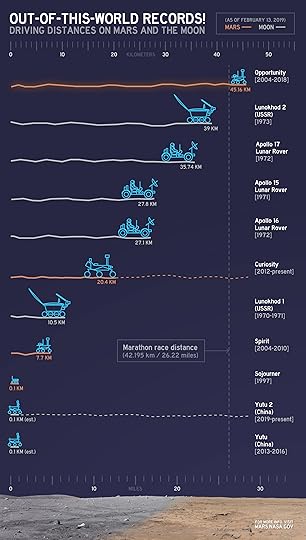



Comparison of all missons send to Mars and Moon


Highly recommended.
Profile Image for Leo.
4,984 reviews627 followers
November 3, 2022
Second five star non fiction of November. Haven't seen the Documentary but found the audiobook to je extremely interesting and didn't get bored with it one bit
Profile Image for Andrew.
680 reviews248 followers
August 21, 2020
The Planets, by Brian Cox, is a fascinating and engaging book on the planets of our solar system, their composition, how they were formed, and how they are explored by humans. This book brings together numerous fields of science; physics of light and gravity, fluid dynamics in gas giants, biology and theoretical astrobiology, chemistry, engineering and so forth. The book takes a holistic look at the history of the solar system and how the developments of planets, their gravitational pull, and how the all encompassing influence of the Sun effects all things. Some fascinating tidbits exist here - the planetoids of the asteroid belt, including Ceres, the effect Jupiters gravity has on flinging asteroids toward the inner solar system, the fascinating moons of the gas giants, the icy dwarf planets of the Kuiper Belt, and so much more. The speculation of the potential for life or historical relics of life is present on many moons and planets: Mars and its ancient and long dried water, Enceladus, Titan and Europa with their surface liquids, Ganymede's explosive water plumes, and so on.

This book is breathtaking in scope, and encompasses so much to do with space and space exploration. The interconnections of our solar system are mind boggling to comprehend. This book and its wonderful prose, updated snaps from some of NASA's latest missions, and information and speculations from some of the top minds in the space exploration field, make this a truly fantastic read. Space is fascinating to me, and the every aspects of its infinite mysteries make it constantly fascinating to read about. The constant updates to our knowledge of the solar system from continued study make it an ever exciting field to read about. A fantastic read through and through.
Profile Image for Radiantflux.
467 reviews500 followers
December 26, 2020
94th book for 2019.

A companion to the BBC series of the same name, this book offers an excellent, and very readable, up-to-date introduction to the planets of our solar system.

4-stars.
Profile Image for Ken.
373 reviews86 followers
May 23, 2021
Planets Brian Cox, just how insignifant is Earth? well lets say it really is, very insignificant, so refreshing being brought down to size, so empowering. Fun fact we need to thank Saturn for halting Jupiter’s hostile takeover of Mars Earth Venus through the amazing power of gravity and that’s why we are special, as apparently in our observable nearby star systems of planets its not normal. In the future as technology improves this could easily change, but for now nope. fun "yes sir" oh it has moons and other stuff....as well.
Profile Image for Grumpus.
498 reviews302 followers
October 3, 2019
The grumpus23 (23-word commentary)
How we know what we know about our terrestrial neighbors in our solar system. Eloquently and clearly explained for both layperson and authority.
Profile Image for Hamid.
149 reviews12 followers
February 9, 2020
Exploring planets is more than just a leisure activity. We do it for fun, but we also do it to learn more about our own planet and ultimately our own existence. This book was a joyful experience. It took me back to four and a half billion years ago.
Profile Image for Justyna.
267 reviews16 followers
December 4, 2020
I mean I had to give it all the stars... 😂
Profile Image for Andrew.
2,539 reviews
December 15, 2019
I will admit that this is the first of Dr Brian Cox's books which I have not seen the TV series first. Now that not may sound like much but considering all the other books if his I have approached them the other way around this was a rather insightful read.

The book itself is fascinating - anyone who has a passing interest in space and the universe around us this book is a treasure trove of historical facts, amazing images (although I wish I had a pound for every time I saw the work colourised) and easy to read and accessible facts.

However on the other had there is a different insight you get when you read this book without the back story from the TV show - dare I say it the book is a little "dryer" reading and although fascinating does not come as alive as remembering the various scenes and topics from the show.

Now I am all for reading the story (or book) before the show but in this case when they say that the book accompanies the series they really mean it - now it may be that I am just as not as knowledgable as I thought I was and I needed that extra support and encouragement or not.

One thing I will certainly take away from this book is that our knowledge is constantly changing - not in years or decades but it seems in cases months - there are new facts being discovered all the time although they are not as attention grabbing as some of the scientific discoveries happening at the moment they may well be just as profound. The question is what will the next book have to say?
Profile Image for Vaughan Hatton.
28 reviews2 followers
June 20, 2020
This book was a perfect read that dances from planet, to moon, and out to the furthest reaches of our own stars light. Taking you on a amazing journey describing how it all began, how it works and how it will likely end for all the beautiful features dotting our vast solar system. This book is easily my favourite on the subject and will make any reader smile and scratch their heads as they embark on the Grand Tour of our very own system.
Profile Image for Simon.
Author 91 books519 followers
December 5, 2020
A great and inspiring read about a solar system and the people over the centuries who've helped us understand the worlds around us. We should be firing off probes left and right to explore the outer reaches of our solar system and beyond. We should always be shooting for the stars...figuratively and literally.
Profile Image for Lee Madden.
48 reviews
June 26, 2019
Outstanding - balances the science with history of astronomy and is a very refreshing listen. Highly recommended if you’re not looking for hardcore astronomy and instead want an entertaining tour of the solar system.
Profile Image for Shae.
756 reviews166 followers
August 31, 2019
Absolutely magnificent. BRILLIANT and beautiful and informative and poetic. I was going to read and pass along to a friend but no. It's mine now.
Profile Image for Maj.
406 reviews21 followers
August 3, 2019
Twenty+ years ago I was a child who listened to a science radio programme every Saturday morning and whose most prized possession was a book on space.
Then puberty happened, music was discovered, and it also turned out that just like both of my parents I was hopeless in maths and was not gonna be an astrophysicist after all.
I'd hear about space-related discoveries via pop-culture mostly but until I started watching this book's namesake sister TV series they also mostly passed me by and didn't really stick in the brain.

Turns out I missed a lot, forgot some, and therefore had to do quite a lot of rewinding to be able to keep up when I was watching the series. The amazing visuals in the series were gorgeous - and therefore slightly distracting, as was the not quite as gorgeous but still quite aesthetically pleasing - and therefore also slightly distracting - presenter, and so I decided it was time to get me an updated sibling to my childhood space book. A lot has happened in space exploration since then....that much was clearly and beautifully told in the course of the series, and - good thinking from the creators, there was a companion book to it too. Perfect!

Look, as I said, I was an enthusiast eons ago, am definitely not an expert enthusiast. I won't be able to tell if the authors choose theories they like instead of the most widely accepted theories (which I think they did, but as I said, I wouldn't know). I can't critique the book on the scientific content.
But I definitely think it's people like me who are the actual target audience, and from my point of view the book gave me exactly what I expected and wanted from it. Did it without talking down to its readers and without any obvious dumbing down (I definitely had to at times do some passage re-reading), but at the same time it also used a lot of gorgeous and helpful photos and illustrations, (with the occasional graph).

The series and book couldn't have come at a better time to rekindle my childhood passion - and for that I'd give it a whole universe of stars - if the rating here didn't stop at five.
56 reviews1 follower
September 8, 2020
Astonishing. Overwhelming story of the solar system concatenated through numerous explorations. A must read. How it came to be, what it is now.. mesmerising, a must read for every person of this planet.
Profile Image for Dejo.
Author 1 book15 followers
December 6, 2019
A wonderful journey through our solar system. Really puts you in perspective and makes you realize how lucky we are to exist, both as a planet and as a species.
Profile Image for Annika.
195 reviews10 followers
February 27, 2022
Well this book was an eye-opener. Literally. If you're looking for me, I'm probably somewhere looking into the sky, searching for planets with my newly bought telescope. And I'm not kidding.
Profile Image for Siji Joseph.
62 reviews1 follower
April 1, 2025
This book is such a key reminder that the fact that earth and humans exist is a literal miracle and that exploring our solar system is so cool! This was really easy to read and mostly written in layman terms! A deep dive into all planets in our solar system, how they came to be, their past environments and why they are presently inhospitable, as well as a deep dive into the missions to explore each planet! Also, the images in this book were so incredible and high definition. Now to watch the TV documentary 😛

P.S. my fave planet is Jupiter 🥰😍
Profile Image for G.R. Matthews.
Author 19 books248 followers
June 10, 2021
Enjoyed learning more about the planets. The images are amazing, and a sense of wonder permeates the whole book.
Profile Image for Cav.
907 reviews205 followers
February 13, 2020
This was an excellent book. Authors Brian Cox and Andrew Cohen have produced an interesting, engaging, and informative look at the planets of the Solar System, beginning with Mercury, (closest to the Sun) and moving outwards, finishing with Pluto (which is not technically a planet). The authors go through a brief history, or theorized history of the planets, as well, which was very interesting.
The ebook version I read also featured many pictures, illustrations and other figures and attachments that helped bring the text to life.
"The Planets" covers all the up-to-date data and information we have about each of the planets, as of its publication in 2019, and describes the numerous space probe planetary pass-bys of the last ~40 years.
I found this book very interesting and informative. It is written in a very accessible format, and is not so technical that it will have the reader lost in the minutia, which always represents effective communication, IMO.
I would highly recommend it to anyone curious about our Solar System, and the planets that reside therein.
5 stars.
Profile Image for Maurice Frank.
41 reviews6 followers
June 8, 2019
Rubbishest planets book ever seen. No mention of Mars's satellites! Outer planets' satellites covered selectively not comprehensively. No chapter on the asteroid belt, discussion of them buried within the Jupiter chapter! which is a layout that makes readers hunt and dig. No heading on the Kuiper belt, traditional heading on Pluto given and the belt just treated within focusing on Pluto like it was still a planet.
So, weighted, neither comprehensive nor balanced in its coverage of all the objects.
Every planet discussed as a potential and failed Earth, anthropocentrically. Not explained how Ceres is supposed to have orbitally survived at all having Jupiter move through the asteroid belt in the formation era. Misedits include age of the Red Spot, no mention of it being over 3 centuries, and Kepler's forename.
225 reviews4 followers
September 9, 2021
A really nicely balanced book, mixing history, information and entertainment which made for an engrossing yet easy read.

I hadn’t realised just how much had been discovered by recent space exploration, particularly concerning the more distant planets, their moons, their history and how much this impacted on the past Earth. I particularly liked the explanations of how data that the spacecraft gathered from their missions was used to draw conclusions, rather than just baldly presenting the facts.

The text is backed up by some truly amazing photographs of even the most distant objects. I really didn’t expect to learn so much new information and theory so was very pleased to have read it.
Profile Image for Lin.
21 reviews1 follower
March 15, 2024
This book has been written with such love and enthusiasm that I can recommend it to anyone who wants an entry-level understanding of the planets in our solar system. It doesn't overwhelm. Lovely read. 👏
Profile Image for Jacob Ownby.
6 reviews
June 11, 2025
Really a fascinating read. Learning about the volatility of the other worlds in our solar system helps me find more wonder and appreciation for the world we have here on Earth.
30 reviews1 follower
June 26, 2025
Fascinating, delightfully compact bite size study of our galaxy. The narrator was top notch and loved listening to every bit of this.
Displaying 1 - 30 of 248 reviews

Can't find what you're looking for?

Get help and learn more about the design.