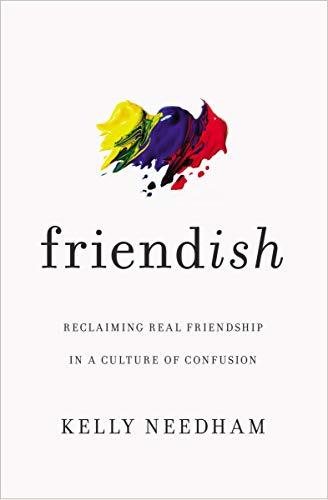
For so many of us, our friends are like family members--we lean on them through our highest highs and our lowest lows--but sometimes those friendships don't turn out quite as we hoped. Bible teacher Kelly Needham debunks our world's constricted, narrow view of friendship and casts a richer, more life-giving, biblical vision for friendship.
In Friend-ish, Kelly Needham reminds us that we were called to more than halfhearted friendships and lukewarm connections. We need something more stable, secure, and sacred. We were designed for real friendship--but the difficult truth is that too many of us are settling for less.
Kelly deconstructs what Scripture says about the gift of friendship and takes a closer look at the distorted view that most of us have instead. As she shares the lessons she's learned from experience, Kelly paints her own glorious vision of what Christian friendship could look like.
With hard-fought wisdom, a clear view of Scripture, and a been-there perspective, Friend-ish teaches us how
Recognize symptoms of idolatry and toxic dependencyBoldly ask for what we need from our community of friendsUnderstand and address the problems that arise in friendship--from neediness to discordRecognize when it's time to end an unhealthy friendshipReorient toward the purposeful, loving relationships we all crave that ultimately bring us closer to GodFind the friends you need and start to become that friend for others
Join Kelly as she challenges you to view your chosen family in a new light, gain a vision of friendship according to Jesus, and finally enjoy friendships as God intended.
Kelly Needham is married to singer/songwriter and speaker Jimmy Needham. Kelly is the author of Friendish: Reclaiming Real Friendship in a Culture of Confusion and her writing has been featured at Revive Our Hearts, Desiring God, The Gospel Coalition, The Ethics and Religious Liberties Commission, Eternal Perspectives Ministries, and Crosswalk. She has been on staff at two different churches, serving in youth, college, and women's ministry and currently teaches the Bible at her home church and co-leads a Women’s Teaching Program, training women to accurately handle the word of truth. Whether writing or speaking, Kelly’s aim is to convince as many people as possible that nothing compares to knowing Jesus. She and Jimmy live in the Dallas area with their four children. You can find more of her writing and speaking at kellyneedham.com or follow her on social media.
I read this book for a book club and I don’t like to speak ill of anyone trying to do God’s work but the author seemed so immature to me. I didn’t feel like she had the wisdom to deliver this book effectively, she gives examples from when she was in middle school. I think she needed to wait another ten years to write a book like this when she’d been though more seasons in her life or target preteens or teenagers for her audience.
While there are things to admire about the author's perspective, and some positives from the book which I will highlight in this review, overall Friendish by Kelly Needham is an ironically unhelpful condemnation of meaningful friendships. The first half of the book is spent dismantling people's attachment to friends and friendship. She routinely calls friendship a "waterless cistern" and more often a "treasureless field." "The only thing friendship can do" she says "is show you ONLY Christ has something to offer." Needham said that because of Christ we don't "need" friends. She stated that if we are lonely it is only because of our own sin, because we wouldn't be lonely if we knew Christ was our everything. It became clear as the book progressed that the author has numerous friendships, many of which have been so fabulous that it caused her to become idolatrous in them. This is alien to the experience of most people I know, who would praise God for even one friendship. Many are horribly isolated and without any meaningful friendships. Some women at my church are desperate for even one person from church to reach out to them during the week (which rarely occurs), one woman recently told me "I wonder sometimes if anyone ever thinks about me, what I'm going through... if anyone even cares I exist." We have an extreme dearth of friendship in our culture and society, so to condemn loneliness as merely the sufferer's own sin problem of not trusting in God (the nouthetic approach to friendship, as I call it) falls beyond flat. This also misses that the perfect Christ experienced grief from human abandonment and ostracization "he was despised and rejected by men, a man of sorrows, acquainted with grief."
I had thought I was reading a book about reclaiming friendship, but became mystified at the chronic condemnation of people for having or cherishing deep friendships. Clarity rang when the author explained "one of the very reasons I began to write on friendship in the first place" was because so many of her friends had such deep friendships that they became same-sex attracted. She believes to protect against developing same-sex attraction, friendships must be strictly utilitarian: seemingly only discussing spiritual things and confronting sin, never being too close, never using "romantic" language of friendship, and especially that friendship must be "without obligations" (she back tracks this point later in the book). I understand wanting to make a defense against Side B Christianity, but she ignores an enormous amount of the biblical data on friendship in her attempt to do so, and this fundamentally undermines her argument.
The author believes that any type of dependency on friends is sinful, and shows a lack of faith in Christ and a lack of focus on the gospel. I wondered what the author might say about Paul, who left Troas even though a "door was open to the gospel" there because "my spirit was not at rest because I did not find my brother Titus there" (2 Cor 2:12-13). Was Paul sinfully dependent on Titus?
A biblical emphasis completely missing from Friendish is the category of "affection." The book makes friendship strictly utilitarian, but Scripture speaks of the affections, which is not strictly utilitarian. "You are not restricted by us, but you are restricted in your own affections. In return (I speak as to children) widen your hearts also." (2 Cor 6:12-13). Notice even the marital vow language on relationships in the church: "Make room in your hearts for us... I do not say this to condemn you, for as I said before that you are in our hearts, to die together and to live together" (2 Cor 7:2) "We rejoiced even more at the joy of Titus, because his spirit has been refreshed by you all... And his affection for you is greater." (2 Cor 7:13-15). "For I seek not what is yours, but you... I will gladly spend and be spent for your souls. If I love you more, am I to be loved less?" (2 Cor 12:14a,15). "So, being affectionately desirous of you, we were ready to share with you not only the gospel of God but also our own selves, because you had become very dear to us" (1 Thes 2:8).
Oh that we would be able to speak of our relationships in the church with such a degree of personal affection and love, not simply a utilitarian purpose of sanctification. Of course, Godly friendships ARE sanctifying, but we "seek not what is yours, but you." This is like affection for God, which is a love for who he IS and not simply what he can do for us. We are meant to both give and receive this from friends in Christ: affection. Love that is not simply seeking an end. Kelly Needham condemns love for love's sake as idolatrous, and the book entirely lacks this biblical category of affection. I also have qualms with the premise that Godly friendship is "without obligations." Certainly Paul does not speak this way either: "Yes, brother, I want some benefit from you in the Lord. Refresh my heart in Christ" (Phil 1:20). Finally, Needham would need to take to task (besides King David and the Apostle Paul): Gregory of Nazianzus, Augustine, John Calvin, Andrew Fuller, John Ryland, and even the bleakly stiff Martin Lloyd Jones, who all employed extraordinarily positive and intimate (romantic) language of friendship. Shall we condemn these, and hundreds of other historical Christian figures, as simply idolatrous? Or could it not be as Michael A.G. Haykin says in his book on friendship "Iron sharpens Iron," that "Modern culture in the West is not one that provides great encouragement for the nurture and development of deep, long-lasting, satisfying friendships. Such friendships take time and sacrifice, and the West in the early twenty-first century is a busy, busy world that, generally speaking, is far more interested in getting and possessing than sacrificing and giving. Moreover, during the course of the twentieth century, popular Western culture 'developed an obsession with individual selfhood and sexual desire that marginalized friendship.'" I would encourage a read through of Haykin's book, because it shows that Godly friendships which are deep and intimate are yet the very best for sanctification of those involved and leads to much praise to God.
Now, with these critiques, it is important to say that there are things to admire within the book. For one, Kelly Needham clearly loves the Lord and promotes a full casting of ourselves on Christ. This is good. Certainly anytime friendship leads us away from the Lord, that is sin, and unhelpful to us. In later chapters, she urges people to learn to ask for help, which though contrary to earlier chapters' emphasis, is good and necessary. In later chapters she mentions that "the body of Christ has family obligations" and "Let's be bold to ask for what we need." Again, while at odds with other statements in the book (such as: if we think we need anything from friends it's idolatry), this is good. One of the best sections of the book was an examination of the role social media plays in our relationships. She explained that Scripture does not tell us to love our two-thousand Facebook friends as ourselves, but our neighbor, and that due to our limitations as people we cannot have endless relationships but must actually prioritize those within near proximity to us.
I want to close with two quotes. The first by Robert Hall, Jr, who says of friendship "under the general culture of reason and religion, it is one of the fairest productions of the human soil, the cordial of life, the lenitive of our sorrows, and the multiplier of our joys; the source equally of animation and repose." The second by Calvin, who wrote of his friends in the dedication of his commentary on Titus: "I do not believe that there have ever been such friends who have lived together in such deep friendship in their everyday style of life in this world as we have in our ministry... it seems to me that you two and I were as one person."
I’ve been following Kelly’s blog for years after seeing a post on Facebook linking to a blog post she wrote about friendships. I recognized her name because I’d been a fan of her husband, Jimmy Needham’s music since college. I don’t even remember what her post was specifically about, but I remember reading it and saying “wow.” It was a lot of what I’d needed to hear for a while and also things I had strong feelings about, but had never seen someone else put into words in such a honest way. I was hooked! When I saw she was writing a book on friendship, I was so excited to read it, but I also wanted to be able to share it with my Christian friends.
I just finished reading an early copy of the book and have so many passages highlighted. Kelly writes in such an honest way. I felt convicted in parts, and in others learned a lot of things I’ve already started to put into practice in my own friendships. My favorite parts of the book talked about how the rise of social media has changed friendships and how we no longer understand or know how to accept seasonal friendships. I’ve definitely felt pressure and stress to maintain tons of different friendships that, before social media, would have just naturally faded out. That isn’t to say we cut out friends who move away—and that isn’t what Kelly is saying either. But she explains how we as people have limits—we are human after all.
This is a book I will be reading again and recommending to my friends. I think it’s an important one for the church as a whole—this book isn’t just for women! Kelly interviewed many men as well when she was writing the book and there is a wealth of growth opportunity in this book for both men and women.
As I was listening to this I kept thinking I needed this in junior high, high school, college, young married life, and definitely need this now as a mom in this season of life. It was just so good and practical.
This is one of those books I think I need to read every year. Because of my personality type I struggle with friendships and letting go, depending too much on them, reading into things, pride, giving too much, pride, learning to lower expectations, and pride, and etc. LOL. This books talks about the balance and the ONE who needs to be there to meet all of our needs. It also goes into what a unhealthy and inappropriate friendship looks like which I thought was very good.
I really appreciated the author pointing out several things that stood out to me: friends may be only for a season. There is a reason and a season why friends come and go. There is no way 700 facebook friends can all be close friends. There is an inner circle of friends (you can trust and call on to help), outer circle, and acquaintances. To have friends one must show himself friendly and go out of your little comfort inner circle, and make oneself available. Not all friendships look the same. You need different friends and types of friends.
This. Book. Humbling. Convicting. Blessed beyond words to have been gifted this book by a sweet friend. It has opened my eyes to truths and issues I didn’t understand or know existed. It’s definitely a reread, one I’ve marked up and a book I wish everyone would read! So what are you waiting for? Go get a copy and read it! You can borrow mine, if you want ;) and if I’m not reading it again 😆
This book was quite a disappointment. I thought the majority of the book would be about what friendship looks like from a Biblical worldview. Instead, the first 60% of to book is spent discussing idolatry in friendship. This felt really long and I wish it had been a single chapter. I found the way the author placed marriage as a relationship superior to friendship both concerning and biblically inaccurate. Especially for folks who are single, I imagine this would be a very discouraging read. Her claim that close, intimate friendship will lead to same-sex attraction was baffling. She makes the claim that loneliness is always a result of our own sin in not putting God in the correct standing in our life. There was just a lot in the first half of the book that felt like it was arguing that any close friendship must be sinful. Additionally, many of the examples in the book were written from the author's middle and high school experience, making the book feel like it was meant more for teens.
I wish the entire book had been the last 3 chapters. They were more balanced, applicable, and Biblically sound. Albeit, they were very confusing and contradicted much of the first half of the book.
Overall, if you're looking for a book on gospel-centered community or friendship, this is not one I would recommend.
I think this is a book that we all could/need to read at various points in our lives.
These are great reminders of how friendship is such a blessing, but when it begins to become a priority in your life, over God and family, it’s time to re-evaluate things.
Encouraging and challenging book on friendships- I find it to be very applicable as a single but I think it would be very helpful in any stage of life! Essentially Kelly hammers home the idea that friendships exist as an opportunity to serve to the glory of God. Am I using my friendships to accomplish *my* ends, or as an opportunity to love and serve *them*? I also loved how she outlined a healthy friendship. Good friends should a) deepen our joy in Christ, b) battle with us, c) carry out our weakness, and d) be there for us. And we ourselves should be that friend.
Friends were few and far between for me in high school but that all changed when I arrived at college. Because friendship was something that was so foreign to me but something I so deeply craved it was and is still difficult to navigate through the waters of what biblical Christ honoring friendship should look like. This book had answers for my questions but not easy ones to swallow. “Why dont our friendships satisfy us? Might I suggest its because they were never meant to.” Kelly craft-fully pointed to our nature that desires water and bread but often times runs to friends to satisify a longing they were never meant to and never can. Jesus is the living water that never will run dry. He is the bread of life. “Loneliness is not primarily a people problem but an unbelief problem: it’s an unwillingness to turn to God to meet our souls deepest needs.” This quote deeply resonates and cuts right to the bone. Mark 9:24 “Lord, I believe; help my unbelief.” She also heavily highlighted the need and requirement for us as believer to be active participants in the local body of believers which includes church membership. I highly recommend this for anyone not just the one who like myself struggles to leave my friendships in their rightful place…subject to the throne of God and for the Glory of God alone.
Really wish this resource had been available to me in college! A really helpful look at what biblical friendship is and how to enjoy the gift without expecting more than is promised. Made me so thankful for my friends 🥲
A solid read on Biblical friendship! Needham details how/why friendship often goes wrong when we are not centered on Christ. She details what Biblical centered friendship looks like backing it with scripture and with many examples from her own life. She teaches how even though friendship is not the end all and definitely shouldn’t be, there are still many ways we are called to be faithful in them. Fairly light and easy read, but quite convicting in many ways!
This book was challenging in the best way. What the world calls friendship doesn't model gospel-centered friendship, and Kelly uses a lot of scripture and her own personal examples to show that. I love how Christ-centered this book is when it could have easily been filled with fluff. It would be great to read in a community group or with a group of friends. Expect to be challenged, encouraged and changed!
This book is so good! I didn’t expect it to be so convicting! Kelly does not just talk about what it means to be a good friend, but calls out the heart issues causing the problems in our relationships. Much emphasis on God being our friend and sufficiency and how friendship is meant to advance the kingdom (not just satisfy some need or make us feel good).
4.75⭐️! This book had some incredible wisdom about what friendships should look like (and not look like) as a Christ follower! The book points a lot to the idol of friendship, and how we so often put friends in positions only God should hold in our lives. One of my favorite quotes in the book is:
“But when Jesus is our stability- our consistent friend and refuge- we are freed to truly love others and love them sacrificially.”
Def would recommend to anyone, but especially those going through transitionary periods in your life, where friendships can be a big question mark. Only qualm was that, especially in the second half, the book got a tad repetitive!
wow. who knew so much wisdom could be packed into a 10-chapter book? I'm going to be putting a video up on my channel talking all about it, but I wanted to say how here how thankful I am that I was able to read this. I started this book at such a needed time I can't call it anything, but a God thing! Highly recommend!
I highly recommend this book! All of us play the role of friend, and we all have friends. This book explores friendships and encourages us to look at one specific friend to address these feelings. She encourages us to “be the friend you wish you had.” She also encourages us to focus on our friendship with Jesus, so we can be free to love others, rather than want or expect something from them.
Age Appropriate For: 16 and up although younger teens might really benefit from this book with some input from their parents (honest discussion about inappropriate relationships and mentions dealing with same-sex attraction)
Best for Ages: 16 and up
I’ve started a quest to read a bunch of books on friendship and this was my first one. I’m wanting to learn how to be a better friend and reading books on the subject seemed like a good way to do it. This was a great book for starting my quest.
Unlike a lot of books that are about how to make and keep friends, this book is a book about defining what godly relationships are and aren’t. Needham dove into the subject with so much love and grace that I felt like I was having a really good conversation with a friend on the subject. Her tone was so loving and honest. I hope she keeps writing.
This book debunks a lot of cultural ideas about healthy friendships. While I pretty much knew everything she talked about, I really appreciated revisiting the subject and felt like I now can better explain some things to others, as well as reminded me of some important truths.
Needham not only debunked some cultural ideas of friendship, but she also showed how often we in the church have Christianized those ideas and used them. She did a wonderful job of bringing all the lies and half-truths into the light of Scripture and what God has called us to.
One of the things that Needham addressed briefly, but very well was same-sex attraction and when you may have crossed boundaries in your friendship of a sexual nature. Sure, I would like it if these sections weren’t needed, but all of us have struggles. While she spent most of the book talking about how most of us are looking to friends to be only what God is supposed to be in our lives, she didn’t ignore that these struggles are real, present, and can be addressed. She handled it with gentleness and grace that I love.
I came away from this book wanting to spend a lot of time on my knees before Jesus, making sure that my heart was right before Him and that I wasn’t depending on the people around me for things only He can provide. I know I will be rereading this book, to help keep my heart grounded in the truth of what is godly friendship and what is just friend-ish.
I highly recommend this to every Christian woman who wants to have healthy, godly friendships.
I started reading this during a time when I had been doing a lot of reflecting on friendship, especially in the context of community. I wondered how had I gotten this far in life without taking a hard look at friendship... I was asking myself questions like: what is friendship and what's it for? Am I surrounding myself with people I like, or who like me? If a friendship gets hard, is it better to lean in or let go? Is it sad if I have just one or two close friends? How many relationships can I realistically be maintaining? Am I constantly trying to overdo it? Why do some friendships seem to require little maintenance, and others seem intent to fade despite significant effort? Why do some friendships weather the years, allowing us to jump back in with ease, whereas with others we would be hesitant to say hello? Is it a bad sign if I'm always the initiator in some friendships?
This book was a balm to these burning questions that I struggled to answer. It hooked me by talking about the context of our culture and how friendship is seen and used by many of us in the millennial generation. However it fed me by talking about the Biblical framework for friendship. I think this was one of my most highlighted books in a long time. I felt like this book answered my questions, or told me where to look for the answers, even ones I hadn't voiced yet.
I think I loved this book so much because I read it at the right time to do a lot of good in my life. I also rate a book based on how many people I try to recommend it to during and after reading. Is it a book I can't wait to share? I don't actually know if those people were as encouraged as I was though. I would highly recommend it, but also with some reservations that perhaps it was just what I needed to hear when I needed to hear it.
Kelly Needham offers a lot of solid direction and empathy for those who are making sense of what friendships should be. I think this is a book that's convicting and helpful for understanding and cultivating God-honoring friendships in any season of life. small note: this book felt a tad repetitive, and I do wish there were more varied examples (e.g., friendships in older age).
"Because Jesus is our friend, we no longer walk into a room alone and in need of friendship. He is with us! We are liberated to be a companion to someone else rather than seeking one out for ourselves. We are free to be the most interested person in the room, not the most interesting. Because the God of the universe has miraculously shown interest in sinners such as us, we can have our eyes open to what’s happening with others.”
Highly recommend for any friend, wife, church or small group member, and especially wish I would have read it as a single woman. Backed highly with Biblical evidence and encouragement for how and why to put friendship in its right place in our lives - a good thing but not the GOD thing that can only ever truly fill our souls. I am having a tough time with a friendship right now and this book was a gift from God with the clarity and conviction it brought!
This book was great. Wayyyy deeper than the title makes it seem. A convicting take on how we should do friendship as Christian’s! A few of my favorite quotes…
“When all our deepest needs are met in Jesus, we no longer enter the field of friendship starving for affection. Rather we come to friendship with a spring of water overflowing from our hearts.”
“The issue is not ‘who is my neighbor?’ but ‘what kind of neighbor am I?’ not ‘Who is my friend?’ but ‘What kind of friend am I?’”
“We do not usually need transformation in our actions in friendship but in our motivation for friendship.”
“It’s true that living for Jesus will mean loving people, many of whom we will call friends. But if our schedule is already booked solid trying to maintain every friendship we’ve ever had, will we even have eyes to see the lonely neighbor across the street?”
Did I just finish the best Christian book I’ve ever read besides the Bible??? If I could purchase a copy of this and give it to EVERY ONE of my friends I would. The theology in this book was so solid and the author referenced so much scripture. It seems like a crime that this is the only book that Needham has written. This book has made me a better friend. It has encouraged me to press on towards the prize Jesus calls us to. I. Love. This. Book.
I went through it with my mentor so pls do not pay attention to the fact it took 6 months to read 🙈
I didn’t have high expectations for this book. I didn’t think Kelly Needham would tell me something about friendship that I hadn’t already heard. I thought she would give advice on how to make friends, or something equally lame.
I ended up reading the entire thing in one day. Needham has a wonderful writing style. She has biblical support for her points, but also shares personal stories without making the book self-centered. The book honours and exhales Christ very well.
I think the major con is that “Friendish” seems to be intended for people caught in a specific type of toxic friendship. Needham keeps talking about women who are such close friends that a husband is seen as a rival and the friendship even turning sexual/romantic. I’ve really only witnessed this in TV/movies.
There are definitely things here that made me rethink some of my own approaches to friendship. I highly recommend this book, especially for single women.
This was so good. It’s basically a collection of what the Bible has to say about friendship, gathered together, organized, and presented in a clear way. Specifically, it was about the dangers of idolizing friendship. The profoundness and helpfulness of reading a book like this sneaked up on me! For instance, she pointed out that the Bible says “Love your neighbor as yourself.” Therefore we should give preference for friends who live nearby and who are in our local church. So simple!
Also she points out that the Bible only says we are obligated to our spouses, family, and local church—as hard as it may be, we are not obligated to our friends. Therefore friendships will come and go—we don’t enter into lifelong covenants with them. So we should support our friends if they move away or enter into a new season.
There was also a very helpful section on how exactly to commune with the Lord as our friend!
I was also very surprised that the book touched on situations when idolatrous friendships can lead to same sex attraction. It was so helpful to see how sometimes this may be how same sex attraction comes about.
I would highly recommend to anyone who wants to read an unflinching yet loving take on what the Bible says about friendship.
I won’t lie, the first few chapters almost threw me off because it sounded as if all the author had to say was that only God can satisfy our longing for friendships. Rightly so, but as someone who was expecting to hear the topic of friendships tackled on a more practical aspect and not necessarily spiritual, I felt less optimistic.
It was a few chapters later after the author introduced the idea of the dangers of marriage mimicking friendships that caught my attention. Quite a fresh and interesting perspective, I must say. The preceding chapters were quite intriguing as well and I am glad that I didn’t give up on this book. I, later on, got to understand that the earlier chapters were meant to set a strong foundation for the preceding chapters.
I would recommend it to any Christians who are interested in the topic of friendship. You might not necessarily find answers to the questions you have but I can guarantee you that you will leave with a fresh perspective on the topic of friendships.
“As we dig into and invest in real friendship, the truth is, most of us will experience many different life transitions in our time on earth. We will move from children in our parents' homes to college students to full-time working singles. Some of us will get married and have children. Some of us will start ministries and organizations and churches. Some will experience unexpected health problems and terminal illnesses. Some will move to new cities or countries; some will stay. Some will experience many losses; some will experience many gains and responsibilities. In each season, as staying on mission for God's kingdom changes, we will have different capacities for friendship. But in each season, we need good friendships. We must often reevaluate what it looks like to love God with all that we are and then love our neighbor as ourselves. We must fight for this in our own lives and encourage our friends to do the same, holding all with open hands, entrusting ourselves and them to a faithful Creator by whom and for whom we are saved.”
Kelly Needham provides an incisive, unflinching, and helpful perspective on friendship in this book. I would imagine that everyone who reads this will be convicted to some degree - I saw many areas where I have been a "fake friend" to others. Her most powerful sections centered in how friendships reflect externally our ultimate friendship with Christ; her weakest sections stem from her own experience and some applications that may a bit too simplistic. However, I strongly recommend this to every Christian seeking to live in unity with one another.