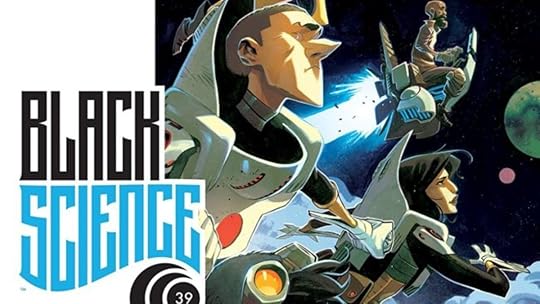
Sometimes our lives are boiled down to one moment, one choice. This is that moment for Grant McKay.
The Anarchist League of Scientists charges forward for one final adventure as RICK REMENDER & MATTEO SCALERA bring their seminal pulp science-fiction epic to a mind-shattering finale.
Rick Remender is an American comic book writer and artist who resides in Los Angeles, California. He is the writer/co-creator of many independent comic books like Black Science, Deadly Class, LOW, Fear Agent and Seven to Eternity. Previously, he wrote The Punisher, Uncanny X-Force, Captain America and Uncanny Avengers for Marvel Comics.
Grant has done a lot wrong. His only redeemable moments are when he's working to save his family. After the events of the last volume we have everyone back together. With that they go to the final mission, the one to fix everything...but what happens? What happens if you get everything you want, but have to sacrifice who you are...
The ending is hard to process. It took me awhile to understand it. I re-read it a few times. As dark as Remender gets, this is probably one of the most fucked up endings. Just when you think people can change, and some do, most don't. The art is as good as over, some great humor to break up the bleakness as well. My main thing, it isn't the easiest to process and might take a bit to accept. Hell you might even hate it. By I really like the ending the more I think about it.
Protagonist center morality FOR THE WIN! What do you mean it’s not okay for Grant to mess up his family’s life and then barge into a new dimension and steal those kids?!
Not saying I love everything Kadir’s done but damn if he doesn’t look the good guy at this point.
And here it is, the final wrap-up of an EPIC press through the layers of the multiverse, the Onion, or the Eucalyptus.
The series works on so many levels, that it really could be a 5-star read, but I had trouble with the ending. Here's why, in as much a non-spoilery way as I can: (1) we see so much, that it is hard to put the pieces from early books together into a clear picture by the end. (2) All the victories (well, except ) get hollowed out by the end, (3) al the redemptions are by chance, not by design.
One of those series where I sort of know it's pretty good, but just doesn't grab, maybe it'll feel better on a reread later? . . The whole privileged white dude has great intentions but always messes up, so I should feel sorry for him, or have empathy, despite his beautiful wife, children, life, mistress etc. And the baddie is an Asian dude who struggles to find love or empathy with anyone, despite doing more heroic things albeit not necessarily for altruistic reasons. . The art is kind of cheeky geeky, but at times, hard to see what was going on. The jury's out.. quality production though, of that there is no doubt. 8 out of 12.
To say I'm sad that this comic series has come to a conclusion would be an understatement, but I'm glad it's ended where it has, as it hasn't dragged on and no story arc felt unnecessary. Following the destruction of the multiverse, as well as the original dimension (and I choose to believe the other dimensions weren't simulations, rather that the eucalyptus was a device to watch others lives), Grant and Sara are finally reunited with their children and the rest of the anarchist league of scientists. Doxta the witch was a good final antagonist and I was glad that she wasn't easily defeated by Grant and rather a bargain had to be made by Kadir to re-create the multiverse, although with his own interests in mind.
I really enjoyed seeing the new universe and how they had finally gotten the "utopia" that Grant had so greatly desired, but begged the question whether free will can be possible in a world where no crime or negative action is permitted. Jumping from the universe in which Grant killed Chandra and the one he hadn't was amazing and I'm pleasantly surprised that so far into the series the story still felt fresh and exciting.
Although the ending was very bittersweet (especially depending on which universe you were in), I loved seeing how the original Grant and Sara were doomed to repeat the mistakes of their doppelgängers, that were originally trying to take Nate and Pia off of them because they couldn't be trusted. It was very heartfelt and thought provoking for what on the surface could be seen as a pure sci-fi pulp fiction story. I will definitely continue to read comics by Rick Remender and Matteo Scalera, and hope that in the future they collaborate more, as they're a force to be reckoned with and easily in Black Science have created one of my favourite comic series of all time.
I'll give it an extra star for ending very darkly, showing how Grant's endless arrogance will destroy any chance at happiness for himself and those around him.
Reading other reviews, I think people are misunderstanding the ending.. yes, there are two variations (sad Grant and contented Grant), but at the end the two smash together, with sad Grant about to invade contented Grant's universe and destroying it by nicking contented Grant's kids.
Záver bol dobre depresívny, ale som s ním spokojná. Všetko do seba krásne zapadlo, a keď človek dával pozor v prvých zošitoch, krásne mu všetko docvakne. Táto séria je jedna z najlepších, čo kedy vyšli, či už po dejovej alebo grafickej stránke. Remender má neskutočnú predstavivosť a aj keď zobral niečo, čo bolo už niekoľkokrát omieľané v inom formáte, stále tomu dal nové čaro a Scalera to nádherne doplnil fakt úžasnou kresbou. Deväť-dielna (43, ak rátame zošity) telenovela, kde ak si niekoho obľúbite, tak rátajte s tým, že ho uvidíte niekoľkokrát zomrieť. Nádherné svety (dimenzie), nádherné príšery a zaujímavé vedľajšie postavy. Skvelá záporná postava, ktorú ani nedokážete brať ako zápornú postavu a v niektoré momenty s ním sympatizujete. Dokonalé tvarovanie a rozvoj charakteru postáv, skvele načasované pohľady do minulosti a u keď je tak veľa fantasy a sci-fi prvkov, stále je to aj veľmi ľudský príbeh zo života rodiny a ľudí okolo nich.. Takže ako hovorí môj rating: "it was amazing".
Final volume in which Grant learns nothing, doesn't save the day, is angry that someone else saved the day instead, and then proceeds to make the same mistakes all over again. To be fair, Kadir is also a jerk as he is not content with simply saving the world, but instead demands that Grant admit he was wrong, which of course leads to problems. The end of mad-science dimension-hopping, or is it?
I'm glad this series is over with. And it has an ending that makes complete sense for the characters and their driving forces. However, I wish there had been a character arc at some point or that somebody learned a lesson somewhere along the way. This is definitely not a series for people who want likable characters or for the characters to have personal growth.
This is it. The End of Everything. This exciting and eventful series has been a long time coming and now the story of Grant McKay and his family of dimensionauts reaches its climax! They have reunited, but now they have to make one last-ditch effort to save all of reality as we know it. I don't want to say much more about the plot because the way that this final volume evolves and wraps everything up is surprising but also satisfying. I admit, I wasn't sure if Remender would stick the landing here, especially given how huge in scope the series has gotten, but I really enjoyed this!
The series has always been focused on Grant trying to fix his past mistakes, whether professional or personal, and overcome his ego and its failures. But it's also been a wildly imaginative sci-fi adventure and this final volume is no exception, striking a great balance between the action, the ideas, and character. As a whole, this series comes highly recommended, even though there are some slip-ups here and there. And for people already reading it, this climax shouldn't disappoint.
I'm curious how the experience would be binge-reading this. I have a feeling that the problems with pacing that I've had in the middle would be less an issue and I would enjoy it even more than I already have! I'll do a re-read in the future!
No me gustó mucho el final pero sí disfruté del recorrido de este tomo. Demasiado del caos de los primeros números que vuelve muy confusa la trama. Llega un punto donde la credibilidad se rompe cuando la fantasía es tan abierta. La resolución final fue la más probable desde el principio, la que uno piensa, ojalá no termine así y termina así, sin llegar a dejar un mal sabor de boca porque toda la historia es buena, la idea, los conceptos, diálogos, es un derroche de imaginación maravilloso. En líneas generales, quizá le pase como a la serie televisiva Lost, no importa tanto como terminó porque el trayecto fue único y fascinante.
I enjoyed the series but felt that this kind of ending was morally ambiguous and a bit lazy. Didn't like the skip from "facing the antagonist" to "oh hey, we beat them but don't show you and now this is what happens next". I give the series overall a 3.75 - If you like Sci-Fi stories with Multiverse, Family Drama and small philosophical hints, you'll enjoy that.
Cinco años nos tomó llegar hasta acá aproximadamente. Si bien me tomé un tiempo en continuar la serie después del primer volumen, del quinto en adelante la leí bastante rápido. Siempre me encantó el aspecto psicológico de la historia y cómo todo giraba en que Grant pudiera superar sus traumas personales de su infancia. Con cada volumen, Remender nos iba dando pistas de que todo tenía que ver con el pasado de Grant, de que la razón por la cuál lo seguía arruinando era porque se rehusaba a mejorar y a encontrar el perdón a su familia y a él mismo. Entonces llega el noveno tomo y el dramático final de la historia, el cual considero es bellamente ejecutado y es un final que va a ser polémico entre los fans. Algunos lo odiarán, algunos lo verán como una victoria, otros como una derrota, creo que eso hace que el final sea muy bueno porque al final transfiere el aspecto psicológico del protagonista de la historia al lector: Remender crea un final agridulce que dependerá de la psicología de cada lector para decidir si fue un final feliz o triste. Esto no es algo muy difícil de lograr pero creo que con todo lo que vimos de la historia, es el mejor final que pudo habernos dado. Sin entrar el spoilers Remender cierra el círculo de historia a la perfección, mostrándonos dos finales, y gracias al tipo de historia que construyó y cómo lo hizo, ambos finales son reales y ambos finales suceden al mismo tiempo. Una belleza para una serie que está repleta de paradojas. Pensar en un final para una serie con una trama tan compleja, seguramente no fue fácil para Remender pero el final que construyó me dejó satisfecho.
I'm torn here because the witches story ends and it's covered in a short sentence in the beginning of the next book. So we're just supposed to take Rick's word for what happened? I mean I get that he's the author but WHY should we?
also the book is daring in that it seems to be a mobius strip if I can believe the artwork on the last few pages.
As a whole it's just hard to root for anyone because everyone makes the same bad decisions over and over. again, a mobius strip.
Szórakoztató és gyönyörűen megrajzolt utazás volt. Én azok szűk táborát szaporítom, akik bírták a befejezést. Örülök, hogy a végén volt valami pozitivizmus és előkerült egy olyan univerzum, ahol Grant nem basz el mindent, még ha áldozatok árán is. De sebaj, jön majd heges Grant és mindent szétbarmol. Az egyetlen problémám itt az utolsó két számmal az volt, hogy volt benne egy csomó elkapkodott szál,amik szerintem simán elbírtak volna még egy 10. kötetet. Doxta vs. Kadir pl. nagyon nem volt kielégítő, meg a gyerekek újabb halálán is túl könnyen túlléptek a szülők.
This entire review has been hidden because of spoilers.
This review isn't just for the this particular volume of Black Science, but for the entire nine-volume series, since I read it all in one go, and honestly, the entire thing is so consistent in its writing, artwork, tone, pace and quality, that it becomes fairly difficult to tell were one chapter ends and another begins.
I came to Black Science as an ardent fan of Rick Remender's Low, a series so sublimely good that it's earned me a huge amount of goodwill with Remender. So it was that i dove into Black Science, not knowing what it was about, but fairly certain that I would have a good, if not great time. And I'd say that, ultimately, is what I got. A good, but not great time.
The story is kind of a hyperactive mash=up of Lost in Space and Quantum Leap, with Grant McKay and his League of Anarchic Scientists jaunting endlessly through the Eververse, an infinite onion-like structure of alternate realities densely layered upon each other. The tech that enables this is the Pillar, a supertech-widget McKay invents so that alternate realities can be plundered for their resources, but the whole thing goes sideways and he and his team and his family are stuck in a super-perilous mission to survive as each alternate reality they visit is more hostile than the last. The further they go, the more they realize that they might not just be putting themselves at risk...they might be endangering all of reality itself.
First, the good. Remender and artist Matteo Scalera work very well together, and the amount of imagination put forth in this is terrific. Each new world is a blast of fresh images, ideas and story hooks. In the first half of the story, especially, the world-building and destroying on display is a thing of wonder. And Scalera's art seems perfect for this particular story. It's a little wild and stylized, but for this tale, it works rather well.
Now, the bad. What works so well in this story also works against it - the wild energy and loopiness often comes at the expense of continuity. You ever get that feeling in Heavy Metal stories that the story itself just kind of lurched forward a bit because they've only got 4 pages left to tell 6 pages of story? Yeah, that happens all the time in Black Science. Sometimes, it's "Wait, where did McKay get that suit of armor from?" And sometimes it's, "Wait, how did a huge plot point happen entirely off-stage?" This gets really distracting in the second half of things, especially when we have parallel stories that offer little to no visual cue that we're jumping from one story to the next. It doesn't help that for much of this, we've got three female characters who look almost identical to each other, and while Scalera is a fine artist, he's got about four facial expressions on him, so sometimes telling certain characters apart becomes difficult. And when different versions of those same characters from other dimensions begin bumping into each other, you kind of throw your hands up and keep reading on the hopes that eventually when Remender has to stop and catch his breath, he'll explain exactly what is going on.
Ultimately, this is a good-ish series. It's far better in the first half than the second, and the ending, to be honest, feels like a huge cosmic-level cop-out. A lot of McKay's exposition makes you wonder if Rememder is using Black Science to work through some mid-life crisis of his own. But at least Black Science feels like a story for the sake of a story, and not an elaborate storyboard pitch for a Netflix adaptation, which is more than can be said for many graphic novels coming out these days. If only Remender and Scalera had throttled back just a little bit and didn't try so hard to be the anarchists they are depicting.
In some ways by the end Black Science resembles very little to dimension hopping adventure of the beginning issues. But if you enjoyed where the last few volumes have been heading then you'll find this to be a very satisfying ending.
One of my criticisms through out the series through out the series that it is sometimes a bit difficult to follow exactly what is going on and how everything is linked together. Often I was left wondering if a sudden change of direction had left us in the same reality, a different dimension or Grant having a dream The final volume answers a lot of these. Or at least leaves it open to you what is going on. The first issue clears up what exactly was going on when Grant and Sara managed to reach the centre of the onion at the end of volume 8. And the last two finally let you know what the whole series was about: choice. (And also why everyone keeps call Grant the eucalyptus. That had been really bugging me, I thought I'd missed it a good way back.) Should we rebel or follow authority? Of course we encouraged to be the anarch through out but in the end, as things have spiralled further and further out of control, we discover that always trying to the take the hardest path may not be the best answer.
You could see it that in the end we're given Grant in 2 starkly different realities. In one he's given up on his morals, accepted his fate and is dumb and happy. In the other he is still pushing against what is wrong (or at least what he perceives as wrong), burning down everything around him in the process. But that's not really the truth about either. And the first is much more positive than this. Not only is it him making the right choices (not killing Kadir, not being temped by Rachel) but finding join in between the harder parts of life. The other side shows that any point he may still fuck up massively and that his decisions may result in horrible consequences. The eucalyptus in action. And the point of the story (as I see anyway).
(And then again with the pillar there's always the chance to change his choices. Dun dun dun!!!!)
I'm going to read it again. There's a lot to take in in the last few issues in this volume. And I might just read it all again. I think to see the whole story with the light of the ending would make a very interesting read. Also it's just a great story.
Quick note on the art. It's lush and I love it. It's a great story by Rick Remender but without Matteo Scalera's beautiful art (and Moreno Dinisio's colours too) it wouldn't be much of a story. O should say more about how amazing it all looks but I've gone on too long already.
This entire review has been hidden because of spoilers.
Man I can't wait to re-read this in its entirety already.
I have mixed feelings about the ending. Don't get me wrong, I love this series and think its one of the best things that Remender has wrote, which is saying a lot. But I felt the ending was a bit of a cop out in that, we get both versions of how the story could have ended told to us. And its up to us to decide which one take precedent. And while this brings up some interesting arguments about freewill, inevitability, and dedication (to a fault), I cant help but feel that I would've preferred something a bit more final. A period instead of three.
But, the ending doesn't take away from the overall series, which I would give a solid 5 stars. The art, the story, the characters, the IMAGINATION! It's amazing what Remender and Scalera have done with this book. It started as a kind of.... "take" on the fantastic four, but ended up being so much more, and with such an inventive cast of characters and settings, it really was one of my favorite things to read for the years it was coming out.
As mentioned, the ending is a bit open ended, so the possibility of more adventures is there. But I can be thankful for Remender taking on this journey that had so many twists and surprises, that I don't think anyone could have really seen most of this book coming. And enjoying the ride that the book took us on, and not the destination, I think is the moral of the story -and life in general - overall.
A modern sci fi classic, you have to check this out if you're a fan of the genre.
Remender ends the series with a bang and a final shot at the idea of security, even perfection without the option for freedom, individuality, and personal choice. It's an interesting final volume bleak as hell in most ways, but with a final dollop of hope that makes it all work for me. Of course, a full-on tragic ending could also have fit this series.
We get the end of the epic space-battle stuff started in volume eight in the first half of the book, and then it's aftermath in the second half. That long epilogue sets up so many possibilities for interpreting both the series as a whole and the specific events of this volume, personally my take is it feels a lot like how King finally ended the Dark Tower...
Apparently, four years ago I started this series. Since then, I have changed so much. This story remains great as I aged, had a kid, changed jobs, lost jobs...to say that there are days that I feel like Grant, is an understatement. A man with a high self image and a large self hating mindset...how does it work? Spoilers, it doesn’t. Am I talking about Grant or me? I guess in some people there is a great sadness and a great desire to overcome, to make an impact, to do what is right, to do what they think is best. I am talking about Grant, right?
What does it say about me that my two things that I feel great about reading this year are this and Mister Miracle?
A really fun series with some seriously incredible art, but the story itself - while a fun ride - left me feeling just a little bit underwhelmed in the end. Your choices matter. But your choices don't really matter because every choice creates a new reality anyhow. And even if your choices really do matter, you're still doomed to repeat your mistakes because you're a slave to your nature. Unless you choose differently, of course. But even if you do choose differently, don't worry because in another time-line you didn't. Everything happens. Good times.