Over the last decade, street art—art made in public spaces including graffiti, stickers, stencil art, and wheat-pasting— has become one of the most popular and hotly discussed areas of art practice on the contemporary scene. Developing out of the graffiti-writing tradition of the 1980s through the work of artists such as Banksy and Futura 2000, it has long since reached the mainstream. Street Art is the first measured, critical account of the development of this global phenomenon. Tracing street art€™s origins in cave painting through the Paris walls photographed by Brassai
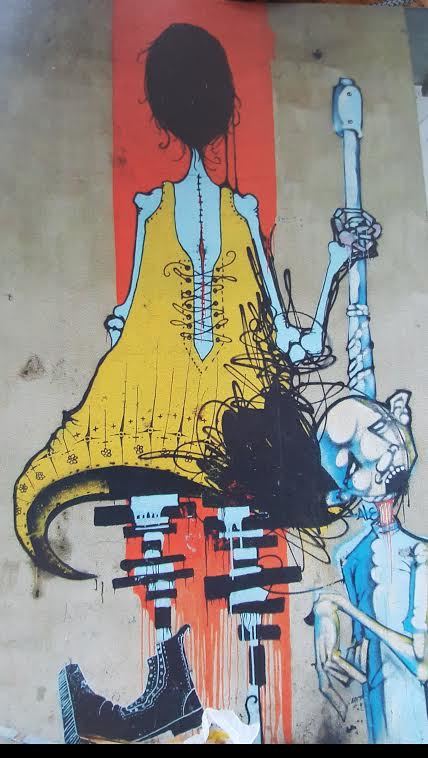
"The public has a right to art"... Keith Haring Work by Bugre (main image) and Shock (bottom right) in Sao Paulo (Brazil style)
Reta knyga apie gatves mena, graffiti. Daugiau skaitymo nei ziurejimo, tad teko panarsyti paveiksliuku internete. Leidinys tikrai informatyvus, puikiai supazindina su grafiti istorija, stiliais, srovemis, dailininkais.
Man asmeniskai ziauriai patinka si vaizduojamojo meno saka. Patinka, kad daznai jis anonimiskas, kad neturi ambiciju I islikima, kad drasus, kad jis tave suranda dazniausiai netiketai, kad nepraejes profesionalu kritiku, galerininku mesmaliu, kad jo beveik neimanoma sukomercinti… ‘not for sale…It can’t be bought, and can’t be owned’.
Kur bekeliauciau - ji matau. Po sios knygos dar ir stengsiuosi ismokti ziureti I ji…
Pats zodis ‘Grafiti’ gime apie 18 a. pabaiga -19 a. pradzia, kai pirmieji Pompejos lankytojai pradejo kalbeti apie tai, kad ant sio miesto griuvesiu sienu rade graffiti.
‘Street art is more about interacting with the audience on the street and the people, the masses. Graffiti isn’t so much about connecting with the masses: it’s about connecting with different crews, it’s an internal language, it’s a secret language. Most graffiti you can’t even read, so it’s really contained within the culture that understands it and does it. Street art is much more open. It’s an open society’ Faile
‘Street art is often more about the concept of the object, the making process, and the message that the object conveys.’
Ich fand das auch ein schönes Buch über Graffiti. Vorallem der Unterschied zwischen Graffiti und Street Art wird hier gut hervorgehoben. Gab auch schön viele Bild-Beispiele
Of all of the texts I've read dealing with this broad genre (street art/graffiti/graffiti writing) detailing the distinction between street art and its subsets (such as graffiti art) and predecessors (i.e. graffiti writing). The essays are very insightful and the profiles of artists are candid and substantive. This is an excellent text for anyone seeking to understand the evolution of street art and its culture.
An incompetent text that tries to be everything. In the end it is nothing.
It is a picture book. But it is rather badly organized. And the pictures are quite random, they do not follow style or authors. The producer doesn't even know the names for some works.
It is an attempt at dictionary, and it ends up as an index of popular artists that have already webpages.
There are some interviews, interviews pieces.
There are some useless scholastic classifications.
For a book published in 1977 this is great. The sole problem it was published after 2010, when the author just pasted data available on the web.
The book so far is the real connection to what I do. Graffiti. I relate to myself and as a graffiti artist I have taken on a new culture that I must understand. The book references directly to terms that I am familiar with and it explains the lifestyle and reason for being a graffiti artist. I can relate to this book and I take on all my understandings of graffiti and expand the knowledge of the art and I enhance it to understand what the people who want to arrest us see us as and why they think what we do is wrong.
This entire review has been hidden because of spoilers.
i've read a lot of graffiti/street art works - everything from dissertations to coffee-table fodder. this is one of the better ones out there...! it's comprehensive, but pretty, interesting, but not weighed-down with too much information, and pretty accurate.