Jump to ratings and reviews
Rate this book

The Earliest English Poems

Rate this book
Anglo-Saxon poetry was produced between 700 and 1000 AD for an audience that delighted in technical accomplishment, and the durable works of Old English verse spring from the source of the English language.

Michael Alexander has translated the best of the Old English poetry into modern English and into a verse form that retains the qualities of Anglo-Saxon metre and alliteration. Included in this selection are the "heroic poems" such as  Widsith, Deor, Brunanburh  and  Maldon , and passages from  Beowulf ; some of the famous 'riddles' from The Exeter Book; all the "elegies," including  The Ruin, The Wanderer, The Seafarer, The Wife's Complaint  and  The Husband's Message , in which the  virtu  of Old English is found in its purest and most concentrated form; together with the great Christian poem  The Dream of the Rood .

For more than seventy years, Penguin has been the leading publisher of classic literature in the English-speaking world. With more than 1,700 titles, Penguin Classics represents a global bookshelf of the best works throughout history and across genres and disciplines. Readers trust the series to provide authoritative texts enhanced by introductions and notes by distinguished scholars and contemporary authors, as well as up-to-date translations by award-winning translators.

192 pages, Paperback

First published January 1, 1966

67 people are currently reading
1844 people want to read

About the author

Michael Alexander

33 books9 followers
Michael Joseph Alexander (born 1941) is an English translator, academic and broadcaster. He held the Berry Chair of English Literature at the University of St. Andrews in Scotland until his retirement in 2003. He translated Beowulf into modern English verse.

Ratings & Reviews

What do you think?
Rate this book

Friends & Following

Create a free account to discover what your friends think of this book!

Community Reviews

5 stars
214 (28%)
4 stars
311 (41%)
3 stars
180 (24%)
2 stars
33 (4%)
1 star
8 (1%)
Displaying 1 - 30 of 72 reviews
Profile Image for Daniel Chaikin.
593 reviews71 followers
September 2, 2019
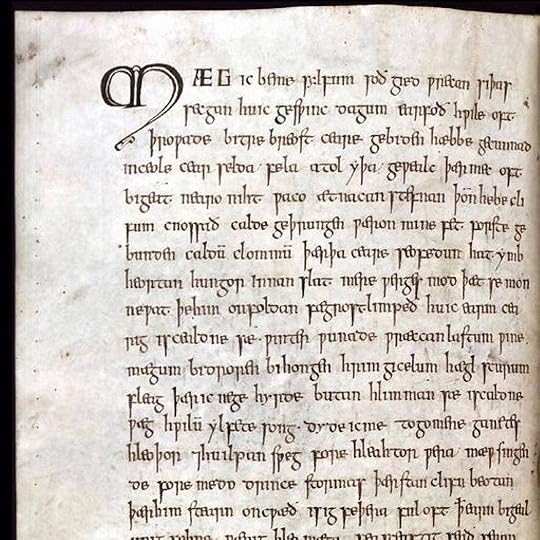
My Listy post: Wasn‘t sure what to expect. It was nice, the poems, and then I encountered The Wanderer and The Seafarer (the beginning of the Anglo-Saxon manuscript is below). You have to understand these were completely new to me. They have such a different perspective compared to everything I know of that‘s older. They look inward at an emotional state in their own kind of touching way. And to imagine, as I currently am, that they just came out of the mist.

Some reference links for anyone curious (note, these are long poems):
Michael R. Burch's The Seafarer - decent, easy to understand translation
Ezra Pound's The Seafarer - a classic translation. This takes some work to get through...but it's quite something.
Sean Miller's The Wanderer - decent, easy to understand translation, with a note about Tolkien's LoRT


39. The Earliest English Poems by Michael Alexander
published: 1966, revised 1977, 1991
format: 200 page Kindle ebook
acquired: Aug 3
read: Aug 8-16
time reading: 8 hr 4 min, 2.8 min/page
rating: 4
Profile Image for Drew Canole.
3,168 reviews44 followers
June 1, 2023
I was getting tired of reading all these translated works. Give me something in English!

I decided to start at the beginning with this book of early English Poems. Quickly I realized my faulty-logic... this book is also translated! Anglo-Saxon English is harder for me to decipher than modern French.

Michael Alexander is the translator and provides a lot of useful background detail.

Here he skips the volumes of religious verse that exists, and gives us the juicy stuff.

Some of the better contents:
The Ruin
Deor
Widsith
(Selections from) Beowulf
The Fight at Finnsburg
Waldere
The Wanderer
The Seafarer
The Dream of the Rood
The Battle of Maldon

A lot of this stuff was clearly inspiration to guys like Tolkien and other people who create English fantasy.
Profile Image for J. Wootton.
Author 9 books212 followers
November 15, 2021
Enjoyable commentary and poetic translation of Beowulf-era Anglo-Saxon poetry. Much of it survives only in fragments, and more's the pity, for these poems were composed with wit and cunning. The ancient poets display a literary mastery that moderns still, ignorantly enough, fail to expect from oral cultures.
Profile Image for Tin.
33 reviews16 followers
March 26, 2015
the commentary was delightfully informative. my copy has a little orange sticker on the cover, hailing the anglo-saxon poetry within as tolkien's inspiration for lotr/the hobbit. while i can see that, i mostly got a lot of skyrim feels. really glad i've exposed myself to anglo-saxon poetry, as i am now obsessed with their alliteration and abundance of double-barrelled words.
Profile Image for Ben Loory.
Author 4 books729 followers
May 31, 2017
Great book, though I can't solve a riddle to save my life
Profile Image for Milo.
265 reviews7 followers
March 30, 2023
Moon-glad, goldbright, of gleams garnished

Michael Alexander cuts to Germanic bone, compound words in plenty (showershields), and a mood of the antique Englishman. The image of olden scop rambling through Roman ruins, a perspective of such profound smallness: here were giants, here was a golden age. Such is the inherent fallacy of the nostalgic man, only in this poem granted a unique truth. Perhaps we are all, in our way, still reeling from the loss of Rome? From a time when things were concrete, iron-ringed; when the world was all-over a heated bath. It takes little thought to disqualify this thought. Horace pleaded the earlier generations; the Greek creation myth is founded on golden, permitting, silver, permitting bronze: human history is, in human mythology, reversed; things only get worse. The Anglo-Saxons were then in an ideal situation in the encompassing of these myths – they appeared all-too-true. Old pillars and outcrops, too old to be remembered, and yet irreplicable. It is an inverse poetry that this manuscript is part-burnt: that an Englishman, looking for those brief scraps of his literary beginning, might find a pur-ruined parchment. Much as the poet imagines Roman cavorting, so too does the reader of his poem imagine those lost lines, and the life to which they belonged. It is a fine entry to a darkling past. It is a kingly thing … city … – words enough to end the poem, the drifting out, the recapitulation. Alexander’s selection, taking a tiny literature and making it smaller, is generally judicious. He plucks only lightly from Beowulf – this text is fundamentally a work of Beowulf scepticism – and often presents small fragments of otherwise lost works as the greater than that very-known text. I am not always convinced that these straggles can, whatever their interest, be intuited into greatness – perhaps they remark some special quality in the original – but they are interesting enough in their brief surmise. Those better poems seem to exist in greater length. The Dream of the Rood I find especially diverting: whether the image of a talking crucifix is original I do not know, but I have never before encountered it: it feels an especially pagan embodiment of a very Christian perspective; something of the ancient, mumbling woods, of the riddle-like thing expressing (what they call) the greatest of all human stories. Beginning not with the deed but with the chopping of the tree, and ending not with the resurrection but the burying of the cross – a great piece of the surreal, regardless of the beauty in its transaction. (Of those nail wounds in the cross; the wood itself in contract with God; a more encompassing view I have not seen.) Into the ancient flow, there might be The Seafarer, which seems a great contradictory rush of the Saxon feeling: the men who came out from the waves, here a man banished out to them – first in exile, then, perhaps, in liberation – the thing crosses its own metaphorical line, in which we might perceive a confused poet or instead a poet of some profound psychological insight; how still is a mind at sea? Alexander poises The Battle of Maldon as the great epic of Old English literature – again, his ashspear pointed toward the Beowulf lobby – and it is a position his translation buttresses tightly. He is right in its quality: the exposure of an ancient moral, a sometimes bizarre preoccupation with fealty and feudal bond. Heroism is not in victory but in noble vanquishment; here is a paeon to the righteous defeat (and not, as it were, the foolhardy manner in which this defeat was gained), in which the Anglo-Saxon people codified what will become their everlasting testament. Of a people destroyed, but destroyed on the their feet, victim to the devious Normans: there was honour on that hill in Hastings.
Profile Image for Holly Raymond.
321 reviews41 followers
January 4, 2011
I remember lying on my coach reading the gnomic poems in this collection, waiting for a friend of mine to arrive. It was a few days after a heavy snowstorm, so his coming over was a pretty charitable effort. At about the same time as I heard him knock, I saw a small thrush alight on a phone wire outside my window, barely intelligible as a form through the frost. It was a really nice moment. My heater would shit out on me several days later, but for then I was pretty much content as I'll ever be.

This anthology is a bit old, so some of the scholarship is outdated.
Profile Image for Pilar.
340 reviews14 followers
August 10, 2025
To me, a good book.
An interesting verse translation from some pieces of Anglo-Saxon poetry trying to reproduce the stress-pattern and the alliteration of the alliterative verse.
Profile Image for kate.
230 reviews51 followers
Read
October 5, 2022
essay done thank god
Profile Image for Gastjäle.
514 reviews59 followers
August 15, 2023
These alliterative poems are sheer manna to my ears. They crunch like the gravel, and howl as squalls 'gainst dark horizons. Huddled wayfarers shielding from the hail, uttering cold-cut prayers and watching their frosty words plume up into the heaven halls. Blear-eyed resignation, sapping of lusty life, goldglow memories.

Michael Alexander is a marvel—his translations make the majesty of the old poetry immediately appreciable, even more so than any translation of iconic works of Ancient Greece I've read so far, and that's saying something. Yet I must criticise him a bit for not finishing his Dream of the Rood fully in verse. The bookended prose really showed that the grandeur of Old English poetry (and its translations) emerges through the metrical limits and the alliteration, not through diction alone. I also would not have minded having less Beowulf excerpts (I'd rather re-read that mighty tome) and less riddles (trivial silliness, though not bereft of entertainment).

I feel like this would also be a good starting point for anyone, who wants to learn to appreciate poetry and the sheer beauty of language over the subject matter.
Profile Image for Matthew.
81 reviews9 followers
November 20, 2017
This anthology of poems from the Anglo-Saxons stands as testament to the artistic achievement of the Germanic people. I find that the translator, Michael Alexander, was correct in his belief that modernity seems to have looked over the contributions of Germanic culture in favor of Mediterranean ones.

Of the selections he included my favorites would be "The Wanderer", "The Seafarer", The Gnomic Verses, "The Dream of the Rood", and "The Battle of Maldon".

In both the Gnomic Verses and "The Dream of the Rood" it is interesting to see pagan elements within them, despite the fact the latter is a Christian poem. In "The Battle of Maldon" the spirit and strain of the ancient Germanic heroic tradition can still be found.
Profile Image for Jordan.
Author 5 books114 followers
April 6, 2018
A collection I’ve returned to again and again over the years. (Amazon informs me that I ordered this at the beginning of 2007!) Good translations, and a good variety of selections from the corpus of Anglo-Saxon literature, including the Exeter Book riddles, The Wanderer, The Seafarer, Brunanburh, The Dream of the Rood, and some small excerpts from Beowulf. If I could improve the anthology at all, I’d include more religious poetry (seriously—the Anglo-Saxon Genesis is like John Milton after six months in the gym). Alexander’s notes and introductions to each selection are excellent.
Profile Image for Robert.
827 reviews44 followers
February 16, 2019
Alexander makes accessible poems that cannot be understood by native speakers of modern English without significant time and effort. Poems that nevertheless form the foundation of poetry in English and provide a window on the Anglo-Saxon world, its history, culture and values. This collection, despite its modest size, shows the range of modes and interests of Anglo-Saxon verse. Fragments such as The Battle of Maldon also make me wonder how much great literature has been lost irretreivably - a sad thought.
Profile Image for Lotte.
258 reviews33 followers
March 20, 2018
Very interesting collection of translated Anglo-Saxon poetry. The introductions and the general 'about this poem' sections are good and thorough, but boy, I so often didn't understand a word the writer was saying. Perhaps that's because it was originally published in the 60s, but I feel like this was written for an already academic audience, rather than the general public. Still, really good and interesting when you're interested in Anglo-Saxon literature!
Profile Image for Jeffrey.
182 reviews2 followers
August 21, 2023
The poems in this collection are fragmented windows onto a past world that is no more. I thought that the selection was a bit strange for this collection (for example, it includes some passages from Beowulf despite the publisher also having Beowulf as another entry in this series "Legends from the Ancient North") but overall interesting to read. The introductory material throughout also provided helpful context and insights.
851 reviews7 followers
August 19, 2020
This is a book I had from a Brit Lit survey I took as an undergrad.

It's fine. (I do think the riddles are interesting, and I do think that there are rather more sexual innuendos in these poems than my teacher mentioned all those years ago LOL).

I have confirmed to myself I am never going to want to read "Dream of the Rood" for entertainment, so I may safely pass this on to its next home.
Profile Image for Tim Pendry.
1,150 reviews487 followers
November 1, 2025

Michael Alexander drew into one volume a wide selection of the best of English Anglo-Saxon poetry in this scholarly volume for Penguin Classics back in 1966. The works (which include only small sections of 'Beowulf') were translated by the Editor.

It remains an excellent guide to a lost culture shattered by the Norman occupation, England's cultural 'naqba'. Much of the work is necessarily fragmentary, lucky to survive at all. That survival relied on Christian tolerance of some pagan texts which were 'adapted' accordingly.

Alexander's commentary is helpful in positioning what survives as best he can at the point where an older pagan warrior culture was coming to terms with Christian culture and then having to face, as Christian warriors, new waves of incoming Viking pagan threats.

The harshness of old English life in a cold climate facing a colder North Sea and the importance of having (as a 'scop' or poet) a hearth-lord or gift-giver is only mitigated by the ability of the nearest thing to an intellectual of that period finding an alternative home in a monastery.

The pagan poet is part of a warrior aristocracy whose ethos is perhaps to seek plunder to bind his hearth together but also (well expressed in 'The Battle of Maldon') to seek honour in service to the lord who gives treasure to his warriors in return for their pledge of death in his defence if necessary.

As an ethos, it has not died even today. It is accepted in Hollywood accounts of military honour and implicit in the 'ethics' of organised crime. The 'band of brothers' stories of the Second World War (or no doubt Ukraine on both sides) is the ethos of honour where Lord has become State or Crown.

Christianity changes little other than to de-emphasise plundering and raiding for treasure in favour of social order and settled land-holding. God becomes Lord of Lords and guarantor of a reward not here on earth as treasure but as the treasure of everlasting life in heaven.

The transfer of one world to another across Europe might be considered as (in essence) the change in the meaning of the word from 'treasure' as gold and symbol of kin and war band relations to 'treasure' as something 'spiritual' to be interpreted by priests and to be found outside time and space.

Yet the old ways remained powerful. There is awe at past glories built by giants ('The Ruin'), remembrances of Germanic continental struggles including with the Huns, Tolkienesque tropes and swords with names and, of course, dealings with Grendel, his mother and dragons.

What comes across in this selection is that pre-Norman England was not isolated but was part of an extended Germano-Nordic culture with common myths and legends even if the old gods are not really part of the picture. This culture was set over and against 'Rome' and Huns alike.

As Peter Ackroyd has noted in his own comments on the grounding of the English imagination in Anglo-Saxon culture and, indeed, in Catholic Christianity (noting that Anglo-Saxon culture never denies the Christian even when most aware of its Germanic origins), some attitudes survive today.

Perhaps it is the climate but the modern English person will recognise a tendency to gloom and 'The Battle of Maldon' heroises defeat on a blunder as much as Tennyson did the Charge of the Light Brigade or we have done more recently with Dunkirk.

Bryhtnorth, Ealdorman of Essex, is a complete idiot when it comes to dealing with the Viking array on Northey Island but we are not supposed to notice that. We are only supposed to note his heroic death, the quasi-suicidal courage of his retainers and the contempt for the scuttling Odda and his kin.

Heroic stupidity seems to be as honoured today in English culture as then, alongside the sense of solitariness and loss of the Englishman who is detached from his society and up against the weather - as in 'The Wanderer' or 'The Seafarer'.

There are also the difficult riddles which sit alongside runes as a reminder that the English have always liked puzzles (as we know from our crime fiction). Anglo-Saxon literature was always primarily oral and social with poetry an advanced rhetorical art for firesides and halls.

There is probably no image more affecting to the English than that of the pagan priest turning to Christianity in the Northumbrian legend because he recognised that we were like sparrows coming from the dark and flying into the dark through the warmth of the Great Hall.

Anglo-Saxons seem to have been readied for Christianity by their very condition as denizens of Great Halls in inclement weather. The vulnerabilities of such an existence drew the Anglo-Saxon (it would seem) towards the question of what happened to the sparrow when it had flown out of the hall.

This leads us to the major Christian poem in the collection - the profoundly pious 'The Dream of the Rood' which, as Alexander points out, deploys riddling tropes to have the Cross of Christ be dreamed and then speak for itself as if it had a consciousness of its own.

This is the very heart of future weird fiction - the inanimate having an imagined life of its own. Things that be. This takes an animist view of the world drawn from the pagan and applies it anew to a poetic glorification of the Christian message of sacrifice.

It is not hard to see that the Christ's sacrifice on the Cross for man is a subtle inversion of something every educated Anglo-Saxon would recognise - the sacrifice of a man for his Lord. Christ was thus made truly heroic in the Anglo-Saxon mind and humanity thus both honoured and humbled.

All in all, a still useful collection that might be regarded as a puzzle in itself. It is quite a small amount of information on which to build a picture of a whole and long departed culture but Alexander does sterling work in at least giving us some chance of understanding the mind of the Anglo-Saxon.
Profile Image for Mark.
337 reviews36 followers
January 28, 2023
How do you review a book of Anglo-Saxon poetry? The poems are what they are, as long as the translations are more or less readable. The quality of the book comes down to the supporting materials (introductions and notes) in the edition, which in this case are excellent. One can also point to the quality of the selection, which again is excellent: The Wanderer, Caedmon's Hymn, a selection of shorter verses and riddles, pretty much everything except Beowulf. The only possible quibble is that the translations, though clear and very readable, don't rise to the level of Seamus Heaney's Beowulf or W.S. Merwin's Sir Gawain. That's not a fair comparison,though, and is a very minor quibble. 

There are more than enough rings, swords, feasts, and lords to keep any Tolkien fan happy, and I would gladly recommend this collection to anyone wanting to get a little insight into Tolkien's imagination. 
Profile Image for James S.
81 reviews10 followers
October 6, 2021
These Anglo-Saxon poems pulled me back to a world more distant somehow than Ancient Greece or Rome. For these Anglo-Saxons, the Roman ruins were mute, ivy-covered mysteries, their former home in Saxony was the stuff of legends, and the Norman invasion wasn’t yet on the horizon.

Alliterative poetry probably isn’t for everyone, but for me it works. These are down-to-earth, matter-of-fact kind of poets, and the alliteration clothes each narrative step with an elegant, unassuming grace. The translation doesn’t use alliteration in every line, as in the original, but that didn’t really bother me.

I wonder if C S Lewis had “The Ruin” in mind when he wrote “Prince Caspian”, and the atmosphere of Tolkien’s Middle Earth is recognizable on every page.
Profile Image for Jenny.
153 reviews9 followers
April 22, 2018
The content is, of course, five-star. I would have preferred a facing page translation and more detailed notes, but many readers may not desire those. This book offers a nice selection of poems to have between two covers and the editor/translator does a good job organizing them into a thematically pleasant arrangement. I do wonder why he thought his readers would have such difficulty grasping the concept of poetic understatement; his repeated notes to point it out got a bit annoying.
Profile Image for Hayley.
3 reviews2 followers
September 26, 2011
This may sound strange, but I actually got a little teary-eyed after reading "Dream of the Rood". I am a big fan of Anglo-Saxon literature, and I enjoyed "Wanderer" and "The Seafarer" as well, but "The Dream of the Rood" definitely left a big impression on me. Amazing work of literature.
Profile Image for Mallory McGuire.
58 reviews2 followers
December 3, 2020
I didn't like this book very much. Edited and translated by Michael Alexander, this is a greatest hits compilation of Old English poetry from the time of the Anglo-Saxons. The concept is great but somewhat flawed; I was hoping for something a little more exhaustive while also excluding anything covered by other editions. This was neither. First and foremost, the editing is not good. Alexander does include the best poems surviving, such as Brunanburh, Maldon, The Wanderer, The Seafarer, and The Ruin, as well as some lesser known poems and novelties. However, some of the poems are presented incompletely by choice, such as The Phoenix. Additionally, some of the riddles are included but not all. Penguin Classics already has an edition (The Exeter Book Riddles) that has all of them, so their presence here is redundant. The same can be said of several passages from Beowulf. Ultimately, the obligatory poems are here, but there's plenty of material I feel I missed out on, and material that my time was wasted on. Also, this book is 70% Michael Alexander and 30% poetry. He does far too much introducing. There is an introduction at the start and an introduction for each poem. Contained within are explanations for his translation and historical tidbits, alongside unnecessary technical detail that I could have just gotten by reading the poem. On account of the editing, I feel ripped off. I want to read more Anglo-Saxon poetry now, but that is because of Alexander's failures, not his successes.

The other big problem is Alexander's translation. If you're reading this book, its either because you're a student studying this stuff or because you just want to read poetry. This translation is clearly geared towards the first camp, and neglectful towards the second. The approach he takes basically is to re-create the oral aspects of this poetry. Anglo-Saxon poetry was primarily oral, and only sometimes was it written down. Therefor, he explicitly states that he expects the reader to read this out loud, and to attempt to mimic the highly specific meter when doing so. That is simply asking too much. I'm here to read and study historical poetry, not to larp. He also neglects alliteration somewhat, which is one of the best aspects of Anglo-Saxon poetry, and one that can be appreciated without reading out loud. The main problem however is the lack of readability and clarity. The translation isn't 100%. Old English and Modern English aren't completely seperate and there is a portion of vocabulary that doesn't absolutely have to be translated, but still should. He doesn't. Between that and a translation focused on meter and not readability for the casual audience, I found this confusing and hard to read at times. This is not the first time I've read The Ruin, Beowulf or Exeter Riddles, and I've seen all three much better translated multiple times each. The Ruin in particular is frankly butchered.

Overall, the Anglo-Saxons had a truly wonderful poetic tradition, and Alexander's editing work poorly represents it. He wastes valuable pages on poetry that can be found elsewhere. If I want to just read Beowulf or the Exeter Riddles again, I can just get those books out of my shelf. I understand that the Exeter Riddles are more obscure, but if you're reading this book, chances are you've already read Beowulf. Meanwhile, in focusing on the greatest hits, he's somewhat cagey. This book is just too short and doesn't have enough stuff, and what it does have, not all of it is necessary. Plus there is just too much introductory material. If I were in charge of this book's production, I would have had about half as much introductory material, I would have excluded the riddles and Beowulf passages, and included the more obscure and niche poems that are not present, and of course gotten a different person to do the translation. Overall, if you want a good cursory knowledge of Old English poetry by reading its highlights and the history of the genre, this ain't it chief.
Profile Image for Fin.
340 reviews43 followers
November 28, 2021
From the dedication alone I was sure this book would be worthwhile: Alexander's translations, with their intentional archaisms and privileging of the metre and alliteration (aka the 'feel') of Old English poetry over the exact dictionary definition, very much belong to the Fenollosa/Pound school of thought, where an exact transferral of the words on the page is held to be less accurate and meaningful than the reproduction of the vigour and artistry of the original. To me (a very much voluntarily closeted Pound devotee STRICTLY IN TERMS OF POETRY), this is entirely the correct approach.

Alexander's translations of Old English verse are easily the best I've read, and to me are the only translations that feel like they really get to the heart of the Anglo-Saxon poetical style, where blunt repetition and recursive parallelism figure as key to the effect of the verse. In terms of method, his poems are at their most effective when read aloud "with as much vigour and deliberation as he find the line warrants", and indeed this is how they deserve to be experienced. Old English verse, as Alexander's introduction is at pains to emphasise, was not meant to be experienced from the pages of the manuscript in which they now survive: the Anglo-Saxon scop was a central figure in society, called upon not only for entertainment but to recall ancestral history and contextualise events, whether happy or tragic, in the lives of the community. Alexander's verse emphasises this oral and elegiac nature, and his selection (necessarily constrained by the fact that we have a pitiful amount of surviving OE poetry) is equally well-representative of the breadth of the extant material. I was particularly struck by his reasoning for the artistic merit of the riddles: their mystic, strangely alien quality, combined with their close (almost pagan) proximity to the natural world, engenders the same kind of defamiliarizing uncanniness that the gothic and modernist movements upheld centuries later, and made me wish the riddlic tradition so central to premodern societies had survived. Indeed, it's interesting how quite so much of the modern literary developments of form (Hopkins, Pound, Eliot, the French Symbolists etc) prized as revolutionary by so many (very much including me) are prefigured by Old English verse.

The quality of the actual poetry here is remarkably high, though the gnomic verses and some of the earlier heroic poems do little for me; I've read many of these in their original language, and poems like The Dream of the Rood and The Ruin are absolutely striking in their intensity of imagery. The Battle of Maldon was new to me, though, and was fantastic in its evocation of Anglo-Saxon social relations; a tragic and noble defeat memorialised (presumably) by a witness to the event, focusing on the vital communitarianism of the soldiers. My favourites are, of course, the haunting elegies The Wanderer and The Seafarer, deeply emotional and evocative poems engaged with the isolation of the outcast and the fleetingness of worldly life; for my money, Alexander's Wanderer is his best achievement, and the closest in feeling to the original that Modern English can render:

Awakeneth after this friendless man,
seeth before him fallow waves,
seabirds bathing, broading out feathers,
snow and hail swirl, hoar-frost falling.
Then all the heavier his heart's wounds,
sore for his loved lord. Sorrow freshens.

Remembered kinsmen press through his mind;
he singeth out gladly, scanneth eagerly
men from the same hearth. They swim away.
Profile Image for Adam Carnehl.
433 reviews23 followers
October 22, 2023
As the ruins the poet described,
Now, too, lie these fragments
Before us, shattered, in heaps
Of verses told long ago
In halls of wood and rings
Of stone, mouldering, worn
From the slow passage of time.

These verses, too, lie in heaps,
Collected by monks, copied
In libraries now roofless,
Arches of stone fallen.
Through accident or Providence
Do they come to our age
And to my library?
How to approach such glory,
Such beauty, such ancient
Longing, which still speaks?

Beowulf before my eyes is brought;
The heroes of Maldon e'en
Now stand firm before us.
The vision of Holy Rood,
The dark riddles of strangers long dead,
Stand out from centuries past,
Flashing forth anew.
The lonely outcast and seafarer
Still long for green fields and the
Lord, the bread-giver.

I, too, long for the Bread-Giver,
And the broad, green place
The Shepherd King described.
May the standing stones be for me
Table-stone, corner-stone,
Stone of foundation.
May the ancient voices of God-fearers
Join me as we feast the Lamb
On the green battlefield, cleared of
Carcasses, but still stained with His blood.
Profile Image for Mark Lisac.
Author 7 books38 followers
August 17, 2024
These fragments and short pieces of Anglo-Saxon poetry from about 1,000 to 1,300 years ago are stunning in their perceptions, wit, frequent emotional depth, and capacity to evoke a world view of a society that is different from ours yet still vaguely recognizable. The tone is set from the start, in an eerie reflection on large architectural remains from the Roman colonization of Britain. The works show much more sophistication than one might expect from an offshoot of Germanic tribes on an island relatively isolated from the European continent. There are occasional overlays of the different culture being spread by Christian monks.
All in all, these poems can be viewed as a more rough and ready counterpart the literature produced by the ancient Greeks. Michael Alexander's introductions to each selection are informative and useful (and some of the attraction is likely due to his translations). Rounded down from 4.5 stars because of the relative sparseness of what survives, and because I wasn't persuaded of the value of the riddles or of the excerpts from Beowulf, no matter how much scholars may try to burnish them.
Profile Image for Laura.
373 reviews1 follower
September 30, 2017
So much battle and mead drinking. That's basically the entirety of this little collection, but a worth while read. These poems are perfect for anyone interested in the social, economic, and political atmosphere of Britain after the fall of Rome. This was an age of heroes and clans and mead drinking and weaving stories long into the night. I followed the translator's advice when I could and read many of these poem's aloud, and the cadence is amazing. The lilting aspect to each poem is beautiful and truly brings you back to a time when bards would stand in the center of a hall and tell these stories. Each poem is more than just fancy, but exemplifies the strength of a clan, the fierce loyalty among those under a liege-lord, of the uncertain world in which they lived that was fraught with battle and blood shed. And for such a simple language, there were phrases of utmost beauty mixed with the lines of each poem. Overall, I thoroughly enjoyed reading these poems.

"That went by, this may too"
Profile Image for Tom Fordham.
188 reviews1 follower
November 11, 2024
It was fun to revisit this short book, having read it before at the start of my Anglo-Saxon history obsession and reading it now when I know a lot more has been informative for me. I find my interpretation is different and rereading Alexander's interpretations I don't fully agree with them as he's taken them in the literal sense. For me poems like The Wanderer and Deor reflect the winters of people's lives as well as the hardship of Anglo-Saxon life, which is more in line with Eleanor Parker's interpretation in 'Winters of the World'. Reading The Dream of the Rood knowing more about Anglo-Saxon religious beliefs was more moving than the first time I read it. The riddles still confused me though! This is a scholarly study at the corpus of Old English poetry that we have, and Alexander provides a good entry point to this area of study.
Profile Image for Mad Medico.
59 reviews2 followers
June 7, 2025
A great collection of poems that really evoke a Medieval atmosphere. The introduction gives a good broad overview of Old English poetry, its lyrical form and the manner and reasons for its creation and performance. It’s very interesting to note that most of the poems come from one single manuscript, the Exeter Book, and a shame that so many are incomplete.

Favourite poems: ‘The Ruin’ (has a modern, almost pagan feel); ‘Deor’ (with a more structured form than is usual, with a haunting refrain regarding fate, a common Old English theme); ‘The Wanderer’ and ‘The Seafarer’ (both evocative pieces).
Displaying 1 - 30 of 72 reviews

Can't find what you're looking for?

Get help and learn more about the design.