Book 53 in the bestselling series, The Horus Heresy.
Horus’s armada gathers, and he has defeated all enemies sent against him, even the Emperor’s own executioner. One barrier remains before he can strike for Terra and lay waste to the Emperor’s dream.
The Beta Garmon system occupies the most direct and only viable route to the Solar System and Terra. To break it, Horus assembles a war host of incredible proportions and Titans in untold numbers. To lose here is to lose the war and Horus has no intention of turning back. But the Imperium understands the importance of Beta Garmon too. A massive army is arrayed, comprised of near numberless Army cohorts and a mustering of Titans to challenge even the martial might of the Warmaster.
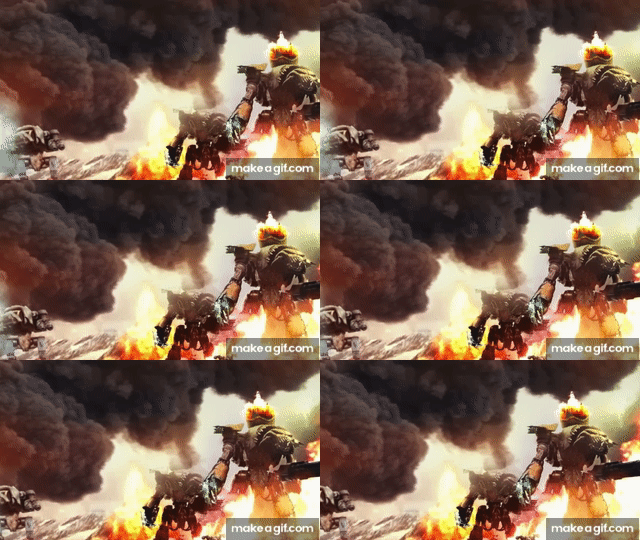
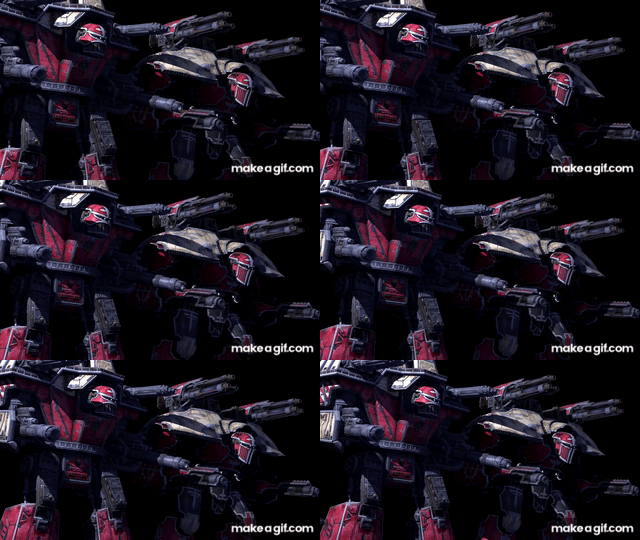
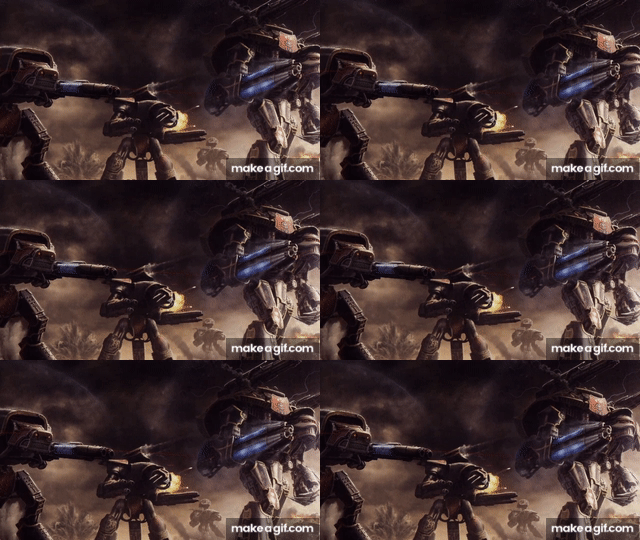
Titans fight against Titans as the God Machines of Loyalists and Traitors alike go to war. This conflict will be like no other before it, a worldending battle that will determine the next phase of the war.
Guy Haley is the author of over 50 novels and novellas. His original fiction includes Crash, Champion of Mars, and the Richards and Klein, Dreaming Cities, and the Gates of the World series (as K M McKinley). However, he is best known as a prolific contributor to Games Workshop's Black Library imprint.
When not writing, he'll be out doing something dangerous in the wild, learning languages or gaming.
'Sanguinius and the Khan must buy Roboute time. I would gladly sacrifice many more than the worlds of the Garmon Cluster for that. Many, many more.’ He looked to the gathering fleet. ‘The armies of the Warmaster attack the Garmon Cluster with unmatched fury. He pushes at us.’ Dorn’s eyes narrowed. ‘It is time the Imperium pushed back.'
Penultimate volume of the Horus Heresy saga before the Siege of Terra ending is a good insight about newborn Adeptus Mechanicus and its traitorous counterpart of the Dark Mechanicum or, from their point of view, the True Mechanicum.
An action-packed tale focusing on the clash in Beta Garmon system, last barrier before Horus final march on Terra, between loyalist Titans Legio Solaria (aka Imperial Hunters) and its long time nemesis, former allied, Legio Vulpa (aka Death Stalkers), with a nearly romantic sub-plot in the middle and lots of Titan vs Titan mayhem, with the giant Machine-Gods fighting under downpours, meteor rains and much more.
Not bad at all. Just loved the ending with the Titans funeral, Nuntio Dolores turning at last in the first fully developed Chaos Titan, Malcador finally announcing the beginning of the end, and Princeps majoris Harrtek being unable to rise hands on Magos Ardim Protos was a sort of a great Directive 4 Robocop easter-egg, but the chapters starring loyalist Primarchs, with Dorn staging the Titandeath of both sides on Beta Garmon just to make them not lay waste to the Throneworld later, giving the Ultramarines time to arrive, and Sanguinius fighting reckless and winning against an Imperator-class titan at the cry of 'I do not die here today', because foreboding of his own fate at the Warmaster's hands is his strongest weapon of all, just shadowed for good main storyline for me.
And when at last infamous Legio Mortis was deployed on the battlefield, I was waiting for Dies Irae Titan, missing from the series since book three, popping up in this novel.
Sadly it not happened, but having read Graham McNeill's Storm of Iron years ago, I already know when and where the Dark Titan and its crew are making their triumphal comeback.
A must read for Titans and Mechanicus fans and a good Horus Heresy novel, just not as good as I was expecting for.
This entire review has been hidden because of spoilers.
Titandeath was not only a great story, it was very instructive in furthering my knowledge about the Collegia Titanica. The Heresy is raging on and the Beta-Garmon system is the next victim of the conflict. If the Loyalists can stop Horus' armies at Beta-Garmon, then they will not be able to move onto Terra. However, Horus is well aware of this and sounded the death knell for the system. This war for Beta-Garmon will not only have elements of the Traitor Astartes and Traitor Imperial Guard but it also involves the Dark Mechanicum and the Traitor Titan Legions.
A Titan, or God-Machine, is a massive combat walker that is worshipped by the Mechanicus. Depending on the size, it is piloted by a Princeps and crewed by several to a dozen other Moderati. From the Scout-Class Warhounds which tend to run 15 meters, to the Reaver- Class coming in at 25 meters, all the way up to the truly intimidating Warlord-Class which can run 33 meters or more- these machines are game changers on a battle field and this is proven in this story.
But I was very excited when they finally showed the true "God-Machines", the Imperator-Class Titans that are an awe inspiring 55 meters or more. Without too many spoilers, I found Sanguinius' logic about utilizing Beta-Garmon as the center-point for this Titan war, due to the catastrophic damage that would be caused by a similar conflict on Terra itself, to be quite logical.
Reading this will show why in the 40K timeline, 10K after these events, Titans are indeed rare. Also there is some interesting information about how the Mechanicum is now splitting into what will be the Loyalists calling themselves the Adeptus Mechanicus, the term by which they are known in the 40K timeline, and the Traitors becoming the Dark Mechanicum.
It is also important to remember that not all those who turned traitor did so due to the worship of the Chaos Gods, though that would come in time. In fact, the sheer ignorance of what is going on should be manifest in the actions of Terent Harrtek, Princeps Majoris of Legio Vulpa, when he unwittingly allows his sheer arrogance and lust for power to allow himself to undergo the profane ritual which will create the horrifying daemon-machine hybrid battle Titans used by Chaos in the 40K setting.
This story told from the viewpoint of the Legio Titanica Solaria (The Imperial Hunters), it is a great look at what it takes to become a Princeps for a Titan. A very interesting story and one that I not only enjoyed for the plot, but fo the additional lore about Titans. Any 40K fan will appreciate this story.
Book 53 in the Horus Heresy series, this is the penultimate novel before the Siege of Terra begins and the first proper look at the vast battle for the Beta-Garmon system. With both sides throwing ever-increasing numbers of troops and war machines into the grinder, the focus here is on the Titan Legios of Solaria (or Imperial Hunters) and Vulpa (Death Stalkers) as they clash throughout the system. There’s history between the two Legios that goes beyond general antipathy for the opposing side, and for Princeps Esha Ani Mohana of the Legio Solaria there’s a very personal element at the heart of the conflict.
It might not be the book everyone expects, as while undeniably epic it does focus almost exclusively on the gradually escalating conflict between these two Legios – there are very few non-Titanicus characters, and even the Primarchs only really get passing references. That’s probably a sensible choice on Haley’s part, as there’s far too much going on to really dig into the big picture while still maintain a compelling narrative all in a single book. As a standalone book within the Heresy, however, focusing on the role of the Adeptus Titanicus, this is a great read. What it does particularly well is offer a view of the Heresy in microcosm – two conflicting ideologies and a very personal, almost familial conflict between staggeringly powerful forces – but on just about the grandest scale imaginable. As long as you like reading about Titans, this is absolutely worth checking out.
Going in I braced for an slug read because I'm not a fan of titans in the 40k universe. Man, I'm glad I didn't skip it, because this book was great. You do get the titan on titan story and a super interesting story about a female pilot, but you also get a broader story of the Heresy and Horus's continued push towards Terra.
A great book, written so well it made me interested in a subject I'm not normally drawn to.
It's the story of 2 legios who end up on different sides. The khornate ritual is cool and the great mother becoming one with the machine god is cool. Awesome book about god machines!
May 2024 Read using the Horus Heresy Omnibus Project Reading Order Omnibus XX Shadows of the Warmaster IV The Dead and the Dying (https://www.heresyomnibus.com/omnibus...) as part of my Oath of Moment to complete the Horus Heresy series and extras.
OK. This is one of those times where I need to give the ole withcindy style heads up of this review being just my personal, extremely subjective, and not particularly informed experience of the book, which might be a bit harsher than some of my others, but I haven't slept, I loved part of this book and have nice things to say about it, but a lot of it I didn't and I have a lot to attempt to express. Nothing is intended to denigrate Haley or detract from anyone else's experience, and this just for readers and trying to entertain myself as I wrangle my tattered mind. It's not intended to be read by the author or anyone particularly close to them.
I've been reading a variety of review and it's always fascinating to see how polarising every entry in this series seems to be. There really are a lot of people who really had a good time with this and I couldn't be happier for them.
The is the penultimate book in the main series in order of release and the first Imperial line of defence against Horus' eventual big push towards Terra, Beta-Gamma. This is where all the big war machines come to whittle their numbers down to something more manageable for the actual Siege of Terra. But it's not so much about big action and Titan on Titan action, though their is some. This is more about the rivalry and complicated relationship between two big players in their respective Legios as an expression of the war as a whole. Also, Sanguinius and his Sons are kind of around, a bit, sometimes, and he is more sad and less insightful than ever, but he does get to do the Oppenheimer quoting the Bhagavad Gita quote that, quite honestly, broke me and just the sheer audacity of how unearned the moment is pushed me over the colossal gulf of three to a two.
I really feel like I'm having a Tyra Banks moment with Haley and this book because I cannot be more explicit about how much I enjoyed the opening third and thing it would have made a wonderful novella, perhaps ending with the inclusion of how communications broke initially broke off. I was all in for the all lady Titan team and there's definitely something to Sanguinius overseeing and feeling responsible for all the carnage, but it just wasn't played out in or resonant in the text.
Sadly, very little resonated in the text. The obvious showdown was obvious, and that's fine, but there simply wasn't enough of a relationship for their to be enough tension, especially with the dialogue, drama, and action not being strong enough. This is the same for the big battle that was going on all around, but never really in focus, made visceral, or intimate as with the story of Tallarn.
I feel like I'm always comparing authors and books, and it doesn't seem right or fair, but it's just how my brain works and I am working on 0 sleep spectrum and the opposite on the autism and ADHD ones. I'm in real danger of damning with faint praise and harsh comparisons, but I am really not trying to be disparaging. This just isn't Tallarn and Haley just isn't French. It could simply be the joys of subjectivity and the uncanny valley with Haley, because it seems like his approach, style, and tone are kind of in the McNeill and possibly Abnett direction, while trying to get a bit more Annandale with the Chaos stuff, and, as far as the former, at least in terms of worldbuilding, presenting, and inviting the reader into that world, he's definitely in the ball park. His prose isn't quite as Master-Crafted to steal an apropos Warhammer term, but the big ideas, set pieces, and narrative arcs and climaxes just aren't there for me, which only hits harder because I buy in so hard on the opening. I don't want to repeat myself, so I'll get more into my Haley experience in a minute.
Is it fair to compare Haley to the Lords of the Dark Millennium or my favourite French fancy? Absolutely not, but it's impossible for me not to when reading a shared series with so many similarities and disparities. Just as it's not fair to compare this book to Tallarn, but with the whole total devastation and ruin of it all, it's also kinda impossible not to do. French gets intimate, visceral, and stone cold brutal with appropriate reverence and weight; he treats the ordeals and characters with a grounded sense of reality that brings home the collosal weight of the death of a world with barely anyone having a clue why. Conversely, from the outset, this is a far more playful and whimsical story--there's a reason I compared the opening to the Cooper's Hill Cheese-Rolling and Wake, before (that's the ridiculous and deadly downhill race after a wheel of cheese than happens on a steel hill in England each year and is absolutely illegal and truly one of the only things about this country that doesn't make me want to combust in disgust, shame, fear, and fury), because it's a bit silly. And silly is fine, but it doesn't slide in to the reverence of observing a the loss of untold numbers of lives, especially when it's been being built up for a while now as being the Titan Thunderdome. (and I don't even want to get into the matriarchal mother of it all, which is tragically, rather Mother! and how the tone and handling of all that and the language used only served to muddy the tone even more--just let us have cool Queer women Titan women without all the boiling genuinely interesting characters to dynastic baby machines...I said I didn't want to get into it. It doesn't couldn't if it's within the parentheses... Is this my parent theses? WE DON'T HAVE TIME!).
What I am saying is that all of that and not naturally building that feeling in what is in the page does not make my feel the weight of this tragedy, and I love tragedy and crying at these ridiculous books! So when the Angel of Death quotes Michael Scott quoting Wayne Gretsky quoting Oppenheimer quoting the Bhagavad Gita I, personally, am become incredulous, exasperated with words...
I wrote the following paragraph a while ago now, but I couldn't fit it in with all my other rambling--Can you tell I haven't slept and feel very scatty right now?--so apologies if I repeat stuff, or it's all over the place, or whatever. I wanted to try to describe my experience of reading a book by Guy Haley:
I don't know what it is about Haley, but I seem to have a very similar experiences each time--I go in with an open mind, really enjoy the way he writes the first half and just how wonderful his worldbuilding, scene setting, and the way he manages to convey the more mundane, minutia, and less obvious and loud stuff so well. This gets me genuinely engaged and excited and then he has to get in some men writing women and hung up on some aspect of sex and/ or gender, ranging from post irony misogyny, which is just misogyny, painting weird, broad strokes that I don't think he necessarily intends to do, but end up being some combination of fetishising and/ degrading (or at least reducing) women, as he struggles to write them in any situation outside of their military/ political position. Then the big build up to action that either doesn't really appear or isn't engaging or memorable, but it seems between juggling relationships and action the grander themes and threads of the narrative, including the aforementioned glorious detail and worldbuilding get tangled, leeching all colour and energy from the narrative and prose, so I end up glazing over and feeling further and and /further disengaged, as the story is building to a climax it's been heading to the whole time and I'm being told that it's getting bigger and more important and intense, and I see the beats and set pieces, but there's no vitality left in anything. Then it's over with a coda that rekindled just enough energy for me to feel the void.
Maybe this one just wasn't for me, and it was for all those lovely folx who did enjoy it and gave it some many glowing reviews. I genuinely love that for you.
I'm very happy that the next book I'm reading is more John French if I remember correctly.
***
I need to come back to review this properly when I have the brain and can summon the energy, but the first part of this is basically a bloody brilliant novella and there's a decent little Malcador story at the end, but my goodness did it have me, lose me, and then absolutely baffle me with how lacking in any kind of impact, urgency, pay off, emotion or any kind of energy, like, at all. To the point where this is now has my all time entirely unearned, but unbelievably straight faced,. quote of Oppenheimer quoting the Bhagavad Gita.
There was a really cool story about a lady doing the Mechanicum equivalent of the Cooper's Hill Cheese-Rolling and Wake that founding an all women Titan Legio and checking in with them a couple hundred years later, but then it became some half-arsed, milquetoast, star crossed, maternal-fethishising morass with Sanguinius on top like an unwanted, flavourless bit of parsley telling me to feel things because the text didn't manage it and to make it feel even remotely like this was the penultimate book of the main series and connected to the overarching narrative in any way.
I would consider giving my imaginary novella full marks and it's the kind of side story I could have endless of in this series, but I think I'm going to have to give the whole novel a two for fumbling it when it truly had me and just how devoid life and peril this is, despite the devastation, and just how insulting and pointless the inclusion of Sanguinius was, especially when it absolutely could have worked.
Through the Horus Heresy Omnibus Project and my own additions, I have currently read 48 Horus Heresy novels (inc. 1 repeat and 9 anthologies), 25 novellas (inc. 2 repeats), 137 short stories/ audio dramas (inc. 10+ repeats), as well as the Macragge's Honour graphic novel, all 17 Primarchs novels, 4 Primarchs short stories/ audio dramas, 3 Characters novels, and 2 Warhammer 40K further reading novels and 1 short story...this run, as well as writing 1 short story myself.
I couldn't be more appreciative of the phenomenal work of the Horus Heresy Omnibus Project, which has made this ridiculous endeavour all the better and has inspired me to create and collate a collection of Horus Heresy and Warhammer 40,000 documents and checklists (http://tiny.cc/im00yz). There are now too many items to list here, but there is a contents and explainer document here (http://tiny.cc/nj00yz).
The rare, surprisingly woke and refreshing WH40k book!
In this one Guy Haley explores an all-women Titan Legio, including how they navigate existing male-dominated power structures.
Aside from that cool side of things, the scale of combat in the book feels awe-inspiring. Death machines tens of metres high battling on strange planets and space installations, existing on a scale where non-augmented humans can't even effect them.
The battle proper, titan versus titan, really begins 2/3 through the book. Much of it is an in depth look at the lives and relationships of titan officers. The book looks at particular titan battles and even duels and gives an impression of the size and importance of this famed battle. I didn’t want an impression. I wanted raging war beyond human reason and endurance, heroes and cowards fighting and dying glorious and sudden deaths and even crazier Primarch feats of arms. I definitely hope to read about deaths of individuals and whole units as we get to Terra.
This book was well narrated, highlighting the titan war between the traitors and loyalists. I found that the inner story, and the relationship fostered between two specific titan princeps didn’t go anywhere and didn’t highlight anything new in regard to the race to Terra.
Not a bad book, a few really good points, but overall not my cup of tea. I’m rarely a fan of the Titan/Knight aspect of WH40K. They’re neat, but not carry the story neat. But we’re almost to the end of the heresy and I’m still enjoying it. Onwards.
At Book 53 (!) of the Horus Heresy, it's fair to say I've begun to get a little tired of the regularly served bolter-fest... which may explain why I found Titandeath a great breath of fresh air!
This epic Titan-on-Titan novel delivers on the often foreshadowed, but not seen battle for Beta-Garmon, the last stronghold before the Siege of Terra.
With great action moments and a real peak under the hood of the Titan legions, I highly recommend this book for any HH fan, particularly if you're picking and choosing the odd novel rather than diligently going through them in release order like myself.
Astoundingly apocalyptic work, as we gear up for the Siege of Terra. The overall strategic situation felt a bit rushed to me, but it worked dramatically enough - and the interesting character study of individuals and a Titan Legio of female Princeps only was interesting and authentic enough to make me consider this as a gift for others.
Hard one to review, no spoilers. It's about the biggest machines in Warhammer, going for to toe. It tells it like it would be. Interesting the idea using another planet to have complete carnage to destroy as many Titans as possible shows Dorn at his calculating best.
Very big stage. Very big story. But, at the same time, it is a very small story. It was difficult for me to envision (and I have a pretty good imagination) the scale of hundreds of Legios gathering to fight one battle against a city and it going on for days. They call these machines world enders, and yet, they cant crack a city. Plus the backdrop of this is the battle over a cluster of the galaxy. Several worlds, systems, stars. It includes Primarchs, God Engines, Warmasters, and fleets of ships..millions of lives. The story is a parallel of one Legio and another. One loyal and made of women and one dark made up of grumpy dudes. The war machine fighting was not even as compelling to me as it was way back in Mechanicum. You know. book 7 or something of this series of which Titandeath is book friggin 53. I am not sure why I am so negative. I liked a lot of this book. I liked the daring nature of the scale of it, but I also disliked just the feeling that it all meant nothing. There are some terrific set pieces, like Sanguinius single handedly taking out an Imerpator Titan. That was maybe one of the best bits of the book...but why then...a book with pages committed to my favorite primarch doing something almost god-like do I feel disappointed on the whole? It is hard for me to put my finger on, but on it is. Also. I know I must have missed something. But what the hell happened to Horus. Right now, the sequence I have is. Wolfsbane - Russ finds and fights Horus. Stabs him with the Spear of Fate. Horus is "wounded" but Russ fails to kill him. (an entire Loyal legion spent in the act of wounding) Horus is wounded grievously in the battle of Beta Garamon...and is beamed from combat to his flagship and goes into a coma where Mal has to kill himself to save him. (Slaves to Darkness) And now Titandeath. You get to see Horus at a meeting suddenly wounded and beamed out. No other details. What did I miss? Will the Burried Dagger finally play out this scene for us? I thought it was just Leman's wound rending open later. But in Slaves they said it happened in the middle of combat. Titandeath's fever vision has it just erupting while he is in a meeting. So. I dunno. Is anyone reading anything. Plus. Why wasnt this BEFORE slaves to darkness? Can you skip this book? Maybe. Sanguinius and the Khan are resolved that even though they say this entire battle was a waste of time, it really wasnt. But...it was. Terra is the main event. I hope the Khan gets more time to shine. I hope Sanguinius' death is wonderful. I hope the Siege of Terra is everything it needs to be and not Season 8 of Game of Thrones. ok. 3 stars. Almost like an anthology book. The end.
This entire review has been hidden because of spoilers.
The first 2/3rds of this book are about the ongoing rivalry/feud between Legio Solaria and Legio Vulpa. There's some great world building around both loyalist and traitor Titan legions, including some great bits about that 'the ends justify the means' mentality that is your typical jumping off point for Chaos.
There's an interesting battle scene that takes place on the hull of an orbital facility. That's all you get for Titan combat for a couple hundred pages.
The last third of this book is about the Titandeath itself. For some reason, this required the absolute barest minimum of actual Titan-on-Titan combat for the largest Titan battle in 40k history. What we got instead was some general impressions that it was really bad, a hastily written 'end' to the feud and a Primarch/Space Marine fight that seemed a bit out of the blue considering the rest of the book. You can almost hear the phone call from GW saying 'We need you to add 100% more Primarch to this book because how are we supposed to sell models without them? Oh and Space Marines! We need to sell those too!'
I REALLY wanted to like this book. To be honest, it was a bit of a slog to get through. There's hardly any development for the ostensible main characters of the story. On the flip side, we get dozens of repetitive pages of the Winged Party Boy's depressed inner monologue. We know, we get it, your fantabulous hair is about to get all mussed by Horus. You have a terrible father who doesn't care about you. Just go hang out on your battleship listening to Morrissey and posting on Space Livejournal and let the rest of enjoy the Heresy in peace.
I’m not sure if 1 star is completely fair, but I just didn’t like this book. The narrative is very confused, and while jumping around from time period to time period is usually something Guy Haley does well it just didn’t work for me in this book. The characters are sort of boring, and while we do get a little extra info on how Titan crews work, I didn’t feel like it really gave me anything that the Mechanicum novel didn’t sort of do better. There is little character development, and while some of the arcs are well written others are a terrible example of men writing women. Maybe I’m just old and too impacted by having a daughter and a woke wife, but I really cringed at how the whole dialogue played out.
The combat isn’t written very well and is very confusing to follow. I think the best bits of it are the few parts where it’s a Primarch fighting, and that’s just terrible in a book where almost all the combat is viewed from titans.
If you love titans then you might want to read it, but it’s perhaps the most skippable HH book that i have read so far. Because even if you’re into Titans (and chaos Titans) and the Mechanicum, this is the worst example of it I’ve read so far.
Very well written, and if it were a standalone, it would be a really good read, but... BUT.
Considering the filler-fluff that populates this series, this story suffers as a result. Not because this is necessarily filler-fluff, but because at Book 53, there is an element of fatigue in the amount of stories that deprive the audience of a direct connection to Horus, The Emperor, and the key tactical developments/advancements in the traitor war as a whole.
This one will only appeal to hardcore 40K fans. And no, this does not contribute to the tactical intrigue of how the heresy progressed, despite being all about titans and other war machines considered vital to the pending siege of Terra. For those with a specific interest, like myself, in the greater heresy story arc, Titandeath did not feel at all necessary for consumption.
But again having said that, very well written, just skippable.
As a veteran and military historian this book is almost pointless. Who sacrifices so many valuable resources to a battle they know they are going to lose before it begins?????? Clearly the Emperor of Mankind! Aside from that bit of silliness, I found the story marred by delving so deeply into the past of minor characters that- my guess- won't be mentioned again in the storyline. Ah well. This series is still my guilty pleasure.
Horus gathers his armada for the final push to Terra. Only onr system stands in his way, Beta-Garmon. The Battle of Beta-Garmon saw the deployment of numerous Titan Legions from both the Loyalist and Traitor forces. Unprecedented destruction of the God Machines lead to the battle earning the nom de querre "Titandeath".
Despite being one of the largest battles in the lore of the Horus Heresy, the Battle for Beta-Garmon doesn't get a lot of coverage in the Black Library series. Only one short story "A Game of Opposites" which is about the Khan clearing the way for the loyalists, an audio drama "Valerius" about an Imperial Army officer who appeared throughout the Raven Guard focused stories, and one novel Titandeath.
Apparently there wasn't even going to be a novel, until fan outcry lead to Titandeath being written last minute.
The book reminds me of Mechanicum in that the plot is largely ancillary to the Heresy series, focusing on factions other than the Legiones Astartes to show the wider effect of the Imperial Civil War.
This story focuses on the Heresy in microcosm, looking at two of the Collegio Titanicus who have diverging ideologies and loyalties. We follow Princeps Esha Ani Mohana of the Legio Titanica Solaria (the Imperial Hunters) an all female Titan Legio who are proud and aggressive hunters. Esha's mother is head of the Legion, and she has a daughter of her own Abhani Lus Mohana. Then there is Princeps Majoris Terent Harrtek of Legio Vulpa (the Death Stalkers), a Legio who are vindicative and brutish in destroying their enemies.
There were some incredible scenes, like three generations of Titan pilots in one room together, grandmother, daughter and granddaughter. There is a strong familal element to the Heresy, often focusing on brotherhood and fathers and sons, so this was a chance to focuse of motherhood and sisterhood.
Mohana Mankata IV is the aged veteran leader of the Imperial Hunters. She was born on a Knight World, where pilots could only be male. Now she leads Titans into battle alongside generations of her family. She lives inside a tank, no longer able to survive outside of it due to her advanced age. Definitely one of my favourite characters from the story.
There is another great and very humorous scene of a Dark Mechanicum Tech Priest performing vile experiments upon members of the Imperial Army aboard a Sons of Horus ship.
That is the only experiment of the Dark Mechanicum, as we see the birth of a Daemon Titan in this book.
The book gives an immersive insight into what it feels like to be part of a Titan crew and to fight in such a mighty engine, high above the battlefield. Haley does a great job capturing the scale of the battlefield.
This book marks the first appearance of Jaghatai and Sanguinius in a novel since "Wolfsbane". Jaghatai disappears for most of the novel, but Sanguinius provides some great action and angst, as he takes on an Imperator-class Titan, while struggling with visions of his death at Horus' hands.
The epilogue of the book is fantastic, a look at Malcador as he acknowledges that Horus will soon arrive on Terra.
The Imperial Hunters return in the Siege of Terra series.
***I was granted an ARC of this via Netgalley from the publisher.***
War and battle are the norm in the Warhammer40k universe, especially during the Horus Heresy. However, in the book, Titandeath: The God-Machines Cometh by Guy Haley we get a first-hand look at Titan Legions in battle on a grand scale. What a grand scale it is, as the Beta Garmon system is plunged into battle as the Loyalist and Traitor forces clash in a climactic struggle. The book follows the Legio Titanicus Solaria, a female-only Titan legion led Domina Princeps Mohana Mankata Vi and her daughter under her command, Princeps marjoris Esha Ani Mohana and the thoughtful Primarch, Sanguinius. Opposite of them in one of the Traitor Legion we get the point of view of Terent Harrek, a princep majoris leader full of rage. We follow these characters as they navigate the epic battles that rage across the system. We are given a sense of the grand scale in which these battles are being fought and a great look at what it takes to man a Titan. However, while the story is good, it could have been better. There is a connection between Esha and Terent that is revealed, however, it isn't explored enough within the story. If it had played more of a role in the plot it would have made the climax of this novel amazing. The pacing could be better as well as it feels like the story lags after the midpoint. That being said I still think this was a good read and I would recommend this to a lover of sci-fi or the WH40K universe.
Rating: 3.5/5 stars. Would recommend to a friend who likes Sci/fi
Beta Garmon is the Sol system's gatehouse. It is is here that the Warmaster must marshal his forces before he strikes for the Throneworld itself. And while Dorn has spent his time reinforcing Tera and he knows he can't defeat the traitor forces in open battle he knows he can't leave them to form up on Beta Garmon unmolested. So he gives Sanguineous and the Kharn their head to launch a final strike before the siege lines are drawn as neither the Blood Angels or the White Scars are known for favouring sieges. Alongside them he sends part of the Imperial forces that too destructive to fight easily on Tera without risking more than they save while also giving them a chance to destroy their counterparts in the Warmaster's forces. For one last time the Titan Legions are walking.
I really enjoyed this book. I think it's the first book i've read that really gives that idea of the breadth of cultures that exist in the Titan legions. In other books with Titans at the fore there has only usually been a single legion. This time there were several together and you can see they are as different from each other as the Space Marine legions. It's always great seeing the inner workings of the god machines.
Taken on it's own this is a really fun book. As part of the Horus Heresy it feels a little tacked on. I didn't really get a sense of the wider battle for Beta Garmon.
Titans are rarely spoken of in the Horus Heresy, and for good reason. They're big, they smash things or shoot things, and they stomp about. There's only so much writing you can wring from them.
Guy Haley here has done something wonderful with titans in Titandeath. He has taken a step back from giant god-machines walking the surfaces of distant planets and focused on the humans that run them. Who they are, what makes them different in a universe of gods and daemons. It's rare to see titans in 40k fiction but it's even rarer to see humans and human factions, even if they are part augmented and worship machines.
Guy Haley brings out the humans fighting and dying in this terrible war, and we get to see glimpses of the pre-Horus Heresy society and frankly, it's all wonderful. Not that this book doesn't have its share of titanic combat but they're spaced out between delicious human stories.
We've lived with space marines for so long they've become commonplace and you can often forget the billions of humans that exist in this universe. Make no mistake, they are humans here, humans piloting colossal beings but still humans.
Titandeath is a novel about titans, but it's more a novel about humans. And that's something special.