The story of how Las Vegas saved Elvis and Elvis saved Las Vegas in the greatest musical comeback of all time.
The conventional wisdom is that Las Vegas is what destroyed Elvis Presley, launching him on a downward spiral of drugs, boredom, erratic stage behavior, and eventually his fatal overdose. But in Elvis in Vegas , Richard Zoglin takes an alternate view, arguing that Vegas is where the King of Rock and Roll resurrected his career, reinvented himself as a performer, and created the most exciting show in Vegas history.
Elvis’s 1969 opening night in Vegas was his first time back on a live stage in more than eight years. His career had gone sour—bad movies, and mediocre pop songs that no longer made the charts. He’d been dismissed by most critics as over the hill. But in Vegas he played the biggest showroom in the biggest hotel in the city, drawing more people for his four-week engagement than any other show in Vegas history. His performance got rave reviews, “Suspicious Minds” gave him his first number-one hit in seven years, and Elvis became Vegas’s biggest star. Over the next seven years, he performed more than 600 shows there, and sold out every one.
Las Vegas was changed too. The intimate night-club-style shows of the Rat Pack, who made Vegas the nation’s premier live-entertainment center in the 1950s and ‘60s, catered largely to well-heeled older gamblers. Elvis brought a new kind of an over-the-top, rock-concert-like extravaganza. He set a new bar for Vegas performers, with the biggest salary, the biggest musical production, and the biggest promotion campaign the city had ever seen. In doing so, he opened the door to a new generation of pop/rock performers, and brought a new audience to Vegas—a mass audience from Middle America that Vegas depends on for its success to this day.
A classic comeback tale set against the backdrop of Las Vegas’s golden age, Richard Zoglin’s Elvis in Vegas is a feel-good story for the ages.
Elvis in Vegas: How the King Reinvented the Vegas Show by Richard Zoglin is a 2019 Simon & Schuster publication.
A wildly entertaining and juicy piece of pop culture history!!
Elvis truly resonated with my mother’s generation, back in the fifties and sixties, but not so much with me. He was before my time, and frankly, I just couldn’t understand what all the fuss was about. I didn’t see in him, what legions of fans apparently did.
For decades, I sneered when someone mentioned Elvis as a pioneer of rock and roll. I thought he was vastly overrated and felt that if a title, such as ‘The King of Rock and Roll’, must be applied, Chuck Berry was far more deserving of it than Elvis.
However, these days, Elvis seems to slip further and further from our mainstream consciousness- unless you happen to be in Las Vegas, that is. Even now Elvis remains a mainstay in Sin City. In fact, very recently an Elvis impersonator performed the wedding ceremony for a popular ‘It’ couple, which made the rounds on social media.
It was the first time I’d thought of Elvis in years.
Elvis is synonymous with Vegas and the big theatrical stage show that became the norm once he set up a residency there. For many, however, it also signifies Elvis’s downfall- the place where he became a parody of himself, becoming bloated and out of shape and dependent on drugs, going through the motions with no enthusiasm.
While it is true that Elvis became bored and restless, and fell prey to his own celebrity and gaudiness, Richard Zoglin shows us a different side of that coin-
The author takes readers on a fascinating journey back to Vegas’ beginnings, through the age of mob -controlled casinos, the peak of night club performances, the ups and downs of the entertainment mecca, and through Elvis’s tenure as Vegas’ top draw.
I never realized what a big impact Elvis had on Vegas. I guess I never really thought about how his show transformed the city and the future of all other popular shows and spectacular stage performances since then.
If not for Elvis, I’m not sure what path Vegas may have traveled down, but I don’t think it would have flourished in the same way.
For the record, this is not another Elvis biography, nor is it a dry history of Vegas. While some familiar ground is covered, this book is more of an analysis of how the city and its entertainment venues changed and adjusted over time, and how it evolved into the entertainment epicenter it is today.
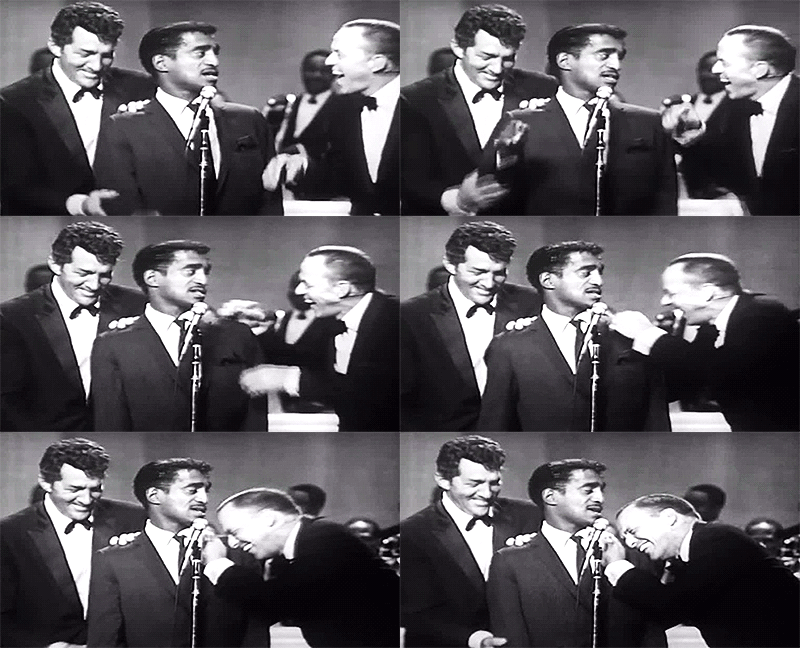
It also offers up many titillating details about major Vegas acts, like Frank Sinatra and the Rat Pack. These are lesser known, and less flattering stories about the nightclub acts, some of which would certainly raise eyebrows today. It is also a nostalgic journey. I’d forgotten about some of the performers mentioned in this book and do remember how popular they were.
I’d also forgotten how Howard Hughes took over Vegas for a time, shoving the mob out of the way. It was a bit weird to hear people like Florence Henderson and Paul Anka lament the lack of mob protection. When the mob was running things- Vegas was a safe place!! Wow!
The author spent a bit too much time with Frank Sinatra. I realize he was the name most associated with Vegas before Elvis stepped into his shoes, and for some, his legacy is still steeped in Vegas lore. But I did grow a bit weary of Frank, wishing we could hurry up and move on into new territory.
Vegas went through an identity crisis a time or two, especially as rock music began to become a dominant force, pushing crooners like Frank Sinatra to the sidelines. No rock performer or group wanted to play Vegas. It just wasn’t cool. It was where one ended up in their twilight years. But in many ways Elvis changed all that.
Shows like Cirque du Soleil and performers like Celine Dion owe Elvis a debt of gratitude. Without him and his elaborate stage shows, it is unlikely that Vegas would be what it is today.
Trust me, one doesn’t need to be an Elvis fan to enjoy this book. I highly recommend it to anyone who enjoys history or pop culture. The author has written a dazzling Vegas showcase giving Elvis a bit of overdue credit, and this time I must concur- he was a pioneer after all- a Vegas pioneer, and this time he earned the respect. So, let’s hand it to him. Elvis changed Vegas, gave it a new lease on life, one the city continues to benefit from, and will for some time to come.
On a personal note, my husband is a huge Elvis fan. If it's the weekend and he decides to have a few beers and gets a bit maudlin, I'll find him watching an old VHS tape of "Elvis in Hawaii" or "The '68 Comeback Special" and crying...especially when Elvis sings the song "If I can Dream", the closer to "The '68 Comeback Special". Also, our wedding first dance was to "Love me Tender", and I can still see our wedding guests surrounding us in a circle, with emotional expressions. My now 18 year old son's band performs a mean "A Little Less Conversation" and "Blue Suede Shoes" which their audiences just love. I was lured into his legend back in the 80's when I read his ex-wife Priscilla Beaulieu Presley's autobiography called "Elvis & Me". It was also made into a mini-series. My gosh, that book was so juicy in details but honestly and well-written that my paperback was dog-eared before long! Elvis was such a fascinating individual, and all his friends and associates have so many interesting stories to tell. I've read many biographies about him over the years. As I sit here writing tonight, I'll be leaving for a road trip to Graceland tomorrow! I had my dream twenty years ago when I visited London and Liverpool for my Beatles/Monarchy passions, so now it's my husband's turn.
So I delved into this tome anxious to read about Elvis, not realizing that there would be a big buildup...a comprehensive overview of the entertainment industry in Vegas...years before Elvis conquered it. It covered "The Rat Pack" consisting of Sammy Davis Jr., Dean Martin, Joey Bishop, Peter Lawford - and most importantly - Frank Sinatra! The stories about Frank Sinatra depicting his rages when he thought he'd been slighted, and the mafia connection lingering in his background...were compelling. The book is extremely well-researched and written, much like another book I've read this year, "Castle on Sunset". Even though I wasn't that interested in some of the old entertainers covered in the lead up to Elvis's Vegas triumph, the writing was so superb that I was willing to hang in there. However, at about the 45% point I got a tad frustrated and did a fast skim to arrive at my happy place, when Elvis was to take on Las Vegas with a spectacularly planned and executed show. So, at around 50% I was solidly in Elvis land, where I wanted to be. Little anecdotes were sprinkled throughout the book about him from the beginning, but I was anxious to read about Elvis and stay there.
At this point in the book where Elvis was planning his show, calling the shots 100% about what he wanted for his musical presentation (and not cow towing to his manager Colonel Tom Parker), I got the chills...good ones! Hearing about the way Elvis coalesced his band, what songs he was going to sing (just the mention of them gave me more chills; "Suspicious Minds", "In the Ghetto", "Memories", etc.) The detailed accounts of his various stage jumpsuits, what celebrities visited him backstage, what the critics had to say. Then the years ahead where he fell into decline with obesity, drug addiction, silly banter between songs, etc., until his passing in August of 1977. I was about 85% through the book when it surprisingly ended, followed by extensive footnotes. So, I enjoyed the first half of the book, but REALLY enjoyed the next 35%. The cover of this book is brilliant, but a bit misleading if you were expecting the entire book to be about Elvis. Still, I'm going to rate this 3.5 stars bumped up to 4 because this was a quality book with great writing and historical research.
Thank you to the publisher Simon & Schuster who provided an advance reader copy via NetGalley.
"There's blackjack and poker and a roulette wheel - a fortune won and lost on every deal. All you need's a strong heart and nerves of steel. Viva Las Vegas!" -- lyrics by Doc Pomus & Mort Shuman
Sure, 'Sin City' originally sprung to life and then gained fame for its numerous hotel-based casinos in the prosperous post-WWII era. But Zoglin's Elvis in Vegas examines the show biz industry also associated with the area. You have to keep the gambling crowd entertained between drinks, right?
To be clear, Elvis is actually a minor character for the initial 100 or so pages here. Other musicians, stand-up comedians, dancers, showgirls, and assorted acts are initially discussed at length. Of course, special attention is given to The Rat Pack, several of whom (Sinatra, Martin, Davis et al.) virtually became synonymous with performing in the town during the 50's and 60's. However, the pop culture tide began turning by the late 60's - with rock music finally having its first generation of fans reaching adulthood - and it was the perfect time for 'The King' to capitalize on the success of his televised '68 Comeback Special. Thus, Elvis headed to the Vegas strip for a summer gig in 1969.
The latter half of the book was perfection, focusing on Elvis' sincere and hard-working preparation for and execution of the engagement. As a fan, it was heartwarming to read sections like " . . . people liked Elvis Presley. [They] were struck by his modesty, his gracious Southern manners, his genuineness. He was still, in many ways, an overgrown country boy . . . [and] was unfailingly generous." True, the man had his flaws and addictions, too - by the mid-70's his drug use / health issues made his performances erratic - but his first few seasons in Vegas represent his last great burst of sustained success.
This book feels like someone telling you a story of Vegas and Elvis's return. A majority of this book discusses how Vegas was started and a focus on the Rat Packs influence, which adds an interesting perspective into how Elvis changed the city.
As someone who lives in Las Vegas and works at a museum celebrating Las Vegas history, this book was one that I knew I needed to read. While the title suggests that this is a book merely about Elvis, this is actually a comprehensive history of Sin City itself. From its humble railroad beginnings to the entertainment capital of the world, author Richard Zoglin takes us through the story of this desert oasis. This is not only an in depth look at the entertainers that set the stage for a performer like Elvis, people like Frank Sinatra, Dean Martin, and Sammy Davis, Jr, but the casinos and the great minds who knew how to sell and market Vegas to tourists. Residencies that pepper The Strip today all have the entertainers of the past to thank for the theaters and fan base that many of us take for granted today. Where else in the world can you go and see multiple top acts in the country on one week's vacation? Welcome to Fabulous Las Vegas!
I love Elvis & I’ve always been fascinated by Las Vegas - so this book was an instant-purchase. The book in itself was really interesting - but some parts failed to engage me & hold my attention completely. This could also be my fault for not being in the right mood 🤷🏻♀️
Oh, how I love all things Elvis! I am a huge fan and have read many books on his life and its many aspects. Finding particular interest in his "Vegas Years", I was elated to be approved to read this story. What I found was a wonderful comeback story of the adventures of Elvis in not only the development and impact Vegas made on his life but what he did for Las Vegas during its "golden age" as well. For fans and non-fans (Is there even such a human who would exist?!), this is a must read. I found it incredibly well-written and insightful to many questions I have had about his years and time there. I highly recommend this!
Whimsical and informative. About 75% of the book focused on the history of Vegas, specifically in the ‘60s. Only the last 50 pages or so talked about Elvis’ time there. Still a pretty fun read. I loved all the info about the Rat Pack 🤩
Many of us have gone to Las Vegas and enjoyed all it has to offer but few realize the impact that Elvis Presley's 1970's residency had on the creation of Sin City's evolution. Loved reading about the ascendency of Las Vegas from the Rat Pack to today's mega-entertainment hub. The insights of the mind of Elvis as he returned to his musical roots in fascinating. It has been 45 years since Elvis died but he remains the king of the stage. Great read!
The title is rather misleading, as the first half has much more to do with the rise of Las Vegas as an entertainment capital, while the second half climaxes with Elvis' first run at the International Hotel (now the Westgate). That said, it's a very fascinating look at both Elvis and Vegas, and how neither were ever the same after they collided.
This is a fascinating look at the evolution of entertainment acts in Vegas. Yes, it's about Elvis, but in my opinion it's more focused on how the lounge and stage acts of Vegas evolved (or didn't, in some cases) with the tastes of the American public. There were a lot of interesting anecdotes about Sinatra, Wayne Newton, and others that really captured the attitudes and tastes of that time. It did a great job of being a breezy yet informative read about a few defining decades in American entertainment in what is perhaps the most extra of extra-American cities.
Elvis in Vegas takes readers through a the history of Las Vegas from the days it basically was a junction point on a railroad line through the development of the Strip with lots of interesting stories about the entertainers brought in to draw patrons into the casinos. Readers learn about the mob connections, easy divorce laws, the rise of nudity, the humiliation early black entertainers endured. Reading this book was a wonderful trip down memory lane. It’s a who’s who of those who developed Vegas into the entertainment capital of the world. It also tells how music changed, chronicling the shifts occurring after the Beatles arrived, and pop standards began to give way to rock. Mob control and management styles began to change when Howard Hughes arrived and started buying property. Hughes brought in a bottom line corporate approach that dispensed with a lot of the perks formerly enjoyed. The author devotes many pages to Frank Sinatra, his volatile temper, his group known as the Rat Pack, and explains why even though Sinatra didn’t particularly like Elvis or have any appreciation for his music, he was instrumental in Elvis’ career. The baton truly was passed from the old Vegas king to the one and only King of rock ‘n roll on July 31, 1969, Presley’s first live performance in nearly a decade. Elvis arrived and Vegas was never the same. This is such a fun, informative and culturally significant story. For those of us who became teenagers in the fifties, Elvis was a huge part of those years. The author does a very good job describing and drawing readers into the excitement of seeing Elvis live...even when viewing him from the nosebleed section of a convention center as I was fortunate to do. There’s no way to properly do justice to this book in a review...you must read it for yourselves. My hope is the teasers given will spike your interest. I voluntarily reviewed an advance copy of this book from NetGalley. Most highly recommend.
Zoglin does an excellent job of detailing the history of Las Vegas from its conception to the modern era and uses Elvis as a motif to package the entire narrative. The only real complaint I have is that the same anecdotes appear multiple times throughout (like Elvis's first reaction to Streisand opening the International Hotel). Engaging, easy ready.
This book should have been titled "The Musical History of Vegas." There are 250 pages in the main part of the book, excluding "note and acknowledgments." The Elvis Vegas concert material starts on page 170, well over half way into the book.
The book was very interesting, but the majority of it was about people and events before Elvis's arrive on the Vegas scene.
A rockin and rollin good read !!! Elvis in Vegas was a pleasant surprise as the title made me think it would be all Elvis all the time. The book is so much more instead telling the story of the Las Vegas casino entertainment scene. Sinatra fans will be disappointed what they learn about Ol Blue Eyes. One for the money, two for the show, three get ready to read a good history.
This book is a must-read not only for Elvis fans, but for anyone interested in the history of Las Vegas. It's a fascinating insight into Las Vegas from its beginning to the present and how the city was influenced by changing times. The impact Elvis made on Las Vegas was huge - - and it was huge for his career as well. I saw Elvis live once in Las Vegas and though I've never been a huge fan, I liked him and his show was magical.
I've seen Las Vegas change since the 70's when I first visited there and it was so interesting to read how these changes came about. A tremendous amount of research went into this book and it's well worth reading.
Misleading and inaccurate title for a book that's mostly about other entertainers in Vegas and that does nothing to prove that "the King reinvented the Las Vegas show." In truth less than half of this is about Elvis (much of it historical about the strip and other performers) and there's little evidence that Elvis did much of anything to impact others on the strip. As a matter of fact, since the book is written as an overview featuring big names that headlined shows, it actually makes Frank Sinatra, Wayne Newton, and Tom Jones seem more significant to the history of Vegas.
Most of the information is pulled from elsewhere with some interviews by the author. The problem is that the book is rather negative, slamming Elvis in spots, being extremely negative about his films (especially Viva Las Vegas) and saying some demeaning things about entertainers in the city. The author's third-rate opinions are unnecessary.
There are also odd inclusions. He says that Elvis's first 1956 appearance in Vegas was "taped by an audience member." Does he mean it was filmed on 8mm? There was no portable video tape back then and I doubt someone hauled in one of the new large reel-to-reel audio devices. In another spot he implies that Viva Las Vegas "finished shooting in September 1963 but MGM didn't release it until the following May." Okay, well it's normal for any movie to have 6 to 9 months to edit and distribute the film. Was this author implying it was delayed it due to what Zoglin perceives as "a pretty bad film?"
Since so little of it is actually about "Elvis in Vegas" one has to wonder why this wasn't titled something else and a more thorough job done researching the history of the city's performers. It just falls way short of what it promises and seems like a rehash of things that are better detailed in other books.
Elvis in Vegas is a rehash of the history of show business in Las Vegas, culled largely from other sources. The title misleads; Elvis becomes part of the history told her in the last 100 pages of the 250-page book. The rest comes from news files and a recitation of memoirs and biographies from other show biz people who are part of Vega lore, including The Rat Pack, Shecky Greene and a host of familiar others. The book has Elvis in the title, but he doesn’t become part of the story until the last 50 pages. Those pages are a solid account of the King’s first stand at the International Hotel in 1969. But there should be more, given the title. The deceptive title belies an author who appears unfamiliar with the Las Vegas culture of the 50s and 60s, therefore needs a way to lure readers. After a few chapters, you'll realize you’ve been led astray by the title, and skip to the back. No one likes to be played, but Simon & Schuster, the publisher, thinks it is smarter than you. It’s not. Avoid this book and check into some on this list - some include solid accounts of Presley's return to Vegas in 1969 - https://lasvegassun.com/news/2015/dec...
If you love Vegas, Elvis, and the entertainers of Vegas, you will I’ve this book. As much a history of Vegas entertainment and the entertainers who played Vegas, as it is the story of Elvis’ Vegas comeback, this is just a great well written look at all these topics. Zoglin, who wrote a great biography of Bob Hope, really tells a great story here. Highly recommended.
In the world of used car advertising, the title of Richard Zoglin’s Elvis in Vegas would be called a “bait and switch.” You see the cover of the book, with the title in huge white letters and a graphic of the iconic Elvis-in-Vegas-jumpsuit, and you instantly assume you will be reading a book about Elvis. Roughly a third of the book is actually about Presley. The rest is a history of entertainment in Sin City. As a new transplant to Las Vegas, I found the book fascinating in that respect, but I purchased it to read about Elvis Presley, not about the various performers who have graced Vegas stages since the inception of the big resort casino/hotels. Around here, we are continually reminded of the Rat Pack, that group featuring Frank Sinatra, Dean Martin, and Sammy Davis Jr. Streets are named after them, stories are told about them, nightclubs and restaurants have booths with plaques declaring the trio ate or drank there. Zoglin covers the Rat Pack extensively, and he actually blows up their myth. Apparently, the trio—chiefly Frank Sinatra—were unprofessional, sloppy performers who were rude to other performers and, particularly in the case of Sinatra, showed a sense of entitlement (no doubt fueled by Sinatra’s mob ties.) So the recount of all that was engrossing and entertaining. But the book is titled Elvis in Vegas, not the Rat Pack in Vegas. Elvis’s first appearance in Vegas was in 1956. Zoglin spins the tale of that almost forgettable performance. Then it takes another 200 pages, give or take twenty, before the 1969 performance that revived Presley’s career and changed the way Las Vegas looked at entertainment. So yes, I get that all that history was to show us that Elvis did, indeed, change the way Las Vegas looked at entertainment. And Zoglin shows that Presley paved the way for the “residency” shows of Celine Dion, Elton John, Cher, Lady GaGa and others. But again, the title doesn’t reflect the truth of the book, so this review is a warning to those who think they will be reading 250 pages about Elvis Presley. It ain’t gonna happen. One other pet peeve I point out: Zoglin, like other non-fiction writers before him, is prone to repeat. I understand that sometimes readers need to be reminded of facts that are presented earlier in a book, but when the repetition is stated as if we haven’t read it before, it is an insult to the reader. Example: the author states that Frank Sinatra, in his later years, showed his age by singing mellower songs like “That’s Life” and “It Was a Very Good Year.” Then later in the book, almost the exact statement is made again, making a thoughtful reader say, “Haven’t I read that before?” The correct reader response, if a reminder is phrased correctly, is “Oh, yes, I remember that.” It’s a small thing, but I, as a reader, feel it is insulting. But never fear, if you are looking for an absorbing and insightful look into the history of Las Vegas entertainment, this is your book no matter what the title. Just don’t think you are purchasing 200+ pages about Elvis Presley.
This book is more about Vegas than it is about Elvis, but that is the point. "Elvis in Vegas" could just as easily been called something like "Vegas Entertainers: From Sinatra to Gaga," but Richard Zoglin tries something quite bold that works masterfully. He asserts the Elvis and Vegas grew into their maturity and their prime at the same time, that the Vegas of Sinatra and the Vegas of Celine Dion are only connected by Elvis. To Zoglin, Elvis is Vegas. And Vegas is Elvis.
There is a reason, after all, that the American flag at Las Vegas' city hall was flown at half-mast the day Elvis died.
I love Las Vegas, and anyone who loves Las Vegas will love this book. Zoglin begins with the building of the Hoover Dam when Vegas was still a frontier town and takes us through present day by tracking the entertainers and money men who made Vegas what it is. He discusses the Rat Pack and Elvis and Liberace of course. But there's also Phyllis Diller, Don Rickles, Shanana, and Cirque Du Soleil. And there's interviews with chorus showgirls, also-ran lounge acts, and comedians that time forgot. He even interviews the managers, accountants, and moguls who kept the books.
"Elvis in Vegas" isn't just a history of entertainment in Vegas. It is an analysis of how Middle America has related to show business and how Vegas has been the conduit. Las Vegas is where mortals go to touch gods, and where celebrities tested the limits of what gods can get away with. It is also a place where celebrities learn of their own mortality the hard way, where they become has-beens. Even Frank Sinatra gets his comeuppance, though we are still due a thorough reckoning of his misdeeds beyond a casino manager knocking his teeth out.
Most importantly though, Zoglin understands the beauty of show business and the camaraderie that comes with the entertainment industry. The afterparties were just as important as the shows. The breakfast chats between singers are just as important as TV specials. The little moments are as important as the larger in life.
"Elvis in Vegas" is a wonderful history of Vegas entertainment, but it is also a chronicle of what show biz means to America, and the people who built that bond between the tourists who crowd the strip and the Hollywood stars who step off of the film set and try to entertain them in person.
A well-researched history of entertainment in Las Vegas, culminating in the triumphant return to the stage of Elvis Presley. The author, Richard Zoglin, has written for Time magazine so the professional reportage should come as no surprise. But the topic itself is considered with more seriousness than seems normally given and Zoglin manages to square his timeline of Vegas' growth as America's entertainment capitol with the nation's postwar evolution of mores and attitudes--the result is very well-written and thought-provoking. That the book should be titled after Elvis is, at first, a bit puzzling: he appears only fleetingly throughout the first half, as Zoglin concentrates on the performers who established the traditional Vegas show that's embedded in the town's mythology: the infamous Rat Pack, concentrating primarily on Frank Sinatra (Zoglin probably should have done the biography that James Kaplan did; he would have brought the critical insight and impartial observations that Kaplan severely lacked), as well as Neely Smith and Louis Prima, Wayne Newton and Liberace; he also delves into the competitive strategies behind the scenes to drive top-name talent to the showrooms and lounges. But when he finally gets to Elvis, it's in the guise of a transformative effect, for both Elvis and the town and, in a linear way, points to the Vegas we know today. Elvis' reintroduction to live performing, after almost a decade away, is galvanizing; Zoglin's description of opening night brings the sweat, anticipation and excitement of that night of triumph to the forefront--it's a very excitingly told highlight that can be re-read over and over just for the thrill of it, the capstone of a credible, engrossing and satisfying read. Recommended.
This turned out to be a fairly interesting read. It is basically a history of Las Vegas but with a history of Elvis too. In talking about it with people it is interesting that anybody born after 1977 has heard of Elvis but of course never saw him live and really has little knowledge about him. These younger people only know the flamboyant Vegas of this century with all the big hotels, sports and the Sphere. But my history overlaps a little with Elvis. I first went to Vegas in 1969 at age 19 with my family. We went to Circus Circus in the morning and it was pretty dead. We didn't stay over but went on with our cross country trip. Within that trip we also went through Memphis and drove past Graceland on a dark and rainy January night. Couldn't tell if Elvis was home. Later when asked by people if I had been to Graceland, I had to say that when I was there in 1969 Elvis was alive and living there and he didn't invite me over. In November 1972 we saw Elvis live at the Oakland Coliseum for a 45 minute show. It was disappointing that it was so short as we had seen Joan Baez there the week before and she was on stage for 2 hours! In August 1977 with my infant strapped in her car seat, I heard on the radio that Elvis was dead at 42. In the 1980's my husband and I saw several Elvis impersonators. In this century my former son-in-law married his second wife in Vegas with an Elvis impersonator. I returned to the much enlarged and spectacular Vegas in 2001 and 2005 staying at the pyramid and Paris respectively. I can't travel anymore but the sphere looks interesting. My dad liked Elvis and was said to look something like him. So Elvis was kind of part of my childhood. The man did have a voice but apparently not a very happy life.
I thoroughly enjoyed this book. I personally have not yet been to Las Vegas, so I did not know much about the history of Vegas, except of course how much Elvis loved Vegas, and how much Vegas loved Elvis. I learned so much about the history of the city in this book, and how it evolved through the years, especially the Rat Pack through to the Elvis years. Elvis would perform for the first time in Vegas on April 23, 1956 at the newly renovated New Frontier. The audience didn’t quite know what to think of this young and rising star, and he got a mixed reception. However, after the army and nearly a decade of movies, Elvis would return to live performing. After his return to the stage in the ‘68 Comeback Special that aired December 3, 1968, the world was ready for Elvis Presley. Elvis never looked better. Still in his early 30’s, Elvis would in 1969 officially return to live performing at the new International Hotel in Vegas. His first show would be on July 31, 1969. He would perform two engagements a year, each engagement being two performances a night, for four weeks, without a night off.
Elvis would play 636 shows in Vegas in seven years, and each one sold out, according to the hotel. His last Vegas engagement would be December of 1976.
This book is perfect for any lover of Vegas, and of course Elvis. Elvis helped put Vegas back on the map during his time there, as people from all over the world and celebrities alike would flock to his shows. Long live Elvis Presley.
This is very well written and very well researched. The book covers Vegas from its beginnings, way before Elvis, to the present day. It’s an eye opening look into the entertainment capital covering the influence of the mob and entertainers such as Sinatra, Dean Martin, Liberace, Paul Anka and a host of show business celebrities. Just when Vegas was looking tired and run down, one new hotel with the worlds biggest showroom coincided with Elvis finally finishing his movie commitments and wanting to comeback to live entertaining and the rest is history! Nobody had ever ( before or since) performed to sell out crowds for a run of 4 weeks, of two shows a night , every night without a break He did this several times a year from 1969 till his death in 1977. Elvis broke every record in Vegas and rejuvenated entertainment into the modern era. Tom Jones, Barbara Streisand etc were contemporaries. Elvis had no showgirls or other stars in his show, Showing that if you were good enough and strong enough you could fill a 2000+ room every night. Even though in the end it killed him, it also left a huge legacy. Still Vegas honours the King with tribute artists and shows dedicated to him ( even a cirque du Soleil honouring Elvis). This is a fine book about Vegas from the very beginning, to when Elvis ruled and saved the city, through to the present day. Very interesting and recommended highly.
"He got better before he got worse," Richard Zoglin assures us about the subject of Elvis in Vegas. In other words, it wasn't all downhill from Presley's triumphant 1969 run at the International Hotel. It's an acknowledgement that when the average music fan thinks of Elvis in Vegas, it's not a pretty picture.
Live footage of his last Vegas engagement, in December 1976, shows his deterioration with painful clarity. Elvis looks bloated and is nearly immobile onstage — all the dynamic energy of his early Vegas years reduced to a little leg jiggling and half-hearted swaying to the beat. He seems distracted, depleted, simply going through the motions.
Zoglin himself acknowledges that Presley's '70s decline "is a sad, familiar story: told many times, psychoanalyzed, moralized about, recounted in books by almost everyone who had even a passing acquaintance with Elvis during his last few years." That's why Elvis in Vegas isn't really about that period, devoting just six of its 296 pages to the half-decade stretch culminating in Presley's 1977 death.