"The Chantic Bird is the confession of a teenage anarchist, a paradoxical character combining a ruthlessness and contempt for contemporary society with a great tenderness and warmth for his small brothers and sisters and for Bee, the girl who looks after them. Like all of David Ireland's novels, implicity in The Chantic Bird is an indictment of the bovine mindlessness of collective man, of the job-captives, the home-owning wage slaves."
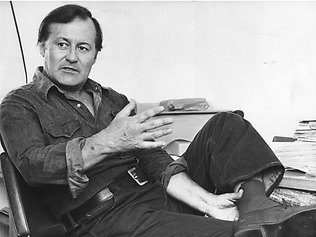
David Ireland was born in Lakemba in New South Wales in 1927.
Before taking up full-time writing in 1973 he undertook the classic writer's apprenticeship by working in a variety of jobs ranging from greenkeeper to an extended period in an oil refinery.
This latter job provided the inspiration for his second (and best-known) novel, The Unknown Industrial Prisoner, which brought him recognition in the early 1970s and which is still considered by many critics to be one of best and most original Australian novels of the period.
He is one of only four Australian writers to win the Miles Franklin Award more than twice
He was appointed a Member of the Order of Australia in the Queen's Birthday Honours of June 1981.
"My manner of thinking, so you say, cannot be approved. Do you suppose I care? A poor fool indeed is he who adopts a manner of thinking for others! My manner of thinking stems straight from my considered reflections; it holds from my existence, with the way I am made. It is not in my power to alter it; and were it, I’d not do so."
David Ireland has been one of my favourite authors for over 40 years. Having said that, I’m not sure I had even heard of his first novel, until I found (and immediately bought) this copy. It remains the only copy of it that I’ve ever seen, although it has been republished by Text Publishing. As the novel itself says (of something else), it’s “fairly splendid and a bit ordinary,” hence the four stars.
David Ireland won three Miles Franklin Awards relatively early in his career, all of which were after “The Chantic Bird”.
Although I loved his second novel, “The Unknown Industrial Prisoner”, I wasn’t aware of the dispute with respect to a film that was based on it. The film had gone into pre-production in 1978, before the Federal Minister for Home Affairs vetoed its funding by Film Australia and effectively killed the project. I subsequently met the producer, a delightful man called Dick Mason, and regret that, not knowing about this scandalous decision, I didn’t have an opportunity to discuss it with him before he died.
One of David Ireland’s novels was also removed from the NSW school syllabus because of its subject matter. For all of the talk on GR about the “burial” of books (i.e., the reluctance of independent publishers to publish a book for which even they anticipate difficulty finding an audience that will purchase it; are they supposed to publish a book at a financial loss and at the expense of their own staff's wages?), this is an author who has been actively suppressed by the governments and institutions of a supposedly liberal democratic first world nation.
Such is My Life
The protagonist of “The Chantic Bird” is nameless, if not unknown (I’m going to refer to him as Bubby, after “Bad Boy Bubby” of film fame). He is also the apparent narrator, although it seems that late in the novel, he ceased to describe the stories of his life to an intermediate author/biographer (Petersen) and assumed responsibility for his own life story, or at least the end of it. From a Post-Modern point of view, it’s possible that this change (while not abrupt or observable in tone) represents the death of the author, if not his or somebody else’s character. If anything, the character prevails, at least in his own story.
I’m not a fan of the concept of an “unreliable narrator”, partly because it is a term that is usually levelled at narrators with whom some of us readers disagree morally. Here, Bubby confides in us that he actually lied to his biographer, Petersen (who presumably wrote everything up to that point), though subsequently he tells us that this was in fact a lie. Petersen eventually tries to seduce, second and appropriate Bubby for his own purposes and pleasures. Who or what are we to believe? In the end, can we only believe in the voice of the novel? Even if it might have derived from two “authors”.
The best way to describe Bubby is as a “juvenile delinquent” (he remains 16 ¾ years of age throughout the novel, if he can be believed), although some of the novel’s publicity describes him as an anarchist. This places him within the scope of a political philosophy with which he might not sympathise, even if the author personally might (though I think of David Ireland as more left wing, a social democrat (e.g., the ALP) or even perhaps a socialist, if not an outright nihilist).
A Novel from Under the Floorboards and Above the Ceiling
Bubby lives in various spaces, many of them hidey-holes or gaps above or below where other people live or socialise (such as under the floorboards of theatres or cinemas, above the ceiling of his own home, or in a car on the street or in a cave in the bush).
This is "a tale told by nobody," full of sound and fury, signifying something. He is both nobody and accountable to nobody. Which makes him everybody.
"I thought of myself as lawless as a meteor, burning everything I touched."
The Unique Followed by the Uniform
Bubby lives in fear of men in uniform who he thinks are out to get him:
“The important thing is not to care what other people think, specially police and people in uniforms. Even if the uniform is only a white shirt and collar and tie...
"Why do they always want leaders? They must like punishment, and being kept in line. I can't stand people in charge and I don't like to be in charge.
"They can keep their gangs, I won't be regimented. There's no freedom doing what someone else decides.”
He would be paranoid, if it were not true. He certainly commits enough crime to deserve to be pursued by the authorities: he kills wild birds, domestic animals, neighbours, retailers and commuters; he steals cars, food and alcohol; he burns down fire stations; and he rapes older women and young girls:
“Perhaps there never had been anyone following me. I must have made it up or something inside me had made it up because it knew I wanted to think someone was after me. But there should have been someone following me, all the same. I had done enough for an army to be following me. In a way, I felt pretty cheated; it took from the excitement of the last few months.”
Transgression in the Post-Modern Context
Bubby's life is one of constant transgression, only not the self-conscious and self-righteous literary pretence of a William T Vollmann or a William H Gass. There is something working class, non-conformist, anti-authoritarian and anti-social in how he goes about things:
“I knew I was more than equal to most of the kids I ever knew, but there was no place for me. There was no actual function, no legal function that would fit me...Suppose it’s not very modern to hate teams and leaders, but that’s the way of it. Maybe that’s why I’m getting out of the crowds...
"I have got right away from going around with other kids and prefer to be a lone wolf...
“I’ve been pushed. Thinking there’s been someone following me, not knowing who it is. I reckon it’s me. Something inside me has to get away from the crowds into a place with more room to move, where you can’t see so many people at any one time. I can manage a few at a time.”
Initially, he seeks some comfort in his family (a younger brother, Stevo, and two younger sisters, Chris and Allie, and their cook, Bee), but as they grow up and question his authority, he decides he has to leave even them:
“I’m no good at working out other people. You need a different sort of brain for that. More sympathetic.”
“I decided to call it quits and look for something bigger. A town of my own, perhaps. I knew I could survive anywhere, all I needed now was to get some practice working through other people. I had to forget my habit of going alone all the time. I’d need a stooge or two…
“A town of my own. Stolen cars, tow trucks, farm protection agent, local council, a town of my own. While the rest were looking upwards for bombs, I’d collapse them from inside.”
As Thomas Pynchon would do many years after him, David Ireland seems to suggest that the biggest threat to capitalist society is from within, rather than from externally.
The Chantic Bird
The Chantic Bird ends up being a mispronunciation of "the Enchanted Bird" by Bubby's poetic little brother, Stevo. The bird is a plain grey bird, whose song sounds like "the tinkling of glass bells".
Bubby might be a grey bird, telling his story, but as he says, "It doesn't bore me, and this is my story...I'd like it to be skilful, brilliant and colourous." And it is, although often the colours are just black and white and grey. Still, how few workers get to tell their story as effectively as Bubby? How many are as imprisoned as him, but can still sing?
"The King really appreciated the beauty of the song; however, he knew nothing of the beauty of freedom, especially the freedom of a bird to sing in its natural home of green trees by the water. He gave the Bird a special cage and allowed it out twice a day, but a dozen hangers-on were there to see she did not fly away home. There was even a rope - a silken rope, but still a rope - tied to each leg when she flew out twice a day for exercise."
This book by David Ireland was certainly a remarkable debut. We are presented with a stream of conscience delivery about, ultimately, what a silly thing it is to live. Told through the eyes of a 16 and three quarter boy, Ireland has stated that the novel “is about freedom. The boy is an analogue of the writer as artist”. The boy seems to me to be an analogue of the themes covered in Irelands next two novel The Unknown Industrial Prisoner and The Flesheaters. The industrial captivity of the working man, violence as a tool of that industrial captivity and the edges of madness and depression that we all could fall into. Ireland is a very challenging author. He makes you, as the reader, uncomfortable. He attacks your comfortable life. He is an observer of those edges of life that most of us steer purposely away from. He has an ability to impart into our mind our fears of those on the periphery with prose that can be both harsh and gentle. We are challenged by violent brutality followed in no time at all by the description of temperate love.
Three Miles Franklin awards but Ireland is sadly not on the radar of the modern reader of Australian literature and I have to ask why.
The Chantic Bird is a remarkable first-person narrative set in a period of dramatic social change in Australia. The antihero is a young outsider struggling to make sense of the world around him and his place in it. Alienation, poverty, and discontent are the driving forces behind his violent tendencies. This book is often compared to A Clockwork Orange, and, as seen by my star rating of 3/5 for the latter title, I was much more impressed by David Ireland's work of fiction. The narrative style (and surprises), the setting, the events, and the conclusion make The Chantic Bird as enjoyable as it is disconcerting, and as darkly humorous as it is thought-provoking.
This is a pretty unpleasant read, by any means. I kept reading out of curiosity. Where is the author going? What is his intent in telling such a dark story. Does he simply want to tell the story of a teenager with mental illness, a sociopath without doubt? Whilst reading I was aware that the author is projecting a certain philosophy through his narrator, particularly attitudes relating to western culture. The narrator appears conflicted in that he is bonded quite strongly and willingly with his 'family' but rejects all other people with complete disdain. His 'perving' activity appears to arise as a result of a normal curiosity perverted by his isolation from normal behaviours, a lack of normal socialising with others. Somehow there's a very fine line between the narrator's inability to co-operate with others and the expectation projected by a culture that the self should be subsumed for the benefit of the many. I found the dialogue of the children quite strange, not at all childlike. The persistent, consistent, narcissistic self-talking and paranoia becomes quite intolerable the further into the book the reader delves, especially as there's no real plot to the novel-it's just him stating his memories of his behaviour. There's a missing narrative in this novel…how do others see him? We only view him from his own perspective.
I consider this as one of my favorite books but I read it so long ago (40 years ago?) that I don't remember it very well. It's hard to find, so I haven't been able to re-read it. When I was 13, my heroes were rebels, loners, people who felt outside. I'm different now, so would I still like the book?
‘One of the most remarkable novels—first, fifth or fifteenth—to appear on the scene for many a long day…Compassionate and pitiless, savage and sad, ironic and naive, horrifying and farcical.’ Sydney Morning Herald
‘Gloriously and savagely comic.’ Adelaide Advertiser
As a first-person, anarchist perspective, goes, this is an excellent book = 5 stars. It was compelling to read. However I found the violence (particularly to animals) and the joy/nonchalance in the violence, too much for my taste (and stomach), hence the 3 stars. I don’t like animals being hurt even in fantasy. ( I am a big fan of first-person eg “catcher in the rye”. A book similar to “chantric bird” is “Loaded” by Australian author, Christos Tsiolkas; with less rampant violence it was less uncomfortable; note: never comfortable. ) As a first novel, chantric bird is remarkable.