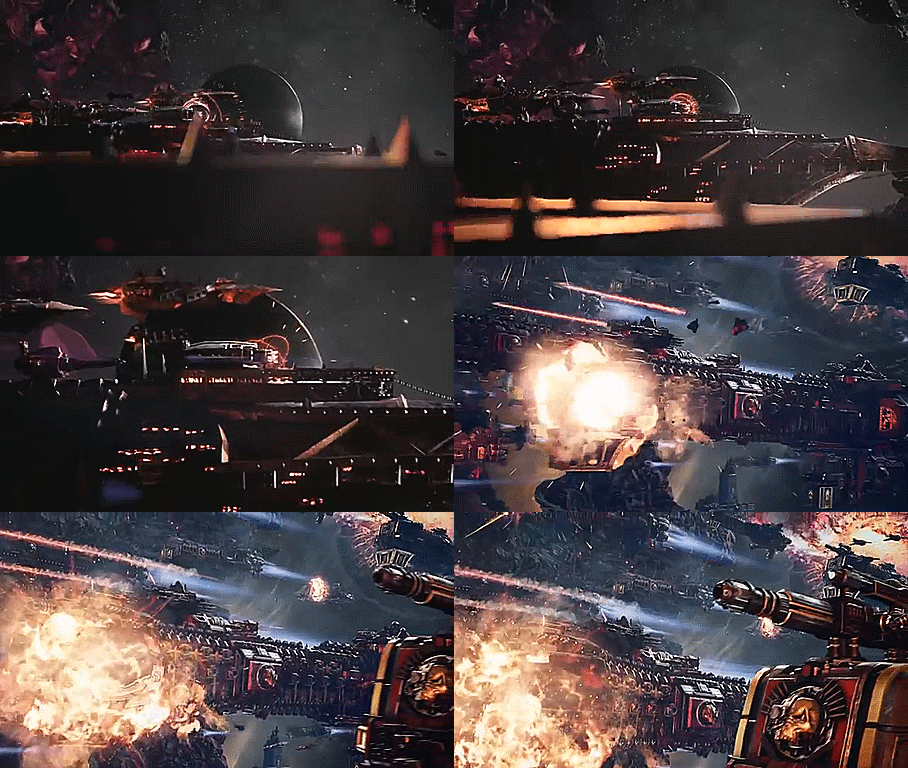
After years of devastating war, Horus and his forces have arrived at Terra. But before they can set foot on the Throneworld, they must first break the defences of the Sol System. Powerful fleets and cunning defences bar their path – but can anything hope to halt the advance of the Traitor armada?
READ IT BECAUSE The final act of the long-running, bestselling series starts here, with a brutal and uncompromising look at the first stage of the Siege of Terra, the war to conquer the solar system. Armies will fall, heroes will rise and legends will be written…
THE STORY After seven years of bitter war, the end has come at last for the conflict known infamously as the Horus Heresy. Terra now lies within the Warmaster’s sights, the Throneworld and the seat of his father’s rule. Horus’ desire is nothing less than the death of the Emperor of Mankind and the utter subjugation of the Imperium. He has become the ascendant vessel of Chaos, and amassed a terrible army with which to enact his will and vengeance. But the way to the Throne will be hard as the primarch Rogal Dorn, the Praetorian and protector of Terra, marshals the defences. First and foremost, Horus must challenge the might of the Sol System itself and the many fleets and bulwarks arrayed there. To gain even a foothold on Terran soil, he must first contend the Solar War. Thus the first stage of the greatest conflict in the history of all mankind begins.
John French is a writer and freelance game designer from Nottingham, England. His novels include the Ahriman series from Black Library, and The Lord of Nightmares trilogy for Fantasy Flight. The rest of his work can be seen scattered through a number of other books, including the New York Times bestselling anthology Age of Darkness. When he is not thinking of ways that dark and corrupting beings could destroy reality and space, John enjoys talking about why it would be a good idea... that and drinking good wine.
‘Will you serve me, Abaddon? Horus had asked, the coin held out in his open palm. ‘I will,’ he had replied, and taken the coin. ‘All ships,’ he said, hearing his voice echo as it reached across the void through the vox. ‘By my word, and the word of the Warmaster. The blade falls.’ One by one, the ships lit their engines and slid down towards the waiting sun.
After thirteen years since Dan Abnett's Horus Rising was released, and 54 novels, the longest and best science-fantasy saga ever is finally close to its end.
+I am aware of the factors involved,+ sent Ahriman. +Then you know that it is not possible.+ +I do,+ replied Ahriman. +Then why–+ +Because it matters.+ Ahriman straightened and looked up again at the image that he had pulled from the psy-resonance of one of the skulls lining the walls of the comet shrine. +In the end, everything is dust – but what we do before we become dust matters. What things were matters.+ +If you say so.+
First book of the Siege of Terra is a magnificent opening salvo of the greatest battle between Chaos and mankind, and I loved everything about it, from the breath-taking references to the above mentioned book that started it and to John French's Ahriman series (it was so good reading again about Ahzek, Ignis Menkaura, after reading and loving Ahriman: The Omnibus last summer), to the appearances and brutal deaths of characters part of the saga since its same start: Sigismund looking for redemption in the eyes of his Primarch and Mersadie Oliton's doom were almost painful to read and the remembrancer's death reminded me a lot Ripley's end in Alien³.
‘I am sorry,’ she said, before he could speak. ‘I am sorry, but I doubt anyone will ever know your story.’ She laughed. ‘Maybe for the best – it’s a good tale, but I have always thought that I would struggle to do it justice. Ignace would have been better. It would have looked fine in verse. The making and undoing of a dream by beings greater than men, but weaker than gods.’
And those interludes of the Emperor's reflection in the Warp, tired and lonely despot who took arms against the Chaos Gods, were a real nice touch and final one with Horus finally at his door was a chilling one.
Sigismund moved aside, bowing his head, waiting for his father to speak. The primarch did not look at him, and did not speak, but kept his eyes on the light of Terra.
My only complaint is about the spoilering of Samus'return in the Dramatis Personae, but his fights against Loken and Dorn were so superb ones that I can forgive it.
‘You still have some strength,’ says Horus and raises his ringed hand. Slowly, he reaches down into the fire and grips a glowing shard of wood. He lifts it, smoke fuming from where his skin chars. Horus holds the ember up, and the red fire glow lights his face. The heat in the fire fades, becomes cold black, then powdered ash. Horus looks at the Emperor for a long second and then stands, his presence stretching up into the bare branches and night sky. ‘But you are not strong enough. You never were.’
I'm almost sad the end being finally here, but at the same time I just can't wait to read the next upcoming novels of the Siege of Terra.
The Emperor looks back to the dead ash of the fire before Him. Then He closes His eyes, and the image of the forest and fire and the face of His false son flee away into the distance, and there is only the voice of Horus, cold and laughing as it echoes after. ‘Run,’ it calls. ‘Run, father, and know that I am coming. Run!’
Excelsior.
This entire review has been hidden because of spoilers.
The Solar War was superb. John French does a great job with describing the start of the infamous Solar campaign of the Heresy.
Horus has turned, the Loyalists have paid a bitter price on Istvaan and now the Traitors are moving towards Terra. A battle fought not only in reality but also in the Emperyean, this is the penultimate struggle for Terra. Chaos backed Horus and his corrupt Legions and Guard units are coming. Rogal Dorn, the Praetorian of Terra, is busy making sure the Imperial Fists are able to buttress the defenses. I will not spoil any of the major stories, as this is a book well worth your time to read.
For seven years Terra has been preparing for the coming of Horus. Some think that it might not happen, the vast majority of others see it only as a temporal conflict and only a handful know of the conflict that is occurring in the warp itself. The vast majority of the first part of the book is the conflict between the Imperial forces and the Traitor legions. It is only near the end of the story where we begin to see the unnatural aspects of Chaos begin to manifest. While this is still an atheist Imperium, the events of the past seven years have caused the Imperial Cult to flourish.
Many characters from the start of the Heresy series make an appearance from Mersadie Oliton to Euphrati Keeler, heck even good old "I am Samus" returns. I rather liked to see the daemon "Samus" from way back in the first book of this massive series when he takes possession of Sergeant Xavyer Jubal of the Luna Wolves (and friend to Grav Loken, now a Knight Errant). The final fight between Samus and Dorn is epic indeed.
I also liked the slow-motion dawning upon the Imperials that this is FAR more than a traitor. The Warp and knowledge of Chaos is little to none, even the Imperials have trouble grasping what is coming. I loved this illustrated version of the Siege of Terra book and I will most certainly grab the rest of this series as it comes out. Superb and a must-read for any 40K fan.
The enemy is at the gate. With the end of the long war across the galaxy and countless pyrrhic victories on both sides, Horus Lupercal now assaults the birthplace of humanity itself. With the full might of the Traitor Legions at his back, he throws everything he has into this effort, making one last roll of the dice to cripple the Imperium. Yet first, he must win the war in orbit to start besieging the ground.
The fortress which the Solar System has become buckles under the constant fighting, as enemy fleets stream into the surrounding space. Rogal Dorn and his forces meet them, move by move and fighting their bloody engagements at every turn. Yet Chaos rarely engages in a truly straightforward battle, and its key to victory lies with someone who was there at the start of this all. Someone who sits alone in a prison, silent and unheard...
The Good
There's one very good part to cite right off of the starting gate, and that relates to escalation. While this is something of a double-edged sword (and we will get into that) the book doesn't simply start big and stay big. It doesn't read like some overly huge event that you cannot keep track of, and some might have expected that. However, that likely would have been a mistake as you need to keep raising the stakes to keep things interesting. As such, the book shows the opening shots and has some very engaging fights at key points, but it's nothing which will dwarf (or seem on the same scale) as the Siege of Terra itself. After all, the last thing anyone wants with a fifteen-year series is for the finale to feel like a let-down. This at least leaves it room to build toward something far more epic.
Another definite point in its favour is how it handles certain characters and their dynamics. John French was someone who managed to juggle between the various traitor primarchs expertly in his previous book, and he handles the main players remarkably well here. This is evident with the opening, where Horus himself is in strong form and we get a very sinister echo of something from Horus Rising in his actions. Yet even without this, Khan and Dorn both manage to be given some very interesting character bits which sheds some further light upon their characters even in this new series, and how they understand one another. This builds somewhat toward confirming a link between the two primarchs that had seemingly been retconned out of existence, but it works well here. Remarkably, even when French finds an excuse to throw Ahriman into the mix very early on, he makes it work in that you can see him starting to head down the path we will see him take much later on.
There's also a major benefit in terms of Chaos itself, as the book does feel as if it is trying to dabble with greater things at many points. This relates largely to choice, fate and life-changing decisions more than anything else, along with how each can be so easily manipulated by greater powers. On its own it makes for a very well handled and fittingly thematic choice for this series, as this is ultimately the culmination of so many mistakes and fateful decisions. It even works somewhat better when you consider just who it focuses upon in these moments and how it deals with their psyche.
Interestingly, the story also keeps you guessing as to where it will go next and how things will pan out. We know what the ultimate fate of this conflict will be, as this is the Siege of Terra after all. You know that the enemy fleet will reach Terra and besiege it, so French works around this by weaving other stories into the narrative. This has a few problems we will be getting into on the next point, but it does help to sidestep the predictability which would otherwise be evident within the tale. By offering new narratives and individual chapters to assist with character development, you at least have something more to keep you hooked as the traitors fight their way to the Throneworld.
All of this would be usually great and make for an excellent book. However, that doesn't quite benefit this particular novel for the reasons we delve into below.
The Bad
This is going to sound like an odd criticism above all else, but I do not think that John French was the right person for this book. A follow-up book or second installment, certainly, but this one is somewhat incoherent because of his typical focuses. Really, think about any of French's novels for a moment and think about what makes them work: Small scale character action, individual moments of extreme violence or very broad depictions across single battlefields, the bizarre secrets and hidden details of Chaos, colourful character histories which unfold over time, and roving journeys which cover great distances. Some of this The Solar War was able to offer, but others are at odds with its overall intended role. It doesn't feel like a war so much of the time as a series of major deciding points which are typically set outside of the main conflict, or adjacent to it.
You'll notice very early on that the novel itself typically tries to find ways to skim over the broader details of the war in favour of smaller character moments. The fall of the outermost worlds is something we see little of from any firsthand perspectives, and it instead shows them first from a war room on Terra and then a group of fleeing refugees. These work as supplementary pieces very well, but it lacks the core of some more definite ship-to-ship fighting to keep things interesting. Even when it begins to pick up steam, the actual story keeps focusing on other areas. We learn more about a major Admiral commanding the defense, the dynamic of the primarchs and even one or two examples of skirmishing. However, the broader "war" in question is told almost entirely through statistics and labeled battlegroups. This could have worked even then, but it lacks the same punch or detail that people like Graham McNeill, Dan Abnett or to a lesser degree Andy Clarke would deliver on. As such, it is simply unfulfilling.
Another problem that the book suffers from is that there's little in the way of a real reintroduction to the story. With so many previous plots being brought to a close, characters killed off and sagas simplified toward the end of the Horus Heresy, it seemed as if this could be a sort of jumping on point for readers. It's a whole new series, and while there is some need to generally cover past events or incorporate ongoing character development, it could have started with something that was easy to follow or keep track of. Instead, much of the novel carries on as if it's just another Horus Heresy novel, and offers little in the way of recaps, introductions or proper explanations for a few major developments here. Several of these are clearly written with reader familiarity in mind, and that can be offputting. Even as someone who has been reading this series and keeping up to date with it, I kept feeling as if I was missing something when something was abruptly introduced to the story.
Finally, the overall event is remarkably inconclusive. It doesn't feel like a chapter in a larger event so much as something which just trails off. You can certainly see where it stands in the larger scheme of things, and how it will lead into later tales. However, unlike the books of the previous series, it doesn't feel like a small part of something greater which leaves you satisfied by the end. It's not even that it doesn't close out events for certain characters, but the way in which the book dabbles so heavily in broadly thematic concepts and intangible ideas makes you think "Wait, is that it?" by the end.
The Verdict
Overall, The Solar War is just okay at the end of the day. It's certainly not due to a lack of effort on John French's part, nor even a lack of ambition when it comes to its themes. However, it simply doesn't quite get across and fully connect its myriad of stories, themes and ideas. All too often it seems to want to avoid the more material elements of the naval conflict itself and focus much more on the immaterial machinations of the Warp and the advantages this offers the Traitor Legions, along with small character moments. The problem is that this never fully connects and it means that more than a few events end up feeling as if they are out of focus, or the story is being told through an oddly skewed vision.
Some people might well like this more, and I personally feel that how much you enjoy French's writings will heavily influence your enjoyment. As such I encourage you to read a few more reviews before making your mind up and buying this one. However, even as someone who liked this author's previous works, this one just didn't feel nearly so engaging as his other sagas. As a result, I ended up liking its themes and ideas much more than the actual novel itself.
Good to a point but ultimatly flawed. There are some great charecter momments and some of the charecter building such as Ahriman and Abbadon are a hightlight of the book. In fact, I would say that one of the few places this novel truly sucseeds is the little momments. Conversation between The Emperor and Malcador, Abbadon's back story, Ahrimans doubts and repulsion toward the Word Bears, Jaghatai Khan and the White Scars charecters, all great! Additionally the naval warfare aspects - while not as focused on as I perhapse would have liked -were well done.
Thats where the praise ends sadly. French clearly struggles with large scale events and places where too much emphesis on events that are inconsiquential. Rogal Dorn had all the mysqiue, charisma and awesome factor of a brick. This novel is a love letter to the Imperial Fists to the point where the White Scars mentions feel shoe horned in and the Blood Angels invoilvments come across as an afterthought.
Some of the hand to hand fights were sound but some were so bogged down in detail that rather than achiving a vivid picture it instead made certains scenes flow like a river of bricks. French also has an entier side plot dedicated to Mersadie Oliton, a charecter who relevants of the plot ended maaany books ago. French could not have included her at all in this book and it would have made 0 difference to the narrative. Loken's behaviour during Oliton's story was also strange, behaviing in a way that made him appear like a shadow of his usual self, very strange.
Sadly, as with a number of other Black Library titles this novel is starting to go down the PC rout. I wont go into detail but I felt like the writter was trying to force the way you picture scenes rather than allowing you to picture them yourself. It's fairly insulting to your intelligence as a reader.
One of the more disapoint entries in the series but hopefully this is simply a speed bump
The Siege of Terra – the final chapter of the Horus Heresy – begins with John French’s The Solar War, which tells the story of the colossal void war that forms the opening stage of the Siege. To the backdrop of the largest void battles imaginable it weaves together a compelling, character-led tale of duty, honour, determination and even hope. While Mersadie Oliton desperately searches for a way back to Terra and Sigismund seeks out atonement in battle, Abaddon cleaves to the path laid out for him by Horus and even Ahriman diligently plays his part. As the war rages on multiple fronts, these and many other individual stories play out with the fate of Terra and the Imperium in the balance.
Even by Heresy standards the incredible cost of the war – both physically and psychologically – is really emphasised, and the mixture of wide-angle bombast and small-scale introspection does a great job of covering things from both perspectives. There are flashes of hope, however, even if they’re inevitably coloured by foreshadowing for the end of the Siege and the future of characters on both sides (including some neat links to a couple of 40k series). Crucially, despite its complexity this is as gripping and entertaining a book as you could want, perfectly balancing the need for a great story in its own right with the requirement to carefully connect back to previous stories and satisfy fans who’ve followed the Heresy every step of the way.
May 2024 Read using the Horus Heresy Omnibus Project Reading Order Omnibus XXI The Siege of Terra (https://www.heresyomnibus.com/omnibus...) as part of my Oath of Moment to complete the Horus Heresy series and extras.
We are finally here! The final omnibus; The Siege of Terra; The End and the Death. Heresy...Horus Heresy is the book beside you...
Honestly, I never thought I would get further than when I was actually present and up to date prior to the release of Vulkan Lives, so my previous record was Scorched Earth, back when I actually cared about limited editions, but we are in the end game!
I have gone back and forth on how to rate this because I am learning I have a very high bar for 2-4 and then a very low bar for 5. This is definitely influenced by supporting indie TTRPG creators who are hugely impacted by any loss of stars, as I am with any kind of service review. Do the Audible customer service actually recommend titles 9 out of 10 times? Absolutely not, but you best believe I always say they do. Frankly, you would have to go out of your way to be awful for me to not give an employee full marks, but I digress. The point is I am big on the 5s and more on 1s and 2s than I would like, but 3 is the broadest number and it perplexes me and most things I would give a 4 charm me in a way that make me want to give them 5. I also try to factor in context, which is why I give out fulls marks like candy to Black Library Advent Calendar shorts that excel and make the constraints work.
All of the above to say, applying numbers to art is ridiculous, but unfortunately necessary, and I have settled in a big, high 4/5 for this, but it's French, so their are rich veins of full marks all through this like Brighton rock. This was a phenomenal work in an impossible situation and I thoroughly enjoyed it, but it did take me a little while to really get my hooks in, it essentially has no choice about being a bit all over the place and a touch messy, and there was one element I actively disliked, though I do wonder how much, if any, choice in its inclusion French had.
Apologies if this review is even more all over the place the place than usual. I got, like, two hours sleep, being woken up at 4am with my chronic pain, and everything is a little surreal right now.
OK.
Following the Warmaster forces of Traitors Extremis' muster on Ullanor in French's glorious Slaves to Darkness, and Malcador, his Agents and Knights Errant, and Mortarion and Typhon/us setting the board and tying up loose ends in The Buried Dagger, the Siege of Terra Series begins with The Solar War!
There are a lot of threads and perspectives, so this will be an extremely vague overview. Abaddon leads the Speatip into the heart of the Sol System, while reminiscing about his former life as a Cthonian Ganger and wrestling with his bizarre and antagonistic relationship with the theology that drives his genesire's Crusade. Sigismund is still grappling with Dorn's truly brutal rejection and admonishment of him, after his confession that his faith and the words of Euphrati Keeler on the Eisenstein lead him to disobey the order to lead the Vengeance Fleet in The Crimson Fist. He is wracked by doubts and consumed with giving his life in defence of his Legion and the Throne, which is put to the test in round one of the -Mund Bowl with Little Horus--the first real significant character match up you could recreate with Forge World models of the Siege. Malcador display his utter ruthlessness, and he, Dorn, and co do everything they can to respond to the initial threats. [Cerberus] has a number of reunion (this is something I'll talk more about with spoilers later). The Emperor remains in the Throne and the Warp since the events of The Master of Mankind, but we get some very different and fascinating imagery and interactions between him and the Sigillite. We see some of the first significant and truly inspired collaborations of tactics, perspective, and responsibilies from the Traitors. The whole situation seems to be going one way and the drastically neeeds to be recalibrated.
There's obviously a lot more, but that's some of the main areas of focus of the novel. It is definitely hectic and a lot, but it also looks a lot more than it is when written out like that.
As always, French's prose and unique perspective (I found a synonym for different, finally) are absolutely glorious, and there are some passages that are absolutely magnificent. The weight of responsibility and the evident laundry list of things he had to include and set up are beyond my capability to even properly consider. I truly can't imagine having to work under those constraints, let alone making something as good as this. Horus Rising was a colossal responsibility for Abnett and Thunder Warriors and Eagle Lightning in a bottle, but beginging at the beginning with the relative narrative freedom and beginging the end are two very different things. Although, I can't imagine the pressure that was on Abnett for the End and the Death.
Something that genuinely made me chuckle, especially after being left so thoroughly disappointed and frustrated by Cthonia's Reckoning and Lupus Daemonis, is that, once again, French seems to be the only author capable of writing about Cthonia in a way that makes it tangible and have any potential for meaningful interactions as his words paint the subterranean ganger purgatory in shades of grey with motes of light and the capacity for human connection amongst the extremely bleak grimdark blackness. Not to sound the neckbeard wargamer battle cry, but a lot of other creators sure do need to thin their paints and turn off the Rolling Stones for a moment--I see a plantet and I want to paint it back. No humanity for anyone, each ganger is so baaaad...
Honestly, if this is a backdoor pilot for French doing the Abaddon Characters novel, or, like, finishing ADB's seemingly " ABAnDDONed Black Legion series, of gaming on the final Primarch's novel with Horus, I am here for it! There was genuinely a part of me in the opening third of the book that would have much preferred reading more about Abaddon and his experiences of Cthonia. Me, the gal, who rants about how awesome Cthonia seems, but how badly it is almost always portrayed, would chomp at the bit for something like the brilliant Sigismund: The Eternal Crusader for the First Captain.
My brain is fried and I don't really know what else to say.
Very good, not perfect, but still seriously impressive and masterful considering everything book is very good, not perfect, but still seriously impressive and masterful considering everything.
***SIGNIFICANT SPOILERs***
OK. I made no bones about just how much I hated the 'I want out, but please leave me in super nightmare prison' aspect of Mersadie Olitan's return in, I think, Vengeful Spirit (and fling the vast majority of that novel crushingly disappointing and decidedly un-McNeill, except the worst way), and, while I enjoyed her journey in this and the repeating flashback and mental degradation, I have a couple of points of confusion and resignation. The first and least important because it really doesn't matter exactly how this works or doesn't work because the narrative and weight it lead to far outweigh something not necessarily adding up and/ or fitting being--admittedly, we only have Loken's perspective, but it seems thoroughly unlikely that Malaghurst would have had the power and foresight to do whatever he did to her to make her a Trojan Host Tether thing. Like, maybe if Keeler's picts of Jubal had a significant effect on her, but if I remember correctly Mersadie specifically doesn't show up to go down to the Whisper Heads in Horus Rising, and the Remembrancer squad escape as Isstvan III happens, and Horus really doesn't seem to be embracing the Chaos until his Apotheosis in Vengeful Spirit and whenever Malaghurst creates the Luperci, so Mal being that much of a socercer already is unlikely. Also, my brain is fried and I can't quite remember exactly when Calth happens, but it's no earlier than around the same time as Isstvan V or later, right? So, the only real Sammus connection was Jubal. But the Lodges, Erebus, and who cares, nerd!?
More significant though is just how weak and frustrating Mersadie's ultimate storyline is. She helped to protect and escaped with the execution of the Remembrancers with Keeler and Sindermann, only to be locked up for, I think it said 7, but it feels like it should been longer. Qruze kept the information from Loken, admittedly on Dorn's orders, but that fedlsess weighty when we see just how much of a golden bootlicking toadie he becomes, whole off with the Primarch. Loken offers to get her out and is shown to be more upset than her at her imprisonment and she gives infuriatingly vague platitudes of about wanting to stay in nightmare prison because there's no place for her now, which is all sorts of fucked up. I also think it's very unfortunate, but I ascribe colossal white British dude privilege brain and privilege ignorance, rather than malice, to the fact that this whole bullshit prison storyline happens to one of the only significant characters explicitly depicted as a Black woman in the series... So, anyways, all of that sucks, but isn't this book, but it is relevant.
In this book she escapes the emergency purging protocol of all the prisoners in the Imperium's nightmare prisons if there's the slightest chance one might escape... She goes on a big journey with Traitors seeming desperate to kill her and her believing she has a message for Dorn from the Saint that she desperately needs to deliver to him. She's a girl, so she has to have the surrogate mother arc to her journey in what is practically a beat repeat of the frustratingly rote trope and narrative of the new, seemingly incredibly important and no doubly popping up in this series Perpetual from Vengeful Spirit, Wolf Mother, etc. She goes through everything, reunites with Loken, and goes full Sammus, which, I don't hate the Sammus storyline and the a wizard did it and that wizard was called Malaghurst conceit and the the Trojan Daemon Host thing, even if it does seem a bit janky. What I do find unbelievably frustrating, and, frankly, did have a significant impact on me acknowledging that as good as this book is, I don't feel like a K2can honestly give it five stars today, was the frustratingly quick resolution once everything was out in the open and the cheap Alien 3 reenactment that gave me a few pangs of feelings, but was far less than Mersadie Oliton deserved. Even if that was how it had to end, I wanted to feel more and she deserved more.
I really can't get past the feeling that this wasn't planned and she was going to maybe be around with Keeler again at some point, but she's also been totally absent except for that one Garro novella. This feels like a convenient way to get rid of her, but making her a part of the plot and having a final moment with Loken. But it feels cheap and rushed and forced. If this wasn't all French, then he at least does a decent job of her journey on the way, but repeating the surrogate mother beats and not sticking the weight of her death landing are definitely on French.
I really did enjoy the book otherwise, but that did take the jam out of my otherwise pretty great doughnut.
Through the Horus Heresy Omnibus Project and my own additions, I have currently read* all 54 Horus Heresy main series novels (+1 repeat), 25 novellas (+2 repeats), Cthonia's Reckoning, as well as the Macragge's Honour graphic novel, all 17 Primarchs novels 3 Primarchs antholologies, 3 Characters novels, 1 Siege of Terra Novel, and 182 short stories/ audio dramas across the Horus Heresy (inc. 11+ repeats). Plus, 2 Warhammer 40K further reading novels and 1 short story...this run, as well as writing 1 short story myself.
I couldn't be more appreciative of the phenomenal work of the Horus Heresy Omnibus Project, which has made this ridiculous endeavour all the better and has inspired me to create and collate a collection of Horus Heresy and Warhammer 40,000 documents and checklists (http://tiny.cc/im00yz). There are now too many items to list here, but there is a contents and explainer document here (http://tiny.cc/nj00yz), as well as some thematic Dark Epochs Generators.
*My tracking consistently proves shoddy, but I'm doing my best.
The Solar War was always going to be a difficult story to execute well. There is so much anticipation and so many technical challenges with this story.
It is the first book in the final act of the Horus Heresy Saga, so it has to really set the scene. It is also the beginning of the largest battle of the entire Horus Heresy, so it had to be big on so many levels and I could easily have imagined a story about something so vast easily getting confusing and becoming unfocussed especially with so many story threads coming back together.
I am so happy to say that this certainly wàs not the case. This book was truely remarkable. John manages to present the vastness and devestation of the conflict taking place across the solar system while at the same time maintaining a tight knit story focus on the important parts of it that really matter in this opening engagement.
There is plenty of action, as you would expect. There are some huge set pieces and amazing moments that really do make tou say 'wow did he just?' Yeah he did. It isn't just all about the action though, there as also some excellent character work and some in depth looks at some well established characters from the lore.
The story is fast paced and wastes no time getting into it. There are plenty of suprises and some excellent and intriguing ground work laid here for the future novels. Though it is the first in an 8 part story arc and obviously ends on a bit of a cliff hanger, it is also very much it's own story.
As we have come to expect from John he is exceptionally good at the symbology of the more incorporeal sides of the 40k universe and it was good to see some of this on show also.
A pleasant surprise of a book. I hadnt read any John French before and wasnt sure what to expect. I am always dubious of different authors handling the same characters, as sometimes it feels stilted and odd, but this is a good novel, action filled and fast-paced. There are good characters and genuine effort put into their development and stories, and all the threads come together in a satisfying manner. The plot can feel a tad messy and samey as it is all 'action on spaceships' but thats only a small criticism really, as generally i felt the book captures the necessary scope and gravitas of its setting.
Excellent. John French is one of the best of the Black Library authors, and this is a worthy beginning to the Siege of Terra series. The Horus Heresy series had, quite frankly, gone on for far too long, and lost much of its initial focus and momentum, so hopefully the Siege rectifies that and brings the story back to a centered position. The Solar War is a great, epic scale, war story in a sci-fi setting, with a heavy dose of dark fantasy in the last third. You will definitely need to have read at least the main plot point novels of the Heresy to understand what's going on, here, however. And I think that's the flaw of the entire, overly long, story. I can't see too many rereading the entire Heresy, and Siege series'. That said, there were some great tales that came before, to name a few: Horus Rising, Flight of the Eisenstien, Fulgrim, Prospero Burns, Betrayer, Scars, The Path of Heaven, Wolfsbane, The Buried Dagger. So it might be worth it to read just the main novels. Focusing on a seemingly long lost character, there at the beginning, and bringing her back to her beginning was a brilliant story telling device that highlights that, for media tie in fiction, and pulp, Warhammer fiction is much better, at times, than it's given credit for. Highly recommended.
Good start to the siege of terra. I felt the first half or so was a little slow but still interesting enough, I was back and forth between 3 and 4 star but am confident on a 4 star rating. Was fantastic to have some early returning charecters in this one. There was a lot of throw backs to stuff that happen in horus rising, very first book of the heresy which was cool to read. Got a bit of rogal dorn action in this one for any rogal fans out there.
It was cool to come back to a familiar universe, but the constant perspective shifts really threw me off. I thought the remembrancer's story was probably the best arc, but I tend to prefer the grubby human stuff anyway. It'll probably be a bit before I move on to the next one.
And they're off and running! John French is an amazing writer, and his prose, particularly when he is writing scenes with the Emperor, are evocative and lyrical. He has a firm grasp of the mythological roots of the Horus Heresy story. Since this is his last contribution to the Heresy, he concludes with a very personal afterword in which he describes how and why he wrote it the way he did. This has reminded me I need to finish his Ahriman novels.
Slight slow start and once it got going it was great , I still think Preatorian of Dorn was better but a solid start to the new mini series and some touching moments when we revisit characters we haven't seen for a while
A very good start for a new series. This book is fast paced, entertaining and engaging. I appreciated how the writer developed the plots, being able to manage the complexity without any plot hole, the well developed characters and the world building. It's the first book I read by this author and won't be the last. Highly recommended! Many thanks to the publisher and Netgalley for this ARC, all opinions are mine.
Book Review: The Solar War by John French The Siege of Terra Book One (From the perspective of a newcomer to the Warhammer universe)
Rating: 4.5/5 Stars
As someone still finding their bearings in the vast, gothic expanse of the Warhammer 40,000 universe, diving into The Solar War by John French was both exhilarating and, at times, overwhelming—but in the best possible way. As the first novel in the Siege of Terra series, and a direct continuation of the sprawling Horus Heresy saga, The Solar War feels like walking into the final act of a galactic tragedy centuries in the making. And yet, surprisingly, even with only a basic understanding of the universe and having read only a few prior entries (notably Horus Rising and Know No Fear), I found myself gripped, awed, and emotionally invested by the sheer scale and atmosphere of what French achieves here.
A Prelude to the End of Everything
The Siege of Terra is the capstone to decades’ worth of lore that Warhammer 40K fans have consumed and obsessed over for years. It’s the climax of the Horus Heresy—a betrayal so profound that it reshaped the galaxy and forever defined the grim darkness of the far future. In The Solar War, Horus, the traitorous Warmaster and once-beloved son of the Emperor of Mankind, has finally arrived at the gates of Terra itself. After years of brutal warfare and cosmic treachery, his forces have crossed the stars and now seek to break the final bastion of the Imperium.
What this means in practice is that John French is tasked with beginning a slow, methodical unraveling of the Imperium’s defenses—and he does so with chilling elegance. The book is not a bombastic, explosion-filled opener, but a brooding, ominous escalation of tension and dread. Think of it like the opening moves in a galactic chess match: the enemy has entered the board, and the players begin maneuvering.
A Universe of Perspective
What makes The Solar War so approachable—even for someone relatively new—is the structure French employs. Rather than drowning readers in monolithic exposition, he guides us through multiple characters and viewpoints across both sides of the conflict. Some of these characters are major figures (like Rogal Dorn, primarch of the Imperial Fists), while others are more grounded—fleet commanders, mortal agents, or even those on the periphery of the action.
This mosaic-style storytelling is what kept me engaged. You don’t need to know every planet or every past betrayal to feel the weight of what’s happening. You feel it in the way characters talk about the coming storm. You feel it in the contrast between the calculated, chilling demeanor of the Traitor forces and the desperate, righteous defiance of the defenders. And you feel it most in the way French writes space warfare—not just as action, but as psychological collapse. Space becomes suffocating. The void is not just a backdrop, but a character in itself, pressing in on all sides.
A Style Suited to the Epic
John French’s prose can be dense, sometimes bordering on poetic, but for the setting, it works. The Warhammer universe thrives on grim grandeur. Cities span continents, ships blot out stars, and every character seems to carry the burden of a thousand years of warfare. French leans into that with rich, philosophical passages and meditations on duty, sacrifice, and inevitability. There were moments where I had to re-read passages to grasp their full implications, but instead of feeling lost, I felt more immersed—like peeling back the layers of a deeply alien, deeply human world.
This does mean, however, that those who prefer straightforward action may find certain parts slow. This is not a Michael Bay blockbuster in space. The battles, while breathtaking, are often more about attrition and maneuvering than climactic clashes. And yet when action comes, it’s thunderous. Whether it’s space marines descending into battle like gods of war, or traitor fleets performing warp-jumps into fortified bastions, the imagery is staggering.
Themes of Doom, Loyalty, and Faith
What surprised me most was how philosophical The Solar War often is. At its heart, this is a story about fate versus free will. The Imperium believes it can hold the line—can prevent the galaxy from falling into darkness. And yet, there’s this constant undercurrent that all their efforts may be futile. Characters debate whether they fight for something real, or just for the illusion of hope.
Rogal Dorn, in particular, stood out. As the architect of Terra’s defenses, he’s a fascinating mix of cold logic and desperate resolve. His interactions with Malcador the Sigillite and other figures of the Imperium feel like something out of Oppenheimer—men who understand the scale of destruction they face, but still build the bomb anyway.
On the other side, Horus barely appears, but his influence is everywhere. His lieutenants—especially Maloghurst, the twisted advisor—are haunted figures, equal parts brilliant and broken. The traitor forces don’t come across as mustache-twirling villains, but as zealots, pragmatists, and lost souls who have become the instruments of ruin.
Accessibility for New Readers
Make no mistake: this book is not a casual introduction to the Warhammer 40K universe. It assumes a degree of familiarity with major players, factions, and events. And yet, I’d argue it can be a starting point—provided you’re comfortable being thrown into the deep end. If you’ve read even just a few of the early Horus Heresy books, or done some background reading (even through wikis or YouTube lore videos), you can find your footing. French provides enough context through dialogue and internal monologues that you begin to piece together the grand mosaic.
And there’s something truly powerful about being a newcomer and seeing Terra—the shining jewel of humanity—under threat. It allows you to empathize with the billions of innocents who live in ignorance of the horrors approaching. In that sense, the reader shares their perspective: the awe, the terror, and the creeping realization that the future is not guaranteed.
Final Thoughts
The Solar War is not a loud book—it’s a heavy one. It’s an atmosphere of dread before the storm. It’s the tightening of a galactic noose. For long-time Warhammer fans, it’s a rich and emotionally resonant payoff for years of build-up. For newer readers like myself, it’s a harrowing yet fascinating entry point into the apocalyptic scale and tragic grandeur of this universe.
If you’re new to Warhammer 40K and wondering whether you can dive in here—the answer is yes, if you’re willing to be patient, attentive, and open to awe. John French doesn’t write for ease; he writes for impact. And The Solar War leaves one.
By the final page, I wasn’t just reading about the Siege of Terra. I felt it. The crushing inevitability. The doomed courage. The endless war.
At stages I just wanted this to end or get to the point, but this is an important new chapter for 40K so it needed to be what it is. Lots and lots of things to proccess in here...
So much plot armour. No one of any importance dies. Just tonnes of boring, generic bolter and orbital lasers porn. John French is no particular talent in general.
This entire review has been hidden because of spoilers.
Overall I think this was a good start to the Siege of Terra series, it's divided between the naval action from the outer part of the Sol system and descriptions of the battles and progression of the engagement with an insider perspective of the high command and some human characters doing stuff that ties in towards the backend of the book, the battles were well described and gave a sense of the grinding advanced of traitor forces against a dogged defence primarily of Imperial Fist, the human storyline still had plenty of action but also grounded the conflict in a more emotional and sympathetic perspective and dealt with things like repercussions on the population and matters of Warp nonsense, this worked well it not only broke up the action but the tie in works well, especially since the book in some ways reflects the opening of The Horus Heresy in Horus Rising not only with recurring characters but the remembrancer drawing back to those moments specifically it's sort of a the beginning and end thing, but also gives an idea of the planning and maliciousness of the Chaos God's during the Heresy, I really like the finale scene as well, my major issues are the scale seems a little silly, I know Warhammer isn't great with number but 250 ships being destroyed after a moon explodes just doesn't scream massive universal scale conflict, even with the ships being ridiculously big this is supposed to be the biggest engagement in recent history in the entire universe, also I felt like while the battles had good descriptions they could have fleshed out more specific details of the conflict, like more strategy, logistics and battle plans, this probably would have dragged the book out a bit longer but I would be interested in hearing it nonetheless.
Having read the start of the Horus Heresy, but not all or even all the key books, the Siege of Terra brings me seamlessly into the narrative. It’s the official beginning of the end. Friends and enemies colliding in the space of the solar system. Indeed this book would be aided by knowing more of the scope and movement of the Horus Heresy, but I found it an incredible place to jump back in. It was good to see some names I knew and easy to track those I didn’t.
This book flows and moves well; John French was an excellent choice to jumpstart the Siege of Terra. I am not a multiple perspectives person, but he excels here. I am excited to pick up the next in this series and wanting to go back and flesh out my Horus Heresy bookshelf!
So here we are: the beginning of the end so to speak. It is both with a feeling of anticipation as well as sadness that I’m starting my journey on the road to the end of the Horus Heresy.
The Solar War is the opening novel of the Siege of Terra saga that will bring the Horus Heresy to a close. And if this novel is anything to go by for what’s coming up, it’s definitely a great start. This book was chock full of some outstanding, and at times even goosebump inducing moments. Throughout the entire novel I felt a sense of hopelessness and terror that humanity truly stand on the edge of falling into darkness forever. And this is just the beginning. I can’t wait to get started on the next one. This really was a very satisfying read, and a great start to the end….if that makes any sense ;)
The Black Library authors finally figured out how to tell a story strewn across the universe from multiple perspectives and not make the reader's head spin.
Siege of Terra starts the 2 part Solar War with the beginning of the invasion of Terra by Horus's traitor forces. We see the interplay between the traitor legions, the pull of Chaos and how Holy Terra, the loyal Primarchs (those accounted for) and the standard Terran humans will react.
This book flawlessly jumps back and forth without losing the reader and builds to an absolute crescendo at the end.
A wonderful read and FINALLY a multi-perspective book well done.
Un comienzo de lo más decepcionante, presagio de lo que vendrá después. Creo que mi problema es que no entiendo a John French. Ninguno de sus libros me ha gustado. No sé si es cómo construye personajes, cómo atasca la historia, o cómo describe sin generar interés, pero eso es justamente lo que ofrece The solar war: una historia mal trazada, llena de personajes que importan muy poco, escenas de batallas navales fatalmente descritas y poca emoción en general.
Recuerdo que me costó mucho acabar el libro, pero que continué por la supuesta relevancia de esta saga en el imaginario de Warhammer 30 y 40k. No debí haberlo hecho.
Incredible... I honestly cannot contain the joy i had reading.
I never really have been a fan of the Imperial Fists, but they are truly the Praetorians of the Imperium. Sigismund is an absolute Beast. Unfortunately I am sad at the White Scars in this, specifically, Jubal... aside from that I loved it. Loken is the man.
A grand start to the Siege of Terra. In this book you return to follow some household characters in the Horus Heresy, such as Sigismund, Abaddon, Loken, and Mersadie Olton, the remembrancer from the first books of the HH series.
The battle for the solar system is quite epic, the strategies in both sides are thrilling, and as the battle unfolds i coudnt keep myself from reading more and more. The Imperial Fists particularly are, on the loyalist side, the main protagonists, and they do not disappoint, specially Sigismund and Rogal Dorn. The void battle in this book rivals anything before, or after, and John French makes justice to it.
I used to think that the HH Black Library books could only reach a certain low standard and simply provide some decent entertainment reading about favorite characters from the rich fluff that surrounds Warhammer.
The Solar War breaks the mold and raises the bar considerably. It is the first book that reads like a decent military SF novel and has solid tempo throughout, with several surpises and reversals.
Highly recommended, even if you have skipped the majority of the previous 54(!) books :)