Jump to ratings and reviews
Rate this book

Nelson: A New Biography

Rate this book
How did Horatio Nelson achieve such extraordinary success? In this authoritative biography, the eminent scholar Roger Knight places him firmly in the context of the Royal Navy of the time. Nelson was passionate and relentless from the outset of his career; his charisma and his coolness in battle are legendary. But his success depended also on the strength of intelligence available to him, the quality of the ships he commanded, the potency of his guns, and the skill of his seamen. Based on a vast array of new sources, this biography demolishes many of the myths that have for two centuries surrounded Nelson. Knight demonstrates that this great Romantic hero was in his time a shrewd political operator and often a difficult subordinate. He was occasionally naive, often impatient, and only happy when completely in command. Readers will emerge from this biography with a greatly enriched understanding of this singular man-one who was brilliant, severely flawed, and never to be crossed. Errata pp. 638 - 665: http://www.perseusbookspromos.com/doc...

873 pages, Hardcover

First published January 1, 2005

Loading...
Loading...

About the author

R.J.B. Knight

7 books10 followers
Roger John Beckett Knight is one of the leading scholars in the field of 18th century and Napoleonic era British naval history. A former Deputy Director of the National Maritime Museum at Greenwich, he is a Fellow of the Royal Historical Society and has served as a member of the council of both the Society for Nautical Research and the Navy Records Society.

Ratings & Reviews

What do you think?
Rate this book

Friends & Following

Create a free account to discover what your friends think of this book!

Community Reviews

5 stars
151 (40%)
4 stars
162 (43%)
3 stars
51 (13%)
2 stars
6 (1%)
1 star
3 (<1%)
Displaying 1 - 30 of 47 reviews
Profile Image for E. G..
1,184 reviews802 followers
April 12, 2018
List of Illustrations
List of Charts and Text Illustrations
Note on the Text
Acknowledgements
Introduction
Prologue


--The Pursuit of Victory: The Life and Achievement of Horatio Nelson

Chronology of Nelson's Life
General Chronology: Naval, Military and Political Events
Nelson's Ships: Size, Armament, Complements and a Full Listing of Officers
Biographical Sketches
Glossary
Text and Illustration Permissions
Index
Profile Image for Anthony.
421 reviews191 followers
February 8, 2026
England’s Hero

Roger Knight’s The Pursuit of Victory offers a measured, authoritative reassessment of Britain’s most famous naval hero, stripping away layers of patriotic myth while preserving the extraordinary scale of Admiral Viscount Horatio Nelson’s achievement. Rather than presenting a romanticised portrait of genius and glory, Knight situates Nelson firmly within the professional, political, and cultural world of the late eighteenth and early nineteenth century Royal Navy.

Knight is solid when it comes to naval history and as such he excels at explaining how Nelson operated within (and occasionally against) the structures of naval command, patronage, and discipline. Nelson’s tactical brilliance is carefully analysed, not as instinctive heroics, but as the result of experience, preparation, and a deep understanding of naval warfare. At the Nile, Knight shows how Nelson’s willingness to challenge orthodox assumptions, particularly his decision to attack immediately and exploit the anchorage’s weaknesses, produced a decisive and transformative victory. At Trafalgar, Nelson’s famous plan to break the line is presented not as reckless bravado but as a calculated response to British strengths in gunnery, leadership, and morale, executed with clarity and confidence. He knew the superiority of the British ships against the French and Spanish and that was the best way to exploit the advantage.

Knight also emphasises Nelson’s exceptional strategic judgement when given time and autonomy. His prolonged pursuit of the French fleet across the Atlantic, including the controversial decision to search for it near Jamaica, is defended as a rational and imaginative assessment of French intentions rather than a blunder. Knight argues that Nelson’s ability to anticipate enemy objectives, rather than simply react to sightings, marked him out from his contemporaries. In these moments, Nelson’s genius lay less in improvisation than in patient, reflective decision-making grounded in experience.

At the same time, The Pursuit of Victory challenges the assumption that Nelson’s rise was inevitable. He argues that Nelson’s success depended heavily on timing, suggesting that had he been born even a decade later, he might never have reached high command. Nelson benefited from being absent from Britain during periods of intense political division, avoiding the need to declare allegiance on contentious issues that damaged other officers’ careers. Moreover, as a member of the professional middle class rather than the aristocracy, Nelson rose at a moment before the Royal Navy became increasingly dominated by elite social connections. In a more overtly aristocratic service, Knight implies, Nelson’s promotion would likely have stalled. Yet this emphasis on circumstance does not diminish Nelson’s abilities; rather, it reinforces Knight’s central argument that exceptional talent required the right historical conditions to flourish.

Knight is equally attentive to Nelson’s flaws and misjudgements. The disastrous attack on Santa Cruz de Tenerife, which resulted in defeat and the loss of Nelson’s arm, is treated as a serious failure of planning and command rather than a heroic mishap. Knight also criticises Nelson’s handling of Prince William Henry, where personal sensitivity and insecurity undermined professional relations. Most troubling is Nelson’s conduct in Naples, where his uncompromising treatment of rebels and involvement in harsh reprisals exposed the darker side of his absolutism, emotionalism, and moral certainty. These episodes complicate Nelson’s reputation, revealing a commander whose judgement could falter when driven by pride, loyalty, or moral rigidity.

The Pursuit of Victory also emphasises Nelson’s exceptional strategic judgement when given time and autonomy. His prolonged pursuit of the French fleet across the Atlantic, including the controversial decision to search for it near Jamaica, is defended as a rational and imaginative assessment of French intentions rather than a blunder. Knight argues that Nelson’s ability to anticipate enemy objectives, rather than simply react to sightings, marked him out from his contemporaries. In these moments, Nelson’s genius lay less in improvisation than in patient, reflective decision-making grounded in experience.

What I liked is the realistic and more grounded approach. Roger Knight’s Nelson is not a solitary genius towering above his age. Knight repeatedly makes clear that Nelson’s success depended on the officers, seamen, and administrative systems that supported him. This broader perspective enriches the narrative and prevents it from collapsing into hero worship, while still acknowledging why Nelson stood out among his contemporaries. Alongside this I was also shocked to learn that his influence in the navy pretty much ended with his death and that by the end of the nineteenth century a revival was required, when Britain was a nice again threatened by a foreign power. This is something which has changed in the past 120 or so years as he has barely left public consciousness.

I will say that I did find that Knight’s writing can be lacklustre at times. There is no emotion, no sprinkling of excellence or excitement. It’s more of a professional or corporate feel. This dos not take away from the content or the fact this is a serious study of the great man.

Overall, The Pursuit of Victory is an intelligent, balanced, and deeply informed biography. Roger Knight succeeds in demythologising Nelson without diminishing his significance: a figure whose victories at the Nile and Trafalgar reshaped naval warfare, whose strategic judgement could be extraordinary when given time, but whose career also depended on timing, structure, and opportunity. By placing Nelson’s brilliance alongside his failures and moral blind spots, Knight presents a compelling portrait of a genuine genius who was nonetheless deeply human and firmly rooted in his age. Even after this balanced review, he is still England’s hero.
Profile Image for Bluenose.
38 reviews
July 27, 2010
The book is 559 pages with another 180 or so pages of chronology, ship descriptions, glossary, biographical sketches and index. It is crammed to the gills with a very straightforward telling of Nelson’s life based on a massive amount of original material. It is a most admirable and honest biography as the author states his intentions before speculating and only does so when the record implies some ambiguity in interpretation. There is no discernible literary embellishment – all to the good – and the author scrupulously lets Nelson and his contemporaries speak for themselves. What emerges is a picture that few of us would like to see of ourselves and one that few would ever measure up to. Though gullible, vain, grasping and naive, Nelson’s extraordinary focus on victory and glory along with his courage, empathy and compassion made him the hero of his and following ages. Heroic status can be conferred by the luck of the historic draw or of artful tending of the heroic memory and Nelson has been helped by both of these. Knight strips him bare of legend, adulation and idealogical interests and gives us the man, full of contradictions and still worthy of our study.
Profile Image for Ozymandias.
448 reviews226 followers
June 10, 2020
It’s hard to assess a biography like this. It is exceptionally accurate and would undoubtedly serve as a fine source for someone doing research on the Napoleanic Era. On the other hand, it’s plodding and uninspiring and reveals nothing of its subject’s character. And on the other other hand, it was clearly never trying to be anything but the former. So is it fair to judge it based on not doing what it clearly wasn’t trying to do?

A part of why this book is so dry is that it’s mainly based on logs and such, and as a result we get few emotive insights or keen descriptions of events. This is intentional as Knight distrusts most earlier biographies for repeating all sorts of whitewashed and legendary details as facts. This also accounts for why the book often comes across as rather technical.

I would not recommend this to anybody as their first book on naval history. I saw a few reviewers comment on this, but I’m quite confident in my ability to work out new concepts through context and I still found myself lost at times. Naval English is basically a different language and the book makes few concessions to the reader apart from including a glossary in back. But really, I don’t think you can understand this book completely unless you’re familiar with the basics of 18th century naval practices. I often found myself perplexed at why something Knight described was such a revolutionary idea. And I’ve no idea why the Battle of the Nile was such a stunning success, apart from the surprise of it.

As far as its role as a biography, I can’t say I ever really understood Nelson the man. Quotes from towards the end of the book surprised me since Nelson’s character is such a blank. For example:
“The damnable and cursed doctrine of Wilberforce and his hypocritical allies; I hope my berth in heaven will be exalted as his, who would certainly cause the murder of all our friends and fellow-subjects in the colonies.”


Wilberforce was England’s key antislavery campaigner (not that Knight tells us that), so what this reveals is that Nelson was quite the militant proslavery racist. No hint of that before. No hint of much of anything before except for three things:
1. He was socially insecure and in awe of royalty.
2. He was extremely confident and aggressive professionally.
3. He was very popular with his men and considered exceptionally accessible.
As for the last point there I have no idea what made him so accessible since we’re given no context for what the norm was. I gather inviting junior captains to meals was not common in the Royal Navy? Or was it that he invited more junior officers? Or was he just good company? I dunno.

So while I’d say this book would work well as a reference, I can’t recommend it as a biography or an introduction to a very complex subject. It certainly could have done better than it did, even given its technical focus. Context is what’s lacking. Sometimes I actually felt that I was expected to know the key details of Nelson’s life already so I could understand what he was contradicting and ignoring. As a source it’s likely to impress. It covers his career in detail and has an array of appendices that cover everything from biographical sketches of key players, to a glossary of key terms, to a detailed rundown of his ships and the chronology of his life. If that’s all you want then this book is for you. But it’s not for me.
21 reviews
June 7, 2013
the book reveals Nelson as a flawed but brilliant individual who, despite, several mistakes and misjudgements gradually rises to become the best leader the Naval forces has ever had. As his career matures and his brilliant victories stack up the story gets more compelling and simultaneously overlaid by his unconventional private life which causes it's own stresses. It would be worth reading for the compelling battle accounts alone as any Englishman/Brit should understand the role that Nelson played in keeping Napoleons European expansion from progressing to our own island and thence to take all our colonies. Destroying the French fleet twice kept Napoleons ambitions in check despite his increasing pan european success. Initially I found it a little too scholarly but then realised the importance of the references as he became a more and more controversial and political figure. I raised my review score from a 4 to a 5 when reading the last third of the book. It greatly helped my broad understanding of the history of the period and would do that for any person whether they come at the book from the sailing-maritime or history-hero-figure angle.
Profile Image for Finn.
86 reviews23 followers
April 23, 2018
Extremely well written and researched. Great balance between Nelson's naval and personal life - and how they interact. Very enjoyable and interesting, and the extra information (details of Nelson's ships, biographical sketches, etc.) were definitely appreciated.
55 reviews
January 4, 2022
This is a dry biography that could have done a better job of explaining strategic context for certain victories/losses etc. However, there are points in the book though that will really hook the reader, and it provides a lot of context and background into what naval war was like in this period. The allure of Nelson is explained well in one of the final chapters ("The Summing Up"). He was popular because he was seen by the subsequent generations as an officer who achieved his station on his own merit rather than being a part of the aristocracy. Having also died in battle, he was before Churchill the embodiment of the British fighting spirit ("England expects that every man will do his duty", pg 514). He was remarkable (for his time) in the sense that he dealt with his subordinates on easier terms than his peer cohort, and while not a lax disciplinarian his subordinates felt attached to him. However, his dealings with them were primarily to make his point of view and order of battle intentions clear so when battle came, the captains and midshipmen knew what the admiral wanted. This allowed his subordinates to feel trusted in operations because they understood what the boss wanted and could do it with minimum direction. My final thought is that most great officers are a product of luck and timing, in addition to their own qualities. Nelson was a product of a strong British navy and weak continental navies. Additionally, the British naval institutions became more aristocratic in the Victorian era, but at in Nelson's time it allowed for commoners to rise through the ranks as a means to improve their station.

What makes this biography remarkable is all the reference material in the back of the book - biographical sketches, timelines, index, terms, etc. I do not think I've read a biography with so much additional content to help the reader keep track of what is going on.
Profile Image for George.
82 reviews21 followers
November 14, 2020
With the recent BLM protests in London, Nelson's legacy is under renewed scrutiny due to his alleged support for the trans-Atlantic slave trade. As it turns out these dubious allegations are based on a single letter in Nelson's name, published after his death by anti-abolitionists and now revealed to be forgery, and Nelson's reputation remains intact. While we're waiting for Afua Hirsch to admit her mistake (yeah right), I figured it was time to learn a little more about this pivotal figure in British history.

Knight's biography weighs in at over 550 pages, not including notes, and it paints a thorough picture of Nelson's life, from his modest beginnings in Norfolk to his rise through the ranks, his heroic victories at the Nile and Cape St Vincent, his disastrous raid on Tenerife, his scandalous affair with Emma Hamilton and his ultimate death in victory at Trafalgar. There's clearly some deep scholarship that went into this work; the broad sweeps of Nelson's life are interspersed with flourishes of detail about naval life in the late 18th/early 19th century and that era's political intrigues, and I learned a lot.

The flipside is that this level of detail at times makes for a dry reading experience; I'll admit I skimmed a few sections because I just wasn't interested enough. Also, while The Pursuit of Victory gave me a thorough understanding of what Nelson did, I don't feel like I learned very much about what Nelson was like as a person. Maybe it's because the book draws so heavily from ships' logs and other matter-of-fact records, but the real-life personalities behind the events don't often shine through.

All in all though, this is a great book if you want to learn more about the eventful life of the man who did more than anyone in his era to make Britannia rule the waves. It's not the lightest of reads, but as a work of scholarship it's hard to find flaws.
Profile Image for Katie.
Author 3 books123 followers
November 30, 2020
This book is a real hefty chonker (the footnotes, biographies and chronology took up about 300 pages on their own at the end) but it felt like a breeze. The author's style isn't the most exciting or brisk, but I loved his use of primary logs and letters. I really like the way it gave the figures a way to talk for themselves. Others have called it 'dry', and yeah, I guess you could say that, but the subject is Nelson, soooo... Saying that though, an interesting subject doesn't always make for an interesting book. The last one I read on Trafalgar was very dry - so it was good to read a real in-depth and engaging one.

I LOVED that this looked at Nelson's legendary image, but was essentially about the real man. He was a brilliant leader, but also the biggest drama queen, often short-tempered, vain, and could be pretty nasty. That's not mentioning the imperialist, colonial overtones of this entire era, which has been discussed and re-discussed over and over (and rightly so). I'm not going to get into that snake pit here as it would take a much longer review, but it's safe to say that Nelson was much more than his pretty portraits (and god, they are pretty) .

To look at some of the more 'glorious' parts of his career, I have to mention the boarding of the Spanish ships at the Battle of St. Vincent, the Battle of the Nile and also, of course, Trafalgar. What an absolute mad lad Nelson was. The sheer audacity of some of his actions - if it was in a fictional novel, it would sound insane; like taking the San Josef and San Nicolas in one crazy manouevre. Clambering up the side of a ship after being shot in the arm (and this is after losing the sight in one eye). His fleet blowing the L'Orient sky high at the Nile. Ploughing straight through the Franco-Spanish line in two divisions, and fighting literally hull to hull.

Plus, he KNEW how to court this popularity. Nelson was like his own walking propaganda. His whole vibe was essentially:


I am utterly fascinated by things like this - people built up as legends and icons by the public, which usually says more about the time period of those building them up than the actual person (in this case, the Victorian era and its values were massive in creating the idea of Nelson). But beneath that icon, there is always more, usually a shaky kind of confidence in theirselves. I loved this quote from Lord St Vincent in the book, even if it doesn't paint Nelson in the best light:

'Poor man! he is devoured with vanity, weakness, and folly; was strung with ribbons, medals etc and yet pretended that he wished to avoid the honours and ceremonies he everywhere met with upon the Road.'

It shows Nelson the icon, Nelson the man, and also how much the public actually did love him. He was such a complex figure, and this book only made me more fascinated in him. So that brings me on to the more negative side of things. I felt so sad for Lady Nelson, Frances. She was really treated badly. Imagine being taken to the theatre by your husband, while the woman he is having an affair with sits the other side of him. Ouch. I do find Lady Hamilton very fascinating though - that was a woman who knew exactly what she was doing, and very cleverly navigated the society of her time, under the restrictions of her gender.

I got the impression that Nelson could also be pretty selfish and hard to reason with sometimes - the epitome of a stubborn, hard-headed man. I cringed sometimes with some of his actions. But that was why this book was good - it didn't gloss over that, and not even Nelson could hide that in his letters. 'But why WHY aren't people paying attention to me? I, I, did that, not them! Did you hear about the time when I...'

(to be fair, they're not all like that, but that's a strong vibe with a lot)

So it's kind of weird that I still came away from this book with a fierce adoration with Nelson. But, like, with a critical eye too, I have to stress that. He might not have been as handsome as his portraits, he was viciously mean sometimes, but there is a certain aura around Nelson that my British heart can't quite tear out of itself. Every history student/historian has a figure that they feel a particularly deep interest in, and Nelson is mine, take it or leave it.

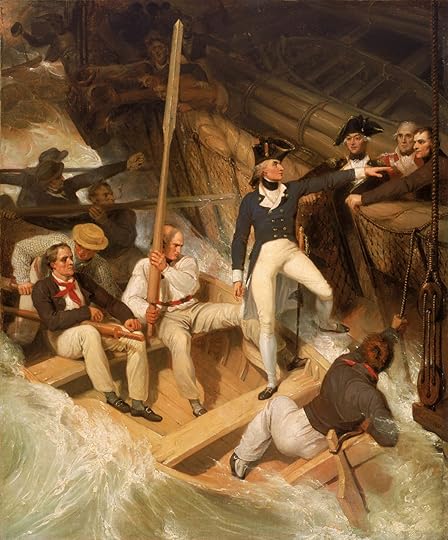
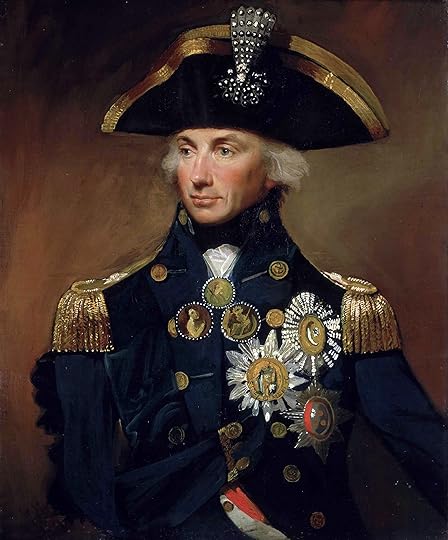
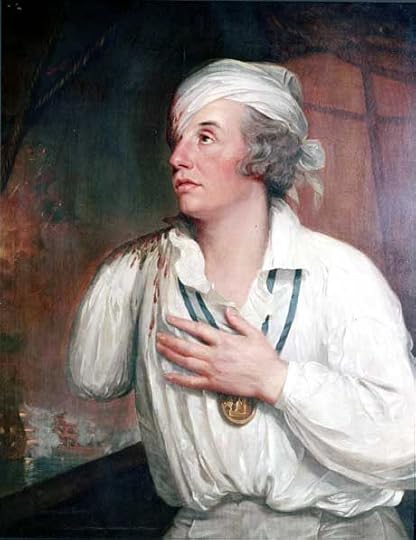
And can we just all appreciate my favourite portrait of Nelson...


(Guy Head really went off with that one)

closely followed by...


and the classic shiny shiny Nelson


Anyway, I loved this book for its subject and its unbiased look at Nelson. I can't wait to go back to the Portsmouth Dockyards now, and see the Victory again.
Profile Image for Todd Stockslager.
1,882 reviews35 followers
October 14, 2026
Review title: Master and Commander of the great age of sailing ships

Written to coincide with the 200th anniversary of the Battle of Trafalgar, this massive biography of the famous Nelson has

--20 pages of introduction explaining why a rigorously researched and sourced biography is essential,

--550 pages of text,

--40 pages of chronology summarizing Nelson's life and major military and political events,

--20 pages documenting the ships on which he served and their officers,

--60 pages of biographical sketches of 200 of the major characters,

--130 pages of bibliography and notes, and (finally!)

--50 pages indexing the whole lot.

My brother found this at a used book sale and thought I might like it, and I am glad I took the journey.

Nelson joined the British navy very young, 16, before he could legally join, and rose quickly to be one of the youngest ever captains in the British navy. Nelson's rise to success was driven by his

--well-placed mentors, starting with his uncle.
--fortunate timing for promotions.
--fortunate placements in ships that offered the best chances to learn the skills needed.
--his performance on the jobs he received due to that mentoring and timing:
--willingness to work hard.
--ability and willingness to lead under duress.
--building teamwork with crew members who respected his leadership and wanted to stay with him. ("The whole Ship's company offered, if I could get a Ship, to enter for her immediately", wrote Nelson in 1783, p. 79).

After duties on ships near home, he served on ships across the globe from the East Indies (off India and across the Indian Ocean to the Middle East) to the West Indies (from the British Caribbean islands up to Newfoundland during the American Revolution years). When you call to mind that all this service was on wind-powered sailing ships that might take weeks to cross the Atlantic in one direction this breadth of service is astounding--45,000 miles by Knight's count (p. 554). And he was still learning and advancing towards captaincy for much of this time, with five years on land at half pay during a period of peace with France and Spain after the American Revolution and before the French Revolution in 1792.

Finally, in 1793 he made captain and began to command his own ships, serving the next five years in the Mediterranean. He began to build the reputation that would lead him to the Battle of Trafalgar.
Up to the beginning of 1796 he was one of a number of a gifted generation of naval officers, taking advantage of superior British naval resources and technology to best the French and Spanish navies. Though physically brave, aggressive and successful, nothing until now had marked him out from others with talent and ambition. . . . Before he left the Mediterranean in February 1797, Nelson had already discovered the foundation for his inspired leadership, which rested on winning goodwill and cooperation. (p. 218)

The description of Nelson facing down a mutiny on a ship in his fleet, after the angry sailors had loaded cannons with shot and swiveled them to point at the ship's captain (p. 214-215), is both rare, dramatic, bold, and demonstrative of the respect Nelson had earned during this Mediterranean stage of his career.

The mid-career climax of Nelson's service was chasing Napoleon's fleet through the Mediterranean and then finding and taking it on in the battle of the Nile in 1798, where he proved his brand of leadership:
His control was instinctive, based on informality, frankness and discussion, and it rested on personal confidence, quickness of mind and a charm of manner. It contrasted sharply with the formal, hierarchical system of the late eighteenth century. . . . Nelson came to the conclusion 'that the best way to control veteran subordinates was not to try'. (p. 286).



While aboard ship Nelson was a successful captain and admiral. Two areas on land in which Nelson was not successful were political negotiations and personal relationships. To be fair in the first, as an 18th century man not born into the upper class, dealing with conflicting objectives of royalty and politicians was a nearly impossible task. Not having grown up with the experience of dealing with royalty, Nelson tended to be obsequious, and since much of the opportunity for advancement within the British navy of his day depended on good relations with those above, it is hard to place blame.

On the second is Nelson's most sad and unfortunate failure. While his marriage to the widow Lady Francis Nelson in 1787 seemed a success (he adopted her son from her first marriage and supported him--with mixed success--in his own naval career), his years in the Mediterranean put him in close contact with Sir Hamilton and his much younger wife Emma. Their close contact turned into an emotional and then a physical relationship, resulting in a daughter with Lady Emma, a life-long separation from his wife, and a tarnished reputation. While he was not a sailor with a woman in every port, Nelson's legacy was forever tainted. After Nelson's final separation from his wife, in a letter to a mutual friend who communicated with both, Lady Francis wrote "I love him. I would do anything in the World to convince him of my affection." (p. 400).

One accusation against Nelson that seems wrong, however, is the charge that he was a hypochondriac. Early in his naval career he contracted malaria during his India service, then mid-career had an arm shattered by shot during battle that required amputation, and took a blow to the head that left him (according to modern medical experts examining the contemporary records) with a severe concussion. All three of these medical emergencies leave recurring flareups of symptoms, and at the time were very often fatal. That he sometimes requested shore leave for these recurrences is no signal of a person skirting their responsibility or feeling sickness that isn't real.

Then came Trafalgar. Back in the Mediterranean, this time as commander of the entire British fleet there, Nelson first ensured the allied French and Spanish ships could not south to Egypt to solidify Napoleon's hold there, then.chased them all the way to the Caribbean and back to Cadiz, Spain. His victory in the battle of Trafalgar came due to his aggressive and detailed battle plan but at the cost of his life as his flagship sailed at the head of the British columns straight into the enemy lines. His memorial column in Trafalgar Square stands as testament to his heroism. With the loss of Nelson the British people could "scarcely rejoice" but with the victory of Trafalgar they could "scarcely refrain from exultation." (p. 529).

Knight concludes this deeply researched biography with chapters on Nelson's burial and memorials, and an assessment of his historical legacy in the two centuries since. A professor of naval history, and former chef curator of the National Maritime Museum in London, Knight is uniquely qualified. This is not a volume to be approached casually, but one that provides an enlightening glimpse into this age of sailing ships and heros for those who come on board for the journey.
119 reviews11 followers
August 23, 2012
At first I was tempted to give this book 4 instead of 5 stars. It drags at parts and the conclusion of Trafalgar is a little iffy for me. When I thought about it, however, Knight is an expert in this field and it shows in his writing. The reader can tell he loves what he writes and goes into (sometimes excruciating) detail about every facet of Nelson's career. The part I love the most about this book, however, is Knight's ability to make Nelson a flawed character. He makes Nelson human in a way I never thought possible. I enjoyed reading this book immensely and would recommend it for any lover of British history or Nelson.
341 reviews10 followers
October 26, 2017
Both literally and figuratively, this is a weighty tome. It is a deeply detailed biography of Lord Nelson buried in an excellent history of the 18th century British Navy. The quality of the scholarship and research is obvious. It may be a bit much for the casual reader of history, but if you are interested in these subjects, it is a must for your bookshelf.
On a side note:
One of my favorite series of books is Patrick O'Brian's Captain Jack Aubrey novels. Pursuit of Victory is an excellent companion piece for fans of those books. It fleshes out the historical context.
5 reviews
January 6, 2019
Extreme spoiler alert!
Horatian Nelson is the legend of the British navy. He is known for his great commanding ability, his leadership, his strategy, and his bravery. Knight’s biography about Nelson provides us with a clear view of his lifetime achievements, using the events in his life as the plot.
Being born in a commoner family alongside with three siblings in a small house at Norfolk, England. Nelson’s uncle Maurice Suckling was a high-ranked officer at the royal navy. As written in Nelson’s diary and in this book, Nelson described his uncle as the main reason of joining the navy. Nelson joined the royal navy at the age of 14, serving under his uncle’s battleship as assistant lieutenant (a common position for will-be-officers, usually requires some sort of background in their family to gain this position). Due to Nelson’s love of the sea and everything in the navy, he gained ranks fast, and soon he became the Navy’s youngest captain at the time, thus beginning his legendary career.
Due to Nelson’s clear mind, logical thinking, bravery, calmness, and natural leadership, he, and his fleet added (first his own vessel to his own fleet) countless amount of victories under her majesty’s name. At the time, it seems like nothing can get in the way from victory and the proud commander.
However, his pride is eventually the cause of his death. At the Battle of Trafalgar, he was shot and later after killed by a French marksman on the enemy ship. The marksman spotted Nelson wearing clothing full of medals and pins (due to his earlier date with the royal family, he was described as “wearing a Christmas tree”), which he earlier refused to take of due to thinking that he doesn’t have anything to fear and the shortage of time.
What made him such a great men is his courage and his beliefs in the "Pursuit of Victory". With those two factors by hand, he became the best commander that the Royal Navy've ever had. Overall, the language in the book are clean, clear, and very precise when it comes to facts. The book doesn’t contain many strong personal opinions, but the only flaw are the parts where the author spends too much time or too much detail on not useful events. I would rank this book a 4 out of 5.
This entire review has been hidden because of spoilers.
Profile Image for Jarrett Bell.
269 reviews8 followers
May 14, 2023
A highly readable, deeply researched, and fair-minded biography, Roger Knight’s “The Pursuit of Victory” convincingly shows how Nelson’s confidence in British naval superiority—especially its trained seamen who could fire and reload cannons much faster than their French and Spanish opponents—facilitated Nelson’s aggressive tactics. For example, in the Battle of the Nile and Trafalgar, Nelson confidently and decisively attacked head-on formations of French and Spanish (in the case of Trafalgar) to get in close next to them, where British rapid-firing cannons and carronades could prove decisive. Nelson’s confidence extended to his subordinates, to whom he delegated much authority in battle, entrusting them to break formation when they spotted an opportunity so long as they erred on the side of aggressiveness.

Moreover, Knight does not overlook Nelson’s more controversial features, including his conduct in Naples (where he allowed British ships to be used to facilitate the execution of Republican opponents of the king), his love of medals and honors, and his affair with Emma Hamilton. And yet, Knight’s biography makes clear that while imperfect and likely unsuited to peacetime life, Nelson was perfectly suited to this moment in history, when British naval power was at its greatest and when Britain was most threatened by invasion.
Profile Image for Chris Fluit.
125 reviews3 followers
July 26, 2019
An incredible book. The author gets into Nelson's life quickly, while still providing important background. The book gets a little tedious when Nelson gets his first command as the author shares a lot of technical information about naval rules of the time but that knowledge pays off later on. The author does a great job illuminating Nelson's strengths and flaws in terms of his personal life and military career. He isn't afraid to share his own view of things, yet always backs up his opinions with relevant contemporary quotes. This is a very humanizing portrait of a legendary, and sometimes controversial, figure.
Profile Image for Rob Markley.
944 reviews10 followers
July 11, 2026
A hugely detailed recounting of the life of Nelson who emerges as a most complex, including being an also very politically/patronage invested character, which heavily accounts for his opportunities for success. In Knight's account Nelson emerges as one of a large number of immensely talented naval captains albeit one who knew better than most how to grasp every opportunity with both hands. This sometimes caused friction with fellow officers. Nelson also misjudged affairs to his disadvantage on two occasions - being the opportunity to mentor Prince William when the King wanted his wayward son disciplined not pampered. Then instead of serving British interests Nelson becomes subservient to the Queen of Naples with attendant complications with respect to the Hamiltons - Emma!

Nelson became hero of the nation but he was also hero to subordinates of all ranks. His portraits suggest a frail man; and he was frequently ill from residual West Indies effects as well as often troubled by doubts and fears. Nevertheless he had an iron will, great vision, boundless courage both personal and tactical. He was both a moral man and an immoral man when it was convenient - in his allowing over flogging onboard and in his rejection of his wife for Emma Hamilton. Strangely Knight devotes several pages to arguing Nelson was not governed by his Christian faith when Knight's own account puts the case of the opposite. Thus we see Nelson as a man full of strange contradictions.

In this book Knight brings a life times knowledge of the topic to leave no stone unturned. As I started reading I felt this was surely the milestone by which all biographies should be measured, however reading deeper there are at times events or circumstances which warranted better explanation. For example some of Nelson's frigate actions are not particularly clear what was going on, or the estate Nelson owns in Sicily is mentioned later but we were never told earlier that he had obtained it. Nevertheless this is a best-in-class biography as a good historical biography should, it enlightens as to the culture (naval and society), the times and the boarder history around its central character.

The immense level of detail is magnified by 124 pages of appendices including details of people mentioned, Nelson life diaried day by day, a descriptive list of every ship Nelson served upon etc. However in my copy several pages in the section on Nelson's ships are misprinted with duplicate pages, missing pages and pages out of order.
Profile Image for Dustin.
4 reviews2 followers
May 30, 2019
"Dry History". An in-depth, well-researched biography of Horatio Nelson. The thing I loved most about it (aside from the standard tales of Nelson's brilliance and bravado) was the delving into the prize money system and the politics surrounding it. When you think of the strong incentives the system provided, both to the captains, and the Admiralty in general, and then think of the implications to treasury and prestige of the nation, wow, the last 400 years are pretty interesting to think about.
327 reviews3 followers
August 26, 2025
My inspiration for reading this book was a visit to Nelson’s final resting place in St. Paul’s Cathedral about 3 weeks ago, preceded by reading ALL OF Patrick O’Brian’s books featuring Jack Aubrey and Steven Maturin. This book filled in a lot of the gaps in my knowledge of Nelson’s life. A bit dry in places, but then a hero’s life can’t be all drama and excitement. A great synopsis of Nelson as a man and a leader is at the very end of the book.
5 reviews
August 21, 2023
For a first time reader of this period of history let alone naval history, it took me a while to get used to some of the nautical terms. But aside from that, I loved it!

I honestly think as British citizen Nelson should be studied more. He was our Napoleon at sea! and his feats can't help but make you feel proud.


Profile Image for Bob Andrews.
289 reviews2 followers
September 26, 2023
I just could not plow through this. The author’s research, knowledge and accuracy remains beyond my question but who would read this?

Certainly not a beginner in naval history. The amount of detail and footnotes made for dry reading. Maybe it’s meant for a truly devoted fan of British naval lore. Not me.
15 reviews1 follower
August 14, 2024
Will admire Nelson's Column more next time i pass by it... Great read, especially how the Royal Navy operated in the 1700's (cough cough nepotism), superior ship building, advanced cannons and better trained sailors. I feel my specialist subject on Mastermind right now could be Vice Admiral, Baron, Lord Horatio Nelson!!!
Profile Image for M. Shipley.
Author 4 books2 followers
June 17, 2025
Outstanding biography to be sure! It takes a long time to read, and I read a couple other books while putting this one aside. But I always came back to it and was fascinated chapter by chapter. A word of caution, one should be extremely interested in the British Navy, and 19 century methods of fighting. Fortunately I am so I found this to be a fascinating book.
Profile Image for Alex Hardie.
5 reviews1 follower
February 20, 2025
Incredibly insightful from start to finish, the book also makes a good attempt to explain in some detail the surrounding geopolitical landscape and the microcosm of day to day life in an 18th century Royal Navy.
Profile Image for JP Mitton.
51 reviews2 followers
July 16, 2020
An excellent study of Admiral Horatio Nelson and his times. Thoroughly researched and well written. Highly recommended for those interested in the topic.
Profile Image for Phil Fortin.
13 reviews1 follower
July 26, 2023
This was a great read. The two people I want to sit down with from history are Jesus and Lord Nelson.
Profile Image for Jonty White.
15 reviews
March 12, 2024
i enjoyed this a surprising amount. 5 stars for grandad but rly a 4.5
Profile Image for Miles Garrett.
Author 1 book11 followers
December 3, 2024
A quite notable account of the life of Britain’s greatest hero (apologies to Thomas Lawrence).
Displaying 1 - 30 of 47 reviews