

What do you think?

The Unauthorised Biography of Ezra Maas
Ezra Maas is dead. The famously reclusive artist vanished without a trace seven years ago while working on his final masterpiece, but his body was never found. While the Maas Foundation prepares to announce his death, journalist Daniel James finds himself hired to write the untold story of the artist's life - but this is no ordinary book. The deeper James delves into the myth of Ezra Maas, the more he is drawn into a nightmarish world of fractured identities and sinister doubles.
A chilling literary labyrinth, The Unauthorised Biography of Ezra Maas blends postmodern noir with pseudo-biography, letters, phone transcripts, documents, emails and newspaper clippings to create a story like no other before it.
"A brilliant, genre-defying debut novel from a major new talent.. a haunting and enigmatic noir and a stylish, multi-layered biography.. a future classic."
- Bryan Talbot, Eisner Award-Winning writer and artist
(Grandville, The Tale Of One Bad Rat, Alice In Sunderland)
A chilling literary labyrinth, The Unauthorised Biography of Ezra Maas blends postmodern noir with pseudo-biography, letters, phone transcripts, documents, emails and newspaper clippings to create a story like no other before it.
"A brilliant, genre-defying debut novel from a major new talent.. a haunting and enigmatic noir and a stylish, multi-layered biography.. a future classic."
- Bryan Talbot, Eisner Award-Winning writer and artist
(Grandville, The Tale Of One Bad Rat, Alice In Sunderland)
399 pages, Paperback
First published November 26, 2018
About the author
Daniel James
2 books70 followersDaniel James is an author and journalist from Newcastle upon Tyne in the UK. His debut novel, The Unauthorised Biography of Ezra Maas, was shortlisted for the Guardian's Not The Booker Prize in 2019. A journalist for daily newspapers and magazines for over a decade, James was a finalist for UK young news writer of the year and spent several years working overseas as a freelance writer, before becoming an author and publishing his first novel.
Ratings & Reviews
Friends & Following
Create a free account to discover what your friends think of this book!
Community Reviews
Displaying 1 - 30 of 93 reviews

February 15, 2019
Now being relaunched in a new edition by Valley Press and finally getting the coverage it deserves 3 years after it’s shortlisting (but not winning) of the 2019 Guardian Not The Booker Prize.
That process in itself was mysterious. The book was the runaway winner of the public vote only to be overturned in the judges meeting - a meeting which in every other year was broadcast live (in fact complete transparency of the judging process is the raison d'être of the Not The Booker) but which mysteriously that year was neither broadcast or even recorded due to “gremlins”
ORIGINAL REVIRW
A multi-layered examination of identity and myth and a magnificent hybrid of multiple literary forms that is never less than enthralling.
This book was published by Dead Ink a UK small press focused on bringing” the most challenging and experimental new writing out from the underground and present[ing] it to our audience in the most beautiful way possible.”.
The challenge in this case was having the bravery (in a literal as well as literary sense) to publish this book, given the efforts of the shadowy but powerful Maas Foundation to supress it.
The book itself is on the surface about the about the experimental and underground scene: in original intent being a biography of the (in)famously reclusive artist Ezra Maas, his links to almost every major underground artist or art scene that one can think of and in fact his extreme experimentation so that, in so many cases, it is possible to trace back apparently new artistic trends to his pioneering influence years previously.
Books which use biography of an art figure as a starting point for a fictional exploration of ideas is I think currently a dominant theme in great literature, particularly that produced by small presses.
If I take the brilliant Republic of Consciousness Longlist for 2019 we have fictionalised biographies on Louise Bourgeois, James Joyce and his daughter, and Lord Kitchener (as well as of Alan Turing, whose creative work was in the field of Art (ificial intelligence).
Last year’s longlist (for which I was a judge) featured books on TS Eliot and Stendhal.
As part of the judging debate last year I talked with fellow judges about the concept of “generosity” – generosity of the author to the reader. Many of these books seems to rely on the reader carrying out extensive Google and You Tube searches to really be able to appreciate them, and in some cases to simply be able understand them: something which his attractive on one level but which can be offputting – I read to get away from the internet. By contrast books such as Jack Robinson’s “Overcoat” while still inviting further exploration, generously lead the reader through many of the allusions and references – in that case by means of footnotes.
“The Unauthorised Biography of Ezra Maas” on one level fits into this literary genre and is a very welcome and strong addition to it – however it is so much more.
The book has to be generous with the references, as the money and influence of the Maas Foundation have served to expunge almost any public reference to Ezra Maas – Maas as far as Google/Wikipedia is concerned (and in the 21st Century that effectively means as far as reality is concerned) is absent – and this absence and its implications that the book explores.
And our generous narrator – in footnotes explaining the structure of the book as well as the many artistic references – is a key to the novel.
If the narrator is Daniel James, then who is the other Daniel James who tells his own story in one set of chapters with excerpts from his attempted biography of Ezra Maas forming the other set of chapters – but with biography merging with autobiography
But as first the narrator and then we realise, this attribution of a double game is to significantly understate the complexity of the book:
And the way in which both the narrator and then we as reader are implicated in it:
The book includes the role of the media members of the International Consortium of Investigative Journalists – best known for the breaking of stories such as the Panama Papers (leaked via an anonymous whistleblower and covered in a number of papers including the Guardian, Süddeutsche Zeitung or Le Monde – in assisting Daniel James in his quest to uncover the story behind Ezra Maas, against the attempts of the Maas Foundation to suppress his work.
Last year I was a judge on the Guardian Not The Booker prize – my favourite book as avowed publically on the Guardian website – Three Dreams In The Key Of G by Marc Nash.
Fast forward a few months and I, making a link to the above books, I receive an unsolicited contact from “Daniel” on Goodreads – whose profile picture shows someone who looks a little like the images on the website of the claimed author Daniel James, but obscured by a blurred newspaper asking if I will review this book – also published by Dead Ink. Is this the Daniel of the book or the Daniel who may be the narrator or someone else?
On accepting the request two unmarked packages arrived, both containing copies of the book – more mystery, more double identity, more merging of fact and fiction.
That process in itself was mysterious. The book was the runaway winner of the public vote only to be overturned in the judges meeting - a meeting which in every other year was broadcast live (in fact complete transparency of the judging process is the raison d'être of the Not The Booker) but which mysteriously that year was neither broadcast or even recorded due to “gremlins”
ORIGINAL REVIRW
A multi-layered examination of identity and myth and a magnificent hybrid of multiple literary forms that is never less than enthralling.
“Ezra Maas was the one. I knew it instinctively. No one had told his story. His art was filled with strange, autobiographical fragments and symbols that said everything and nothing, so dense with meaning that it overflowed, haemorrhaging in possibilities. Maas didn’t have to hide his secrets, he casually scattered them on the ground for all to see and watched the trees grow up around him. For in a forest of signs, nothing could be seen clearly at all.”
This book was published by Dead Ink a UK small press focused on bringing” the most challenging and experimental new writing out from the underground and present[ing] it to our audience in the most beautiful way possible.”.
The challenge in this case was having the bravery (in a literal as well as literary sense) to publish this book, given the efforts of the shadowy but powerful Maas Foundation to supress it.
The book itself is on the surface about the about the experimental and underground scene: in original intent being a biography of the (in)famously reclusive artist Ezra Maas, his links to almost every major underground artist or art scene that one can think of and in fact his extreme experimentation so that, in so many cases, it is possible to trace back apparently new artistic trends to his pioneering influence years previously.
Books which use biography of an art figure as a starting point for a fictional exploration of ideas is I think currently a dominant theme in great literature, particularly that produced by small presses.
If I take the brilliant Republic of Consciousness Longlist for 2019 we have fictionalised biographies on Louise Bourgeois, James Joyce and his daughter, and Lord Kitchener (as well as of Alan Turing, whose creative work was in the field of Art (ificial intelligence).
Last year’s longlist (for which I was a judge) featured books on TS Eliot and Stendhal.
As part of the judging debate last year I talked with fellow judges about the concept of “generosity” – generosity of the author to the reader. Many of these books seems to rely on the reader carrying out extensive Google and You Tube searches to really be able to appreciate them, and in some cases to simply be able understand them: something which his attractive on one level but which can be offputting – I read to get away from the internet. By contrast books such as Jack Robinson’s “Overcoat” while still inviting further exploration, generously lead the reader through many of the allusions and references – in that case by means of footnotes.
“The Unauthorised Biography of Ezra Maas” on one level fits into this literary genre and is a very welcome and strong addition to it – however it is so much more.
The book has to be generous with the references, as the money and influence of the Maas Foundation have served to expunge almost any public reference to Ezra Maas – Maas as far as Google/Wikipedia is concerned (and in the 21st Century that effectively means as far as reality is concerned) is absent – and this absence and its implications that the book explores.
“All I know for sure is that Maas’s absence is the centre of the book. It’s the catalyst, the inciting incident, and its effects reverberate through the past, present and future.”
And our generous narrator – in footnotes explaining the structure of the book as well as the many artistic references – is a key to the novel.
If the narrator is Daniel James, then who is the other Daniel James who tells his own story in one set of chapters with excerpts from his attempted biography of Ezra Maas forming the other set of chapters – but with biography merging with autobiography
As in the short stories of Borges, Daniel’s protagonist is a version of himself. In some ways, the manuscript could be considered an experiment in autofiction, to utilise a recent term. Yet, as I have previously stated, this is not the Daniel I once knew, but a fictionalised “character”, distinct and separate from the “authorial” Daniel. Again, as with the overt use of noir and postmodern techniques in the exterior structure of the narrative. I believe Daniel was playing a game with the reader by including himself in the text and uses his own identity as another form of misdirection. Admittedly, it took me some time to realise the “double game” that was being played here and, while I have not evidence to prove it, I have a compelling theory about Daniel’s identity which you can read on page xx
But as first the narrator and then we realise, this attribution of a double game is to significantly understate the complexity of the book:
“There are rooms within rooms, worlds within worlds … it has reimagined how we engage with artwork …”
And the way in which both the narrator and then we as reader are implicated in it:
I came to realise that all of the stories and layers, Daniel’s, Ezra’s, mine, yours, were one and the same, in the end.
The book includes the role of the media members of the International Consortium of Investigative Journalists – best known for the breaking of stories such as the Panama Papers (leaked via an anonymous whistleblower and covered in a number of papers including the Guardian, Süddeutsche Zeitung or Le Monde – in assisting Daniel James in his quest to uncover the story behind Ezra Maas, against the attempts of the Maas Foundation to suppress his work.
Last year I was a judge on the Guardian Not The Booker prize – my favourite book as avowed publically on the Guardian website – Three Dreams In The Key Of G by Marc Nash.
Fast forward a few months and I, making a link to the above books, I receive an unsolicited contact from “Daniel” on Goodreads – whose profile picture shows someone who looks a little like the images on the website of the claimed author Daniel James, but obscured by a blurred newspaper asking if I will review this book – also published by Dead Ink. Is this the Daniel of the book or the Daniel who may be the narrator or someone else?
On accepting the request two unmarked packages arrived, both containing copies of the book – more mystery, more double identity, more merging of fact and fiction.
You may come to see this book as many things, a biography, a detective novel, a love letter, a true story, a work of fiction, a forsaken text, an encyclopaedic narrative, or something else entirely. It is all of these things are more.
In final summary, the book is legion, for it is many things

February 8, 2019
This is not a biography. It is a true story.
...
It began with a phone call in the dead of night.
...
It is impossible to discount the possibility that some of what you are about to read may contain fiction.
...
"You know that line ‘the greatest trick the devil ever pulled was convincing the world he didn’t exist’? Well, I think Ezra Maas’s greatest trick was convincing the world he did."
...
Some stories are more dangerous than others, and true stories are the most dangerous of all.
This book is dangerous. You need to know that before you begin
The famously reclusive artist Ezra Maas was believed to have been born in Britain on 1 January 1950, but first made his artistic reputation (but, deliberately, not his public fame) in the New York pop art scene of the late 1960s. A man of many talents, even more legends amongst his cult-like followers, and multiple personalities:
the romantic artist, the withdrawn recluse, the violent, temperamental genius, the charismatic cult leader, the counterculture icon, the serial womaniser, the drug addict, the experimenter, the intense loner, the passionate collaborator, the painter, the poet, the madman.
His life story and works contains elements of those of, amongst others: Andy Warhol, Charles Manson, L Ron Hubbard, Hunter S. Thompson, John Lennon and Paul McCartney, Joseph Beuys, Samuel Beckett, Damien Hirst, Thomas Pynchon, David Lynch, the Unabomber, Banksy, R B Kitaj, John Wheeler and Rozz Williams; most of these people who he worked with or influenced. Maas was an artist who was in the vanguard of many key creative trends, often years before they became a trend.
In the 1970s through to the 1990s, Maas himself became more and more of a recluse, almost a rumour, the public face of his works instead controlled by the rich and rather sinister Maas Foundation.
In 2002 Maas released, through the foundation a statement announcing his withdrawal from public life (rather ironically given his already highly reclusive nature and ambiguous identity) to concentrate on his final and most important creation.
But then in 2005, Maas was officially registered as missing, his wife and controller of the Foundation, admitting he had not been seen since 2002.
In the following years, his works were bought up, removed from public display, newspaper stories about him suppressed. It was almost as if he had never existed.
In 2011, journalist and author Daniel James received a 3am phone call from the representative of a mysterious, and never identified, third party, offering him a huge sum simply to write the unauthorised biography Of Ezra Maas, and to find the truth behind both his origins and disappearance. His investigations took him around the world, and placed the lives of himself, and others, at risk.
Then in May 2012, when his book was about to be launched, the Maas foundation scheduled a press conference, claiming Maas was alive and well and ready to unveil has master work. The book was dropped by James's original mainstream publisher (under pressure from the Maas foundation?).
And in 2013, James himself went missing.
The evidence suggests James tried to destroy his research and his writing. But in this book, a former close companion of James who prefers to remain anonymous, the Brod to James' Kafka, has reassembled what survives, and published it under Daniel James's name.
Shunned by the large conglomerates (again as a result of pressure from the Maas Foundation?) the book was picked up, in a crowdfunded campaign, by the brave independent press Dead Ink:
We see it as Dead Ink’s job to bring the most challenging and experimental new writing out from the underground and present it to our audience in the most beautiful way possible.
The resulting book interweaves four separate sections:
- what remains of James's official biography, at times rather hagiographic, as much of what remains of Maas's history has been controlled by the Foundation;
- oral accounts of those who knew him (a filmed example here from Bryan Talbot, father of the UK' graphic novel https://www.youtube.com/watch?v=QKO9K...). Notably the picture of Maas that emerges from these different accounts - even the descriptions his physical appearance - are highly contradictory: was he one man or many?
- Daniel James's own account of his investigations into Ezra Maas, written in a self-aware style that combines existential and metaphysical noir, auto-fiction and new journalism.
- copious footnotes from the anonymous narrator (the anonymity presumably as he or she wishes to avoid the fate of James and Maas), both clarifying various references but also adding his own commentary on the story and the disappearance of James. But these footnotes, while answering many questions, raise a key one of their own - who exactly is the mysterious narrator - James himself, Ezra Maas or one of his representatives, or someone else?
It is a fascinating mix. Indeed it is more than just a book, it’s a work of conceptual art.
But how much is pure fiction?
Well searching for Ezra Maas on the internet, reveals very little - only interviews and articles connected with James’s book and the highly obtuse website of the shadowy Ezra Maas Foundation: http://ezramaas.com/ and their twitter feed @maasfoundation, which seems mostly intent on discrediting this very book.
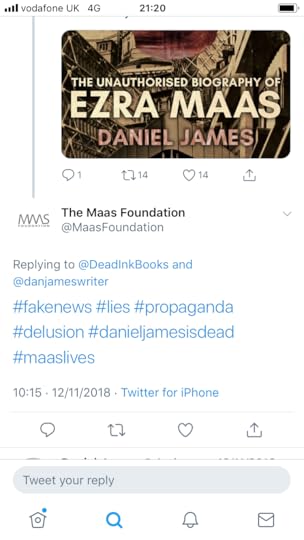
But then we learn early on that the Foundation have gradually wiped the internet clean of references to Mass in the same way they’ve removed his artworks from galleries. Daniel James himself, with his desire to destroy what he has found, tells us towards the end that we will you will only know I have succeeded if you do not know who Ezra Maas is, if the name means nothing to you.
And mysteriously, having vanished, in rather suspicious circumstances, 5 years earlier, the original author Daniel James has suddenly reappeared, seemingly alive and well, on the publication of this book, giving various interviews that explain more of his project and even appearing in 2019 at book launch events.
Or is it Daniel James? - whose own history seems fairly opaque. The Maas Foundation claims otherwise:
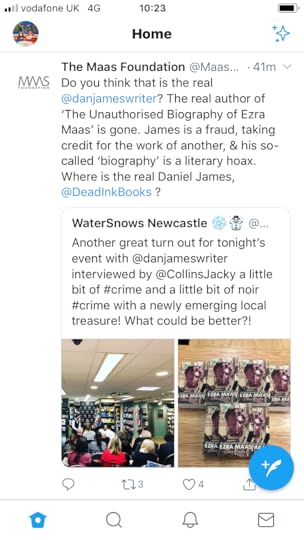
The interviews of thepersonnowclaimingtobeDanielJames, do give some fascinating additional insight.
Describing Ezra Maas:

...
It began with a phone call in the dead of night.
...
It is impossible to discount the possibility that some of what you are about to read may contain fiction.
...
"You know that line ‘the greatest trick the devil ever pulled was convincing the world he didn’t exist’? Well, I think Ezra Maas’s greatest trick was convincing the world he did."
...
Some stories are more dangerous than others, and true stories are the most dangerous of all.
This book is dangerous. You need to know that before you begin
The famously reclusive artist Ezra Maas was believed to have been born in Britain on 1 January 1950, but first made his artistic reputation (but, deliberately, not his public fame) in the New York pop art scene of the late 1960s. A man of many talents, even more legends amongst his cult-like followers, and multiple personalities:
the romantic artist, the withdrawn recluse, the violent, temperamental genius, the charismatic cult leader, the counterculture icon, the serial womaniser, the drug addict, the experimenter, the intense loner, the passionate collaborator, the painter, the poet, the madman.
His life story and works contains elements of those of, amongst others: Andy Warhol, Charles Manson, L Ron Hubbard, Hunter S. Thompson, John Lennon and Paul McCartney, Joseph Beuys, Samuel Beckett, Damien Hirst, Thomas Pynchon, David Lynch, the Unabomber, Banksy, R B Kitaj, John Wheeler and Rozz Williams; most of these people who he worked with or influenced. Maas was an artist who was in the vanguard of many key creative trends, often years before they became a trend.
In the 1970s through to the 1990s, Maas himself became more and more of a recluse, almost a rumour, the public face of his works instead controlled by the rich and rather sinister Maas Foundation.
In 2002 Maas released, through the foundation a statement announcing his withdrawal from public life (rather ironically given his already highly reclusive nature and ambiguous identity) to concentrate on his final and most important creation.
But then in 2005, Maas was officially registered as missing, his wife and controller of the Foundation, admitting he had not been seen since 2002.
In the following years, his works were bought up, removed from public display, newspaper stories about him suppressed. It was almost as if he had never existed.
In 2011, journalist and author Daniel James received a 3am phone call from the representative of a mysterious, and never identified, third party, offering him a huge sum simply to write the unauthorised biography Of Ezra Maas, and to find the truth behind both his origins and disappearance. His investigations took him around the world, and placed the lives of himself, and others, at risk.
Then in May 2012, when his book was about to be launched, the Maas foundation scheduled a press conference, claiming Maas was alive and well and ready to unveil has master work. The book was dropped by James's original mainstream publisher (under pressure from the Maas foundation?).
And in 2013, James himself went missing.
The evidence suggests James tried to destroy his research and his writing. But in this book, a former close companion of James who prefers to remain anonymous, the Brod to James' Kafka, has reassembled what survives, and published it under Daniel James's name.
Shunned by the large conglomerates (again as a result of pressure from the Maas Foundation?) the book was picked up, in a crowdfunded campaign, by the brave independent press Dead Ink:
We see it as Dead Ink’s job to bring the most challenging and experimental new writing out from the underground and present it to our audience in the most beautiful way possible.
The resulting book interweaves four separate sections:
- what remains of James's official biography, at times rather hagiographic, as much of what remains of Maas's history has been controlled by the Foundation;
- oral accounts of those who knew him (a filmed example here from Bryan Talbot, father of the UK' graphic novel https://www.youtube.com/watch?v=QKO9K...). Notably the picture of Maas that emerges from these different accounts - even the descriptions his physical appearance - are highly contradictory: was he one man or many?
- Daniel James's own account of his investigations into Ezra Maas, written in a self-aware style that combines existential and metaphysical noir, auto-fiction and new journalism.
- copious footnotes from the anonymous narrator (the anonymity presumably as he or she wishes to avoid the fate of James and Maas), both clarifying various references but also adding his own commentary on the story and the disappearance of James. But these footnotes, while answering many questions, raise a key one of their own - who exactly is the mysterious narrator - James himself, Ezra Maas or one of his representatives, or someone else?
It is a fascinating mix. Indeed it is more than just a book, it’s a work of conceptual art.
But how much is pure fiction?
Well searching for Ezra Maas on the internet, reveals very little - only interviews and articles connected with James’s book and the highly obtuse website of the shadowy Ezra Maas Foundation: http://ezramaas.com/ and their twitter feed @maasfoundation, which seems mostly intent on discrediting this very book.
But then we learn early on that the Foundation have gradually wiped the internet clean of references to Mass in the same way they’ve removed his artworks from galleries. Daniel James himself, with his desire to destroy what he has found, tells us towards the end that we will you will only know I have succeeded if you do not know who Ezra Maas is, if the name means nothing to you.
And mysteriously, having vanished, in rather suspicious circumstances, 5 years earlier, the original author Daniel James has suddenly reappeared, seemingly alive and well, on the publication of this book, giving various interviews that explain more of his project and even appearing in 2019 at book launch events.
Or is it Daniel James? - whose own history seems fairly opaque. The Maas Foundation claims otherwise:
The interviews of thepersonnowclaimingtobeDanielJames, do give some fascinating additional insight.
Describing Ezra Maas:
Ezra Maas is a reclusive British artist who first became famous in New York in the 1960s. Unlike his contemporaries, Maas rejected the cult of celebrity, never giving interviews and refusing to be photographed, insisting that his radical artwork speak for him. He was intensely private and his exhibitions were surrounded in secrecy. This created a kind of anti-fame around him and he quickly gained a cult following as a result. Maas went on to exhibit work in galleries and museums around the world, including Paris, Bruges, Berlin and Switzerland.How James became involved in the project:
From the 1980s onwards, he was rumoured to be working from a studio mansion in the Hertfordshire countryside, but as ever with Maas, nothing could be sure. There were stories of agoraphobia, drug addiction, mental illness, as well as links to cult-like groups who claimed there were hidden messages in his work, but most of these stories were dismissed as tabloid gossip. Less and less was heard from Maas throughout the 1990s, although he continued to produce new work, adopting new technologies and releasing pieces via his website.
Maas disappeared under mysterious circumstances from his studio in the mid-2000s after announcing plans for his final and most important artwork. His representatives, The Maas Foundation, continue to maintain and protect his legacy, staging retrospectives and selling his work for larger amounts every year. Many believe Maas is dead, but others claim he’s simply in seclusion and will return when his final work is complete.
(from https://www.thebooktrail.com/authorso...)
Six years after Maas was officially registered as missing in 2005, Daniel received a late night phone call from a mysterious third party and embarked on his life story of Maas.James's own take on what he had written:
In 2012 the book was ready to go – and then, out of the blue, the Maas Foundation scheduled a press conference.
Could it have been to declare that the artist was dead... or alive? Or could it have been to unveil the masterpiece that he allegedly went into seclusion to work on?
(http://narcmagazine.com/feature-danie... and https://www.chroniclelive.co.uk/whats... and https://rhystranter.com/2017/08/23/da...)
It is an unorthodox hybrid of literary fiction, biography and detective story, written by a former journalist and told through a combination of prose fiction, biographical chapters, news clippings, academic footnotes, emails, phone transcripts and more. Given these origins, the novel occupies a unique space at the intersection between truth and fiction, history and myth.His literary influences:
(from http://newwritingnorth.com/journal/ar...)
Paul Auster, Raymond Chandler, Samuel Beckett. James Joyce, Thomas Pynchon, Philip Pullman, Philip K Dick, Jorge Luis Borges, Alasdair Grey, Flann O’Brien, David Lynch.(from https://deadinkbooks.com/post-truth-d... https://elementaryvwatson.wordpress.c...and to that male-dominated list should be added Virginia Woolf, whose Orlando is one clear precedent for this work, and who is quoted, early on in the book, from To The Lighthouse:
and https://www.livingnorth.com/northeast... )
What art was there, known to love or cunning, by which one pressed through into these secret chambers? ... How then, she had asked herself, did one know one thing or another thing about people, sealed as they were?A fascinating and disturbing work. And perhaps most disturbingly of all, while writing this review, a Twitter notification appeared on my account ...
May 15, 2022
You will only know I have succeeded if you do not know who Ezra Maas is, if the name means nothing to you. If he lives now, it is only in the pages of this book.
A brilliant new special edition of one of the most important books of the last decade.
The Unauthorised Biography of Ezra Maas has had a troubled history.
Ezra Maas, the romantic artist, the withdrawn recluse, the violent, temperamental genius, the charismatic cult leader, the counterculture icon, the serial womaniser, the drug addict, the experimenter, the intense loner, the passionate collaborator, the painter, the poet, the madman, was officially registered missing in 2005 after a brilliant, but increasingly mysterious, career, by the shadowy Maas Foundation. In the following years, his works were bought up, removed from public display, newspaper stories about him suppressed. It was almost as if he had never existed.
In 2011, journalist and author Daniel James received a 3am phone call from the representative of a mysterious, and never identified, third party, offering him a huge sum simply to write the unauthorised biography Of Ezra Maas, and to find the truth behind both his origins and disappearance. His investigations took him around the world, and placed the lives of himself, and others, at risk.
Then in May 2012, when his book was about to be launched, the Maas foundation scheduled a press conference, claiming Maas was alive and well and ready to unveil has master work. The book was dropped by James's original mainstream publisher (under pressure from the Maas foundation?).
And in 2013, James himself went missing.
The evidence suggests James tried to destroy his research and his writing. But an anonymous former close companion of James who prefers to remain anonymous, the Brod to James' Kafka, has reassembled what survives, and published it under Daniel James's name.
Shunned by the large conglomerates (again as a result of pressure from the Maas Foundation?) the book was picked up, in a crowdfunded campaign, by the independent press Dead Ink and published in 2019. My review: https://www.goodreads.com/review/show...?
The book was initially hailed by readers as a work of genius, and shortlisted for the Guardian's Not The Booker Prize, decided by readers not critics, a runaway winner of the public vote.
But - it isn't hard to guess whose hands were at work- the judges of the prize overruled the public vote, Dead Ink seemed to mysteriously lose interest in promoting the book, which one suspects wasn't entered for the Booker Prize itself, and it went out of print.
Until now.
In May 2022, Valley Press have reissued the The Unauthorised Biography of Ezra Maas in a brilliant new edition, with superb production quality that does the work justice. Wonderfully, given many feared what had become of him, Daniel James himself has apparently resurfaced.
And the new edition contains some explicit additional information, but also some interesting secrets of its own.
But be careful....
It is impossible to discount the possibility that some of what you are about to read may contain fiction.
...
"You know that line ‘the greatest trick the devil ever pulled was convincing the world he didn’t exist’? Well, I think Ezra Maas’s greatest trick was convincing the world he did."
...
Some stories are more dangerous than others, and true stories are the most dangerous of all.
This book is dangerous. You need to know that before you begin
A brilliant new special edition of one of the most important books of the last decade.
The Unauthorised Biography of Ezra Maas has had a troubled history.
Ezra Maas, the romantic artist, the withdrawn recluse, the violent, temperamental genius, the charismatic cult leader, the counterculture icon, the serial womaniser, the drug addict, the experimenter, the intense loner, the passionate collaborator, the painter, the poet, the madman, was officially registered missing in 2005 after a brilliant, but increasingly mysterious, career, by the shadowy Maas Foundation. In the following years, his works were bought up, removed from public display, newspaper stories about him suppressed. It was almost as if he had never existed.
In 2011, journalist and author Daniel James received a 3am phone call from the representative of a mysterious, and never identified, third party, offering him a huge sum simply to write the unauthorised biography Of Ezra Maas, and to find the truth behind both his origins and disappearance. His investigations took him around the world, and placed the lives of himself, and others, at risk.
Then in May 2012, when his book was about to be launched, the Maas foundation scheduled a press conference, claiming Maas was alive and well and ready to unveil has master work. The book was dropped by James's original mainstream publisher (under pressure from the Maas foundation?).
And in 2013, James himself went missing.
The evidence suggests James tried to destroy his research and his writing. But an anonymous former close companion of James who prefers to remain anonymous, the Brod to James' Kafka, has reassembled what survives, and published it under Daniel James's name.
Shunned by the large conglomerates (again as a result of pressure from the Maas Foundation?) the book was picked up, in a crowdfunded campaign, by the independent press Dead Ink and published in 2019. My review: https://www.goodreads.com/review/show...?
The book was initially hailed by readers as a work of genius, and shortlisted for the Guardian's Not The Booker Prize, decided by readers not critics, a runaway winner of the public vote.
But - it isn't hard to guess whose hands were at work- the judges of the prize overruled the public vote, Dead Ink seemed to mysteriously lose interest in promoting the book, which one suspects wasn't entered for the Booker Prize itself, and it went out of print.
Until now.
In May 2022, Valley Press have reissued the The Unauthorised Biography of Ezra Maas in a brilliant new edition, with superb production quality that does the work justice. Wonderfully, given many feared what had become of him, Daniel James himself has apparently resurfaced.
And the new edition contains some explicit additional information, but also some interesting secrets of its own.
But be careful....
It is impossible to discount the possibility that some of what you are about to read may contain fiction.
...
"You know that line ‘the greatest trick the devil ever pulled was convincing the world he didn’t exist’? Well, I think Ezra Maas’s greatest trick was convincing the world he did."
...
Some stories are more dangerous than others, and true stories are the most dangerous of all.
This book is dangerous. You need to know that before you begin

July 11, 2019
Most of the publicity and reviews I’ve read centre around the reality, or not, of the eponymous Ezra Maas. As befits a metafictional structure, many reviewers have bought into the deceit, and have engaged with the author(s) directly. That’s quite appropriate for this book, and makes it exciting to be a part of a developing, unfinished story.
The metafiction involves author Daniel James and a third, unnamed, “anonymous”, biographer. Social media, Maas websites, and online message board misinformation and duplicity has fuelled the fires of speculation into the integrity of the information presented as factual. If a reader feels reached out to, on a personal basis, it’s quite intoxicating.
Its all good fun.
As much as anything else I was really impressed by the way Daniel James moves seamlessly between iconic figures from different branches of the arts world, the scientific world, the world of philosophers
My thoughts about the content of this book are divided up as follows:
Funny, tongue in cheek, knockabout jokes shared by the reader .
There are plenty, and many others will reveal themselves on a second reading.
Some favourites:
• Jordan College Oxford, (a fictional college in Philip Pullman’s His Dark Materials) (172)
• Exclusive private storage firm (!!!!) in London (Merivale & Sweeney)(202- footnote 300). A perfect joke that connects with the metaphysical detective story at the heart of Ezra Mass and which takes in Edgar Allen Poe.
• A Daniel James transcript, as he speaks into a phone to record Soho house- (Diane & Bob are the silent witnesses - Twin Peaks 229). Daniel James spells this out in the footnotes. I wonder if I would have made the Twin Peaks connection otherwise?
• Exhibiting in Tate Modern in the 1980s…….. Tate Modern opened in 2000!
• Maas “was the same man who had sent an impersonator to the 1974 book awards in America”(261)
Pynchon in a meeting Malcolm Bradbury (who knew him):Pynchon sent an impersonator to collect his National Book Award for Gravity’s Rainbow in 1974(324)
So, Ezra Mass is Thomas Pynchon?
• The Bleed magazine received emails from M.T. Stewart (while in footnote 450-on the same page.293- M.T. Stuart )
• (302) Joe Summerfield “UK bartender Joe Summerfield has been crowned Wenneker Swizzle Master 2016 for his ... cocktails and mind-boggling mixology, Joe Summerfield of The Poison Cabinet in Newcastle” I hope Joe won a prize and got included as a live character in the book as a result? Maybe he and Daniel are just good friends?!
• Rittenhouse (88). Whiskey (as a ‘go to’). Straight out of black and white noir movies.
Encapsulation of youth culture in the 1970/80s especially in the USA .
• Cabaret Voltaire, Zurich- Dada (110) This is pretty well a straight historical summary, but in the context of the mystery unfolding in a work of fiction it has more impact on me.
• Warhol’s set; including Valerie Solanas shooting; MK Ultra drug test (Ken Kelsey?) (119)
• Father Yod (177). Quite unbelievable Hollywood America
• R.B.Kitaj(221), the American artist linking to art galleries and museums and then impromptu street art
Spotlight on seminal figures from the modern history .
A few examples:
• Thomas Pynchon (any opportunity to quote is welcome):
Newspaper reports Daniel James “every weirdo in the world is on his wavelength” (Pynchon-91)
Pynchon is evident in the Mass Foundation online website- a list of Ezra Maas picture titles include Entropy 1973 Wilson and Wilson 1990, Oedipa 1979,
• Paul Auster. An example of homage to an acknowledged influence, and a noir style. The set up in Ezra Mass : It began with a phone call in the dead of night”(8) is a straight nod to Auster’s City of Glass It was a wrong number that started it, the telephone ringing three times
• Theoretical physicist John Wheeler when dying- “How come existence” (331) Wheeler appears multiple times and piqued my interest in a field I’m sadly ignorant of.(Wheeler is also a title on the Mass Goundation website (for 1995)
• Robert W. Chambers The King in Yellow (358), written in 1895 and describing unknown forces.
Structural literary techniques incorporated in a single work of fiction.
• poioumenon. (12) I was amazed to find that there’s an actual descriptive term to describe what James is doing (metafiction in which the story is about the process of creation) The use of the term Auto fiction as a catch all, is too general it would appear!
• Adam Diment and Rosemary Tonks (155/6). Banksy (regularly), Elena Ferrante. While Thomas Pynchon and Howard Hughes are the best known (!) examples of deliberate reclusiveness they are by no means unique
• Borges- The Book of Sand (358) the ‘mise en abyme’ fiction writing structure of which Ezra Maas is an example
• Apophenia (239 footnote) (from a google look up: the tendency to perceive connections and meaning between unrelated things). This book in essence!
• Maas was a polymath. ‘an individual whose knowledge spans a significant number of subjects’. Maas and Daniel James certainly share a wide ranging knowledge
Layout of the physical book (I don’t know how/if this translates to kindle) .
• Different typefaces
• Footnotes (again, very David Foster Wallace)
There were some obvious omissions too.
• No mention of William Boyd and Nat Tate: An American Artist Given the multiple references to David Bowie I thought this was a certainty (published in 1998)
• No reference to Siri Hustvedt. New York based; wife of Paul Auster (like Bowie, a frequent visitor to the pages of Ezra Maas). This Blazing World covers the world of art galleries and questionable provenance.
There’s even a mention of Duchamp’s - R.Mutt urinal (which appears in Blazing World, and in Hustvedt’s latest Memories of the Future )
• Most surprising of all… no David Foster Wallace. The importance, the mystique, that centres on a specific, mythical film in Ezra Maas is also the centre point of Infinite Jest (a film, so entertaining to its viewers that they lose all interest in anything other than repeatedly viewing it and thus eventually die).
unanswered questions .
(Maybe I’ll get the chance to meet Daniel James sometime later this year?)
• Three numbers 1-12-49, or a date? (66)
• Jane Doe journals- man called Malcolm (????)(101)
In among the subterfuge, the paranoia, Daniel James writes a great summary of why we (I) read:
the feeling I have when I’m reading a book and become completely absorbed by the story. I pass over into the text. When I return I find myself looking at the world around me with fresh eyes, a new perspective, greater knowledge, more empathy. That’s the power of fiction. It can change how you think, how you feel, what you see- everything.(153)
That’s how The Unauthorised Biography of Ezra Maas made me feel. I loved this book.
The metafiction involves author Daniel James and a third, unnamed, “anonymous”, biographer. Social media, Maas websites, and online message board misinformation and duplicity has fuelled the fires of speculation into the integrity of the information presented as factual. If a reader feels reached out to, on a personal basis, it’s quite intoxicating.
Its all good fun.
As much as anything else I was really impressed by the way Daniel James moves seamlessly between iconic figures from different branches of the arts world, the scientific world, the world of philosophers
My thoughts about the content of this book are divided up as follows:
Funny, tongue in cheek, knockabout jokes shared by the reader .
There are plenty, and many others will reveal themselves on a second reading.
Some favourites:
• Jordan College Oxford, (a fictional college in Philip Pullman’s His Dark Materials) (172)
• Exclusive private storage firm (!!!!) in London (Merivale & Sweeney)(202- footnote 300). A perfect joke that connects with the metaphysical detective story at the heart of Ezra Mass and which takes in Edgar Allen Poe.
• A Daniel James transcript, as he speaks into a phone to record Soho house- (Diane & Bob are the silent witnesses - Twin Peaks 229). Daniel James spells this out in the footnotes. I wonder if I would have made the Twin Peaks connection otherwise?
• Exhibiting in Tate Modern in the 1980s…….. Tate Modern opened in 2000!
• Maas “was the same man who had sent an impersonator to the 1974 book awards in America”(261)
Pynchon in a meeting Malcolm Bradbury (who knew him):Pynchon sent an impersonator to collect his National Book Award for Gravity’s Rainbow in 1974(324)
So, Ezra Mass is Thomas Pynchon?
• The Bleed magazine received emails from M.T. Stewart (while in footnote 450-on the same page.293- M.T. Stuart )
• (302) Joe Summerfield “UK bartender Joe Summerfield has been crowned Wenneker Swizzle Master 2016 for his ... cocktails and mind-boggling mixology, Joe Summerfield of The Poison Cabinet in Newcastle” I hope Joe won a prize and got included as a live character in the book as a result? Maybe he and Daniel are just good friends?!
• Rittenhouse (88). Whiskey (as a ‘go to’). Straight out of black and white noir movies.
Encapsulation of youth culture in the 1970/80s especially in the USA .
• Cabaret Voltaire, Zurich- Dada (110) This is pretty well a straight historical summary, but in the context of the mystery unfolding in a work of fiction it has more impact on me.
• Warhol’s set; including Valerie Solanas shooting; MK Ultra drug test (Ken Kelsey?) (119)
• Father Yod (177). Quite unbelievable Hollywood America
• R.B.Kitaj(221), the American artist linking to art galleries and museums and then impromptu street art
Spotlight on seminal figures from the modern history .
A few examples:
• Thomas Pynchon (any opportunity to quote is welcome):
Newspaper reports Daniel James “every weirdo in the world is on his wavelength” (Pynchon-91)
Pynchon is evident in the Mass Foundation online website- a list of Ezra Maas picture titles include Entropy 1973 Wilson and Wilson 1990, Oedipa 1979,
• Paul Auster. An example of homage to an acknowledged influence, and a noir style. The set up in Ezra Mass : It began with a phone call in the dead of night”(8) is a straight nod to Auster’s City of Glass It was a wrong number that started it, the telephone ringing three times
• Theoretical physicist John Wheeler when dying- “How come existence” (331) Wheeler appears multiple times and piqued my interest in a field I’m sadly ignorant of.(Wheeler is also a title on the Mass Goundation website (for 1995)
• Robert W. Chambers The King in Yellow (358), written in 1895 and describing unknown forces.
Structural literary techniques incorporated in a single work of fiction.
• poioumenon. (12) I was amazed to find that there’s an actual descriptive term to describe what James is doing (metafiction in which the story is about the process of creation) The use of the term Auto fiction as a catch all, is too general it would appear!
• Adam Diment and Rosemary Tonks (155/6). Banksy (regularly), Elena Ferrante. While Thomas Pynchon and Howard Hughes are the best known (!) examples of deliberate reclusiveness they are by no means unique
• Borges- The Book of Sand (358) the ‘mise en abyme’ fiction writing structure of which Ezra Maas is an example
• Apophenia (239 footnote) (from a google look up: the tendency to perceive connections and meaning between unrelated things). This book in essence!
• Maas was a polymath. ‘an individual whose knowledge spans a significant number of subjects’. Maas and Daniel James certainly share a wide ranging knowledge
Layout of the physical book (I don’t know how/if this translates to kindle) .
• Different typefaces
• Footnotes (again, very David Foster Wallace)
There were some obvious omissions too.
• No mention of William Boyd and Nat Tate: An American Artist Given the multiple references to David Bowie I thought this was a certainty (published in 1998)
• No reference to Siri Hustvedt. New York based; wife of Paul Auster (like Bowie, a frequent visitor to the pages of Ezra Maas). This Blazing World covers the world of art galleries and questionable provenance.
There’s even a mention of Duchamp’s - R.Mutt urinal (which appears in Blazing World, and in Hustvedt’s latest Memories of the Future )
• Most surprising of all… no David Foster Wallace. The importance, the mystique, that centres on a specific, mythical film in Ezra Maas is also the centre point of Infinite Jest (a film, so entertaining to its viewers that they lose all interest in anything other than repeatedly viewing it and thus eventually die).
unanswered questions .
(Maybe I’ll get the chance to meet Daniel James sometime later this year?)
• Three numbers 1-12-49, or a date? (66)
• Jane Doe journals- man called Malcolm (????)(101)
In among the subterfuge, the paranoia, Daniel James writes a great summary of why we (I) read:
the feeling I have when I’m reading a book and become completely absorbed by the story. I pass over into the text. When I return I find myself looking at the world around me with fresh eyes, a new perspective, greater knowledge, more empathy. That’s the power of fiction. It can change how you think, how you feel, what you see- everything.(153)
That’s how The Unauthorised Biography of Ezra Maas made me feel. I loved this book.

May 11, 2019
“Maybe it’s all subterfuge - quantum mechanics, the unspeakable name of God, breaking through to a new psychological state of being, returning to a pre-linguistic state, restoring humanity to a core self, revealing the ultimate truth or discovering there is no truth at all - maybe it’s all smoke and mirrors?”
Or perhaps it isn’t.
“I'm telling you, man. Ezra Maas does not exist.”
Or perhaps he does.
“This book is dangerous. You need to know that before you begin.”
The effect of this book on this reader is encapsulated in my reaction to a story about halfway through that discusses Thomas Pynchon and his use of a company to buy facial prostheses as a disguise for going out in public. It references an interview with Pynchon in The Paris Review. By this point, I doubted everything I was reading. I Googled it (search “Pynchon gesicht”). I found the relevant interview. But then I began to wonder whether perhaps someone (the author?) had created a fake web page to fool those who were checking up on the book.
This is what happens to you when you read The Unauthorised Biography Of Ezra Maas.
In 2011, the journalist/author Daniel James received a mysterious phone call offering to make him very rich if he would write the unauthorised biography of Ezra Maas, one of the most influential artists of the 20th century who went missing in 2005, possibly to focus on his final and most significant work. Daniel embarked on a remarkable adventure in an attempt to track down the elusive truth about Maas. It took him round the world, into danger and placed the lives of both him and others at risk. When the book was due for publication in 2012, the Maas Foundation, a shadowy organisation set up by Ezra’s wife Helena to manage his image and catalogue, suddenly scheduled a press conference to announce that Maas was, in fact, alive and well and ready to release his final work. James’ book was dropped by his publisher. Then James himself went missing.
The indications are that James attempted to destroy his work. But an anonymous editor has managed to piece together what remains to give us this book which is published under Daniel James’ name. What we get has four distinct strands:
- James’ own account of what happened as he sought the truth about Maas. This strand reads almost like a dream sequence written in a very self-aware style that discusses its own nature using terms like existential or metaphysical noir and new journalism.
- What remains of James’ biography of Maas
- Collections of snippets from interviews conducted by James with various people who knew, or claimed to know, Maas.
- Hundreds of footnotes inserted by the editor or by James himself.
Each one of these threads increases the mystery of the book. And the pleasure to be had in reading it.
The footnotes make us question who the mysterious person known only as Anonymous actually is. Is it actually James himself? Is it Maas? Is it the Maas Foundation? Is it someone else? These footnotes also provide a huge amount of factual verification of events described in the book making sure that we know the history we are reading is firmly grounded in what we consider to be the “real world”.
The interview notes present us with a vast array of contradictory views of Maas. They serve to muddy the waters. Who is this mysterious man who, it seems, was part of everything significant that happened in the art world in the second half of the 20th century?
Maas’ biography is so detailed and so grounded in “real” events that it becomes hard to believe you have never heard of him. When you read that the Maas Foundation has put a lot of effort into ensuring that all trace of him has been removed from the Internet etc., you start to believe this is the only reason. You thought you were reading a work of fiction, but you begin to wonder. Lots of references to Thomas Pynchon (also famously reclusive), David Lynch and David Bowie (amongst many others) make this a fascinating read for someone like me who is a fan of all three of those. But it messes with your head.
And James’ own account of what happens to him leads to some of the most mind-bending parts of the book. Another subject that has fascinated me for years is quantum physics and some of the weird things that flow out of that theory. There’s a particular part of the theory that is about the effect of the observer on events (famously illustrated by Schrodinger and his cat and, at least in my view and in my review, incorporated in Deborah Levy’s forthcoming book The Man Who Saw Everything). Here, James’ account of his investigation raises quantum questions about truth and reality:
“You assume the world, the past, is fixed and immutable, but it’s not. What if the words I am writing here, which you are reading now, are already changing things?”
How much of James’ reality is actually being controlled by Maas (maybe none, may be all of it)? Or is it, as could be the case, that Maas only exists because James is observing him?
There is a lot to love in this book, especially if, like me, you are a fan of David Lynch (Twin Peaks and Eraserhead especially), Thomas Pynchon (V. and Gravity’s Rainbow get several mentions) and David Bowie. It is very cleverly constructed and draws you through. As I suggested at the start, it sort of sneaks up on you: I hadn't realised how much I was getting sucked in until I caught myself checking up on the Pynchon story. At that point, the paranoia started transfer to me...
Or perhaps it isn’t.
“I'm telling you, man. Ezra Maas does not exist.”
Or perhaps he does.
“This book is dangerous. You need to know that before you begin.”
The effect of this book on this reader is encapsulated in my reaction to a story about halfway through that discusses Thomas Pynchon and his use of a company to buy facial prostheses as a disguise for going out in public. It references an interview with Pynchon in The Paris Review. By this point, I doubted everything I was reading. I Googled it (search “Pynchon gesicht”). I found the relevant interview. But then I began to wonder whether perhaps someone (the author?) had created a fake web page to fool those who were checking up on the book.
This is what happens to you when you read The Unauthorised Biography Of Ezra Maas.
In 2011, the journalist/author Daniel James received a mysterious phone call offering to make him very rich if he would write the unauthorised biography of Ezra Maas, one of the most influential artists of the 20th century who went missing in 2005, possibly to focus on his final and most significant work. Daniel embarked on a remarkable adventure in an attempt to track down the elusive truth about Maas. It took him round the world, into danger and placed the lives of both him and others at risk. When the book was due for publication in 2012, the Maas Foundation, a shadowy organisation set up by Ezra’s wife Helena to manage his image and catalogue, suddenly scheduled a press conference to announce that Maas was, in fact, alive and well and ready to release his final work. James’ book was dropped by his publisher. Then James himself went missing.
The indications are that James attempted to destroy his work. But an anonymous editor has managed to piece together what remains to give us this book which is published under Daniel James’ name. What we get has four distinct strands:
- James’ own account of what happened as he sought the truth about Maas. This strand reads almost like a dream sequence written in a very self-aware style that discusses its own nature using terms like existential or metaphysical noir and new journalism.
- What remains of James’ biography of Maas
- Collections of snippets from interviews conducted by James with various people who knew, or claimed to know, Maas.
- Hundreds of footnotes inserted by the editor or by James himself.
Each one of these threads increases the mystery of the book. And the pleasure to be had in reading it.
The footnotes make us question who the mysterious person known only as Anonymous actually is. Is it actually James himself? Is it Maas? Is it the Maas Foundation? Is it someone else? These footnotes also provide a huge amount of factual verification of events described in the book making sure that we know the history we are reading is firmly grounded in what we consider to be the “real world”.
The interview notes present us with a vast array of contradictory views of Maas. They serve to muddy the waters. Who is this mysterious man who, it seems, was part of everything significant that happened in the art world in the second half of the 20th century?
Maas’ biography is so detailed and so grounded in “real” events that it becomes hard to believe you have never heard of him. When you read that the Maas Foundation has put a lot of effort into ensuring that all trace of him has been removed from the Internet etc., you start to believe this is the only reason. You thought you were reading a work of fiction, but you begin to wonder. Lots of references to Thomas Pynchon (also famously reclusive), David Lynch and David Bowie (amongst many others) make this a fascinating read for someone like me who is a fan of all three of those. But it messes with your head.
And James’ own account of what happens to him leads to some of the most mind-bending parts of the book. Another subject that has fascinated me for years is quantum physics and some of the weird things that flow out of that theory. There’s a particular part of the theory that is about the effect of the observer on events (famously illustrated by Schrodinger and his cat and, at least in my view and in my review, incorporated in Deborah Levy’s forthcoming book The Man Who Saw Everything). Here, James’ account of his investigation raises quantum questions about truth and reality:
“You assume the world, the past, is fixed and immutable, but it’s not. What if the words I am writing here, which you are reading now, are already changing things?”
How much of James’ reality is actually being controlled by Maas (maybe none, may be all of it)? Or is it, as could be the case, that Maas only exists because James is observing him?
There is a lot to love in this book, especially if, like me, you are a fan of David Lynch (Twin Peaks and Eraserhead especially), Thomas Pynchon (V. and Gravity’s Rainbow get several mentions) and David Bowie. It is very cleverly constructed and draws you through. As I suggested at the start, it sort of sneaks up on you: I hadn't realised how much I was getting sucked in until I caught myself checking up on the Pynchon story. At that point, the paranoia started transfer to me...

March 28, 2019
Wow! Just wow. My mind has been blown with this debut novel, and now I'm not sure where fiction begins and fact ends. So we have this seemingly ordinary guy, Daniel James, who, through an anonymous tip off, sees the opportunity to make a breakthrough in his career in journalism to write a biography of the recluse artist Ezra Maas. However, we know that something went wrong because we are told this through his notes which were found by someone who wishes to remain anonymous. There are many twists and turns in this novel, following James' story and his interviews with others as he retraces Mass' steps though Europe and America, and the dangers he faces because of his research. Everyone he speaks to has a different story to tell, so we have a different view of who Ezra Maas actually is/was, which adds to the excitement of wanting to know who exactly is he? Artist, cult leader, womaniser, manipulator, alcoholic, troubled soul ...?
Many genres are enveloped in this labyrinth of a novel, and the footnotes are excellent and guaranteed to mess with your mind even further.
This is a total page turner, and definitely my book of 2019 so far. Like all the books we read, and think we got, and re-read years later to get a bit more - this is definitely one of those. An amazing journey!
Thanks to the author for the free copy in exchange for an honest review.
Many genres are enveloped in this labyrinth of a novel, and the footnotes are excellent and guaranteed to mess with your mind even further.
This is a total page turner, and definitely my book of 2019 so far. Like all the books we read, and think we got, and re-read years later to get a bit more - this is definitely one of those. An amazing journey!
Thanks to the author for the free copy in exchange for an honest review.

February 9, 2021
When I picked up The Unauthorised Biography of Ezra Maas – chunky, replete with lengthy footnotes – I thought it’d keep me occupied for about a week. 24 hours later, I had finished it, having been largely unable to put it down. The first line is ‘This book is dangerous’; it might just as well be ‘This book is addictive’.
Ezra Maas is several books in one. It’s a biography of the eponymous artist, a man who has managed to remain almost entirely anonymous despite a long, lucrative and influential career. This biography is the work of one ‘Daniel James’, and the other main narrative concerns his attempts to write it and the strange obstacles he comes up against. ‘Daniel’ (for the Daniel in this book is just as much an invention as Maas), we learn, has disappeared, and the story is picked up by an anonymous friend who – largely through footnotes – tries to make sense of the incomplete manuscript. Additionally, documents relating to both Maas and ‘Daniel’ are scattered throughout the text: articles from newspapers and blogs, emails, transcripts of conversations, and an oral history of Maas comprising fragments from interviews with those who knew him.
The result is a maze-like narrative filled with mysteries, misdirects and layers of (un)reality. The ‘Daniel’ thread is a noir pastiche, deliberately stuffed with cliches, femmes fatales and corny dialogue; meanwhile, Anonymous’s footnotes work to undermine its pretensions, assuring us the hackneyed style is an intentional smokescreen. Acquaintances of Maas give accounts of him that vary so wildly you begin to suspect you’re reading about at least a few different people. It’s impossible not to be fascinated. As the book’s writer-detective hero pursued the truth, I found myself doing the same: reading one more chapter, and one more, and so on, in the hope that something would click together.
The obvious reference point, I suppose, is Marisha Pessl’s Night Film, which similarly blends the story of an elusive artist, filmmaker and author with a noirish tale of one man’s search for the truth. But I found myself more strongly remined of several novels about fictional musicians, especially The Book of Luce by L.R. Fredericks – which also charts a writer’s quest to discover the real story about the enigmatic figure of the title – and Adrianne Geffel: A Fiction and The Ghost Network. If you can get your head around the concept of Daisy Jones & The Six written by Borges, this book is basically that. Labyrinthine and clever, but its chief pleasure is that it’s very readable and just great fun.
TinyLetter | Linktree
Ezra Maas is several books in one. It’s a biography of the eponymous artist, a man who has managed to remain almost entirely anonymous despite a long, lucrative and influential career. This biography is the work of one ‘Daniel James’, and the other main narrative concerns his attempts to write it and the strange obstacles he comes up against. ‘Daniel’ (for the Daniel in this book is just as much an invention as Maas), we learn, has disappeared, and the story is picked up by an anonymous friend who – largely through footnotes – tries to make sense of the incomplete manuscript. Additionally, documents relating to both Maas and ‘Daniel’ are scattered throughout the text: articles from newspapers and blogs, emails, transcripts of conversations, and an oral history of Maas comprising fragments from interviews with those who knew him.
The result is a maze-like narrative filled with mysteries, misdirects and layers of (un)reality. The ‘Daniel’ thread is a noir pastiche, deliberately stuffed with cliches, femmes fatales and corny dialogue; meanwhile, Anonymous’s footnotes work to undermine its pretensions, assuring us the hackneyed style is an intentional smokescreen. Acquaintances of Maas give accounts of him that vary so wildly you begin to suspect you’re reading about at least a few different people. It’s impossible not to be fascinated. As the book’s writer-detective hero pursued the truth, I found myself doing the same: reading one more chapter, and one more, and so on, in the hope that something would click together.
The obvious reference point, I suppose, is Marisha Pessl’s Night Film, which similarly blends the story of an elusive artist, filmmaker and author with a noirish tale of one man’s search for the truth. But I found myself more strongly remined of several novels about fictional musicians, especially The Book of Luce by L.R. Fredericks – which also charts a writer’s quest to discover the real story about the enigmatic figure of the title – and Adrianne Geffel: A Fiction and The Ghost Network. If you can get your head around the concept of Daisy Jones & The Six written by Borges, this book is basically that. Labyrinthine and clever, but its chief pleasure is that it’s very readable and just great fun.
TinyLetter | Linktree

December 12, 2022
Back in 2019 I reviewed The Unauthorised Biography of Ezra Maas , which I described as an experience. When the author contacted me in order to review this new edition on Valley Press, I wondered how this ‘novel’ could be taken further as the old version was a read that left an impact on me.
It turns out that this new version has been tweaked: now the found footage looks more authentic, there are some tiny little edits in the texts, print is bigger, some more surprises crop up, the whole thing just looks AND feels great. For an analogy think of Dorothy leaving black and white Kansas for that color riot that is OZ.
Ezra Maas is (or was) an artist, filmmaker and author. During the peak of his existence he hung with notable people such as Andy Warhol and David lynch but ever since his disappearance there has been little to no trace of him. Journalist Daniel James has decided that it is his mission to seek out Maas and provide a complete biography of this enigmatic figure. This is not an easy task as the subjects he interviews are killed and every attempt to discover clues push him further into a labyrinthine vortex of red herrings.
My rereading of this book did help me observe some things that bypassed me first time round and that is the philosophical connections between the written word and it’s reflection on the world. The Socratic dialogue Phaedrus makes an emphasis on the permanence of something written AND a biography in itself recording those life details in a permanent way. Yet in the Unauthorised Autobiography of Ezra Maas there is a juxtaposition of this idea as the subject is so slippery there is no permanence whatsoever in the text, leading to a deconstruction of the idea of the biography. What I’m trying to say is that although we are presented with a book about the life of someone, there is the possibility that due to all the dead ends that person may not exist so the written word has no meaning .
The book is told through various narrators and I explained who they are in my first review so I won’t go into that. The real biography is not actually Ezra Maas though but Daniel James and the jump into his psychosis in his search. Am I contradicting myself with by saying the text has no meaning when us readers are presented with an actual autobiography then? no because the bits pertaining to Maas – the oral history and the details of his life have no permanence (to reuse a word, something I hate doing but I do want to drive in a point). The Ezra Maas sections are just one shaggy and highly entertaining detective story but the actual story of Daniel James, his research methods, life as a journalist and his way of presenting arguments by use of popular, academic and cult references is the real crux of this book. THAT is something brilliant.
If the above argument seems complicated I’d also like to reference Graeme Macrae Burnet’s Booker and Gordon Burn prize nominated Case Study , which also plays with the fluidity of the notion of a biography and pulled off on a smaller scale.
I am a huge fan of The Unauthorised Biography of Ezra Maas. It is a mind warping piece of post modern fiction which unveils new secrets with each reading, with the new version contributing much more to the story. I would like to say that this is the definitive version but nothing is definitive in the universe Daniel James has cooked up so I’ll just say get this one and wait for the next version (saying that there is an essay collection which seems to be an extension of this autobiography so this world is getting bigger)
It turns out that this new version has been tweaked: now the found footage looks more authentic, there are some tiny little edits in the texts, print is bigger, some more surprises crop up, the whole thing just looks AND feels great. For an analogy think of Dorothy leaving black and white Kansas for that color riot that is OZ.
Ezra Maas is (or was) an artist, filmmaker and author. During the peak of his existence he hung with notable people such as Andy Warhol and David lynch but ever since his disappearance there has been little to no trace of him. Journalist Daniel James has decided that it is his mission to seek out Maas and provide a complete biography of this enigmatic figure. This is not an easy task as the subjects he interviews are killed and every attempt to discover clues push him further into a labyrinthine vortex of red herrings.
My rereading of this book did help me observe some things that bypassed me first time round and that is the philosophical connections between the written word and it’s reflection on the world. The Socratic dialogue Phaedrus makes an emphasis on the permanence of something written AND a biography in itself recording those life details in a permanent way. Yet in the Unauthorised Autobiography of Ezra Maas there is a juxtaposition of this idea as the subject is so slippery there is no permanence whatsoever in the text, leading to a deconstruction of the idea of the biography. What I’m trying to say is that although we are presented with a book about the life of someone, there is the possibility that due to all the dead ends that person may not exist so the written word has no meaning .
The book is told through various narrators and I explained who they are in my first review so I won’t go into that. The real biography is not actually Ezra Maas though but Daniel James and the jump into his psychosis in his search. Am I contradicting myself with by saying the text has no meaning when us readers are presented with an actual autobiography then? no because the bits pertaining to Maas – the oral history and the details of his life have no permanence (to reuse a word, something I hate doing but I do want to drive in a point). The Ezra Maas sections are just one shaggy and highly entertaining detective story but the actual story of Daniel James, his research methods, life as a journalist and his way of presenting arguments by use of popular, academic and cult references is the real crux of this book. THAT is something brilliant.
If the above argument seems complicated I’d also like to reference Graeme Macrae Burnet’s Booker and Gordon Burn prize nominated Case Study , which also plays with the fluidity of the notion of a biography and pulled off on a smaller scale.
I am a huge fan of The Unauthorised Biography of Ezra Maas. It is a mind warping piece of post modern fiction which unveils new secrets with each reading, with the new version contributing much more to the story. I would like to say that this is the definitive version but nothing is definitive in the universe Daniel James has cooked up so I’ll just say get this one and wait for the next version (saying that there is an essay collection which seems to be an extension of this autobiography so this world is getting bigger)

December 7, 2018
This novel explores the borders between fact and fiction, biography and manipulation, in a wonderful spiralling labyrinth of twists and turns, not so much of plot, but of reality itself.
Ezra Maas is/was a conceptual artist who blended his art with life as his own personal story becomes his art, to the point of disappearing from public life and prompting a great mystery as to whether he even existed, or is part of an elaborate art stunt. A journalist called Daniel James, who may or may not share features with the actual author of this novel Daniel James, gets a mystery phone call commissioning him to get on Maas' trail and root out the story.
So there are biographical elements about Maas, particularly his troubled upbringing and prodigious talents as a child prodigy, told through psych reports, school teacher reminiscences, and the like; then there are his early years as an artist in NYC when he developed a rabid following suggestive of a cult. There are strange hints of this cult conning parents of their precociously bright children and set to work in educational camps on Maas' projects that inform his paintings (the metaphysics and physics of reality that feed into his work). The character Daniel James' style, is to continuously insert himself into the story, his own biographical details (including his own psych reports) which merge the hard bitten, heavy drinking womanising journalist with the hard bitten, heavy drinking womanising gumshoe. So James the biographer inserts plenty of Noir tropes such as the body in the swimming pool, the rescued young girl, the having to go three minutes in the boxing ring in exchange for information. What today might be called Creative Non-Fiction and yet, so lovingly tips its Fedora at Noir which is avowedly fiction, the reader begins to seek the safety of the ropes around the literary boxing ring himself.
There are inquiries into metaphysics and the nature of reality itself as to how much of James' world is created by and manipulated by Maas, as to whether he is just another actor in Maas' zoetropic carney world. Equally Maas only seems to exist through the writings and investigation of James. What is the relationship of Maas & James beyond subject and biographer, for they seem to share certain traits...? The feeling of vertigo as your melon is spun yet again is delicious and a delight. Fans of House of Leaves and The New York Trilogy
 will love this book.
Ezra Maas is/was a conceptual artist who blended his art with life as his own personal story becomes his art, to the point of disappearing from public life and prompting a great mystery as to whether he even existed, or is part of an elaborate art stunt. A journalist called Daniel James, who may or may not share features with the actual author of this novel Daniel James, gets a mystery phone call commissioning him to get on Maas' trail and root out the story.
So there are biographical elements about Maas, particularly his troubled upbringing and prodigious talents as a child prodigy, told through psych reports, school teacher reminiscences, and the like; then there are his early years as an artist in NYC when he developed a rabid following suggestive of a cult. There are strange hints of this cult conning parents of their precociously bright children and set to work in educational camps on Maas' projects that inform his paintings (the metaphysics and physics of reality that feed into his work). The character Daniel James' style, is to continuously insert himself into the story, his own biographical details (including his own psych reports) which merge the hard bitten, heavy drinking womanising journalist with the hard bitten, heavy drinking womanising gumshoe. So James the biographer inserts plenty of Noir tropes such as the body in the swimming pool, the rescued young girl, the having to go three minutes in the boxing ring in exchange for information. What today might be called Creative Non-Fiction and yet, so lovingly tips its Fedora at Noir which is avowedly fiction, the reader begins to seek the safety of the ropes around the literary boxing ring himself.
There are inquiries into metaphysics and the nature of reality itself as to how much of James' world is created by and manipulated by Maas, as to whether he is just another actor in Maas' zoetropic carney world. Equally Maas only seems to exist through the writings and investigation of James. What is the relationship of Maas & James beyond subject and biographer, for they seem to share certain traits...? The feeling of vertigo as your melon is spun yet again is delicious and a delight. Fans of House of Leaves
and The New York Trilogy
will love this book.
June 21, 2019
This book was brilliant. Totally insane and crazy on too many levels to list but utterly brilliant.
It’s been a while since a novel challenged the very way I read but Ezra Mars certainly did that with its mix of fact and fiction, pushing the boundaries of the narrative norms and forcing the reader to think outside the box for the entirety of the read.
Back and forth I went, often using Google to expand my knowledge of the real world layers and I probably looked at more art during the process of reading this than I have in my life ever. The Unauthorised Biography Of Ezra Mars is an immersive experience with neo noir aspects, surreal edgy moments that make you unable to separate fact from fiction and backing it all up with ingenious online resources.
Or maybe it’s all real and the Daniel James of the book is Daniel James the author and also Ezra Mars who may or may not exist and The Maas Foundation may be watching me as we speak…
Who knows? I finished this book and immediately had an existential crisis. Not sure I’m over it yet…
Surreal and extraordinarily clever – read this one. Be afraid though. Be very afraid…
Highly Recommended
It’s been a while since a novel challenged the very way I read but Ezra Mars certainly did that with its mix of fact and fiction, pushing the boundaries of the narrative norms and forcing the reader to think outside the box for the entirety of the read.
Back and forth I went, often using Google to expand my knowledge of the real world layers and I probably looked at more art during the process of reading this than I have in my life ever. The Unauthorised Biography Of Ezra Mars is an immersive experience with neo noir aspects, surreal edgy moments that make you unable to separate fact from fiction and backing it all up with ingenious online resources.
Or maybe it’s all real and the Daniel James of the book is Daniel James the author and also Ezra Mars who may or may not exist and The Maas Foundation may be watching me as we speak…
Who knows? I finished this book and immediately had an existential crisis. Not sure I’m over it yet…
Surreal and extraordinarily clever – read this one. Be afraid though. Be very afraid…
Highly Recommended

December 4, 2019
It's a wonderfully wonky meta narrative incorporating phone transcripts, online clippings, extensive interviews and psychological assessments, interspersed among detective noir, literary fiction, gonzo journalism and biography creating a nesting Matryoshka doll of a story that extends outward beyond Daniel James the biographer to an anonymous curator who extensively footnotes the collection and even spills out into our world with the Maas Foundation website and its ever vigilant Twitter account.
It's the literary equivalent of a late night internet rabbit hole where you start out looking to rebalance your dryer and end up realizing the Large Hadron Collider is actually a trans-dimensional portal intended to awaken Osiris the Egyptian God of Death but has been repeatedly thwarted by time travellers desperate to sabotage the effort. The story ducks into dark alleyways, spirals into philosophical tangents, name drops effusively, and invokes quantum mechanics. It is a post-truth, internet enabled conspiracy of a novel.
Ezra Maas has been wiped from our collective memory. A seminal figure in the New York art scene of the 70's, a contemporary of Thomas Pynchon and Hunter S. Thompson, the artistic precursor to Banksy and Shepard Fairey, his works have been systematically and rigorously extricated from the public eye. Daniel James is out to uncover the truth despite the best efforts of the shadowy Maas Foundation.
I will quibble with the overzealous footnoter constantly pulling us away from the main narrative to less than helpfully inform us that Umberto Eco is an Italian novelist and philosopher and that the Oststrand can be found on the banks of the river Spree in Berlin as if he's embedded Wikipedia searches into the story. But I can still applaud the sheer, swing for the fences, commitment to the bit, overflowing into the world of social media and the attempt to manufacture a Mandela effect in regards to the enigmatic Ezra Maas. That is some next level marketing hustle paired with a page-turner of a read.
It's the literary equivalent of a late night internet rabbit hole where you start out looking to rebalance your dryer and end up realizing the Large Hadron Collider is actually a trans-dimensional portal intended to awaken Osiris the Egyptian God of Death but has been repeatedly thwarted by time travellers desperate to sabotage the effort. The story ducks into dark alleyways, spirals into philosophical tangents, name drops effusively, and invokes quantum mechanics. It is a post-truth, internet enabled conspiracy of a novel.
Ezra Maas has been wiped from our collective memory. A seminal figure in the New York art scene of the 70's, a contemporary of Thomas Pynchon and Hunter S. Thompson, the artistic precursor to Banksy and Shepard Fairey, his works have been systematically and rigorously extricated from the public eye. Daniel James is out to uncover the truth despite the best efforts of the shadowy Maas Foundation.
I will quibble with the overzealous footnoter constantly pulling us away from the main narrative to less than helpfully inform us that Umberto Eco is an Italian novelist and philosopher and that the Oststrand can be found on the banks of the river Spree in Berlin as if he's embedded Wikipedia searches into the story. But I can still applaud the sheer, swing for the fences, commitment to the bit, overflowing into the world of social media and the attempt to manufacture a Mandela effect in regards to the enigmatic Ezra Maas. That is some next level marketing hustle paired with a page-turner of a read.

December 18, 2018
“This book is dangerous. You need to know that before you begin.”
The Unauthorised Biography of Ezra Maas, by Daniel James, is an attempt by the journalist author to discover the truth behind the cult like persona of a reclusive artist known as Ezra Maas. Yet what is the truth when supposed facts are changed simply by putting them into words that rely on context and interpretation? When a man affects a persona how long will it be before they become their creation? Is the artist known as Maas a man or a myth?
Ezra Maas first came to prominence as a teenager in 1960s New York. His output was inspiring and eclectic. The tales from those times were of drugs, exploitation, and a growing number of followers attending ‘happenings’ that rode the zeitgeist.
Maas then moved cities, perhaps to Europe or elsewhere in America. He met with many of the big names of the time around the world. He is remembered without detail or clarity. He eschewed photo opportunities. For decades he was revered and remained an enigma – his life itself perhaps a PR exercise or an example of performance art.
When Daniel James is commissioned by an unknown source to write the artist’s biography he approaches the task with determination.
“He’s a writer who isn’t afraid to take risks. As a journalist Daniel James took on the newspaper industry from the inside. With his fiction he played the dangerous game of putting his own life on the page. And now, as a biographer, he is exploring the very possibility of truth and attempting to unravel one of the art world’s biggest mysteries.
A news reporter for over a decade James was best known for exploring the cult of fame and contemporary culture, questioning systems of truth and authority, and exposing the hyper-reality of modern news coverage. Blurring the lines between fact and fiction his writing questioned the representation of reality through language, and our perceptions of knowledge and power.”
Seven years prior to James starting out on his investigations, Ezra Maas disappeared. Access to his background and work are strictly controlled by the powerful and litigious Maas Foundation. People have been silenced, sometimes erased. James follows a trail through: letters, interviews with the artist’s acquaintances, leads uncovered by contacts, coded messages left by Maas himself.
The biography includes: opinion pieces, published articles, transcripts, emails. What we are reading here is not all that was intended. The pages are incomplete, brought together by the anonymous curator of what remains from the original manuscript. In copious footnotes he attempts to make sense of what is described as a literary labyrinth.
How does one uncover the truth when answers to questions proliferate and contradict? This is the story of Ezra Maas. It is also the story of Daniel James.
“You assume the world, the past, is fixed and immutable, but it’s not. What if the words I am writing here, which you are reading now, are already changing things?”
How much is any person a construct? How much are they altered by each and every experience and interaction? In seeking to uncover the truth behind the legend of Ezra Maas, James faces forces that alter his perceptions. In reading this book, the reader takes the same risk.
An astonishing, mind-bending creation that defies the limitations of cliched description. Drawing on many sources from the literary canon, it will challenge understanding of how a damn fine story may be told.
The Unauthorised Biography of Ezra Maas, by Daniel James, is an attempt by the journalist author to discover the truth behind the cult like persona of a reclusive artist known as Ezra Maas. Yet what is the truth when supposed facts are changed simply by putting them into words that rely on context and interpretation? When a man affects a persona how long will it be before they become their creation? Is the artist known as Maas a man or a myth?
Ezra Maas first came to prominence as a teenager in 1960s New York. His output was inspiring and eclectic. The tales from those times were of drugs, exploitation, and a growing number of followers attending ‘happenings’ that rode the zeitgeist.
Maas then moved cities, perhaps to Europe or elsewhere in America. He met with many of the big names of the time around the world. He is remembered without detail or clarity. He eschewed photo opportunities. For decades he was revered and remained an enigma – his life itself perhaps a PR exercise or an example of performance art.
When Daniel James is commissioned by an unknown source to write the artist’s biography he approaches the task with determination.
“He’s a writer who isn’t afraid to take risks. As a journalist Daniel James took on the newspaper industry from the inside. With his fiction he played the dangerous game of putting his own life on the page. And now, as a biographer, he is exploring the very possibility of truth and attempting to unravel one of the art world’s biggest mysteries.
A news reporter for over a decade James was best known for exploring the cult of fame and contemporary culture, questioning systems of truth and authority, and exposing the hyper-reality of modern news coverage. Blurring the lines between fact and fiction his writing questioned the representation of reality through language, and our perceptions of knowledge and power.”
Seven years prior to James starting out on his investigations, Ezra Maas disappeared. Access to his background and work are strictly controlled by the powerful and litigious Maas Foundation. People have been silenced, sometimes erased. James follows a trail through: letters, interviews with the artist’s acquaintances, leads uncovered by contacts, coded messages left by Maas himself.
The biography includes: opinion pieces, published articles, transcripts, emails. What we are reading here is not all that was intended. The pages are incomplete, brought together by the anonymous curator of what remains from the original manuscript. In copious footnotes he attempts to make sense of what is described as a literary labyrinth.
How does one uncover the truth when answers to questions proliferate and contradict? This is the story of Ezra Maas. It is also the story of Daniel James.
“You assume the world, the past, is fixed and immutable, but it’s not. What if the words I am writing here, which you are reading now, are already changing things?”
How much is any person a construct? How much are they altered by each and every experience and interaction? In seeking to uncover the truth behind the legend of Ezra Maas, James faces forces that alter his perceptions. In reading this book, the reader takes the same risk.
An astonishing, mind-bending creation that defies the limitations of cliched description. Drawing on many sources from the literary canon, it will challenge understanding of how a damn fine story may be told.
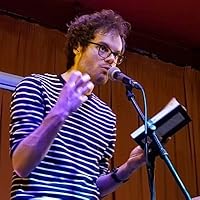
March 22, 2019
The Unauthorised Biography of Ezra Maas (TUBEM) is an incredibly ambitious debut that weaves together metabiography, literary noir, and unashamed pulp-thriller. At the centre is the eponymous Ezra Maas, a mysterious and chameleon-like polymath / artist / cult leader / sociopath whose shadow has fallen across the last 60 years of Western culture. Then there is his biographer Daniel James—or version of him—author of the book itself, who is attempting to penetrate the layers of misdirection and rumour surrounding the man. However, this reasonably simple premise of journalistic cat-and-mouse is soon subsumed into the book’s central motif of labyrinths both physical and metaphysical as James explores the intersections of biography and literature, reality and identity. TUBEM is comprised of transcripts, redacted notes, emails, journal entries and interviews with the many people left scarred by Maas; a bricolage approach that leads you to engage not just with the inherent unreliability of James the writer, but of the form itself.
Touchstones include Raymond Chandler, Elmore Leonard, Auster’s New York Trilogy and Mark Z. Danielewiski’s House of Leaves. TUBEM manages to tack a fresh course through these influences by delivering both a prime example—and deconstruction of—a page-turning thriller; to conjure a feeling of resolution in something that has nothing so simple as an end. It is a book about multiplicity, mirrored in its fragmentary approach; yet it is testament to James’ skill as writer that the narrative thread is never lost, nor the sense of momentum as James the character gets closer to the secret of Maas.
In TUBEM, James has written something that you don’t come across too often: a book that dismantles and devours itself as you read on. Being along for the ride is hugely enjoyable.
Touchstones include Raymond Chandler, Elmore Leonard, Auster’s New York Trilogy and Mark Z. Danielewiski’s House of Leaves. TUBEM manages to tack a fresh course through these influences by delivering both a prime example—and deconstruction of—a page-turning thriller; to conjure a feeling of resolution in something that has nothing so simple as an end. It is a book about multiplicity, mirrored in its fragmentary approach; yet it is testament to James’ skill as writer that the narrative thread is never lost, nor the sense of momentum as James the character gets closer to the secret of Maas.
In TUBEM, James has written something that you don’t come across too often: a book that dismantles and devours itself as you read on. Being along for the ride is hugely enjoyable.

August 3, 2019
Please note: my remarks are based on my having read only a sample of this book. Even that was too much! 😊
This is about as metafictional as you can get. I’m really not interested in committing to an extended piece—full of what I’d call tricks and gimmicks (e.g., endless and tiresome footnotes)—which explores the intersection of biography and fiction, the nature/meaning of authorship and editorial work, the impossibility of accessing the minds of others (biographical subjects), the impact of the biographer’s biases and psychology on his or interpretation of the life of another, author and artist reclusiveness, and so on, and so on, and so on. Some readers might find this unconventional novel playful, stimulating, and entertaining, but I’m not one them. I find literary game-playing of this variety wears thin pretty quickly. Having said that, I expect this will be receiving a good deal of attention (and a fair number of hyperbolic accolades) in this time of “fake news” and alternative facts. To me, it reads like the show-offy work of someone fresh out of grad school in what used to be called “English”.
This is about as metafictional as you can get. I’m really not interested in committing to an extended piece—full of what I’d call tricks and gimmicks (e.g., endless and tiresome footnotes)—which explores the intersection of biography and fiction, the nature/meaning of authorship and editorial work, the impossibility of accessing the minds of others (biographical subjects), the impact of the biographer’s biases and psychology on his or interpretation of the life of another, author and artist reclusiveness, and so on, and so on, and so on. Some readers might find this unconventional novel playful, stimulating, and entertaining, but I’m not one them. I find literary game-playing of this variety wears thin pretty quickly. Having said that, I expect this will be receiving a good deal of attention (and a fair number of hyperbolic accolades) in this time of “fake news” and alternative facts. To me, it reads like the show-offy work of someone fresh out of grad school in what used to be called “English”.

May 22, 2019
This book is different in so many ways. Deciphering fact from fiction is the task which is set of the reader right from the off. It drags the reader along the dark path of Daniel James as he attempts to uncover the truth of the Ezra Maas story. I really didn’t know what to expect but I defy anyone to read it without having a Google tab open on the nearest device to research and attempt to find traces and clues of the key points of this investigation which has a real noir feel. Told via different sources and media, The Unauthorised Biography of Ezra Maas is a jigsaw of the life, works and mysterious background of the elusive artist.
We are led to believe that Ezra Maas is dead and that the Ezra Maas Foundation are covering up his history and artworks and to ensure the finer details of his life are kept from the wider world. Think Andy Warhol meets Scientology. Daniel James is understandably suspicious of the motives of The Foundation and the investigative journalist sets out to uncover the truth. As he delves deeper and starts to uncover and get closer to the heart of this murky world, James himself goes missing in action.
James’ investigations to that point are then picked up and compiled by an anonymous ally and the ensuing story is made up of recovered accounts of the biography written by James himself, newspaper articles, transcripts of telephone calls, recordings and a variety of other sources, often redacted to add to the mystery.
The really strong point of this piece of work is how James evokes an emotive approach. It becomes an immersive experience which draws the reader in, stirs emotions and reflects the author’s thirst for knowledge and paranoia. It leads to a constant questioning of Maas as a real entity and the Wizard of Oz nature of his legend as a conceptual artist. The journey James travels, and brings the reader along with him, is a dark and enthralling see-saw ride.
James has an engaging style which facilitates the pace of a crime novel as shown in this opening to one of the middle chapters:
There was a body in the pool. I stopped moving and considered whether to retrace my steps out of the garden. No one would know I had been there. The only problem was I couldn’t move.
Each page is tagged with lengthy footnotes which I initially found a distraction but soon came to appreciate as an essential tool and commentary to the variety of media on show. The following footnote accompanied the above passage:
Daniel was an expert in noir fiction and saw the role of the biographer as a kind of literary detective…The body in the pool is a recurring motif in noir, particularly those set in LA and Hollywood.
The footnote then proceeds to provide a brief analysis of the significance of this type of scene to the noir genre and how it fits in the story. The level of detail of these accompaniments is quite staggering and it provides for a rich depth to the book which is remarkably informative but never patronising. The heavily researched, factual nature of the notes also adds to the constant question of what is fact and what is fiction.
It took me a good quarter of the book to get into it due to the original and individual style and approach to the form but I’m pleased I stayed with it as it truly is a rewarding read is so many ways. This story could have been told in a much more conformist layout to meet a more mainstream audience but the end result wouldn’t have been anywhere near as effective. The finished product is a brilliant achievement of many years work by James and it was clearly a labour of love for him. This is a stylish piece of art in itself, crossing several genres and if you have an admiration of authors who are willing to take risks to meet their vision, you really should try this book.
I hope you enjoy it and, if Daniel James is ever found, I’d love to read more of his work.
TheBookSpine.com
We are led to believe that Ezra Maas is dead and that the Ezra Maas Foundation are covering up his history and artworks and to ensure the finer details of his life are kept from the wider world. Think Andy Warhol meets Scientology. Daniel James is understandably suspicious of the motives of The Foundation and the investigative journalist sets out to uncover the truth. As he delves deeper and starts to uncover and get closer to the heart of this murky world, James himself goes missing in action.
James’ investigations to that point are then picked up and compiled by an anonymous ally and the ensuing story is made up of recovered accounts of the biography written by James himself, newspaper articles, transcripts of telephone calls, recordings and a variety of other sources, often redacted to add to the mystery.
The really strong point of this piece of work is how James evokes an emotive approach. It becomes an immersive experience which draws the reader in, stirs emotions and reflects the author’s thirst for knowledge and paranoia. It leads to a constant questioning of Maas as a real entity and the Wizard of Oz nature of his legend as a conceptual artist. The journey James travels, and brings the reader along with him, is a dark and enthralling see-saw ride.
James has an engaging style which facilitates the pace of a crime novel as shown in this opening to one of the middle chapters:
There was a body in the pool. I stopped moving and considered whether to retrace my steps out of the garden. No one would know I had been there. The only problem was I couldn’t move.
Each page is tagged with lengthy footnotes which I initially found a distraction but soon came to appreciate as an essential tool and commentary to the variety of media on show. The following footnote accompanied the above passage:
Daniel was an expert in noir fiction and saw the role of the biographer as a kind of literary detective…The body in the pool is a recurring motif in noir, particularly those set in LA and Hollywood.
The footnote then proceeds to provide a brief analysis of the significance of this type of scene to the noir genre and how it fits in the story. The level of detail of these accompaniments is quite staggering and it provides for a rich depth to the book which is remarkably informative but never patronising. The heavily researched, factual nature of the notes also adds to the constant question of what is fact and what is fiction.
It took me a good quarter of the book to get into it due to the original and individual style and approach to the form but I’m pleased I stayed with it as it truly is a rewarding read is so many ways. This story could have been told in a much more conformist layout to meet a more mainstream audience but the end result wouldn’t have been anywhere near as effective. The finished product is a brilliant achievement of many years work by James and it was clearly a labour of love for him. This is a stylish piece of art in itself, crossing several genres and if you have an admiration of authors who are willing to take risks to meet their vision, you really should try this book.
I hope you enjoy it and, if Daniel James is ever found, I’d love to read more of his work.
TheBookSpine.com

April 21, 2019
Are you ready to go down the rabbit hole? Because that is where this book is going to take you! How to describe this book...or even put it in a genre? It is a detective novel, it is both a biography and an autobiography, it is part encyclopedia, it is full of lies and truths and there is no telling which is which, it is nightmarish, a prophecy of sorts, but most of all it is a labyrinth stalked by Ezra Maas...dare you start reading it?
On the day I started this book the following events happened. The Maas Foundation started following me on twitter, a black van parked outside my house and when I walked down the road a blacked out Mercedes slowly followed me.
I have never read anything quite like this, the whole thing is like a puzzle that draws you in and forces you to keep asking questions like, are the typos a clue? Why do some of the chapters not have "End" at the end? Who is Ezra Maas, why can't I find him on google? Why did Google home stop recognising my voice when I asked questions about Ezra Maas? Who is Daniel James? And who the hell is "Anonymous" the person putting this manuscript together?
The book's oddness could put a few people off, for me I struggled with the many many footnotes, that is until I realised there was a story in there too. As Shrek says this book is like an onion, it has so many layers. The main chapters are broken up with interviews, phone conversations, emails, and newspaper reports. This has a real positive effect on the book, it gives you time to take in and process what you've just read.
You're never going to get the full story or all of your questions answered during the first read, this book demands you read it again and again, discovering something new each time. The next time I read this I'm going to focus on those chapters with the missing "End", there must be clue in there.
I've gotta say congrats to Dead Ink books for picking up this book, I've read 3 of their publications (Sealed by Naomi Booth and The Study Circle by Haroun Khan) and all three have been fantastic.
Don't be scared, give this book a go as it does what all good books should do, Take you on an adventure!
Blog review (with pictures) > https://felcherman.wordpress.com/2019...
On the day I started this book the following events happened. The Maas Foundation started following me on twitter, a black van parked outside my house and when I walked down the road a blacked out Mercedes slowly followed me.
I have never read anything quite like this, the whole thing is like a puzzle that draws you in and forces you to keep asking questions like, are the typos a clue? Why do some of the chapters not have "End" at the end? Who is Ezra Maas, why can't I find him on google? Why did Google home stop recognising my voice when I asked questions about Ezra Maas? Who is Daniel James? And who the hell is "Anonymous" the person putting this manuscript together?
The book's oddness could put a few people off, for me I struggled with the many many footnotes, that is until I realised there was a story in there too. As Shrek says this book is like an onion, it has so many layers. The main chapters are broken up with interviews, phone conversations, emails, and newspaper reports. This has a real positive effect on the book, it gives you time to take in and process what you've just read.
You're never going to get the full story or all of your questions answered during the first read, this book demands you read it again and again, discovering something new each time. The next time I read this I'm going to focus on those chapters with the missing "End", there must be clue in there.
I've gotta say congrats to Dead Ink books for picking up this book, I've read 3 of their publications (Sealed by Naomi Booth and The Study Circle by Haroun Khan) and all three have been fantastic.
Don't be scared, give this book a go as it does what all good books should do, Take you on an adventure!
Blog review (with pictures) > https://felcherman.wordpress.com/2019...

May 13, 2019
(3.5) This is a twisty, clever meta novel about “Daniel James” desperately trying to write a biography of Ezra Maas, an enigmatic artist who grew up a child prodigy in Oxford and attracted a cult following in 1960s New York City, where he was a friend of Warhol et al. But, with rumors abounding that The Maas Foundation is preparing to announce Ezra’s death in 2011, James finds that his subject’s story keeps shifting shape and even disappearing around him – as one interviewee tells him, “Maas is a black hole. His presence draws everything in, warps, destroys, changes, and rewrites it.” The book’s epistolary style deftly combines fragments of various document types: James’s biography-in-progress and an oral history he’s assembled from conversations with those who knew Maas, his narrative of his quest, transcripts of interviews and phone conversations, e-mails and more. All of this has been brought together into manuscript form by an anonymous editor whose presence is indicated through coy but increasingly tiresome long footnotes. Look at the sort of authors who get frequent mentions in the footnotes, though, and you’ll get an idea of whether this might appeal to you: Paul Auster, Samuel Beckett, George Orwell and Thomas Pynchon. I enjoyed the noir atmosphere – complete with dream sequences and psychiatric evaluations – and the way that James the “writer-detective” has to careen around Europe and America looking for answers; it all feels rather like a superior Jason Bourne film.
My thanks to the author for sending a free signed copy for review.
My thanks to the author for sending a free signed copy for review.

May 9, 2019
Who is Ezra Maas? Is he Daniel James the author of this ambitious fiction (or is it non-fiction?)? Is he a real artist? Is it a fake name that a group of artists hide behind? Or did James make him up for this book? These are some of the questions that’ll follow you as you delve into James debut novel. The Unauthorised Biography of Ezra Maas is a twisty, mind-bending, maze feat of amazing storytelling.
Everything is up for questioning. What is true and what is false will nag at you as you plunge into James’ account of events that lead to his writing of this book. This might make your head spin at first, but you’ll soon get into the rhythm of the story and find yourself becoming as much of a detective as James is.
The first big thing we have to tackle is who is Ezra Maas. Is he a real person or just a character? This might seem like a funny thing to ask, but trust me when I say it’ll only take a few pages for you to wonder if he really is a made up character.
If he is or isn’t real, we do have some puzzle pieces we can claim to be true. We know that there are pieces of artwork that have Ezra Maas’ signature style. We know that there is an Ezra Maas Foundation. And we know that there is a person named Daniel James that was charged with writing Maas’ biography by an unknown voice over the phone. After that it is all up in the air.
James breaks the story up into multiple parts, giving us all angles of who Maas is as well as how James researched him. We get snippets of articles, emails, phone calls, and an oral history from friends, lovers, enemies, teachers, and followers of Maas. Then there are the sections of James’ actual biography of Maas, that were saved and delivered to an anonymous person. And finally there are the autobiographical sections that follow James as he tries to uncover who Maas is. The jumping back and forth between each of these sections adds tension to the mystery of what happened to James and Maas.
Strung throughout the novel is the fact that no one really knows who Maas is. Our best real world comparison is Banksy, which according to James, took a lot of inspiration from Maas. Which, if want to extrapolate from what we know of Banksy, means Maas could be multiple artists, or could be a fake name for someone else. James uses this mystery, while throwing in real world names, places, and incidents to build you into the narrative as a detective sifting through the facts.
I was so convinced that Maas was real that I tried to find his artwork online. I did find some websites, including a Maas Foundation website, and some articles about an author trying to write a biography on Maas, but I couldn’t find any of his art. Which, as you dig deeper are soon to discover that the Maas Foundation has been systematically removing all of Maas’ artwork from the internet. Does this mean Maas is really out there or did James create a really fun game of interactive fiction?
I found James’ autobiographical journey into writing the biography of Maas extremely enjoyable. Right from the start we are introduced to an anonymous person that was friends with James and through mysterious means received all of James’ notes and finished biography. This plays out like a noir novel with all the tropes of that genre (our anonymous person points out this fact multiple times throughout the story). James also throws in a bit of Hunter S. Thompson’s gonzo style of storytelling into the mix. James has a huge self-destruction streak that bleeds into the biography. This all allows James to stretch and play with mystery plots, biographies, and what it means to be an artist.
The chapters focusing on Ezra Maas come across as the weakest of the parts. They are interesting, adding some color and hints to the mystery, but quickly get a bit too predictable. We get that Maas is a heady artist that is perfect at everything he does, that he knew everybody, that he is a genius. So many names are thrown around that they eventually become noise. There is also a point that the sections become so fantastical that they lose the feeling of being a biography and stray a bit too far into fiction, which doesn’t help making us believe he is real.
However, we do have James’ alibis. There are notes from the anonymous person repeatedly pointing out sections of the biography and autobiography that James might have embellished to increase the noir feeling of the narrative. It’s genius. He gives himself a way out. As long as this voice keeps chiming in, mirroring our own thoughts, we can assume it was done intentionally. There are also paragraphs and chapters there were either missing or censored. We are even lead to believe that the Maas Foundation had gotten ahold of the biography. Layers upon layers.
Overall, I thought this was a well thought out experiment in fiction writing. We are constantly questioning what is real and what isn’t, what’s been tampered with and what has been embellished, who is and who isn’t who they say they are. And these questions push us deeper into the story, turning each page looking for a clue that might give us a grasp on reality.
Maybe Maas is real? Maybe he is out there right now reading this and laughing at the ultimate trick he’s pulled on me. Maybe I’m Maas and I’ve been writing reviews for STORGY for a year to get myself ingrained into your psyche, so that when I review this biography you’ll be compelled to believe I’m telling you the truth. There really is only one way for you to figure that out, and that’s for you to read the book.
Everything is up for questioning. What is true and what is false will nag at you as you plunge into James’ account of events that lead to his writing of this book. This might make your head spin at first, but you’ll soon get into the rhythm of the story and find yourself becoming as much of a detective as James is.
The first big thing we have to tackle is who is Ezra Maas. Is he a real person or just a character? This might seem like a funny thing to ask, but trust me when I say it’ll only take a few pages for you to wonder if he really is a made up character.
If he is or isn’t real, we do have some puzzle pieces we can claim to be true. We know that there are pieces of artwork that have Ezra Maas’ signature style. We know that there is an Ezra Maas Foundation. And we know that there is a person named Daniel James that was charged with writing Maas’ biography by an unknown voice over the phone. After that it is all up in the air.
James breaks the story up into multiple parts, giving us all angles of who Maas is as well as how James researched him. We get snippets of articles, emails, phone calls, and an oral history from friends, lovers, enemies, teachers, and followers of Maas. Then there are the sections of James’ actual biography of Maas, that were saved and delivered to an anonymous person. And finally there are the autobiographical sections that follow James as he tries to uncover who Maas is. The jumping back and forth between each of these sections adds tension to the mystery of what happened to James and Maas.
Strung throughout the novel is the fact that no one really knows who Maas is. Our best real world comparison is Banksy, which according to James, took a lot of inspiration from Maas. Which, if want to extrapolate from what we know of Banksy, means Maas could be multiple artists, or could be a fake name for someone else. James uses this mystery, while throwing in real world names, places, and incidents to build you into the narrative as a detective sifting through the facts.
I was so convinced that Maas was real that I tried to find his artwork online. I did find some websites, including a Maas Foundation website, and some articles about an author trying to write a biography on Maas, but I couldn’t find any of his art. Which, as you dig deeper are soon to discover that the Maas Foundation has been systematically removing all of Maas’ artwork from the internet. Does this mean Maas is really out there or did James create a really fun game of interactive fiction?
I found James’ autobiographical journey into writing the biography of Maas extremely enjoyable. Right from the start we are introduced to an anonymous person that was friends with James and through mysterious means received all of James’ notes and finished biography. This plays out like a noir novel with all the tropes of that genre (our anonymous person points out this fact multiple times throughout the story). James also throws in a bit of Hunter S. Thompson’s gonzo style of storytelling into the mix. James has a huge self-destruction streak that bleeds into the biography. This all allows James to stretch and play with mystery plots, biographies, and what it means to be an artist.
The chapters focusing on Ezra Maas come across as the weakest of the parts. They are interesting, adding some color and hints to the mystery, but quickly get a bit too predictable. We get that Maas is a heady artist that is perfect at everything he does, that he knew everybody, that he is a genius. So many names are thrown around that they eventually become noise. There is also a point that the sections become so fantastical that they lose the feeling of being a biography and stray a bit too far into fiction, which doesn’t help making us believe he is real.
However, we do have James’ alibis. There are notes from the anonymous person repeatedly pointing out sections of the biography and autobiography that James might have embellished to increase the noir feeling of the narrative. It’s genius. He gives himself a way out. As long as this voice keeps chiming in, mirroring our own thoughts, we can assume it was done intentionally. There are also paragraphs and chapters there were either missing or censored. We are even lead to believe that the Maas Foundation had gotten ahold of the biography. Layers upon layers.
Overall, I thought this was a well thought out experiment in fiction writing. We are constantly questioning what is real and what isn’t, what’s been tampered with and what has been embellished, who is and who isn’t who they say they are. And these questions push us deeper into the story, turning each page looking for a clue that might give us a grasp on reality.
Maybe Maas is real? Maybe he is out there right now reading this and laughing at the ultimate trick he’s pulled on me. Maybe I’m Maas and I’ve been writing reviews for STORGY for a year to get myself ingrained into your psyche, so that when I review this biography you’ll be compelled to believe I’m telling you the truth. There really is only one way for you to figure that out, and that’s for you to read the book.
This entire review has been hidden because of spoilers.

November 25, 2018
It is quite a challenge to shoehorn this book into any particular genre. It is certainly a classic detective novel in the style of Chandler or Hammett, even though there is no ‘real’ detective as such. It is also certainly a biography, a factual retelling of the background of one of the 20th century’s most iconic (and unheard of) artists who influenced the likes of Warhol, Basquiat, Beuys and Banksy. It asks more questions than it gives answers.
Ezra Maas was apparently something of an enigma. Fiercely private, he was surrounded by mystery, and then disappeared without a trace several years ago. And not just he did - his legacy did too. All apparently protected (destroyed?) by the foundation set up to manage his estate, which has been so thorough I’ve been unable to find any coherent info on him, let alone examples of his artwork.
It gets more intriguing. This is an unauthorised biography. The Maas Foundation apparently fought tooth and nail to stop the book from being published - there were rumours the initial print run of it disappeared last year ahead of Daniel James’ appearance at the Books on Tyne Festival.
James himself was hired by an unknown client to write this biography - to uncover the truth. A task that proves challenging to a degree of carrying great personal risk, which becomes more and more palpable throughout the book. It is structured in interweaving narratives of journalistic chapters on the life of Ezra Maas and chapters written in the first person in which James recounts his process of retracing Ezra Maas’ footsteps, in the hope of solving the puzzle that is Maas. Newspaper clippings, telephone transcripts, reports, interviews and email correspondence intersperse this. However, nothing is quite as it seems - and how much of it is real?
The book is meticulously researched - it is evident James has a background in journalism. The footnotes themselves are a story within the story, interwoven voices of two, three, multiple narratives. It will leave you changed, baffled and in awe. I devoured it in two sittings.
Ezra Maas was apparently something of an enigma. Fiercely private, he was surrounded by mystery, and then disappeared without a trace several years ago. And not just he did - his legacy did too. All apparently protected (destroyed?) by the foundation set up to manage his estate, which has been so thorough I’ve been unable to find any coherent info on him, let alone examples of his artwork.
It gets more intriguing. This is an unauthorised biography. The Maas Foundation apparently fought tooth and nail to stop the book from being published - there were rumours the initial print run of it disappeared last year ahead of Daniel James’ appearance at the Books on Tyne Festival.
James himself was hired by an unknown client to write this biography - to uncover the truth. A task that proves challenging to a degree of carrying great personal risk, which becomes more and more palpable throughout the book. It is structured in interweaving narratives of journalistic chapters on the life of Ezra Maas and chapters written in the first person in which James recounts his process of retracing Ezra Maas’ footsteps, in the hope of solving the puzzle that is Maas. Newspaper clippings, telephone transcripts, reports, interviews and email correspondence intersperse this. However, nothing is quite as it seems - and how much of it is real?
The book is meticulously researched - it is evident James has a background in journalism. The footnotes themselves are a story within the story, interwoven voices of two, three, multiple narratives. It will leave you changed, baffled and in awe. I devoured it in two sittings.
April 29, 2019
This is a fascinating book that I suspect will haunt me for a long time to come. It is ostensibly about a journalist writing the biography of Ezra Maas, an artist who has disappeared, or died, or maybe never existed and it throws up so many questions about truth, reality and ultimately the difference between fact and fiction. I am not even sure that the author exists, although he just 'liked' my review before I had even written it. Given the paranoia that this book can instill into the mind of the reader, this is quite spooky. At one point I thought the author might really be Tom McCarthy, who I am sure mentions Bas Jan Ader, an artist who really did mysteriously go missing, in one of his books. Maas is a latter-day Zelig who seems to know everyone in the artistic world of the late 20th century from Beckett through Bowie to Banksy. Given that J D Salinger gets a mention too, I couldn't help thinking of that great line at the end of Catcher in the Rye; “What really knocks me out is a book that, when you're all done reading it, you wish the author that wrote it was a terrific friend of yours and you could call him up on the phone whenever you felt like it. That doesn't happen much, though.” Sadly not, but maybe Daniel James will let me know whether he likes my real review.

May 26, 2019
Do you ever remember the 1970s "Concept Album"? Pink Floyd's The Wall is an example; so too is Bowie's Ziggy Stardust.
The Unauthorised Biography of Ezra Maas is a "Concept Novel" in a similar vein. Daniel James has created a Novocastrian artist, Ezra Maas, and dropped him into the real world of modern art history. There are stories of his time at Warhol's Factory, his tour of Europe, his hideaway mansion in Hertfordshire, his near-fatal accident in the Congo, and his withdrawal from public life. Mass's image is managed by the shadowy Maas Foundation which has been buying all his artworks back and removing all trace of him from the Internet. There are no known pictures of Maas, no artworks on public display, no official biography.
The Concept is that a journalist, Daniel James, has been invited to write an unofficial biography of Maas by an anonymous source. James compiles the biography while writing his own gonzo journal of his research. However, James disappears - much like Maas before him - and leaves two partial manuscripts behind to be compiles along with various notes, transcripts and news clippings by an anonymous source - who is himself (herself?) in fear of dire consequences. The anonymous editor then adds to James's own footnotes to offer a form of commentary.
This is all very thorough. The texts are interspersed with real details and real people. And so many details - huge tracts of art theory being marshalled to add granularity to the story. The different narratives contradict and even argue against each other. There is even a website, www.ezramaas.com, that purports to represent the Maas Foundation.
So we have a text that is part mystery, part conspiracy (does Dan Brown write stuff like this?), part criticism of modern art and literature, part parody of reclusive artists. When it is good, it is very good. But it does go on for a long, long time and after a while, some of the details start to repeat. The ending is a let-down but it is difficult to see how Daniel James could have got off the trajectory in any other way.
Ezra Maas is quirky, but it is not unique. There are other novels that gather multiple narratives and footnotes to create some kind of pseudo-academic canon. Recent examples include Memorial Device, Hame, Unity and Nazi Literature in the Americas. Ezra Maas is probably somewhere mid-list in this ambitious genre. The balance should probably have been slightly more tilted towards plot and away from theory; and the characters probably needed to be slightly more clearly delineated. But overall it's a pretty good effort.
The Unauthorised Biography of Ezra Maas is a "Concept Novel" in a similar vein. Daniel James has created a Novocastrian artist, Ezra Maas, and dropped him into the real world of modern art history. There are stories of his time at Warhol's Factory, his tour of Europe, his hideaway mansion in Hertfordshire, his near-fatal accident in the Congo, and his withdrawal from public life. Mass's image is managed by the shadowy Maas Foundation which has been buying all his artworks back and removing all trace of him from the Internet. There are no known pictures of Maas, no artworks on public display, no official biography.
The Concept is that a journalist, Daniel James, has been invited to write an unofficial biography of Maas by an anonymous source. James compiles the biography while writing his own gonzo journal of his research. However, James disappears - much like Maas before him - and leaves two partial manuscripts behind to be compiles along with various notes, transcripts and news clippings by an anonymous source - who is himself (herself?) in fear of dire consequences. The anonymous editor then adds to James's own footnotes to offer a form of commentary.
This is all very thorough. The texts are interspersed with real details and real people. And so many details - huge tracts of art theory being marshalled to add granularity to the story. The different narratives contradict and even argue against each other. There is even a website, www.ezramaas.com, that purports to represent the Maas Foundation.
So we have a text that is part mystery, part conspiracy (does Dan Brown write stuff like this?), part criticism of modern art and literature, part parody of reclusive artists. When it is good, it is very good. But it does go on for a long, long time and after a while, some of the details start to repeat. The ending is a let-down but it is difficult to see how Daniel James could have got off the trajectory in any other way.
Ezra Maas is quirky, but it is not unique. There are other novels that gather multiple narratives and footnotes to create some kind of pseudo-academic canon. Recent examples include Memorial Device, Hame, Unity and Nazi Literature in the Americas. Ezra Maas is probably somewhere mid-list in this ambitious genre. The balance should probably have been slightly more tilted towards plot and away from theory; and the characters probably needed to be slightly more clearly delineated. But overall it's a pretty good effort.
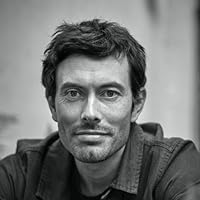
January 30, 2019
If like me you're a fan of mind-bending epic novels that dismantle accepted notions of identity, culture, language, self and consciousness, you will seriously dig this book. Dan James somehow manages to blend a wide range of writing techniques very smoothly. It's unabashedly a neonoir detective story (there are heavy shades of Borges) but there's a lot of journalism, interviews and ever-complexifying narratives and encyclopedic footnotes (with equally heavy shades of DFW) that consciously tread a clever line between truth and art, exploring that idea without ever disappearing up its own arse or feeling dense and inaccessible. A seriously clever novel that asks a lot of important questions that have never needed answers more urgently. (Spoiler alert: it is not big on 'answers', and that's the point.) I loved it, and could see myself rereading it, which is not always the case with longer, high concept books like this.

May 8, 2019
Life wasn’t linear, and if my book hoped to tell the truth it couldn’t be either… you start to lose a sense of where and when… it was a kind of possession.
The Unauthorised Biography of Ezra Maas is quite a read, one so multi-layered as to defy attempts at categorisation from all angles, or any delimiting terms such as modernist, postmodern, metafiction, biography, or gumshoe noir. Daniel James successfully manages to mix the last three or four of these with biography and a crash course in art and architectural history, literature and philosophy, whilst placing a fictionalised version of himself at dead centre: all in all, it’s no mean feat. I thought at first the relentless footnotes would put me off, as they often do with David Foster Wallace, but after a short time their effect was to provide further immersion in the world of The Unauthorised Biography of Ezra Maas, implicating the reader thoroughly in the protagonist’s doomed venture and the dark mystery at the heart of it – at first you feel like you’re drowning in them, but before too long, it’s as if you need them in order to stay afloat. This is even true of the ostensibly irritating ones, the ones that tell you just where a European beer is from and exactly how it’s brewed, or how wild garlic is harvested in the Basque region of Spain for the purposes of local rustic cuisine, or who Fluxus were. About three quarters of the way through The Unauthorised Biography of Ezra Maas, James goes full-on postmodern with a two-page footnote explaining the purpose of all the (500+) footnotes. That’s me kind of sailing close to giving too much away, but as it’s nothing to do with the plot as such, I don’t consider it a spoiler.
The book’s structure is, on a basic level, a documentarian one, like the packages-as-chapters concept employed by Peter Carey in True History of the Kelly Gang taken many steps further, and those ubiquitous footnotes only serve to embellish and reinforce this. The narrative sections are the chapters from James’s book-with-in-a-book, and these are broken up by transcripts of telephone conversations and podcasts, recorded notes made on a smartphone, letters from the authorities concerning the protocol of how you would go about declaring a person dead absent a body, magazine pieces, redactions, oral histories and more, all wrapped up in a classic private detective noir, one with the more than a slight air of otherness, of the supernatural – in many ways it felt a little like Alan Parker’s 1987 classic modern noir movie Angel Heart.
The ostensible plot is that the Daniel James of the novel is contracted by an anonymous agent to write a biography of the reclusive conceptual artist and synaesthetic savant Ezra Mass, who has disappeared, supposedly to prepare his final artwork. The agent offers James an incredible, unspecified amount of money: James is in considerable debt and his career’s on the skids, he’s described by some as a showman and a charlatan, by the anonymous friend providing the footnotes as a man who had always had a complicated relationship with the truth; but there’s more to his taking on the job than this. He’s fascinated, and quickly becomes enmeshed, obsessed, as his mind incrementally disintegrates. The job also pits him against the sinister Ezra Maas Foundation, notoriously litigious, as well as his lunatic fans – the Foundation have been expunging all information on Maas from the internet since his disappearance, leaving only their own website, www.ezramaas.com. This gave the novel a slight <>Blair Witch Project feel, in arms of viral marketing, at least at first – I was also reminded of Adam Nevill’s Last Days, wherein a washed-up indie filmmaker is employed to make a documentary on an international Mansonesque apocalypse cult from the 1970s, and to uncover whatever’s happened to its surviving members, but although I did enjoy Last Days, The Unauthorised Biography of Ezra Maas is a far more accomplished novel, one that will keep you thinking of it between reading sessions, and for long afterwards too, and I’m afraid Last Days seems like pulp by comparison. As Daniel careers around Europe and the United States, meeting warning after warning, encountering horror after death after portent, and more and more disturbing pieces of information about Mass’s past and the origins of the Foundation, we are there with him each and every step of the way, holding his hand, telling him, no Dan, don’t look, take a step back, please, no more mate; can’t you see what going on here, knowing all the time that he can’t. Because he has to go on, he has no choice. He’s chasing, among other things, the last copy of an unnamed film Maas made, one with encoded mathematical messages that are said to drive the viewer insane and to have seizures – indeed, the first death he encounters, Jane, pleads with him via her diary/suicide note, don’t watch the film. Rarely have I felt so thoroughly involved with and hypnotised by a novel. Because this seems like more than just another book. It will not so much draw you in as drag you to its febrile core, shaking your bones to dust and robbing you of all sleep and peace of mind as you go. Really. I mean it. Five stars.
The Unauthorised Biography of Ezra Maas is quite a read, one so multi-layered as to defy attempts at categorisation from all angles, or any delimiting terms such as modernist, postmodern, metafiction, biography, or gumshoe noir. Daniel James successfully manages to mix the last three or four of these with biography and a crash course in art and architectural history, literature and philosophy, whilst placing a fictionalised version of himself at dead centre: all in all, it’s no mean feat. I thought at first the relentless footnotes would put me off, as they often do with David Foster Wallace, but after a short time their effect was to provide further immersion in the world of The Unauthorised Biography of Ezra Maas, implicating the reader thoroughly in the protagonist’s doomed venture and the dark mystery at the heart of it – at first you feel like you’re drowning in them, but before too long, it’s as if you need them in order to stay afloat. This is even true of the ostensibly irritating ones, the ones that tell you just where a European beer is from and exactly how it’s brewed, or how wild garlic is harvested in the Basque region of Spain for the purposes of local rustic cuisine, or who Fluxus were. About three quarters of the way through The Unauthorised Biography of Ezra Maas, James goes full-on postmodern with a two-page footnote explaining the purpose of all the (500+) footnotes. That’s me kind of sailing close to giving too much away, but as it’s nothing to do with the plot as such, I don’t consider it a spoiler.
The book’s structure is, on a basic level, a documentarian one, like the packages-as-chapters concept employed by Peter Carey in True History of the Kelly Gang taken many steps further, and those ubiquitous footnotes only serve to embellish and reinforce this. The narrative sections are the chapters from James’s book-with-in-a-book, and these are broken up by transcripts of telephone conversations and podcasts, recorded notes made on a smartphone, letters from the authorities concerning the protocol of how you would go about declaring a person dead absent a body, magazine pieces, redactions, oral histories and more, all wrapped up in a classic private detective noir, one with the more than a slight air of otherness, of the supernatural – in many ways it felt a little like Alan Parker’s 1987 classic modern noir movie Angel Heart.
The ostensible plot is that the Daniel James of the novel is contracted by an anonymous agent to write a biography of the reclusive conceptual artist and synaesthetic savant Ezra Mass, who has disappeared, supposedly to prepare his final artwork. The agent offers James an incredible, unspecified amount of money: James is in considerable debt and his career’s on the skids, he’s described by some as a showman and a charlatan, by the anonymous friend providing the footnotes as a man who had always had a complicated relationship with the truth; but there’s more to his taking on the job than this. He’s fascinated, and quickly becomes enmeshed, obsessed, as his mind incrementally disintegrates. The job also pits him against the sinister Ezra Maas Foundation, notoriously litigious, as well as his lunatic fans – the Foundation have been expunging all information on Maas from the internet since his disappearance, leaving only their own website, www.ezramaas.com. This gave the novel a slight <>Blair Witch Project feel, in arms of viral marketing, at least at first – I was also reminded of Adam Nevill’s Last Days, wherein a washed-up indie filmmaker is employed to make a documentary on an international Mansonesque apocalypse cult from the 1970s, and to uncover whatever’s happened to its surviving members, but although I did enjoy Last Days, The Unauthorised Biography of Ezra Maas is a far more accomplished novel, one that will keep you thinking of it between reading sessions, and for long afterwards too, and I’m afraid Last Days seems like pulp by comparison. As Daniel careers around Europe and the United States, meeting warning after warning, encountering horror after death after portent, and more and more disturbing pieces of information about Mass’s past and the origins of the Foundation, we are there with him each and every step of the way, holding his hand, telling him, no Dan, don’t look, take a step back, please, no more mate; can’t you see what going on here, knowing all the time that he can’t. Because he has to go on, he has no choice. He’s chasing, among other things, the last copy of an unnamed film Maas made, one with encoded mathematical messages that are said to drive the viewer insane and to have seizures – indeed, the first death he encounters, Jane, pleads with him via her diary/suicide note, don’t watch the film. Rarely have I felt so thoroughly involved with and hypnotised by a novel. Because this seems like more than just another book. It will not so much draw you in as drag you to its febrile core, shaking your bones to dust and robbing you of all sleep and peace of mind as you go. Really. I mean it. Five stars.
May 14, 2019
Postmodernism is notoriously difficult to define. After spending nearly seven years in the academy, I listened to dozens of the countrys smartest people explain this slippery concept, and, in their own unique ways, every one of them failed. Maybe it's because so much of postmodern theory is predicated on the absence of things. Namely, the absence of stable referents like nature and god and history that underpinned previous epochs. So no wonder my tutors failed. After all, how do you describe something that isn't there? How do you speak about silence? Well, as far as Daniel James is concerned, you write a debut-novel called The Unauthorised Biography of Ezra Maas. You start with the words "This book is dangerous" and then proceed to work through every postmodern trope before ending on the most disturbing idea of all, the dissolution of the I.
That I is also called Daniel James, the narcissistic journalist and professional outrage merchant tasked with writing the story of Ezra Maas, a kind of post-modern renaissance man who disappeared without a trace while working on his final masterpiece. In just one of many nods to the hard-boiled detective genre, the narrative begins with a phone call in the dead of night. During his quest to uncover the truth behind Mass and his final work, James stumbles across a dead body floating in a pool, is outwitted by femme-fatales and mysterious widows, gets beaten to a pulp by nameless goons, and downs enough hard liquor to give Phillip Marlowe the shakes. Just don't expect any nice neat endings. James stumbles across plenty of clues, but the world of Ezra Mass is one where the more you learn, the less you understand.
The Unauthorised Biography of Ezra Maas is a different kind of detective story, one that poses philosophical questions about identity, subjective experience, language, and the very nature of truth. It's part of a rarified sub-genre that has fascinated some of the true greats of modern fiction, including Kafka, Nabakov, Auster, and Delillo. And like the most compelling characters who populate this unique genre, James's obsession with uncovering the truth soon descends into madness and despair.
Like much postmodern fiction, James focuses on the artifice of narrative, and, by extension, the artifice of meaning. However, like the very best postmodern fiction, he goes one step further. He applies the same logic to the idea of self, which, when reduced to just another "concept," disappears from underneath his narrator's feet - and with disastrous consequences. At the end of the novel, the narrator Daniel James, “a man of letters”, shatters into a million tiny pieces. His inverted epiphany that words are only words means he is lost forever in silence, leaving the reader to contemplate their own “existence” (or even "non-existence") within the tangled web of language and signs. The Unauthorised Biography of Ezra Maas follows a strand of postmodern theory to its logical endpoint, but be warned; this particular thought experiment is especially unsettling.
But it's also oddly exhilarating. Closing the book for the last time reminded me of that glorious moment when the mind begins to reorder itself after an intense psychedelic trip. You breathe a sigh of relief, thankful that you've made it back to reality. But in the next blink of the eye, you realise that the world you've returned to is ever so slightly different from the one you left. It's as if an extra layer of meaning has revealed itself, a new dimension of experience where silence is the only language. And isn't this, in the end, what all great books are supposed to do?
The Unauthorised biography of Ezra Maas is a complicated, compelling, and highly accomplished debut. It’s essential reading for anyone interested in fiction that explores the deepest and most disturbing aspects of what it means to be a “modern” human being.
'Review originally published on Subscript.It'
July 30, 2022
“I’ll have you know, now reading Daniel James book The Unauthorised Biography of Ezra Maas, I already hold him in very high regard as being in the class of author that is progressively pushing forward our notions of the very boundaries surrounding our ideas of what the novel is capable of achieving as one of our culture’s highest art forms!”
-Phillip Freedenberg
Author of America and the Cult of the Cactus Boots: A Diagnostic
Buffalo, NY
July 2022
-Phillip Freedenberg
Author of America and the Cult of the Cactus Boots: A Diagnostic
Buffalo, NY
July 2022

July 26, 2019
Oh, man, I love this book. I love literary mysteries (and it's got all the tropes associated with those) about reclusive artists (now that's a precise genre). I'm thinking of Pessl's Night Film which I liked a great deal, and a weird one called The Absolution of Roberto Acestes Laing.
Started seeing secret signs in the book. Like, occasionally, there would be a too-long gap between words. Is that important? Should I note the word before the gap...or after? Or maybe it's the page number that's important in this regard. Or how many lines from the top. Or the bottom? And I noticed one foot note number was not superscripted--it was the same size as the text. Was that a secret to something? What have I tapped here?
You should read it at night. It's more fun that way.
Started seeing secret signs in the book. Like, occasionally, there would be a too-long gap between words. Is that important? Should I note the word before the gap...or after? Or maybe it's the page number that's important in this regard. Or how many lines from the top. Or the bottom? And I noticed one foot note number was not superscripted--it was the same size as the text. Was that a secret to something? What have I tapped here?
You should read it at night. It's more fun that way.

July 29, 2022
I think my copy of The Unauthorized Biography of Ezra Maas was sprayed with the same hallucinogen as his art brochures because I couldn’t put this down. Everyone reads a lot of good, successful books. Do you ever pick up and see what an outstanding piece of art that said book is? This book is one.
From design to typeface to art work this book is just gorgeous. It’s also one major mind F. In the best possible way. It’s impeccably researched. It’s the best type of mystery novel. It’s journalism at its pinnacle. To quote the author himself, “it’s incredible…impossible…insane…”
I’m buying for whatever Daniel James or Ezra Mass is selling. If I could only get my hands on some of those pieces. That Gardenback piece from 1972 (year of my birth) would look sick in my living room.
Anyways, long live Ezra Maas.
Ummm, a million ⭐️
From design to typeface to art work this book is just gorgeous. It’s also one major mind F. In the best possible way. It’s impeccably researched. It’s the best type of mystery novel. It’s journalism at its pinnacle. To quote the author himself, “it’s incredible…impossible…insane…”
I’m buying for whatever Daniel James or Ezra Mass is selling. If I could only get my hands on some of those pieces. That Gardenback piece from 1972 (year of my birth) would look sick in my living room.
Anyways, long live Ezra Maas.
Ummm, a million ⭐️
April 13, 2019
Just finished reading #theunauthorisedbiographyofezramaas by #DanielJames WHOA! Where does the #fiction stop and the #facts start? A #mindbending #read that is fully loaded with #noirfiction and #twists and #turns Imagine #TwinPeaks meets #DashellHammet If you read only one book this year, READ THIS BOOK!
May 16, 2019
I will be honest when I was first asked by Dan James to review his book. The Unauthorised Biography of Ezra Maas. I was unsure whether it would keep my attention. It wasn’t what I usually like to read. However, as they say don’t judge a book by its cover. So, I agreed, I am so pleased I did as it has become my book of the year so far for 2019.
From the first page I was swept into a world of red-herrings, encrypted clues, and a life that breathed as soon as you read the first sentence. What I loved most was how Dan was able to blur the lines between reality and fiction. Immersing the reader into a world of mystery and biography writing that the great Hunter S Thompson would of been proud of. It is gonzo journalism at its finest. As the pages ran away from me. I found myself constantly questioning whether I was reading about a real person. Did Ezra Maas totally exist? If so, why hasn’t his disappearance made national headlines? Why hasn’t his family been shouting from the rooftops? What do they really have to hide? These were only a sample of the questions that formed in my mind as I devoured this book in two sittings.
Dan’s voice for a debut novel is charming making you trust him, even though there’s a nagging voice in the back of your head screaming don’t he’s lying. This is a major strength of his writing, and enables him to abuse your trust leading you down paths of drama, intrigue, and double bluffs that makes for an enjoyable thrill ride. Asking you to piece together the numerous clues he presents, and decipher the deeply layered story of the mysterious Ezra Maas. From the premature death of his brother which has a profound affect upon him, to Ezra been compared to geniuses such as Einstein and Mozart. Dan shows us both sides of Ezra. This allows Dan to have your undivided attention from the off as he takes you on a whistle stop tour of Europe and beyond. Making you sprint along the banks of the Seine in Paris to escape an unseen danger to Newcastle’s northern charm. He bares it all without reducing the quality of the plot.
This book bleeds uniqueness. I adored how it was written using many different methods to entice the reader from interview transcripts, diary entries, and James’s own personal notebook where he gives you previously unseen information on the enigma that is Ezra Maas. Including unseen photos and his last known location. These clues only help to feed your excitement further. As you get closer to your goal you begin to wonder could Ezra be an alternative personality for James. A persona he uses to escape from the struggles in his own life. This is what I mean by Dan blurring the lines of reality. Ezra feels real to me. I got lost in his world feeling as though I was talking to an old friend. It makes you wonder where does Ezra Maas end, and Dan James begin or vice versa.
This is a book that you could read countless times and it would still have you questioning your own sanity. I didn’t want it to end. Dan has captured the essence of what it truly means to be a gonzo writer exposing a character to the world that’s undeniably believable. Take a bow Mr James. You get 5 stars. I would give it more if I could. Simply incredible. Read it now it will blow your mind. Dan is the new Hunter S Thompson. I can’t wait to see what he produces next. A fresh new voice in the world of fiction.
From the first page I was swept into a world of red-herrings, encrypted clues, and a life that breathed as soon as you read the first sentence. What I loved most was how Dan was able to blur the lines between reality and fiction. Immersing the reader into a world of mystery and biography writing that the great Hunter S Thompson would of been proud of. It is gonzo journalism at its finest. As the pages ran away from me. I found myself constantly questioning whether I was reading about a real person. Did Ezra Maas totally exist? If so, why hasn’t his disappearance made national headlines? Why hasn’t his family been shouting from the rooftops? What do they really have to hide? These were only a sample of the questions that formed in my mind as I devoured this book in two sittings.
Dan’s voice for a debut novel is charming making you trust him, even though there’s a nagging voice in the back of your head screaming don’t he’s lying. This is a major strength of his writing, and enables him to abuse your trust leading you down paths of drama, intrigue, and double bluffs that makes for an enjoyable thrill ride. Asking you to piece together the numerous clues he presents, and decipher the deeply layered story of the mysterious Ezra Maas. From the premature death of his brother which has a profound affect upon him, to Ezra been compared to geniuses such as Einstein and Mozart. Dan shows us both sides of Ezra. This allows Dan to have your undivided attention from the off as he takes you on a whistle stop tour of Europe and beyond. Making you sprint along the banks of the Seine in Paris to escape an unseen danger to Newcastle’s northern charm. He bares it all without reducing the quality of the plot.
This book bleeds uniqueness. I adored how it was written using many different methods to entice the reader from interview transcripts, diary entries, and James’s own personal notebook where he gives you previously unseen information on the enigma that is Ezra Maas. Including unseen photos and his last known location. These clues only help to feed your excitement further. As you get closer to your goal you begin to wonder could Ezra be an alternative personality for James. A persona he uses to escape from the struggles in his own life. This is what I mean by Dan blurring the lines of reality. Ezra feels real to me. I got lost in his world feeling as though I was talking to an old friend. It makes you wonder where does Ezra Maas end, and Dan James begin or vice versa.
This is a book that you could read countless times and it would still have you questioning your own sanity. I didn’t want it to end. Dan has captured the essence of what it truly means to be a gonzo writer exposing a character to the world that’s undeniably believable. Take a bow Mr James. You get 5 stars. I would give it more if I could. Simply incredible. Read it now it will blow your mind. Dan is the new Hunter S Thompson. I can’t wait to see what he produces next. A fresh new voice in the world of fiction.

May 2, 2019
This is a disturbing, challenging, monumental, labyrinthine, gripping construction. It’s the [extremely] unauthorised biography of the reclusive conceptual artist, the late Ezra Maas. I confess I had never heard of him, but perhaps that’s not surprising since it’s clear from this book that the Maas Foundation, a shadowy and possibly sinister organisation, is so protectionist of his estate that it effectively operates a news blackout on him.
The author’s name on the cover is Daniel James, a journalist who was commissioned by an unknown client to write Maas’ biography, but in fact the work is curated by an anonymous friend of James’s, since the journalist has disappeared. Someone purporting to be a journalist called Daniel James has subsequently appeared at book launches, but this book leaves you utterly baffled as to what “truth” is.
The reader is thrown in at the deep end: an unsettling introduction by Anonymous, complete with footnotes. And then the book is made up of transcripts, interviews, emails, James’s own manuscript (both footnoted and redacted). The changes of pace and style keep up the intrigue throughout – a fabulous achievement. I can definitely see this becoming a cult novel.
The author’s name on the cover is Daniel James, a journalist who was commissioned by an unknown client to write Maas’ biography, but in fact the work is curated by an anonymous friend of James’s, since the journalist has disappeared. Someone purporting to be a journalist called Daniel James has subsequently appeared at book launches, but this book leaves you utterly baffled as to what “truth” is.
The reader is thrown in at the deep end: an unsettling introduction by Anonymous, complete with footnotes. And then the book is made up of transcripts, interviews, emails, James’s own manuscript (both footnoted and redacted). The changes of pace and style keep up the intrigue throughout – a fabulous achievement. I can definitely see this becoming a cult novel.
Displaying 1 - 30 of 93 reviews