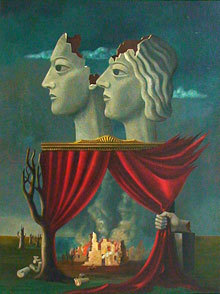
A survey of the phases of Expressionism from its beginnings in 1905 to the 1970s. It examines Expressionist art in the context of the history of philosophy and social ideas and looks at the movement's intellectual milieu, subject matter, iconography, style, social psychology and art criticism.
Unlike, for example, Dietmar Elger's Expressionism: A Revolution in German Art, which I would recommend to anyone with an interest in the period, I would only suggest Gordon's work to someone studying it in a serious, academic way. Whereas Elger gave a factual overview, Gordon is doing a more standard academic "study" which is more in-depth, analytic, subjective [that is, one could disagree with his interpretations], and sporadic [i.e. focusing on certain pieces or issues with are of interest to him, rather than attempting any sort of complete coverage of a topic]. I would also not recommend this to casual readers because the book is wider than it is tall with the text arranged in columns in a not very attractive font -- like a textbook. I skipped quite a bit of the text just because I found it visually unpleasant. However, I do appreciate that he mentioned some areas of Expressionism that are usually left out, such as the Swedish De Unga group.
I appreciate Gordon's book for driving home the simplest point about Expressionism, that it is defined as a response and reaction against the "period of decline" (i.e. Post-Victorian culture and thought) toward the end of the 19th century. In this light, and the light of Nietzsche so well explained, the reader can see how such periods are necessary as prerequisites to Renewal.
In this light, expressionism can be explored as an affirmation of life, and a celebration of human potential. Expressionists and Fauves invoked Walt Whitman, declared the equality of women, rejected Darwin's concept of "instinct," and "wanted to break the back of classic art." The color and life of expressionist art proclaims this pro-vital spirit.
Expressionism ends up embodying a tension between optimism and pessimism; creation and destruction. Various stripes of the movement could bring out either side, or a combination. Expressionism well explained, and engaging.
i read this as a part of my independent research project - as my thesis shifted, i still wanted to read what's considered Gordon's "most important" work. he provides a refreshing perspective and well-organized timeline of the history of expressionism and its reception. maybe i would have given it five stars if i read it for leisure instead of for a project, haha!