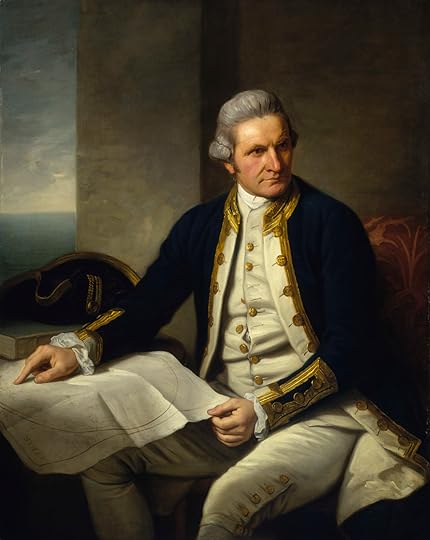
Commonly regarded as the greatest sea explorer of all time, James Cook made his three world-changing voyages during the 1770s, at a time when ships were routinely lost around the English coast. He made history by making geography-- sailing through previously unknown southern seas, charting the eastern Australian coast and circumnavigating New Zealand, putting many Pacific islands on the map, and exploring both the Arctic and Antarctic. His men suffered near shipwreck, were ravaged by tropical diseases, and survived frozen oceans; his lieutenants-- including George Vancouver and William Bligh-- became celebrated captains in their own right. Exploits among native peoples combined to make Cook a celebrity and a legend. Cook is not, however, viewed by all as a heroic figure. Some Hawaiians demonize him as a syphilitic rascist who had a catastrophic effect on local health. Indigenous Australians often see him as the violent dispossessor of their lands. Nicholas Thomas explores Cook's contradictory character as never before, by reconstructing the many sides of encounters that were curious and unusual for Europeans and natives alike. The result of twenty years' research, Thomas's magnificently rich portrait overturns the familiar images of Cook and reveals the fascinating and far more ambiguous figure beneath.
This is a marvelous biography of the British explorer Captain James Cook. It is very eloquently written. The author delves into the complex relationship between the British sailors and the varied peoples they encountered in their long voyages in the vast Pacific areas – like the Maori of New Zealand, aborigines in Australia, Tahitians, the inhabitants of Tierra del Fuego, Hawaiians (where Cook was killed) – and many more.
The area that Cook’s three voyages covered is immense – with unlimited variations in landscape and weather. In addition to the Pacific Ocean, the first two voyages went to Antarctica and the last voyage beyond the Bering Strait in Alaska-Russia.
Page 166-67 (my book) towards Antarctica
By the second week of December [1772], the weather was [Cook commented] ‘thick and hazy’. There were frequent sleet and snow storms. Icebergs, or rather ‘ice islands’ miles in diameter began to surround the ship. Some members of the crew would have seen ice in the north Atlantic, but no one had seen such prodigious ice masses, which were, from a detached perspective, curious and impressive. As Cook put it, they ‘exhibited a view which for a few moments was pleasing to the eye; but when we reflected on the danger, the mind was filled with horror.’ The great swells broke upon them as they broke upon any reef, and scarcely anywhere else could the outcome of shipwreck be so certainly fatal... then [they] moved east and south again; the weather was a little warmer, but there was still much snow and sleet that froze in the rigging, sails and blocks, so ‘as to make them exceedingly bad to handle’. But, he [Cook] reported, the people dealt with these hardships ‘with a steady perseverance, and withstood this intense cold much better than I expected’.
As the author points out, Cook, as an adult, spent more time at sea than in his native England. Prior to his Pacific expeditions, Cook was in North America mapping the Canadian coastline, more so around Newfoundland. Cook’s reputation was made by his cartographic maps which were, for the era, excellent and valuable. Often maps were not shared with other European countries (namely France, Spain, Holland...).
Cook’s first voyage was from August, 1768 to July, 1771; the second voyage from July, 1772 to July, 1775; and the last voyage from June, 1776 and Cook was killed in 1779.
In scale these were monumental voyages with about only one-hundred men on a boat journeying on their own in the endless Pacific. This is indeed self-reliance. They had to rely on food and supplies (like wood for ship repairs) from the Pacific Islanders. They had to negotiate with them and come to trading terms – with peoples of a different language and culture. Overall, given the circumstances, it is remarkable that there was so little overt conflict. The author analyzes the many facets of these complex relationships from different perspectives. For example there could be many groups on these islands competing for favours (power, goods, and just an understanding of who these British invaders were). Some people would represent themselves as being leaders of their community – when in fact they held little power.
Cook seems to be a rationalist (he was a cartographer after all) – who tried to observe and to understand – but often saw events from a European perspective. In many ways he respected the people’s he encountered more than the members of his crew, whose behavior he often found objectionable (lascivious). Interestingly Cook was more accepted in the Pacific where he was the leader of his crew and boat, than in England, where he was simply treated as a mariner by the upper classes.
The author also presents these voyages as explorations on several levels. There was always a scientist aboard (at that time called a naturalist), cartographers, and artists. There was much collecting of artifacts and plants. Observations were recorded which were later published very successfully as books. A few Tahitians voluntarily made the journey with them back to England.
After Cook’s demise the explorations continued, with the two ships (there were two ships on the second and third voyages) leaving Hawaii and setting off again for the north Pacific, this time on the Russian coast.
This is a magnificent book, on surely, one of the world’s greatest explorers.
Nicholas Thomas' The Extraordinary Voyages of Captain James Cook is an excellent book. However, readers should be aware, as the author goes to great trouble to explain in his introduction, it does not deal with Cook as either a navigator or an explorer. Moreover, it does not comment on the race for empire in the Pacific being disputed by the European countries during the era. Thomas' book is about an intelligent man's reactions to wide variety of foreign cultures that he encounters as he conducts a voyage having the purpose of exploring the Pacific Ocean As presented by Thomas, Cook performed what resembles a statistical random walk in which the best predicator of one event (or state) is the previous state plus an undefined error function. In other words, at each point of landing during his three voyages, Cook assumed that the culture, language and social structures of the island would ressembled those of the previous island. In this way he assumed that the Maoris would be something like the Tahitans and that the Tongans would be similar to the residents of the New Hebrides . In some instances, the assumption worked moderately well. In other instances (landing in Alaska after Hawaii) the approach was no help at all. Cook was made commander of the expeditions because of his solid skills as a naval commander and his remarkable talent as a cartographer. His aptitude or lack of it for intercultural diplomacy was never a consideration. Cook, however, rose to the occasion. He attempted to learn the languages and made every effort to study the culture at each stop. Inevitably he made mistakes that cost lives both of his crew members and of the residents of the islands he visited. Ultimately, one of his blunders cost him his own life. Although Thomas is writing history, he uses his professional expertise as an anthropolgist to great effect. Fieldwork conducted according to a formal academic methods did not begin until more than 100 years after Cook's death. There is of course no way to project backwards to determine the nature of the societies at the time they were visited by Cook. However, the modern historian can legitimately as Thomas does comment on the likely accuracy of the perceptions of Cook and his crew members having been correct in any given instance. At times, Thomas believes that Cook badly misunderstood the situation that he was in. At other times Cook was probably understood the situation quite well. In expressing his opinions on the various cultural encounters, Thomas is consistently enlightening but always very careful not to push his analysis further than the evidence warrants. Nicholas Thomas' The Extraordinary Voyages of Captain James Cook is a superb reflection on the early meetings of Europeans and the peoples of the Pacific. Without ever adopting an adulatory tone, it also presents a fascinating portrait of a truly remarkable man.
Sitting on our verandah on a quiet Sunday today staring out to see boats moving up and down the Straits of Malacca, I read this outstanding biography of a unparalleled navigator and brave explorer, whose advances in shipboard hygiene and nutrition set the standard for ship and sailors thereafter.
It was easy to imagine the Endeavor tacking along the channel. I was fascinated by the description of Cook and his crew negotiating the shoals of the Great Barrier Reef and just barely avoiding having their ship thrust onto the sharp coral.
What an adventure!!! Better than going to the movie theatre.
This book encompasses all three great voyages that Captain Cook commanded. Breathtaking in scope, his voyages of exploration forever changed how Europe viewed the globe in general, and the Pacific ocean in particular. Over the course of the voyages are the usual exciting episodes, near-death experiences, as well as deadly experiences. The general panopoly of natives is on display, with Cook and his crew acting as ambassadors of the West, sometime honorably, often dishonorably. Alas, Cook's life would be cut short by native Hawaiians in 1779. Much like Magellan and Drake, Cook "lived by sea, died on it, and was buried in it." While this book is a good read, the writing is a little more turgid than say Nathaniel Philbrick or Laurence Bergreen. Nevertheless, it is well worth your time.
A fairly difficult read, especially at the beginning, but it turns out to be worth the effort. Fascinating to discover all of the cultures of the various people throughout the South Pacific. The interesting part of the book is how the author spends a lot of time looking at the interactions through Captain Cook's eyes as well as from the native people's perspective.
This is probably the best biography of Captain James Cook that I have found. It is a fascinating study into a man who was an awesome explorer, a crucial part of history, and a disciplined leader. The book takes an honest look at Cook and shows that even great leaders have many flaws, and are not looked upon as great by all.
Well researched and presented summary of Cook's three voyages. The many discoveries are recorded in detail. Although he didn't discover Antarctic or the northwest passage he explored the South Pacific and northwest extensively. He visited Australia, New Zealand, Tahiti, Hawaii, Alaska and Kamchatka on his multi year journeys. The text is accompanied by numerous illustrations and excellent maps in a rear section. If your interest in the discovery of these lands and the challenges of ocean going sailing ships is strong, this is a great read!
This book only tells of Cook’s voyages and the planning of them it doesn’t tell the rest of his story. Very detailed of the islands he visited and his interactions with the different native cultures; Tahitian, Maori, Australian Aboriginals, Hawaians etc. There is some speculation on what happened but a lot of it is based on first hand sources of Cook and the other members of the expeditions papers.
Fewer things are better than a good sea story dealing with unexplored regions of the world. Captain James Cook's British Naval expeditions in the late 1700's were some of the last expeditions to the unexplored parts of the world. For introducing the subject and telling a good story, Thomas does an excellent job of introducing the reader to the inherent problems in leading a naval and scientific expedition and first contact with Pacific Islanders.
In many ways, today's outer space missions are less complicated than Cook's expeditions.
The anthropology sections of this book are the weakest sections, but there are simply few ways to understand the native Pacific islanders of Hawaii and Polynesia and the Maori peoples of New Zealand and Aborigines of Australia.
Cook's legacy is somewhat mixed in the Pacific basin, though to his credit, he handled first contact issues as well as he probably could. His death that resulted from an altercation with some Hawaiian tribe members was a bit of a tragedy, for few of his generation had as much patience in dealing with the inherent issues of Western and native interaction.
For the reader wanting a solid introduction to one of history's greatest explorers and one of the greatest sea stories, this is a worthwhile book.
True, this book did help me answer a "Jeopardy" question correctly (about the island of Tierra del Feugo). But it is not an easy book to read - took me about four months. The author documents almost every aspect of Cook's three world journeys, in which he encounters diverse and sometimes hostile island peoples, crew discontent, bad weather, and countless cultural misunderstandings that get people killed. The last mistake of his life was taking a Hawaiian chief hostage in an attempt to get a stolen goat back. The author certainly did his research, and cites journals by Cook and many shipmates, as well as looking into Pacific Islander histories and English texts of the time. However, like Cook's long adventures, reading this is quite the undertaking. Haven't read "Blue Latitudes" by Tony Horwitz, which I've heard is more humorous and biased toward Cook.
Fast-moving and fascinating account of Captain Cook's three around-the-world voyages, culminating in his death at the hands of Hawaiian peoples who apparently mistook him for a god based on his ill-timed arrival and departual schedule.
The concept of leaving on just one 3-year trip in uncharted lands so far from home and family and communication with them seems even more astounding and heroic today in the age of always available, always on communication. Of course, Cook and his crew weren't t always heros, displaying at times the reflexive racism and cultural arrogance of the age of Empire that spawned the exploration in the first place. However, it is interesting to watch Cook's attitudes change and mature during the voyages.
Is there a greater adventure through unknown seas than the 3 voyages of Capt. Cook? I thoroughly enjoyed this book and would highly recommend it to anyone interested in Cook's explorations, his impact on the cultures of the South Pacific, and his untimely end on the island of Hawaii. A well-researched and well-written historical account of these epic voyages that took Capt. Cook and his crew around the world 3 times and each trip took years to complete.
Let's get drunk and explore the world, meet exotic people, and kill them. Great prespective on how the Pacific was explored and how those experiences were shared with the people back home in England. Good read.