Jump to ratings and reviews
Rate this book

Shut Out: How a Housing Shortage Caused the Great Recession and Crippled Our Economy

Rate this book
The United States suffers from a shortage of well-placed homes. This was true even at the peak of the housing boom in 2005. Using a broad array of evidence on housing inflation, income, migration, homeownership trends, and international comparisons, Shut Out demonstrates that high home prices have been largely caused by the constrained housing supply in a handful of magnet cities leading the new economy.

The same phenomenon is occurring in leading countries across the globe. Gentrifying cities have become exclusionary bastions in the new postindustrial economy. The US housing bubble that peaked in 2005 is more accurately described as a refugee crisis than a credit bubble. Surging demand for limited urban housing triggered a spike of migration away from the magnet cities among households with moderate and lower incomes who could no longer afford to remain, causing a brief contagion of high prices in the cities where the migrants moved.

In this book, author Kevin Erdmann observes that the housing bubble has been broadly and incorrectly attributed to various "excesses." Policymakers and economists concluded that our key challenge was that we had built too many homes. This misdiagnosis of the problem, according to Erdmann, led to misguided public polices, which were the primary cause of the subsequent financial crisis. A sort of moral panic about supposed excesses in home lending and construction led to destabilizing monetary and regulatory decisions. As the economy slumped, a sense of fatalism prevented the government from responding appropriately to the worsening situation.

Shut Out provides a much-needed correction to the causes and consequences of financial crises and secular stagnation.

420 pages, Kindle Edition

Published January 21, 2019

14 people are currently reading
198 people want to read

About the author

Ratings & Reviews

What do you think?
Rate this book

Friends & Following

Create a free account to discover what your friends think of this book!

Community Reviews

5 stars
11 (37%)
4 stars
10 (34%)
3 stars
7 (24%)
2 stars
0 (0%)
1 star
1 (3%)
Displaying 1 - 5 of 5 reviews
84 reviews75 followers
September 3, 2021
Why did the US have an unusually bad recession in 2008, followed by years of disappointing growth?

Many influential people attribute it to the 2004-2006 housing bubble, and the ensuing subprime mortgage crisis, with an implication that people bought too many houses. Erdmann says: no, the main problems were due to obstacles which prevented the building and buying of houses.

He mainly argues against two competing narratives that are popular among economists:
* increased availability of credit fueled a buying binge among people who had trouble affording homes.
* there was a general and unusual increase in the demand for homes.

Reframing the Housing Bubble
There was a homebuilding boom, somewhat catering to those who wanted lower-than-average priced houses.

There was also an important surge in prices for houses, which was mildly concentrated on houses priced below average.

Many pundits put those two together, to conclude that the boom was caused by loose credit, which fueled purchases by people who couldn't quite afford a house.

Erdmann shows that those two patterns were mostly happening in very different places, and the pundits are confused because they're not separating out data for those places.

Four Categories of Regions
We are bidding up little condos and bungalows in the metropolitan enclaves of privilege, where high incomes are available but only to a limited number of families. ... Homes haven't become trophies. They've become toll gates barring the way to employment.


The biggest surge in prices was in cheaper-than-average houses in a few big cities. It was caused by massive demand from workers who could earn unusual incomes there, because that's where unusually productive industries became concentrated.

New housing was largely outlawed there. So prices rose because housing became more valuable there. That generated an important refugee crisis, as rents rose faster than many renters' income, and as homeowners cashed in on windfall gains. (I don't quite endorse Erdmann's use of the word crisis here, but I'll use it for lack of a better term.)

Erdmann calls these locations closed access cities (CACs). Soaring prices in these cities coincided with a population decrease, which strongly points to a housing shortage as a leading cause of those prices.

Erdmann's second category of regions is the contagion cities: mainly Las Vegas, Phoenix, Miami, and Tampa. They were favorite refugee destinations, by enough of a margin to produce a fairly stereotypical bubble, with builders sometimes unable to keep up with demand, and home prices rising, then falling (more than elsewhere) after the influx of refugees decreased abruptly in 2006.

New home building in Phoenix increased nearly 50% between 2001 and 2005. That almost exactly matched the net in-migration of households.

Since a good deal of this demand came from people who couldn't afford to stay in CACs, their credit rating wasn't great. But they were typically moving to cheaper houses, because housing costs were high in CACs, whereas in contagion cities housing costs only rose a little relative to incomes.

To the extent that reckless borrowing increased, it was by middle and upper class people buying extra houses as investments. They're the people with the least to lose from defaulting on mortgages that were underwater.

His third category is open cities, such as Atlanta, Houston, and Dallas, where homebuilders were able to accommodate a similar (slightly smaller?) influx of refugees, without prices getting much above building costs.

There's also a group of unclassified cities where nothing particularly important to this story happened.

Erdmann has some rather complex arguments about why there was little connection between subprime lending and the subsequent crisis, but I wanted something simpler. So I checked maps of subprime loans and foreclosures. The foreclosures show a modest tendency to be concentrated in contagion regions, whereas the subprime loans are more concentrated in open access areas. That provides some support for Erdmann's narrative.

Closed Access Cities
Cities like New York City have become creative centers because the cores of those cities developed before modern aesthetic sensibilities and local political control limited density. So density has become a sort of natural resource, like gold.


nearly as many additional home were being built in Florida for New Yorkers and former Boston residents as in New York City and Boston.
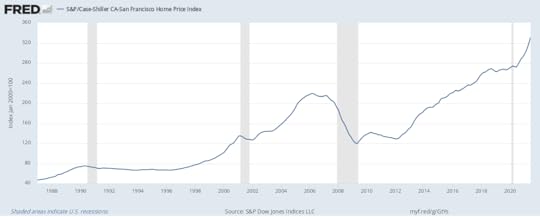
Soaring home prices in CACs look at times like a bubble, because those prices fluctuate more than prices do in places where supply expands to meet demand. But any bubbles there are small blips compared to the longer-term trend of buyers sensibly paying more for increasingly valuable locations:
SF Housing Prices

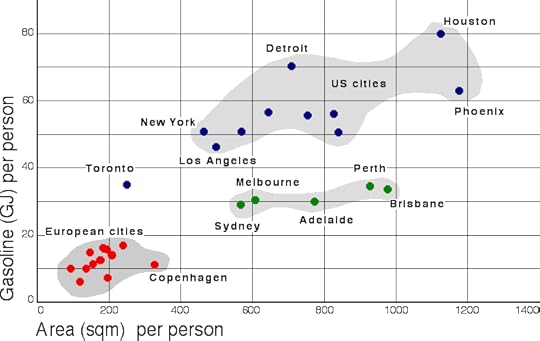
Some of you may wonder whether CACs could have built enough housing to avoid the refugee crisis. Here are some hints:
* US cities aren't close to being the densest cities in the world:

* Growth in commercial building density has not been similarly restricted - the obvious explanation is that fewer voters own commercial property, so there are fewer votes for restricting that.
* Building apartment complexes is outlawed in much of SF

What about the urban planners who have been advocating increased urban density? Erdmann implies that approximately all of the constraints on increased density are limits on residential building. Yet it appears that urban density advocates are devoting at least half their effort to making cities more desirable places to live, which does approximately nothing to increase density.

They're putting some effort into removing minimum parking requirements. Removing those requirements would be one modest step toward solving the housing shortage. But they're also putting effort into policies such as environmental impact assessments that delay construction in order to serve goals other than increased density. Urban density may be one of their goals, yet their other goals seem to lead them to strategies that divert them from progress on urban density.

Inevitable Bust?
How much of the crash and recession were inevitable consequences of the boom and bubble? According to Erdmann, little or none. He provides some medium-quality evidence to support that conclusion.

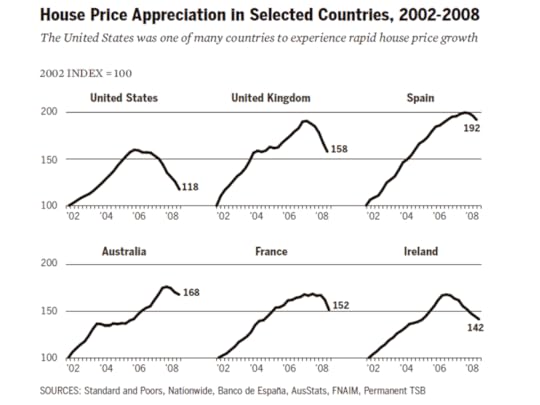
The boom in the US did not stand out as exceptionally large compared to other English-speaking countries, by criteria such as home price to income ratios.

Australia appeared to have a bigger housing boom, partly due to having closed-access cities:

yet it managed to avoid a recession until 2020.

The crash and recession were more unusual than was the boom, at least by many measures, e.g. changes in home building.

The US economy in late 2007, through the summer of 2008, looked to me like it was teetering on the verge of a recession, but it looked like things were going well enough that the US could avoid a clear recession. Then the economy fell off a cliff around September 2008, when Fannie Mae and Freddie Mac were put into conservatorship, and their lending was restricted further.

Erdmann implies that lending to homebuyers became too restricted around this time, and that most of the financial crisis could have been averted with better monetary policy and more home loans.

It's pretty clear that the Fed's policies became disastrous around September 2008.

I'm unclear about what other policy changes in 2008 mistakenly hurt housing markets. But whatever the cause, loans to homebuyers with below-average credit dropped dramatically in 2008. The large rise in housing prices starting in 2012 shows clearly that prices in 2008 were unusually depressed. It seems plausible that bad monetary policy and credit restrictions were the main reasons why housing prices declined in 2008-2010. It seems pretty clear that most defaults on mortgages that happened in this time frame wouldn't have happened without the price declines (if only because selling the house would have been more attractive than default). It's less clear how we could have known that in 2008. I tried to analyze those issues at the time, and was unable to decide whether the relevant policies were mistaken.

In 2010, Dodd Frank further restricted mortgage loans. That slowed the economy by shutting a number of people out of the homebuying market. That was mostly a reaction to imagined predatory lending. This looks clearly harmful in hindsight - there was probably some need to ensure that financial institutions took less risk in the next housing boom, but solutions should have focused more on how much leverage those institutions used, and less on preventing people with low credit quality from buying homes.

Moral Panic?
Erdmann blames much of the 2008 recession and subsequent stagnation on the mistaken belief that home prices were too high.

After the crisis, the regulators at the Federal Housing Finance Agency and the Consumer Financial Protection Bureau were protecting potential homebuyers from the best buyer's market in a lifetime.


Imagine that the conversations about the labor market over the past decade had been similar to the conversation about the housing market. There would have been a consensus that the problem was that there were too many jobs in 2005 and that real wages were growing too fast. We would have watched unemployment shoot up to 10% without attempting to stabilize it because we would have considered the spike to be a correction following the period of excess.


Erdmann's narrative is the housing market was doing about as well as could be expected, given the problem of the CACs, through about 2006. The subsequent credit restrictions (and poor monetary policy) caused people to buy too little housing. The only housing bubble was in contagion cities, and it was quickly corrected in 2007. Yet key parts of US policy continued to react for years as if there was a wider bubble that needed correcting.

Erdmann portrays the Fed's disastrous monetary tightening in late 2008 as being driven by a desire to drive down housing prices. That might be a bit of what motivated the Fed, but Erdmann's selective use of evidence gives a misleading impression that that was the Fed's primary motive. The Fed clearly made other mistakes that were at least as important, such as predicting they would hit their 2% inflation target, even as markets were rapidly changing to predict deflation.

What about the problems at Fannie Mae and Freddie Mac? Erdmann wants us to imagine that they would have been ok if only authorities hadn't depressed housing prices. That's a somewhat plausible claim. He doesn't present much of an argument for it, and likely couldn't do so without a mind-numbing amount of detail. And even if they could have recovered on their own under optimal policy, it's likely a sign of recklessness if they weren't prepared to handle an ordinary degree of faulty monetary policy.

Other Problems that Erdmann Downplays
Erdmann convinced me that the 2008 recession remained mostly avoidable well after the peak of the housing boom. Yet when discussing many other proposed causes of the recession and subsequent malaise, he often says something that boils down to "this didn't cause the boom, so it's not important".

That sounds rather close to reverting to the standard narrative of boom causing an inevitable bust when it suits his purposes.

There was some fairly reckless borrowing by people who bought houses they didn't live in (i.e. as investments). At the time, I saw evidence of inexperienced investors flipping houses (maybe only in contagion regions), and inferred that the bubble was near a peak.

Erdmann convinced me that this recklessness didn't become significant until after the boom peaked. He wants us to also believe that it didn't contribute much to the crash.

I agree with him that increased subprime loans, and increased loans to investors/speculators, were not too important when the bubble was inflating. They expanded shortly after the peak, by enough that it became hard to return to normal without a crash. Erdmann wants us ignore that, whereas I say those two factors together deserve about 25% of the blame for the crash.

Fed policy was a bit too inflationary in 2003-4, although that was a relatively small mistake compared to prior Fed mistakes. That influenced the timing of the bubble, and appears to have made the bubble grow and crash more abruptly than it did in other countries.

It's clear to me that many financial institutions and homebuyers took on too much risk, due to a widespread belief that housing prices never fall by much. Erdmann's response is mostly to point out that the price declines were temporary in most places, and due to bad policies. Those aren't sufficient reasons to exonerate those faulty risk estimates.

Other Causes
Many people point to indicators such as price to rent and price to income ratios. I found those to be fairly good heuristics that helped me to see that there was a bubble around 2005.

Erdmann shows that increases in these indicators were fairly normal and sensible reactions by homeowners to a combination of reasons such as tax incentives, and housing scarcity. Yet none of that contradicts the concerns that they made housing markets, and therefore much of the economy, more fragile.

Interest rates exert an important influence on housing prices. It's pretty important to figure out whether the unusually low interest rates of the past few decades are likely to be permanent, or whether they reflect a bubble-like phenomenon that is broader than a housing bubble. I've been predicting a rise in interest rates.

Until recently, I've ignored the demographic effects of the boomer generation. Their savings rate has been high the past decade or two, and will decline as they retire (although other effects might offset that). The Baby Boom: Predictability in House Prices and Interest Rates suggests we should see declines in home prices and rising real interest rates (see figures 8a and 9). I'll guess that demographic effects explain 25% the housing boom.

Wider Implications
Erdmann proposes high housing costs as a leading cause of the gap between rising productivity and stagnating median wages. I.e. the productivity benefits are going mainly to CACs homeowners and landlords. My intuition is that this explains maybe 1/4 of the gap, but I haven't analyzed this carefully.

Two thirds of the increase in wage inequality since 1978 is due to rising inequality between firms. Erdmann attributes this to the effects of CACs attracting the most profitable firms, and the highest-wage workers.

The housing situation in CACs is a near-perfect recipe for polarizing the nation, by increasing class-based segregation. Has it been the main cause of the past decade's political conflict? I suspect not, but I don't have a good way of ruling out that possibility.

Can anything be done about the CACs housing restrictions? Erdmann is pessimistic. Many of the people who have bought houses there would lose a significant fraction of their net worth if those restrictions were significantly eased.

There's a Bootleggers and Baptists type situation, where greedy homeowners team up with moralizing environmental and historical conservationists, affordable housing advocates, etc. to generate a maze of regulations. Changing that likely requires convincing the average pundit to treat most conservationists and affordable housing advocates with the kind of disrespect that Erdmann does. We're a long way from reaching that kind of broad support for more housing. Startup cities sound a bit more promising, but would require handling major coordination challenges in order to replace existing cities.

How has the pandemic affected the housing shortages? It triggered a sizable one-time exodus from big cities, but that effect seems small compared to the long-term trend of people increasingly preferring to live in or near big cities. It increased acceptance of remote work, which will put some sort of dent in the unequal access to the most lucrative jobs. But I expect that there are still nontrivial advantages to in-person contact with social and professional groups, which will maintain some of that inequality for quite a while.

Conclusion
Many factors influenced the Great Recession. Erdmann's ideas provide a valuable new perspective, but he goes a bit overboard about dismissing the standard narratives.

I've quoted him a good deal here because of his eloquent rants against the systemic classism of the elites, but beware that the book also contains some mind-numbing detail to support those rants.
Profile Image for Frank Stein.
1,094 reviews170 followers
January 30, 2019
This is probably the best book out there about the bursting of the housing and financial bubble in 2008, mainly because it convincingly shows that there was no such thing as a housing and financial bubble in 2008. Quite the opposite, in fact. Author Kevin Erdmann shows that what really happened from 1995 to 2006 is an unbelievable slowdown in housing construction in a handful of "closed access" cities, such as New York, Boston, San Francisco, an LA. This led to an outflux of migrants to "contagion cities," such as Phoenix, Los Angeles, and Miami, where there was real construction, but which had just a small and temporary uptick in prices due to the new residents. The real problem is that we've been building too few houses overall, and yet the counterproductive reaction to the 2008 crisis was to clamp down further on homeownership and building.

There are so many myths demolished in this book that it is difficult to keep them straight. First, there was no boom in homeownership during the bubble. By 2001, long before the supposed "bubble," homeownership was at 68%, just one percent below its peak, and most of that recent increase had come from the older overall distribution of population in those years (relative to the late 1970s, the homeownership rate for the under 45 crowd was still lower). There wasn't a surge in loans to low-income, questionable borrowers. If anything, in the 2000s a higher percentage of loans went to wealthier households, who took on higher leverage during the boom than the poorer households. The real reason for the rapidly rising housing prices in Closed Access cities was an increase in rent (which, because of the rising rent/price ratio as rents in general go up, causes an even faster proportional increase in prices). Poor zip codes in closed cities had rapidly increasing housing prices because more gentrifying in-migrants were replacing poorer residents, who generally left for cheaper cities, not because poor residents were being swamped with excessive loans. After the crisis, homeownership fell first among the highest class of borrowers, since they were the ones most likely to borrow.

This books shows that policymakers made a grave mistake squelching the economy in 2008 in order to force a housing "correction." In fact, they exacerbated the very problem they tried to solve. Hopefully they will read this book and not make the same mistake again.
Profile Image for Herzog.
973 reviews15 followers
August 4, 2019
This book is a dense read. The author argues that the financial crisis of 2008 was caused by a failure to build additional housing in closed access cities like San Francisco, New York, Boston and Los Angeles.
Profile Image for Pete.
1,105 reviews78 followers
November 15, 2021
Shut Out (2018) by Kevin Erdmann is a really interesting book that describes the causes of the Great Recession in the US. Erdmann was a businessman who studied the causes of the Great Recession and came to different conclusions from those generally put forward. It’s not an easy read but does contain a wealth of information.

Erdmann divides US cities into Closed Access Cities (CACs), contagion cities (CCs) and Open Access Cities (OACs). The CACs were New York, Boston, the Bay Area and Los Angeles where building housing has become very difficult and where the prices are shooting up. The contagian cities were places that people who moved out of the closed access cities went to. These include Phoenix and Florida. The Open Access Cities were places like Houston, Atlanta and Dallas where sufficient housing for population increases was being built. Erdmann describes the CACs as having a chronic undersupply that has caused many people to move into the CCs. The OACs saw some ride and an increase in homebuilding but didn’t see nearly the drop in prices as the other types of cities.

The book describes how the CACs have become economic dynamos where the information economy generates large numbers of high paying jobs. Erdmann also points out that around the world similar cities are seeing similar house price rises. In Australia the rise was bigger than in the US and there was a decline in two of the capital cities and prices were steady in the others before starting to shoot up again. Australia, of course, was also supported by Chinese demand for Australian exports that didn’t significantly fall during the Great Recession.

Shut Out suggests that a reaction to the rise in housing prices that was occuring in CACs led to policy that brought up interest rates and caused prices in the CCs to drop which then led to a loss in confidence and a drop in housing prices across the board. Erdmann says that excess credit wasn’t the primary driver and points to the fact that the increase in US house prices was well underway before the bad loans came in.

The book is absolutely full of graphs and data about the rate of home building. It’s really interesting to see that the number of homes built in the US compared to the population increase has been trending down for decades. Not only are fewer houses being built relative to population increase but it’s become very hard to build where the best jobs are. It appears to be fundamentally hard to get change low density housing into high density housing that would very much be worth it.

Erdmann doesn’t put blame on the US’s unique housing lending institutions, Fannie Mae and Freddie Mac, even though they have twice caused financial problems in the US in the Savings and Loan crisis and then later contributing to it in the Great Recession. The 30 year fixed loan has been gone from most of the world for decades but in the US Fannie Mae and Freddie Mac enable it to keep going.

Shut Out is very much worth a read for anyone who is interested in what has happened in US real estate markets. Erdmann makes the point very well that the US housing market is not a single market and that the differences between the Closed Access Cities and the other cities is really important.
174 reviews
September 27, 2022
This is an interesting (and alternative) view of the Great Recession and the subsequent housing crash. I think it focused well on some unexplored (at least by mainstream researchers) causes of the housing crisis. I would recommend it for a different view on the Great Recession and its fallout.
Displaying 1 - 5 of 5 reviews

Can't find what you're looking for?

Get help and learn more about the design.