

What do you think?

Batman: The Golden Age #Omnibus #7
Batman: The Golden Age Omnibus Vol. 7
Batman's adventures from the late 1940s and early 1950s are collected for the first time in this new hardcover omnibus series, continuing here with Batman: The Golden Age Vol. 7.
The comprehensive hardcover collections of the Dark Knight's adventures continues! In these tales from the start of the 1950s, the Dynamic Duo continues to fight crime as they encounter villains including The Joker, the Penguin, Catwoman and more! This new Omnibus hardcover also includes the debut appearance of Killer Moth, the introductions of a new Batmobile and a new Batplane for the new decade and more!
Collects Detective Comics #154-173, Batman #56-66 and stories from World's Finest Comics #43-53.
The comprehensive hardcover collections of the Dark Knight's adventures continues! In these tales from the start of the 1950s, the Dynamic Duo continues to fight crime as they encounter villains including The Joker, the Penguin, Catwoman and more! This new Omnibus hardcover also includes the debut appearance of Killer Moth, the introductions of a new Batmobile and a new Batplane for the new decade and more!
Collects Detective Comics #154-173, Batman #56-66 and stories from World's Finest Comics #43-53.
824 pages, Hardcover
First published August 1, 1951
About the author
Bill Finger
657 books112 followersWilliam "Bill" Finger was an American comic strip and comic book writer best known as the uncredited co-creator, with Bob Kane, of the DC Comics character Batman, as well as the co-architect of the series' development. In later years, Kane acknowledged Finger as "a contributing force" in the character's creation. Comics historian Ron Goulart, in Comic Book Encyclopedia, refers to Batman as the "creation of artist Bob Kane and writer Bill Finger", and a DC Comics press release in 2007 about colleague Jerry Robinson states that in 1939, "Kane, along with writer Bill Finger, had just created Batman for [DC predecessor] National Comics".
Film and television credits include scripting The Green Slime (1969), Track of the Moon Beast (1976), and three episodes of 77 Sunset Strip.
-Wikipedia
Film and television credits include scripting The Green Slime (1969), Track of the Moon Beast (1976), and three episodes of 77 Sunset Strip.
-Wikipedia
Ratings & Reviews
Friends & Following
Create a free account to discover what your friends think of this book!
Community Reviews
Displaying 1 - 3 of 3 reviews
June 11, 2020
This omnibus collects every Batman comic published between December 1949 September 1951. By now Batman had celebrated his 10th anniversary, and his editors and writers were intent on keeping him up-to-date and further building his world. So in these stories Batman receives a new Batmobile and Batplane, and a redesigned bat-signal. And for the first time the secret origins of the Catwoman and the Joker are revealed. We even learn about Commissioner Gordon's backstory! The comics have also grown cognizant of their own continuity, and references to old stories fill "The Thousand and One Trophies of Batman" and "The Strange Costumes of Batman."
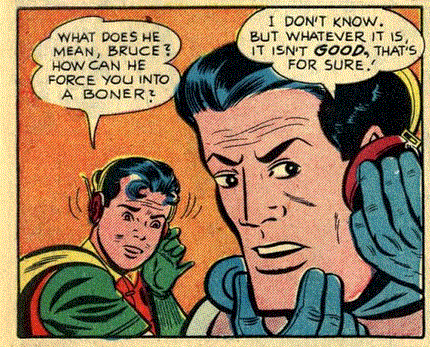
As usual with golden age Batman, there's a mix of tightly plotted 12 page mysteries, crime capers with mobsters, and supervillains committing gimmick crimes. Joker and the Penguin pop up in almost every other issue. In the now infamous story "The Joker's Comedy of Errors" the Clown Prince of Crime makes a dumb mistake during a robbery and gets mocked by the newspapers. He screams "I'll show them how many boners the Joker can make!" Worried by the resulting crime wave, Commissioner Gordon says "Batman, we've got to stop the Joker! These boner crimes are making us look bad! And I'm worried about the boner he's readying for YOU!"
In common with past omnibuses, there are a few time travel stories, with the dynamic duo venturing to old California, ancient Egypt (where they meet Cleopatra and anachronistically work on the great pyramids--built 2,000 years before Cleopatra was born), and even 100 years into the future.
Other stories rely on newer hooks, such as Bruce Wayne switching professions: he becomes a private detective, riveter, and crime reporter (and Batman becomes a prison warden). Multiple stories revolve around Batman's secret identity being threatened or even found out, in which case he has to make the villains doubt their eyes. Perhaps this subject was inspired by Superman's own secret identity issues.
Several stories take a look at the relationship between Batman and Robin. In "The Trial of Bruce Wayne" he almost loses custody of Dick Grayson. In a later story Dick fears Batman intends to replace him with the trainee hero Wingman, and in the book's final story a guilt-ridden Grayson dreams of himself as with Batman II, with his son as Robin Junior.
Two new villains are introduced in Vol. 7: Deadshot, an aspiring crime lord posing as a crimefighter, and Killer Moth, an anti-batman who rescues underworld villains when they flash the moth-signal. In his third appearance he anticipates several future villains by impersonating both Bruce Wayne and Batman.
A large number of stories still credited to "unknown." Many are by David Vern, who has a knack for corny but fun high concepts (Millionaire island! A Criminal academy! A club for policemen who've been shot!). A majority of the stories are by Bill Finger, the original bat-writer, and they're usually the best of the bunch (aside from the boner one). Finger's trademark use of giant props is evident in this volume.
Almost all the covers are by Win Mortimer. As for interiors, Jim Mooney drew a handful of stories in first half, but art is mostlly split between Dick Sprang and Bob Kane's ghost Lew Sayre Schwartz (whose Batman and Robin figures were often retouched by Kane). Schwartz was an okay cartoonist, but his attempt to emulate Kane's cartoony style looks almost as stilted and hammy as the original. Sprang by contrast demonstrates what made him the greatest Batman artist of this era: cinematic staging, intricately varied compositions, and an exquisite knack for drawing ultra-stylized characters that retained solidity and dramatic plausibility.

July 6, 2020
This was an era when comics looked to deliver the same formula every month, so there's not a lot of difference from Vol. 5 or 6, but as I like this era that's not a problem. We aren't yet plunged into the 1950s SF Batman era other than a few time-travel stories and there are fewer new villains than the previous volume; Killer Moth gets three issues and Deadshot debuts in a good story, then vanishes for a quarter-century.
Joker and Penguin get a lot of action, Catwoman surprisingly less (one theory is that a sexy bad girl who attracts the hero wasn't quite respectable enough for DC at this point); after getting an origin, she had only a few more stories (not all in this volume) before disappearing for a decade. The Joker gets an origin too, but didn't stop him showing up.
Overall, if you're into this era of Batman the stories are great and the reproduction quality is outstanding.
Joker and Penguin get a lot of action, Catwoman surprisingly less (one theory is that a sexy bad girl who attracts the hero wasn't quite respectable enough for DC at this point); after getting an origin, she had only a few more stories (not all in this volume) before disappearing for a decade. The Joker gets an origin too, but didn't stop him showing up.
Overall, if you're into this era of Batman the stories are great and the reproduction quality is outstanding.

August 30, 2025
1949-51 gems include Gaucho & Papagayo debut, Bruce Wayne PI hired to steal a Bat trophy, Bat 9/11s an obelisk w/ the Batplane to try & knock it on a mummy, Batmobile 1950, gasmasked Penguin springs from a sarcophagus, Dr. Doom is trapped in Bat trophy room, Deadshot debuts, Bruce Wayne unmasked, bomb Bat, jacked Batplane, secrets of the Batsignal & Batsuits, Knight & Squire debut, Sphinx Batsignal, Killer Moth & Red Hood debut, Bat & Moth deduce each other’s identities, Wingman debuts, Killer Moth does Heart of Hush 55y early, & Joker’s boner
Displaying 1 - 3 of 3 reviews