

What do you think?

Lucifer (2018)
Lucifer, Vol. 1: The Infernal Comedy
The Prince of Darkness is missing, and from the look of things he's not coming back. Blind, crippled, and without a penny to his name, the onetime ruler of Hell is now a wizened, unkempt old man trapped in a small town where sinister forces torment him at every turn and nothing is as it seems. He has no memory of how he got here, no hope of escape, and no way to track down his child--the only entity capable of preventing the end of the world.
At the same time, a police officer in Lucifer's adopted hometown of Los Angeles is about to lose everything he holds dear. Desperate to find a reason for his suffering, Detective John Decker is drawn into a shadowy conspiracy whose widely varied members share a single common purpose: to kill Lucifer Morningstar.
With monsters and magicians from every plane of reality set against him, can the Lightbringer heal his broken mind and body and regain his wrongful place in the cosmos?
Acclaimed author Dan Watters (The Shadow, Deep Roots) and the incredible art team of Max and Sebastian Fiumara (All-Star Batman, The Amazing Spider-Man, Abe Sapien) begin an all-new chapter in the saga of one of the Sandman Universe's most mesmerizing characters in Lucifer Vol. 1: The Infernal Comedy--from the mind of New York Times best-selling author Neil Gaiman!
At the same time, a police officer in Lucifer's adopted hometown of Los Angeles is about to lose everything he holds dear. Desperate to find a reason for his suffering, Detective John Decker is drawn into a shadowy conspiracy whose widely varied members share a single common purpose: to kill Lucifer Morningstar.
With monsters and magicians from every plane of reality set against him, can the Lightbringer heal his broken mind and body and regain his wrongful place in the cosmos?
Acclaimed author Dan Watters (The Shadow, Deep Roots) and the incredible art team of Max and Sebastian Fiumara (All-Star Batman, The Amazing Spider-Man, Abe Sapien) begin an all-new chapter in the saga of one of the Sandman Universe's most mesmerizing characters in Lucifer Vol. 1: The Infernal Comedy--from the mind of New York Times best-selling author Neil Gaiman!
200 pages, Paperback
First published June 25, 2019
About the author
Dan Watters
442 books173 followersDan Watters is a UK based comic book writer. His first book, LIMBO, was released through Image Comics in 2016. He has since written THE SHADOW at Dynamite Comics, and ASSASSIN’S CREED and WOLFENSTEIN for Titan Comics.
Currently he is writing the relaunch of LUCIFER for Vertigo’s Sandman Universe, as well as DEEP ROOTS for Vault Comics. Deeply rooted in London Town, and firmly of the Devil's party.
Currently he is writing the relaunch of LUCIFER for Vertigo’s Sandman Universe, as well as DEEP ROOTS for Vault Comics. Deeply rooted in London Town, and firmly of the Devil's party.
Ratings & Reviews
Friends & Following
Create a free account to discover what your friends think of this book!
Community Reviews
Displaying 1 - 30 of 156 reviews

August 25, 2019
***Advance Review Copy generously provided through NetGalley in exchange for an honest review.
Okay, let me tell you that this confused me, a lot.
At first, I had to download this book like five times because I thought that I was doing something wrong. That was not Lucifer but Sandman! However, after reading some reviews, I realised that really one-quarter of this Lucifer Volume is about Sandman, which I mostly skipped because I read it just recently.
I have to say that I know Sandman way better than I do know Lucifer, but I still managed to get what was going on fairly quickly. But I was not invested in the story until the last 20 pages or so.
Plus my everlasting issue with Lucifer stories is that since I'm not a native speaker, I have a very, very hard time grasping what Mazikeen is saying.
Okay, let me tell you that this confused me, a lot.
At first, I had to download this book like five times because I thought that I was doing something wrong. That was not Lucifer but Sandman! However, after reading some reviews, I realised that really one-quarter of this Lucifer Volume is about Sandman, which I mostly skipped because I read it just recently.
I have to say that I know Sandman way better than I do know Lucifer, but I still managed to get what was going on fairly quickly. But I was not invested in the story until the last 20 pages or so.
Plus my everlasting issue with Lucifer stories is that since I'm not a native speaker, I have a very, very hard time grasping what Mazikeen is saying.

May 30, 2019
I’ve never read the Mike Carey Lucifer series or seen the TV show (and I’ll probably never do either now) so I don’t know if it’s because I’m so unfamiliar with the character and his story (couldn’t tell you if this is a continuation of the previous books or a reboot) or whether Dan Watters is just that incompetent a storyteller but I had absolutely no fucking idea what was going on in Lucifer, Volume 1: The Infernal Comedy!
It’s not a good sign when you get to the end of the book, read the blurb and don’t recognise the summary as reflective of what you’ve just read! I got that Lucifer was no longer King of Hell for some reason but apparently his kid will prevent the end of the world? If you say so, Vertigo marketing department!
There’s also a Philip K. Dick-looking LAPD cop embroiled in this mess but even the blurb can’t explain why! His wife dies and he has a breakdown which enables him to see demons for no reason? How and why he’s singled out in the first place is beyond me. Dude does nothing as well - a total waste of space character!
There are apparently conspiracies to kill Lucifer but, again, don’t know why. It gets worse. We see Lucifer as this broken, weak, homeless-looking dude who’s obviously in a bad way - but he’s also a David Bowie-looking dude who’s got his shit together? So… does he need to regain control of Hell or doesn’t he? One version of him needs help, the other seems to be ok. Was Lucifer always two people? Ah, who cares? It’s not like I’m gonna keep reading this title!
Into the mix is William Blake, because why not, and one character with a Phantom of the Opera mask who talksh indecihpehbly liksh thsh fer het whleo tme and it’s so fucking annoying to read. Actually, the other characters talk clearly and they’re only slightly less annoying to read - that’s how awful the writing is!
An unrelentingly bad, incomprehensible and boring book from cover to cover, the latest ill-conceived Sandman Universe title is definitely the worst comic of 2019 I’ve read so far - abandon all hope ye who pick up this crap!
It’s not a good sign when you get to the end of the book, read the blurb and don’t recognise the summary as reflective of what you’ve just read! I got that Lucifer was no longer King of Hell for some reason but apparently his kid will prevent the end of the world? If you say so, Vertigo marketing department!
There’s also a Philip K. Dick-looking LAPD cop embroiled in this mess but even the blurb can’t explain why! His wife dies and he has a breakdown which enables him to see demons for no reason? How and why he’s singled out in the first place is beyond me. Dude does nothing as well - a total waste of space character!
There are apparently conspiracies to kill Lucifer but, again, don’t know why. It gets worse. We see Lucifer as this broken, weak, homeless-looking dude who’s obviously in a bad way - but he’s also a David Bowie-looking dude who’s got his shit together? So… does he need to regain control of Hell or doesn’t he? One version of him needs help, the other seems to be ok. Was Lucifer always two people? Ah, who cares? It’s not like I’m gonna keep reading this title!
Into the mix is William Blake, because why not, and one character with a Phantom of the Opera mask who talksh indecihpehbly liksh thsh fer het whleo tme and it’s so fucking annoying to read. Actually, the other characters talk clearly and they’re only slightly less annoying to read - that’s how awful the writing is!
An unrelentingly bad, incomprehensible and boring book from cover to cover, the latest ill-conceived Sandman Universe title is definitely the worst comic of 2019 I’ve read so far - abandon all hope ye who pick up this crap!

November 15, 2022
This was ok.
I've never been a Lucifer completionist but I have read about this character before. And by that, I mean that I read Mike Carey's Lucifer Book One & Holly Black's first Lucifer volume Cold Heaven, but then never finished either run.
So, I know who the character is but I'm not a superfan.
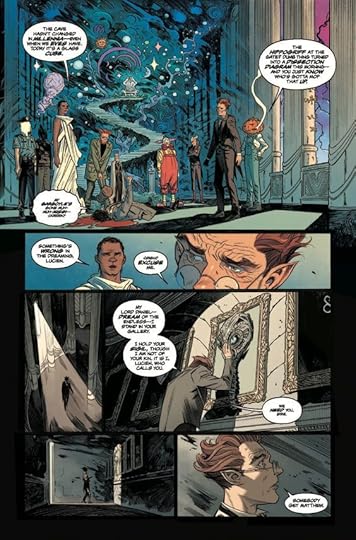
This opens with The Sandman Universe Special #1 where Dream's realm is in a bit of chaos and then transitions as Matthew's journey to find Daniel runs into whatever is happening with Lucifer.
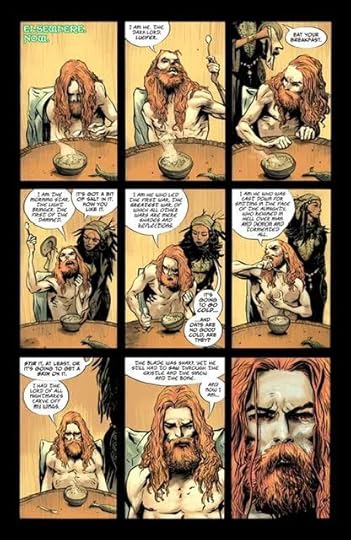
So the gist is that Lucifer is trapped and his memory has been stripped (or something) and he's trying to figure out what's happening to him. But in this rambling crazy-hobo way.
Meanwhile, his son and Mazikeen are searching for him, trying to piece together where he is.
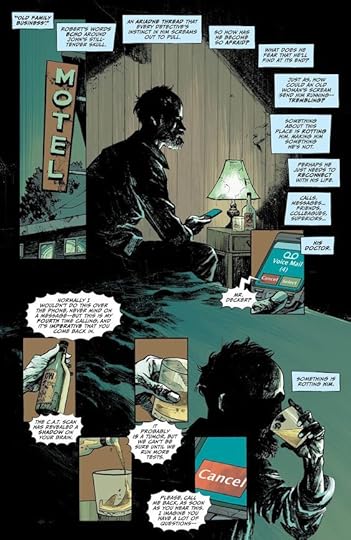
And a cop, whose wife was rambling incoherently with a brain tumor before she died, is searching for answers due to some spoilery stuff that happened.
All of it does eventually come together to tell you a story. And while I'm not sure if I will personally continue with this one or not, I don't really have anything bad to say about it, either.
I've never been a Lucifer completionist but I have read about this character before. And by that, I mean that I read Mike Carey's Lucifer Book One & Holly Black's first Lucifer volume Cold Heaven, but then never finished either run.
So, I know who the character is but I'm not a superfan.
This opens with The Sandman Universe Special #1 where Dream's realm is in a bit of chaos and then transitions as Matthew's journey to find Daniel runs into whatever is happening with Lucifer.
So the gist is that Lucifer is trapped and his memory has been stripped (or something) and he's trying to figure out what's happening to him. But in this rambling crazy-hobo way.
Meanwhile, his son and Mazikeen are searching for him, trying to piece together where he is.
And a cop, whose wife was rambling incoherently with a brain tumor before she died, is searching for answers due to some spoilery stuff that happened.
All of it does eventually come together to tell you a story. And while I'm not sure if I will personally continue with this one or not, I don't really have anything bad to say about it, either.

August 15, 2019
This book was so decompressed it bored me to tears. The first several issues just seemed to be random things happening with no connection, although it sort of eventually came together. Of course, by that point I'd already given up on this garbage. The book also apparently has very little connection to any of the previous series (Mahzikeen does appear but does nothing.) or to Lucifer from the Sandman comics to which I say "Screw you, DC." The art was solid though.
Received a review copy from DC and NetGalley. All thoughts are my own and in no way influenced by the aforementioned.
Received a review copy from DC and NetGalley. All thoughts are my own and in no way influenced by the aforementioned.

June 17, 2019
An excellent new chapter in Lucifer's story. This one comes as part of the Sandman's Universe new series. The creative team behind Lucifer Vol. 1 – The Infernal Comedy is a large one (even when compared to the original series). The writers behind this volume are Dan Watters, Neil Gaiman, Simon Spurrier, Kat Howard, and Nalo Hopkinson. Lettering is delivered by Steve Wands and Simon Bowland, and colors by Dave McCaig and Mat Lopes, with art credits for Max and Sebastian Fiumara, Bilquis Evely, Tom Fowler, and Dominike Stanton.
As in the original series, the story line of this new chapter is anything but linear, jumping in time and space, from a multiverse kind of Heaven to a very particular and desolated little village, where Lucifer is now an old, blind man. Developed from a mix of Christian mythology, some Shakespeare and a lot of Sandman's style narrative flair, the plot is suspenseful, bloody and intelligent, with a lot of satire, hence a proper one for none other than the Devil, Mr. Lucifer Morningstar.
One of the great things about this jumping time-line is that the artistic design, while not the drawing itself, adapts to the fragment of story we found ourselves in, reflecting the state and even the personality of the characters involved in that fragment. This allows for a gorgeous display of styles, with color pallets reflecting moods and worlds, from the blues and greens of an old folks home (that it's all but a old folks home); to the oranges and browns of a decrepit island that could be Elba but is instead populated by souls unaware of their exile, and a vibrant multicolored place that it's as much Heaven as it is Hell.
There are many things to like about this Infernal Comedy, however the story may seem a little convoluted at first, mostly because it opens with a sequence about the Dreaming which importance we only get to appreciate (and fully understand) later. Importantly, for those unfamiliar with Gaiman's Sandman Universe, following the story will require extra patience, but it's well worth the effort.
Along the volume, as we get to see Lucifer present situation--after his father has left creation--the pace quickens forcing us to pay attention or else missing out a crucial detail. In that sense, this new book maintains one of the most successful aspects of the original series: the need, not only the pleasure, for total immersion in order to get everything there's on the pages to get.
All things considered, this new chapter in Lucifer's story is a great start to this ongoing series and a good entry point for new readers, unfamiliar with story of this character, while it's also a great return to the character for preexisting fans.
As in the original series, the story line of this new chapter is anything but linear, jumping in time and space, from a multiverse kind of Heaven to a very particular and desolated little village, where Lucifer is now an old, blind man. Developed from a mix of Christian mythology, some Shakespeare and a lot of Sandman's style narrative flair, the plot is suspenseful, bloody and intelligent, with a lot of satire, hence a proper one for none other than the Devil, Mr. Lucifer Morningstar.
One of the great things about this jumping time-line is that the artistic design, while not the drawing itself, adapts to the fragment of story we found ourselves in, reflecting the state and even the personality of the characters involved in that fragment. This allows for a gorgeous display of styles, with color pallets reflecting moods and worlds, from the blues and greens of an old folks home (that it's all but a old folks home); to the oranges and browns of a decrepit island that could be Elba but is instead populated by souls unaware of their exile, and a vibrant multicolored place that it's as much Heaven as it is Hell.
There are many things to like about this Infernal Comedy, however the story may seem a little convoluted at first, mostly because it opens with a sequence about the Dreaming which importance we only get to appreciate (and fully understand) later. Importantly, for those unfamiliar with Gaiman's Sandman Universe, following the story will require extra patience, but it's well worth the effort.
Along the volume, as we get to see Lucifer present situation--after his father has left creation--the pace quickens forcing us to pay attention or else missing out a crucial detail. In that sense, this new book maintains one of the most successful aspects of the original series: the need, not only the pleasure, for total immersion in order to get everything there's on the pages to get.
All things considered, this new chapter in Lucifer's story is a great start to this ongoing series and a good entry point for new readers, unfamiliar with story of this character, while it's also a great return to the character for preexisting fans.

August 1, 2021
Mike Carey's "Lucifer" is one of the best comics written in a long time. Since then, there have been others who have taken on this character with varying degrees of sucess. Dan Watters' version is quite good.
"You blame me for your sins and tragedies? All I granted you was agency when I saw a use. I never gave a single toss for your souls. It was easier, when the first act of evil was committed, to claim to be of my party, wasn't it? I've made it clear to each of you. I have NO party."
-Lucifer
This volume starts with a Neil Gaiman "Sandman" story, though this covers Morpheus' son. It seems to set the stage for the upcoming story, but implies that Dream has "quit". Then on to the Lucifer story.
Lucifer has gone missing. It seems a very clever man named Stingy Jack has outwitted the Devil. But, as with most fools who think so, Lucifer isn't new to this game. Jack pays the price but has revenge in store. Teaming up with Lucifer's son, Caliban, they trap Lucifer in a world of forgetfulness.
That's the gist. It is ambitious and very well written. Parts of it are slightly confusing as there must have been more volumes previously, I shall hunt them down.
Good artwork, a clever and ambitious story that is in keeping with the style and tradition of Mike Carey. Highly recommended.
"You blame me for your sins and tragedies? All I granted you was agency when I saw a use. I never gave a single toss for your souls. It was easier, when the first act of evil was committed, to claim to be of my party, wasn't it? I've made it clear to each of you. I have NO party."
-Lucifer
This volume starts with a Neil Gaiman "Sandman" story, though this covers Morpheus' son. It seems to set the stage for the upcoming story, but implies that Dream has "quit". Then on to the Lucifer story.
Lucifer has gone missing. It seems a very clever man named Stingy Jack has outwitted the Devil. But, as with most fools who think so, Lucifer isn't new to this game. Jack pays the price but has revenge in store. Teaming up with Lucifer's son, Caliban, they trap Lucifer in a world of forgetfulness.
That's the gist. It is ambitious and very well written. Parts of it are slightly confusing as there must have been more volumes previously, I shall hunt them down.
Good artwork, a clever and ambitious story that is in keeping with the style and tradition of Mike Carey. Highly recommended.

May 31, 2019
I received an ARC copy of this book from NetGalley.
I should have known after the summary started with "This is the ~one true tale~ of what befell the Prince of Lies" that it was going to be like this, but I had to give it a chance. I was going to call it a DNF after issue 3, but then I decided to at least look at the artwork for the rest of the issues and I ended up reading about the last half of issue 6 so I guess I read slightly more than half of this comic. From what some other reviewers are saying I don't think it would have made much more sense if I had read the whole thing.
Mostly I just don't understand why they felt the need to entirely reboot the Lucifer character, and if they were going to then why do it in this way. Not only did I have next to no idea what was actually happening, but Lucifer was not a compelling or likable main character in this AT ALL (and yeah I know, he's Lucifer, but even when he was doing awful things in the original you were still always rooting for him at least a bit). I suppose if you have never read the original Lucifer series by Mike Carey then you may find some value in this, but I found it pretentious and convoluted.
It is possible that it will get better in the next issue because a lot of the things I hated about the majority of this volume seem to be resolved at the very end, but the original Lucifer series is pretty much the best graphic novel series I have ever read and I don't see why they felt the need to erase all of that instead of continuing on from the end of it. They could have easily ignored the shortly rebooted series from 2016, but to ignore Carey's work and take Lucifer back to only his Sandman beginnings is like saying we should all give up cars and go back to horse drawn carriages. Ridiculous.
I should have known after the summary started with "This is the ~one true tale~ of what befell the Prince of Lies" that it was going to be like this, but I had to give it a chance. I was going to call it a DNF after issue 3, but then I decided to at least look at the artwork for the rest of the issues and I ended up reading about the last half of issue 6 so I guess I read slightly more than half of this comic. From what some other reviewers are saying I don't think it would have made much more sense if I had read the whole thing.
Mostly I just don't understand why they felt the need to entirely reboot the Lucifer character, and if they were going to then why do it in this way. Not only did I have next to no idea what was actually happening, but Lucifer was not a compelling or likable main character in this AT ALL (and yeah I know, he's Lucifer, but even when he was doing awful things in the original you were still always rooting for him at least a bit). I suppose if you have never read the original Lucifer series by Mike Carey then you may find some value in this, but I found it pretentious and convoluted.
It is possible that it will get better in the next issue because a lot of the things I hated about the majority of this volume seem to be resolved at the very end, but the original Lucifer series is pretty much the best graphic novel series I have ever read and I don't see why they felt the need to erase all of that instead of continuing on from the end of it. They could have easily ignored the shortly rebooted series from 2016, but to ignore Carey's work and take Lucifer back to only his Sandman beginnings is like saying we should all give up cars and go back to horse drawn carriages. Ridiculous.

June 16, 2019
I was so pleasantly surprised by The Dreaming Vol. 1: Pathways and Emanations that I kind of got my hopes up too much for this one. Yeah, the new Lucifer book is not very good and I’m really not sure why — I didn’t get through Mike Carey’s run, nor did I read any other reboots of the series, so I can’t say if my confusion comes from not being familiar with previous material or if it’s just a sloppily written book by itself. Either way, I really can’t tell what happened in this volume. It’s kind of a shame really, because for the first few issues I was at least digging the story of a guy who lost his wife and had a brain tumor — a sort of Lovecraftian descent-into-madness type of horror story that didn’t feel original but was still very atmospheric and overall not that bad. Then that storyline went some places that I cannot explain. Lucifer’s storyline, on the other hand, was confusing and messy throughout, which is really not good in a book where he’s supposed to be the main character. So yeah, I’d say skip this one, but definitely get The Dreaming instead.

August 9, 2019
Disclaimer: I received a free ecopy via NetGalley in exchange for an honest review.
The story was kind of boring. It never grabbed my attention enough to care about what was happening. The art was good though.
The story was kind of boring. It never grabbed my attention enough to care about what was happening. The art was good though.

June 2, 2019
I got this volume as an eARC along with Volume One of
The Dreaming
, which means I sampled half of the new Sandman Universe story arcs released to celebrate the series' 30th anniversary.
Lucifer Morningstar was one of my favorite original Sandman characters, even though he only plays a pretty minor role in the original run. DC went on to create a quite successful spin-off around his character, and I guess that must be required reading, because I'm not familiar with it (yet) and honestly have no idea what the fuck I just read. The summary at the back of the volume says that Lucifer's son Caliban is the only one who can "prevent the end of the world"... but there are absolutely no allusions in these pages that suggest that the world is in need of saving? What?
Lucifer is no longer Lord of Hell, but a destitute beggar with no recollection of how he ended up in that position, trapped and tormented... in some strange village surrounded by buried statues he digs out? His eyes have been picked, but he grows them back? A LAPD detective who recently lost his wife to a brain tumor is trying to make sense of some secrets she seems to have kept during their marriage... he ends up with a brain tumor too, which enables him to see demons, and he decides he must kill Lucifer because of it, I guess? There's also a witch coven that needs a third, a mother, to be complete, William Blake is involved for some reason, and some guy Lucifer tricked and damned to eternity outside of Heaven or Hell who is now out for revenge? Oh, and the mysterious village turns out to be on the skull of the witch Sycorax, mother of Caliban? That just now may have possibly been a major plot spoiler, but since I was completely lost while reading this, I couldn't tell you with any certainty. I also think that there must have been some sort of flashbacks through-out, because Lucifer repeatedly goes from looking like an unkempt homeless man to a chiseled David Bowie?
I honestly don't know if Watters is a lousy story-teller or if he just throws the reader in the deep-end, assuming one's familiar with all the spin-off material, which is why I'm having a really hard time rating this—I may just have been the entirely wrong audience for it, not familiar with enough character backstory, William Blake poetry, mythology and/or Shakespeare plays to "get it". The art was very nice, but I didn't enjoy reading this, it was a convoluted mess of a story that made no sense to me and offered no satisfying pay-off at the end. I won't be checking out any more of the Sandman Universe story arcs after this.
—————
Note: I received an ARC of this book in exchange for an honest review.
—————
My other ડꪖꪀᦔꪑꪖꪀ reviews:
01: Preludes & Nocturnes · ★★★½
02: The Doll's House · ★★★★
03: Dream Country · ★★★
04: Season of Mists · ★★★★½
05: A Game of You · ★★★½
06: Fables and Reflections · ★★★½
07: Brief Lives · ★★★★½
08: Worlds' End · ★★★
09: The Kindly Ones · ★★★★★
10: The Wake · ★★★
Overture · ★★★
Endless Nights · ★★★★
The Dream Hunters · ★★★★
Death: The Deluxe Edition · ★★★★
Audible Original #1 · ★★★★★
The Sandman Universe · The Dreaming: Pathways and Emanations · ★★
Lucifer Morningstar was one of my favorite original Sandman characters, even though he only plays a pretty minor role in the original run. DC went on to create a quite successful spin-off around his character, and I guess that must be required reading, because I'm not familiar with it (yet) and honestly have no idea what the fuck I just read. The summary at the back of the volume says that Lucifer's son Caliban is the only one who can "prevent the end of the world"... but there are absolutely no allusions in these pages that suggest that the world is in need of saving? What?
Lucifer is no longer Lord of Hell, but a destitute beggar with no recollection of how he ended up in that position, trapped and tormented... in some strange village surrounded by buried statues he digs out? His eyes have been picked, but he grows them back? A LAPD detective who recently lost his wife to a brain tumor is trying to make sense of some secrets she seems to have kept during their marriage... he ends up with a brain tumor too, which enables him to see demons, and he decides he must kill Lucifer because of it, I guess? There's also a witch coven that needs a third, a mother, to be complete, William Blake is involved for some reason, and some guy Lucifer tricked and damned to eternity outside of Heaven or Hell who is now out for revenge? Oh, and the mysterious village turns out to be on the skull of the witch Sycorax, mother of Caliban? That just now may have possibly been a major plot spoiler, but since I was completely lost while reading this, I couldn't tell you with any certainty. I also think that there must have been some sort of flashbacks through-out, because Lucifer repeatedly goes from looking like an unkempt homeless man to a chiseled David Bowie?
I honestly don't know if Watters is a lousy story-teller or if he just throws the reader in the deep-end, assuming one's familiar with all the spin-off material, which is why I'm having a really hard time rating this—I may just have been the entirely wrong audience for it, not familiar with enough character backstory, William Blake poetry, mythology and/or Shakespeare plays to "get it". The art was very nice, but I didn't enjoy reading this, it was a convoluted mess of a story that made no sense to me and offered no satisfying pay-off at the end. I won't be checking out any more of the Sandman Universe story arcs after this.
—————
Note: I received an ARC of this book in exchange for an honest review.
—————
My other ડꪖꪀᦔꪑꪖꪀ reviews:
01: Preludes & Nocturnes · ★★★½
02: The Doll's House · ★★★★
03: Dream Country · ★★★
04: Season of Mists · ★★★★½
05: A Game of You · ★★★½
06: Fables and Reflections · ★★★½
07: Brief Lives · ★★★★½
08: Worlds' End · ★★★
09: The Kindly Ones · ★★★★★
10: The Wake · ★★★
Overture · ★★★
Endless Nights · ★★★★
The Dream Hunters · ★★★★
Death: The Deluxe Edition · ★★★★
Audible Original #1 · ★★★★★
The Sandman Universe · The Dreaming: Pathways and Emanations · ★★

July 1, 2020
3.5
As I finally begin my Sandman Universe storylines I found myself starting with The Dreaming and Lucifer. I must say Lucifer is a strange beast as I picked up the original omnibus series and I'm unsure if this is going to be a direct follow-up storyline to that or not. The Sandman original series by Gaiman is often held with praise but it's a daunting appearance when you have never read the series. I thought this Sandman Universe upgrade would be a great jumping on point but I've found myself lost with all the characters. Lucifer is not a bad book but it's a little slow and uneventful for an opening series. I'm not looking to abandon ship as the story is interesting and it seems to hitting a point for the next arc.
Why the 3.5?
While I was confused with the world and the players, it was still an interesting book. Dan Watters has been a consistent writer and tends to have a slow burning style. I won't deny this was tough to read and I'm very surprised they chose such slow developing storylines out of the gate. I'll reserve the judgement later on if the series goes nowhere but for now I'm trusting them. This won't appeal to everyone and had I not purchased the floppies, I may have skipped this for a few more years. I'm jumping onto Book of Magic next and I'll soon get a sense if this series is for me.
As I finally begin my Sandman Universe storylines I found myself starting with The Dreaming and Lucifer. I must say Lucifer is a strange beast as I picked up the original omnibus series and I'm unsure if this is going to be a direct follow-up storyline to that or not. The Sandman original series by Gaiman is often held with praise but it's a daunting appearance when you have never read the series. I thought this Sandman Universe upgrade would be a great jumping on point but I've found myself lost with all the characters. Lucifer is not a bad book but it's a little slow and uneventful for an opening series. I'm not looking to abandon ship as the story is interesting and it seems to hitting a point for the next arc.
Why the 3.5?
While I was confused with the world and the players, it was still an interesting book. Dan Watters has been a consistent writer and tends to have a slow burning style. I won't deny this was tough to read and I'm very surprised they chose such slow developing storylines out of the gate. I'll reserve the judgement later on if the series goes nowhere but for now I'm trusting them. This won't appeal to everyone and had I not purchased the floppies, I may have skipped this for a few more years. I'm jumping onto Book of Magic next and I'll soon get a sense if this series is for me.

May 27, 2019
The Second, (and Possibly Best), of the Four New Sandman Universe Series
O.K., here's the deal as I understand it. There are four new series that are spinoffs of Neil Gaiman's Sandman Universe. Each shares and expands on the Sandman Universe and is set in the "evolving" world of the Dreaming. Don't know how much Gaiman is involved, (the books are claimed to be "from the mind of...", or "curated by"), but there seem to be more and more books out there that use Gaiman's name and stories but in which he otherwise does not seem that much involved.
I've now read the beginning of the "Dreaming" series, (Volume 1, "Pathways and Emanations"), and the beginning of the"Lucifer" series, (Volume 1, "The Infernal Comedy"). Don't be confused. While each Volume collects the first 6 issues of their respective series, each Volume also starts with the same "Sandman Universe Special #1". This Special lays the groundwork for all four of the spinoffs. At first I thought I had the same book twice over, until I realized that they were different books, but just started with the same 48 page one-shot. It appears the two other spinoff series, ("Books of Magic" and "House of Whispers"), will open the same way. The Special follows the raven Mathew as he confirms that the Dreamer has abandoned the Dreamland, and introduces and sets the stage for each of the four new series. For what it's worth, so far the Special one-shot has been my favorite part of this whole project.
Each of the series has a different writer; liking or disliking one won't tell you much about the others. So, with that background, (hah! I'm doing the same opening for each series review), let's turn to "Lucifer", the second of the four new Volumes. Our theme, if we need one, is "Hope and Suffering".
MILD PLOT AND PREMISE SPOILERS.We open with Lucifer trapped in a strange village-like place. He's blind and destitute, with no memory of who he is or how he got there. The story is told through a narrative in the present and lots of flashbacks, which may be a bit showy but actually works well. Basically, Lucifer has to reunite his son with the boy's mother, and figure out which character from his past has confined him to this village prison. An entirely separate story thread follows an L.A. detective caught up in some shadowy satanic conspiracy. The threads do eventually merge in a suspenseful, and even thrilling, fashion.
Lots of interesting things going on. Lucifer, when he isn't agonizing, has a deadpan sense of humor. Modeling young and powerful Lucifer on David Bowie has worked for everyone who has ever done it, including Bowie, and it works very well here. Making William Blake Lucifer's sidekick of sorts is a masterstroke, since Blake's actual poetry could be right out of the Sandman Universe anyway. There are lots of heavy throwaway lines and deep observations, but more of them make sense here than seems usual.
For those of a literary bent there is a lot to work with here. William Blake wrote an actual book, "The Marriage of Heaven and Hell" that addresses many of the same "contraries" that arise in this novel's fictional "Annulment of Heaven and Hell". Sycorax, Prospero, and of course Caliban, are all taken from Shakespeare's "The Tempest", a play about justice and the superiority of forgiveness over revenge. That's all fairly heavy stuff, but it is fun to have real, instead of entirely fanciful, allusions in novels like this. (And "Jack Tales" are everywhere and essential reading for any folklorist. The Stingy Jack tale in this book is an exceptionally fine version of one of the foundational Jack tales.) And so it goes; slews of literary and folktale Easter eggs hidden throughout the book. Of course, you can skip all of that if you care to, since the double-threaded story is fine as is.
My upshot was that I enjoyed this much more than the first spinoff, "The Dreaming". I don't know how Sandman Universey it is, but this novel was great fun to read, rewarding on close examination, and, it almost goes without saying, a pleasure to look at.
(Please note that I received a free advance will-self-destruct-in-x-days Adobe Digital copy of this book without a review requirement, or any influence regarding review content should I choose to post a review. Apart from that I have no connection at all to either the author or the publisher of this book.)
O.K., here's the deal as I understand it. There are four new series that are spinoffs of Neil Gaiman's Sandman Universe. Each shares and expands on the Sandman Universe and is set in the "evolving" world of the Dreaming. Don't know how much Gaiman is involved, (the books are claimed to be "from the mind of...", or "curated by"), but there seem to be more and more books out there that use Gaiman's name and stories but in which he otherwise does not seem that much involved.
I've now read the beginning of the "Dreaming" series, (Volume 1, "Pathways and Emanations"), and the beginning of the"Lucifer" series, (Volume 1, "The Infernal Comedy"). Don't be confused. While each Volume collects the first 6 issues of their respective series, each Volume also starts with the same "Sandman Universe Special #1". This Special lays the groundwork for all four of the spinoffs. At first I thought I had the same book twice over, until I realized that they were different books, but just started with the same 48 page one-shot. It appears the two other spinoff series, ("Books of Magic" and "House of Whispers"), will open the same way. The Special follows the raven Mathew as he confirms that the Dreamer has abandoned the Dreamland, and introduces and sets the stage for each of the four new series. For what it's worth, so far the Special one-shot has been my favorite part of this whole project.
Each of the series has a different writer; liking or disliking one won't tell you much about the others. So, with that background, (hah! I'm doing the same opening for each series review), let's turn to "Lucifer", the second of the four new Volumes. Our theme, if we need one, is "Hope and Suffering".
MILD PLOT AND PREMISE SPOILERS.We open with Lucifer trapped in a strange village-like place. He's blind and destitute, with no memory of who he is or how he got there. The story is told through a narrative in the present and lots of flashbacks, which may be a bit showy but actually works well. Basically, Lucifer has to reunite his son with the boy's mother, and figure out which character from his past has confined him to this village prison. An entirely separate story thread follows an L.A. detective caught up in some shadowy satanic conspiracy. The threads do eventually merge in a suspenseful, and even thrilling, fashion.
Lots of interesting things going on. Lucifer, when he isn't agonizing, has a deadpan sense of humor. Modeling young and powerful Lucifer on David Bowie has worked for everyone who has ever done it, including Bowie, and it works very well here. Making William Blake Lucifer's sidekick of sorts is a masterstroke, since Blake's actual poetry could be right out of the Sandman Universe anyway. There are lots of heavy throwaway lines and deep observations, but more of them make sense here than seems usual.
For those of a literary bent there is a lot to work with here. William Blake wrote an actual book, "The Marriage of Heaven and Hell" that addresses many of the same "contraries" that arise in this novel's fictional "Annulment of Heaven and Hell". Sycorax, Prospero, and of course Caliban, are all taken from Shakespeare's "The Tempest", a play about justice and the superiority of forgiveness over revenge. That's all fairly heavy stuff, but it is fun to have real, instead of entirely fanciful, allusions in novels like this. (And "Jack Tales" are everywhere and essential reading for any folklorist. The Stingy Jack tale in this book is an exceptionally fine version of one of the foundational Jack tales.) And so it goes; slews of literary and folktale Easter eggs hidden throughout the book. Of course, you can skip all of that if you care to, since the double-threaded story is fine as is.
My upshot was that I enjoyed this much more than the first spinoff, "The Dreaming". I don't know how Sandman Universey it is, but this novel was great fun to read, rewarding on close examination, and, it almost goes without saying, a pleasure to look at.
(Please note that I received a free advance will-self-destruct-in-x-days Adobe Digital copy of this book without a review requirement, or any influence regarding review content should I choose to post a review. Apart from that I have no connection at all to either the author or the publisher of this book.)

Read
June 2, 2019Another in the new line of Sandman spin-offs, but one I enjoyed far more than The Dreaming; a scratchy, claustrophobic anxiety dream of a comic, with Watters' knack for stories that feel like fevers perfectly complemented by the Fiumaras' unsettling visuals. Opening with enough injury-to-the-eye motifs to get Frederic Wertham's corpse up another few hundred RPM, we find the Morningstar blinded and imprisoned in a strange town, while a second strand of the story follows a detective watching his wife slowly fade away, medicine maintaining her life long after its quality has gone. Obviously something ties these two prisoners to each other, but what? And how about the other scenes, in which Shakespeare's Prospero merges with Poe's (well, maybe more Corman's), and Lucifer appears to be engaged in the sort of Devil-ish activities which I thought this version of the character found somewhat beneath him? True, it wobbles with the third issue: fictional 'Bill' Blakes are a lot harder to pull off than you might deduce from the number of fictional Blakes out there. And after that it never wholly recovers the sureness of the opening, but it does pull back together into a tense and curious little knot of a story, as against the floppy mess of The Dreaming. Yes, on one level, much like the previous Lucifer series, it shouldn't exist; the Lightbringer should have been allowed his final escape into the outside of everything at the end of the Carey run. But hey, this is corporate comics, and them's the breaks; there'll always be another threat Superman must vanquish, another chauvinist for Wonder Woman to take down, another cage for Lucifer. They're our saints, and that means they exist in ritual time, re-enacting their emblematic trials for as long as we need them.
(Netgalley ARC)
(Netgalley ARC)

May 3, 2021
Uf, el tiempo que hacía que no leía algo así y lo que me he dado cuenta de que lo echaba de menos. Sandman de Neil Gaiman, el Lucifer de Mike Carey... Todo aquello se me había quedado muy lejos, la verdad, y no tenía demasiadas esperanzas en este "Sandman Presenta" que DC ha lanzado en los últimos años, con El Sueño, La Casa de los Susurros, Los Libros de la Magia y Lucifer... Y si La Casa de los Susurros estuvo bien, dentro de un orden, el primer volumen de Lucifer me ha parecido la leche.
Y me parece difícil de describir por qué, la verdad. Watters, en La Comedia Infernal, ha narrado la historia de un Lucifer cautivo, ciego y debilitado, prisionero en un especie de extraño mundo con habitantes como el poeta William Blake; y mientras Lucifer parece buscar su lugar en este nuevo "infierno", un detective humano, John Decker (Detective Decker, como en la serie de Lucifer), tras perder a su mujer, se ve envuelto en una especie de extraña historia relacionada con una especie de sanatorio mental. Y todo esto lo hace con un trasfondo shakespeariano relacionado con la Tempestad, en el que aparecen personajes como Calibán o la bruja Sycorax, o el propio duque Próspero, aunque con un toque también de Edgar Alan Poe.
Y en fin, me parece una historia que navega a medias entre el horror y la poesía, con los lápices de Max y Sebastian Fiumara, que no puedo decir que sean especialmente atractivos... pero que son muy apropiados para la historia que cuentan.
Y me parece difícil de describir por qué, la verdad. Watters, en La Comedia Infernal, ha narrado la historia de un Lucifer cautivo, ciego y debilitado, prisionero en un especie de extraño mundo con habitantes como el poeta William Blake; y mientras Lucifer parece buscar su lugar en este nuevo "infierno", un detective humano, John Decker (Detective Decker, como en la serie de Lucifer), tras perder a su mujer, se ve envuelto en una especie de extraña historia relacionada con una especie de sanatorio mental. Y todo esto lo hace con un trasfondo shakespeariano relacionado con la Tempestad, en el que aparecen personajes como Calibán o la bruja Sycorax, o el propio duque Próspero, aunque con un toque también de Edgar Alan Poe.
Y en fin, me parece una historia que navega a medias entre el horror y la poesía, con los lápices de Max y Sebastian Fiumara, que no puedo decir que sean especialmente atractivos... pero que son muy apropiados para la historia que cuentan.

May 25, 2019
I came to this graphic novel with no prior knowledge of the Sandman universe. All I know of the character of Lucifer comes from the recent TV series, so I was interested to go back to the roots, as it were. Due to my lack of background reading, I did find the opening section a tad confusing; however, it will probably mean more to longtime fans. Once the main plot kicked off, I settled into it with ease. I enjoyed the premise and loved the ties to Shakespeare. The story moved at a good pace, with an excellent balance of images and text, and the artwork was gorgeous. It certainly left me keen to read future volumes. Although those in the know will probably take away more from this work than a newbie, the story is also accessible to those who, like me, are coming to the character and world via the television show.
I received this book as a free eBook ARC via NetGalley in exchange for an honest review.
I received this book as a free eBook ARC via NetGalley in exchange for an honest review.
May 30, 2019
3,5/5. I never read the original Sandman series so I can’t really compare them. But this one, in itself, was good. Dark universe, dark humor has well and an interesting but a bit confusing plot. Not sure I will continue exploring this universe but I’m glad I read this one!

June 23, 2019
Lucifer is missing - that's never a good sign. So who is that red-headed man digging holes and searching for his missing memories? And what does this have to do with a coven of witches, a detective's dead wife, and the demon Mazikeen? When the dust settles, the answers you find might not be to these questions at all. And yet...
This isn't the Lucifer you're used to, let's get that out of the way right from the start. This isn't Mike Carey's (excellent) Lucifer, it's not the Lucifer from the (also excellent) TV show, and it's definitely not Neil Gaiman's proto-Lucifer that gave us Mike Carey's Lucifer. This is a new beast, and when you take that into account, this becomes a much more interesting read. I think most of the battle I had with the first few issues of this title was trying to reconcile it with previous incarnations of the character, and that's not what new writer Dan Watters is trying to do. He's telling a Lucifer story, but he's not out to copy or straight up re-tell anything we've already heard. This is a new story, so get on board or get out of the way.
This feels very Sandman in tone; there are a lot of smaller storylines outside of Lucifer's own, and they each build and build until they combine into one right at the end, with some breadcrumbs leading where you expect and some others springing out into new and unexpected directions - exactly how you'd expect to deal with Satan, I think. It's a tale of revenge and redemption, and of someone getting their dues - be it Lucifer, or one of the other characters is up to your interpretation.
Max and Sebastian Fiumara bring a moody, dark atmosphere to the world of Lucifer that sets it apart from the previous Vertigo incarnations of the book. Again, it's a new aesthetic to suit the new character and direction, and I've always liked the Fiumaras.
Lucifer's not going to be for everyone. Of all the Sandman Universe titles, I think it's the one that will divide most people. But if you're willing to give it a chance, you might find yourself trapped by the Lord of Lies once again, but for different reasons than you have been before.
This isn't the Lucifer you're used to, let's get that out of the way right from the start. This isn't Mike Carey's (excellent) Lucifer, it's not the Lucifer from the (also excellent) TV show, and it's definitely not Neil Gaiman's proto-Lucifer that gave us Mike Carey's Lucifer. This is a new beast, and when you take that into account, this becomes a much more interesting read. I think most of the battle I had with the first few issues of this title was trying to reconcile it with previous incarnations of the character, and that's not what new writer Dan Watters is trying to do. He's telling a Lucifer story, but he's not out to copy or straight up re-tell anything we've already heard. This is a new story, so get on board or get out of the way.
This feels very Sandman in tone; there are a lot of smaller storylines outside of Lucifer's own, and they each build and build until they combine into one right at the end, with some breadcrumbs leading where you expect and some others springing out into new and unexpected directions - exactly how you'd expect to deal with Satan, I think. It's a tale of revenge and redemption, and of someone getting their dues - be it Lucifer, or one of the other characters is up to your interpretation.
Max and Sebastian Fiumara bring a moody, dark atmosphere to the world of Lucifer that sets it apart from the previous Vertigo incarnations of the book. Again, it's a new aesthetic to suit the new character and direction, and I've always liked the Fiumaras.
Lucifer's not going to be for everyone. Of all the Sandman Universe titles, I think it's the one that will divide most people. But if you're willing to give it a chance, you might find yourself trapped by the Lord of Lies once again, but for different reasons than you have been before.

September 20, 2019
Estou gostando bastante do tratamento dado a esta nova versão dos quadrinhos ligados ao "Universo de Sandman", eles fazem jus, como no volume de O Sonhar, com a série original Sandman e com as séries originadas deles. Mas se você está esperando que esse volume de Lúcifer seja, de alguma forma, parecido com a série de televisão ou com as séries pregressas do Estrela da Manhã nos quadrinhos, pode se decepcionar bastante. Esta série é muito peculiar, muito própria mesmo, mas isso não quer dizer que não mergulhe na mitologia de Lúcifer ou ainda na tradição do Sandman de Neil Gaiman. Do primeiro, ela traz alguns personagens conhecidos como Caliban, Mazikeen, e introduz novos. Da segunda, vem a tradição de ser uma história sobre histórias, que em cada edição foca em uma história dentro da história dando destaque a algum personagem em especial, sempre variando aquele que será apresentado. Ela também tem um elemento muito próprio dela, que é a atmosfera de terror, do "tudo pode acontecer então precisamos estar ao máximo protegidos dessas intempéries do desconhecido". É um quadrinho estranho a princípio, que não vai agradar a todo mundo mesmo por tentar juntar dentro de si todos esses elementos que, para alguns, poderão soar como conflitantes. A arte dos Fiumara também não colabora muito: com traços grossos e rabiscados, elas lembram muito o começo da Vertigo dos anos 1990 quando os desenhos da maioria dos seus títulos"eram bonitos sendo feios" para implicar ainda mais na sensação de desespero e desamparo que aquelas histórias - em sua maioria de terror - queria nos passar. De qualquer forma, esse novo volume de Lúcifer nos traz uma nova perspectiva para o personagem e à série. perspectiva, essa, que se no começo me afastou da HQ, no final acabou me agradando bastante e me deixando curioso para ler mais.

January 16, 2021
This isn't terrible, it just isn't very good. The early issues are so meandering and inscrutable, that it's hard to read and care about the characters or the events. By the end, when everything comes together a bit more, the payoff is so small that it hardly seems worth the investment. Mike Carey's run on Lucifer was a bit of a slow starter, too, but not nearly at this level. I think I might try the next volume of this, but I'm probably not going to follow Watters too much longer (this is a much better comic than his impenetrable Coffin Bound). The artwork is the real standout throughout this volume. The work by the Fiumaras (father/son, is that right? or are they brothers?) really deserves a better story.

January 8, 2020
Huh? I just... Huh? Is the opening section related to The Sandman supposed to be the "present," and the rest of the book is going back in time to tell the story of how Lucifer got to the "present"? It's the only explanation that makes sense. Also how is Lucifer talking to Caliban and also trapped with Sycorax in her skull at the same time? Or is that not meant to be happening at the same time? When is it meant to happen, then, and how did we get from there to Lucifer's entrapment? Why is Mazikeen unintelligible? Are John Decker and Stingy Jack both out of commission now? What is the overarching story supposed to be about? WHY DOES NOTHING MAKE SENSE?!
This entire review has been hidden because of spoilers.

September 12, 2019
This is an incredibly dark and oddly-enough really smart piece of writing. Exactly my cup of tea. Awesome story telling, great pace and the aesthetics come correct. Super excited to continue this storyline.

April 14, 2021
Lucifer Volume 1: The Infernal Comedy is an odd experience for me. It exists inside the Sandman Universe. It freely utilizes characters from the original Sandman run and the Lucifer spinoff. The references to the Sandman are often subtle, but they are there. Overall, I’m interested in where this story is going, but I just did not enjoy the way it started.
The first trouble I have is that Lucifer from the Sandman and the Lucifer runs is a very well-defined character. After 80+ issues, that should totally be the case. That is why it always bugs me when an entire arc is dedicated to erasing certain character traits, only for that character to gain them back at the end. It’s alright for an issue or two, but to dedicate 6 issues to it is too long for my tastes.
Beyond that complaint, the entire volume was just tepid. There are 4 different storylines, one featuring a detective, one with the old man beggar Lucifer pictured on the cover that seems to be parallel to the detective storyline, then two different flashback storylines at different points in Lucifer’s history. It’s a bit much. The primary narratives are the detective story, which is probably the most engaging of the bunch, and beggar Lucifer, which is confusing.
I think the biggest issue with this volume is the pacing. It plods along, and the constant shifting from timeline to timeline really throws things off. The antagonist makes their intentions known relatively late in the story, and in retrospect made things make sense, but without his explanation, nothing would have clicked into place. Returning to the pacing, the volume ends on a huge cliffhanger when it did not need to. It literally could have ended few pages before, with Lucifer overcoming the antagonist's plot and leaving his clutches, and there we go, volume one done, get ready for the aftermath in volume two. Instead, we rocket forward with a cliffhanger ending that leaves me wanting more, but not in an introspective way.
What is not in question, however, is the artwork. Each storyline has a distinctive flair to the art, and each is supremely detailed. There is not much to say beyond that. It can be gore-filled, and brimming with hellishness, but… it’s a book called Lucifer. It’s subtitled the Infernal Comedy. If you are abhorred by gore and demons, why even pick this up in the first place?
All in all, this is a 3/5 for me. The primary narratives were a bit of a mess, but I liked how true Lucifer was to the original runs in the flashback stuff. That solid characterization gives me some hope for the future. As I alluded to above, I dislike the trope of depowering the hero. Generally, the ending can be easily guessed, the hero gets their power back. That’s what happened here. I’m going to continue on with this series, and I’m hoping it steps up a bit.
The first trouble I have is that Lucifer from the Sandman and the Lucifer runs is a very well-defined character. After 80+ issues, that should totally be the case. That is why it always bugs me when an entire arc is dedicated to erasing certain character traits, only for that character to gain them back at the end. It’s alright for an issue or two, but to dedicate 6 issues to it is too long for my tastes.
Beyond that complaint, the entire volume was just tepid. There are 4 different storylines, one featuring a detective, one with the old man beggar Lucifer pictured on the cover that seems to be parallel to the detective storyline, then two different flashback storylines at different points in Lucifer’s history. It’s a bit much. The primary narratives are the detective story, which is probably the most engaging of the bunch, and beggar Lucifer, which is confusing.
I think the biggest issue with this volume is the pacing. It plods along, and the constant shifting from timeline to timeline really throws things off. The antagonist makes their intentions known relatively late in the story, and in retrospect made things make sense, but without his explanation, nothing would have clicked into place. Returning to the pacing, the volume ends on a huge cliffhanger when it did not need to. It literally could have ended few pages before, with Lucifer overcoming the antagonist's plot and leaving his clutches, and there we go, volume one done, get ready for the aftermath in volume two. Instead, we rocket forward with a cliffhanger ending that leaves me wanting more, but not in an introspective way.
What is not in question, however, is the artwork. Each storyline has a distinctive flair to the art, and each is supremely detailed. There is not much to say beyond that. It can be gore-filled, and brimming with hellishness, but… it’s a book called Lucifer. It’s subtitled the Infernal Comedy. If you are abhorred by gore and demons, why even pick this up in the first place?
All in all, this is a 3/5 for me. The primary narratives were a bit of a mess, but I liked how true Lucifer was to the original runs in the flashback stuff. That solid characterization gives me some hope for the future. As I alluded to above, I dislike the trope of depowering the hero. Generally, the ending can be easily guessed, the hero gets their power back. That’s what happened here. I’m going to continue on with this series, and I’m hoping it steps up a bit.

June 24, 2019
This anthology of stories started taking place years after the first "Sandman" series came to an end. After that, Leslie S. Klinger annotated them, which allowed a lot of Neil Gaiman's original ruminations to be explained and clarified.
History now moves on. Aided by raven Matthew, we are guided through worlds where the Prince of Sleep is, seemingly, missing, or even escaped.
Through a barrage of well-known entities, we see the Universe unfurl through large and very colourful representations of both Earth, The Dreaming, and other places.
Gaiman's style is the same as before, as is his imagination. The only thing that is remarkably lacking from this anthology is plot, which is lacklustre. I've always thought Gaiman to be an extraordinary storyteller, but where he goes on a downward trajectory he falls quickly; this is, sadly, the case here. The stories don't hold up to their usual standard and the epics feel repetitive in comparison with what previously has been.
This is still an OK collection of fantastical stories.
History now moves on. Aided by raven Matthew, we are guided through worlds where the Prince of Sleep is, seemingly, missing, or even escaped.
Through a barrage of well-known entities, we see the Universe unfurl through large and very colourful representations of both Earth, The Dreaming, and other places.
Gaiman's style is the same as before, as is his imagination. The only thing that is remarkably lacking from this anthology is plot, which is lacklustre. I've always thought Gaiman to be an extraordinary storyteller, but where he goes on a downward trajectory he falls quickly; this is, sadly, the case here. The stories don't hold up to their usual standard and the epics feel repetitive in comparison with what previously has been.
This is still an OK collection of fantastical stories.

June 20, 2020
I'm not entirely sure whether to love or hate this book. I suspect it's going to be one of those cases where the rest of the series will tell all.
On the one hand, the Sandman Universe infuriatingly seems to insist on rebooting all of these stories to the day Gaiman left them off, here as is Mike Carey hadn't written one of the best comics ever in between. (It isn't entirely explicit here, but it sure feels like that.)
And the story is also deeply murky.
And it uses the unfortunate trope of the protagonist not being right in his head the whole time, leaving us with a deeply diminished "hero".
But on the other hand it's dark and icky and scary and overall deeply thematic, and it feels like it really covers new ground, not found in The Sandman, not found in Carey's masterpiece, and not found in that thing published in between.
There are some neat characters, some neat plots, and a really terrific ending.
So, 3.5 stars?
On the one hand, the Sandman Universe infuriatingly seems to insist on rebooting all of these stories to the day Gaiman left them off, here as is Mike Carey hadn't written one of the best comics ever in between. (It isn't entirely explicit here, but it sure feels like that.)
And the story is also deeply murky.
And it uses the unfortunate trope of the protagonist not being right in his head the whole time, leaving us with a deeply diminished "hero".
But on the other hand it's dark and icky and scary and overall deeply thematic, and it feels like it really covers new ground, not found in The Sandman, not found in Carey's masterpiece, and not found in that thing published in between.
There are some neat characters, some neat plots, and a really terrific ending.
So, 3.5 stars?

June 25, 2019
High fantasy, beautiful art, and mythology weave together to create a tremendous reading experience in this book. The characters are the stuff of dreams -- Neil Gaiman's dreams, in fact. And those are very interesting and revelatory dreams to explore.
Si Spurrier leads this journey into the Sandman universe and I was glad to have the opportunity to see what this text had to offer. I would gladly visit for another volume.
Si Spurrier leads this journey into the Sandman universe and I was glad to have the opportunity to see what this text had to offer. I would gladly visit for another volume.

January 14, 2020
Oh how the mighty have fallen...again.

May 7, 2020
Oh dear lord this was depressing. And fairly gross. I suppose it had a decent story, but since I've never read Sandman I think I missed way too much.

March 25, 2021
3.5/5 stars I don't know - I really enjoyed some of the stories and loved the Bowie-esque Lucifer but the story arc itself didn't seem to flow super well and I don't really understand how everything fits into the grander Sandman narrative considering there were some overlaps between this and The Dreaming. I think I'm probably missing something...

April 10, 2021
Great art and story as expected from anything Sandman related.

May 18, 2019
This is the first Lucifer comic I'd ever read. I was familiar with the character from Neil Gaiman's Sandman series, but I'd never actually read any of the character's solo stories. So, as this volume began, I did feel a bit confused as to what was going on. Watters definitely throws readers into the deep end in this story, but it quickly becomes clear that he has a well-thought-out masterplan that proves to be very accessible for new readers - and very rewarding, I suspect, for longtime readers.
In this story, Lucifer has had a son and has abandoned that son in the past - a fact that was alluded to within "The Sandman Universe #1" one-shot (also included in this volume). To right this wrong, he seeks to reunite the son with his mother. Naturally, things don't go according to plan and Lucifer ends up in a prison he can't escape from, being held hostage by someone from his past with an ax to grind. And when you're the literal devil, that's a lot of people.
The story unfolds in a very interesting way. As I said, it starts off right in the middle of everything, with Lucifer lost in this other world, missing his memories and trying to unravel everything. As the story goes on and the characters all figure out what is going on, the audience is clued in with a series of flashbacks - and a B-plot that ties in directly with the A-plot - and everything unfolds in a very interesting way and ultimately leads to a pretty climactic finale that perfectly sets up the next arc in this ongoing series.
Watters' writing isn't the only highlight of this book, however. Accompanying his writing is artwork from Max Fiumara and Sebastian Fiumara. The artwork from these two definitely elevates Watters' script into something befitting of the devil. The art perfectly builds off of the established features of the Lucifer character - a character designed to be reminiscent of David Bowie - while also adding some new things and perfectly fleshing out the world with gorgeous settings and interesting characters. Watters' script and Max and Sebastian Fiumara's art is a match made in heaven - or, perhaps, in hell.
All in all, this first volume of Lucifer is a great start to this ongoing season. It's a great jumping on point for readers new to the ongoing story of this character and it appears to be a great return to the character for preexisting fans. The story told within this volume is delightful, mixing Christian mythology with The Sandman Universe's narrative flair. It's equal parts moving, suspenseful, and bloody. It's a great book for a great devil.
In this story, Lucifer has had a son and has abandoned that son in the past - a fact that was alluded to within "The Sandman Universe #1" one-shot (also included in this volume). To right this wrong, he seeks to reunite the son with his mother. Naturally, things don't go according to plan and Lucifer ends up in a prison he can't escape from, being held hostage by someone from his past with an ax to grind. And when you're the literal devil, that's a lot of people.
The story unfolds in a very interesting way. As I said, it starts off right in the middle of everything, with Lucifer lost in this other world, missing his memories and trying to unravel everything. As the story goes on and the characters all figure out what is going on, the audience is clued in with a series of flashbacks - and a B-plot that ties in directly with the A-plot - and everything unfolds in a very interesting way and ultimately leads to a pretty climactic finale that perfectly sets up the next arc in this ongoing series.
Watters' writing isn't the only highlight of this book, however. Accompanying his writing is artwork from Max Fiumara and Sebastian Fiumara. The artwork from these two definitely elevates Watters' script into something befitting of the devil. The art perfectly builds off of the established features of the Lucifer character - a character designed to be reminiscent of David Bowie - while also adding some new things and perfectly fleshing out the world with gorgeous settings and interesting characters. Watters' script and Max and Sebastian Fiumara's art is a match made in heaven - or, perhaps, in hell.
All in all, this first volume of Lucifer is a great start to this ongoing season. It's a great jumping on point for readers new to the ongoing story of this character and it appears to be a great return to the character for preexisting fans. The story told within this volume is delightful, mixing Christian mythology with The Sandman Universe's narrative flair. It's equal parts moving, suspenseful, and bloody. It's a great book for a great devil.
Displaying 1 - 30 of 156 reviews