

What do you think?

The 10 Big Lies about America
“It ain’t so much the things we don’t know that get us into trouble,nineteenth-century humorist Josh Billings remarked. “It’s the things we know that just ain’t so.”
In this bold and brilliantly argued book, acclaimed author and talk-radio host Michael Medved zeroes in on ten of the biggest fallacies that millions of Americans believe about our country—in spite of incontrovertible facts to the contrary. In The 10 Big Lies About America , Medved pinpoints the most pernicious pieces of America-bashing disinformation that pollute current debates about the economy, race, religion in politics, the Iraq war, and other contentious issues.
The myths that Medved deftly debunks
The United States is uniquely guilty for the crime of slavery and based its wealth on stolen African labor.
The colonies that became the United States accounted for, at most, 3 percent of the abominable international slave trade; the persistence of slavery in America slowed economic progress; and the U.S. deserves unique credit for ending slavery.
The alarming rise of big business hurts the United States and oppresses its people.
Corporations played an indispensable role in building America, and corporate growth has brought progress that benefits all with cheaper goods and better jobs.
The Founders intended a secular, not Christian, nation.
Even after ratifying the Constitution, fully half the state governments endorsed specific Christian denominations. And just a day after approving the First Amendment, forbidding the establishment of religion, Congress called for a national “day of public thanksgiving and prayer” to acknowledge “the many signal favors of Almighty God.”
A war on the middle class means less comfort and opportunity for the average American.
Familiar campaign rhetoric about the victimized middle class ignores the overwhelming statistical evidence that the standard of living keeps rising for every segment of the population, as well as the real-life experience of tens of millions of middle-class Americans.
Each of the ten lies—widely believed among elites and taught as truth in universities and public schools—is a grotesque, propagandistic distortion of the historical record. For everyone who is tired of hearing America denigrated by people who don’t know what they’re talking about, The 10 Big Lies About America supplies the ammunition necessary to fire back the next time somebody tries to recycle these baseless beliefs. Medved’s witty, well-documented rebuttal is a refreshing reminder that as Americans we should feel blessed, not burdened, by our heritage.
In this bold and brilliantly argued book, acclaimed author and talk-radio host Michael Medved zeroes in on ten of the biggest fallacies that millions of Americans believe about our country—in spite of incontrovertible facts to the contrary. In The 10 Big Lies About America , Medved pinpoints the most pernicious pieces of America-bashing disinformation that pollute current debates about the economy, race, religion in politics, the Iraq war, and other contentious issues.
The myths that Medved deftly debunks
The United States is uniquely guilty for the crime of slavery and based its wealth on stolen African labor.
The colonies that became the United States accounted for, at most, 3 percent of the abominable international slave trade; the persistence of slavery in America slowed economic progress; and the U.S. deserves unique credit for ending slavery.
The alarming rise of big business hurts the United States and oppresses its people.
Corporations played an indispensable role in building America, and corporate growth has brought progress that benefits all with cheaper goods and better jobs.
The Founders intended a secular, not Christian, nation.
Even after ratifying the Constitution, fully half the state governments endorsed specific Christian denominations. And just a day after approving the First Amendment, forbidding the establishment of religion, Congress called for a national “day of public thanksgiving and prayer” to acknowledge “the many signal favors of Almighty God.”
A war on the middle class means less comfort and opportunity for the average American.
Familiar campaign rhetoric about the victimized middle class ignores the overwhelming statistical evidence that the standard of living keeps rising for every segment of the population, as well as the real-life experience of tens of millions of middle-class Americans.
Each of the ten lies—widely believed among elites and taught as truth in universities and public schools—is a grotesque, propagandistic distortion of the historical record. For everyone who is tired of hearing America denigrated by people who don’t know what they’re talking about, The 10 Big Lies About America supplies the ammunition necessary to fire back the next time somebody tries to recycle these baseless beliefs. Medved’s witty, well-documented rebuttal is a refreshing reminder that as Americans we should feel blessed, not burdened, by our heritage.
280 pages, Hardcover
First published November 8, 2008
About the author
Michael Medved
43 books86 followersAmerican radio show host, author, political commentator, and film critic.
MICHAEL MEDVED’s daily three-hour radio program, The Michael Medved Show, reaches five million listeners on more than three hundred stations coast to coast.
He is the author of twelve other books, including the bestsellers The 10 Big Lies About America, Hollywood vs. America, Hospital, and What Really Happened to the Class of ’65?
He is a member of USA Today’s board of contributors, is a former chief film critic for the New York Post, and, for more than a decade, cohosted Sneak Previews, the weekly movie-review show on PBS. Medved is an honors graduate of Yale with departmental honors in American history. He lives with his family in the Seattle area.
MICHAEL MEDVED’s daily three-hour radio program, The Michael Medved Show, reaches five million listeners on more than three hundred stations coast to coast.
He is the author of twelve other books, including the bestsellers The 10 Big Lies About America, Hollywood vs. America, Hospital, and What Really Happened to the Class of ’65?
He is a member of USA Today’s board of contributors, is a former chief film critic for the New York Post, and, for more than a decade, cohosted Sneak Previews, the weekly movie-review show on PBS. Medved is an honors graduate of Yale with departmental honors in American history. He lives with his family in the Seattle area.
Ratings & Reviews
Friends & Following
Create a free account to discover what your friends think of this book!
Community Reviews
Displaying 1 - 30 of 88 reviews

March 26, 2019
This books aims to combat the falsehoods of American history spread by people such as Howard Zinn. That view has, quite unfortunately, made its way into our institutions despite the little evidence offered. While this book is quite old there’s still plenty of information here that is useful in debunking the Disconstructionist, as Ben Shapiro likes to put it, view of American history. It’s a shame Michael Medved doesn’t do his podcast anymore.

February 16, 2010
Admittedly, I didn't finish the book, and my impression was only formed by the little I did read. My idea of the book could be partially off, but I'm fairly confident I captured the flavor of the message.
Medved seemed to start with each segment with an extreme and minority viewpoint, presented it as if it was the widely-held mainstream belief, and then, by showing errors or inconsistencies in the extreme views, make it sound that if those extreme minority views can be proven incorrect, then the entire subject is incorrect and therefore can simply be dismissed. I didn't disagree with his rebuttals of the premise necessarily, just didn't think there was much need to make the argument in the first place. So my feeling was, why bother? I found myself thinking that the argument didn't need to be made in the first place.
The next level he seemed to want to lead us to was that because he could disprove the initial premise, that the net outcome was that we, as a Country, have nothing to be criticized for. That could be a reach, and leads to the belief, sometimes touted by very conservative spokespersons, that you're an "America Hater" if you admit to seeing any faults in our Country's past or present policies. However, it's my belief that if you aren't willing to look honestly at your faults or weaknesses, past or present, you're not likely to maintain high values or improve in the future. So I think that's a tenuous position to hold, and I got the distinct feeling that's the direction Medved was heading toward.
For example, in "Lie #1", the premise is that the U.S. had an established policy of genocide against the native American Indians, and therefore we as a Nation should recognize this and the erroneous ways of our forefathers. So Medved explains how and why there was no sanctioned official National policy of genocide, aka like the official government policy of Nazi Germany against the Jews during the Holocaust. He admits that there were isolated incidents of slaughter of native Americans, but argues that it wasn't "official government policy". That may be correct, in general, but isolated cases of the opposite also exist. But the feeling you're left with is that since there was no official U.S. policy to exterminate the Indian Nations, that any examples of killings were evil acts by evil individuals, and therefore the U.S. has nothing to be ashamed of in the resulting treatment of the indigenous population. So in spite of any examples history tells us of unfortunate treatment of the Native Americans (e.g., "Indian Tribes") across the country, we can proudly hold our collective heads high. It's as if that excuses every evil from the past, or at least that's the feeling I was left with.
And in his "Lie #2", he sets out to disprove that the U.S. was exclusively responsible for slavery in the world and the exploitation of African slaves in particular. I don't imagine many thinking citizens of this country believe that the U.S. was exclusively responsible for slavery. Far from it. I would like to believe that most citizens are aware that it's been a long-held practice by various civilizations throughout history. But by disproving an belief which I suspect isn't as widespread as the author presents, I was left with the feeling that Medved was trying to foster the idea that we, as a Country, were the good guys in terms of the African slave trade. But by finding and pointing out that someone else was worse may make you "better" by comparison, you can't necessarily extend that to the point that you were "good".
So it was at this point in the book that I got the feeling that Medved was echoing the take-no-prisoners / make no apologies sentiments of some radio talk show hosts who take the stand that to admit the any of our Country's past policies were faulty is akin to bashing the Country. To some, to admit to any past faults is to be a liberal weenie who hates our Country. I don't buy into that argument, and think it's important to recognize the facts, and by so doing, recognize that maintaining high ideals means you have to work at it, not just sit back and smugly feel that we're always right because we want to believe that, and that the position of our leaders are always automatically right simply by virtue of our nationality. I've traveled a lot, and am firmly convinced that we do have the best Country, are a noble and well-intentioned people, and we have it so good compared to most of thw world. But that doesn't exempt us from the possibility never having a policy which isn't noble, and if we don't recognize a miss-step on occasion from the past, we won't foresee a similar miss-step facing us in the future. I think the author was presenting more of the "we're Americans, and therefore we're always right" viewpoint. I think sometimes we need to challenge our leaders to make the right choices, not necessarily the easiest or most politically expedient choices.
Medved seemed to start with each segment with an extreme and minority viewpoint, presented it as if it was the widely-held mainstream belief, and then, by showing errors or inconsistencies in the extreme views, make it sound that if those extreme minority views can be proven incorrect, then the entire subject is incorrect and therefore can simply be dismissed. I didn't disagree with his rebuttals of the premise necessarily, just didn't think there was much need to make the argument in the first place. So my feeling was, why bother? I found myself thinking that the argument didn't need to be made in the first place.
The next level he seemed to want to lead us to was that because he could disprove the initial premise, that the net outcome was that we, as a Country, have nothing to be criticized for. That could be a reach, and leads to the belief, sometimes touted by very conservative spokespersons, that you're an "America Hater" if you admit to seeing any faults in our Country's past or present policies. However, it's my belief that if you aren't willing to look honestly at your faults or weaknesses, past or present, you're not likely to maintain high values or improve in the future. So I think that's a tenuous position to hold, and I got the distinct feeling that's the direction Medved was heading toward.
For example, in "Lie #1", the premise is that the U.S. had an established policy of genocide against the native American Indians, and therefore we as a Nation should recognize this and the erroneous ways of our forefathers. So Medved explains how and why there was no sanctioned official National policy of genocide, aka like the official government policy of Nazi Germany against the Jews during the Holocaust. He admits that there were isolated incidents of slaughter of native Americans, but argues that it wasn't "official government policy". That may be correct, in general, but isolated cases of the opposite also exist. But the feeling you're left with is that since there was no official U.S. policy to exterminate the Indian Nations, that any examples of killings were evil acts by evil individuals, and therefore the U.S. has nothing to be ashamed of in the resulting treatment of the indigenous population. So in spite of any examples history tells us of unfortunate treatment of the Native Americans (e.g., "Indian Tribes") across the country, we can proudly hold our collective heads high. It's as if that excuses every evil from the past, or at least that's the feeling I was left with.
And in his "Lie #2", he sets out to disprove that the U.S. was exclusively responsible for slavery in the world and the exploitation of African slaves in particular. I don't imagine many thinking citizens of this country believe that the U.S. was exclusively responsible for slavery. Far from it. I would like to believe that most citizens are aware that it's been a long-held practice by various civilizations throughout history. But by disproving an belief which I suspect isn't as widespread as the author presents, I was left with the feeling that Medved was trying to foster the idea that we, as a Country, were the good guys in terms of the African slave trade. But by finding and pointing out that someone else was worse may make you "better" by comparison, you can't necessarily extend that to the point that you were "good".
So it was at this point in the book that I got the feeling that Medved was echoing the take-no-prisoners / make no apologies sentiments of some radio talk show hosts who take the stand that to admit the any of our Country's past policies were faulty is akin to bashing the Country. To some, to admit to any past faults is to be a liberal weenie who hates our Country. I don't buy into that argument, and think it's important to recognize the facts, and by so doing, recognize that maintaining high ideals means you have to work at it, not just sit back and smugly feel that we're always right because we want to believe that, and that the position of our leaders are always automatically right simply by virtue of our nationality. I've traveled a lot, and am firmly convinced that we do have the best Country, are a noble and well-intentioned people, and we have it so good compared to most of thw world. But that doesn't exempt us from the possibility never having a policy which isn't noble, and if we don't recognize a miss-step on occasion from the past, we won't foresee a similar miss-step facing us in the future. I think the author was presenting more of the "we're Americans, and therefore we're always right" viewpoint. I think sometimes we need to challenge our leaders to make the right choices, not necessarily the easiest or most politically expedient choices.

May 18, 2009
Michael Medved is one of the smartest people in media today. Always a great listener, he is respectful to everyone who calls his radio show whether they agree or disagree. What he does not respect? Lies.
Our culture is used to getting "news" and "facts" from media which is documented by independent research to be biased. Mr. Medved, on the other hand, is an excellent critical thinker, researcher and orator. He can make the complex understandable and the truth apparent to even the most staunch opponent without insulting them. I admire this and find his style entertaining. I have learned soooo much listening to Mr. Medved and this is the first book of his I have read.
A well researched book full of historical facts and quotes with plain commentary. You may not agree with the cited 10 Biggest Lies or the answers Mr. Medved provides, but it is always a great idea to understand a variety of educated opinions on controversial subjects which impact our lives everyday.
Our culture is used to getting "news" and "facts" from media which is documented by independent research to be biased. Mr. Medved, on the other hand, is an excellent critical thinker, researcher and orator. He can make the complex understandable and the truth apparent to even the most staunch opponent without insulting them. I admire this and find his style entertaining. I have learned soooo much listening to Mr. Medved and this is the first book of his I have read.
A well researched book full of historical facts and quotes with plain commentary. You may not agree with the cited 10 Biggest Lies or the answers Mr. Medved provides, but it is always a great idea to understand a variety of educated opinions on controversial subjects which impact our lives everyday.
January 22, 2009
Michael Medved is a conservative talk show host that seems for the most part to present a rational point of view. When I heard about this book I was intrigued. It is not a bombastic tirade on the left, but presents a reasonable look at history that is not normally taught in school. I do not blame schools for leaving out some things in history because of their limited time frame. It is up to me to continue to learn.

May 30, 2009
Based on it's excellent research and relevant topics, I would recommend this book. Medved has an ability to put things in context, and examine the data from a different perspective. I learned a lot, and I do believe (for whatever reason) it is harder to hear the conservative voice in today's national dialogue. Medved does an excellent job of bring that voice, reasoned, educated, and full of wisdom, to life. Even accepting that I will keep this book as a reference, I read some of the chapters through more than once to solidify the line of reasoning in my mind. I think any person would be intrigued by his discussion of the 10 Big Lies he presents:
Big Lie #1: America was Founded on Genocide Against Native Americans
Big Lie #2: The United States is Uniquely Guilty for the Crime of Slavery, and Based Its Wealth on Stolen African Labor
Big Lie #3: The Founders Intended a Secular, Not Christian, Nation
Big Lie #4: American Has Always Been a Multicultural Society, Strengthened by Diversity
Big Lie #5: The Power of Big Business Hurst the Country and Oppresses the People
Big Lie #6: Government Programs Offer the Only Remedy for Economic Downturns and Poverty
Big Lie #7: America is an Imperialist Nation and a Constant Threat to World Peace
Big Lie #8: The Two-Party System is Broken, and We Urgently Need a Viable Third Party
Big Lie #9: A War on the Middle Class Means Less Comfort and Opportunity for the Average American
Big Lie #10: America is in the Midst of an Irreversible Moral Decline
Even as I type them out, I am again impressed with how engaging this list is and how many times I have had discussions about several of these topics (some here on Goodreads!).
However, two things took away from this reading, and both criticisms are more about the WRITING than the CONTENT. 1) Medved has a tendency to speak emotionally/ sarcastically about his subject matter. It's true, many of the things said in public discourse are outrageously incorrect, but this becomes a bit tiresome the entire book through. and 2) Most chapters begin with some exposition on the "Big Lie" Medved is debunking. While context is important, I found some of these passages to be entirely too long. In addition, they provide opportunity for him to highlight certain politicians and thinkers with whom his disagrees, which brings a more personal tone into the work. Though he avoids apriori arguments, and the discussion remains intellectually honest, I think shorter intros would have better served his subject matter.
For me personally, though the entire book was intriguing, my mind kept returning to the discussions of Chapters 1 & 2 regarding Native Americans and Slavery. While there are some nuances to the Native American chapter, Medved's basic argument is that disease, not systematic extermination by either the USA government or it's people were at fault for the majority of Native American deaths. Quoting Diamond's "Guns, Germs, and Steel: The Fate of Human Societies", Medved states, "throughout the Americas, diseases introduced with Europeans spread from tribe to tribe far in advance of the Europeans themselves, killing an estimated 95 percent of the pre-Columbian Native American population... The main killers were Old World germs to which Indians had never been exposed, and against which they therefore had neither immune nor genetic resistance. Smallpox, measles, influenze and typhus rank top among the killers" (p. 15-16). Medved further states that:
- war casualties were few
- intertribal conflict among the Native Americans prevented a unified military or cultural stance against Europeans
- the technology of the Native tribes was limited to stone age accomplishments (they were still using arrowheads, had no metals, no manufactures, no ships to cross oceans, primitive medicine, etc.) compared to the Europeans, making European victory inevitable. In fact, settlement of the New World by Europeans, once discovered, was inevitable.
In the slavery chapter, Medved did me the favor of summarizing his arguments, which are:
1) Slavery is a timeless, universal institution, not an American innovation.
2) The slave economy played only a minor role in building American power and prosperity, and for the most part retarded economic progress more than advanced it.
3) America deserves unique credit for rapidly *ending* slavery, not distinctive blame for its establishment.
4) There's scant reason to believe that today's African Americans would be better off had their ancestors remained behind in Africa.
Did some of those points make you think? Challenge your assumptions or even anger you? I hope so. Medved gives you his reasoning with a thorough bibliography to back it up and give you more resources for further exploration. I learned a lot and I hope you will too!
I wish 3.5 stars were possible. Recommended. Because the content is so good and I really want you and others to read it, let's call it 4 stars.
Big Lie #1: America was Founded on Genocide Against Native Americans
Big Lie #2: The United States is Uniquely Guilty for the Crime of Slavery, and Based Its Wealth on Stolen African Labor
Big Lie #3: The Founders Intended a Secular, Not Christian, Nation
Big Lie #4: American Has Always Been a Multicultural Society, Strengthened by Diversity
Big Lie #5: The Power of Big Business Hurst the Country and Oppresses the People
Big Lie #6: Government Programs Offer the Only Remedy for Economic Downturns and Poverty
Big Lie #7: America is an Imperialist Nation and a Constant Threat to World Peace
Big Lie #8: The Two-Party System is Broken, and We Urgently Need a Viable Third Party
Big Lie #9: A War on the Middle Class Means Less Comfort and Opportunity for the Average American
Big Lie #10: America is in the Midst of an Irreversible Moral Decline
Even as I type them out, I am again impressed with how engaging this list is and how many times I have had discussions about several of these topics (some here on Goodreads!).
However, two things took away from this reading, and both criticisms are more about the WRITING than the CONTENT. 1) Medved has a tendency to speak emotionally/ sarcastically about his subject matter. It's true, many of the things said in public discourse are outrageously incorrect, but this becomes a bit tiresome the entire book through. and 2) Most chapters begin with some exposition on the "Big Lie" Medved is debunking. While context is important, I found some of these passages to be entirely too long. In addition, they provide opportunity for him to highlight certain politicians and thinkers with whom his disagrees, which brings a more personal tone into the work. Though he avoids apriori arguments, and the discussion remains intellectually honest, I think shorter intros would have better served his subject matter.
For me personally, though the entire book was intriguing, my mind kept returning to the discussions of Chapters 1 & 2 regarding Native Americans and Slavery. While there are some nuances to the Native American chapter, Medved's basic argument is that disease, not systematic extermination by either the USA government or it's people were at fault for the majority of Native American deaths. Quoting Diamond's "Guns, Germs, and Steel: The Fate of Human Societies", Medved states, "throughout the Americas, diseases introduced with Europeans spread from tribe to tribe far in advance of the Europeans themselves, killing an estimated 95 percent of the pre-Columbian Native American population... The main killers were Old World germs to which Indians had never been exposed, and against which they therefore had neither immune nor genetic resistance. Smallpox, measles, influenze and typhus rank top among the killers" (p. 15-16). Medved further states that:
- war casualties were few
- intertribal conflict among the Native Americans prevented a unified military or cultural stance against Europeans
- the technology of the Native tribes was limited to stone age accomplishments (they were still using arrowheads, had no metals, no manufactures, no ships to cross oceans, primitive medicine, etc.) compared to the Europeans, making European victory inevitable. In fact, settlement of the New World by Europeans, once discovered, was inevitable.
In the slavery chapter, Medved did me the favor of summarizing his arguments, which are:
1) Slavery is a timeless, universal institution, not an American innovation.
2) The slave economy played only a minor role in building American power and prosperity, and for the most part retarded economic progress more than advanced it.
3) America deserves unique credit for rapidly *ending* slavery, not distinctive blame for its establishment.
4) There's scant reason to believe that today's African Americans would be better off had their ancestors remained behind in Africa.
Did some of those points make you think? Challenge your assumptions or even anger you? I hope so. Medved gives you his reasoning with a thorough bibliography to back it up and give you more resources for further exploration. I learned a lot and I hope you will too!
I wish 3.5 stars were possible. Recommended. Because the content is so good and I really want you and others to read it, let's call it 4 stars.

April 1, 2018
This book and author held my interest throughout. I learned that even I have been affected by the constant barrage of disinformation, political propaganda, and outright lies about our country’s history. With a constant, one-sided media campaign of twisted history that is also prevalent in our schools, it was refreshing to read and rediscover the truth. Whatever you believe, this book provides alternative information that used to be mainstream for everyone to consider.

January 5, 2009
Great book about a number of historical controversies such as third parties in politics, Native Americans, Slavery (e.g., America only consisted of 5% of all slave traffic to the new world--most slaves went to Brazil, the Carribean, or other South American countries), etc.
Very enlightening and entertaining. I listened to the audiobook format.
Very enlightening and entertaining. I listened to the audiobook format.
September 28, 2009
This book is definitely worth reading. Medved does an excellent job at backing up his statements and proving that overall our country is a wonderful place. At the same time, though, he doesn't sugar coat anything or pretend that America is perfect. It's a great balance of admitting where we've made mistakes and showing what we've done to try to become better.

June 1, 2018
Interesting points and the author has done his research, although his political preferences are blatantly obvious. The book has given me some things to think about and items to research further. I like a book that moves me to learn more.

June 30, 2010
Must read for every American. Loved it. Great information
October 25, 2017
The book THE TEN BIG LIES ABOUT AMERICA is well worth the read it will expand your knowledge about America. You will learn about everything from native Americans to how the American government works. Well worth the read to broaden your horizons with American government and history. Food for thought I don’t have many thoughts about this book but my review has to be 500 words. Overall this book is informative and can help to build a knowledge about American government. This book really clears up basis that you did not know you had, and helps you understand things that you misunderstood. You might also know or have to read this book because it is a mandatory book in my POLS 1100 class. If that tells you anything its saying that this book has a lot of real knowledge, IF YOU DON’T READ this book and it was assigned you will have a problem and will not learn much or do very well in the class. Unless you are already a history of America expert. People read books so that they can sleep at night. The Ten Big Lies about America is a book to put you to sleep, but it is also writing very very very well and it puts you in to the realm of American development. You can see the deaths hear the screams of poor families and see the third world countries in our Indian Reservations. You will learn to be warry of government bearing gifts. This book would be like most books in that if everyone in society read it they would gain knowledge that would make us better as a country and species. But is knolage for all truly the answer to a lot of are problems. Mabey not right we still need trades really bad and a lot of someone’s to build our concreate jungle and sell you some Pepsi. Make your golden arches burger and fries. I obviously write book reviews all the time and based of reading this you know that you need to read this book for your class. Or even better you want to broaden your horizons and gain some knowledge just like obviously my writing skills could use some improvement, unlike the author of this book who flows from topics elegances and grace. This is a book I would deffinatly recommend for anyone! Everyone who lives in America or anyone who want to should read THE TEN BIG LIES ABOUT AMERICA.

December 12, 2011
I debated myself whether or not to review this book for a while. I randomly found this book in my local library when I was looking for books about Scotland (I wrote a paper on Scotland in my geography class). How odd is that? I think it was fate for me to read this...I'm glad I decided to review this and read this, because the book touches base with many "issues" Americans and others have against the United States.
Professor Hull, my US History professor, had always said its good to have an open ear to different opinions. That was why he always pushed for discussions in class. So when this book came around, I was excited and intrigued to hear this guys opinions. Yes, I call them opinions.
This was a quick read. I could barely put it down. Usually with books like these, the writing seems choppy and rather boring. This isn't the case with this one. Michael Medved's writing style seemed to flow very nicely and it kept me interested. I was also impressed by his examples and his sources. He seems like an intelligent man and I would be very interested in discussing some of these "myths" with him. I agree with him on about 75% of the things he "debunked", but the other 25% I felt like calling him up and giving him a debate he would never forget.
At times I felt like his "opinions" were strongly biased and one-dimensional. Even though I found his writing to "flow very nicely", at times I felt like he was too emotional and sarcastic about the matters at hand. Also, some parts were dry and very, VERY biased. However, I feel like a learned a lot from the conservative point of view.
Even though I don't agree with him on a lot of points, I can now understand that viewpoint. Since I'm going to school to be a teacher, its always good to learn how to take opposite opinions in stride and understand them. All-in-all, I'm glad I read this book and I learned a lot. I recommend this book to those who would like a good shake up in their reading and for those looking for a good conservative aspect to certain American issues. Our of five stars, I grant this one 4 stars. In all reality it would be 3.5 stars, but I don't give decimals, so I rounded.
Professor Hull, my US History professor, had always said its good to have an open ear to different opinions. That was why he always pushed for discussions in class. So when this book came around, I was excited and intrigued to hear this guys opinions. Yes, I call them opinions.
This was a quick read. I could barely put it down. Usually with books like these, the writing seems choppy and rather boring. This isn't the case with this one. Michael Medved's writing style seemed to flow very nicely and it kept me interested. I was also impressed by his examples and his sources. He seems like an intelligent man and I would be very interested in discussing some of these "myths" with him. I agree with him on about 75% of the things he "debunked", but the other 25% I felt like calling him up and giving him a debate he would never forget.
At times I felt like his "opinions" were strongly biased and one-dimensional. Even though I found his writing to "flow very nicely", at times I felt like he was too emotional and sarcastic about the matters at hand. Also, some parts were dry and very, VERY biased. However, I feel like a learned a lot from the conservative point of view.
Even though I don't agree with him on a lot of points, I can now understand that viewpoint. Since I'm going to school to be a teacher, its always good to learn how to take opposite opinions in stride and understand them. All-in-all, I'm glad I read this book and I learned a lot. I recommend this book to those who would like a good shake up in their reading and for those looking for a good conservative aspect to certain American issues. Our of five stars, I grant this one 4 stars. In all reality it would be 3.5 stars, but I don't give decimals, so I rounded.

May 13, 2017
If You Attended Public School Or Live In A Liberal Enclave You've Been Exposed To Many Of These Big Fat Lies. (a must read)
LIES ABOUT: •Indians •Slavery •A Christian Nation •Diversity •Big Business •Gov't Programs •Imperialism •Our 2 Party System •The Middle Class •Moral Decline
It is great 5/5☆. It is alarming that america bashers have succeeded at distorting our history.
Cover--
"It ain’t so much the things we don’t know that get us into trouble," nineteenth-century humorist Josh Billings remarked. "It’s the things we know that just ain’t so."
In this bold New York Times bestseller, acclaimed author and talk-radio host Michael Medved zeroes in on ten of the biggest fallacies that millions of Americans believe about our country–in spite of incontrovertible evidence to the contrary.
The Big Lies exposed and dissected include:
• America was founded on genocide against Native Americans.
• The United States is uniquely guilty for the crime of slavery and built its wealth on stolen African labor.
• Aggressive governmental programs offer the only remedy for economic downturns and poverty.
• The Founders intended a secular, not Christian, nation.
Each of the ten lies is a grotesque, propagandistic misrepresentation of the historical record. Medved’s witty, well-documented rebuttal supplies the ammunition necessary to fire back the next time somebody tries to recycle destructive distortions about our nation.
LIES ABOUT: •Indians •Slavery •A Christian Nation •Diversity •Big Business •Gov't Programs •Imperialism •Our 2 Party System •The Middle Class •Moral Decline
It is great 5/5☆. It is alarming that america bashers have succeeded at distorting our history.
Cover--
"It ain’t so much the things we don’t know that get us into trouble," nineteenth-century humorist Josh Billings remarked. "It’s the things we know that just ain’t so."
In this bold New York Times bestseller, acclaimed author and talk-radio host Michael Medved zeroes in on ten of the biggest fallacies that millions of Americans believe about our country–in spite of incontrovertible evidence to the contrary.
The Big Lies exposed and dissected include:
• America was founded on genocide against Native Americans.
• The United States is uniquely guilty for the crime of slavery and built its wealth on stolen African labor.
• Aggressive governmental programs offer the only remedy for economic downturns and poverty.
• The Founders intended a secular, not Christian, nation.
Each of the ten lies is a grotesque, propagandistic misrepresentation of the historical record. Medved’s witty, well-documented rebuttal supplies the ammunition necessary to fire back the next time somebody tries to recycle destructive distortions about our nation.

November 22, 2017
Another of the everything you know, or more everything you have been told, is wrong type of books. Medved provides some facts and examples of how some of the things that you know are true in history are either wrong or are presented from one perspective when there are equally valid alternative perspectives. And Medved, being a film critic in an earlier career, knows about perspective.
As is typical of these types of books, the opponent’s views are presented in their extreme. While this makes the “lies” easier to refute, they also make them sound phony and ridiculous. A more balanced debate would have been of more interest here, but it wouldn’t have been this book. Instead, we get as part of one “lie” that America was responsible for slavery throughout the world. I have never heard anyone state this, and it is so obviously over the top wrong that it doesn’t need a lengthy refuting. But we get one here, lengthy and repetitive. And strangely, given Medved narrated this audiobook, it sounded to me like he was sorry he wrote some topics in the depth that he did. In other cases, though, the information comes across as novel (or at least lesser known), and I believe this is what Medved was really trying to showcase, the surprising things. I ended up getting some interesting factoids from the book that I hadn’t heard. I would have liked this to be a bit shorter, though (like cut 4 lies).
As is typical of these types of books, the opponent’s views are presented in their extreme. While this makes the “lies” easier to refute, they also make them sound phony and ridiculous. A more balanced debate would have been of more interest here, but it wouldn’t have been this book. Instead, we get as part of one “lie” that America was responsible for slavery throughout the world. I have never heard anyone state this, and it is so obviously over the top wrong that it doesn’t need a lengthy refuting. But we get one here, lengthy and repetitive. And strangely, given Medved narrated this audiobook, it sounded to me like he was sorry he wrote some topics in the depth that he did. In other cases, though, the information comes across as novel (or at least lesser known), and I believe this is what Medved was really trying to showcase, the surprising things. I ended up getting some interesting factoids from the book that I hadn’t heard. I would have liked this to be a bit shorter, though (like cut 4 lies).
March 17, 2017
The title sums up the book pretty well. But how does it perform? My answer - outstanding, and he even changed my mind on a couple of them where I initially strongly disagreed with him.
I picked up this book knowing quite a lot about half of the "lies" that he discussed. Yet he blew me away by disproving those lies more eloquently than I thought possible and with better statistics than I even knew existed.
But what really sets this book apart is that it changed my mind on several parts where I initially disagreed with him. I double-checked many of his facts that I thought were false. And it turns that he was right on all of them.
5 stars for four reasons - first, he never once stretches the truth. Second, it's extremely easy to read yet still detailed enough to make a complete argument. Third, while it's impossible to have a 100% complete argument on 10 topics in 250 pages, he fits it all in and only leaves a couple of minor competing arguments. Fourth, he presents a very realistic and hopeful vision for America's future - and this makes me happy :)
I picked up this book knowing quite a lot about half of the "lies" that he discussed. Yet he blew me away by disproving those lies more eloquently than I thought possible and with better statistics than I even knew existed.
But what really sets this book apart is that it changed my mind on several parts where I initially disagreed with him. I double-checked many of his facts that I thought were false. And it turns that he was right on all of them.
5 stars for four reasons - first, he never once stretches the truth. Second, it's extremely easy to read yet still detailed enough to make a complete argument. Third, while it's impossible to have a 100% complete argument on 10 topics in 250 pages, he fits it all in and only leaves a couple of minor competing arguments. Fourth, he presents a very realistic and hopeful vision for America's future - and this makes me happy :)

February 13, 2009
I enjoyed this analysis of our nations history and the people who would seek to demean the greatness of the United States. For the most part, I think that Medved keeps a realistic perspective on the failings of our nation's heritage while lauding all of the uniquely good things that have taken shape here.
I found his assessment on lie #10 (Moral Decline) to be a little short on detail. It was almost as though he wanted to be fair by calling out some of the conservatives on a "big lie". The chapter isn't without merit, but it seems to me to be a little thin in its analysis.
For voracious readers of conservative material, this will probably not be a groudbreaking type of read for you. For people in the so-called center of the political divide between conservatives and liberals, you might find this book informative without feeling beaten up by a firebrand apologist. Medved does not hide his conservative ideals, but I think he does a reasonable job of selling his analysis.
I found his assessment on lie #10 (Moral Decline) to be a little short on detail. It was almost as though he wanted to be fair by calling out some of the conservatives on a "big lie". The chapter isn't without merit, but it seems to me to be a little thin in its analysis.
For voracious readers of conservative material, this will probably not be a groudbreaking type of read for you. For people in the so-called center of the political divide between conservatives and liberals, you might find this book informative without feeling beaten up by a firebrand apologist. Medved does not hide his conservative ideals, but I think he does a reasonable job of selling his analysis.
July 23, 2017
A book by conservative talk show host Michael Medved, whose radio show is based out of Seattle, WA. Very interesting and educational. I don't agree with everything in the book, (President FDR, for example. The American people loved him and his policies as evidenced by his being elected 4 times. ) But all in all, very enlightening. Takes a lot of negative things you hear about America and stands them on its ear. For example, if society is doing so bad, especially the middle class as they are always saying, who are all of the people at the sporting events for the NFL, NBA, NHL, MLB, college football etc etc??? Seems to me the middle class is thriving. Also big business creates jobs etc etc. Good book!

September 7, 2018
I don't read many political books, but I enjoyed this book club selection. I already agreed with most of his ideas, although some of his supporting arguments seemed a bit weak to me. I appreciate the author taking the time to explain the historical context for some of the misconceptions. Overall, would recommend.

December 18, 2008
great book. has a lot of myths about America that i have actually heard of. Medved does a good job addressing each lie, and makes it interesting as well (double whammy). every patriotic American should read this book.

July 5, 2010
poorly researched and poorly written...but I wouldn't expect much more from a moron like Medved.

July 17, 2020
Very good. Material on the two party system is informative.
July 28, 2021
This book lacks a lot of accuracy especially when dealing with statistics for example: mass murders of native Americans and the credibility of statistics as old as 200 years old...etc
Besides, the author tries to play around facts ( because he can't deny them since the're FACTS) to try to convince the audience otherwise, for example: the secular base of the American republic (he ignores what's really written in the constitution and the independence treaty and pushes focus towards the personal faith and belief of the founding fathers which is something still not agreed upon by historians....
Besides, the author tries to play around facts ( because he can't deny them since the're FACTS) to try to convince the audience otherwise, for example: the secular base of the American republic (he ignores what's really written in the constitution and the independence treaty and pushes focus towards the personal faith and belief of the founding fathers which is something still not agreed upon by historians....

December 5, 2021
When my husband and I were newlyweds living in Southern California, we would go to the movies almost every weekend. My husband would often recommend that I look up movie reviews by Michael Medved. I think that he was reviewing movies on PBS at the time. It turns out that he’s also written many books.
This is the second one that I have read by him and once again, I learned so much. It’s meticulously researched and although there were a few parts that were a bit on the dry side for me, all in all I enjoyed it immensely. His approach is reasonable and intelligent. I wish that every American, or really anyone, would read this book. Although I’m not an American, nor do I live in the U.S., as is the case in many places today, we are heavily influenced by all that goes on there.
Some of the fallacies that Medved covers include: Native Americans (including Thanksgiving) as well as slavery. Having gone to school in the Caribbean, I am familiar with Caribbean history. However, I did not know, or at least I must have forgotten, that of all the slave traffic that headed to the new world, only five percent of it went to America. I thought that it was much higher. The rest were sent to Brazil, other South American countries, and to the Caribbean. Of course, this doesn’t make anything about it right, but it’s an important fact to know.
This is the sort of book that I would like to re-read from time to time, or, at the very least, to refer to my notes. The reason being to remember what to say when communicating with others who believe all the fallacies and disinformation that Medved does such a fabulous job of disproving. You see, I’m the type of person that often gets tongue-tied when faced with differing opinions. Although I usually prefer to stay silent, especially as I get older, and because I know that there’s no convincing most people, it helps to be somewhat better prepared, and, if necessary, to be better able to solidify my point of view.
Here are some of my favorite quotes. There were so many. I couldn't include them all.
Agonizing over our History
“The hardworking public knows and cares so little about all the other imperfect nations of the world that the USA’s shortcomings look singular, unprecedented, and overwhelming. We tend to take our failures more seriously than do our fellow members of the international community. Other nations manage to cope with far more shameful histories of mass murder, backwardness, and barbarity without feeling the need for apologies, handwringing, or wrenching self-criticism. For example, Oscar-winning director Ang Lee notes the overwhelming importance of unquestioning patriotism to all those who claim Chinese identity: ‘Chinese patriotism is not supposed to be negotiable. To us that’s a black-and-white thing. You sacrifice yourself—how can you let China down?’ Politicians and pundits in the People’s Republic don’t agonize about thousands of years of conquest and colonialism over ‘lesser’ peoples at the edges of the Middle Kingdom. Similarly, in France’s government-run schools ‘the very content of education is discriminatory,’” according to French journalist and author Guy Sorman. ‘The history of colonization is taught as if it were a glorious feature of French history. In Senegal, on his first official visit to Africa, [President Nicolas] Sarkozy regretted the violence of colonization but insisted on the good intentions of the French colonizers, out there to bring civilization to the ‘African man’ who had ‘not entered history.’” Our French cousins celebrate Bastille Day with unapologetic pride, despite the ugly stains on the tricolor. For Mexicans and for Mexican immigrants in the United States, Cinco de Mayo doesn’t provide an occasion for brooding meditation on the pain and injustice that’s always characterized our turbulent neighbor to the south.”
America Bashing
“Critics of the United States support their dark vision of its role in the world by concentrating on specific instances of bullying or brutality, trotting out their favorite horror stories from Indochina or Chile, Vietnam or Iraq, or dozens of other cases where American involvement imperfectly exemplified the nation’s high ideals. These arguments lack perspective and ignore context. They emphasize details over destiny, appalling but isolated incidents over fateful long-term struggles. Anti-American scholars and agitators love to cite random crimes and blunders by U.S. troops and diplomats in order to smear the larger goals of the nation’s policies, no matter how noble or necessary. No one, for instance, questions the righteous nature of America’s determination to crush Hitlerism.”
“America bashers may insist that the Russian empire never constituted a real threat to the West and that militant anti-Communists merely conjured up the specter of the ‘Red menace’ to serve their own power-mad ends, but the corpses piled high in much of Europe, Asia, and Latin America provide unimpeachable evidence to the contrary. The Black Book of Communism: Crimes, Terror, Repression, the 1997 compilation of research edited by French academician Stéphane Courtois, counts some one hundred million victims of Communist murder during the twentieth century. This horrifying record, ignored by too many contemporary Americans, may not excuse American misdeeds of the Cold War period, but it certainly can help to explain them.”
“The best way to put America’s place in the world in proper context is to call to mind a famous sequence from the most beloved Hollywood movie of them all. In It’s a Wonderful Life, small-town banker George Bailey (Jimmy Stewart) contemplates a Christmas Eve suicide before guardian angel Clarence provides the ultimate life-affirming vision. He provides the disheartened hero with a dark, dysfunctional view of the town of Bedford Falls as it would have been if he’d never drawn breath, the community taking shape without his good deeds and benevolent influence. With that sharper perspective, George can go home to his loving family to celebrate the holiday with gratitude and joy. Those who condemn the United States should perform a thought experiment involving a global ‘Bedford Falls vision.’ Imagine that the United States had never become a world power, or never existed at all. Would the ideals of democracy and free markets wield the same power in the world? Would murderous dictatorships have claimed more victims, or fewer? Would the community of nations strain under the lash of Nazism, Communism, or some vicious combination of both? Would multiethnic, multireligious democracy flourish anywhere on earth without inspiration from the groundbreaking example of the USA? Would the threat of jihadist violence and resurgent Islamic fundamentalism menace humanity more grievously, or not at all? No one can provide definitive, authoritative answers to such hypothetical questions, but merely confronting the questions should help put the American role in more complete perspective. Just as George Bailey’s view of an alternative reality convinced him that ‘it’s a wonderful life,’ even the briefest contemplation of a world without America should persuade us that ‘it’s a wonderful nation’—and an indispensable boon to all of humanity.
“If a Spaniard or a Swede won’t acknowledge how much he has benefited from the United States and its world leadership for ideals of liberty, free markets, and self-government, he’s shallow and stupid. But if a citizen of this favored land can’t appreciate his own prodigious good fortune, his limitless opportunities as an American, then it’s a case of willful ignorance and ingratitude.
“The Lubavitcher rebbe Menachem Mendel Schneerson, the late, great leader of Chassidic Judaism, immigrated to the United States as a Holocaust refugee in 1941 and always marveled at the goodness and decency of his adopted homeland. He referred to America as the ‘malchus shel chesed’—the kingdom of loving-kindness—and that description neatly summarizes the warmhearted, openhanded qualities of our national life for newcomer and native-born alike.”
Capitalism
“Thomas J. DiLorenzo, economics professor at Loyola College in Maryland, highlights the deeper impact of corporate expansion. ‘Capitalism improves the quality of life for the working class not just because it leads to improved wages but also because it produces new, better, and cheaper goods,’ he writes in his 2005 book How Capitalism Saved America. ‘When Henry Ford first started selling automobiles only the relatively wealthy could afford them, but soon enough working-class families were buying his cars.’”
Hyphenated Americans
“In a famous 1915 address to an Irish Catholic audience, former president Theodore Roosevelt made an unforgettable and passionate plea for the ideal of one nation, indivisible: There is no room in this country for hyphenated Americanism. When I refer to hyphenated Americans, I do not refer to naturalized Americans. Some of the very best Americans I have ever known were naturalized Americans. Americans born abroad. But a hyphenated American is not an American at all. . . . The one absolutely certain way of bringing this nation to ruin, of preventing all possibility of its continuing to be a nation at all, would be to permit it to become a tangle of squabbling nationalities, an intricate knot of German-Americans, Irish-Americans, English-Americans, French-Americans, Scandinavian-Americans or Italian-Americans, each preserving its separate nationality, each at heart feeling more sympathy with Europeans of that nationality, than with the other citizens of the American Republic. There is no such thing as a hyphenated American who is a good American. The only man who is a good American is the man who is an American and nothing else.”
“President Woodrow Wilson, TR’s archrival, emphatically agreed with Roosevelt on this essential point. ‘Any man who carries hyphen about with him carries a dagger that he is ready to plunge into the vitals of this Republic whenever he gets ready.’”
Poverty
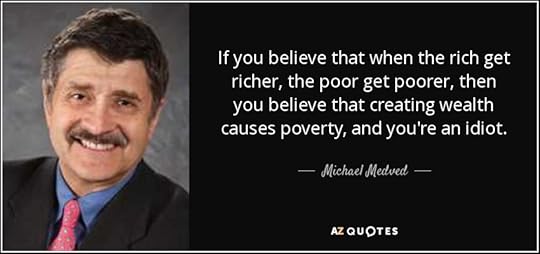
“Ending poverty, on the other hand, means altering part of the human condition which governments may attempt but never can achieve. No secretary of poverty, no matter how dedicated or talented or lavishly funded, will be able to prevent suffering for a fourteen-year-old girl who gives birth to a baby and drops out of high school while functionally illiterate. This same official will similarly fail to rescue a heroin addict and gang member who goes to jail for burglary and assault and returns to a life of drugs and crime upon his release. An unskilled new immigrant with six children (even if all of them enter the country legally, with proper documentation) may need to go through several years (at least) of poverty, despite official determination to end inequality. There’s also little chance to give security to a family with small children whose father gambles away all resources at local casinos, even while compiling prodigious credit card debt to live above his means. In other words, much of today’s poverty stems from bad choices and self-destructive behavior, rather than a lack of bureaucratic attention. The president may hector a new secretary of poverty (and every other cabinet official, for that matter) with the daily question “What have you done today to end poverty in America?” but it’s safe to assume that poverty still won’t end. It’s a relative status in any event: today’s “poor”—with their cell phones, color TVs, DVD players, air conditioners, cars, Medicaid, free lunches, and food stamps—would have been considered middle class some fifty years ago.”
Slavery
“1. Slavery is a timeless, universal institution, not an American innovation.
2. The slave economy played only a minor role in building American power and prosperity, and for the most part retarded economic progress more than advanced it.
3. America deserves unique credit for rapidly ending slavery, not distinctive blame for its establishment.
4. There’s scant reason to believe that today’s African Americans would be better off had their ancestors remained behind in Africa.”
“During four hundred years of European slave trade, the white merchants were primarily the recipients rather than the collectors of the people they handled. Despite popular images of European slavers assaulting peaceful tribes with guns blazing, chaining and dragging away their victims, in fact the Portuguese and other merchants procured their cargo from willing indigenous African vendors along the coast. The esteemed African American historian Nathan Huggins pointed out that ‘virtually all of the enslavement of Africans was carried out by other Africans.’ Most of these African traders ‘saw themselves as selling people other than their own,’ since the concept of a single African ‘race’ was the dubious invention of Western colonists. The kings of Dahomey (today called Benin) attacked neighboring villages on a regular basis to seize slaves for commerce. In 1840 King Gezo told English visitors he would do anything the British wanted him to do ‘except to give up the slave trade.’ He proudly declared: ‘The slave trade is the ruling principle of my people. It is the source and glory of their wealth.’”
“Saudi Arabia outlawed slave owning only in 1962. The Islamic Republic of Mauritania finally moved toward abolition in 1981, but the practice continued unabated, even after a 2003 law that made slave ownership punishable with jail or a fine. As recently as December 2004, the BBC cited Boubakar Messaoud of Mauritania’s SOS Slaves organization: ‘A Mauritanian slave, whose parents and grandparents before him were slaves, doesn’t need chains. He has been brought up as a domesticated animal.’”
“… the overwhelming majority of the transatlantic slave trade—at least 94 percent—went to Central and South America or the West Indies. For instance, slave ships transported a total of 480,000 Africans to all of America north of Mexico but carried 3.6 million to Brazil alone. Another 4 million went to the islands of the West Indies, with the relatively small island of Cuba receiving double the number of slaves imported to all of North America throughout the history of British settlement. The Portuguese, and later the Spaniards, established and monopolized the transatlantic slave trade nearly two hundred years before the English even established their first settlements in the Western Hemisphere.”
Third Party
“No minor-party candidate has ever won the presidency or, for that matter, even come close. For the most part, these ego-driven ‘independent’ adventures in electoral narcissism push the political process further away from their supporters’ professed goals, rather than advancing the insurgent group’s agenda or ideas.”
This is the second one that I have read by him and once again, I learned so much. It’s meticulously researched and although there were a few parts that were a bit on the dry side for me, all in all I enjoyed it immensely. His approach is reasonable and intelligent. I wish that every American, or really anyone, would read this book. Although I’m not an American, nor do I live in the U.S., as is the case in many places today, we are heavily influenced by all that goes on there.
Some of the fallacies that Medved covers include: Native Americans (including Thanksgiving) as well as slavery. Having gone to school in the Caribbean, I am familiar with Caribbean history. However, I did not know, or at least I must have forgotten, that of all the slave traffic that headed to the new world, only five percent of it went to America. I thought that it was much higher. The rest were sent to Brazil, other South American countries, and to the Caribbean. Of course, this doesn’t make anything about it right, but it’s an important fact to know.
This is the sort of book that I would like to re-read from time to time, or, at the very least, to refer to my notes. The reason being to remember what to say when communicating with others who believe all the fallacies and disinformation that Medved does such a fabulous job of disproving. You see, I’m the type of person that often gets tongue-tied when faced with differing opinions. Although I usually prefer to stay silent, especially as I get older, and because I know that there’s no convincing most people, it helps to be somewhat better prepared, and, if necessary, to be better able to solidify my point of view.
Here are some of my favorite quotes. There were so many. I couldn't include them all.
Agonizing over our History
“The hardworking public knows and cares so little about all the other imperfect nations of the world that the USA’s shortcomings look singular, unprecedented, and overwhelming. We tend to take our failures more seriously than do our fellow members of the international community. Other nations manage to cope with far more shameful histories of mass murder, backwardness, and barbarity without feeling the need for apologies, handwringing, or wrenching self-criticism. For example, Oscar-winning director Ang Lee notes the overwhelming importance of unquestioning patriotism to all those who claim Chinese identity: ‘Chinese patriotism is not supposed to be negotiable. To us that’s a black-and-white thing. You sacrifice yourself—how can you let China down?’ Politicians and pundits in the People’s Republic don’t agonize about thousands of years of conquest and colonialism over ‘lesser’ peoples at the edges of the Middle Kingdom. Similarly, in France’s government-run schools ‘the very content of education is discriminatory,’” according to French journalist and author Guy Sorman. ‘The history of colonization is taught as if it were a glorious feature of French history. In Senegal, on his first official visit to Africa, [President Nicolas] Sarkozy regretted the violence of colonization but insisted on the good intentions of the French colonizers, out there to bring civilization to the ‘African man’ who had ‘not entered history.’” Our French cousins celebrate Bastille Day with unapologetic pride, despite the ugly stains on the tricolor. For Mexicans and for Mexican immigrants in the United States, Cinco de Mayo doesn’t provide an occasion for brooding meditation on the pain and injustice that’s always characterized our turbulent neighbor to the south.”
America Bashing
“Critics of the United States support their dark vision of its role in the world by concentrating on specific instances of bullying or brutality, trotting out their favorite horror stories from Indochina or Chile, Vietnam or Iraq, or dozens of other cases where American involvement imperfectly exemplified the nation’s high ideals. These arguments lack perspective and ignore context. They emphasize details over destiny, appalling but isolated incidents over fateful long-term struggles. Anti-American scholars and agitators love to cite random crimes and blunders by U.S. troops and diplomats in order to smear the larger goals of the nation’s policies, no matter how noble or necessary. No one, for instance, questions the righteous nature of America’s determination to crush Hitlerism.”
“America bashers may insist that the Russian empire never constituted a real threat to the West and that militant anti-Communists merely conjured up the specter of the ‘Red menace’ to serve their own power-mad ends, but the corpses piled high in much of Europe, Asia, and Latin America provide unimpeachable evidence to the contrary. The Black Book of Communism: Crimes, Terror, Repression, the 1997 compilation of research edited by French academician Stéphane Courtois, counts some one hundred million victims of Communist murder during the twentieth century. This horrifying record, ignored by too many contemporary Americans, may not excuse American misdeeds of the Cold War period, but it certainly can help to explain them.”
“The best way to put America’s place in the world in proper context is to call to mind a famous sequence from the most beloved Hollywood movie of them all. In It’s a Wonderful Life, small-town banker George Bailey (Jimmy Stewart) contemplates a Christmas Eve suicide before guardian angel Clarence provides the ultimate life-affirming vision. He provides the disheartened hero with a dark, dysfunctional view of the town of Bedford Falls as it would have been if he’d never drawn breath, the community taking shape without his good deeds and benevolent influence. With that sharper perspective, George can go home to his loving family to celebrate the holiday with gratitude and joy. Those who condemn the United States should perform a thought experiment involving a global ‘Bedford Falls vision.’ Imagine that the United States had never become a world power, or never existed at all. Would the ideals of democracy and free markets wield the same power in the world? Would murderous dictatorships have claimed more victims, or fewer? Would the community of nations strain under the lash of Nazism, Communism, or some vicious combination of both? Would multiethnic, multireligious democracy flourish anywhere on earth without inspiration from the groundbreaking example of the USA? Would the threat of jihadist violence and resurgent Islamic fundamentalism menace humanity more grievously, or not at all? No one can provide definitive, authoritative answers to such hypothetical questions, but merely confronting the questions should help put the American role in more complete perspective. Just as George Bailey’s view of an alternative reality convinced him that ‘it’s a wonderful life,’ even the briefest contemplation of a world without America should persuade us that ‘it’s a wonderful nation’—and an indispensable boon to all of humanity.
“If a Spaniard or a Swede won’t acknowledge how much he has benefited from the United States and its world leadership for ideals of liberty, free markets, and self-government, he’s shallow and stupid. But if a citizen of this favored land can’t appreciate his own prodigious good fortune, his limitless opportunities as an American, then it’s a case of willful ignorance and ingratitude.
“The Lubavitcher rebbe Menachem Mendel Schneerson, the late, great leader of Chassidic Judaism, immigrated to the United States as a Holocaust refugee in 1941 and always marveled at the goodness and decency of his adopted homeland. He referred to America as the ‘malchus shel chesed’—the kingdom of loving-kindness—and that description neatly summarizes the warmhearted, openhanded qualities of our national life for newcomer and native-born alike.”
Capitalism
“Thomas J. DiLorenzo, economics professor at Loyola College in Maryland, highlights the deeper impact of corporate expansion. ‘Capitalism improves the quality of life for the working class not just because it leads to improved wages but also because it produces new, better, and cheaper goods,’ he writes in his 2005 book How Capitalism Saved America. ‘When Henry Ford first started selling automobiles only the relatively wealthy could afford them, but soon enough working-class families were buying his cars.’”
Hyphenated Americans
“In a famous 1915 address to an Irish Catholic audience, former president Theodore Roosevelt made an unforgettable and passionate plea for the ideal of one nation, indivisible: There is no room in this country for hyphenated Americanism. When I refer to hyphenated Americans, I do not refer to naturalized Americans. Some of the very best Americans I have ever known were naturalized Americans. Americans born abroad. But a hyphenated American is not an American at all. . . . The one absolutely certain way of bringing this nation to ruin, of preventing all possibility of its continuing to be a nation at all, would be to permit it to become a tangle of squabbling nationalities, an intricate knot of German-Americans, Irish-Americans, English-Americans, French-Americans, Scandinavian-Americans or Italian-Americans, each preserving its separate nationality, each at heart feeling more sympathy with Europeans of that nationality, than with the other citizens of the American Republic. There is no such thing as a hyphenated American who is a good American. The only man who is a good American is the man who is an American and nothing else.”
“President Woodrow Wilson, TR’s archrival, emphatically agreed with Roosevelt on this essential point. ‘Any man who carries hyphen about with him carries a dagger that he is ready to plunge into the vitals of this Republic whenever he gets ready.’”
Poverty
“Ending poverty, on the other hand, means altering part of the human condition which governments may attempt but never can achieve. No secretary of poverty, no matter how dedicated or talented or lavishly funded, will be able to prevent suffering for a fourteen-year-old girl who gives birth to a baby and drops out of high school while functionally illiterate. This same official will similarly fail to rescue a heroin addict and gang member who goes to jail for burglary and assault and returns to a life of drugs and crime upon his release. An unskilled new immigrant with six children (even if all of them enter the country legally, with proper documentation) may need to go through several years (at least) of poverty, despite official determination to end inequality. There’s also little chance to give security to a family with small children whose father gambles away all resources at local casinos, even while compiling prodigious credit card debt to live above his means. In other words, much of today’s poverty stems from bad choices and self-destructive behavior, rather than a lack of bureaucratic attention. The president may hector a new secretary of poverty (and every other cabinet official, for that matter) with the daily question “What have you done today to end poverty in America?” but it’s safe to assume that poverty still won’t end. It’s a relative status in any event: today’s “poor”—with their cell phones, color TVs, DVD players, air conditioners, cars, Medicaid, free lunches, and food stamps—would have been considered middle class some fifty years ago.”
Slavery
“1. Slavery is a timeless, universal institution, not an American innovation.
2. The slave economy played only a minor role in building American power and prosperity, and for the most part retarded economic progress more than advanced it.
3. America deserves unique credit for rapidly ending slavery, not distinctive blame for its establishment.
4. There’s scant reason to believe that today’s African Americans would be better off had their ancestors remained behind in Africa.”
“During four hundred years of European slave trade, the white merchants were primarily the recipients rather than the collectors of the people they handled. Despite popular images of European slavers assaulting peaceful tribes with guns blazing, chaining and dragging away their victims, in fact the Portuguese and other merchants procured their cargo from willing indigenous African vendors along the coast. The esteemed African American historian Nathan Huggins pointed out that ‘virtually all of the enslavement of Africans was carried out by other Africans.’ Most of these African traders ‘saw themselves as selling people other than their own,’ since the concept of a single African ‘race’ was the dubious invention of Western colonists. The kings of Dahomey (today called Benin) attacked neighboring villages on a regular basis to seize slaves for commerce. In 1840 King Gezo told English visitors he would do anything the British wanted him to do ‘except to give up the slave trade.’ He proudly declared: ‘The slave trade is the ruling principle of my people. It is the source and glory of their wealth.’”
“Saudi Arabia outlawed slave owning only in 1962. The Islamic Republic of Mauritania finally moved toward abolition in 1981, but the practice continued unabated, even after a 2003 law that made slave ownership punishable with jail or a fine. As recently as December 2004, the BBC cited Boubakar Messaoud of Mauritania’s SOS Slaves organization: ‘A Mauritanian slave, whose parents and grandparents before him were slaves, doesn’t need chains. He has been brought up as a domesticated animal.’”
“… the overwhelming majority of the transatlantic slave trade—at least 94 percent—went to Central and South America or the West Indies. For instance, slave ships transported a total of 480,000 Africans to all of America north of Mexico but carried 3.6 million to Brazil alone. Another 4 million went to the islands of the West Indies, with the relatively small island of Cuba receiving double the number of slaves imported to all of North America throughout the history of British settlement. The Portuguese, and later the Spaniards, established and monopolized the transatlantic slave trade nearly two hundred years before the English even established their first settlements in the Western Hemisphere.”
Third Party
“No minor-party candidate has ever won the presidency or, for that matter, even come close. For the most part, these ego-driven ‘independent’ adventures in electoral narcissism push the political process further away from their supporters’ professed goals, rather than advancing the insurgent group’s agenda or ideas.”
July 10, 2021
This book is written by a conservative radio show host. It addresses ten topics about America. Some are history (how Indians and Blacks were treated in the old days). Some are typical conservative agendas, such as the roles of business and government in the economy. Yet some others are cultural issues, such as the role of religion and diversity in American identity. Discussions on some topics are more fact-based (such as the black and Indian history), others are more argumentative (such as on big business), and yet others rely more on quotes from the “famous people” (such as on secularism and multi-culturalism). Some other topics are well-balanced between facts and arguments.
The book is definitely slanted toward the conservative views. However, it does contain much material in data and facts. It can serve as a good reference book, although fact-checking is probably needed given the book’s overall political inclination.
The book is definitely slanted toward the conservative views. However, it does contain much material in data and facts. It can serve as a good reference book, although fact-checking is probably needed given the book’s overall political inclination.

March 8, 2017
Honestly better written than I thought it would be, but the arguments themselves relied more on faith and tradition. Which was basically the central thesis: faith and tradition provides.
January 24, 2020
Almost finished this pile of crap. But in the end I just couldn't. How could this one sided garbage be published. Fucking pathetic excuse for a book.

April 3, 2020
This book is trash. If I could give it negative stars I would. It could easily be satire, but unfortunately I think the author is serious.

September 6, 2021
Wild use of arguments and selective use of stats to support absurd claims. Far-right fanatic... this text could be used as a primer in critical thinking mistakes.
Read
April 9, 2018This is sort of a joint review for A Nation Among Nations: America's Place in World History by Thomas Bender and The 10 Big Lies About America: Combating Destructive Distortions About Our Nation by Michael Medved. The reason for this is I kind of read them together. I thought it would be interesting to compare this book by a credentialed historian that argues that the United States is less "exceptional," less unique that is often claimed with one by a right-wing nut job that argues that the U.S. is more praiseworthy than its many critics would have you believe.
Both books are historically focused and I feel like I learned a lot from both of them. But in the end, I'm going to declare Mr. Right-Wing Nut Job the winner. Both had their strengths and their flaws, but Medved's book annoyed me less. This may in fact be due to the post-grad school hangover I've been nursing for a good three and a half years now that means I have very little patience for the excesses of academics with a vaguely left-wing agenda and their popular trickle-down these days.
But this doesn't mean I've become politically "conservative" by the standard definition in contemporary U.S. terms. I know this because I was annoyed by some of the moves Medved made, too. Frankly, I was a bit embarrassed by even reading his book. I mean, my usual take on books marketed to the American political right has been that they are written by ideologues who are totally willing to stick their head in the sand when necessary rather than concede any points to their ideological opponents. Really I think it was my memories of Medved's stint on Sneak Previews, a PBS version of the Siskel and Ebert film review show that also featured Jeffry Lyons that made me more willing to read Medved's work. I used to like watching that show when I was like thirteen or fourteen. Frankly, I didn't know he was anything else but a film critic until I started seeing books with American flag lettering for their titles with his name as the author.
Turns out he makes some good points, actually. Really the most valuable chapters for me were the first two, where he addresses 1) the interaction between the European colonists and the native peoples of what is now the United States and 2) slavery in the U.S. Really his purposes are to put both those "black marks" on U.S. history in a little bit of context and temper the extremist perspectives on both of those issues that are becoming more mainstream despite not really being supported by the historical record.
Regarding point one, he mostly he wants to debunk the idea that Native American were a some kind of Utopian, Tolkien elf-type civilization that lived harmoniously and sang Kumbaya around the magic mother tree every night after riding their giant pterodactyls. . . until they were mercilessly and systematically rounded up, raped, and butchered by greedy, racist Europeans. A few significant details: the indigenous tribes of the U.S., like most societies (certainly the Europeans), were almost constantly at war with each other, competed for territory, etc.; and "new" (to them) diseases killed the vast majority of Native Americans, not white settlers. More broadly speaking, Medved tries to contextualize the interaction between the two cultures in the long history of such meetings where one culture had a significant upper hand technologically speaking (not to mention those diseases! . . .). Not a genocide, he emphatically asserts, and if the definition of genocide is a conscious, organized effort to eradicate a culture then he is right. If real genocide had been attempted, it sadly might not have taken so long. . .
His point two is mostly just an effort to do the same thing with slavery--put it into a broader historical context and debunk the idea that some Europeans seem to have that Americans are somehow uniquely racist. (Hello? Where do you think these Euro-Americans came from in the first place?) The reality is that slavery was much less prevalent and much less cruel in the U.S. than it was in many other parts of the Americas and the abolition of slavery in the U.S. was part of a broader transatlantic abolitionist movement that had the U.K. abolishing their slave trade in 1833 and Brazil outlawing slavery in 1888.
I do not mean to minimize or make light of these tragic and sad episodes from American history, just trying to summarize Medved's very apt correction of some exaggerated notions that have become common in the wake historical revisionism.
But Medved's efforts to advocate for big business and unfettered capitalism are less well-received by this reader. He writes as if business owners have never, ever done anything to take advantage of their workers. He seems to operate under the maxim that ANY government regulation on business is wrong. Tellingly, his book was authored before the 2008 economic collapse. I'd be interested to hear his take on that. But not that interested.
That said, I appreciated Medved's earlier chapters and his overall aim and dispelling exaggerated notions of the guilt some think Americans should feel about their horrible history. He argues that the U.S.'s contribution to the world has been, all things accounted for, clearly positive. And I think he's right.
Bender is also interested in dispelling exaggerated notions. But instead of writing in response to the hypercritical voices on the left, Bender seems to be in a conversation with 1950s grade school history text books that present the United States as unique and exceptionally virtuous, a lone light illuminating the world. He seeks a perspective on the nation in the broader context of world history.
Like Medved, the earlier chapter present excellent information and real perspective before he goes off track in later chapters and falls into promoting a politically-biased agenda. At least that is how I read it.
His first chapters treat 1) the colonization of what is now the U.S. in the context of the age of oceanic exploration, 2) the Revolutionary War in the context of the ongoing conflict between England and France and the series of worldwide revolutions that sought to create democratic governments inspired by Locke's liberalism philosophy, and 3) the Civil War in the context of the rising tide of liberal Nationalism. I'm not going to pretend I understood every last point Bender makes. I'm a bit under-schooled in political science. But by and large he presented what was a nice fresh view of U.S. and world history for me. It seems he sometimes admitted real American contributions to the world begrudgingly (e.g. The U.S. was both early and relatively advanced in its Lockean revolution and inspired many other nations to follow suit.), which seemed a little silly, but at least he didn't totally ignore them.
In the fourth chapter, however, he went off the rails. Even though his premise was talking about the U.S. as "a nation among nations," debunking naive notions of American exceptionalism, Bender seems totally cool with arguing that the U.S. is exceptional in BAD ways. For me this chapter was revealing about his agenda. He uses a clunky metaphor based on a narrow reading of Moby Dick that has crazed Captain Ahab representing the United States, bent on world domination. No, Bender argues, the U.S. doesn't want to conquer the world in a military sense, it wants to conquer the world in an ideological sense--mostly to open up markets for its capitalist aims of selling stuff. But if we have to use our military to do that, then by gosh we will. He goes on and on about the Spanish-American War and acts as if it is the key to understanding the entire history of American foreign policy. Nope. Try again.
If you can't tell, I was really put off by the turn in the chapter. I think what bothered me the most was that he insisted on minimizing any U.S. contributions to the liberty and prosperity of people throughout the world, but seemed totally fine in magnifying what he sees as negative impacts of the U.S. on other nations. Just as Medved's book could have used a little dose of the 2008 financial collapse to inform its discussion of U.S. economic history, so could have Bender's book (published in 2006) been less zeroed-in on the Iraq War (or its historical surrogate the Spanish-American War) as the lone model of the history of U.S. foreign policy.
So all told, for me, both books have much to offer and leave much to be desired. But I kind of enjoyed this experiment and was certainly pleased how well they books seemed to be in conversation with one another.
Both books are historically focused and I feel like I learned a lot from both of them. But in the end, I'm going to declare Mr. Right-Wing Nut Job the winner. Both had their strengths and their flaws, but Medved's book annoyed me less. This may in fact be due to the post-grad school hangover I've been nursing for a good three and a half years now that means I have very little patience for the excesses of academics with a vaguely left-wing agenda and their popular trickle-down these days.
But this doesn't mean I've become politically "conservative" by the standard definition in contemporary U.S. terms. I know this because I was annoyed by some of the moves Medved made, too. Frankly, I was a bit embarrassed by even reading his book. I mean, my usual take on books marketed to the American political right has been that they are written by ideologues who are totally willing to stick their head in the sand when necessary rather than concede any points to their ideological opponents. Really I think it was my memories of Medved's stint on Sneak Previews, a PBS version of the Siskel and Ebert film review show that also featured Jeffry Lyons that made me more willing to read Medved's work. I used to like watching that show when I was like thirteen or fourteen. Frankly, I didn't know he was anything else but a film critic until I started seeing books with American flag lettering for their titles with his name as the author.
Turns out he makes some good points, actually. Really the most valuable chapters for me were the first two, where he addresses 1) the interaction between the European colonists and the native peoples of what is now the United States and 2) slavery in the U.S. Really his purposes are to put both those "black marks" on U.S. history in a little bit of context and temper the extremist perspectives on both of those issues that are becoming more mainstream despite not really being supported by the historical record.
Regarding point one, he mostly he wants to debunk the idea that Native American were a some kind of Utopian, Tolkien elf-type civilization that lived harmoniously and sang Kumbaya around the magic mother tree every night after riding their giant pterodactyls. . . until they were mercilessly and systematically rounded up, raped, and butchered by greedy, racist Europeans. A few significant details: the indigenous tribes of the U.S., like most societies (certainly the Europeans), were almost constantly at war with each other, competed for territory, etc.; and "new" (to them) diseases killed the vast majority of Native Americans, not white settlers. More broadly speaking, Medved tries to contextualize the interaction between the two cultures in the long history of such meetings where one culture had a significant upper hand technologically speaking (not to mention those diseases! . . .). Not a genocide, he emphatically asserts, and if the definition of genocide is a conscious, organized effort to eradicate a culture then he is right. If real genocide had been attempted, it sadly might not have taken so long. . .
His point two is mostly just an effort to do the same thing with slavery--put it into a broader historical context and debunk the idea that some Europeans seem to have that Americans are somehow uniquely racist. (Hello? Where do you think these Euro-Americans came from in the first place?) The reality is that slavery was much less prevalent and much less cruel in the U.S. than it was in many other parts of the Americas and the abolition of slavery in the U.S. was part of a broader transatlantic abolitionist movement that had the U.K. abolishing their slave trade in 1833 and Brazil outlawing slavery in 1888.
I do not mean to minimize or make light of these tragic and sad episodes from American history, just trying to summarize Medved's very apt correction of some exaggerated notions that have become common in the wake historical revisionism.
But Medved's efforts to advocate for big business and unfettered capitalism are less well-received by this reader. He writes as if business owners have never, ever done anything to take advantage of their workers. He seems to operate under the maxim that ANY government regulation on business is wrong. Tellingly, his book was authored before the 2008 economic collapse. I'd be interested to hear his take on that. But not that interested.
That said, I appreciated Medved's earlier chapters and his overall aim and dispelling exaggerated notions of the guilt some think Americans should feel about their horrible history. He argues that the U.S.'s contribution to the world has been, all things accounted for, clearly positive. And I think he's right.
Bender is also interested in dispelling exaggerated notions. But instead of writing in response to the hypercritical voices on the left, Bender seems to be in a conversation with 1950s grade school history text books that present the United States as unique and exceptionally virtuous, a lone light illuminating the world. He seeks a perspective on the nation in the broader context of world history.
Like Medved, the earlier chapter present excellent information and real perspective before he goes off track in later chapters and falls into promoting a politically-biased agenda. At least that is how I read it.
His first chapters treat 1) the colonization of what is now the U.S. in the context of the age of oceanic exploration, 2) the Revolutionary War in the context of the ongoing conflict between England and France and the series of worldwide revolutions that sought to create democratic governments inspired by Locke's liberalism philosophy, and 3) the Civil War in the context of the rising tide of liberal Nationalism. I'm not going to pretend I understood every last point Bender makes. I'm a bit under-schooled in political science. But by and large he presented what was a nice fresh view of U.S. and world history for me. It seems he sometimes admitted real American contributions to the world begrudgingly (e.g. The U.S. was both early and relatively advanced in its Lockean revolution and inspired many other nations to follow suit.), which seemed a little silly, but at least he didn't totally ignore them.
In the fourth chapter, however, he went off the rails. Even though his premise was talking about the U.S. as "a nation among nations," debunking naive notions of American exceptionalism, Bender seems totally cool with arguing that the U.S. is exceptional in BAD ways. For me this chapter was revealing about his agenda. He uses a clunky metaphor based on a narrow reading of Moby Dick that has crazed Captain Ahab representing the United States, bent on world domination. No, Bender argues, the U.S. doesn't want to conquer the world in a military sense, it wants to conquer the world in an ideological sense--mostly to open up markets for its capitalist aims of selling stuff. But if we have to use our military to do that, then by gosh we will. He goes on and on about the Spanish-American War and acts as if it is the key to understanding the entire history of American foreign policy. Nope. Try again.
If you can't tell, I was really put off by the turn in the chapter. I think what bothered me the most was that he insisted on minimizing any U.S. contributions to the liberty and prosperity of people throughout the world, but seemed totally fine in magnifying what he sees as negative impacts of the U.S. on other nations. Just as Medved's book could have used a little dose of the 2008 financial collapse to inform its discussion of U.S. economic history, so could have Bender's book (published in 2006) been less zeroed-in on the Iraq War (or its historical surrogate the Spanish-American War) as the lone model of the history of U.S. foreign policy.
So all told, for me, both books have much to offer and leave much to be desired. But I kind of enjoyed this experiment and was certainly pleased how well they books seemed to be in conversation with one another.

Did Not Finish
November 29, 2019No, I didn’t actually read this book. I only read the chapter on the “lie” of “America was founded on genocide against Native Americans.” During Native American History Month. I picked this up on a whim at the library to read something I knew I would disagree with. Medved wrote this book in 2008 and so it seems almost quaint in its flag-waving, before it became virulent & xenophobic with Trump.
I was happy (surprised) to see some sense of balance in the Native American chapter, acknowledging white atrocities. However, the whole structure of the argument is flawed & just unhelpful to reasoned consideration of Indian-white history. Medved sets up the straw man of genocide and takes it down arguing (again against straw men, carefully chosen examples of alleged white atrocities) that the examples don’t show genocidal intent; that Indians did bad stuff to whites too (both sides are equally culpable); that intermarriage with whites “claimed at least as many Indian families as murder and massacre; and—most disappointingly—that the question doesn’t even matter because Indian people were doomed to subjugation.
Medved’s view is that “scornful assaults” on America’s history are unpatriotic. He attempts to correct what he views as unjustified guilt over America’s past. I knew this going in, and just wanted to hear how/what those I disagree with are saying. And I still disagree, and find this line of argument counterproductive. It’s minimizing this shameful treatment of Indian people. He never mentions the Indian boarding schools, the Trail of Tears, the Indian Removal Act—all pretty clear and deliberate efforts to de-indianize the people. If devaluing and removing their culture from them isn’t the same as murdering them it seems to be quibbling to me.
Medved refers to his “friend Dinesh D’Souza,” which isn’t good at all. To Medved, loyalty and patriotism in America is the highest & unassailable value. I will never agree with that worldview.
I was happy (surprised) to see some sense of balance in the Native American chapter, acknowledging white atrocities. However, the whole structure of the argument is flawed & just unhelpful to reasoned consideration of Indian-white history. Medved sets up the straw man of genocide and takes it down arguing (again against straw men, carefully chosen examples of alleged white atrocities) that the examples don’t show genocidal intent; that Indians did bad stuff to whites too (both sides are equally culpable); that intermarriage with whites “claimed at least as many Indian families as murder and massacre; and—most disappointingly—that the question doesn’t even matter because Indian people were doomed to subjugation.
Medved’s view is that “scornful assaults” on America’s history are unpatriotic. He attempts to correct what he views as unjustified guilt over America’s past. I knew this going in, and just wanted to hear how/what those I disagree with are saying. And I still disagree, and find this line of argument counterproductive. It’s minimizing this shameful treatment of Indian people. He never mentions the Indian boarding schools, the Trail of Tears, the Indian Removal Act—all pretty clear and deliberate efforts to de-indianize the people. If devaluing and removing their culture from them isn’t the same as murdering them it seems to be quibbling to me.
Medved refers to his “friend Dinesh D’Souza,” which isn’t good at all. To Medved, loyalty and patriotism in America is the highest & unassailable value. I will never agree with that worldview.
Displaying 1 - 30 of 88 reviews