

What do you think?

Green Tyranny: Exposing the Totalitarian Roots of the Climate Industrial Complex
Climate change was political long before Al Gore first started talking about it. In the 1970s, the Swedish Social Democrats used global warming to get political support for building a string of nuclear power stations. It was the second phase of their war on coal, which began with the acid rain scare and the first big UN environment conference in Stockholm in 1969.
Acid rain swept all before it. America held out for as long as Ronald Reagan was in the White House, but capitulated under his successor. Like global warming, acid rain had the vocal support of the scientific establishment, but the consensus science collapsed just as Congress was passing acid rain cap-and-trade legislation. Rather than tell legislators and the nation the truth, the EPA attacked a lead scientist and suppressed the federal report showing that the scientific case for action on curbing power station emissions was baseless.
Ostensibly neutral in the Cold War, Sweden had a secret military alliance with Washington. A hero of the international Left, Sweden’s Olof Palme used environmentalism to maintain a precarious balance between East and West. Thus Stockholm was the conduit for the KGB-inspired nuclear winter scare. The bait was taken by Carl Sagan and leading scientists, who tried to undermine Ronald Reagan’s nuclear strategy and acted as propaganda tools to end the Cold War on Moscow’s terms.
Nuclear energy was to have been the solution to global warming. It didn’t turn out that way, most of all thanks to Germany. Instead America and the world are following Germany’s lead in embracing wind and solar. German obsession with renewable energy originates deep within its culture. Few know today that the Nazis were the first political party to champion wind power, Hitler calling wind the energy of the future.
Post-1945 West Germany appeared normal, but anti-nuclear protests in the 1970s led to the fusion of extreme Left and Right and the birth of the Greens in 1980. Their rise changed Germany, then Europe and now the world. Radical environmentalism became mainstream. It demands more than the rejection of the abundant hydrocarbon energy that fuels American greatness. It requires the suppression of dissent.
Acid rain swept all before it. America held out for as long as Ronald Reagan was in the White House, but capitulated under his successor. Like global warming, acid rain had the vocal support of the scientific establishment, but the consensus science collapsed just as Congress was passing acid rain cap-and-trade legislation. Rather than tell legislators and the nation the truth, the EPA attacked a lead scientist and suppressed the federal report showing that the scientific case for action on curbing power station emissions was baseless.
Ostensibly neutral in the Cold War, Sweden had a secret military alliance with Washington. A hero of the international Left, Sweden’s Olof Palme used environmentalism to maintain a precarious balance between East and West. Thus Stockholm was the conduit for the KGB-inspired nuclear winter scare. The bait was taken by Carl Sagan and leading scientists, who tried to undermine Ronald Reagan’s nuclear strategy and acted as propaganda tools to end the Cold War on Moscow’s terms.
Nuclear energy was to have been the solution to global warming. It didn’t turn out that way, most of all thanks to Germany. Instead America and the world are following Germany’s lead in embracing wind and solar. German obsession with renewable energy originates deep within its culture. Few know today that the Nazis were the first political party to champion wind power, Hitler calling wind the energy of the future.
Post-1945 West Germany appeared normal, but anti-nuclear protests in the 1970s led to the fusion of extreme Left and Right and the birth of the Greens in 1980. Their rise changed Germany, then Europe and now the world. Radical environmentalism became mainstream. It demands more than the rejection of the abundant hydrocarbon energy that fuels American greatness. It requires the suppression of dissent.
350 pages, Kindle Edition
Published March 26, 2019
Ratings & Reviews
Friends & Following
Create a free account to discover what your friends think of this book!
Community Reviews
Displaying 1 - 12 of 12 reviews

May 13, 2018
biggest takeaway: electricity cant really be stored, so wind and solar arent that effective.
February 11, 2018
An interesting and meticulously researched book. The climate war and global warming is such an important topic, it is incumbent on us to inform ourselves and regularly revisit our opinions. Whether you agree with the author's conclusions or not, Rupert Darwall's arguments are impeccably researched and extremely informative. A fascinating read.

Want to Read
September 28, 2019
(Guess who is she lookin' at....)
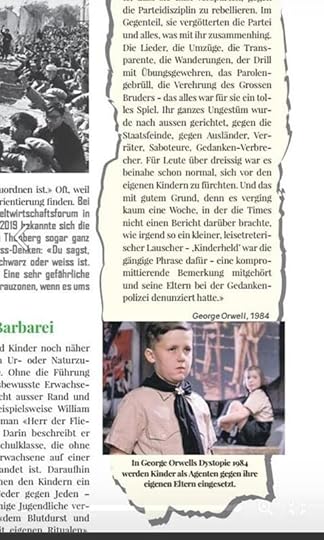
(Kids denouncing grownups, in Orwell's 1984)
"The Nazi Roots of Environmentalism and the Climate Change Fraud"
I wonder what would Greta Thunberg think about that.
Ah, the author speaks also about the "Sweden’s environmentalist power grab."
"A hero of the international Left, Sweden’s Olof Palme used environmentalism to maintain a precarious balance between East and West. Thus Stockholm was the conduit for the KGB-inspired nuclear winter scare."
In: https://www.encounterbooks.com/books/...
December 20, 2020
I don’t usually write reviews of books but this one really justifies taking the time.
The main issue with this book is that Mr Darwall is contradictory about climate change throughout and that dampens any impact of what his arguments. Without a clear position the rest of the book is confused and doesn’t really make an impact. During the book he seems to swing from a number of different viewpoints without committing to any – climate change is a hoax, it’s real but not that bad, it will be good for us or it is a serious challenge but renewables aren’t the answer. His constant changing of opinion and reasoning echoes some of our populist leaders and I think Mr Darwall has the same respect they have for their audiences – not much.
If he really wanted to make me change my mind he would have needed to present evidence of a climate change hoax. I would love for there to be proof that climate change is a hoax or not a risk but that really isn’t the case. Without this he misses the reason why renewables get so much attention (sort of key to the whole book he has just written), it isn’t about cost effectiveness or efficient tech – it is our best option right now. No, renewables aren’t perfect and there are huge challenges but a business-as-usual approach or using fracking (which Rupert Darwall is a big advocate of) just aren’t going to do it.
In one of the moments where he inadvertently argues against himself Mr Darwall discusses the early development of electricity and how its imperfections were ironed out over time. For some reason he doesn’t connect the dots that this approach is also needed with renewables.
The reason I gave this book 2 stars (1.5 if I could) is because I do agree that nuclear energy is needed to be a serious consideration for a energy mix to overcome the challenges that renewables have around intermittency. Baffling though that he argues for fracking. We don’t want to get rid of dirty energy just to have full on filth.
One of the highlights of the book for me was Mr Darwall acknowledging that to make renewables work you need to have centralised control of energy. This really is the problem for him – it isn’t that the tech doesn’t work, it’s that it doesn’t align with his politics. He seems to be so stubborn that even when a solution is presenting itself he would rather concoct a global conspiracy theory than admit that maybe nationalisation could be of benefit.
Beyond the central issues with his argument there is so much wrong with this book. He constantly berates “the left” and this is defined as anything he doesn’t like. Whenever there is someone he wants to present as shady he will just use some variation on "leftist" or "communist" to describe them without anything to back this up (my favourite being “far right Marxists”). All the while complaining about how the left use language to meet their nefarious ends.
Also funny (but disturbing when you see the positive reviews for this book) was Mr Darwall’s tenuous links that he uses to link renewables to the forces of evil. A couple of my favourites – Nazi’s were vegetarian and explored renewables so these must be Nazi ideas (it only took a couple of chapters for that one) and his claims that an author was a communist because the publisher of one of his books also published a biography of Brezhnev. I have never understood how an author expects to be taken seriously when they are so desperate to make a point that they don't have backing for that they resort to this.
Overall this book was incoherent and isn’t backed up by any evidence which is going to make a difference to any global discussions. I’m sure if that evidence was there Mr Darwall would have been able to include it in the book. What would have been nice to hear is what Mr Darwall's solution is but I'm sure it is probably just fracking to the rescue so maybe that explains why he didn't bother.
The main issue with this book is that Mr Darwall is contradictory about climate change throughout and that dampens any impact of what his arguments. Without a clear position the rest of the book is confused and doesn’t really make an impact. During the book he seems to swing from a number of different viewpoints without committing to any – climate change is a hoax, it’s real but not that bad, it will be good for us or it is a serious challenge but renewables aren’t the answer. His constant changing of opinion and reasoning echoes some of our populist leaders and I think Mr Darwall has the same respect they have for their audiences – not much.
If he really wanted to make me change my mind he would have needed to present evidence of a climate change hoax. I would love for there to be proof that climate change is a hoax or not a risk but that really isn’t the case. Without this he misses the reason why renewables get so much attention (sort of key to the whole book he has just written), it isn’t about cost effectiveness or efficient tech – it is our best option right now. No, renewables aren’t perfect and there are huge challenges but a business-as-usual approach or using fracking (which Rupert Darwall is a big advocate of) just aren’t going to do it.
In one of the moments where he inadvertently argues against himself Mr Darwall discusses the early development of electricity and how its imperfections were ironed out over time. For some reason he doesn’t connect the dots that this approach is also needed with renewables.
The reason I gave this book 2 stars (1.5 if I could) is because I do agree that nuclear energy is needed to be a serious consideration for a energy mix to overcome the challenges that renewables have around intermittency. Baffling though that he argues for fracking. We don’t want to get rid of dirty energy just to have full on filth.
One of the highlights of the book for me was Mr Darwall acknowledging that to make renewables work you need to have centralised control of energy. This really is the problem for him – it isn’t that the tech doesn’t work, it’s that it doesn’t align with his politics. He seems to be so stubborn that even when a solution is presenting itself he would rather concoct a global conspiracy theory than admit that maybe nationalisation could be of benefit.
Beyond the central issues with his argument there is so much wrong with this book. He constantly berates “the left” and this is defined as anything he doesn’t like. Whenever there is someone he wants to present as shady he will just use some variation on "leftist" or "communist" to describe them without anything to back this up (my favourite being “far right Marxists”). All the while complaining about how the left use language to meet their nefarious ends.
Also funny (but disturbing when you see the positive reviews for this book) was Mr Darwall’s tenuous links that he uses to link renewables to the forces of evil. A couple of my favourites – Nazi’s were vegetarian and explored renewables so these must be Nazi ideas (it only took a couple of chapters for that one) and his claims that an author was a communist because the publisher of one of his books also published a biography of Brezhnev. I have never understood how an author expects to be taken seriously when they are so desperate to make a point that they don't have backing for that they resort to this.
Overall this book was incoherent and isn’t backed up by any evidence which is going to make a difference to any global discussions. I’m sure if that evidence was there Mr Darwall would have been able to include it in the book. What would have been nice to hear is what Mr Darwall's solution is but I'm sure it is probably just fracking to the rescue so maybe that explains why he didn't bother.

July 25, 2020
This is a must read for anyone that cares for democracy and all it's perceived values. The green environmental movement has its roots in Nazism and NeoMarxism. Totalitarian Sweden and irrational Germany have pushed the green tyranny upon the rest of the world, widening the inequality gap and sabotaging real alternatives, all while creating a new group of eco billionaires.
This book has been written before the latest strategies of the Climate Industrial Complex to use children and emotional blackmail to spread their cancerous message. If you thought that Corona fascism was the biggest threat to liberty anno 2020, think twice. Totalitarianism is no longer luring around the corner... you are in the midst of it, like a frog slowly being boiled in its own water.
This book has been written before the latest strategies of the Climate Industrial Complex to use children and emotional blackmail to spread their cancerous message. If you thought that Corona fascism was the biggest threat to liberty anno 2020, think twice. Totalitarianism is no longer luring around the corner... you are in the midst of it, like a frog slowly being boiled in its own water.

February 10, 2024
The confusion in Darwall's arguments are apparent from the very start. As another reviewer wrote, which is the problem? Darwall is just throwing things at the wall figuring one or two will stick with different skeptical readers. He doesn't try to mount an actual consistent argument. At least Judith Curry is consistent about her positions, much as I disagree with her. Darwall has no such qualms.
The weaknesses of Darwall's bleating about costs and feasibility of renewables was apparent in 2017 when this first appeared, but now that markets are being created, and renewable contributions are increasing in leaps and bounds, it just all reads so terribly silly. It's like the creationist arguments that are obviously god-of-the-gaps. If we need markets, if we need grid infrastructure, if we need forms of storage, well yes a kick start, but once things reach the scale at which it matters, markets have provided, do provide, will provide. It's the same bullshit: Darwall doesn't like it, so he denies that markets will ever favour it, but then when markets do begin to turn in renewables' favour, he claims conspiracies. Why is China now investing in renewables so heavily? Darwall uses creativity and chaotic imagination to come up with many silly arguments against but utterly fails to envision what a thriving renewables economy might look like. With every passing year his arguments looks sillier and sillier. This is one sure sign this is not serious.
It's the perfect example of making something appear serious while not actually being serious; it'll fool people that don't know the science but only so long as they themselves wish to remain ignorant. Providing citations, particularly front-loading them at the ends of chapters, is not the same as being rigorous. The quality and correct use of the sources is suspect here.
Darwall includes this sentence near the very start of the book: "In this respect, President Trump has a surer grasp of the economic realities than the Europeans." What serious analyst would ever praise Trump's faculties for economic analysis? He claimed global warming is a hoax perpetuated by China. I don't need to go through the financial ruin that has been Trump's business life; the emperor wears no clothes, he is a fraudster. Thus is displayed the quality of analysis and opinion that Darwall is offering here. We also (sadly, predictably) get DDT impact denial and acid rain impact denial. What a fool. Note that he does not deny anthropogenic damage to the ozone layer, he's not willing to be that obvious a fool in front of his chosen audience. He only denies that in any other way humans can affect the planet significantly. What's the best prior to use for determining whether humans can affect the planet? If we've done it before.
He makes three comparisons to Nazism using the most tenuous threads imaginable, maybe more, in the first few pages. Really? I can do it to: nuclear energy is bad because the Nazis researched nuclear fission. See how easy it is? To me it seems Darwall's true intended audience is his funders at the cushy right-wing think tanks that provide his living.
Nuclear power is part of the solution, no doubt. This doesn't mean a reasonable person shits on renewables or speaks so strongly against their further development. Until storage of renewable energy is worked out (Darwall foolishly denies this will ever happen), there needs to be some form of carbon-free energy and nuclear might provide it. But nuclear is also prone to terrible accidents, represents an extraordinarily potent source of toxins if damaged by human-caused disasters such as war or by natural disasters, and has a spent fuel storage problem. These obvious problems cannot be denied. We need to not use nuclear as soon as feasible so as not to poison ourselves and our world further.
The weaknesses of Darwall's bleating about costs and feasibility of renewables was apparent in 2017 when this first appeared, but now that markets are being created, and renewable contributions are increasing in leaps and bounds, it just all reads so terribly silly. It's like the creationist arguments that are obviously god-of-the-gaps. If we need markets, if we need grid infrastructure, if we need forms of storage, well yes a kick start, but once things reach the scale at which it matters, markets have provided, do provide, will provide. It's the same bullshit: Darwall doesn't like it, so he denies that markets will ever favour it, but then when markets do begin to turn in renewables' favour, he claims conspiracies. Why is China now investing in renewables so heavily? Darwall uses creativity and chaotic imagination to come up with many silly arguments against but utterly fails to envision what a thriving renewables economy might look like. With every passing year his arguments looks sillier and sillier. This is one sure sign this is not serious.
It's the perfect example of making something appear serious while not actually being serious; it'll fool people that don't know the science but only so long as they themselves wish to remain ignorant. Providing citations, particularly front-loading them at the ends of chapters, is not the same as being rigorous. The quality and correct use of the sources is suspect here.
Darwall includes this sentence near the very start of the book: "In this respect, President Trump has a surer grasp of the economic realities than the Europeans." What serious analyst would ever praise Trump's faculties for economic analysis? He claimed global warming is a hoax perpetuated by China. I don't need to go through the financial ruin that has been Trump's business life; the emperor wears no clothes, he is a fraudster. Thus is displayed the quality of analysis and opinion that Darwall is offering here. We also (sadly, predictably) get DDT impact denial and acid rain impact denial. What a fool. Note that he does not deny anthropogenic damage to the ozone layer, he's not willing to be that obvious a fool in front of his chosen audience. He only denies that in any other way humans can affect the planet significantly. What's the best prior to use for determining whether humans can affect the planet? If we've done it before.
He makes three comparisons to Nazism using the most tenuous threads imaginable, maybe more, in the first few pages. Really? I can do it to: nuclear energy is bad because the Nazis researched nuclear fission. See how easy it is? To me it seems Darwall's true intended audience is his funders at the cushy right-wing think tanks that provide his living.
Nuclear power is part of the solution, no doubt. This doesn't mean a reasonable person shits on renewables or speaks so strongly against their further development. Until storage of renewable energy is worked out (Darwall foolishly denies this will ever happen), there needs to be some form of carbon-free energy and nuclear might provide it. But nuclear is also prone to terrible accidents, represents an extraordinarily potent source of toxins if damaged by human-caused disasters such as war or by natural disasters, and has a spent fuel storage problem. These obvious problems cannot be denied. We need to not use nuclear as soon as feasible so as not to poison ourselves and our world further.
Read
January 23, 2022Excellent book. Not an easy read but shows much of the policy trail that influenced ‘The Science’.
Particularly amazed at how Angela Merkel went from East German science apparatchik to deputy of a major reunified Germany in just over two years! It makes you think.
We’ve been lied to and indoctrinated over Covid;
This is far worse. Man-made climate change is just a method of stripping democracy and standard of living from the people. Truly Orwellian.
Particularly amazed at how Angela Merkel went from East German science apparatchik to deputy of a major reunified Germany in just over two years! It makes you think.
We’ve been lied to and indoctrinated over Covid;
This is far worse. Man-made climate change is just a method of stripping democracy and standard of living from the people. Truly Orwellian.

January 22, 2025
Löysin käsiini kolme kirjaa kympillä-tarjouksen. Olen avoin kyllä diskurssille ilmastonmuutoksesta, itse edustan sitä "jotain pitää tehdä konkreettisesti mahd pian"-porukkaa, ja täytyy sanoa, että tämän kirjan jätin kesken. Ei vain ollut sen esittämät väitteet meikäläisen mielenkuvaan sopivia, vaikka aihetta selkeästi oli tukemassa dataa ja muita aspekteja. Kirjoittajan tutkimustyön johdosta toinen tähti siis, voi sen aja varmasti huonomminkin käyttää

August 27, 2020
Always good to challenge your views and the views contained within this book were certainly interesting.

December 11, 2020
The comparison of environmentalism to fascism is apt.

January 6, 2020
Decent dive into Northern and Central European philosophies and political history of environmental politics and ideology. The first 3/4s is mostly on this then it pivots to update some machinations in the USA that came after Mr Darwall's first book and seems slightly out of whack with the flow.
Pretty good though.
Pretty good though.

October 9, 2021
This is remarkable. Green Tyranny rips the mask off the "environmentalists" fake concern about global warming. Darwall does a magnificent job of shutting down the arguments of the global warming hoax. Renewable energy punishes the people in the name of "sustainability". Well written, well documented. If you read only one book on environmentalism and its political agenda, this is it.
Displaying 1 - 12 of 12 reviews