

What do you think?

The Big Ones: How Natural Disasters Have Shaped Us
Goodreads Choice Award
Nominee for Readers' Favorite Science & Technology (2018)By a veteran seismologist of the U.S. Geological Survey, a lively and revealing history of the world's most disruptive natural disasters, their impact on our culture, and new ways of thinking about the ones to come
Natural disasters emerge from the same forces that give our planet life. Earthquakes have provided us with natural springs. Volcanoes have given us fertile soil. A world without floods would be a world without rain. It is only when these forces exceed our ability to withstand them that they become disasters. Together, these colossal events have shaped our cities and their architecture; elevated leaders and toppled governments; influenced the way we reason, feel, fight, unite, and pray. The history of natural disasters is a history of ourselves.
The Big Ones is a look at some of the most devastating disasters in human history, whose reverberations we continue to feel today. It considers Pompeii, and how a volcanic eruption in the first century AD challenged and reinforced prevailing views of religion for centuries to come. It explores the California floods of 1862, examining the failures of our collective memory. And it transports us to today, showing what Hurricane Katrina and the 2004 Indian Ocean tsunami can tell us about governance and globalization.
With global temperatures rising, natural disasters are striking with greater frequency. More than just history, The Big Ones is a call to action. Natural disasters are inevitable; human catastrophes are not. With this energizing and richly researched book, Jones offers a look at our past, readying us to face down the Big Ones in our future.
Natural disasters emerge from the same forces that give our planet life. Earthquakes have provided us with natural springs. Volcanoes have given us fertile soil. A world without floods would be a world without rain. It is only when these forces exceed our ability to withstand them that they become disasters. Together, these colossal events have shaped our cities and their architecture; elevated leaders and toppled governments; influenced the way we reason, feel, fight, unite, and pray. The history of natural disasters is a history of ourselves.
The Big Ones is a look at some of the most devastating disasters in human history, whose reverberations we continue to feel today. It considers Pompeii, and how a volcanic eruption in the first century AD challenged and reinforced prevailing views of religion for centuries to come. It explores the California floods of 1862, examining the failures of our collective memory. And it transports us to today, showing what Hurricane Katrina and the 2004 Indian Ocean tsunami can tell us about governance and globalization.
With global temperatures rising, natural disasters are striking with greater frequency. More than just history, The Big Ones is a call to action. Natural disasters are inevitable; human catastrophes are not. With this energizing and richly researched book, Jones offers a look at our past, readying us to face down the Big Ones in our future.
256 pages, Paperback
First published April 17, 2018
Ratings & Reviews
Friends & Following
Create a free account to discover what your friends think of this book!
Community Reviews
Displaying 1 - 30 of 298 reviews

July 1, 2021
The positive effect of natural disasters is that they are signs of functioning systems that made life possible, bring change, make earth more fertile, and enable changes in the evolution of life that might not have been possible without them. Static, cold planets without all the different, complex systems and cycles of our home planet are good candidates for mining, but not for searching aliens. If everything was constant, dominating species, plants, and ecosystems would last forever, restricting the number of experiments and new paths natural development could go. For instance, we might not be here without dinosaur killing mass extinctions.
Pure coincidences and good and bad luck shaped much of our history and we seem to have forgotten that it were not just our primitive ancestors that depended on stable conditions, but that even we with all our tech could face very improbable catastrophes of apocalyptic scale that are too big to handle.
The influence on religion depended on the mentality and orientation of the faith, if it were other human tribes or gods to blame for the catastrophes and I imagine the unknown impact hundreds of thousands and millions of years ago even larger. How might evolving primates and very primitive humans have thought about and reacted to such happenings? Culture and traditions evolved similarly and it´s hard to find a celebration or national tradition without any relation to nature.
It might be a question of when, because if it happens in a period of hundreds or thousands of years in the future, it might not matter so much, as tech can fix the problem or we have already successfully avoided putting all eggs in one basket. If it comes earlier, it might destroy the global civilization and kill a majority of all human beings. We might be able to predict it earlier with better tech and scientific breakthroughs in understanding how nature works and will at least know the relatively exact date of Armageddon while watching it coming closer or waiting for it.
A wiki walk can be as refreshing to the mind as a walk through nature in this completely overrated real life outside books:
https://en.wikipedia.org/wiki/Natural...
Pure coincidences and good and bad luck shaped much of our history and we seem to have forgotten that it were not just our primitive ancestors that depended on stable conditions, but that even we with all our tech could face very improbable catastrophes of apocalyptic scale that are too big to handle.
The influence on religion depended on the mentality and orientation of the faith, if it were other human tribes or gods to blame for the catastrophes and I imagine the unknown impact hundreds of thousands and millions of years ago even larger. How might evolving primates and very primitive humans have thought about and reacted to such happenings? Culture and traditions evolved similarly and it´s hard to find a celebration or national tradition without any relation to nature.
It might be a question of when, because if it happens in a period of hundreds or thousands of years in the future, it might not matter so much, as tech can fix the problem or we have already successfully avoided putting all eggs in one basket. If it comes earlier, it might destroy the global civilization and kill a majority of all human beings. We might be able to predict it earlier with better tech and scientific breakthroughs in understanding how nature works and will at least know the relatively exact date of Armageddon while watching it coming closer or waiting for it.
A wiki walk can be as refreshing to the mind as a walk through nature in this completely overrated real life outside books:
https://en.wikipedia.org/wiki/Natural...

August 17, 2018
If you enjoy a really good scare, think about Trump in the Oval Office while you’re reading!
Natural disasters are called “natural” for a reason. They happen. It’s a fact of life and, as seismologist Lucy Jones repeatedly warns us, they’re not a matter of “if”. It’s always “when” and “how big”. She also acerbically cautions us, if you think you’re ready for the “big one”, then you can be assured that nature is very capable of dumping something on you that is far more massive, terrifying and damaging than you could possibly plan for within the constraints of political reality and limited human resources.
Although there’s enough technical information in Lucy Jones’ master work to whet the whistle of any natural science geek who wants to know the difference between a vertical fault and a sub-horizontal fault or why tsunamis inevitably follow sub-oceanic earthquakes, The Big Ones: How Natural Disasters Have Shaped Us (And What We Can Do About Them) is not first and foremost a book on seismology, hydraulic engineering or volcanology. It is a compelling essay on the sociology and the history of natural disasters – how we shape our lives in the ever present likelihood of disasters and how we have modified ourselves, our cities, our lives and our culture after “the big ones” happen to us.
The Big Ones will fascinate you with the awe-inspiring stories of 11 of the most destructive and devastating natural disasters in human history that will leave you as breathless as the most compelling suspense thriller you’ve ever read – the 1755 earthquake that leveled Lisbon and its subsequent re-construction under the powerful leadership of Sebastião José de Carvalho e Melo, whose exemplary skills could be used to define statesmanship; the bald-faced, shameless deceit of the Hoover Republicans in 1929 when they repudiated every campaign promise made or implied to the black community after the Mississippi floods of 1927; the drowning and near bankruptcy of the state of California in the devastating floods of 1861, floods that most Americans have never even heard of; the stagnant and still incomplete recovery from 2005’s Hurricane Katrina caused by the compounded effects of systemic racism, incompetence, poor planning, and graft and corruption at every government level; the near impossible cascade of black swan events that caused the 2011 Fukushima nuclear disaster, a nuclear meltdown whose magnitude and resulting devastation eclipsed even Chernobyl.
The Big Ones is an informative masterpiece that, despite its theme, closes with a carefully tempered feeling of optimism that we are learning and we are getting better at dealing with that which is impossible to avoid. On the other hand, we know that when Yosemite decides it’s time to erupt, the jig is up!
Highly recommended
Paul Weiss
Natural disasters are called “natural” for a reason. They happen. It’s a fact of life and, as seismologist Lucy Jones repeatedly warns us, they’re not a matter of “if”. It’s always “when” and “how big”. She also acerbically cautions us, if you think you’re ready for the “big one”, then you can be assured that nature is very capable of dumping something on you that is far more massive, terrifying and damaging than you could possibly plan for within the constraints of political reality and limited human resources.
Although there’s enough technical information in Lucy Jones’ master work to whet the whistle of any natural science geek who wants to know the difference between a vertical fault and a sub-horizontal fault or why tsunamis inevitably follow sub-oceanic earthquakes, The Big Ones: How Natural Disasters Have Shaped Us (And What We Can Do About Them) is not first and foremost a book on seismology, hydraulic engineering or volcanology. It is a compelling essay on the sociology and the history of natural disasters – how we shape our lives in the ever present likelihood of disasters and how we have modified ourselves, our cities, our lives and our culture after “the big ones” happen to us.
The Big Ones will fascinate you with the awe-inspiring stories of 11 of the most destructive and devastating natural disasters in human history that will leave you as breathless as the most compelling suspense thriller you’ve ever read – the 1755 earthquake that leveled Lisbon and its subsequent re-construction under the powerful leadership of Sebastião José de Carvalho e Melo, whose exemplary skills could be used to define statesmanship; the bald-faced, shameless deceit of the Hoover Republicans in 1929 when they repudiated every campaign promise made or implied to the black community after the Mississippi floods of 1927; the drowning and near bankruptcy of the state of California in the devastating floods of 1861, floods that most Americans have never even heard of; the stagnant and still incomplete recovery from 2005’s Hurricane Katrina caused by the compounded effects of systemic racism, incompetence, poor planning, and graft and corruption at every government level; the near impossible cascade of black swan events that caused the 2011 Fukushima nuclear disaster, a nuclear meltdown whose magnitude and resulting devastation eclipsed even Chernobyl.
The Big Ones is an informative masterpiece that, despite its theme, closes with a carefully tempered feeling of optimism that we are learning and we are getting better at dealing with that which is impossible to avoid. On the other hand, we know that when Yosemite decides it’s time to erupt, the jig is up!
Highly recommended
Paul Weiss

July 19, 2018
Dr. Lucy Jones covers a lot of ground in her quick and delightful The Big Ones: How Natural Disasters Have Shaped Us (and What We Can Do About Them). It's one of those rare books in which the author is not only a lead authority on the topic at hand, but also a gifted explainer and storyteller. The Big Ones weaves the history of natural disasters, heroic individuals who helped survivors or pursued prevention, the physical forces involved, the science and pseudoscience of prediction, the psychology of our responses, and what we can do to prepare for the future. As a story of survival, it is a topic of interest to everyone: we all live in the crosshairs of a potential natural disaster, be it a volcano, earthquake, flood, fire, tornado or tsunami. While reading this, you will invariably look up every few minutes to ponder: "What if an earthquake happened.... NOW?"
Each chapter pulls lessons from a particular calamity, working forward chronologically. First up is the eruption of Vesuvius and destruction of Pomepei in 79 CE. I was surprised to learn that 90 percent of the population survived the incident, and that Pliny the Elder was involved in rescue attempts and died as a result. Here we learn much about the geology of volcanoes and the ancient tendency to blame destruction on the arbitrary whims of the gods (Greek and Roman mythology) or the anger of God at us (Jewish and Christian mythology). The Lisbon earthquake of 1755 shows those ideas colliding with the rise of secularism and the Enlightenment in a city where, on All Saints' Day, churches crushed their parishioners while brothels remained standing. Lisbon's story also highlights the mechanics of fault lines, subduction zones, and the ravages of P-waves and S-waves, as well what clear-headed civic response can do to contain, manage, rebuild and prepare.
Iceland sees a major volcanic event every 3-5 years, but the Laki explosion in 1783 coated much of the island in lava and obliterated a quarter of the population, throwing enough material in the upper atmosphere to spell the end for over a million around the world. A little-remembered massive flood in California in 1861-62 buried Sacramento and wiped out Agua Mansa, one of the largest communities at the time (which I'd never heard of). If repeated today, such a deluge would prove more disastrous than any earthquake we can imagine. The 1923 Kanto earthquake in Japan also pit tradition against modernity, with earthquakes popularly perceived as imbalances of yin and yang reflecting the actions of emperors and shoguns. Meanwhile, the science of seismology came into its own as early pioneers built detection devices and classification systems. On the horrific, social side, racism and unreason arose as victims sought out scapegoats, producing new victims in turn: 6,000 of the 20,000 Koreans living in the area were tortured and killed. Massive flooding of the Mississippi in 1927 resulted in widespread death, property loss, and more injustice as African Americans were denied aid while being forced to labor on repairs at gunpoint.
And on it goes... Dr. Jones talks about her own time in China as a researcher in the time of the 1976 Tangshan quake. The 2004 Indian Ocean earthquake and tsunami. Hurricane Katrina and the destruction of New Orleans in 2005. Earthquake predictions with legal consequences in Italy. The monstrous 9.0 earthquake off the coast of Japan in 2011 resulting in the Fukushima reaction meltdown. All along the way, Jones shares interesting anecdotes, important figures, insights into human psychology, the relevant science, the factors of destruction, the seeds of recovery, and lessons learned.
There were more things Dr. Jones could have covered, and it could have easily been a much longer book I would have gladly kept reading. She debunked many bad ideas about disasters: there is no "earthquake weather", animals can't foretell quakes in advance, and small earthquakes do not "relieve tension". If anything, they drive up the statistical likelihood of a larger quake. She doesn't spell out precisely what to do in an emergency, or what to pack, or debunk ideas like the "triangles of life", opting instead to keep the focus at a more zoomed-out level. I was surprised that she didn't mention the 1857 Fort Tejon quake in California - I'd love to hear her talk about that one.
For a book about mass death and destruction, it ends positively. Jones shares her own efforts working with Los Angeles Mayor Eric Garcetti to enact preemptive measures and get buy-in from all parties. Despite our human failings when it comes to preparing for the unseen future (not to mention the difficulty of understanding the probabilities involved), with enough skillful explanation, business owners and politicians and the public can be led to see that disaster preparedness is a wise investment in the long-run. As Dr. Jones would say, "Earthquakes are inevitable, but disasters are not."
Each chapter pulls lessons from a particular calamity, working forward chronologically. First up is the eruption of Vesuvius and destruction of Pomepei in 79 CE. I was surprised to learn that 90 percent of the population survived the incident, and that Pliny the Elder was involved in rescue attempts and died as a result. Here we learn much about the geology of volcanoes and the ancient tendency to blame destruction on the arbitrary whims of the gods (Greek and Roman mythology) or the anger of God at us (Jewish and Christian mythology). The Lisbon earthquake of 1755 shows those ideas colliding with the rise of secularism and the Enlightenment in a city where, on All Saints' Day, churches crushed their parishioners while brothels remained standing. Lisbon's story also highlights the mechanics of fault lines, subduction zones, and the ravages of P-waves and S-waves, as well what clear-headed civic response can do to contain, manage, rebuild and prepare.
Iceland sees a major volcanic event every 3-5 years, but the Laki explosion in 1783 coated much of the island in lava and obliterated a quarter of the population, throwing enough material in the upper atmosphere to spell the end for over a million around the world. A little-remembered massive flood in California in 1861-62 buried Sacramento and wiped out Agua Mansa, one of the largest communities at the time (which I'd never heard of). If repeated today, such a deluge would prove more disastrous than any earthquake we can imagine. The 1923 Kanto earthquake in Japan also pit tradition against modernity, with earthquakes popularly perceived as imbalances of yin and yang reflecting the actions of emperors and shoguns. Meanwhile, the science of seismology came into its own as early pioneers built detection devices and classification systems. On the horrific, social side, racism and unreason arose as victims sought out scapegoats, producing new victims in turn: 6,000 of the 20,000 Koreans living in the area were tortured and killed. Massive flooding of the Mississippi in 1927 resulted in widespread death, property loss, and more injustice as African Americans were denied aid while being forced to labor on repairs at gunpoint.
And on it goes... Dr. Jones talks about her own time in China as a researcher in the time of the 1976 Tangshan quake. The 2004 Indian Ocean earthquake and tsunami. Hurricane Katrina and the destruction of New Orleans in 2005. Earthquake predictions with legal consequences in Italy. The monstrous 9.0 earthquake off the coast of Japan in 2011 resulting in the Fukushima reaction meltdown. All along the way, Jones shares interesting anecdotes, important figures, insights into human psychology, the relevant science, the factors of destruction, the seeds of recovery, and lessons learned.
There were more things Dr. Jones could have covered, and it could have easily been a much longer book I would have gladly kept reading. She debunked many bad ideas about disasters: there is no "earthquake weather", animals can't foretell quakes in advance, and small earthquakes do not "relieve tension". If anything, they drive up the statistical likelihood of a larger quake. She doesn't spell out precisely what to do in an emergency, or what to pack, or debunk ideas like the "triangles of life", opting instead to keep the focus at a more zoomed-out level. I was surprised that she didn't mention the 1857 Fort Tejon quake in California - I'd love to hear her talk about that one.
For a book about mass death and destruction, it ends positively. Jones shares her own efforts working with Los Angeles Mayor Eric Garcetti to enact preemptive measures and get buy-in from all parties. Despite our human failings when it comes to preparing for the unseen future (not to mention the difficulty of understanding the probabilities involved), with enough skillful explanation, business owners and politicians and the public can be led to see that disaster preparedness is a wise investment in the long-run. As Dr. Jones would say, "Earthquakes are inevitable, but disasters are not."

June 10, 2018
I highly recommend this book to everyone, regardless of where you live and the disasters that might be most probable. Dr. Lucy Jones, the well-known seismologist, has written a very important argument for planning ahead to handle the natural disasters that are bound to affect us. By exploring the responses to disasters throughout history, she demonstrates how critical it is to be prepared and to think of the communities we are a part of and respond in the most effective and compassionate way possible. "Remember that disasters are more than the moment at which they happen." Do yourself and your family a favor and read this book.

April 14, 2024
5/5–Expertly paced, with far-ranging research that incorporates everything from the entertaining anecdote to the staggering statistic. Jones ingeniously reveals the narratives that emerge from disasters and recovers the tested mechanisms of survival that may ensure our future survival.
April 5, 2018
Very informative book. We don't receive this sort of information in public schools as youngsters, but should be more exposed more to what our planet really is. Reminds us of just how NOT in control we are. Takes a book such as this to bring home the facts, which we may gloss over in our daily lives. Highly recommended reading for all.

January 24, 2025
This one was fairly disappointing. Informative enough but a kind of superficial and dry overview of some major disasters from different points in history, with a focus on earthquakes because that’s the author’s area of expertise. Theses include: we can’t predict earthquakes with current science, and anyone claiming to is a fraud; governments and communities need to prepare for major disasters; natural disasters are inevitable and often a necessary byproduct of the processes that support life, but bad human infrastructure and social problems cause lots of suffering and loss. The author also spends some of the book working through how scientists need to communicate with the public to make sure information is received, understood and actionable.
I do see a bit of the lecturing tone others have complained about when counterproductive beliefs and decisions around disasters come up, but mostly it is just very dry, though some of these stories about people working to help their communities are no doubt supposed to be inspiring. What I’m more likely to remember are the stories about some of the worst responses to disasters: racist atrocities around the 1923 Tokyo earthquake (immediately followed by massacres of Koreans) and the 1927 Great Mississippi Flood (from Black Americans being left on levees in the midst of flooding rather than rescued, to being herded into camps where they were virtual prisoners but also deprived of donated supplies. This isn’t to mention New Orleans dynamiting other parishes’ levees to protect themselves).
Disasters profiled:
- Pompeii eruption, year 79
- Lisbon earthquake, 1755
- Iceland eruption, 1783
- California flooding, 1861-2
- Tokyo earthquake, 1923
- Mississippi flooding, 1927
- China earthquakes, 1976
- Indian Ocean tsunami, 2004
- Hurricane Katrina, 2005
- Italy earthquake, 2009
- Japan earthquake/Fukushima meltdown, 2011
Overall, not one I see myself passing on, despite this being related to my line of work, mostly just because I found it too dull to recommend. But maybe you’ll like it better.
I do see a bit of the lecturing tone others have complained about when counterproductive beliefs and decisions around disasters come up, but mostly it is just very dry, though some of these stories about people working to help their communities are no doubt supposed to be inspiring. What I’m more likely to remember are the stories about some of the worst responses to disasters: racist atrocities around the 1923 Tokyo earthquake (immediately followed by massacres of Koreans) and the 1927 Great Mississippi Flood (from Black Americans being left on levees in the midst of flooding rather than rescued, to being herded into camps where they were virtual prisoners but also deprived of donated supplies. This isn’t to mention New Orleans dynamiting other parishes’ levees to protect themselves).
Disasters profiled:
- Pompeii eruption, year 79
- Lisbon earthquake, 1755
- Iceland eruption, 1783
- California flooding, 1861-2
- Tokyo earthquake, 1923
- Mississippi flooding, 1927
- China earthquakes, 1976
- Indian Ocean tsunami, 2004
- Hurricane Katrina, 2005
- Italy earthquake, 2009
- Japan earthquake/Fukushima meltdown, 2011
Overall, not one I see myself passing on, despite this being related to my line of work, mostly just because I found it too dull to recommend. But maybe you’ll like it better.

May 13, 2020
Natural hazards are inevitable; the disaster is not.
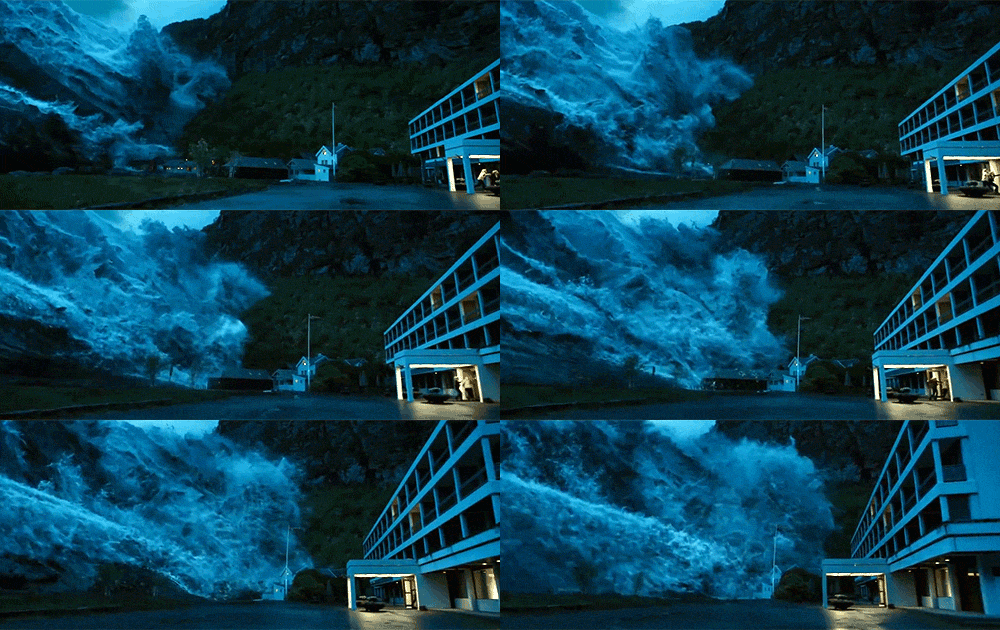
3.5 stars. Review to come.
3.5 stars. Review to come.

June 1, 2021
It’s a rare book that can make me alternately vaguely intrigued and teeth-grittingly irritated. This one managed just that mood swing in every chapter. Well, maybe the introduction didn’t. Honestly, it’s been almost a week since I finished it and I can’t remember what that section said. Actually, I don’t remember distinctly any of the science particulars she presented. There were a few details that you won’t find in your average science documentary, but not very many.
I mostly remember her constant pontificating and repetition. About the latter for example, by the end, I was afraid that if I heard her lecture about the randomness of natural disasters one more time I would gag. She opens every chapter with a scientific description of each disaster and then moves on to her liberal interpretation of its aftermath. There the pontificating was infinitely more aggravating. She uses every disaster as a reason to level blanket charges of sexism or racism at every culture or nation in every era. Actually, much of it left me with the distinct feeling that this was written by a seismologist who opted to take a few courses in women’s studies, world religions, and critical race theory. Then decided to use her platform as a respected seismologist to lecture us, extremely condescendingly, on those topics. While occasionally, taking time out to pat herself on the back for her success in working with various government officials. There are one or two times she manages to find praiseworthy examples in disaster response, but mostly she seeks to find the bad in every response. For example, she focuses on rumored racist reactions to Katrina’s victims, while leaving out any mention of the open-handed response of so many individuals and communities. That left every chapter ending on a maddening note.
I am absolutely certain that my take away from the science presented in this book is not what the author intended, but I was left with a distinct feeling that seismology has an enormous way to go yet before it will be really useful. That makes it simultaneously exciting and a little frustrating. They have become very good at describing and measuring events, but have a long way to go before they can begin to predict or understand them.
So, this book is one that I would not recommend. If you need more info about why it’s one to avoid, please read Keith’s excellent review.
I mostly remember her constant pontificating and repetition. About the latter for example, by the end, I was afraid that if I heard her lecture about the randomness of natural disasters one more time I would gag. She opens every chapter with a scientific description of each disaster and then moves on to her liberal interpretation of its aftermath. There the pontificating was infinitely more aggravating. She uses every disaster as a reason to level blanket charges of sexism or racism at every culture or nation in every era. Actually, much of it left me with the distinct feeling that this was written by a seismologist who opted to take a few courses in women’s studies, world religions, and critical race theory. Then decided to use her platform as a respected seismologist to lecture us, extremely condescendingly, on those topics. While occasionally, taking time out to pat herself on the back for her success in working with various government officials. There are one or two times she manages to find praiseworthy examples in disaster response, but mostly she seeks to find the bad in every response. For example, she focuses on rumored racist reactions to Katrina’s victims, while leaving out any mention of the open-handed response of so many individuals and communities. That left every chapter ending on a maddening note.
I am absolutely certain that my take away from the science presented in this book is not what the author intended, but I was left with a distinct feeling that seismology has an enormous way to go yet before it will be really useful. That makes it simultaneously exciting and a little frustrating. They have become very good at describing and measuring events, but have a long way to go before they can begin to predict or understand them.
So, this book is one that I would not recommend. If you need more info about why it’s one to avoid, please read Keith’s excellent review.

June 11, 2018
This book is neither a good history of the disasters it covers nor (mostly) a good discussion of the science behind them. She selected some intriguing events to discuss, but if you are looking for a good history of these disasters, then skip this. There are some bright points, especially in the earthquake science portions, where Ms. Jones is an expert. And I'm sure Ms. Jones is a talented scientist, but the narrative was all over the place. From her chastising of societies for their views on God and disasters, to the strange narrative about Fukushima that focuses on women's rights, I couldn't find any sort of thread - the stories ramble on with no common themes.
Each disaster seems to bring up an opportunity for the author to approach it from a different social vantage point and left me wondering what the point of this book was. In the end, she brings it back to Los Angeles - her hometown - to discuss future earthquake preparedness, but mostly to congratulate herself on how good a job she has done planning with CA communities. A few pages at the very end discuss the "what we can do about them" part in detail.
Each disaster seems to bring up an opportunity for the author to approach it from a different social vantage point and left me wondering what the point of this book was. In the end, she brings it back to Los Angeles - her hometown - to discuss future earthquake preparedness, but mostly to congratulate herself on how good a job she has done planning with CA communities. A few pages at the very end discuss the "what we can do about them" part in detail.

April 23, 2020
A brilliant book. Reminds me why Geography was my favourite subject at school. Fascinating and scary it will make you angry and sad. Very interesting and entertaining though.

August 5, 2020
I really enjoyed the portions of this book that focused on the actual science, but I absolutely loathed her constant stream of liberal psychology. I flipped back and forth between being completely fascinated and incredibly annoyed. The book goes through a number of the biggest natural disasters in history and discusses what led up to the event, what happened during, and what happened in the aftermath. The rest of my review is just going to be a rant.
Jones spends a good portion of the book making wild assumptions about people, speaks condescendingly towards anybody not a Scientist, and accuses wild swaths of different societies of being stupid and immoral with little evidence other than her bias. One of her early lines was about how when an earthquake happens, people treat her like a shaman or a priest and demand to know why something happened. She makes these outrageous claims that the stupid, non-scientific mind of anybody without a doctorate just can't fathom that some things happen with a certain amount of randomness. Nope, they need her to be their priest. Or maybe is it that a big earthquake happened and they go to the person who is an expert on earthquakes and want an explanation of what happened and if she can provide an idea of what is likely to happen going forward?
Jones is also incredibly cynical. In her warped world view, people don't give donations to victims of natural disasters out of the goodness of their hearts or because they can empathize with the victims. Nope. They donate and help out as a subconscious good luck charm or talisman to ward off disaster happening to them.
"And for most human beings, as for the inhabitants of Pompeii in AD 79; if it hasn't happened to me, it simply hasn't happened." What? Maybe people in Pompeii had bigger worries than a volcano that erupts every 500 years. She acts like they wouldn't care if their kids died as long as they made it through.
Jones is very quick to criticize religious belief and Christianity in particular when she doesn't seem to have basic understanding of the beliefs. It is a common attack from critics to question how God can be just if bad things happen to good people. How can God be good when babies die? This is something that every believer has to consider and think through, usually early in their religious education. The overwhelming majority of Christians do not look at natural disasters and think, "This was God directly punishing those individuals." It is possible that it is a form of punishment from God, but there is no way for us to know. In the world of Lucy Jones, she probably thinks Christians sit around wondering why Jesus hates Florida so much because he keeps sending hurricanes every year. In reality, Christian belief is that this is a fallen world ever since Adam and Eve were expelled from the Garden of Eden. Injustices happen every day everywhere. It isn't that God is evil and laughs maniacally when a baby dies or a woman is raped. None of this is to say that if Las Vegas was destroyed tomorrow you wouldn't have some televangelist proclaiming that this was God's judgement on sinners. The point is that the vast amount of Christians in the world don't believe that we can look at events like natural disasters and divine what God's role in it was and what his motivations would have been.
"Such belief not only justifies why a good God could allow evil to happen; it provides an illusion of control. If disasters are a punishment for sins, then a pure life offers salvation....However, as Western theology developed, some found it hard to accept that no innocents were killed in natural disasters." I think very few actually believe this, maybe only proponents of the Prosperity Gospel.
Does anyone really claim that only guilty people die in disasters? Maybe she is confused about the theology and doesn't understand that Christians believe every single person in the world is guilty.
There is no innocent person, that is why we need Jesus and God. Plenty of people will theorize and say something like, "God is punishing the United States for X", but nobody thinks that means that everybody in the United States is guilty in the terms that Lucy Jones seems to think this means.
"My astonishment is not at the cities being there...What puzzles me is the inability of the cities' inhabitants to recognize their risk and to do something about it. To a geologist, 'sometime in the next millennium' sounds not like an evasion but a threat..Try asking a Californian what the worst natural disaster was in its nearly 170-year history." I found this one hilarious. She is surprised and looks down on people that aren't going to turn their lives upside down over a disaster that may happen in the next thousand years? And then she uses the ignorance of the average person to justify her claim that people just don't think about dangers cause it makes them feel better or they can't comprehend randomness. It is far more likely that they are just ignorant of history and our school system is a joke. I live in California and grew up in the Central Valley. I didn't learn a thing about the flood she was talking about and I lived where it happened. That wasn't because my school couldn't comprehend that concept of random natural disasters. The school had different priorities.
"We evolved into humans beings in a world of predators and famines, where responding quickly to short-term crises was essential for our survival. Risk was all around us, and the most successful breeders were those who learned to recognize the most imminent ones. To most of us, flooding doesn't feel imminent...Flooding is always seen as more benign than other hazards...In that prehistoric world in which we became human, the predator that could be seen was often less dangerous than the hidden one, lying in the grass...We continue, accordingly, to fear those risks that lurk out of sight. We fear nuclear energy, even though the only American nuclear accident, Three Mile Island, killed no one, but pay little mind to the act of driving, even as more than thirty thousand Americans die in car crashes every year. We fret about cancer from cell phones as we drag on cigarettes." She keeps coming back to this argument and seems so offended that people are more scared of earthquakes than flooding. Yeah, when we see rivers all the time, the thought of more water coming down a river isn't in and of itself a fearful prospect. We also have the benefit of usually having a decent amount of warning. We know when huge storms are going to hit. We would probably be less fearful of earthquakes if we had continuous 5.0 earthquakes. If were were constantly shaking at a 5.0, the concept of a 6.0 would be less fearful. The biggest difference is that you can't predict when an earthquake could strike. In most flood scenarios, you can predict or at least know when you should be on your guard. Even if a levee breaks, you would know that there is a major storm and you have the chance to gather some things if you were worried about it. You don't have that luxury with an earthquake. You don't get a weather forecaster letting you know that we are expected a big earthquake tomorrow, so maybe stay away from those skyscrapers. And her nuclear fear explanation is nonsense. People fear nuclear power because it could render large areas uninhabitable for thousands of year, lead to many forms of cancers and deformities, and can all fall apart due to governmental negligence. And finally, I am highly doubtful that people chain smoking are the same people worried about getting cancer from cell phones.
"But I thought that when presented with the evidence, cities would say, 'We need to change our priorities.' Instead, the data was largely rejected because it didn't conform to the emotional response of the emergency managers-people who, like all of us, are more afraid of the unseen. ...This inability to accept the possibility of extreme flooding events increases the risk for people across the United States, and indeed the world." Another example of Jones making accusatory claims on a foundation of her bias. She doesn't give any information to support her claim at all. She doesn't give any indication that she has considered all of the other factors these government officials may be considering. Sure, it is easy to show that danger exists, but maybe they are looking at other factors like the cost of construction/maintenance or the nightmare of dealing with environmental regulations. I work for a Flood Control department. People often complain when we get a storm that is above the threshold some facility was built to handle and act like it was a failure. We can always build bigger and stronger facilities to handle larger storms, but they are often cost prohibitive. Maybe the officials have experience with the nightmare of building anything, particularly in places like California, that have to go through environmental review. Maybe she should place more of the blame on the environmentalists that inflate the cost and difficulty of the performing the types of projects I presume Jones is advocating for. It's possible that Jones' complaints here are justified, but she should give evidence to back up her claim.
"That winter, several farmers in Louisiana had kidnapped a family of African Americans at gunpoint and taken them to Mississippi, where they were sold for $20. The victims were forced to work without pay for weeks, watched by armed guards. The white farmers were eventually indicted, but their egregiousness is telling." This was a good example of the type of crap Jones puts in. This had nothing to do with the event. What is the point of including this? Does anybody not understand that in the early 1900's there were racist people in the South? Basically, this story says that there were some white people who did something terrible and they were held accountable. That is super relevant to levees breaking on the Mississippi river. It is just part of her liberal perspective where she views everything through race and feels the need to continuously point out how terrible white people are.
"Indifferent to African American fatalities, the Red Cross officially reported just two deaths at that break." She should probably give any kind of evidence for why this is racist. If you are going to accuse a major charity of being vicious racists that are completely indifferent to the deaths of black people, you should back it up. There are plenty of reasons that are justifiable, given what she presents us, that the Red Cross could report this. Maybe that is what the government told them. Maybe that was all that they could actually confirm. If you aren't going to take the time to show us that they did have the knowledge of how many people died and chose instead to report only two, then maybe you should keep your accusations of racism to yourself.
"In Mississippi, we observed a gross failure of the levees, but perhaps more meaningfully, a failure of our society. The Mississippi flood exposed a fundamental weakness in the American social order, a tendency to minimize, dehumanize, and victimize those viewed as other, especially African Americans. " Again, Jones explains most things as white people are racist.
"Unable to attribute our misfortune to random chance, we wonder what we did wrong. Homes gone, dependent on the goodwill of strangers, fearing financial ruin, perhaps with loves ones killed, we look for someone to blame, we turn on the outsider. " Yes, white people totally blame earthquakes and tornadoes on black people. So stupid.
"Anything coming up this street darker than a brown paper bag is getting shot." Pretty weak. She dismisses the fact that there was a ton of violence and looting after Katrina. Uses a few lines like this to show that white people are racist.
"'There, but for the Grace of God,' "At its best, the phrases demonstrates a recognition of our common vulnerability, a sympathy for the suffering. For many it operates, too, like a kind of talisman, a shield against the randomness of disaster. If I trust enough in God's goodness, I will be spared the same fate. But we often become less charitable in speculating why God's grace was withheld from the victims...But the handmaid to causation is blame. When we hear that a person has had a heart attack, how quickly do we leap to considering her lifestyle, her weight? When we're told someone has been diagnosed with cancer, we often ask, "Did he smoke?" Consciously or not, by assigning a person the blame for his or her own misfortune, we are inoculating ourselves from the same fate, I am active, we might silently assure ourselves, I don't smoke." Theologically ignorant. Read the Bible. Tons of bad stuff happen to the Jews and Christians. And if your actions influence the outcome, that is pretty relevant to how much sympathy you deserve. So yeah, if you eat 5 pizzas a day, I feel less sympathy for you than someone who was born with a heart defect.
"There are those victims, we might argue, who simply made the wrong choice. The approximately one hundred thousand people who remained in New Orleans defied evacuation orders." Well duh. If you stay in the path of a hurricane when you had the chance to escape, you've taken some risks.
"If buses had been operational and residents had escaped, where would they have gone? Many couldn't afford lodging." Housing is a lesser priority than drowning. "We saw the way too many Americans found their African American compatriots to be victims not of circumstance but of their own choices...We naturally resist the idea that suffering might be caused by forces outside our control, and so, to reassure ourselves, we assign the responsibility to the sufferer." No, only you do.
"But most cultures with earthquakes have, for instance, created a myth of 'earthquake weather'." Her only example is her mother. This isn't absurd in a historical sense.
"The cautionary note, however, is that where the flooding in Katrina overwhelmingly affected impoverished neighborhoods, Harvey was more of an equal-opportunity assault, flooding poor and rich neighborhoods alike. Empathy is easier when you can see yourself in the victims. The initial response to Hurricane Maria and the devastation of Puerto Rico also suggested that empathy comes more slowly when the victims are Americans who don't speak English." Again, the only explanation she can see is white people are racist. Maybe it has more to do with Puerto Rico's corrupt government.
"Natural disasters are becoming more common. As we have seen, heat - in the oceans and the atmosphere- is the fundamental driver of extreme storms, and the current warming trend is expected to increase both the number and spatial distribution of hazards." This isn't true. They become more costly because we have more people living in dangerous areas.
Jones spends a good portion of the book making wild assumptions about people, speaks condescendingly towards anybody not a Scientist, and accuses wild swaths of different societies of being stupid and immoral with little evidence other than her bias. One of her early lines was about how when an earthquake happens, people treat her like a shaman or a priest and demand to know why something happened. She makes these outrageous claims that the stupid, non-scientific mind of anybody without a doctorate just can't fathom that some things happen with a certain amount of randomness. Nope, they need her to be their priest. Or maybe is it that a big earthquake happened and they go to the person who is an expert on earthquakes and want an explanation of what happened and if she can provide an idea of what is likely to happen going forward?
Jones is also incredibly cynical. In her warped world view, people don't give donations to victims of natural disasters out of the goodness of their hearts or because they can empathize with the victims. Nope. They donate and help out as a subconscious good luck charm or talisman to ward off disaster happening to them.
"And for most human beings, as for the inhabitants of Pompeii in AD 79; if it hasn't happened to me, it simply hasn't happened." What? Maybe people in Pompeii had bigger worries than a volcano that erupts every 500 years. She acts like they wouldn't care if their kids died as long as they made it through.
Jones is very quick to criticize religious belief and Christianity in particular when she doesn't seem to have basic understanding of the beliefs. It is a common attack from critics to question how God can be just if bad things happen to good people. How can God be good when babies die? This is something that every believer has to consider and think through, usually early in their religious education. The overwhelming majority of Christians do not look at natural disasters and think, "This was God directly punishing those individuals." It is possible that it is a form of punishment from God, but there is no way for us to know. In the world of Lucy Jones, she probably thinks Christians sit around wondering why Jesus hates Florida so much because he keeps sending hurricanes every year. In reality, Christian belief is that this is a fallen world ever since Adam and Eve were expelled from the Garden of Eden. Injustices happen every day everywhere. It isn't that God is evil and laughs maniacally when a baby dies or a woman is raped. None of this is to say that if Las Vegas was destroyed tomorrow you wouldn't have some televangelist proclaiming that this was God's judgement on sinners. The point is that the vast amount of Christians in the world don't believe that we can look at events like natural disasters and divine what God's role in it was and what his motivations would have been.
"Such belief not only justifies why a good God could allow evil to happen; it provides an illusion of control. If disasters are a punishment for sins, then a pure life offers salvation....However, as Western theology developed, some found it hard to accept that no innocents were killed in natural disasters." I think very few actually believe this, maybe only proponents of the Prosperity Gospel.
Does anyone really claim that only guilty people die in disasters? Maybe she is confused about the theology and doesn't understand that Christians believe every single person in the world is guilty.
There is no innocent person, that is why we need Jesus and God. Plenty of people will theorize and say something like, "God is punishing the United States for X", but nobody thinks that means that everybody in the United States is guilty in the terms that Lucy Jones seems to think this means.
"My astonishment is not at the cities being there...What puzzles me is the inability of the cities' inhabitants to recognize their risk and to do something about it. To a geologist, 'sometime in the next millennium' sounds not like an evasion but a threat..Try asking a Californian what the worst natural disaster was in its nearly 170-year history." I found this one hilarious. She is surprised and looks down on people that aren't going to turn their lives upside down over a disaster that may happen in the next thousand years? And then she uses the ignorance of the average person to justify her claim that people just don't think about dangers cause it makes them feel better or they can't comprehend randomness. It is far more likely that they are just ignorant of history and our school system is a joke. I live in California and grew up in the Central Valley. I didn't learn a thing about the flood she was talking about and I lived where it happened. That wasn't because my school couldn't comprehend that concept of random natural disasters. The school had different priorities.
"We evolved into humans beings in a world of predators and famines, where responding quickly to short-term crises was essential for our survival. Risk was all around us, and the most successful breeders were those who learned to recognize the most imminent ones. To most of us, flooding doesn't feel imminent...Flooding is always seen as more benign than other hazards...In that prehistoric world in which we became human, the predator that could be seen was often less dangerous than the hidden one, lying in the grass...We continue, accordingly, to fear those risks that lurk out of sight. We fear nuclear energy, even though the only American nuclear accident, Three Mile Island, killed no one, but pay little mind to the act of driving, even as more than thirty thousand Americans die in car crashes every year. We fret about cancer from cell phones as we drag on cigarettes." She keeps coming back to this argument and seems so offended that people are more scared of earthquakes than flooding. Yeah, when we see rivers all the time, the thought of more water coming down a river isn't in and of itself a fearful prospect. We also have the benefit of usually having a decent amount of warning. We know when huge storms are going to hit. We would probably be less fearful of earthquakes if we had continuous 5.0 earthquakes. If were were constantly shaking at a 5.0, the concept of a 6.0 would be less fearful. The biggest difference is that you can't predict when an earthquake could strike. In most flood scenarios, you can predict or at least know when you should be on your guard. Even if a levee breaks, you would know that there is a major storm and you have the chance to gather some things if you were worried about it. You don't have that luxury with an earthquake. You don't get a weather forecaster letting you know that we are expected a big earthquake tomorrow, so maybe stay away from those skyscrapers. And her nuclear fear explanation is nonsense. People fear nuclear power because it could render large areas uninhabitable for thousands of year, lead to many forms of cancers and deformities, and can all fall apart due to governmental negligence. And finally, I am highly doubtful that people chain smoking are the same people worried about getting cancer from cell phones.
"But I thought that when presented with the evidence, cities would say, 'We need to change our priorities.' Instead, the data was largely rejected because it didn't conform to the emotional response of the emergency managers-people who, like all of us, are more afraid of the unseen. ...This inability to accept the possibility of extreme flooding events increases the risk for people across the United States, and indeed the world." Another example of Jones making accusatory claims on a foundation of her bias. She doesn't give any information to support her claim at all. She doesn't give any indication that she has considered all of the other factors these government officials may be considering. Sure, it is easy to show that danger exists, but maybe they are looking at other factors like the cost of construction/maintenance or the nightmare of dealing with environmental regulations. I work for a Flood Control department. People often complain when we get a storm that is above the threshold some facility was built to handle and act like it was a failure. We can always build bigger and stronger facilities to handle larger storms, but they are often cost prohibitive. Maybe the officials have experience with the nightmare of building anything, particularly in places like California, that have to go through environmental review. Maybe she should place more of the blame on the environmentalists that inflate the cost and difficulty of the performing the types of projects I presume Jones is advocating for. It's possible that Jones' complaints here are justified, but she should give evidence to back up her claim.
"That winter, several farmers in Louisiana had kidnapped a family of African Americans at gunpoint and taken them to Mississippi, where they were sold for $20. The victims were forced to work without pay for weeks, watched by armed guards. The white farmers were eventually indicted, but their egregiousness is telling." This was a good example of the type of crap Jones puts in. This had nothing to do with the event. What is the point of including this? Does anybody not understand that in the early 1900's there were racist people in the South? Basically, this story says that there were some white people who did something terrible and they were held accountable. That is super relevant to levees breaking on the Mississippi river. It is just part of her liberal perspective where she views everything through race and feels the need to continuously point out how terrible white people are.
"Indifferent to African American fatalities, the Red Cross officially reported just two deaths at that break." She should probably give any kind of evidence for why this is racist. If you are going to accuse a major charity of being vicious racists that are completely indifferent to the deaths of black people, you should back it up. There are plenty of reasons that are justifiable, given what she presents us, that the Red Cross could report this. Maybe that is what the government told them. Maybe that was all that they could actually confirm. If you aren't going to take the time to show us that they did have the knowledge of how many people died and chose instead to report only two, then maybe you should keep your accusations of racism to yourself.
"In Mississippi, we observed a gross failure of the levees, but perhaps more meaningfully, a failure of our society. The Mississippi flood exposed a fundamental weakness in the American social order, a tendency to minimize, dehumanize, and victimize those viewed as other, especially African Americans. " Again, Jones explains most things as white people are racist.
"Unable to attribute our misfortune to random chance, we wonder what we did wrong. Homes gone, dependent on the goodwill of strangers, fearing financial ruin, perhaps with loves ones killed, we look for someone to blame, we turn on the outsider. " Yes, white people totally blame earthquakes and tornadoes on black people. So stupid.
"Anything coming up this street darker than a brown paper bag is getting shot." Pretty weak. She dismisses the fact that there was a ton of violence and looting after Katrina. Uses a few lines like this to show that white people are racist.
"'There, but for the Grace of God,' "At its best, the phrases demonstrates a recognition of our common vulnerability, a sympathy for the suffering. For many it operates, too, like a kind of talisman, a shield against the randomness of disaster. If I trust enough in God's goodness, I will be spared the same fate. But we often become less charitable in speculating why God's grace was withheld from the victims...But the handmaid to causation is blame. When we hear that a person has had a heart attack, how quickly do we leap to considering her lifestyle, her weight? When we're told someone has been diagnosed with cancer, we often ask, "Did he smoke?" Consciously or not, by assigning a person the blame for his or her own misfortune, we are inoculating ourselves from the same fate, I am active, we might silently assure ourselves, I don't smoke." Theologically ignorant. Read the Bible. Tons of bad stuff happen to the Jews and Christians. And if your actions influence the outcome, that is pretty relevant to how much sympathy you deserve. So yeah, if you eat 5 pizzas a day, I feel less sympathy for you than someone who was born with a heart defect.
"There are those victims, we might argue, who simply made the wrong choice. The approximately one hundred thousand people who remained in New Orleans defied evacuation orders." Well duh. If you stay in the path of a hurricane when you had the chance to escape, you've taken some risks.
"If buses had been operational and residents had escaped, where would they have gone? Many couldn't afford lodging." Housing is a lesser priority than drowning. "We saw the way too many Americans found their African American compatriots to be victims not of circumstance but of their own choices...We naturally resist the idea that suffering might be caused by forces outside our control, and so, to reassure ourselves, we assign the responsibility to the sufferer." No, only you do.
"But most cultures with earthquakes have, for instance, created a myth of 'earthquake weather'." Her only example is her mother. This isn't absurd in a historical sense.
"The cautionary note, however, is that where the flooding in Katrina overwhelmingly affected impoverished neighborhoods, Harvey was more of an equal-opportunity assault, flooding poor and rich neighborhoods alike. Empathy is easier when you can see yourself in the victims. The initial response to Hurricane Maria and the devastation of Puerto Rico also suggested that empathy comes more slowly when the victims are Americans who don't speak English." Again, the only explanation she can see is white people are racist. Maybe it has more to do with Puerto Rico's corrupt government.
"Natural disasters are becoming more common. As we have seen, heat - in the oceans and the atmosphere- is the fundamental driver of extreme storms, and the current warming trend is expected to increase both the number and spatial distribution of hazards." This isn't true. They become more costly because we have more people living in dangerous areas.

May 17, 2018
I super love natural disasters. I am, in fact, a supernatural disaster geek. (This stems from a life time of never actually having been in one.) So I saw this book on Edelweiss, and instantly clicked the "request it" button, and I'm very glad I did.
It's great! It's a summation of some of the world's biggest natural disasters, but also how societies dealt with - and are still dealing with - them. It delves not only into who we are as humans, but at how we can look at past disasters to help shape how we can present ourselves going forward. The tone was light, with some humor scattered throughout, it was a very engaging read, no slogging involved. It had enough anecdotes for me to get my disaster fix it, and made me pause and think about how I would react in these situations.
All in all, a must-read for any fan of natural disasters, human nature, or non-fiction.
Thanks Edeweiss, for my free review copy.
It's great! It's a summation of some of the world's biggest natural disasters, but also how societies dealt with - and are still dealing with - them. It delves not only into who we are as humans, but at how we can look at past disasters to help shape how we can present ourselves going forward. The tone was light, with some humor scattered throughout, it was a very engaging read, no slogging involved. It had enough anecdotes for me to get my disaster fix it, and made me pause and think about how I would react in these situations.
All in all, a must-read for any fan of natural disasters, human nature, or non-fiction.
Thanks Edeweiss, for my free review copy.

April 26, 2025
Dr. Lucy Jones—the scientist you are!
Dr. Jones has presented a human-focused case for disaster awareness and preparedness, sharing the science of major disasters (primarily major seismic and flooding events) while bringing a compelling sociological element to her work. This book may hit best if you have a basic knowledge of seismic science in particular, but is still written in an extremely accessible way that everyone can benefit from no matter your region or local risks.
As someone who grew up under the shadow of a volcano, and lives in one of the most potentially dangerous seismic regions in the world, I was fascinated by this book and deeply appreciate Dr. Jones’ commitment to educating others, driven in part by her clear Angeleno pride.
I was a little disappointed we didn’t hear about Cascadia, but understanding Dr. Jones’ background makes the future focus of San Andreas perfectly appropriate. The case studies over time and culture were compelling, and the social consequences of the events she focused on were emphasized in a way that gives you a true sense of what you should be thinking about for the aftermath of your own local risks.
Really enjoyed and appreciated this one.
Dr. Jones has presented a human-focused case for disaster awareness and preparedness, sharing the science of major disasters (primarily major seismic and flooding events) while bringing a compelling sociological element to her work. This book may hit best if you have a basic knowledge of seismic science in particular, but is still written in an extremely accessible way that everyone can benefit from no matter your region or local risks.
As someone who grew up under the shadow of a volcano, and lives in one of the most potentially dangerous seismic regions in the world, I was fascinated by this book and deeply appreciate Dr. Jones’ commitment to educating others, driven in part by her clear Angeleno pride.
I was a little disappointed we didn’t hear about Cascadia, but understanding Dr. Jones’ background makes the future focus of San Andreas perfectly appropriate. The case studies over time and culture were compelling, and the social consequences of the events she focused on were emphasized in a way that gives you a true sense of what you should be thinking about for the aftermath of your own local risks.
Really enjoyed and appreciated this one.

September 30, 2022
Autor on pühendanud kogu oma karjääri loodusõnnetuste uurimisele, töötanud seismoloogina ja riskiohje konsultandina. Raamatus antakse ülevaade mõningatest suurimatest looduskatastroofidest alates Pompejist ja lõpetades 2004. aasta hiigeltsunami ja 2005. aasta orkaani Katrinaga. Loodusõnnetuste ülevaatest olulisemgi on aga küsimus, kas ja mida inimesed sellest kõigest järeldanud on ning mida on ette võetud, et selliste sündmuste tagajärjed tulevikus enam nii katastroofilised ei oleks. Autor selgitab nii maavärinate tekkepõhjusi kui ka jagab oma pikaajalise tegevuse kogemusi. Selgub, et isegi tänapäevaste seadmete juures ei saa tihti maavärinat rohkem ette ennustada kui tunnike ja tihtipeale aktiveerub inimestes psühholoogiline kaitsemehhanism "Minu ajal ega minuga seda ei juhtu", mistõttu riskiohjesüsteemid on sageli puudulikud ja inimmälugi lühike. Oli hariv ja mõtlemapanev lugemine.

September 20, 2020
Interesting read. And just reveals how much more of American history we aren't told in school. It really is a failure on every level of society that we "lose interest" so to speak after natural disasters. Because some of the worst damage and effects are felt long after the storm or after the ground has stopped shaking.

March 14, 2025
I had no idea what to expect from this, I don't read a ton of geology and had not heard of Dr Jones but it was on sale through LibroFM and I bought it. Usually I am a bit leary about the author narrating but Jones did a very good job, it flowed well and her voice added drama where needed.
Jones gave a few examples where natural disasters made significant changes to government and they were all compelling and will reside in my brain for a long time. Highly recommended for anyone interested in learning more about natural disasters (all types) and how they affect society.
Jones gave a few examples where natural disasters made significant changes to government and they were all compelling and will reside in my brain for a long time. Highly recommended for anyone interested in learning more about natural disasters (all types) and how they affect society.

June 18, 2021
3.5 stars. Fascinating look at how major natural disasters have changed societies around the world. Also an interesting look at how short collective memory is when it comes to major disasters. I too have been guilty of the “it won’t happen to me” mentality.
I also liked how she discussed fear. It’s not about instilling fear into people, but about doing something today. I liked her list of things we can do today to make a difference. Because natural hazards are inevitable but disaster doesn’t have to be.
I also liked how she discussed fear. It’s not about instilling fear into people, but about doing something today. I liked her list of things we can do today to make a difference. Because natural hazards are inevitable but disaster doesn’t have to be.

June 4, 2018
This book provides a superficial look at a few of the world's biggest natural disasters and how these disasters effected societies. Jones explores how the disaster victims and relevant governments dealt with the catastrophe and what they are doing to mitigate the adverse effects of any subsequent natural disasters. This is a history book with minimal, superficial science. The book is informative with an easy going writing style, however, I was hoping for more specific information on the disaster themselves and the engineering options used to mitigate disaster impacts. This book makes for a good introductory text to the subject.

May 10, 2018
Listened to the audio. It is not often that a non-fiction book holds my attention long enough to read the whole thing, but I devoured this one. Extremely interesting, accessible, and thought-provoking.
June 2, 2020
I expected a book on disasters to be depressing and scary, but this really wasn't. The writer has a clear, engaging voice and comes from a fairly positive view of disasters happen, what matters is how we prepare and react. I also learned some really interesting history I didn't know!

July 12, 2019
A nonfiction book about natural disasters, written by a seismologist who has worked with a Los Angeles committee to spearhead efforts at earthquake prevention and recovery.
She surveys all types of natural disasters, not just earthquakes, and examples throughout history. Her descriptions of the mechanisms of each (volcanoes, hurricanes, etc.) were very helpful to the layperson (me) in understanding the mechanics. Particularly with hurricanes: I'd read before but forgotten the details about how the conditions actually have to be pretty specific for a big hurricane to form (nearness to equator, water temperature, air temperature and how it differs vertically in the atmosphere, etc.)
The Fukushima nuclear disaster is particularly interesting because it was the marriage of natural and man-made disasters: an earthquake/tsunami causing a nuclear plant's destruction.
Science has saved (some of) us from our self-centeredness: no, this was not "divine retribution," let me explain exactly the science behind this or that disaster.
Sad but true how people tend to be more generous when they're funding disaster RESPONSE, rather than disaster prevention.
I was inspired to sign up for the USGS email alert system, which notifies you whenever an earthquake of at least magnitude 5 occurs anywhere in the world. A magnitude 6 quake occurred in Papua New Guinea a couple days ago. In the news? Nope. It needs to be in a prominent place, cause lots of destruction, or affect a large number of people. Just goes to show you how dynamic and very much alive the Earth is. It's just doing its own thing, and we're just along for the ride.
She surveys all types of natural disasters, not just earthquakes, and examples throughout history. Her descriptions of the mechanisms of each (volcanoes, hurricanes, etc.) were very helpful to the layperson (me) in understanding the mechanics. Particularly with hurricanes: I'd read before but forgotten the details about how the conditions actually have to be pretty specific for a big hurricane to form (nearness to equator, water temperature, air temperature and how it differs vertically in the atmosphere, etc.)
The Fukushima nuclear disaster is particularly interesting because it was the marriage of natural and man-made disasters: an earthquake/tsunami causing a nuclear plant's destruction.
Science has saved (some of) us from our self-centeredness: no, this was not "divine retribution," let me explain exactly the science behind this or that disaster.
Sad but true how people tend to be more generous when they're funding disaster RESPONSE, rather than disaster prevention.
I was inspired to sign up for the USGS email alert system, which notifies you whenever an earthquake of at least magnitude 5 occurs anywhere in the world. A magnitude 6 quake occurred in Papua New Guinea a couple days ago. In the news? Nope. It needs to be in a prominent place, cause lots of destruction, or affect a large number of people. Just goes to show you how dynamic and very much alive the Earth is. It's just doing its own thing, and we're just along for the ride.

Read
April 2, 2026I don’t usually read science books, but I thought this one looked pretty interesting. It was very history and human-based, the geology aspects were hidden behind stories from real people living through the disasters. I liked that, it was super accessible and didn’t require much prior knowledge to understand the geological impacts and causes described.
Each chapter was pretty short, only around 20-30 pages spent per event. I liked that there were a variety of events from around the world and throughout time. I learned a lot about each event and how science has evolved to help prepare better for natural disasters in the future. There were also several types featured. I remember reading about earthquakes, tsunamis, volcanoes, and other things caused by each of those disasters. Going into the book, I was mostly expecting it to just be earthquakes, so I was happily surprised to find out there would be more than just that.
Coming from a seismologist’s perspective, Dr. Lucy Jones wasn’t trying to make us scared about these disasters. It was still hopeful in a way to show how society helped each other out through these events. I came into the book thinking it would mainly be about geology. While it definitely was, I think the human aspects shone through and made it a much better read than I anticipated.
Each chapter was pretty short, only around 20-30 pages spent per event. I liked that there were a variety of events from around the world and throughout time. I learned a lot about each event and how science has evolved to help prepare better for natural disasters in the future. There were also several types featured. I remember reading about earthquakes, tsunamis, volcanoes, and other things caused by each of those disasters. Going into the book, I was mostly expecting it to just be earthquakes, so I was happily surprised to find out there would be more than just that.
Coming from a seismologist’s perspective, Dr. Lucy Jones wasn’t trying to make us scared about these disasters. It was still hopeful in a way to show how society helped each other out through these events. I came into the book thinking it would mainly be about geology. While it definitely was, I think the human aspects shone through and made it a much better read than I anticipated.

February 29, 2024
Minu arvamuse raamatust leiab blogist https://triinuraamatud.wordpress.com/...
March 11, 2018
Fire and Ice by Robert Frost
Some say the world will end in fire,
Some say in ice.
From what I’ve tasted of desire
I hold with those who favor fire.
But if it had to perish twice,
I think I know enough of hate
To say that for destruction ice
Is also great
And would suffice.
Undoubtedly, The Voice of New England had the deeds of his fellow humans in mind, rather than so-called Acts of God, when he penned the above rumination in rhyme about a possible apocalypse. Nevertheless, his thought provoking short verse seems particularly apt when we contemplate the effects of volcanoes, earthquakes, and floods on our species and the structures we have built, often in the least advisable locations.
In this equally thought provoking volume, Dr. Lucy Stone, who spent three decades of her career as a seismologist with the United States Geological Survey, outlines the many ways our race has suffered by the hand of Mother Nature. Part scientific treatise, part history lesson and part memoir, she lays out a series of case studies that examines such monumental events as the earthquake that struck Lisbon, Portugal in 1755 and the Mississippi River flood in 1927. Both heartbreaking and hopeful, Jones describes how humankind sets itself up for failure by congregating on floodplains and fissures in the earth, either through ignorance or folly. On the other hand, knowledge is power, and with what we now know of plate tectonics and fluid mechanics, we can now avoid some of the mistakes of the past. With a minimum of technical jargon, she explains the physical processes that move earth, air and water, often to our detriment. Not only does she demystify some of the theories underlying the many “ologies” at work studying this ball of rock and brine that we inhabit, but she also sprinkles anecdotes and stories of those who seek and have sought to unlock nature’s secrets. Most of us are familiar with the name of Charles Richter, who developed the well-known scale used to estimate the intensity of earthquakes. More obscure, but no less important is John Milne, the English Victorian geologist that moved to Japan to study this phenomenon and is now considered one of the founding fathers of seismology. His is just one of several fascinating vignettes presented within these pages.
Clearly written and well-illustrated with maps and diagrams, this engaging book will be of interest not only to the armchair geologist but to any curious reader who would like to know more about living with our living planet.
Some say the world will end in fire,
Some say in ice.
From what I’ve tasted of desire
I hold with those who favor fire.
But if it had to perish twice,
I think I know enough of hate
To say that for destruction ice
Is also great
And would suffice.
Undoubtedly, The Voice of New England had the deeds of his fellow humans in mind, rather than so-called Acts of God, when he penned the above rumination in rhyme about a possible apocalypse. Nevertheless, his thought provoking short verse seems particularly apt when we contemplate the effects of volcanoes, earthquakes, and floods on our species and the structures we have built, often in the least advisable locations.
In this equally thought provoking volume, Dr. Lucy Stone, who spent three decades of her career as a seismologist with the United States Geological Survey, outlines the many ways our race has suffered by the hand of Mother Nature. Part scientific treatise, part history lesson and part memoir, she lays out a series of case studies that examines such monumental events as the earthquake that struck Lisbon, Portugal in 1755 and the Mississippi River flood in 1927. Both heartbreaking and hopeful, Jones describes how humankind sets itself up for failure by congregating on floodplains and fissures in the earth, either through ignorance or folly. On the other hand, knowledge is power, and with what we now know of plate tectonics and fluid mechanics, we can now avoid some of the mistakes of the past. With a minimum of technical jargon, she explains the physical processes that move earth, air and water, often to our detriment. Not only does she demystify some of the theories underlying the many “ologies” at work studying this ball of rock and brine that we inhabit, but she also sprinkles anecdotes and stories of those who seek and have sought to unlock nature’s secrets. Most of us are familiar with the name of Charles Richter, who developed the well-known scale used to estimate the intensity of earthquakes. More obscure, but no less important is John Milne, the English Victorian geologist that moved to Japan to study this phenomenon and is now considered one of the founding fathers of seismology. His is just one of several fascinating vignettes presented within these pages.
Clearly written and well-illustrated with maps and diagrams, this engaging book will be of interest not only to the armchair geologist but to any curious reader who would like to know more about living with our living planet.

September 19, 2018
I’ve been doing a lot of true crime and not enough other stuff lately, with the exception of the Ehrman book. Let’s switch it up with some general disaster books!
“Big Ones” is fantastic. Dr. Jones is one of the most respected scientists in the field of seismology. This book doesn’t limit itself to talking about earthquakes, though. Its focus is in lessons we can learn from past disasters which ended up being literal civilization-altering events. From the Lisbon earthquake and tsunami to Vesuvius’s 79CE eruption, she covers how this affected people and how they recovered.
Dr. Jones is an amazing communicator. The overall feeling I had reading this book is of sitting down to have a talk with her and just listening as she educated me. I have a greater understanding of how subduction zones work and why their earthquakes are so much worse. I know more about what the ShakeOut scenario really is and how it works. I know much more about flooding than I did before, and I’m glad I live up on a ridge now. I had no idea whatsoever about the Central Valley floods in California, but now I have a new story to research. And I’ve rethought my plans of perhaps moving to Iceland in my eighties - Hekla and Katla are scary volcanoes. If you’re new to disaster books, don’t let that stop you from picking this up. Dr. Jones gets you up to speed very quickly, and her tone is matter-of-fact and reassuring.
This came out in 2018, so it’s very up to date and talks about very recent disasters, even briefly touching on Hurricane Maria and its effect on Puerto Rico. I heartily recommend this to absolutely anyone who wants to know more about how disasters happen, how people can learn from them, and as a jumping-off point to learning more. Five of five stars, wish I could give it six!
“Big Ones” is fantastic. Dr. Jones is one of the most respected scientists in the field of seismology. This book doesn’t limit itself to talking about earthquakes, though. Its focus is in lessons we can learn from past disasters which ended up being literal civilization-altering events. From the Lisbon earthquake and tsunami to Vesuvius’s 79CE eruption, she covers how this affected people and how they recovered.
Dr. Jones is an amazing communicator. The overall feeling I had reading this book is of sitting down to have a talk with her and just listening as she educated me. I have a greater understanding of how subduction zones work and why their earthquakes are so much worse. I know more about what the ShakeOut scenario really is and how it works. I know much more about flooding than I did before, and I’m glad I live up on a ridge now. I had no idea whatsoever about the Central Valley floods in California, but now I have a new story to research. And I’ve rethought my plans of perhaps moving to Iceland in my eighties - Hekla and Katla are scary volcanoes. If you’re new to disaster books, don’t let that stop you from picking this up. Dr. Jones gets you up to speed very quickly, and her tone is matter-of-fact and reassuring.
This came out in 2018, so it’s very up to date and talks about very recent disasters, even briefly touching on Hurricane Maria and its effect on Puerto Rico. I heartily recommend this to absolutely anyone who wants to know more about how disasters happen, how people can learn from them, and as a jumping-off point to learning more. Five of five stars, wish I could give it six!

September 14, 2018
Excellent primer on major natural disaster events and the human response from Pompeii to present day. Dr. Jones' new book or something very like it should be required reading in high schools, to help combat all-too-common ignorance and/or fear regarding natural disaster events. There are many other books on these events out there, but few are so readably approachable and succinctly comprehensive. Was there more science, and psychology, and policy she could have included? Absolutely, but that wouldn't be as effective for this target audience. I'd still read that one though. Come on out with a volume 2.
This one will now go on the pile with the other potential read-aloud picks. I'll probably be seeing you again soon, The Big Ones.
Updated review after second read, October 2019: I was right. Read-aloud now completed. No substantive changes to previous review. 😂 The kids both found it interesting and informative, and gave 4 stars (K) and 4.5 stars (L).
This one will now go on the pile with the other potential read-aloud picks. I'll probably be seeing you again soon, The Big Ones.
Updated review after second read, October 2019: I was right. Read-aloud now completed. No substantive changes to previous review. 😂 The kids both found it interesting and informative, and gave 4 stars (K) and 4.5 stars (L).

February 6, 2019
Earth is not a peaceful place; even it were stripped of all life, it would still teem with energy, from vast tectonic plates below, to the rolling seas and fantastic lightening storms above. Much of that energy is put to use by human ingenuity, but sometimes it lashes out in displays that destroy hundreds or thousands of lives and undermine what we've built. The Big One reviews some of the greatest recorded disasters to strike human civilization, mixing science and history, and closes with some general advice to the public on how to think about disaster preparation and emergency management.
Jones' background is in seismology, so it's probably no surprise that most of the disasters chronicled here are earthquakes. But disasters that make history -- the 'big ones' that people remember -- are rarely by themselves. The great San Francisco earthquake, for instance, did great direct damage, but its greatest impact was the fires it helped create and feed. Likewise, for the Fukushima affair; the earthquake and tsunami that struck Japan were formidable in themselves, but they compromised and accelerated the demise of a nuclear reactor and led to an altogether different kind. The most recent 'big ones' covered in this book are the Christmas 2004 tsunami that affected sixteen countries and killed nearly three hundred thousand people, and the Fukushima event. There are some here which have nearly no name recognition (like the massive earthquake that struck immediately after the chaos of the Cultural Revolution in China, and some I've seen mentioned in other books, like the earthquake and fire that destroyed over eighty percent of Lisbon in 1755.
In addition to discussing the science behind disasters -- why they happened, what specific forces are causing various calamities, why some earthquakes are more disastrous than others -- Jones also addresses the long-term effects of these disasters when possible. The timing of the Lisbon earthquake -- on All Saint's Day, during the morning when all the churches were full of faithful parishioners celebrating the memory of saints present and pass -- could not have been better timed for mass death, and it shook the faith of many, just as the Holocaust would centuries later. Japan and China's traditional way of explaining disasters, as distortions of yin and yang, would be challenged by "big ones' during the dawn of modernity as well. The disasters around the Mississippi -- a great flood and then Katrina -- also bring up a discussion of race, and the US government's first forays into federal emergency management. Jones defends FEMA during Katrina, however, arguing that the great failures there happened on the ground, as both the city and state officials were not communicating with one another or with FEMA enough to be at all effective. In one of the few non-earthquake examples, Jones points to greater international information-sharing as a result of the 2004 tsunami. (Which...was triggered by an earthquake. We're really never far removed from that!)
All said, this is an interesting history of how a few earthquakes have altered nations' responses to disaster response, driving the desire to learn about them and find realistic politics to cope with the aftermath -- topped with advice to citizens at the end that's a little generic ("Educate yourself"). It's not as wide-ranging as I'd hoped, since most of the disasters were earthquakes, but keeping this subject in mind is good for any citizen today. Future disasters will effect proportionally more people, as the global population swells and concentrates, and as the globe becomes fully industrialized we will have more distortive effects on the environment. Emergency awareness and management should be near to the forefront not just for citizens, but for every level of government.
Jones' background is in seismology, so it's probably no surprise that most of the disasters chronicled here are earthquakes. But disasters that make history -- the 'big ones' that people remember -- are rarely by themselves. The great San Francisco earthquake, for instance, did great direct damage, but its greatest impact was the fires it helped create and feed. Likewise, for the Fukushima affair; the earthquake and tsunami that struck Japan were formidable in themselves, but they compromised and accelerated the demise of a nuclear reactor and led to an altogether different kind. The most recent 'big ones' covered in this book are the Christmas 2004 tsunami that affected sixteen countries and killed nearly three hundred thousand people, and the Fukushima event. There are some here which have nearly no name recognition (like the massive earthquake that struck immediately after the chaos of the Cultural Revolution in China, and some I've seen mentioned in other books, like the earthquake and fire that destroyed over eighty percent of Lisbon in 1755.
In addition to discussing the science behind disasters -- why they happened, what specific forces are causing various calamities, why some earthquakes are more disastrous than others -- Jones also addresses the long-term effects of these disasters when possible. The timing of the Lisbon earthquake -- on All Saint's Day, during the morning when all the churches were full of faithful parishioners celebrating the memory of saints present and pass -- could not have been better timed for mass death, and it shook the faith of many, just as the Holocaust would centuries later. Japan and China's traditional way of explaining disasters, as distortions of yin and yang, would be challenged by "big ones' during the dawn of modernity as well. The disasters around the Mississippi -- a great flood and then Katrina -- also bring up a discussion of race, and the US government's first forays into federal emergency management. Jones defends FEMA during Katrina, however, arguing that the great failures there happened on the ground, as both the city and state officials were not communicating with one another or with FEMA enough to be at all effective. In one of the few non-earthquake examples, Jones points to greater international information-sharing as a result of the 2004 tsunami. (Which...was triggered by an earthquake. We're really never far removed from that!)
All said, this is an interesting history of how a few earthquakes have altered nations' responses to disaster response, driving the desire to learn about them and find realistic politics to cope with the aftermath -- topped with advice to citizens at the end that's a little generic ("Educate yourself"). It's not as wide-ranging as I'd hoped, since most of the disasters were earthquakes, but keeping this subject in mind is good for any citizen today. Future disasters will effect proportionally more people, as the global population swells and concentrates, and as the globe becomes fully industrialized we will have more distortive effects on the environment. Emergency awareness and management should be near to the forefront not just for citizens, but for every level of government.

August 3, 2020
I was looking for something to read on the Boxing Day tsunami and I came up on this book. Then corona shut the libraries and I almost forgot I had ordered this. I think the title is quite intriguing, as is the synopsis on the back cover. Sadly, the stuff between the covers doesn't come up to par with the expectations created by the said covers. Granted, the book gets better towards the end which is a plus. I would have organized the book differently: first by the type of catastrophe and the organize them chronologically; instead, Dr. Jones describes the events chronologically. In the beginning of the chapter, I would have liked to have seen a few pages of gripping story-telling, describing the events of each Big One. This didn't happen. Neither did she sufficiently describe the shaping done by these events. I think modern day scientists should aim to bring their findings to such a level that a lay person can understand the meaning of them. I got the feeling that Dr. Jones doesn't share my opinion on this. Luckily, the book is a fast read and does include some interesting tidbits. I think my expectations were just too high to be reached.

February 17, 2025
Great, concise, and well-informed look at some of the "Big One" natural disasters throughout history and how the societies they effected responded, for good or ill. Highly recommend for any of my homies on our big 3 faults (Cascadia, San Andreas, Alpine). And if you take any lesson away, let it be:
"Work with your community. Remember what's really at stake. You will almost certainly live through the disaster. Even in Pompeii, 90 percent of the residents escaped. It is the community, society itself, that is at risk. We know that damage occurs where a system is already weak. A community whose people know and care about one another is the one that will pull through. A community divided, whose ideas of preparedness involve procuring guns or fortified bunkers, is at risk. It becomes a self-fulfilling prophecy: if you treat your neighbor as a potential enemy, you make him one, and in so doing contribute to your society's collapse."
"Work with your community. Remember what's really at stake. You will almost certainly live through the disaster. Even in Pompeii, 90 percent of the residents escaped. It is the community, society itself, that is at risk. We know that damage occurs where a system is already weak. A community whose people know and care about one another is the one that will pull through. A community divided, whose ideas of preparedness involve procuring guns or fortified bunkers, is at risk. It becomes a self-fulfilling prophecy: if you treat your neighbor as a potential enemy, you make him one, and in so doing contribute to your society's collapse."
Displaying 1 - 30 of 298 reviews