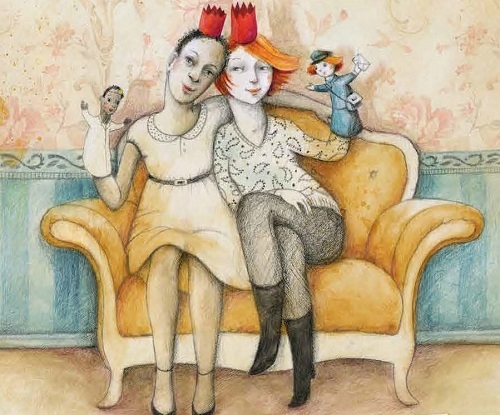
A past-due book with a truly diverse cast that focuses on the many ways women and girls can be princesses, from doctors to architects. I especially love the female coupling.
There are things I appreciated about this book but a lot of it kinda made me angry. With a couple of exceptions, the very first sentence about each "princess" is her marital/relationship status. One of the exceptions is a 23-year-old woman with Downs Syndrome, and her relationship status isn't mentioned I guess because the assumption is that she wouldn't date? I applaud the variety of representation, and some of the illustrations are beautiful, but I would not recommend this book.
2.5 star. I like the depictions of diverse women and relationships, but a lot of this is still very binary. I have no problem with women who like to be described as princesses, but it has never really been my thing. I understand that this is supposed to appeal to kids that like princess books, but this defaults to often defining women in terms of who their romantic partners are and how that relationship works, which seems beside the point.
I loved the art. I enjoyed how each page showcased princesses of varying ages, races, sizes, professions, abilities etc. The one HUGE caveat holding this book back is the repeated mention of each woman's marital status - often used as the first identifier of the princess' qualities. Frankly, I don't care if a princess is married/single/divorced etc., just tell me how awesome she is!
This book features all sorts of women in various professions, in various relationship configurations, various body types, some with disabilities--I love the inclusivity! When the women are in relationships with men, the men are doing non-stereotypical things. Good stuff.
A well-intentioned book with gorgeous art that aims for inclusion and diversity but ultimately reinforces many of the stereotypes that it ostensibly seeks to tear down. The adult "princesses" are defined by their marital status and the book displays a clear gender binary, sending a regressive message to young readers. The final princess in the story has decided that she doesn't want to be a princess anymore, but nothing else is said about why she made that choice or what the implications are of no longer being a princess...it's a confusing ending to a book that misses the mark in its purported message of empowerment and diversity. I really wish I could give this a higher rating, because I appreciate what I think it was going for (and the art truly is amazing), but I just can't recommend this book.
This is an interesting book. It depicts "princesses" of all ages, races, sizes, occupations etc. They lose points for age and marital status, because I think it really hinders the message (particularly the marital status. Women of all ages as princesses, yes. But does it matter if they're single or not? Oy). Every character has something different that makes them happy--be it a hobby, person, career, etc. I appreciate that there are different ways to be "truly brave." We do have a woman going to space, but others who do puppet shows, play guitar for dogs, or who just like to go and dance.
Oh my goodness, this is so perfect. I'm totally in love, and want to live in this book.. and give it to absolutely everyone.
Unlike some readers, I didn't mind the mention of relationships. It's a nice reminder that love can exist in many forms. My only wish is that there might be some more gender diversity (a trans woman, and a nonbinary person), but otherwise, I love this so much.
I get what this author & illustrator are trying to do, but they actually end up enforcing a lot of the stereotypes they're trying to subvert. I have maybe 100 small edits that could make this so much better. This honestly seems like something someone wrote in the throes of an earlier girl power movement. Keep it.
looked like a good idea, but i can't recommend it. not sure why every female has to/would want to be a "princess" anyway, and why all the males are "princes." also not sure what is brave/amazing/noteworthy about working your daily job with kindness and efficiency, or many of the other activities described in the book. I'm not big on crowns/tiaras either, so that seemed really false to me. i guess there are plenty of people people who have sacrificed to do things in life i would consider "braver" and i would rather read about them and hold up their courage, faith and endurance as examples to my own daughter.
I enjoyed the depictions of the girls and women, all seen as princesses, but starting several of the adult women's descriptions with their relationship status as well as starting with a physical description (e.g., Down syndrome) seems contradictory to the overall message. I'm also wondering about the title that includes 'brave.' Is a woman brave for proposing, for spending time with friends, for having Down Syndrome and working in an office? I should stop asking and note that the diversity of ages, physical depictions, skills, and relationships of the girls and women is wonderful.
"Perhaps on more than one occasion you've seen a princess. Maybe you didn't realize she was actually a princess, because at that moment she was not wearing her crown. But if you open your eyes and your heart, you will discover that there are more princesses than you ever imagined."
The cover of this delightful, refreshing, and original book (for readers aged 4-10) gives a hint of the concept inside: a group illustration of a woman in a wheelchair, one of grandmotherly age, one wearing a hijab, a little girl, and a woman with blue hair.
This diversity is reflected on every page, as Brown and Wimmer celebrate women of all shapes, sizes, ages, marital statuses, sexual orientation, race, socioeconomic status, and occupation. The myth of princesses needing to be rescued, protected, and elevated by men is replaced by a new reality of princesses. It's a different era, folks.
There are hairdressers, physicians, astronauts, mailcarriers, and supermarket cashiers. There are single moms, heterosexual marriages, lesbian marriages, princesses who just live with their princes, a divorcee, and a widow. You will spy dreadlocks, blue hair and afros.
Some of the characters have a lisp, a lazy eye, and Down's Syndrome. All are depicted as strong and unique, without being over-the-top or pandering. "Brown and Wimmer use diversity not only to highlight important differences among people, but also to show how these unique traits and interests allow every princess to choose her own path." (Kirkus Reviews. )
The book doesn't treat today's women's movement as propaganda. Lovely, rich illustrations showcase what each girl and woman cares about, and note the men in their lives, if any. (A stay-at-home dad shows up in one spread; the widow is courting on another spread.)
A notecard lists the name, age, profession of a variety of "princesses", along with a description of their life. "Princess Anita does not usually wait for the prince to come home; it is he who usually waits for her. Although her hospital emergency shifts are exhausting, she always returns eagerly to work the following day."
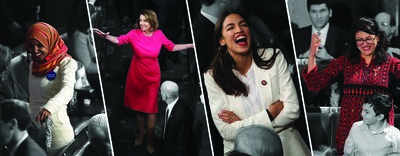
Looking back on the cover illustration, it much reminds me of photos of this week's historic swearing-in ceremony for the 116th session of Congress, which ushers in the most diverse set of lawmakers in history. This includes a record number of women in Congress (including African-American, Hispanic and LGBT members), as well as the first Muslim women and the first Native-American women.
Kirkus Reviews says, "The book feels modern in its references and social cornerstones while retaining a classic, elegant style thanks to Wimmer’s gorgeous portraits of the princesses in their crowns, each facing a page of that princess in action."
As for the illustrations, Sonja Wimmer is a renowned international illustrator. Her books are among the most best-selling in Europe, and you can see why, with her dimensional and beautiful style. In the USA, she has received the Independent Publisher Book Award, the International Latino Book, and she was two times winner of the Moonbeam Children's Book Awards
This is joining my library, and I hope it joins yours too.
The Truly Brave Princesses shows how "princesses" come in every shape, size, age, color, ability, and sexuality. Each page-spread gives little mini-bios of (fictional?) women, which includes information like how old they are, what their profession is, and what they love to do. Some of the bios include "princes" in the background, who are usually represented doing something feminine-coded, like being a stay-at-home parent, or baking. In this way, this book seeks to break down the barriers of gender-coded activities. It encourages readers to dream big and follow their passions regardless of social stigmas, and also to look beyond the surface for the "princess" or "prince" in everyone they meet.
This book isn't perfect-- I'd have liked to see some gender diversity among the princesses. I agree with several other reviewers that marital status/presence of a "prince" was oddly emphasized. I also think the title is odd: it is never stated what exactly makes the princesses brave, much less truly brave... as opposed to what/who?
The illustrations are detailed, colorful, and unusual. This is the kind of book that is a pleasure to look through and admire, rather than a structured story to read.
This picture book shows that princesses come in all shapes and sizes, some young, some old, and not a single one in a frothy ballgown. Instead, readers meet princesses who work in emergency rooms, operate the cash register at supermarkets, write their own books, carry the mail, fight fires, and perform heroic acts every day of the week. The illustrations are lush and luminous and highlight each of these marvelous women and the work they do. As the last page shows, sometimes dreaming big means changing one's goals and no longer wanting to be a princess. The illustrations and text feature a wide variety of individuals, each one doing her own thing and living large, and there's even a character with Down syndrome who has an office job. Clearly, it isn't the crown or the gown that makes someone a princess. This title would be good for sharing with young girls and boys as tehy start dreaming of what they want to be.
This lush picture book explores the ways in which all women are princesses and all women are brave. Each woman’s details are shared, including their name, age, profession and what they love most. Then a brief explanation of their bravery is shared with the reader. Each woman is wonderfully different from the others in terms of race, culture, sexuality, being differently abled, and much more.
The entire picture book has a celebratory feeling. Each woman is given a crown in her portrait, one that matches her personality perfectly. Most charming are the small details that are shared, like the physician’s love of hot chocolate and architect’s connection to the sea. The artwork in the picture book is detailed and filled with color. Each woman gets a close-up portrait and then an image showing her with her family and loved ones actively enjoying life.
A diverse and inclusive look at the strength of all women. Appropriate for ages 3-6.
This is a picture book meant for ages 4 to 8. This is a book with no plot that goes through a list of everyday women(that are brave princesses) and states 3 to 4 facts of their lives.
On the plus side for this book, it is very diverse. There are many different kinds of women being represented, which is most definitely the goal of this book. The downsides for this book are that I find it repetitive and clearly trying to meet a 'diversity quota.' In my opinion, the best way that diverse representation is done is when it's within a story. The purpose of representation is so that a child can see a character, and see their trials/tribulations, and know that they're not alone. Another purpose is to humanize a culture that may have not been represented in a humanizing way before. In this book, every princess has one page dedicated to her with a couple of written out facts about their lives that only takes up the space of an index card. There is no plot, only a series of characters back-to-back that checks a checklist. This book is clearly trying to be intersectionally feminist, but there are definitely more interesting ways of doing that. I don't feel that this book would be appealing to young readers in the long run, because there is nothing to draw a child in.
I love the premise of this princess book which is that princesses are not confined to the Disneyland ideal and category. Chances are you know princesses right here in your neighborhood, of all ages, in all walks of life, of varying looks and chances are, you are one of those truly brave princesses. This review is dedicated to my 4 year old princess warrior granddaughter who has been engaged in a battle with the dread dragon cancer for half her life and is living life every day with joy and bravado. **just so you know** one of the princesses is not married to her prince or one is married to another princess.
So much struggle with this one! The art, okay, the art is sublime, and if I think about the art it takes me away momentarily from my vexation with the writing. BUT, it must be said, I want to take a red pen and just strike through chunks of this book!
WHY does it matter what a princess' marital status is?! And for that matter, WHY did the princess with Ds NOT have a marital status?! Out of all of the princess?! SHAME! Whatever someone's relationship status should have absolutely NO merit on their being a "truly brave princess" or not! Vexation!
This book could have been SO MUCH BETTER. I will struggle to recommend this. (The last page tore at my heart. Was I alone in this?)
In a world where we think the word "princess" means frothy dresses and singing Disney songs, this book gives us a different spin on them! A princess doesn't look the same. Princesses can be white or black. They can be disabled. They come from all different walks of life! I appreciated that this book sought to drive that home.
Other people have a little bit of an issue with some of the misrepresentation or assumptions that were made....I can see them. I can. But I really appreciated a book that had a princess with Down Syndrome or a princess in a wheel chair!
I loved the artwork for this book. The pictures are full of small details and vivid colors that add to the words. The premise is to highlight princesses that are not the standard Disney damsel in distress.
We have princesses that are single moms, women of color, women that work with husbands that stay home with the kids, and any other progressive woman you imagine!
I loved reading it with my daughter and I will gift it to many of the young girls I know.
I wanted to like this book. The art style is unique and the cover is intriguing, but the actual book. I mean. Every single woman is a princess and every single woman has exactly three facts written about her: her job, a hobby or skill, and her relationship status. We know three things about each "princess" and one of them has to be if she's married? That coupled with the white woman with dreadlocks makes this book a pretty shallow concept of diversity.
The illustrations are awesome, but I was really put off by the text. First, it feels totally forced and agenda-driven. Second, the first thing each spread uses to define the respective princess is their marital status. Um, that feels like a subversive kick in the teeth against what I assume the book is trying to do - convince people that every girl can be a powerful individual "princess" in her own right/sphere. Yeah, this was a real miss for me and I won't be using it in my story times.
Why princesses? Why not just cool women? Why were so many princes mentioned; it doesn't seem like they need to be important? Why just a catalog? And other reviewers have specific complaints, such as white woman in dreadlocks, etc. Not representative nor diverse, actually.
And no, I don't care for the art style at all.
There are plenty of other books about girls and women who dream and achieve. Read those instead.
This one sneaked past me and very pleasantly surprised me. Not the style of illustration that I normally I'm attracted to, I picked it up because the grouping in the cover caught my attention. And I started reading,... and I kept reading, ... and it kept getting better with every page, until I had a very BIG grin plastered on my face. Very few books manage to do that. Bravo Ms Brown.
There is so much about this book that I appreciate - especially in representing women and girls from diverse backgrounds as being royal - though I'm a bit at a loss for what to do with it. My four-year-old and I started reading page by page, but since there is not a narrative, we stopped after the first couple of princesses and I let her just flip through the pages.
These are fictional profiles of diverse women who work and care for people, trying to make the world a better place. There is a different individual featured on each spread. Their lives are described to offer realistic role models for girls. There is no story and the illustrations are romantically idealistic.
I mean I get the point, everyone is a princess. It is not a term that is bound by age, gender, race or ability. That said I would find this a lot more interesting if these were real people. And it's kind of patronizing to tell someone with a lazy eye or dark skin that they are just so brave for having basic interests and hobbies.
The premise, that princesses come in many shapes and sizes, is wonderful. I really wish the princesses featured were real people. Since these are fictional princesses, it all comes out extremely contrived. It bothered me that marital status was specifically mentioned, even emphasized, for most princesses. To me, I don't see why it needed to be mentioned at all.