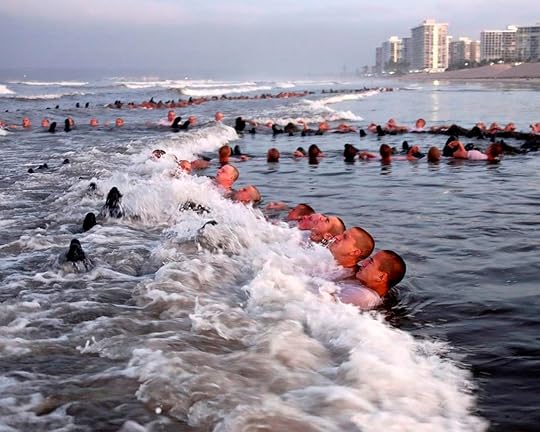
With a postscript describing SEAL efforts in Afghanistan, The Warrior Elite takes you into the toughest, longest, and most relentless military training in the world.
What does it take to become a Navy SEAL? What makes talented, intelligent young men volunteer for physical punishment, cold water, and days without sleep? In The Warrior Elite, former Navy SEAL Dick Couch documents the process that transforms young men into warriors. SEAL training is the distillation of the human spirit, a tradition-bound ordeal that seeks to find men with character, courage, and the burning desire to win at all costs, men who would rather die than quit.
This book was very informative about the US Naval Special Warfare Command, the Navy SEALs. If you have read Chosen Warrior or anything else by the author, he does not give you a history of these units but takes you on the journey to becoming a member of the elite group. The author starts with the grueling Hell Week and moves through each training phase. The book goes into great detail about the different stages of training: mental and physical stress like sleep deprivation and constant exercise, pool and swim qualification and 'drown proofing', weapons qualifying, and all the training milestones these sailors must obtain. This was very readable and informative. Overall I liked it and would recommend it to anyone curious about undertaking this demanding adventure. I have much respect for these guys because it takes a special type of individual to become a Navy SEAL. Thanks!
Though I did not serve in the military, I have the utmost appreciation and respect for those who do, and this riveting account of what is endured by those who enter the lengthy training program to become a Navy SEAL only deepened that respect.
Author Dick Couch, himself an older, retired SEAL, was embedded for many months with SEAL Class 228, in order to write this often day by day account of just how tough SEAL training is. Imagine weeks upon weeks of massive physical challenges, both day and night: "drownproofing" underwater, steering your team in a small boat over crashing surf that often capsizes you, a tough obstacle course, constant and seemingly endless push ups, long runs (in boots), little sleep, and being constantly wet (and covered in sand) from very cold water. Add in the harassment from instructors, the temptation to quit, and the fact that every skill you need to achieve has fairly strict time or performance standards which must be met.
And I am barely scratching the surface, believe me. The grit and determination of those who attempt SEAL training will inspire you, and I have come to understand, even better now, why SEALs are among the armed forces elite. The training dropout rate is quite high, and becoming a SEAL is an incredible achievement.
On a lighter, personal note: since reading this book, whenever I've been tempted to skip the morning run, or time at the gym, Class 228 comes to mind and I avoid the shame and jump right up!
This account of the travails of a group of naval officers and sailors, starting with nearly a hundred who want to become SEALs and ending with ten or so actually making it through the initial training - the SEAL version of boot camp, really, although they've all been through either Navy boot camp or the Naval Academy already - is a grinding read. I saw SEALs a few times during my own 20 years in the Marine Corps, and I'd read some things about them, but I didn't know this much about them before reading this. I gave it four stars instead of five for a couple of reasons, one minor and one major. The minor reason was that the author's prose is kind of sloppy and deserved better editing; the more important problem I have with it, though, is the lack of any consideration of the problem of the SEALs, like the rest of our military, sometimes being misused by our country's executive leadership in ways that clash with our ideals as a nation (for example, the involvement of some SEALs in the mistreatment of prisoners, a la Abu Ghraib.) That's a problem without an easy solution, if you accept the tenets that we do need armed forces to protect Americans and our allies and interests, and that the military have to leave the decisions as to how they're used to the elected civilian leadership that's accountable to the electorate. I wish Captain Couch had at least touched on it.
The Warrior Elite shows the SEAL's training up close and personal, including all the struggles and obstacles that these men have to overcome. This book starts off at the basic BUD/S training of students and what kind of exercises they have to proceed threw and each exercise has a requirement. These SEAL's in training have only a short period of time to comprehend and preform the skills that they are being taught by their instructors. As time goes on the amount of people they are surrounded by vanishes. This book has a very steady rate of action that thrills the reader but increases dramatically at the end of the book, which in turn, allows for a great ending. The ending leaves you with a feeling of awe & jealousy at the same time.
Later in the book they really start PT training, or actual SEAL's training, and have to push themselves physically and mentally. This type of training is a test of perseverance and the author describes the struggles perfectly threw out the book. Characters like Burch, are very strong minded, and have much perseverance. They take punishment with joy and smile about it. That quality in these men is jaw-dropping and I envy it. Some Qualities these men have that I believe I have as well are: if you have a passion towards something you wont ever give up, and being mentally strong.
The theme that would fit this book very well would be perseverance. These men that have gone threw all of the training have more than just that. There should be a more detailed word that could possibly describe the amount of pain, suffering, and isolation -- while at the same time continue threw all that while smiling. Its just astonishing that these men could do something so hopeless and go threw it acting like its nothing.
This book is amazing and i recommend it for anyone. Builds up very nicely. Great job on the authors part.
"Set the highest example. Remember, no one ever did anything absolutely right. Perfection is impossible, but striving for perfection is not. You have the power to do that. " -Dick Couch, Author & Former U.S. Navy SEAL
For anyone curious about the toughest military training in the world for the single most highly trained and selective military force, this is the book for you.
Dick Couch, a highly respected retired Navy SEAL from the Vietnam era, received permission to be an observer and unofficial member as he describes it. He observed Class 228 of SEAL training, from the indoctrination phase of BUD/S (Basic Underwater Demolition/ SEAL) training to phase 3 which takes place at the Naval Special Warfare Center in San Diego.
Class 228 is the class of Navy SEAL Marcus Luttrell, a medical rollback from a previous phase (Lutrell explains this in his memoir, Lone Survivor). This book was written years before operation Redwing and luttrell's book. He wasn't mentioned in the book until Hell Week when Luttrell is referred to as "Mark" and is a "brownshirt" (a member of class 228 who had already completed Hell Week). By second phase the author invariably refers to him as Mark or Marcus. As a rollback awaiting second phase, Luttrell assists and provides support to the current group of trainees struggling through Hell Week.
During Hell Week of BUD/s, trainees are pushed beyond the point of what for most people would be humanly possible. The intention of hell week is to weed out anyone who is either unwilling or unable to withstand the most extreme physical and environmental conditions. BUD/S training is the most difficult military training in the world and only a fraction of the men who are allowed to attempt it are able to make it to the end. As the author describes in great detail, it is absolutely brutal, and apparently, even life changing.
The explosives portion of BUD/S training takes place on the northeastern part of San Clemente Island.
I feel terrible for the trainees who pass through first phase and Hell Week and then are unable to advance through second or third phase, and are dropped and reassigned to the fleet without the option to return to BUD/S. They must feel devastated. Each phase of Hell Week is described by the author, and each one comes with it's own challenges. Although phase one is the most physically demanding of the three, no single phase is more challenging than the other two.
"During WWII, the Navy expended no small amount of time and money to develop a reliable, waterproof firing assembly. None of them worked. The early Frogmen solved the problem on the job. Waterproof neoprene cement and condoms. Two condoms for extra protection from the salt water. They worked every time." -Dick Couch, Author & Former U.S. Navy SEAL
To start things off, The Warrior Elite by Dick Couch was a very well written book full of details. This book taught me many things that I didn’t know about the navy seals and what they have to go through in order to become Navy seals. I felt like I learned something new every 20 pages and I really learned what it truly takes to become a navy seal. Moving on, The Warrior Elite had many strengths and very little weaknesses. One of the book’s strengths were the characters in the book. This book is non-fiction, so the characters in the story are real people. The trainees and class leaders all had strong personalities filled with pride and determination. The trainees were determined to complete BUD/S camp and the class leaders were determined to get the trainees through the camp. As the story went on and the camp continued, the trainees built very strong relationships with each other and some of the class leaders made relationships with some of the trainees. The trainees worked together to complete all of the training exercises and the all believed in each other. The trainees personalities were a huge factor in the warrior elite being a very strong book. Another strength is the great amount of detail Dick Couch added to the story. He explained every training exercise with a lot of detail which helped ,e understand what was going on. He also went into details about some of the trainees and class leaders which made it possible for me to imagine what the characters looked like in real life. He explained the physical and mental traits of a lot of the characters in the story. One weakness the book had was that it never went into detail about the recovery time for the seals. The book went from one phase to the next without really saying what happened in between each phase. It would’ve been interesting to know what the trainees did in between each phase to prepare for the next. Many good reads readers had positive things to say about the book that I agree with. One reader stated “The Warrior Elite Shows the Seal’s training up close and personal , including all the struggles and obstacles these men have to overcome.” In my opinion, the book has lots of details about the training during BUD/S and this quote relates to that. The book taught me many new things and the great amount of detail in the booked made everything easier to understand. Another good read reader stated “ Characters like Burch are very strong minded, and have much perseverance.” This refers to one of the book’s strengths, which is the characters. Burch is a very strong character in the book, and has traits that are fit for a navy seal. Many characters in the story are like Burch and that is what makes the story even stronger. In conclusion, I gave this book 5 starts because it was very detailed, interesting, and I learned many knew things from the story. Dick Couch really did a great job with taking us through and up-close experience of what it takes to become a navy seal. I recommend this book to people who are interested in the special forces and like to learn many new things about the Navy Seals.
What does it take to make a warrior? Author and former SEAL Dick Couch documents the training process for SEAL teams by following a class of prospective SEALs as they advance through the BUD/s course. The Warrior Elite describes in great detail the torture prospective SEALs undergo to prove themselves as warriors, as well as the practice and education that they receive to work more effectively as a team. As many others on goodreads have said, this book does a great job at making the reader understand the torture trainees go through, even though most of us have probably never felt anything close to the sleep-deprived slog that is hell week during SEAL training. This book has a few segments on how the SEALs function within real-life missions, but most of the book is dedicated to the indoctrination, weeding out, and training of SEAL team applicants. This makes The Warrior Elite quite different from many different books written by former soldiers, most of which focus on real missions and experiences. This focus on training creates an atmosphere that is distinctly different from many other military-related books. The author aims to give the reader a front-row seat on the sidelines rather than trying to throw the reader right into the middle of the action. In many ways, this is actually more effective at describing how difficult some of the training really is. With a book written from the perspective of a soldier in a battle, all the reader sees is that the soldiers carried out some action. We, as readers, don’t know how hard that task really was. With the sideline perspective, the reader gets to see exactly how each trainee reacts to each task, how they approach the tasks, and how they struggle through the confusion and pain to complete the tasks. One thing The Warrior Elite does not capture completely is repetition. Because repetition is such a critical part of training, the author often skims over entire weeks, only mentioning who dropped out. The author could have used this as an opportunity to make the reader feel how long training is, and what it would feel like to be in such a stressful environment for so long. Although the author does a good job at conveying what it feels like to do a task once, he fails to express just how demanding that same task would be after an hour and a half of repeating it. Overall, The Warrior Elite was a great book. It showcases the dedication and toughness that SEAL trainees need to become warriors and does a great job at showing the reader just how hard SEAL training is. I would recommend this book to anyone who wants to learn more about the Navy SEALs, or the army in general. Even for those who are not interested in the military, this book still instills a good amount of appreciation for what soldiers have to go through.
The United States Marine Corps is one of the finest fighting forces ever to exist. In the book “The Warrior Elite,” one can get a look at the training required to become one of the top ranking members in that fighting force: the Navy SEAL. Others on GoodReads exclaim that it is one of the finest reading experiences they’ve had in their lives due to how real and informative the information was. One post in particular related the trainees’ struggles to his own “daily gym outings” and how if he is ever considering skipping out on his regiment, he would remember the trainees and how far they went to achieve the SEAL ranking.
A major strength this book has is the fact that it can make one feel as if they are reading a history book. All the information starting from page one all the way to three-hundred is what the trainees had to through or what they signed up for upon entering this step in their training. There are no gaps in the way it flows in terms of time and feel, so it feels as if you could read more and more until you reach the end of the journey. As far as weaknesses go, there really aren’t many in any respect. This book was written to showcase one things: BUD/S Navy SEAL training. Seeing as that is exactly what the book does (not to mention the fact that it is done with fantastic imagery and tone), there is no wonder why it is rated so high on GoodReads.
If there were any discussion question I would ask a group, it would be this: “How do you think that you would hold up in the trainees’ situation? Would you be able to handle the ‘drown-proofing,’ constant cold, and the nonstop running?” Instinctively, most people probably wish that they could answer with an honest “yes” right away. If they did this, however, most of them would definitely be lying. When it is really put into perspective how much work it is to become a SEAL, any number of us would instantly back away from the challenge. It is only the people who are not only physically in shape, but the people with pride who would even have a chance in the slightest of making it through the training program. I believe that many discussion groups could have countless interesting conversations with that question as their topic for this stellar novel.
The United States has the world's most powerful Navy and some infamous groups within that will always be forever known Navy Seals. How their training conducted to make them the most feared adversary that their enemies will face is explained in thorough detail in the book. Many readers on Goodreads gave the book 4 to 5 stars based on that they had no idea of all the hardships and struggles that they had to endure to become a Seal. Or how long the process was through each phase with each evolution being so tough to endure. I agree with most of these reviews, because I had not known of everything that goes into making or creating a Navy Seal, like the amount of time they spend at BUD/S learning a large variety of skills. Like underwater reconnaissance or demolitions training.
I would say that the type of readers that would most enjoy a book like this would be one that enjoys military related books, someone going through that pathway, and or someone that enjoys to learn something new. Because there are many things in this book that not everyone might have known before. With this book it could also give an idea of what they need to do or what it’s like to become a Navy Seal. This book doesn’t have many weaknesses but it has a lot of strengths that it does exactly what the Title says it is. It tells you of the journey of Navy Seal Class 228 and their struggles that they went through as they started with a full class of over 100 and ended with around ten students at the end of their training at BUD/S and earning their trident.
If there was one discussion question that I would ask it would be: How well do you think that you could hold up in BUD/S? How well could you handle the cold, nonstop running and tiredness? Or even the drownproofing? Most people might say that they could do it, but when it would come to actually trying it many would give in and give up. It goes to show how much dedication and effort thee men put into their time at BUD/S and into their trial at becoming a Seal.
This entire review has been hidden because of spoilers.
The Warrior Elite by Dick Couch is about the many adventures and journeys of SEAL Class 228. It takes the reader through them going through basic camp to become a SEAL all the way to the SEALS in combat. I would recommend this book to anyone who is interested in the military whether it be hearing stories or just learning about it. Overall I was not a big fan of this book because throughout the story there were very boring parts that felt like nothing was going on. It was hard for me to stay focused on the book. Another reason it was hard to stay focused was because there were so many characters, and they were all very similar. Another weakness of this book was the organization. The book kind of bounced around different times which made it confusing. I often found myself rereading parts to figure out exactly what was going on. Despite the weaknesses there were strengths too. The first strength was it gave the reader an interesting perspective since it was told through the point of view as if you were in the military. Another strength was there were so many amazing facts and unique stories. Most of the stories convey helpful messages and give good advice which is good to read. The final strength of Warrior Elite is the writer does such a good job describing some events like the exhausting training, it makes you feel like you are experiencing it too. I would give the Warrior Elite three stars. One Goodreads reviewer said that, “the author often skims over entire weeks, only mentioning who dropped out.” I strongly believe in this. As you are reading you feel like you forgot to read an entire page because the writer leaves out so much. This is what also makes the book confusing at times. Another review stated, “The book was a touch redundant and slow.” I also agree with this. This is what led me to lose interest in the book and have a hard time continuously. I think the training especially becomes very redundant because for the most part they go through the same drills and exercises. One statement that I disagree with is, “Couch is assuming his audience knows a lot more about the military than they do.” While reading the book I never felt like the military knowledge was over my head. I think Couch did a good job explaining all military terms and unfamiliar phrases.
The Warrior Elite was a very interesting book that never seemed to have a dull moment. It presented the information in a very straightforward way that was easy to understand. A GoodReads user sarcastically said, "Nice light reading if you're in the mood for military propaganda." attached to a two-star rating. I do not agree with this as this is a nonfiction book and the events depicted in this book are being depicted exactly how they happened. Furthermore the military is not glorified in this book, in fact, quite the opposite is true. The book covers all the gritty details about the process of becoming a navy seal. Because the book is nonfiction and does not glorify the military I can not see how the book could be described as "military propaganda". Another GoodReads user stated "This is a very interesting book about the training that Seals undertake, which is quite grueling. Hell week in particular is fascinating, as to what these trainees have to endure. Only 1 in 5 gets through this training, which is a testament to its difficulty. Highly recommend this book." attached to a four-star review. I completely agree with this as the book is very fascinating. I find it amazing what the seal trainees must go through as I could never imagine doing even half of what the seal trainees do. For example, during "Hell Week" the seal trainees did nothing but physical training and intensive exercise for over 20 hours a day with very little food. This book had very few shortcoming, but there were a few. For starters, the book seemed somewhat repetitive at times. It was still interesting, but repetitive as the seals were pretty much doing the same exercises every day during "Hell Week". Second, the book was very hard to follow in some places. There were nearly 200 trainees during the first phase of training and they were constantly being referred to by name. As you can imagine it is pretty much impossible to keep track of everyone. Even when the pool of trainees thinned out it was still very hard to keep track of everyone as there were simply too many people to keep track of. However, towards the end of the book, it is easier to keep track of the trainees as there are only around 20 trainees left. In conclusion The Warrior Elite is a great book and you should read it if you are interested in what it takes to become a navy seal.
Author and former SEAL, Dick Couch, documents the training process for SEAL teams by following a class of men as they go through all the struggles and obstacles that they need to overcome in the BUD/S course. This book does a great job of describing the men's daily life during training to become warriors. Without having to physically go through Hell Week like the trainees, the reader could easily understand the torture and pain during the training thanks to the author. Just like how many Goodreads reviews included how the book nicely portrayed the obstacles and hard training, numerous reviews included the fact that the book skipped weeks of information; twenty men are dropped out in a matter of pages, and the author fails to include information to fills these gaps in. I agree because I was confused for many of the parts. Another reason why I gave the book four stars instead of five is the unnecessary amount of minor characters that were added into the books. This simply made the book more confusing to follow which leads to less interest in the book. Overall, The Warrior Elite was a good book full of useful information about the training that SEALs go through. It showcases the men's dedication and will to succeed. It does a great job of showing the reader just how hard SEAL training is. I recommend this book for anyone interested in this topic or wants to learn more about Navy SEALS. I chose to read this book because I wanted to be more educated in this topic, and after reading it, I have a greater understanding of the true hardships these brave men go through to protect our country.
You picked this book up for dive-inspiration before your Sipadan'19 trip, and it. was. amazing. If one is an aspiring BUD/S trainee wanting an idea of the pain ahead of them, a rebel army trying to train their special forces more professionally than from watching YT videos of Russians shooting stuff with ridiculously overpowered rifles, or a sloth like you trying to shame yourself into waking up at 9am and doing 10 pushups to earn that 10 pancake breakfast, this book will do the job for 2 of them, and for approximately 2 days for one of you.
It was a sobering moment you discovered the famous and expected crux of the book, Hell Week, was basically step 1. At the end of the book is a list of collected wise witticisms as Dick delivers his commencement speech, saying 'the only easy day was yesterday', and that is a common theme through your experience of this book. Hell Week was laid out in all its gory masochism and, wouldn't you know it, hellishness, that after the chapter ended you needed to eat a large meal and take a well-deserved nap. The idea that Hell Week was 'secured' and the trainees proceeded to 'Phase...ONE' was galling for you, and at no point did you wonder why people were DOR'ing at various stages. The intensity of training never lets up, and makes you remark at just how far from that level of durability your mind currently is. An average of 3hrs sleep over the better part of a year, following which they are ready to... join the actual SEAL training. You reflect on the near certainty of crying and quitting after the alarm clock rang on day 1.
You loved the idea of Hell Week being not just about surviving but performing. They were constantly giving it their all to win the races, not just get through the exercise. Leaders were given the activity and had to brief their teams efficiently and approach the problem cerebrally. Eventually your dive trip finished by the time you got to the diving section, which was utterly terrifying and humbling for you as you complained about a little occasional fog developing on your mask and stressing you out as you incompetently tried to clear it underwater in pristine conditions. The dive test in the pool was terrifying to read and incredible to equate to your own diving comfort inadequacies given that half of those trainees had never dived in their lives.
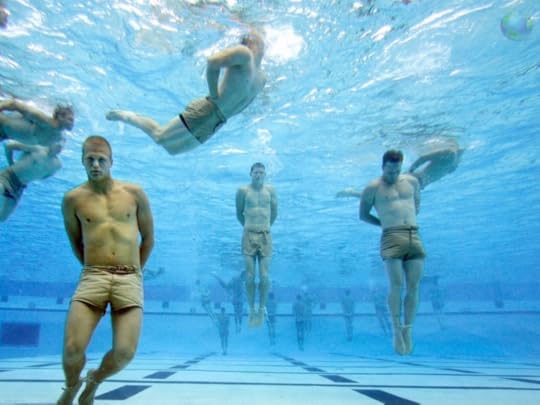
Clippings Kim had to drag his useless arm through the water; the other wounded had to swim as best they could. But SEALs prepare for this. In BUD/S training, the trainees are bound, hands and feet, and made to swim this way. They call it drown proofing.
In World War II and Korea and Vietnam, a young frogman or SEAL could find himself in a firefight after three or four months of training. Today, it takes more than thirty months to train a Navy SEAL.
Officers at BUD/S have a lower dropout rate than enlisted men. They tend to be older and, as a group, better educated. Because of the highly competitive selection process at Annapolis, they have a history of success in training.
Next to Hell Week, the first week of First Phase causes the greatest percentage of attrition. It's as if some of the trainees simply wanted to get to First Phase before they DOR.
“You will have thirty seconds to brief your crews. Go!” Taylor gives boat leaders a few extra seconds to plot strategy and fire up their crews. His surf evolutions are clever; the crews have to follow directions as well as pull together to win a surf race.
Many blacks who come to BUD/S, like Williams, are men with a heavy muscle mass. They tend to sink like a stone. With hands and feet bound, BUD/S trainees must travel several lengths of the pool and tread water for a period of time. Then, after executing an underwater somersault, they have to “swim” or wriggle to the bottom and retrieve their face mask in their teeth.
Some of them seem totally baffled by the idea of making a choice; others drift off in the middle of a sentence. “Okay, if that's the way you want it—door three. We'll go get wet and sandy, carry the boats through the O-course, and then do surf passage.” The assembled students accept the verdict like a death sentence. But none question it.
There was a time at BUD/S in the early 1970s when Hell Week was discontinued. The Vietnam War demanded a higher output of young men for the SEAL teams, so, in a top-down move, the Navy canceled Hell Week.
Water that cold is devastating; you go from miserable to numb very quickly. We were never in for more than a few minutes at a time; immersions were quick and very painful. I'm not so sure that twenty minutes at sixty degrees is any easier than two minutes at thirty-two degrees.
Today's BUD/S students are clearly stronger and more athletic than those in the past. It's obvious that many who arrive at BUD/S have logged more than a few hours in the weight room. But life in these United States is good—and often soft. On balance, the feel-good generation may be less prepared mentally for the crucible of BUD/S than their predecessors.
“Most guys with law degrees just want to be lawyers,” he told me. “They don't really, and I mean really, want to practice law.” I think it's the same with BUD/S trainees. A lot of them would like to call themselves SEALs, but perhaps not so many of them are prepared to do the work of Navy SEALs.
First, small men seem to get through the training easier and in larger numbers than big men. The second, almost a third of the men who began with Class 228 had tattoos. All but a very few of these trainees were gone by the end of Hell Week. Many young people get tattoos because they yield to peer pressure, or because they lack self-confidence or a strong personal identity. These are not traits I saw in the men who finished Hell Week.
In small groups, they are taken down to sixty feet in the recompression chamber, where they breathe pure oxygen. A small percentage of the population has a toxic reaction to oxygen under pressure. The men of Class 228 come through just fine.
BUD/S instructors, who are all enlisted men, lean heavier on their officer trainees. They know officers who leave BUD/S get treated much differently than enlisted men.
free-swimming ascents, or FSAs are taught so that in the event a SEAL should ever have to abandon his diving rig while on a mission, he can do so and safely get to the surface.
In the early 1960s, single-hose regulators replaced the two-hose models because they were simpler, safer, and easier to maintain. Only in BUD/S training do they still teach open-circuit scuba with the old double-hose equipment. There's a good reason for this. Next week the trainees will transition to the Draeger Lar V closed-circuit diving rig. Two hoses are required for closed-circuit operation.
Once in the water, they practice taking off all their gear and arranging it on the bottom of the pool. The last item to come off is the face mask. Then they secure all the gear with their weight belt and make an FSA to the surface. When a trainee signals he is ready to go to the surface, his instructor will swim down and tap him twice on the back of the head. The student diver then secures his air, kisses the bottom of the pool, and, while maintaining a steady exhalation,
The afternoon's diving evolution is equipment ditch and don—at night. For this evolution they do the same thing they did in the morning dive, only this time they use blacked-out face masks. Everything is by feel. It's a matter of confidence and familiarity. Seaman Marc Luttrell, the class corpsman, has trouble with the morning evolution. It takes him several tries to properly ditch and don his equipment. Back in the pool that afternoon, he does it perfectly the first time—in the dark.
But we want you to crawl—no standing. If you stand up, it tells us that you are panicky and you flunk the dive.”
First thing, release the mouthpiece and extend the hoses over your head—let it free flow.”Next trace the hoses from the horns to the mouthpiece.”“Next, bite the bubble and clear the mouthpiece.” Shaffer, holding the mouthpiece down, rotates it toward his chin and puts it in his mouth. Then he tilts his head to the left, in the direction of the exhalation hose, and blows.“Check air supply and reserve.” “Correct.” Shaffer reaches behind his head and turns his air valve fully counterclockwise and back a quarter turn. Then he checks to see that his reserve J-valve is in the up position.“Trace the straps, check for twists in the straps, and that all quick-releases have three-finger loops.”“Make sure the weight belt is over all tank straps and that the release buckle pulls to the right-hand side.” “When the mouthpiece over your head is free flowing, the air is on and your inhalation hose is working. So where is the kink? Probably in your exhalation hose, right? If the regulator is not free-flowing, you have a problem with the inhalation hose or the air is not turned on. Remember, if you can inhale, but can't exhale, you're okay. Just breathe out through your nose, complete your dive supe check, and fix the problem.
Class 228 splashes back into the pool. They begin to tread water while keeping their hands above the surface. With twelve pounds of lead around their waists and the dual tanks on their backs, they kick furiously to keep their heads above the surface and their hands visible. “Five minutes, that's all we ask. Gut it out for five minutes
Instructor John Surmont immediately pulls off his fins and face mask and delivers them to the side of the pool. Moments later, Surmont swoops down behind 228's class leader and grabs his feet. He tumbles him violently and almost carries him out of the lane. Then he cranks Gallagher's air valve almost off—not quite, but almost. Surmont returns to the surface for a bite of air. By the time Gallagher gets to his knees and begins a dive supe check, the instructor is on him again. This time he grabs his student's exhalation hose and turns his air fully off. Gallagher can neither breathe in nor out. He releases his mouthpiece and begins to trace his hoses from the regulator. He finds Surmont's hand on his left hose and taps it twice. Tracing back from his mouthpiece, he again double-taps the hand on the hose. Then he finds his air valve and cranks it on. Gallagher manages only a few breaths in and out when he finds he again can't exhale. But he can breathe in. Exhaling through his nose, he begins a dive supe check, twice double-tapping the hand crimping his exhalation hose. Then he completes his dive supe check without interruption. He begins crawling along his lane, waiting for the next assault. Bill Gallagher knows John Surmont is above him planning his next attack. He doesn't have to wait long. On his first pass, Surmont again turns Gallagher's air nearly off and gives him a good tumble. The next time down, he grabs the mouthpiece, allowing Gallagher a full breath before he pulls it from his mouth. Gallagher braces himself on all fours, like a cow being milked, while Surmont fully secures his air and pulls the regulator hoses through the manifold yoke and back up over the air valve. He gives Gallagher a good shove and heads for the surface. Snorkeling above, he watches as Gallagher goes to work. His dive supe check is short-lived. Reaching back, he finds the horns of his regulator, but the hoses will not budge. Gallagher drops his weight belt, draping it across the back of his knees. Then he methodically pulls the three quick-release straps and brings the twin 80s over his head. With the bottles in front of him, he is able to free the tangled hoses and turn on his air. After a few sweet breaths, he reseats the tanks on his back and begins to strap them on. As he goes for the weight belt, suddenly he can't breathe. He hesitates, but only for a second. He releases the mouthpiece and starts to trace his hoses, finding Surmont's hand clinched on his right hose. Two double-taps later he is breathing normally. Strapping on the weight belt, Gallagher again starts through his dive supe check. He does not get far. Again, there is a hand on his mouthpiece. Surmont allows him to draw a single deep breath—his last for awhile. Bill Gallagher waits while John Surmont works. Another shove and it's Gallagher's turn. As before, he can't breathe and he can't find his hoses. Off come the tanks. This time the hoses are rubber-banded around the manifold yoke in a Gordian knot. Gallagher knows he'll not solve this one on the air he has left, but he makes a show of it. Quickly, he steals a glance at the surface. There are several instructors milling above him. He is vaguely aware of a fellow student being tossed about to his left. That's enough; no way it's gonna come loose! Time to ditch this rig. Gallagher signals for an FSA and goes back to work, just maybe, if I can find a loop in the hose … There it is; the two taps on the back of the head. I'm outta here! Gallagher quickly drags his weight belt from the back of his legs and lays it across the tank. He tries to find the tank valve to secure the air, but it is buried under the tangle of rubber. Outta here! He kisses the bottom of the pool and begins blowing bubbles. An instant later, Surmont takes a handful of his shirt from the middle of his shoulder blades and guides him to the surface. “I feel fine!” “Again!” “I feel fine!”
The Draeger is the current edition of a long line of combat swimmer scubas, tracing its lineage back to crude British and Italian models developed during World War II. The diver breathes pure oxygen and his exhalation gas is sent through a canister that scrubs away the carbon dioxide. Additional oxygen is added to the breathing gas as needed. The theory of the oxygen rebreather has changed little over the past five decades, but the design and safety of these scubas have undergone considerable refinement. The Draeger is a light, compact rig worn on the diver's chest. There are no bubbles; with it, a combat swimmer has up to six hours of underwater time to complete his mission.
It is a shallow-water scuba; divers using the Draeger are restricted to a working depth of thirty feet. Below two atmospheres of pressure—pressures found below the thirty-two-foot depth— pure oxygen can become toxic.
This surface swimming with Draegers is called turtlebacking. Combat swimmers often turtleback on the surface at night as they approach a harbor and submerge to make their attack. Owens and Gallagher swim like this for close to a thousand yards. As they approach McKendry in the dive supe boat, they execute an emergency dive. This simulates the sudden arrival of a patrol boat or searchlight, and they have to get under quickly. The swim pair drops below the surface, turns on the oxygen to their Draegers, and begins their purge procedures. This replaces the air in their lungs with pure oxygen. Finally they get their face masks in place and are ready to continue.
Third Phase training is divided into two segments—training at the Center and training on San Clemente Island. During the first five weeks of Third Phase, they will be at the Center. This includes four days of training at La Posta for land navigation and four days at Camp Pendleton on the shooting ranges. They will then fly to San Clemente Island for more tactics, more shooting, demolitions, and the field training exercises.
Waterproofing a nonelectric firing assembly is a technical and highly evolved procedure. During World War II, the Navy expended no small amount of time and money to develop a reliable, waterproof firing assembly. None of them worked. The early frogmen solved the problem on the job: waterproof neoprene cement and condoms—two condoms for extra protection from the saltwater.
‘The only easy day was yesterday.’
I personally have come to believe the single trait that will get a man through BUD/S is the will to win. The desire to win is different from refusing to lose, or not quitting.
Realize that what you do and what you tolerate in your presence demonstrate your standards far more than what you say.
The qualities that make for a good SEAL leader also make them prized by business. Young ex-SEAL platoon officers often find themselves working half the hours for twice the pay, and they get to be with their families at night. But they pay a price for these opportunities in the business world and the potential for affluence: They are no longer warriors, and they will never again lead other warriors in harm's way. As one former platoon officer put it, “The money's there but not the rush. God help me, but I do miss it.”
More than half of what makes a Navy SEAL special is his commute to the job site. It's a tough commute—through the air, under the sea, or across the land.
$1 million per SEAL, deployed and ready to go, calls to mind an interesting analogy. Cruise missiles cost about $1 million dollars each.
The number of policy makers today who understand the culture of the military is less than it was several decades ago. And that number is shrinking. I believe this applies as well to the media and those who report on military affairs.
I suspect that these men do in fact have a very real pride in serving their country, but that was not why they volunteered for BUD/S. To one degree or another, they are simply talented, determined, motivated young men who were looking for a yardstick by which to measure themselves. So the question remains, do our armed forces need the conspicuous support of a grateful nation?
The gain in gender equality would come at a tremendous cost in operational effectiveness, and ultimately, in human lives. SEALs live and work together for long periods of time under some very basic and demanding conditions. I feel the inclusion of women would adversely alter the chemistry that is so vital to the teamwork of a combat-effective SEAL platoon.
Can you imagine having a tryout or recruitment session for one of the most elite military units in the world, the answer is no you couldn’t. In The Warrior Elite: The Forging of SEAL Class 228, the story follows a group of trainees in BUD/S class 228. The only reviews on Goodreads I believe in are the ones rating this book a five stars because this book was fascinating and enjoyable. One comment I disagree with on Goodreads is someone saying “Nice light reading if you’re in the mood for military propaganda.” The first thing that annoys me is that this isn’t propaganda or some sort of fake show, it is a great telling of the actual events that take place during BUD/S training. Also, there is no propaganda in this book the definition of propaganda is “information, especially of a biased or misleading nature, used to promote or publicize a particular political cause or point of view.” There is no such thing in this book no Uncle Sam pointing at you and saying “We want you!”, Or even a subtle message that tells you to join. Also if anything this would make lots of people steer away, just because of how tough it is. A comment I agree with is one saying “I really enjoyed the atmosphere and vocabulary in the book, and it never felt dull.” I agree 100% with this claim because during the book there are so many intense scenes within the book that I can’t even keep track, one being where the class of 228 has to take over a radio tower from their instructors. I also loved the vocab because it had such great immersion that I felt that I could be doing the exercises with class 228. Using slang that I understood like dip, or using military phrases like BUD/S or KIA. I enjoyed the atmosphere by far the most because of how immersive and intense that is is during the book. Like when the trainees took the radio tower, I felt that I could see what was going on clearly in my head with no questions. Another comment I agree with is the one stating “You need to interested in the SEALS to like the book. I agree with this statement because if you went into let’s say a video game not knowing anything about what is happening it would be pretty dull. The book is interesting to lots of men because I feel like guns and military games are what our childhood was, and this just takes an in-depth look at the training of some of the people we played as while we were children. Due to all the reasons above, I believe this book deserves a solid five stars because of how immersed and interested it kept me in the story.
This entire review has been hidden because of spoilers.
This is a study of US Navy Seal training, following the progress of a particular class. There is a lot of talk about how training has changed since the author was an active duty Navy Seal in Vietnam. I am no expert AT ALL and am definitely not a military person. But Class 228 is special as they are a good example of those who were undergoing the beginning of their training before and around the time of 9/11. The fact that Marc Luttrell,(author of Lone Survivor), is among the graduates of class 228 is rather significant. This is fascinating stuff, regarding what sort of people decide to do this, where they come from, what qualities they share yet how they differ and what they have to endure together in order to become Navy Seals.
In my opinion, Dick Couch addresses the issue of women in combat or in Seal Teams politely and with more of an open mind than some readers might expect. Again, not being a military individual I wouldn't say much about that. Only that I am just as grateful for the women who serve as I am towards the men. Being willing and able to put yourself in harms way to protect others is an admirable quality.
What is more important is his devotion to studying this particular Seal warrior culture, how and why it is elite, why it is necessary, how it is and could evolve. There is a lot of technical talk, a lot of abbreviations and information about weaponry. That I couldn't keep up with. But his discussion about basic human qualities and motivations that make great warriors was very interesting.
I think I enjoyed this book a lot mainly because of the fact that I could relate to a lot of what these men had to go through as a team. Obviously what I could relate to was not the fact that what I do is on the same difficulty level, but the fact that what I do focuses on a lot of the same concepts. One good example is that to accomplish something big you have to come together with a group, and work together as one, and if one person is dragging everybody down by not doing his own individual part you leave them behind and move on past it. Now I'm not saying you can't enjoy this book if you have never been on a team but it made it much easier to read for me. I only rated this book a 4 because of a few select parts of the book that were not as exciting but I expect to see that out of a lot of books. Great book overall.
This book was really interesting. It's very much a guide to the BUD/S indoctrination and first phase, with very specific details about the process. It's less about strategy, and more about some of the challenges faced by individuals trying to become SEALs. A great book for those interested in learning more about the actual nuts and bolts of BUD/S, and a little more general information on becoming a SEAL. I had hoped this book was more of a memoir but it really isn't, although Couch was a SEAL himself. His second book, "The Finishing School," continues where this book left off.
Excellent writing, but more technical than relaxing.
It's written by a former SEAL who shadowed this particular class. There's a strong bias there, but the account feels very real. Well written and easy to read, with the Author making the training very personal by giving stories of individual recruits, their backgrounds, and some of the challenges they overcame (or didn't).
The book corrected a lot of misconceptions I had about SEALs in general, especially their training, and left me with even more respect for what they go through.
A very detailed about what a prospective SEAL goes through. I had an understanding of this from other books so that is why I only rated this a 3 star rating. Well written and very informative. If you have wondered what it takes to become a SEAL this is a wonderful read, I think you get the whole picture. I know I would not make it through the rigors and misery. They are an amazing group of men who deserve our respect as well as our thanks.
When a trainee goes to Navy Seals training, they can drop on request at anytime and are honorably returned to the fleet, and they finish their tours there. When you read about how exhausted, wet and cold they get, it’s easy to understand why 1/5 makes it. What you’re left with are the people who never quite, no matter the cost. I’ve read 4 books about the Navy Seals now, and every time I finish one, I’m inspired to be on my game, no matter what I’m doing.
Author Dick Crouch follows the training of future Navy Seals. For most people the training would be torture, but a few amazing individuals excel and make it through to join the Special Forces. I was intrigued by the endurance of the men that continued training while others dropped out. This is a fascinating book that anyone considering the military or Special Forces training should read.
An interesting read on what it takes to be a Navy SEAL, including BUD/S orientation, hell week, physical screening tests, combat diving, drown proofing, surf torture, obstacle courses, demolitions training, parachute jump school, seal qualification training, and much more.
- It's extraordinary what these guys manage to accomplish. Hell week alone is insanity—5 straight days of training where they do more than 20 hours of training per day, sleep less than 4 hours total, run 0ver 200 miles, and experience misery I can hardly imagine—and they describe that as no more than a "speed bump" in the training of a SEAL.
- At first, putting people through such torture seems unnecessary, but when you think about the type of conditions a SEAL will be faced with in the real world, it makes more sense. To succeed in such conditions, they need soldiers who would rather die than quit, and programs like hell week are one way to figure that out. I was particularly struck by one scene in the book where a drill instructor is going especially hard on one candidate, putting him through one tortuous exercise after another, when they both start laughing, realizing that this candidate will never give up, never stop, never quit. I can't imagine there are many people like that in the world, but if you were building something like a SEAL team, they would be the ones you're trying to find.
- Torture aside, the amount of training SEALs go through is pretty mind blowing. They spend years learning and learning and learning. In reality, it never stops, and they train more or less nonstop their entire careers. On the one hand, it makes me wonder why in so many other professions, you train initially, and then training stops. How much more could we accomplish with the never-stop-learning attitude of SEALs? On the other hand, it also makes me think of the ever-increasing amount of knowledge and specialization it takes to become an expert in the modern world. Doctors, soldiers, researchers, astronauts, and so many other professions take decades to train, and as human knowledge continues to increase at an ever increasing pace, I can only imagine the amount of training time will grow. I wonder if we'll eventually hit a limit where the amount of time it takes to create an expert starts to butt up against the lifespan of a human being?
This was a great book and a quick read. I’d like to thank Captain Couch, the men of Class 228 and all other Navy SEALS for their service, America and I am truly in your debt-thank you. This book was a great look into BUD/S training which is what you have to go through to become a Navy SEAL. I liked a lot about this book from the determination of the graduates to get through this rigorous training, which really inspired me to be better, to the team work that they showed and how they helped each other along to the end of the training. But the part of the book that stuck out the most to me, which was not intended by the author was the small section about an unknown sailor going through BUD/S at the time, Marcus Luttrell. When the book was published in 2001 nobody knew who this man was. But four years later he would be fighting alongside three other Navy SEALS in Operation Red Wings in Afghanistan. He would later write a book, Lone Survivor, about his experiences, and the book would spawn a movie in which Mark Wahlberg would portray Luttrell. In that battle the detachment of four SEALs that Luttrell was in fought hundreds of taliban insurgents and more than exemplified the true spirit of the American Naval Service. All men were wounded and Luttrell as the team Corpsman (medical officer) did everything in his power to keep them all alive. I had chills down my spine when I read this line in The Warrior Elite, “Luttrell and others like him may be responsible for keeping their teammates alive and moving under the most extreme circumstances.” It’s like the author knew that this man was bound for greatness. Thank you Luttrell for your service and thank you to your three shipmates for making the ultimate sacrifice for all of us. I truly appreciate everything that you all have done for our nation. For those of you still reading this review please do yourself a favor and read Lone Survivor, you may find it to be the best book you’ve ever read like I did.
A very good book on the brave young men how have aspirations in becoming Navy Seals. These men vary from kids right out of high school, the Navy Academy, other parts of the Navy fleet, etc. I have read a few books that spent a few chapters in what it takes and their lives through those weeks, but this book is a fully dedicated to this program. From start to finish less than 10% finish due to various reasons such as mental preparations or this being just too physically challenging.
It is also interesting how he described what their backgrounds or characteristics are who finish. They are typically white, they have devoted parents, single, mostly officers from the Academy and those with no tattoos.
Another great observation is what the future holds for the program. There are not too many active Navy Seals and the average cost per Seal is about $1M. This includes the training program, the instructors, supplies, etc. Some missiles by themselves are $1M each with no chance of casualty occurring and there is also the drone programs. There is a small amount of veterans that are serving in Congress, the House and in the presidency case the past 20 out of 28 years (Trump, Obama and Clinton with only Bush being a veteran) and will be at least another 4 years because Biden got a deferment to avoid service in Vietnam, Bernie was a conscientious objector and Warren and Harris didn’t serve either. His conclusion is that these people have less of an understanding what these men represent and how vital it is to continue to fund and keep them active. I think that is an interesting point that the people in all types of office have zero military experience. It is a shame.
But overall a solid book. It looks like he has a semi sequel in ‘The Finishing School’ that looks at the next step of the Seal program.
Highly informative and interesting book! The author did a fantastic job in describing just how hard it is for these special warriors to complete SEAL training. Having a SEAL in the family, I knew close-up it was/is hard, but this book takes it to another level. The underlying question, what determines who will or will not complete SEAL training, is a thread throughout the book. The author said: 5-10 percent will DOR (Drop on Request) due to lack of physical capability; 5-10 percent will succeed regardless of what is done to them (you would have to maim or kill them); the success of the remaining 80 percent will be determined by just how much do they really want to be a SEAL. Consider this: Class 228 started with 130 trainees, after six months of training, 20 trainees graduated (Being cold and wet will change your perspective). This book has provided me a new-profound respect and admiration for those who have earned their SEAL Trident pin.
3.5 stars. I added this book to my to-read list almost ten years ago, for some reason that is long forgotten. Lately, I've been trying to dip into books that are a little more outside my usual reading and this fit the bill. This is all to say, I’m not the usual audience for this book but I enjoyed it.
This was an interesting looking at the arduous training gone through by Navy SEAL hopefuls. It will either make you immediately want to improve your workout regimen or never do a push-up again. It was also a good look at the mentality of the trainees and why some seemingly ideal candidates end up quitting by the first week. My only complaints were that the book could get repetitive with overly detailed rundowns of evolutions (training events), and that I wish there was more about the trainees themselves. We get snippets of personal info but I didn’t have any attachment to the characters. So, when they dropped out, the moment was met with a shrug.
This is a very detailed account of basic SEAL training (the course known as "BUD/S"), written by a SEAL veteran from the Vietnam era. He followed one class of BUD/s students through the entire training sequence. They started with about 140 students and graduated 20. Couch follows each student through the process and details how they come to DOR ("drop on request"), or be dropped from the program. The reader gets a very graphic illustration of the almost superhuman effort and tenacity required to become a SEAL.
There is an occasional mention of BUD/S student Marcus Luttrell, who was enrolled in this class. Luttrell went on to receive the Navy Cross for actions taken and described in his book, "Lone Survivor." He was the inspiration for a movie by the same name, where he was portrayed by Mark Wahlberg.
Dick Couch gives a great first-hand account of the evolutions, training, and preparation that is BUD/S for class 228. He dives into (and always remains respectful towards) the individuals that make up this class and how they navigate this training. He also looks at abstract concepts such as what make a successful candidate of BUD/S? He provides all of the accounts and information in an unbiased way, and tries to use his own experience to compare for context how BUD/S has changed since his time with Class 45. Finally, I actually thought the prologue and extra content at the end of the book was great to provide information on how things have changed post 9/11 (Class 228 finished BUD/S April of 2000 if I’m not mistaken). Great read and really helped me understand more about what makes a Navy SEAL and how the training really never is over.