Yes, thank you, these bite-sized Knausgaard’s do quite perfectly for me. This is my second of his seasonal quartet of books, following reading “Spring”, I'm a bit out of order, and while I meant to read this in the heart of winter for my imagined idealized atmosphere (the book takes place over the months of December, January and February - two months preceding and one month following his daughter’s birth), it seems I’ve still been, fairly successful as I write my notes on a winter-like day in March, NYC.
Each of the three months contains 20 topics, each topic two or three pages. It’s quite perfect for picking up, putting down, reading with whatever time you may have. The chapters float along like a dream covering an eclectic array of topics - drifting gently like snow in the wind from an essay describing an acquaintance or friend, to a (generally unexpected) part of the anatomy, to a household item, to a bit of nature or family life, to Scandinavian folklore. Often the most mundane-seeming topics surprise into being about something completely unexpected and philosophical and I found this to be quite fun.
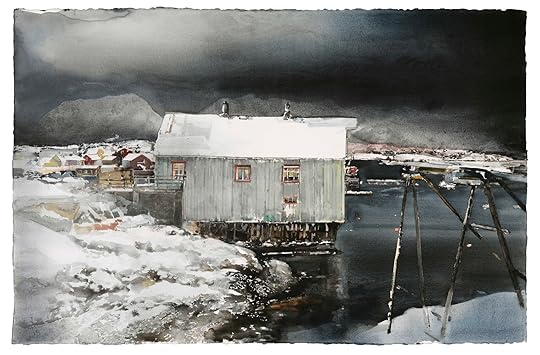
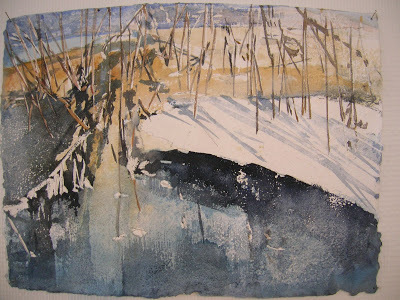
Within the current state of world - pandemic/war - affairs, I found this to be a particularly comforting book to escape to. While he includes the inevitability of death throughout, he also writes at a remove from the state of the world or any sort of anxious discourse of civilization. This book feels like it exists on its own plane - the “we can be civilized, and we can end up ok”. I need this. In this way, for some reason, these books remind me of a classical painting, and fittingly he includes gorgeous paintings by Lars Lerin interspersed within the pages.
I really admire - whether it always works or not - his complete open vulnerability and earnest nature. I find it to be incredibly liberating, this simplicity of: here is my life, here is my every thought about it, and here we are. It feels like we are best friends, and I like that. The downside, is at times it feels a bit preachy to me, but I find even that somewhat interesting to have such a look inside how someone else is approaching being alive. Really one of the best things about books and perhaps one of my personal favorite things.
There’s also something so pleasing about the pacing of his many sensitive observations of life’s simple wonders. He is able to perfectly capture an inner voice, the exact rhythm, and while I wonder how much is him and how much is his translator (Ingvild Berkey), the pace - especially in these short chapters - works for me.
Ultimately, although the essays are for us as readers, they are attributed as a gift to his new daughter, and he includes a “letter to the newborn” which is worth the book - it brought tears to my eyes in its beauty. I have two children and I wrote them both long letters before they were born, and I found it very moving to read this sensitive letter from a father’s perspective. I love how universal some feelings are that we all can share.
Here’s a few fave excerpts:
A new favorite sweet little quote about books:
“A little ink on a page wakens a tempest of emotions and causes everything else to vanish”
From “funeral procession”:
“I followed the boat with my eyes, half expecting it to continue at trolling speed, out of respect for the dead, but as soon as it had cleared the shoals, it sped up, giving rise to that curious effect which occurs when the drone of an engine increases and grows stronger, and at the same time, since it is moving away, also becomes fainter. As the boat was swallowed up by all the grey, I thought that that is exactly how death is.”
From “trains”:
“The train’s escape, on the other hand, is almost an embodiment of longing, as it winds slowly through the landscape, never stopping long enough in one place for any commitments to be undertaken, and from the windows of which the view is constantly changing, as in a dream. The train never goes from being ‘here’ to being ‘there’, and this it has in common with longing, which as soon it reaches ‘there’ transforms it into ‘here’, which by its nature it doesn’t accept and therefore begins to direct itself towards a new ‘there’. And so life goes on."
About “Georg” whom he describes as a great poet and brilliant social critic:
“And then, at that moment, I understood who he was, or the quality that was most essential to his nature. He had the most sensitive eyes I have seen. They were filled with sorrow, and they took everything in. … He himself talked the whole way without ever stopping amiably and about trivial matters, and I realized that it was his way of coping. He was so close to the world and he was so close to other people, so full of feelings, that in order to cope he had to establish a permanent, continual distance between himself and everything and everyone.”
“Winter boots” with a (bitter)sweet thought on childhood joy - ends like this:
“if I equate the child I was then with the man I am now and say that the child’s happiness is worth every bit as much as the man’s, then those weeks were probably the happiest of my life: it is the only time I have achieved everything I dreamed of.”
And, finally - I think this one is my favorite. Love this excerpt from “feeling of life”
“both because I have children and see how the world flows through them and because I myself have been a child and remember what it was like, but also because on a very few occasions I have experienced everything within me lifting and becoming light and easy, and each time it was caused by a powerful experience of the world. The experience of art can be powerful too, it can lift one up and seem light but without leaving what it is bound to - as when a branch is lifted by the wind, when all its leaves tremble and flicker and are filled with glinting reflections on sunlight. The lightness of experiencing the world is different, it isn't centered on anything in particular, what fills the soul is precisely the lightness of the indefinite. Not the branch lifting in the wind, but the wind. Not the leaves reflecting the sunlight, but the sunlight.”