537-Bloomberg by Bloomberg-Michael Bloomberg-Autobiography-1997
Barack
2024/09/22
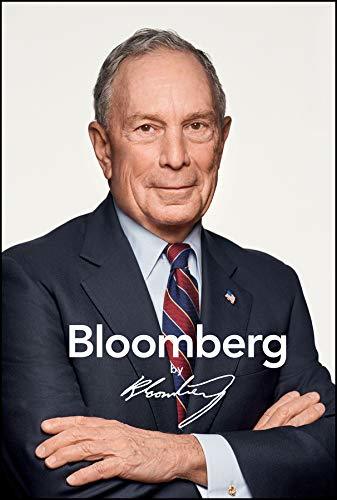
Bloomberg by Bloomberg, first published in 1997, tells the extraordinary story of Michael Bloomberg's creation of a media empire.
Michael Bloomberg was born in 1942 in Boston, Massachusetts, US. He studied at Johns Hopkins University (BS) and Harvard University (MBA). He is an American businessman and politician. He is the majority shareholder and co-founder of Bloomberg LP and served as the company's CEO from 1981 to 2001 and again from 2014 to 2023. He was re-elected as mayor of New York City for three terms from 2002 to 2013 and became a candidate for the Democratic nomination for the US presidency in 2020. In 2024, Bloomberg received the Presidential Medal of Freedom from President Joe Biden. Since June 2022, he has served as chairman of the Defense Innovation Board, an independent advisory committee that advises the US Department of Defense on artificial intelligence, software, data, and digital modernization. As of April 2024, Forbes ranked him as the 13th richest person in the world, with an estimated net worth of $106.2 billion.
Table of Contents
Chapter 1 The Last Supper: The Thrill of Getting Fired: Tarrytown 1981
Chapter 2 Capitalism, Here I Come: School, Work, and Hard Knocks
Chapter 3 I Love Mondays: Entrepreneurship: Vocation and Avocation
Chapter 4 We Can Do That: Elementary Journalism, Not Rocket Science
Chapter 5 “No” Is No Answer: Establishment Ignorance and Arrogance
Chapter 6 Money Talks: Textbook Multimedia
Chapter 7 Man vs. Machine: Technology: Politics and Promises
Chapter 8 Management 101: The Bloomberg Way
Chapter 9 Coming Up Next: America's a Wonderful Country
When Michael Bloomberg was fired at the age of 39, no matter how much compensation he received, the negative emotions brought by losing the job he had worked for 15 years must have far outweighed everything. Of course, we may say from the perspective of hindsight that it was because he was fired that he had the opportunity to create one of the most successful financial media companies. But even so, the fact that he was able to receive a compensation of $10 million at the time was enough to prove his strong ability and value. How many people today can get such high compensation when they are laid off? There is a saying in China that "blessings are accompanied by misfortunes, and misfortunes are accompanied by blessings." This saying itself is difficult to verify and evaluate using scientific methods because it cannot be falsified. The premise of scientific analysis of an assertion is that it can be falsified. If it cannot be falsified, we cannot conduct scientific analysis. Similar to the question of "whether God exists or not", at least in terms of the current level of human cognition and technology, this cannot be falsified. Recently, I began to pay attention to the autobiographies of these rich people on the Forbes list, or biographies written by others about them. The main motivation is to understand how they deal with various problems. Of course, I know very well that the environment they face is completely different from mine, and the cards they have in their hands are different from the cards I can play. Therefore, it is not necessarily important what they do specifically. What is important is how they think and what process they use to guide themselves to make the final decision. It is like writing a novel. My story is always different from other authors' stories. Even if there are similarities in the plot, every sentence, every paragraph, every chapter, and even every volume is unique. However, we still need to read other authors' works to learn their writing ideas and methods. If we only see the surface of things and cannot summarize the general guiding ideas from the phenomenon, we will always be blinded by appearances, and we will only solve a problem when we encounter it. In the end, we will only be exhausted and difficult to get real relief.
How many times in a person's life can he or she encounter the opportunity to become rich overnight? How many people have the opportunity to attend a meeting and suddenly turn paper funds into real cash? How many people can really enjoy this extreme luck? From another perspective, even if the opportunity comes, not every employee in Salomon Brothers can enjoy the same bonus, or in other words, can enjoy the same degree of bonus. The author has the opportunity to enjoy such an opportunity because of his or her high position. Just like when we are looking for a job, we have different choices. Before we choose a company, we often hesitate between choosing A or B. However, after a few years, we may see that a company has become famous because of a successful game, bringing huge benefits and returns to employees. We often regret missing similar opportunities. However, this situation will occur more or less in everyone's life. For a certain choice at the moment, we may give up another possibility, and many years later, this abandoned choice proves to be a huge opportunity. When we make decisions at the moment, we always feel that choosing A will bring more benefits than choosing B, but from the perspective of the whole life, things may not be so. So, how can we make decisions so that we won’t regret it? Or, how can we make choices that are optimal? If we can try repeatedly, we may find the best solution, but life is not like a program, and we can’t make choices over and over again. Perhaps, we can only go back to the starting point and pursue inner peace - make the choice we really want to make, so that we can face everything calmly.
When I read biographies of Michael Bloomberg and others, I found that they always provide rich details when recalling memories from their early years, especially in their teenage years. This makes me think that human memory is very interesting - we can often remember something that happened ten years ago, and these memories are often accompanied by strong emotions, but we may not remember what we did last week. This makes me think that the more important things in life are, the sooner we should do them. We need certain events as "memory points". This also makes me begin to doubt the saying "delayed gratification". We always say that we will do something later, but when we really get to "later", we may not be able to realize our original wishes psychologically and physically. If life is just a journey of constantly checking off the to-do list, then what is the meaning of life? Is it just to check off all the items? Of course, sometimes people use real-life problems to remind or warn themselves, such as: if you don't work hard, you can't get into a good university; without a degree from a good university, it's hard to find a good job; without a good job, you can't get enough money to support a decent life. These principles are not wrong. However, even if we eventually get a good university, a good job, a decent income, and a working environment, will we still return to the original starting point to question the true meaning of life?
Recently, I found in my reading that the author recalled an experience in his high school in the book, which had a very positive impact on him and even shaped his deep understanding of the learning process. The teacher in that school took a unique way of teaching knowledge, which made him and his classmates very interested in the content of the class, and everyone's performance became more active. He summed up an important learning process from his high school experience: Listen, Question, Test, Think. The first is Listen. In fact, not only children but also adults need to be interested in something when learning. Generally speaking, to be interested in a topic, you must first be interested in the person who explains the topic. When we are interested in someone, we will be willing to listen to what he says. This should be an experience that many people have had in life. For example, in school, the teacher we like often gets better grades in his class. When you change to a teacher you don’t like or are not interested in, your grades will often drop. Next is the Question. We often use some examples to illustrate the differences between undergraduates, masters, and doctoral students. For example, undergraduates learn to pick up "dead" rabbits; master's students learn to shoot a live rabbit running in the field of vision; doctoral students learn to shoot a live rabbit that cannot be seen. This is the importance of the ability to ask questions, especially asking good questions. It is difficult for us to ask high-quality questions at the beginning. Usually, we need to go through a process of increasing the number of questions and then improving the quality of questions. The third step is Test, that is, testing. For example, in the study of computer science, you often hear a sentence: "Talk is cheap, show me the code." This means that ideas are not important, what is important is how to put ideas into practice, even if it is to make a small prototype Demo. Finally, Think. In the process of research, we will experience many trials and errors. In this process, thinking is very critical. I still remember that the teacher once asked a question that triggered me to rethink the entire research design.
When Bloomberg was fired at the age of 39, he faced several choices: he could continue to look for a job, retire, or start his own business. As someone who had worked for others for many years, he decided to try to work for himself. Although he received a compensation of $10 million, which was enough for him to live a comfortable life, he was not satisfied with it, so he chose to start a business. He mentioned that the most exciting moment for him was Sunday night because he knew that after waking up, he had another five full days to do something he was interested in. This reminded me of my mentor. When he guided me in research, he clearly told me that he knew very well what he wanted, which was to constantly explore new knowledge that interested him. He emphasized that my research must be of my own interest, that is, when I wake up every morning, I should be excited about what I am about to do, rather than completing the task mechanically. It is not because I have to submit a report or hand it in the next day that I rush to spend two or three hours to complete a problem. Bloomberg's views are very consistent with my mentor's ideas on this point. Of course, my mentor cannot be compared with Bloomberg in terms of wealth or social status, but the joy they get from their work may be similar. I often feel that as we grow older, we become less and less aware of what we really want. When we were young, we knew clearly what we liked, but when we grew up, we often did "what we should do" out of rational considerations. Now, my outlook on life has changed. I think the most important things in life are nothing more than three things: first, to maintain physical and mental health; second, to find a career that you like and like yourself; and finally, to find someone you like and who likes you.
Bloomberg mentioned that investors can sometimes be the biggest enemy of entrepreneurs, which reminds me of an experience I had when I was a sophomore. At that time, due to the general environment, my entrepreneurial partner and I were lucky enough to get 1 million in venture capital. But looking back, although this money sounds like a good start, the investors greatly influenced the decisions that my entrepreneurial partner and I originally wanted to make. It turned out that the investors' advice was not suitable for us. It was not because they were unprofessional or that they were not more visionary than the two of us sophomores, but because they invested far less time and energy in this project than the two of us. In the end, we are the ones who know best what we want to do, rather than investors telling us what we should do. Bloomberg also mentioned a point that coincides with the "lean startup" concept advocated by current startups, that is, "do it first and then talk about it." The student team I participated in during my undergraduate studies also held a similar belief, that is, "learn by doing." We first try to do what we want to do and then continue to learn in practice, rather than trying to make a detailed plan at the beginning. Planning is important, but the author does not mean to deny the plan, but to emphasize the need for flexible adjustment according to actual conditions. One point mentioned by the author resonates with me deeply, that is, write down the plan. Everyone has a lot of ideas in their mind, but if these ideas only stay in their minds, they are often chaotic and disordered. Only when we write them down and present them in written form will they be clearer and more specific. Moreover, we need to share these ideas with others to see if they resonate with them. Only when others can understand and agree with our ideas can the plan be successful. Written plans often involve time, place, and the products and services we intend to provide, and whether these details are really willing to be used or even paid for by others is the key we need to verify. Bloomberg is more concerned about getting feedback from others to see if the products or services we provide meet their needs, rather than struggling with how to achieve it from the beginning. Just like writing a novel, as an author, I hope that my words can present a vivid picture in the reader's mind, and I can get feedback from readers on whether they like this picture. However, readers will not teach us how to use words and sentences. They only care about whether our content is worth their time to read and are even willing to pay for it. Therefore, instead of getting hung up on the details, it is better to take action first and then continuously adjust and improve based on the feedback.