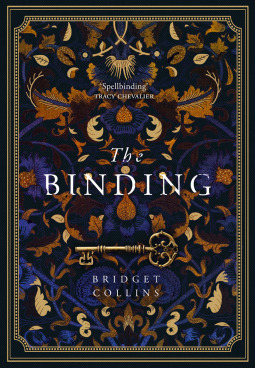
I was excited to begin this book with its interesting premise and the promise of a blend of fantasy and reality. And I was not disappointed at first. I was intrigued by the Victorian style world the author created, one in which books aren’t filled with fictional stories that are for purchase, but rather, ones that are filled with memories of people who chose to have them removed from their minds by book binders. Those memories would then be kept safe in beautiful books the binders fashioned for their clients, which meant they’d be locked away, never to be seen or read. This also kept the books safe from physical harm, since if a book were ever to be destroyed, the memories in it would return to the person. Bindings could only be done for those giving their permission. However, this rule did not take into account those being coerced into giving their permission. And it didn’t account for unscrupulous binders who might discreetly sell such books to collectors. And then, there were those people desperate enough to sell their memories, even the good ones, to those same unscrupulous binders. Such books were often indistinguishable from those labeled novels. Novels, unlike books, were clearly filled with fictitious contents and were permissible to be sold.


All these elements of binding were a rich field in which to grow an abundant story. But this is where my disappointment came in. The author never did explore many of these elements in any depth beyond how they connected to her main characters. She hardly explored that world at large or the act of binding itself and the morality involved. Instead, the book focused on the relationship between the two main male characters, to the exclusion of all else, in the second and third parts, comprising the bulk of this story.
By far, section one was my favorite when focusing on its Dickens-like character, Emmett Farmer, a young man suffering from some emotional strain and physical ailment that left him unable to work on his family’s farm and kept his parents and sister at an emotional distance from him. He doesn’t even know why any of this is so.
I couldn’t remember getting sick; if I tried, all I saw was a mess of nightmare-scorched fragments. Even my memories of my life before that—last spring, last winter—were tinged with the same gangrenous shadow, as if nothing was healthy anymore.
How he came to be in this state and why his family acted toward him as they did and why a wealthy young man named Lucian Darnay, visiting his uncle on a neighboring farm, disquiets him so much—all these elements were teeming with gothic mystery which added to the tension and suspense and made me feel for Emmett Farmer. Eventually, Emmett is sent away to train as a book binder, something he feels is a punishment. This is where the story really took off for me as Emmett trains with an old woman named Seredith who lives out in the marshes and whom people think of as a witch.
So what happened after this point that had me feeling disappointed in this book? In parts two and three, the relationship between Emmett and Lucian dominated the story. I felt this was detrimental to the story at large and to the premise it was built on. I enjoyed their relationship, but the details of it became repetitive and drawn out, and very little about bookbinding was explored outside of their lives. The morality and philosophy of bookbinding would have made for an interesting discussion among the characters who might question their world a little more and get the reader thinking along with them. Instead, I was a bystander in the story, able to sympathize with the characters, but not able to fully immerse myself in all that was happening after part one. I wanted to see more of that world and have the peripheral characters better developed such as Emmett’s sister who only had one thing on her mind. Villainous characters, likewise, were one dimensional. It was as if the author had used all her energy on Emmett and Lucian and had little left over for much else besides describing the environment around them. In this, the writing is highly descriptive and often poetic, which is both a compliment and a complaint. On the positive side, the author is an expressive and extremely observant person who details her story in beautiful and surprising ways.
Here the clock in the hall dredged up seconds like stones and dropped them again into the pool of the day, letting each ripple widen before the next one fell.
I settled myself again, and after a while I felt my body loosen, as if the silence was undoing knots I hadn’t known were there. The fire had nearly gone out; ash had grown over the embers like moss. I ought to tend to it, but I couldn’t bring myself to get up. I moved my fingers through the focused ellipse of lamplight, letting it sit above my knuckle like a ring. When I sat back, it shone on the patchwork quilt, picking out the curl of a printed fern.
But on the negative side, those same details sometimes got out of hand and overpowered the scenes in which more dialogue or action would have been welcome, rather than the moment by moment observations she stuffed into the characters’ heads and onto the page. It teetered on the edge of ridiculousness at one point when one character spat a huge wad of phlegm and another character watched it land on the ground in the shape of a leaf. Uh...no. This is not an observation that anyone would probably have in this instance or one a reader would care to have thrown their way.
So this book has many good things to recommend it—a fascinating premise, sympathetic main characters, plus one very good supporting character, many instances of beautiful and atmospheric writing, a gothic style setting, and plenty of mystery. But the relationship between the two main characters took center stage after part one, which I feel took something away from the general story and left no room for the author to explore the act of binding or its effect on that society, especially with a change in viewpoint. The ending was also a bit too tidy for me and didn’t answer some lingering questions.
I do think this would make a nice first book in a series if, in later books, the art of bookbinding was actually the focus and practiced in numerous circumstances beyond the few times portrayed in this book. I’d read another book by the author if she decided to go that route and to broaden her scope to include some examination of the conflicts inherent to binding. As it stands, I’m glad I read this book, but I can’t help feeling it could have been better.