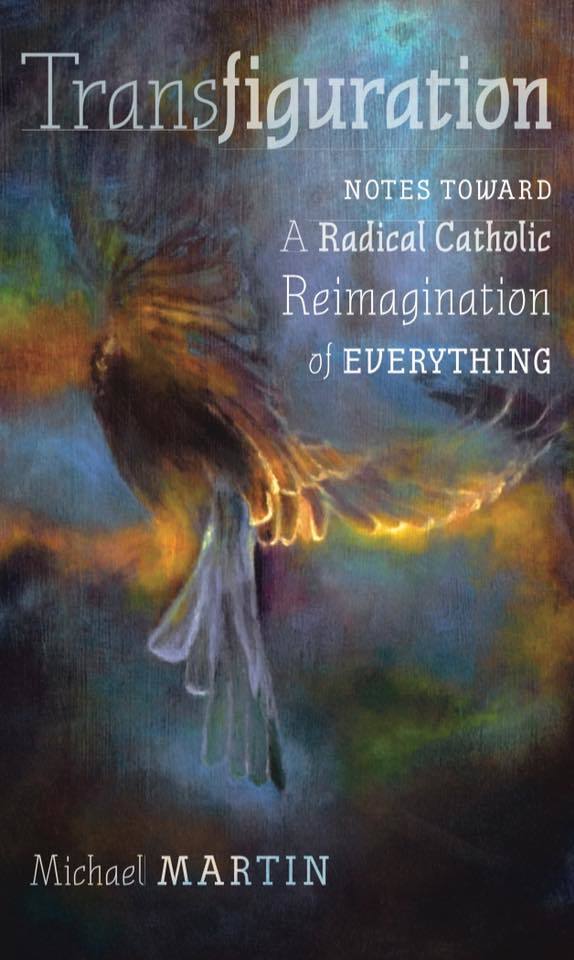
In a wide-ranging yet cohesive set of essays—on science, art, education, economics, Sophiology, and both the poisons of our age and their antidote—Michael Martin argues on behalf of an integral Christian culture. His is not a nostalgic yearning for a legendary “Christendom”; rather, his is a project of renewal, an anticipation of the Parousia. At a time when Christianity seems all but in retreat, Martin’s Transfiguration open doors into possible futures.
Michael Martin, Ph.D. is a philosopher, theologian, poet, musician, songwriter, editor, and biodynamic farmer. He is the editor of the journal 'Jesus the Imagination' and director of The Center for Sophiological Studies.
Over the last four centuries, the rise of rationalism and materialism has undermined Christian faith.
Such is a truism, a bromide, a weary mantra educated Christians have repeated endlessly for generations.
And with what result?
Arguably, Christianity has only grown ever more materialistic, even whilst it nominally clings to the tenets of faith, even whilst it recycles the cliche – tired AND true – of faith undermined.
Michael Martin sees the desperate need for something different. And his obvious years of urgent, passionate enquiry have yielded a glorious book – truly, filled with glory – here. And much of that glory resides in the fact there is absolutely nothing cliched about it.
Indeed, it is the very antithesis of cliches: a vibrant (re-)imaginative call to inspired thinking and action, across numerous fields, including science, education, economics, the arts, technology and more.
For Martin sees with startling freshness how much materialism – philosophic, scientific, technocratic, commercial – is not simply undermining Christian tenets. It is murdering our souls.
Just like it is murdering culture, creativity, art, the soil, the bees …
I said: “Michael Martin sees”. A better word could be FEELS. This book records a living heart suffering the murder all around him.
At times, this heart suffers, too, the kind of Catholicism that may produce sincere participation at Mass, yet all-too-easily yields to the same murderous utilitarianism the rest of the week.
Thus, there is sometimes impatience with contemporary Catholic culture here, both modern and traditional. I understand that, even if I do think that, at times, Martin is a little too impatient with good people who mean well.
Yet even if I am right, the reason, I suspect, is that his eye is set on higher horizons of human possibility than the vast majority of us and that his heart intuits remedies rarely found in the Catholic mainstream. Put differently: this author is ORIGINAL.
What his originality entails is not easily distilled in a short review like this. But his remedies involve a contemplative way of life that profoundly honours the liturgy, whilst remaining seriously concerned with how we LIVE our lives beyond the Mass.
Yet the contemplation envisaged here is not simply solitary prayer and meditation, crucial though that is. Martin also asks how we can contemplatively engage all aspects of the cosmos.
Can we prayerfully, reverently contemplate the phenomena we encounter – “be it a flower, an owl, a geode, the rising sun, or a piece of writing” – Martin asks.
If not, he suggests, we had better start. Else the continuing descent into materialistic hell is all but guaranteed. Because materialistic hell is constructed on the abstract, reductionist programme of the Enlightenment that, as Martin has it, buffers us from Reality.
In a way, the book provides a tour of this hell of Enlightenment buffering, as it feeds into modern politics, economics, technology and more.
And, as a tour of hell it is disquieting – to say the least! – yet also sobering, salutary, awakening, because based on such keen observation. Martin obviously practices what he preaches: he prays not simply at Mass, he contemplates the cosmos.
Thus, the author grieves not only the obvious horrors that concern many traditionalists such as myself – puberty blockers, pornography, transgenderism, but other horrors, too, hardly discussed enough on the Catholic “Right”. (And too often abandoned to the Catholic “Left.”) For example: the immense poison of Big Agriculture or even the demonic agencies working through cyberspace and Artificial Intelligence. (And indeed, he does mean preternatural demons, quite, quite literally.)
What Martin is not saying, though, is that all this demands hobbit-like retreat from the world or abstinence from technology. Quite the opposite.
Rather, it involves balancing soulless utilitarianism with soulful contemplation. It means, too, going to the ROOT of these things. For all this horror, poisoning the soil, poisoning children through puberty blockers, poisoning through pornography, are only symptoms of Enlightenment buffering from the Real.
That is, to say: the LIFE Christ brings us, in the Eucharist above all, but also in all that is truly wholesome in nature (or Sophianic).
Sophianic: it may help to say that Martin, a Byzantine Catholic, draws on unusual insights beyond the mainstream of (Western) Catholicism, including the Russian Sophiologists, the Phenomenologists, Goethe, Boehme, Rudolf Steiner and Valentin Tomberg. This is not to say he endorses such figures wholesale, but rather welcomes profound insight, wherever it is found.
I do not endorse these figures wholesale either. I recognise this list poses, sometimes at least, real problems for Orthodoxy.
And Orthodoxy is crucial.
But Christianity has always been about inculturation. From antiquity, it has continuously co-existed with non-Christian orientations and has sought to honour, even adopt, what is best in them.
Valentin Tomberg, I might add, believed Hermeticism needed to be baptised, rather than crushed. Martin sees this too, as do I. And his Transfiguration is in many respects an extension of the critical project Tomberg initiated.
Some may think Martin occasionally goes too far. This, plus the aforementioned impatience I experience in the book, may alienate certain readers.
This would be a great pity.
Because, dear Reader, we live in a time of great darkness, including darkness in the Church.
I said of an earlier book by Martin – reviewed here – that it shone light in the darkness.
This book, for me, shines even greater light. And I have not even mentioned how poetically beautiful his writing his . . .
I do not always agree with Martin, but I am more moved than I can possibly say.
It's good to see someone else reject the stultifying circles of thought that weigh heavily on Catholic intellectual circles. Give me integralism or death! Give me Chesterton, Tolkien, and tweeds or death! The Latin Mass or death! Also, hey, yeah, we're eager to be countercultural but also desperate to wave LeMaitre and Mendel around as signs that Catholics are as with "modern" science as anyone else.
Martin cuts past the worship of the past and the bizarrely unChristian dreams of eternal power in the present by calling us to refocus on this world, this creation, these current demands upon us by God to pay attention. He invokes Rudolf Steiner, Simone Weil, Ivan Illich, Bulgakov, and Goethe. He notes the importance of Waldorf education, while not failing to address how Waldorf, like Montessori, has been yuppie-fied by people who have no interest in Steiner's work, no understanding of his principles, and seek only to gate off the unwashed masses.
He also takes time to emphasize the role enclosure has played in our affairs for over 500 years, something hair-pullingly neglected in most discussions of political philosophy. He has no illusions about distributism; as beautiful as it is, it will not be achieved without some sort of collapse or transfiguration of our minds beyond our predictive abilities. Better to try to live distributism where we are, how we can; to create the much-discussed "parallel polis."
I'm particularly impressed by how he emphasizes the importance of the Real. Increasingly I suspect that "what is real" will emerge as the most pressing question of the 21st century. Thanks a lot, Ockham (I'm kidding).
My only reservation regarding the work has less to do with any disagreement with the author than on the dangers of something he invokes; something so fragile and liable to abuse. "Sophia" can become a form of gnosticism, and gnosticism is to choose knowledge/power over love, humility, and attention. It is especially prone to become a form of self-worship. This is because Sophia is not our end, and when taken as an end warps our understanding of God. Martin may know this, but all of history shows people are incredibly eager to play with fire. Sophia may be ignored, but perhaps its suppression wasn't always out of malice; instead, it was an over-reaction to a very real (and currently very present) danger.
That's my only reservation. It's a great book, and one hopes it will prompt a re-engagement and re-envisioning of what it means to be human, and what is real, in circles willing to face those questions.
Transfiguration is a bold and reflective call to reimagine culture, faith, and modern life through a deeply Catholic lens. Michael Martin weaves theology, philosophy, and cultural critique into a cohesive vision of renewal rather than nostalgia. The essays challenge complacency and invite readers to see the world as charged with meaning, wisdom, and hope. A provocative and enriching read for those seeking a faith rooted response to modern dislocation.
My name is Tina T. Davis, and I specialize in promoting books to audiences who will truly appreciate their message. I work with a dedicated team that has consistently delivered top quality marketing campaigns for authors, helping their work reach the right readers and gain the recognition it deserves.
Transfiguration is the kind of book that can resonate strongly with readers interested in theology, philosophy, cultural criticism, and the renewal of Christian thought in contemporary society. Can I send over a detailed proposal outlining how I can promote your book and maximize its reach?
Best Regards, Tina T. Davis Book Marketing Specialist tina.t.davisbook@gmail.com
A call that is at once valiant but also a conservative one that beckons us back to a contemplative way of seeing akin to phenomenology that employs agapeic attention to nurture religious inwardness. More specific suggestions, such as Steiner’s way, are offered for cosmic awareness, education, stance towards technology, etc. as a concrete entry way for those of the Catholic faith, although possibly at the slight risk of brushing against formulaic imperatives* it wishes to avoid because, as the author notes, “if we pursue the sophianic through the will, it eludes us.” Such is the challenging nature of the terrain the book attempts to navigate out of deep love and concern for the future of the Catholic/universal Church.
* e.g., cosmologically sensitive liturgical cycle: “otherwise, we are cut off ... and have no life in us”
This is an exceptional book by a profound thinker, poet, and biodynamic farmer. His vision is one of wholeness, of the union (or, better, communion) of the spiritual and the natural. Highly recommended.