

What do you think?
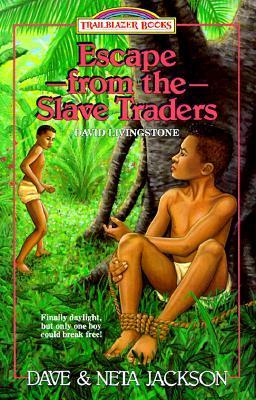
Trailblazer Books (Chronological) #17
Escape from the Slave Traders: David Livingstone
Two young African boys are captured by slave traders, then rescued by David Livingstone. Ages 8-12.
135 pages, Paperback
First published August 1, 1992
About the author
Dave Jackson
244 books76 followersDave and Neta Jackson are a full-time husband/wife writing team who have authored and co-authored many books on marriage and family, the church, relationships, and other subjects. Their books for children include the TRAILBLAZER series and Hero Tales, volumes I,II, III, and IV. The Jacksons make their home in Evanston, Illinois.
Ratings & Reviews
Friends & Following
Create a free account to discover what your friends think of this book!
Community Reviews
Displaying 1 - 24 of 24 reviews

April 25, 2017
I have fond memories of my mom reading these books to us over lunch. And we’d beg her to keep going when lunch was over too, because we just had to know what happened! Well told, engaging, adventuresome and you learn about a famous Christian in history.
Ages: 7+
**Like my reviews? Then you should follow me! Because I have hundreds more just like this one. With each review, I provide a Cleanliness Report, mentioning any objectionable content I come across so that parents and/or conscientious readers (like me) can determine beforehand whether they want to read a book or not. Content surprises are super annoying, especially when you’re 100+ pages in, so here’s my attempt to help you avoid that!
So Follow or Friend me here on GoodReads! You’ll see my updates as I’m reading and know which books I’m liking and what I’m not finishing and why. You’ll also be able to utilize my library for looking up titles to see whether the book you’re thinking about reading next has any objectionable content or not. From swear words, to romance, to bad attitudes (in children’s books), I cover it all!
Ages: 7+
**Like my reviews? Then you should follow me! Because I have hundreds more just like this one. With each review, I provide a Cleanliness Report, mentioning any objectionable content I come across so that parents and/or conscientious readers (like me) can determine beforehand whether they want to read a book or not. Content surprises are super annoying, especially when you’re 100+ pages in, so here’s my attempt to help you avoid that!
So Follow or Friend me here on GoodReads! You’ll see my updates as I’m reading and know which books I’m liking and what I’m not finishing and why. You’ll also be able to utilize my library for looking up titles to see whether the book you’re thinking about reading next has any objectionable content or not. From swear words, to romance, to bad attitudes (in children’s books), I cover it all!

December 30, 2012
Not even a little bit as good as the other books in this historical fiction book series.

August 8, 2025
A story for middle grade readers, set in Malawi in 1860. The story is told from the perspective of a boy called Chuma focuses on his interactions with David Livingstone.
The story moved quickly at first and was engaging as Chuma and his friend were captured and tried to make their escape. It got boring after they joined up with Dr Livingstone. Chuma doesn't have much of a character arc. We see no faults or desires or anything that makes him and his friend different in personality from each other. His eventual conversion isn't linked to any character growth. He is mostly an observer in the second part of the book.
But in general the book is a good introduction to this time in history, to the person of Dr Livingstone and to the complex issue of the slave trade and it's relation to foreign activity in 1800s Africa.
How are these complexities portrayed? It is shown that the warring peoples were enemies before. But we also see how the Arab traders enflamed the conflict for the purpose of slave trade. Livingstone seems to think ending the foreign slave trade will stop the conflict between Chuma's people and the neighboring peoples. But also he acknowledges that only God's work in hearts can lead to true peace. Arab slavers and Portuguese traders are clearly portrayed as evil. But British influence, represented by Livingstone, is seen as benign. Yet the authors portray David Livingstone at times sorrowful and discouraged because of the results of his work. He said to the boys at one point that he wanted to open up the way for the gospel but he feared that he was also opening up the way for people who would come in and exploit the indigenous Africans. A good discussion point would be, how much did that prove to be the case? So while the story may gloss over some of these difficult issues, it does give enough of a glimpse to serve as a foundation for further discussion and research.
Content is appropriate for the age range. Warning for sensitive readers: slaves are treated poorly, Chuma gets injured by a whip, warfare between African peoples leads to people killed and villages burned, Chuma's family dies (but we never met them in the story, so the emotional impact is minimal)
There is a helpful historical note at the back. Chuma is based on a real life Chuma who travelled with Dr Livingstone.
Some possible inaccuracies: How did the boys understand Livingstone when he was praying, which would have been in his own native English? How had they never heard of the concept of reading and writing but instantly knew how to use a map? Why does Chuma think of the Africans who helped with Livingstone's travel simply as "the porters"? Wouldn't he have identified them by tribe or at least got to know some by name, rather than seeing them as a faceless mass like the foreigners did?
I'm being critical here but honestly if you're looking for missionary stories set in Africa, written for kids, this is an excellent choice. A generally informative and sensitive portrayal, told through the eyes of an African young person, and with some exciting adventures mixed in.
The story moved quickly at first and was engaging as Chuma and his friend were captured and tried to make their escape. It got boring after they joined up with Dr Livingstone. Chuma doesn't have much of a character arc. We see no faults or desires or anything that makes him and his friend different in personality from each other. His eventual conversion isn't linked to any character growth. He is mostly an observer in the second part of the book.
But in general the book is a good introduction to this time in history, to the person of Dr Livingstone and to the complex issue of the slave trade and it's relation to foreign activity in 1800s Africa.
How are these complexities portrayed? It is shown that the warring peoples were enemies before. But we also see how the Arab traders enflamed the conflict for the purpose of slave trade. Livingstone seems to think ending the foreign slave trade will stop the conflict between Chuma's people and the neighboring peoples. But also he acknowledges that only God's work in hearts can lead to true peace. Arab slavers and Portuguese traders are clearly portrayed as evil. But British influence, represented by Livingstone, is seen as benign. Yet the authors portray David Livingstone at times sorrowful and discouraged because of the results of his work. He said to the boys at one point that he wanted to open up the way for the gospel but he feared that he was also opening up the way for people who would come in and exploit the indigenous Africans. A good discussion point would be, how much did that prove to be the case? So while the story may gloss over some of these difficult issues, it does give enough of a glimpse to serve as a foundation for further discussion and research.
Content is appropriate for the age range. Warning for sensitive readers: slaves are treated poorly, Chuma gets injured by a whip, warfare between African peoples leads to people killed and villages burned, Chuma's family dies (but we never met them in the story, so the emotional impact is minimal)
There is a helpful historical note at the back. Chuma is based on a real life Chuma who travelled with Dr Livingstone.
Some possible inaccuracies: How did the boys understand Livingstone when he was praying, which would have been in his own native English? How had they never heard of the concept of reading and writing but instantly knew how to use a map? Why does Chuma think of the Africans who helped with Livingstone's travel simply as "the porters"? Wouldn't he have identified them by tribe or at least got to know some by name, rather than seeing them as a faceless mass like the foreigners did?
I'm being critical here but honestly if you're looking for missionary stories set in Africa, written for kids, this is an excellent choice. A generally informative and sensitive portrayal, told through the eyes of an African young person, and with some exciting adventures mixed in.
February 22, 2019
I found this book very interesting to me because I’m in too African American history and novels about them. This book is based upon two boys who are slaves owned by slave owners, they consistently try to change and escape but not just for them but for others. They want to escape somewhere but in order to know, you’ll have to find out yourself.

December 30, 2021
In the 1860's, two African boys are taken captive and mistakenly left in the care of David Livingstone, whom they accompany on his quest to find a way to stop the slave trade and open the interior of Africa to missionaries. Fast-paced. I read this book out-loud to my grade-school-aged children and it kept them interested and wondering more about Livingstone. A true story.

May 9, 2026
This story was a Really great connection point for my kids as we learned about David Livingstone and the people/events of his time period. Led to a comparison to other missionaries who had a heart for making inroads into other unreached lands. I edited certain parts for intensity for the tender/sensitive listeners among us, but everything mentioned was appropriate to the story.

May 3, 2025
An historical fiction/missionary novel of David Livingstone as he helps two young boys escape from slave traders.
⚠️Parental Warnings ⚠️
Some violent drawings for sensitive readers:
A dead body in water, an arrow through an arm, a skull on a stick.
⚠️Parental Warnings ⚠️
Some violent drawings for sensitive readers:
A dead body in water, an arrow through an arm, a skull on a stick.

July 6, 2017
An interesting look at the life of one of the beloved heroes of the Christian faith.

August 2, 2017
This book was good .

May 20, 2020
Lots of great information and detail. A book for young readers.

April 4, 2022
3 stars for me, 5 for the kiddos, so a good solid 4. I like the history part of it. The children liked the action and suspense.
March 7, 2025
Interesting story about David Livingstone. Easy read about how God works for a fourth or fifth grader.

September 18, 2025
formational childhood read

October 15, 2025
Not the best book in their series. There would be better ways to learn about David Livingstone.

December 20, 2016
"Wikatani looked as if he was fighting for his life! One man held him securely from behind while another man tried to bind the boy’s feet with cords. Frightened, Chuma barely held back a scream. What should he do? Should he rush to the attackers and try to free his friend or hold back until he figured out what was happening? Just then Wikatani must have bitten the hand of the man who held him because the man yelped, and Wikatani began yelling again: “Chuma! Chuma! Run for help!” Quickly the man clamped his hand back over Wikatani’s mouth and looked at Chuma."
Two young boys, Wikatani and Chuma, have been captured by slave traders. Where are they being taken? Will they survive? They do not have the answers to those questions. Their only hope is David Livingstone, a missionary and a man against slavery. But will he take the time and effort to save two frightened boys?
Genre: adventure. Age: for those 12 and under. Issues dealt with: slavery, missionaries.
"Escape from the Slave Traders" is part of the Trailblazer series. This book doesn’t really have God at the center of everything, but it does show how a life can change through contact with Christians. It introduces the historical figure David Livingstone making history interesting.
"“The King will reply, ‘Truly I tell you, whatever you did for one of the least of these brothers and sisters of mine, you did for me.’" Matthew 25:40 (NIV)
Two young boys, Wikatani and Chuma, have been captured by slave traders. Where are they being taken? Will they survive? They do not have the answers to those questions. Their only hope is David Livingstone, a missionary and a man against slavery. But will he take the time and effort to save two frightened boys?
Genre: adventure. Age: for those 12 and under. Issues dealt with: slavery, missionaries.
"Escape from the Slave Traders" is part of the Trailblazer series. This book doesn’t really have God at the center of everything, but it does show how a life can change through contact with Christians. It introduces the historical figure David Livingstone making history interesting.
"“The King will reply, ‘Truly I tell you, whatever you did for one of the least of these brothers and sisters of mine, you did for me.’" Matthew 25:40 (NIV)

March 10, 2014
The Overview
This is historical fiction book for children on the life of David Livingstone. It combines fictional characters with historical facts to create a realistic story line of what happened in a way that children can easily understand and learn about.
The Readability
At 129 pages long this is a very short read for the average reader. The target audience is probably a fourth or fifth grade reading level, but could go either way depending on the child's interest and ability. It also makes a good read-a-loud story for family reading.
The Highlights
The fact that this book brings history to life for children and adults alike makes this a great book. I also really like it due to the fact that it is not just about history and a good story, but also about all of that within the context of God's Word.
The Downside
The only downside I can think of for this book is that due to the nature of Livingstone's life there are some parts that may not be appropriate for younger children. There are some parts that describe the war going on that would not be appropriate for all ages. Other than that, I have no issues with this book.
The Recommendation
I highly recommend yet another book from the pen of Dave & Neta Jackson. They are an amazing team who help children learn about men and women who have lived out faith in Christ.
This is historical fiction book for children on the life of David Livingstone. It combines fictional characters with historical facts to create a realistic story line of what happened in a way that children can easily understand and learn about.
The Readability
At 129 pages long this is a very short read for the average reader. The target audience is probably a fourth or fifth grade reading level, but could go either way depending on the child's interest and ability. It also makes a good read-a-loud story for family reading.
The Highlights
The fact that this book brings history to life for children and adults alike makes this a great book. I also really like it due to the fact that it is not just about history and a good story, but also about all of that within the context of God's Word.
The Downside
The only downside I can think of for this book is that due to the nature of Livingstone's life there are some parts that may not be appropriate for younger children. There are some parts that describe the war going on that would not be appropriate for all ages. Other than that, I have no issues with this book.
The Recommendation
I highly recommend yet another book from the pen of Dave & Neta Jackson. They are an amazing team who help children learn about men and women who have lived out faith in Christ.
September 2, 2015
I enjoyed this book because it was a good story about the work of David Livingstone. It's about these two African boys named Wikatani and Chuma, who are captured by a group of slave traders known as Red Caps. As the story goes on, all they want is to go back home and be with their families. There seems to be no way to escape until they meet David Livingstone and he offers to help them. He also tells them and anyone else that wants to that they can either join his missionary camp or he will help them (if he can) to get back home.
This was just a great story for anyone to read, I found that the authors worked together to make yet another fantastic book in the Trailblazer series.
This was just a great story for anyone to read, I found that the authors worked together to make yet another fantastic book in the Trailblazer series.
August 5, 2007
Not too bad, but I'd say it's at a 4th grade reading level. I could see kids getting into it more than adults. The story was a great introduction for me to the life, times, and passions of David Livingston. It's a worthwhile read simply for that info.

August 7, 2007
This was the first of the Jackson's "Trailblazer Books" that I read as a kid. It was one of those early books that helped me really start reading more.
January 1, 2008
inspirational
Read
February 12, 2009JAR5-Jac
July 9, 2011
Very addicting!
July 29, 2015
See the first book in the series (Spy for the Night Riders) for a full review.

October 14, 2015
This is an amazing book. It is about two boys named Chuma and Whikitini. I highly reccomend it for all ages.
Displaying 1 - 24 of 24 reviews