In this mesmerizing examination of Delacroix’s crowning masterwork, Jacob Wrestling with the Angel , and of Saint-Sulpice, the grand church that houses it, Jean-Paul Kauffmann reveals the city of Paris in an entirely new way.
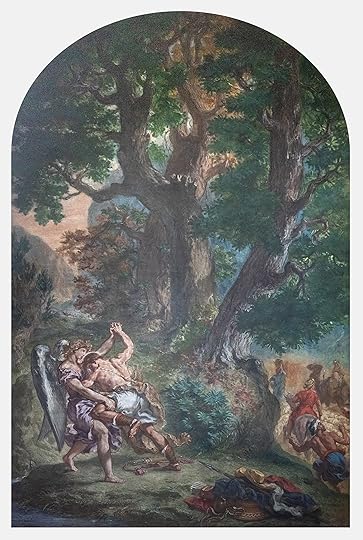
With the same insight and understanding he brought to his National Book Critics Circle Award–nominated The Black Room at Longwood , in The Angel of the Left Bank Jean-Paul Kauffmann confronts humanity’s struggle with God. His muse is Jacob Wrestling with the Angel , Eugène Delacroix’s “spiritual testimony” and certainly one of his masterpieces, a painting that portrays one of the most enigmatic episodes in Genesis.
Throughout his careful, impassioned examination of the work, which Delacroix labored over for eight years and finished in 1861, Kauffmann touches on architecture and art history, philosophy and religion, and the luminous city of Paris itself. Like a detective, he looks for lingering clues in the places Delacroix frequented and the objects he touched some 150 years ago, seeking to connect with the artist’s philosophical and artistic process—and, in turn, to discover what truths we might ultimately glean from it. His journey makes for enthralling reading.
This is non-fiction in the Sarah Vowell mode: highly idiosyncratic, well researched and full of interesting factoids you half want to log but don't, and so ultimately frustrating although full of nice touches. Presumably I would have enjoyed it more if I was a fan of Delacroix, but I have to admit I'm not, and fail to see what's so special about "La Lutte avec l'Ange". On the other hand, I fully share Kauffmann's love of Saint-Sulpice itself, and was frankly envious of the unlimited access he got to all its nooks and crannies to write this book. But I thought he returned far too often to the discredited rumor that Delacroix was the illegitimate son of Talleyrand, and the claim on the flap jacket that this reads like a thriller is misleading. What you get is an appealing account of one man's obsession with a Parisian landmark which, since its construction, has had as many admirers as it has had detractors, as well as with the most famous painting it contains.
What an odd book! The author pursues an understanding of Delacroix and his painting through innumerable twists and turns, down blind alleys and up against a wall. The reader feels pulled into all these tunnels without much enlightenment. Along the way: interesting factoids about Delacroix and his parents and contemporaries, and about the innumerable rooms, nooks and crannies of the St. Sulpice cathedral. I found myself wanting to do my own research, to learn the things and find the illumination the book wasn't giving me. Intriguing, finally, and a bit frustrating. How, I wonder, does the author's traumatic experience of imprisonment in Lebanon play into the oddly dark and inconclusive, almost paralytic drama he enacts here?
This book is ostensibly about the last paintings done by Delacroix for the church of Saint-Sulpice in Paris but it is also a meditation on faith, Jean-Paul Kauffmann's and Delacroix 's in particular and faith in general. When I read one of the descriptions of the English language edition of the book (which has been published under a number of titles) it sounded like Kauffmann's exploration of the painting and Delacroix final years would be a mystery quest similar to exploring Théodore Géricault's 'Raft of the Medusa'. Well it is not, in part because Delacroix's mural of the obscure biblical subject of 'Jacob Wrestling with the Angel' is not, and never was seen as, a ground breaking or definitive work by Delacroix. Without being unkind if you were challenged to save it and its companion pieces in the chapel of Saint Sulpice or Delacroix's 'Liberty Leading the people', 'The Death of Sardanapalus' or any of his wild animal paintings such as 'The Lion Hunt' I am sure most people would happily loose the Saint Sulpice pictures.
This is a very French book, which is not criticism, just stating that the French can look at certain cultural/philosophical areas much better than English language authors. What Kauffmann discusses is fascinating because Delacroix is fascinating, Paris in the mid-19th century is cultural so fascinating - England produced the pre-Raphaelites and Dickens but Paris Baudelaire, Flaubert, Delacroix, Corbet, and so much more - and the church of Saint Sulpice is fascinating (everything Dan Brown said in the 'Da Vinci Code' is wrong) and Kauffmann's exploration of its many mysteries is fascinating (and in the near twenty years since the book was published the work to restore and save Saint Sulpice and other Parisian churches has advanced immeasurably). There is a great deal in this book but it doesn't necessarily amount to any great revelation.
But that doesn't mean it is not worth reading - it is fascinating, just not in the way the synopsis might lead to expect.
This was one of the most touching books about art I have ever read. So different from some of the reactions described in the book Tears and Pictures by James Elkins https://www.goodreads.com/review/show... there is no crying here, no overwhelming reaction as this is more of a story of walking in a labyrinth --the labyrinth of the painting and the labyrinth of Saint-Sulpice. I understand why some reviewers complained that there were so many threads brought up and explored that never led anywhere. I think part of that was because this is a book written for a French audience. The English translation could have included a translator's introduction to provide background context about the church, the artist and the mural-- and maybe even something about the author's tragedy in Lebanon, where he was inprisoned for three years. I felt much like one reviewer below that I was constantly looking things up to try to understand and the ending might not satisfy people since no conclusions per se are drawn. That said, this book is a jewel. Beautifully written, it is a very subtle meditation about how art can save and about the nature of evil. I am planning to re-read after visiting St Sulpice next month.
From my mom's book collection. Read this right after Ross King's Mad Enchantment, about the Water Lilly Paintings, Monet's final magnum opus. Eugène Delacroix's gigantic Jacob Wrestling with the Angel, painted on a wall in the Chapel of the Holy Angels at Saint-Sulpice in Paris has many parallels. The Da Vinci Code notwithstanding, Saint-Sulpice is a uniquely idiosyncratic church with a fascinating story in a part of Paris well known by three generations of my family. Kauffman dives deep into the church and places where the painter lived or stayed with an intensity that must have been at times offputting to their custodians. On the other hand, much of the intensity seems rooted in the three years he was kept hostage in 1980's Beirut. It was fascinating to read about the technical and motivational struggles eventually overcome by Delacroix overlaid with the author's own journey.
I grabbed this book at the Delacroix Museum bookstore thinking it would be nice to try non-fiction for a change and hoping that I would get a better understanding of Saint-Sulpice’s most famous paining, the Wrestle of Jacob with the Angel.
I am not exactly sure I would call this ‘mesmerizing’. We are very far away from the detective story taunted on the back of the book: more a very long and winding exploration of Delacroix’s painting with multiple detours. For example, the author retells his talking in front of an audience in the church during a commemoration of Delacroix’s birthdate. Elsewhere, he recounts his being interviewed by a documentarian researching Delacroix. We follow him as he meets with one of Saint-Sulpice’s resident artists, stares up at a funambulist walking the space between Saint-Sulpice towers… All this to say that the author cast a wide, indulgent net, and does not exactly justifies for such expansive scope.
For sure, the prose (I read this in the original French) is pristine with a precise, poetic vocabulary, and some analogies are interesting. The author also successfully sticks the landing, and this certainly redeems the book at large, but reading this, I felt that the author could have comfortably trimmed off 100 pages without hurting the book. I am not sure I am clamoring for more of that kind of loose explorations: I’d rather have spent this time on a tight, thrilling exposé, be it fiction or not, than this slack musing.
I learnt of the existence of this book in the Chapter “The Angel’s Fight” in Mario Vargas Llosa Un bárbaro en París: Textos sobre la cultura francesa. Given that I had always thought this church looked bizarre, that I had however never entered it, and that I was going to Paris in the coming days, I decided both to read the book and to visit the Church.
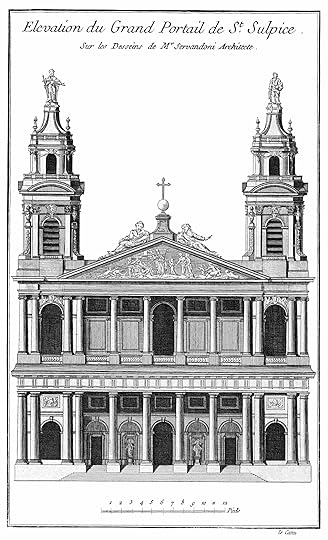
The bizarreness of this church can be accounted by the fact that its façade was designed by Giovanni Niccolò Servandoni (1695-1766), a designer of stages for the opera. But now its main claim to notoriety is that one of its chapels (the first one on your right when you enter it) was frescoed by Eugène Delacroix. There are two walls, "The Fight of the Angel" and "Heliodorus expelled from the Temple", and the ceiling with St Michael.
Kauffmann’s book is difficult to categorize. Is it a biography (of the Church? of Delacroix?), or is it a Memoir? Maybe it is better to consider it as a string of cultural musings.
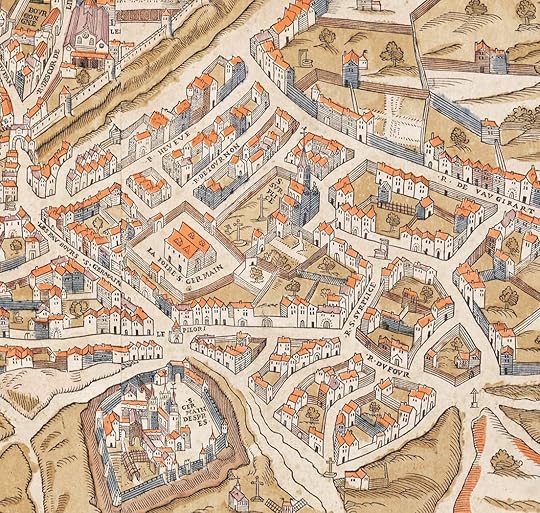
The church has a long and complex history. Its first existence dates from the mid 12th Century, but the main part of the current building dates from the 17th century, when queen Anne of Austria laid its first stone, but as indicated above, its striking façade dates from the following century. With the two towers that Victor Hugo compared to a couple of clarinets, the more than its 100 columns and its overall theatrical character, we cannot be surprised that during the Revolution it was dedicated to the goddess of Reason. To its ceremonious spirit the large main square in front of it, is clearly a main contributor.
The spacious church is also famous for the reverberating effect that its organ achieves, (in which César Franck played). Delacroix wanted to paint his frescoes only when there was music in the air of the church. Despite the appeal of the music, it took a while for Delacroix to finish his work. And how this developed Kauffmann narrates with care, as he also takes up the disputed paternity of the painter resolving for Eugène being a real Delacroix and not a natural Talleyrand.
Across time this church has attracted the attention of various figures. Both Sade and Baudelaire were baptised there. Poulenc was buried there, and François Mauriac described the ceremony. Victor Hugo married on its altar. Balzac’s La Messe de l'athée takes place in St Sulpice and we readers can wonder about the origin of the name of his recurrent hero Eugène in the La Comédie Humaine - Tome 1/12, since the Bishop who consecrated this church in 1745 was called Rastignac.
At the end of this read one feels Kauffmann must have had enjoyed greatly writing this delightful account.
And as often happens with books, I walk away from it with two more for my list. Balzac’s homage to St Sulpice and Kauffmann’s Venise à double tour.
French journalist Jean-Paul Kauffmann explores the Saint-Sulpice church, mysteries of Eugene Delcroix’s painting of Jacob Wrestling with the Angel, the biblical story and his own troubled heart in this love story to a Paris landmark.
I received this alongside my prise at the end of a school year with a dedication from the teacher in charge of my class. So it meant a lot to me, even if the story was not to my tastes. I did enjoyed some facts about French art.