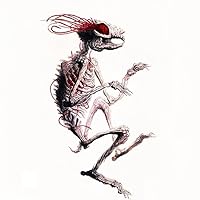
Todd Schorr grew up in the 1950s in a world populated by Revell models, Mad Magazine, Mr. Peanut, and Mickey Mouse. These images fueled his artistic imagination, spawning vibrant, outlandish visions of Santa Claus and the Easter Bunny in a murderous pas de deux, hapless kiddies forced through flaming hoops, a genocidal egg hunt, and all other manner of mayhem. This illustrated tour of Schorr's best work is like a Saturday morning cartoon created by Hieronymous Bosch.
Todd Schorr is an American artist and member of the "Lowbrow", or pop surrealism, art movement. Combining a cartoon influenced visual vocabulary with a highly polished technical ability, based on the exacting painting methods of the Old Masters, Schorr weaves intricate narratives that are often biting yet humorous in their commentary on the human condition.
Eisnein's No.33 Favorite Artist/Artbook. Check Out No.34 Right HERE. Go Back to No.1 HERE.
'Real men paint with oils' -- or so says the revered underground commix pioneer-turned-gallery artist and prime mover of Pop Surrealism -- Robert Williams. All due respect to 'Mr. Bitchin', but he needs to shut the fuck up. Setting aside the macho idiocy and implied chauvinism of this statement, Williams' assertion is that real artists embrace the difficult qualities and aesthetic rewards of oils, rejecting the quicker, easier, but more limited medium of acrylics. I tend to prefer artists who work with oils, watercolors and inks, due in part to the long and prestigious history stretching back to the Renaissance, to the genius of Campin, Jan Van Eyck & Rogier Van Der Weyden; Durer, Bosch & Bruegel; Giovanni Bellini, Titian & Caravaggio.
But in the case of Todd Schorr, acrylic paint is really the perfect choice. It's a newer medium for painters that first gained popularity in the mid-20th century amongst illustrators working on strict deadlines. Oil takes much longer to dry, which has many benefits... unless you're doing a painting that has to be sompleted in 2 days. Since Todd Schorr's work is concerned entirely with the magnificent kitsch of 20th Century America -- classic horror and science fiction films from Grade A - Grade F, made-in-Taiwan mechanical toys, pre-code E.C.comic-books like 'Tales From the Crypt' and 'Weird Science', and the cartoons that are so much a part of childhood in the US -- Acrylics are the only choice. For his brand of epic pop-cultural surrealism - unpretentious, divorced from the historical tradition of oil painting -- the medium truly is the message. That said, Schorr famously manages levels of detail and realism with Acrylics that very few artists could match with oils.
Todd Schorr is one the most influential and respected practitioners of Pop Surrealism (or 'HiLo', or 'Lowbrow', a name I hate). Only Williams and Mark Ryden have acheived similar levels of critical, popular & financial success. As one of many young painters who work primarily with acrylics, Schorr has provided a powerful argument for the possibilities of acrylics. 'Dreamland', one of the most stunningly gorgeous monograph's to be published by Last Gasp, a company with a long history of beautifully designed artbooks, includes many of his largest and most intricate canvases, a series of works in which each is dedicated to a specific pop cultural theme: Horror, Science Fiction, Cartoons, Comics... again, the complexity of his compositions and the level of detail he achieves is unmatched in contemporary art, demonstrating the intrinsic value and possibilities afforded by acrylic paint.
At 11" x 11", 140 pages, this is a generous format that utilizes space as efficiently as possible. After a brief and interesting introduction, it's all about the art; on one page, the finished painting, on the facing page, Schorr provides sketches and preliminary paintings, sometimes with accompanying stories based on each work. The cover is a wraparound detail of one of his large homages, in this case the 'Cartoon Gods'. The front and back covers have no text at all; instead, the titles are stamped onto the translucent plastic slipcase, an extravagant touch that makes this monograph one of the best designs I've seen at this price-range. The fact that it features some of the most essential art produced in the last 20 years makes it a must-buy for artbook aficionados.
Eisnein's No.33 Favorite Artist/Artbook. Check Out No.34 Right HERE. Go Back to No.1 HERE.
In Dreamland by Todd Schorr, the picture-book monograph performs a small, wicked miracle: it translates the tactile spectacle of Schorr’s paintings into a narrative argument about American visual fantasy — one in which commercial icons, childhood cartoons, and Old-Master technique collide and breed. The book is both a career statement and a provocation: sumptuous, obscene, and obsessively detailed. Form and Intent The artist’s central gambit is formal hybridity. Each painting reads at first like a cartoon tableau — bright, legible, packed with characters — and then unravels into baroque density the longer you look. The book’s reproductions emphasize that doubleness: large-format plates let you savour his tight modelling and glazing (the Old-Master finish), while the compositions remain resolutely comic-strip in narrative energy. The publisher’s pithy blurb captures this paradox neatly: “This illustrated tour of hiss best work is like a Saturday morning cartoon created by Hieronymous Bosch.” Themes: Consumer Mythology and Carnivalesque Violence Reading Dreamland as a sustained allegory of late-20th-century American culture is persuasive. The artist mines childhood media (Disney, comic books, TV ads) and turns their saccharine veneer inside out: Santa and the Easter Bunny perform grotesqueries, mascots become monstrous, and playgrounds look like battlefields. The book’s texts and captions — essays by hands associated with the lowbrow/pop-surreal scene — frame these images as both homage and critique: Schorr revels in his sources even as he exposes their absurd, sometimes violent underside. That dual stance (affectionate mimicry + satirical exposure) is the book’s most interesting ethical posture. Technique as Argument A literary scholar would call Schorr’s method rhetorical: technique is deployed as argument. His painstaking brushwork lends the absurd a weight that mocks facile dismissal of lowbrow art as “merely” cartoonish. Look at paintings like Spectre of Cartoon Appeal or recurring figures such as “Bunny Duck” (appearing across multiple canvases): the iconography is instantly legible, but the virtuosity of paint insists you take the scene seriously. In short, he forces a reassessment of hierarchy: the visual language of mass culture is shown to be as capacious and as morally ambiguous as any canonical myth. (See the book’s many plates for the best evidence.) Context and Reception Dreamland also operates as a document of the Lowbrow movement finding its public voice. The essays and editorial apparatus in the book position Schorr among a generation that reclaim cartoon and commercial imagery within the fine-art frame. That reclamation hasn’t been uncontroversial: episodes such as the public outcry over “Clash of Holidays” (a painting that drew accusations of blasphemy when shown) illustrate how his work courts — and often provokes — moral panic, a fact the book doesn’t shy away from and which helps explain its cultural stakes. Samples from the book (what they show) The publisher’s blurb — “like a Saturday morning cartoon created by Hieronymous Bosch” — functions as a useful shorthand for the book’s tonal mix: naiveté plus apocalyptic detail. The short biographical précis that accompanies the plates repeatedly stresses Schorr’s childhood media diet (Mad Magazine, Saturday cartoons, model kits) as formative; that lineage explains the book’s visual DNA and his deliberate retrieval of mid-century Americana. (The biographical material appears in the front matter and captions.) Critical Limits If Dreamland has a weakness it is curatorial: the book sometimes assumes you will read all its visual jokes and references, and readers without a working knowledge of 1950s–70s pop ephemera may miss layers of meaning. The essays, while knowledgeable, are short and sometimes celebratory where one might want a more sustained critical interrogation — for instance, of gendered caricature or of the political valences of consumer satire. A slightly longer, more theoretically nimble catalogue essay would have made the monograph not only a feast for the eyes but a stronger intervention in contemporary art history debates. Who should read it As an object, Dreamland is indispensable to anyone interested in pop-surrealism/lowbrow art, in the afterlives of commercial imagery, or in how painterly virtuosity can be marshalled for satire. Collectors and curious scholars will both find it rewarding: the reproductions are excellent and the contextual pieces, though light, place the art usefully within a movement that insists on the seriousness of the comic. For readers seeking deeper critical theory, pair Dreamland with broader surveys of lowbrow/pop-surrealism or with critical essays that foreground race, gender, and consumer capitalism as analytical frames.