

What do you think?

The Knowledge Manager's Handbook: A Step-by-Step Guide to Embedding Effective Knowledge Management in your Organization
The way an organization manages and disseminates its knowledge is key to informed business decision-making, effectiveness and competitive edge.
The Knowledge Manager's Handbook
takes you step by step through the processes needed to define and embed an effective knowledge management framework within an organization.
This second edition now includes clear guidance on the best practice requirements from the first ever internationally recognised standard for knowledge management, ISO 30401, as well as content on the impact of AI and data analytics. Nick Milton and Patrick Lambe work through each stage of creating and implementing a knowledge management framework for an organization's specific needs, based around the four essential aspects of knowledge management: people, processes, technologies and governance. With updated international case studies from organizations of all sizes and sectors, along with user-friendly templates and checklists to help implement effective knowledge management procedures, The Knowledge Manager's Handbook is the end-to-end guide to making a sustainable change in the knowledge management culture.
This second edition now includes clear guidance on the best practice requirements from the first ever internationally recognised standard for knowledge management, ISO 30401, as well as content on the impact of AI and data analytics. Nick Milton and Patrick Lambe work through each stage of creating and implementing a knowledge management framework for an organization's specific needs, based around the four essential aspects of knowledge management: people, processes, technologies and governance. With updated international case studies from organizations of all sizes and sectors, along with user-friendly templates and checklists to help implement effective knowledge management procedures, The Knowledge Manager's Handbook is the end-to-end guide to making a sustainable change in the knowledge management culture.
448 pages, Paperback
Published October 29, 2019
Ratings & Reviews
Friends & Following
Create a free account to discover what your friends think of this book!
Community Reviews
Displaying 1 - 16 of 16 reviews

April 30, 2016
It sounds easy doesn’t it? A company has some information and it is a case of just managing, storing and disseminating it to relevant employees and other partners as required. It shouldn’t be a problem should it? Who needs knowledge management and knowledge managers? It is as easy as 1-2-3, or…?
Ah, if only this was the case then a book like this would not be a possibly essential read for your company. Far too many companies are terrible at communicating internally, no matter how many smiling face pictures they put on their Intranet or what fine internal magazines and latterly social media-type presence they have. Many companies also treat information as a state secret and lock it up in silos, away from those who really would benefit from getting access to it.
This is a fairly specialist book that is priced outside of the budget of the casual reader. Understandable but a shame, as a lot of the knowledge in the book could be of benefit to a wider audience. The authors explain that there is a certain art to knowledge management, it is not a universal one-size-fit-all approach that can be resolved by purchasing a piece of software and letting it do the work. A framework needs to be designed for a company that looks at its operations, its priorities and its needs and then it assists in examining and changing, if necessary, internal processes as well as getting possibly recalcitrant co-workers on-side. Wrap this up with some case studies taken from many organisations around the world and you have a potentially powerful little guide in your hands. Reading it is easy, implementing it can be the harder part!
The authors equate knowledge management to a supply chain and that is a fairly good way to illustrate it. Even the most insular manager will surely understand the basic concepts of a supply chain and how things can go wrong in simplistic terms as the chain is traversed. It is no different with a company’s internal knowledge, since the information (“product”) may have to be sourced, assembled and supplied from “suppliers” within the company and, of course, if the chain is weak, inefficient or breaks repeatedly how can the “product” be of a high-quality, relevant, valuable or usable?
Being picky this book was a bit heavy-going in places. Publishers Kogan Page usually manage the difficult balancing act between an accessible book and an informative book. Yet this moan is not a deal-breaker. You just need to close your office door, silence the telephone and email alert, and focus, focus and focus a bit more. You will, in any case, need lots of focus time to help see the bigger picture and plan a methodology to implement efficient knowledge management within your organisation. Advice is even given to getting senior management on side and how to ensure compliance and governance.
All in all, it is an interesting, thought-provoking and incisive book in a good little package that may be a frequently consulted companion and reference source for many company executives.
Ah, if only this was the case then a book like this would not be a possibly essential read for your company. Far too many companies are terrible at communicating internally, no matter how many smiling face pictures they put on their Intranet or what fine internal magazines and latterly social media-type presence they have. Many companies also treat information as a state secret and lock it up in silos, away from those who really would benefit from getting access to it.
This is a fairly specialist book that is priced outside of the budget of the casual reader. Understandable but a shame, as a lot of the knowledge in the book could be of benefit to a wider audience. The authors explain that there is a certain art to knowledge management, it is not a universal one-size-fit-all approach that can be resolved by purchasing a piece of software and letting it do the work. A framework needs to be designed for a company that looks at its operations, its priorities and its needs and then it assists in examining and changing, if necessary, internal processes as well as getting possibly recalcitrant co-workers on-side. Wrap this up with some case studies taken from many organisations around the world and you have a potentially powerful little guide in your hands. Reading it is easy, implementing it can be the harder part!
The authors equate knowledge management to a supply chain and that is a fairly good way to illustrate it. Even the most insular manager will surely understand the basic concepts of a supply chain and how things can go wrong in simplistic terms as the chain is traversed. It is no different with a company’s internal knowledge, since the information (“product”) may have to be sourced, assembled and supplied from “suppliers” within the company and, of course, if the chain is weak, inefficient or breaks repeatedly how can the “product” be of a high-quality, relevant, valuable or usable?
Being picky this book was a bit heavy-going in places. Publishers Kogan Page usually manage the difficult balancing act between an accessible book and an informative book. Yet this moan is not a deal-breaker. You just need to close your office door, silence the telephone and email alert, and focus, focus and focus a bit more. You will, in any case, need lots of focus time to help see the bigger picture and plan a methodology to implement efficient knowledge management within your organisation. Advice is even given to getting senior management on side and how to ensure compliance and governance.
All in all, it is an interesting, thought-provoking and incisive book in a good little package that may be a frequently consulted companion and reference source for many company executives.

August 12, 2017
How did I end up with this book?
The first time I have encountered the topic was when I had to create a Knowledge Base in my subject matter expert's role. The technology was already in place and there was no need to work on getting manager's commitment for making this happen, we just wanted to start doing the knowledge-sharing right.
So I had to deal with methods to capture knowledge and manage those assets, built some taxonomy and metadata structure along the way, opportunistically used any means to get people to contribute and advocate the concept. I've been relying on my own experiences and ambiguous blueprints like "Lessons from KM pioneers" or "Agile Knowledge Management". As the techniques and approaches that we have developed emerged in other parts of organization, we kept laughing about Nonaka's SECI model of knowledge dimensions:
"Spill some blood on the right quadrant of this rune, leave it over night and get ready to find out about diamond knowledge base article getting submitted in the morning."
Later on I have found myself in the position to layout a detailed plan for moving this behemoth further as the demand on Knowledge Management and field expertise grew. Having my mind polluted with confronting definitions from various research papers, search for a strong specialist book seemed the only way I could carry out this task while in isolation from other KM practitioners. So I have picked up this one.
Framework: what is in your scope while implementing Knowledge Management
A good part of the book covers how you must consider KM transactions in terms of roles, governance, process and technology. According to authors that's pretty much everything you need to precise for figuring out how knowledge-sharing works and where your points for improvement lie.
Starting with powerful analogy between the table and four enabling elements of KM, this is where you begin to find out what's missing in the thing you called "KM" before stumbling upon a complete body of knowledge.
Authors push on sustainability of KM elements as a key requirement to any implementation program. I've been assuming that given simple and efficient ways to share and access knowledge people will be quick to feel the value that they get in return to own contributions. In my past work I have been focusing on methods to capture and ensure accessibility of explicit knowledge, overlooking the governance for accountability and expectations . That's how I had to observe alarming decrease of knowledge-sharing behaviors when I got more and more withdrawn from my "parent" community - no table can stand on just two legs.
The book is rich with other analogies, jokes and anecdotes that you can pick up for your further endeavors while advocating the concept through.
Regardless of where you start with KM initiative, be it a project related with collaboration tool roll-out, or a mission to "know everything" in some part of organization - your only path to success is taking that framework and making at least minimal effort to address it's all elements. To do this thoughtfully, you want to understand critical knowledge areas that really need your focus - that's what the strategy part stands for.
Strategy: where to go
The most painful learning was about the balance of effort between addressing needs to capture things we already know and mining for tacit knowledge locked in people's minds:
That's when you crave to get your strategy right and look for knowledge areas that really drive your organization's business. Those must bear the potential to prove value of KM methods, thus a concept of strong link to business drivers follows you through the entire book. A separate and twice shorter expansion on the topic, Designing a Successful KM Strategy: A Guide for the Knowledge Management Professional, begins with Sun Tzu's quote:
"Strategy without tactics is the slowest route to victory.
Tactics without strategy is the noise before defeat.”
You can probably succeeded improving methods to handle knowledge in your framework, but it is more like a fancy set of tools when applied in the emergent manner. Guidance on strategy proposes thoughtful but yet lean approach to implementation that must help your organisation painlessly go "all in" about Knowledge Management through distinct phases and milestone-based growth of stakeholder commitment.
Conclusion
This work totally fits it's purpose and deserves the title it's given - indeed a handbook for frequent reference and a must-read for every practitioner in the field.
The first time I have encountered the topic was when I had to create a Knowledge Base in my subject matter expert's role. The technology was already in place and there was no need to work on getting manager's commitment for making this happen, we just wanted to start doing the knowledge-sharing right.
So I had to deal with methods to capture knowledge and manage those assets, built some taxonomy and metadata structure along the way, opportunistically used any means to get people to contribute and advocate the concept. I've been relying on my own experiences and ambiguous blueprints like "Lessons from KM pioneers" or "Agile Knowledge Management". As the techniques and approaches that we have developed emerged in other parts of organization, we kept laughing about Nonaka's SECI model of knowledge dimensions:
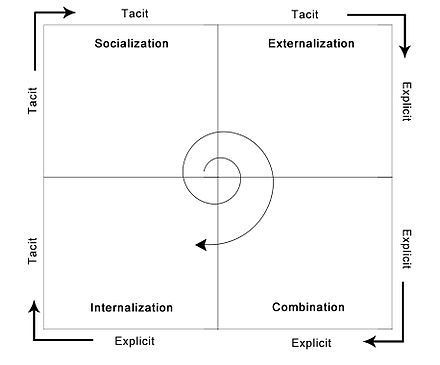
"Spill some blood on the right quadrant of this rune, leave it over night and get ready to find out about diamond knowledge base article getting submitted in the morning."
Later on I have found myself in the position to layout a detailed plan for moving this behemoth further as the demand on Knowledge Management and field expertise grew. Having my mind polluted with confronting definitions from various research papers, search for a strong specialist book seemed the only way I could carry out this task while in isolation from other KM practitioners. So I have picked up this one.
Framework: what is in your scope while implementing Knowledge Management
A good part of the book covers how you must consider KM transactions in terms of roles, governance, process and technology. According to authors that's pretty much everything you need to precise for figuring out how knowledge-sharing works and where your points for improvement lie.
Starting with powerful analogy between the table and four enabling elements of KM, this is where you begin to find out what's missing in the thing you called "KM" before stumbling upon a complete body of knowledge.
Authors push on sustainability of KM elements as a key requirement to any implementation program. I've been assuming that given simple and efficient ways to share and access knowledge people will be quick to feel the value that they get in return to own contributions. In my past work I have been focusing on methods to capture and ensure accessibility of explicit knowledge, overlooking the governance for accountability and expectations . That's how I had to observe alarming decrease of knowledge-sharing behaviors when I got more and more withdrawn from my "parent" community - no table can stand on just two legs.
The book is rich with other analogies, jokes and anecdotes that you can pick up for your further endeavors while advocating the concept through.
Regardless of where you start with KM initiative, be it a project related with collaboration tool roll-out, or a mission to "know everything" in some part of organization - your only path to success is taking that framework and making at least minimal effort to address it's all elements. To do this thoughtfully, you want to understand critical knowledge areas that really need your focus - that's what the strategy part stands for.
Strategy: where to go
The most painful learning was about the balance of effort between addressing needs to capture things we already know and mining for tacit knowledge locked in people's minds:
‘Out of 100 per cent of the captured explicit knowledge, often only 5 per cent will make it into real-world application.’ This was a great inspiration for me. If you only do explicit knowledge management, this means that 95 per cent of your work is wasted.
That's when you crave to get your strategy right and look for knowledge areas that really drive your organization's business. Those must bear the potential to prove value of KM methods, thus a concept of strong link to business drivers follows you through the entire book. A separate and twice shorter expansion on the topic, Designing a Successful KM Strategy: A Guide for the Knowledge Management Professional, begins with Sun Tzu's quote:
"Strategy without tactics is the slowest route to victory.
Tactics without strategy is the noise before defeat.”
You can probably succeeded improving methods to handle knowledge in your framework, but it is more like a fancy set of tools when applied in the emergent manner. Guidance on strategy proposes thoughtful but yet lean approach to implementation that must help your organisation painlessly go "all in" about Knowledge Management through distinct phases and milestone-based growth of stakeholder commitment.
Conclusion
This work totally fits it's purpose and deserves the title it's given - indeed a handbook for frequent reference and a must-read for every practitioner in the field.

December 23, 2022
أمضيتُ أياماً وأنا أبحث في كتب "إدارة المعرفة" (وهي مجال عملي) قبل شراء هذا الكتاب، وكان الأكثر إقناعاً لي مما رأيتُ من فهرسه ومراجعاته لأن مجال "إدارة المعرفة" جديدٌ وعام، ولذا فإن كثيراً من الكتب فيه يغلب عليها التعميم في الموضوعات أو المبالغة في الأكاديمية بحيث أنها ليست مفيدةً في سياق العمل اليومي. والحقيقة أنه ليس لدي ما أُقَارِنُ هذا الكتاب به لأنه كان مدخلي الأول لإدارة المعرفة بجوانبها كافة، ولذلك فهو مصدر كل "معرفتي" بهذا المجال (وقد أعطاني كثيراً منها)، لكني وجدته -للأسف- أقل دقّة مما تخيَّلت، ورُغْم ترتيب فصوله بتسلسلٍ ممتاز إلا أنه لم يمنحني نظرةً واضحة عن إدارة المعرفة كما تمنَّيْت، فما زلتُ أرى هذا المجال هلامياً وواسعاً وما من تعريف دقيقٍ لكيفية التخطيط له والعمل فيه، وربما يرجع هذا إلى طبيعة المجال نفسه. أحببتُ الدراسات العملية التي في الفصول الأخيرة، ولو أن أسلوب سرد كثيرٍ من هذه الدراسات لم تكن فيه -فعلياً- أي أمثلة عملية أكثر من سائر الكتاب، وإنما ما أفادني فيها هو أنها كانت دليلاً لي للاطلاع على أنظمة إدارة المعرفة في بعض الشركات المعروفة بريادتها في هذا المجال، وأهمّها -بسبب كثرة ما تنشره علناً- هي "وكالة ناسا" للفضاء.

October 28, 2019
This book is about defining and planning for knowledge management, which is just a buzz word for intellectual assets. The problem is most companies plan and either don't execute the plan, or they develop a content management system and never communicate it to the staff.
January 13, 2024
Brief and to the point guide often offering multiple options how to proceed, with useful references to additional information in other books. Will definitely go back to it if I have an opportunity to work in KM again.

August 26, 2024
A really fascinating insight into the benefits of knowledge management and the process to get your company to value and appreciate it. Really great use cases as well. A must read on this fascinating topic.

December 5, 2024
Too long. Not boring though. Liked the inclusion of case studies.
July 20, 2025
As it says on the front cover, this is a Step by Step guided to embedding Effective Knowledge Management in your organisation.
January 1, 2026
Comprehensive but more appropriate for larger organisations.

October 29, 2019
Fantastic and very comprehensive handbook on knowledge management. I think it suits all types of organizations and is a very good helping hand for companies who make many M&As. Knowledge management is an invisible but very important part of any business because it helps business to run smoothly with a well established interconnection between the department's and offices in multiple locations.

October 19, 2019
An interesting and well written book, full of interesting ideas that I will surely use in my everyday work practice.
Highly recommended!
Many thanks to the publisher and Netgalley for this ARC, all opinions are mine.
Highly recommended!
Many thanks to the publisher and Netgalley for this ARC, all opinions are mine.
July 6, 2016
For someone who read it just to familiarize oneself with a discipline, this book was full of insights. Lots of practical steps and interesting examples and case studies.

September 20, 2017
good book, I recommend to my friend to read this book.
April 3, 2022
Lear helpful reference book on how to build a knowledge management programme in an organisation. Highly recommend!

November 8, 2022
No other book has so directly impacted my approach to designing KM systems in organizations than this one. The layered discussion of transactions and roles is worth the price of admission itself.
April 16, 2023
While not my "Bible" exactly, this is the knowledge management book that most directly impacts my approach to social knowledge exchange in my organization. I highly, highly recommend.
Displaying 1 - 16 of 16 reviews