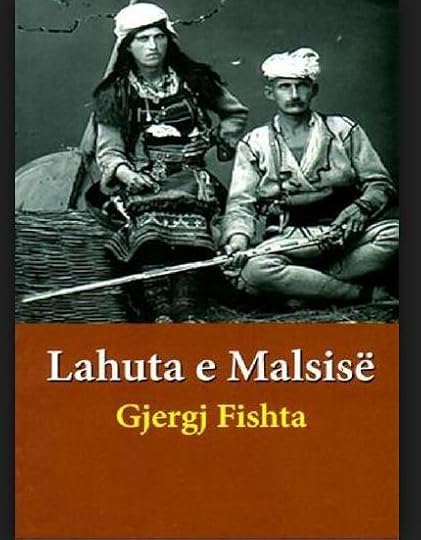
Born in Fishtë, Dajç, Lezhë, Albania (then Ottoman Empire), Fishta studied philosophy and Catholic theology in Bosnia. In 1902, he became the head of the Franciscan gymnasium in Shkodër. Fishta was under influence of Franciscan monks as a student in monasteries in Austria-Hungary, when he wrote his main work Lahuta e Malcis, influenced by the national epics of the Croatian and Montenegrin literature.
Fishta participated and was elected for president of the committee in the Congress of Monastir (today Bitola in Macedonia, then Ottoman Empire) held in 1908. Participants of the congress accepted Fishta's proposal for the Latin Bashkimi alphabet to be the standard Albanian alphabet, rejecting proposals that the Arabic alphabet be used.
He interpreted Albania in the conference of Paris on 1919. From the beginning of April 1919 to 1920, he served as Secretary of the Albanian delegation to the Paris Peace Conference. At the end of 1920, he was elected to parliament by Shkodër, and in 1921 he became the Vice President of the Albanian parliament.
After the establishment of the Zogu Regime, Fishta left willingly to go into exile in Italy in 1925/26, before he resumed his position as teacher and writer in Shkodër, where he died in 1940.
Through both his work as a teacher as well as through his literary works, Fishta had a great influence on the development of the written form of his native Gheg Albanian. Fishta worked moreover as a translator (of Molière, Manzoni, Homer, et al.).
Fishta was editor of the magazine 'Hylli i Dritës' (1913) and the newspaper 'Posta e Shypnisë' (1916–1917).
His noted works include the epic poem Lahuta e Malcís, the melodrama Shqiptari i qytetnuem, the tragedy Juda Makabe, and the satire Anzat e Parnasit.
"The Highland Lute" is considered to be a masterpiece in Albanian Literature, and not only. I have read/studied this for my Advanced Literature Class.
Fishta has created some characters that can be divided in two groups: mythological and real. Still, the difference between these two groups is not that big, in fact it is not big at all.
This is not a light read. You must have time and the right focus to truely enjoy and understand it correctly.
Fishta's epic poem was the first Albanian book to be announced as a candidate for the Noble Prize (literature) in 1940. Fishta is regarded as "Albanian Homer".
30 VJET PUNE TE BILBILIT TE GJUHES HYJNORE NE DISA PIKA *Nuk e kisha te veshtire ta kuptoja Fishten. Se ai flet me gjuhen e shqipetarit dhe do e ndjesh ate cka ai do te trasmetoje, do gjendesh ne fushe beteje me Leket dhe do ndjesh virgellimen e shpatave. Do te bashkoje shpirtin tend me ate te shqiptarve te tjere, te cdo kohe. Eshte dialekti, menyra e te folunit e shqiptarit. Ajo c’ka na ben shqiptar, c’ka mund te na shkaterroje dhe tna ndertoje. E ka bere dhe sterbere. *Qendresa deri ne skajet e njerzores qe Fishta kaq shume e levderon dhe e mendon krenarine kryesore, mund te shihet nga te tjeret fare thjesht si barbarizem, mungese qyteterimi, jetese ne male e ne te eger. Por ajo cka ky kenveshtrim humbet eshte ideali. Po. Ne nuk luftuam per gje tjeter vetem per Atdheun tone dhe Fene. Ta kishim tonen pa e ndare me askend. Zoti na e dha kete fat te kishin shpirtin aq te larte saqe te kuptonim shume mire per cka duhet te luftonim dhe na dha forcen per te perballuar perandorine dhe fiset endacake e barbare. Per cfare ja vlen tjeter te humbasesh jete njeriu? E Fishta kete ta ben ta kuptosh. Perseri jemi nje popull i vogel, nje grumbull njerezish qe cuam peshe dhe cojme sot peshe (2015) krajlat e medhenj.Ne Lahuten e Malcis Fishta eshte e vertet qe hyjnizon malesoret, shqiptaret si ne karakter dhe ne force por ti e kupton ndermejet rreshtave dhe ne pasazhe te tjera se Fishta revoltohet kunder Lekeve dhe kunder shkujdesjes se tyre ndaj ceshtjes kombtare. E te keqijat tona jane te pafund, sepse keshtu Zoti i ndertoi kombet. *Edhe Fishta si Konica shpreh se shqiptari te keqen me te madhe e ka nga vetja. Si ai trimi qe kishte per mik bese Mehmet Pashen dhe nuk e dorezoi ate te Leket dhe pse behej fjale per tradheti ndaj A tdheut. Eshte e cuditshme sesi ne mendojme se nuk kemi, shprehim se kemi, mund te mos kemi, por na imponojne te kemi nevoje per te tjeret. *Tringa do mbetet gjate ne kujtesen time. Personazh tipik i nje gruaje shqiptare. Fataliste. Por qe mjafton ta fusesh ne kornizat e realiteti dhe do gjesh nje shqiptare edhe te diteve te sotme. Fataliste. Dihet tashme se si gruaja merr trajtat e hyjnise ne letersine popullore bashke me perfaqesueset e tyre si Oret e Zanat por Fishta e coi ne nje tjeter nivel.
Shkaju s’do t’shkalse, jo, atij bregut Der sa t’rrejdhe vala e Drinit.
....shkemb i tokes dhe shkemb i shpirtit shqiptarc
Read it a few years back, it's an amazing mix of albanian mythical figures and tales and modern Albanian history up until it's indipendence in 1912. Would highly recommend it to anyone interested in Albanian history, culture and mythology, you would understand a lot of it from this book.
A very good and well-written book, by the albanian priest and writer Gjergj Fishta. It talks about a sequence of historical events on a scale of about 50 years.
This entire review has been hidden because of spoilers.
Had to give it 5 stars because it references where my family is from and specific members of the “tribe.”
Otherwise, it’s a pretty straightforward National epic, outlining how the country became independent. Though, it would have been nice to have some mythology of the origin of the people like the Aeneid had.
A lot of historical war mixed with local folklore akin to the Homeric epics.
I had a lot of interest in this book because of the familial connection, but also because the original author was hailed as the National Poet of Albania, then subsequently blacklisted by the communist government. It took a long time for me to find an English translation of this book.
If you want to read this book, you can find a fully scanned English translation here:
homeri ynë shqiptar. fishta n’ket’ libër ka përshkru aq bukur e me aq zell nji pjesë tejet t’randsishme t’historisë tonë shqiptare. me epitetet, krahasimet dhe metaforat e tij, ka arri që me zan’ mes shqiptarisë nji fillë të patriotzmit e dashnisë për atdheun, pa dallim feje e prejardhje. lexim jo i lehtë, kërkon vëmendje edhe analizë kritike, se asgja nuk e ka shkru për me u marrë veç siperfaqsisht. libër i mrekullushëm!
Nje kryeveper e tille e meriton te quhet ''Iliada shqiptare'' e Fishta "Homeri shqiptar''. Nese deshiron te njohesh themelet e te qenurit shqiptar ,hyr ne boten fishtiane ,degjo me vemendje e zemer vargjet e Fishtes ,te shkruara me vertetesi e ndjenje . Ne letersine shqiptare nuk mund te kete nje Fishte te dyte ,vetem ai ta thote te verteten ne sy,te fshikullon (sigurisht,pa harruar Migjenin) pa meshire ata pseudopatriotet ''trima'' dhe ngre ne piedestal atdhedashurine e atyre burrave e grave qe derdhen gjakun per te mbrojtur kombin e tyre. Kjo veper pa dyshim e rendesishme ,sepse ruan identitetin tone shqiptar !
LATER NOTE: ooooh, damn. This is translated by the notorious Elsie. Avoid, then.
Elsie has made the grave mistake of Taking Sides on Balkan conflicts, which destroys any hope of a detached, objective kind of scholarship on this messy, convoluted region. In other words, it's a huge DON'T. Looks like I'll stick with Njegos. (WINK)