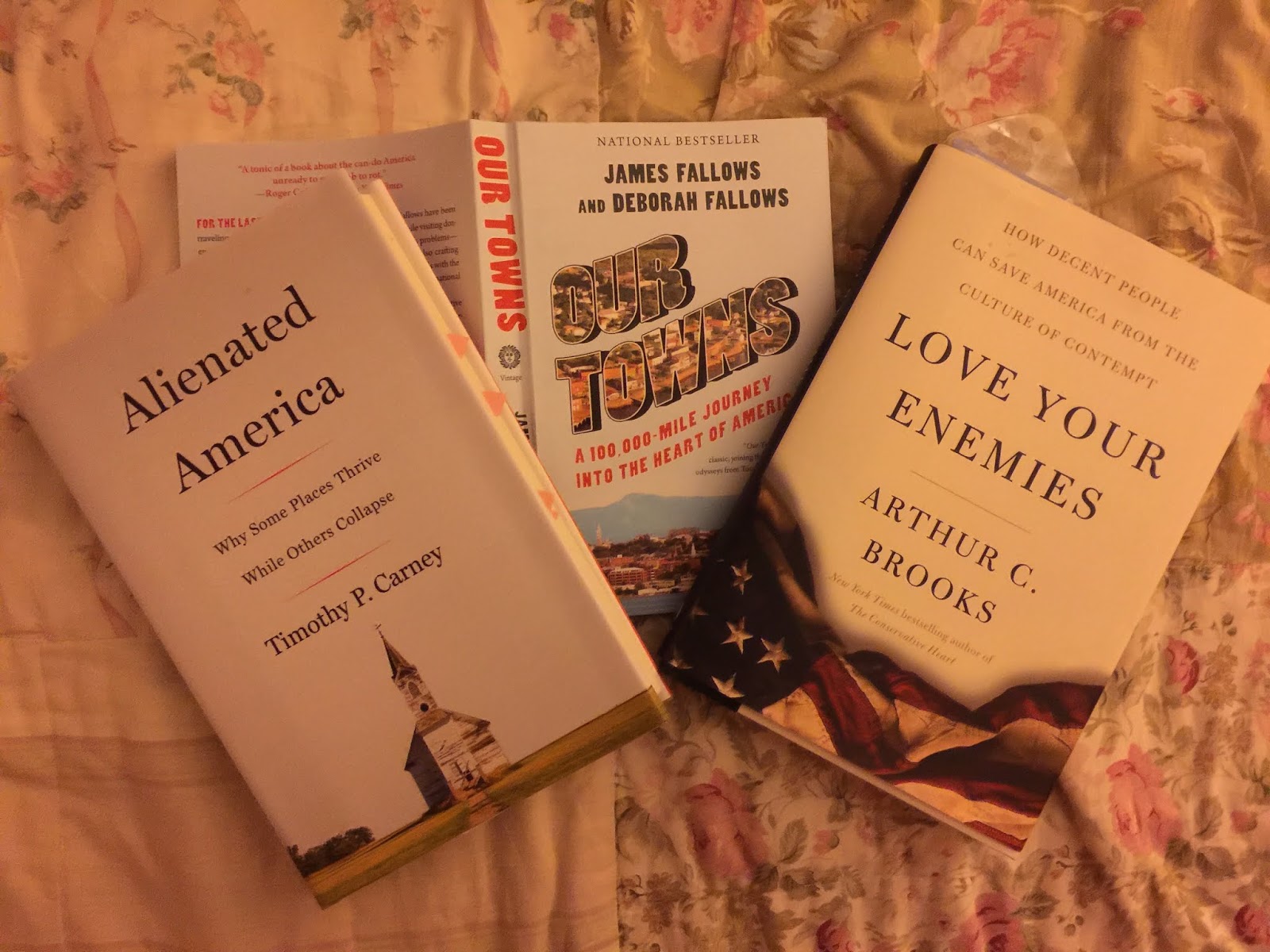
This is a fantastic book! Arthur Brooks is calling on all of us to stand up and help change the culture in our country today. We live in a culture of contempt. We need kindness and love. We need to see people as people, hear their stories, disagree better, and seek truth and love together. Here are some great quotes:
"'We are not enemies, but friends. We must not be enemies. Though passion may have strained, it must not break our bounds of affection. The mystic chords of memory, stretching from every battlefield and patriot grave to every living heart and hearthstone all over this broad land, will yet swell the chorus of the Union when again touched, as surely they will be, by the better angels of our nature' (Abraham Lincoln, p. vii)."
"To me, politics is like the weather. It changes a lot, people drone on about it constantly, and 'good' is totally subjective. I like winter, you like summer; you're a liberal, I'm a conservative.... While politics is like the weather, ideas are like the climate. Climate has a big impact on the weather, but it's not the same thing. Similarly, ideas affect politics, but they aren't the same (p. 1)."
"Political differences are ripping our country apart, rendering my big, fancy policy ideas largely superfluous. Political scientists find that our nation is more polarized than it has been since the Civil War (p. 2)."
"I love meeting people and sharing ideas (p. 2)."
"We are being driven apart (p. 4)."
"We need national healing every bit as much as economic growth. But what are we getting instead...? Across the political spectrum, people in positions of power and influence are setting us against one another. They tell us our neighbors who disagree with us politically are ruining our country... In the very moment in which America most needs to come together as a nation...we are being torn apart, thoughtlessly and needlessly. We are living in a culture of contempt. We need to fight back. But how (p. 5)?"
"'All lives matter!... If we really want to make America great, we do it together (p. 7)!'"
"'We don't get there by screaming at each other all the time. We get there by building bridges... It's time to bring everybody together, and get everybody to celebrate America together... We need to set a new standard... It's time that people shake hands and agree to disagree. And if people can't do that this country is going to fall apart (p. 9).'"
"'Unity is what is going to make the world a better place for all (p. 10).'"
"Contempt...anger mixed with disgust (p. 10)."
"The choice between either political ideology or our friends and family, so often peddled by leaders today, is a false choice (p. 11)."
"This message of kindness in the face of contempt is one that resonates widely (p. 11)."
"'What do I do when I feel contempt?'... 'Practice warm-heartedness (p. 11).'"
"Love. And not just love for friends and those who agree with me, but rather, love for those who disagree with me as well (p. 13)."
"'Love is not sentimental, nor restful in illusions, but watchful, alert, and ready to follow evidence. It seeks the real as lungs crave air (p. 13).'"
"You should never be anonymous or engage with anonymous interlocutors. Engagement with love is a human endeavor, and requires us to be...real people--not disembodied messages (p. 14)."
"Contempt makes you unhappy, unhealthy, and unattractive even to those who agree with you (p. 15)."
"It's regular citizens acting as leaders who matter most in the battle against the culture of contempt... Famous people purvey it, but ordinary citizens are the ones creating a market for it... We can't wait for our leaders to change; we need to lead the rebellion ourselves. While we can't single-handedly change the country, we can change ourselves. By declaring our independence from the bitterness washing over our nation, each of us can strike a small blow for greater national harmony, and become happier in the process (p. 16)."
"Disagreement--if we do it right--is what makes our country strong (p. 17)."
"What would you do at this point?... Ignore him... Insult him... Destroy him... Few other options come to ind when we're confronted with disagreement. Notice that they all grow from the same root: contempt (p. 20)."
"A majority of Republicans and Democrats today suffer from a level of motive attribution asymmetry that is comparable to that of Palestinians and Israelis (p. 21)."
"We may not be engaging in daily violence against each other, but we can't make progress as a society when both sides believe that they are motivated by love while the other side is motivated by hate (p. 22)."
"The pandemic of contempt in political matters makes it impossible for people of opposing views to work together (p. 24)."
"Unless we hope to become a one-party state, we cannot afford contempt for our fellow Americans who simply disagree with us (p. 24)."
"The vast majority of Americans on the other side of the ideological divide are not terrorists or criminals. They are people like us who happen to see certain contentious issues differently. When we treat our fellow Americans as enemies, we lose friendships, and thus, love and happiness (p. 25)."
"Being treated with contempt takes a measurable physical toll (p. 26)."
"Not a day goes by when someone doesn't bemoan the fact that we are coming apart as a country, unable to have a respectful airing of political views like civilized adults. People are exhausted (p. 26)."
"We wish our national debates were nutritious and substantive, but we have an insatiable craving for insults to the other side (p. 29)."
"Social media intensifies our addiction by allowing us to filter out the news and opinions we disagree with, thus purifying the contempt drug (p. 30)."
"'Ideological siloing' means we stop interacting entirely with those who hold opposing views... The results of not knowing people of opposing viewpoints and seeing them only through the lens of hostile media is predictable... as we become less exposed to opposing viewpoints, we become less logically competent as people (p. 30)."
"Like us, [Congress] are victims of America's political contempt addiction (p. 32)."
"Contempt is driving us apart and making us miserable. It is holding us hostage (p. 33)."
"He simply learned that he liked me because I had taken the time to read his email and was nice in the way I responded.... The cycle of contempt depended on me, and I broke it with just a few words of gratitude. Doing so felt great for me, and it changed another person's heart. I saw firsthand that contempt transmuted into friendliness when it was met with an overt expression of kindness and respect... Kindness, reconciliation, and connection--not contempt, division, and isolation--are what our hearts really desire (p. 34)."
"Simply having a friend you see on most days gives the equivalent happiness boost of earning an additional $100,000 of income each year. Seeing your neighbors on a regular basis gives as much happiness as an extra $60,000 (p. 35)."
"In his farewell address, George Washington famously warned against 'the baneful effects' of political enmity (p. 37)."
"Contempt crowds out love because it becomes our focus (p. 37)."
"We want love. How do we get it? We have to start by saying that it is what we really want (p. 38)."
"We want love, kindness, and respect. But we have to ask for it, choose it. It's hard; we are prideful, and contempt can give a sense of short-term purpose and satisfaction... But...we can choose what we truly want, as individuals and as a nation (p. 39)."
"1. Focus on other people's distress, and focus on it empathetically....
2. In your interactions with others, particularly in areas of disagreement...make sure you offer five positive comments for every criticism....
3. No contempt is ever justified...
4. Go where people disagree with you and learn from them (p. 39)."
"Warm-heartedness is for strong people, not weak people (p. 41)."
"Kindness and warm-heartedness are the antivenom for the poisonous contempt coursing through the veins of our political discourse (p. 41)."
"I may not agree with you, but what you have to say matters (p. 42)."
"When you're treated with contempt, don't see it as a threat but as an opportunity.... change at least one heart--yours... Respond with kindness (p. 42)."
"Those who practiced kindness came out ahead in all three categories [(1) being sought out for advice; (2) being perceived as a leader; (3) job performance] (p. 50)."
"'The way to influence--and to lead--is to being with warmth (p. 51).'"
"You can afford to be nice (p. 53)."
"There are certain things that happy people do. They get up and move around, get out of the house, engage with other people--and smile (p. 56)."
"'Love is a verb... Serve... Sacrifice... Listen... Empathize. Appreciate. Affirm.... Love is something you do: the sacrifices you make, the giving of self (p. 57).'"
"Show gratitude. Gratitude is, quite simply, a contempt killer (p. 58)."
"The key to being nicer and happier is gratitude (p. 60)."
"To be happier and to be better to others, count your blessings (p. 61)."
"'If you love those who love you, what credit is that to you? For even sinners love those who love them...But love your enemies...Then your reward will be great (p. 61).'"
"To feel dignified, one must be needed by others. Millions of Americans no longer feel needed--by their families, their communities, the economy, or their country (p. 72)."
"Beyond ruining relationships, coercive leadership also begets mediocrity (p. 76)."
"We can exhibit the kind of leadership we wish to see from our country's public figures (p. 85)."
"Can America persist as a great nation with a population unwilling or unable to set a few standards of right and wrong (p. 88)?"
"Belief in compassion and fairness is encoded into the moral compass of almost all people (p. 94)."
"1. Focus your arguments on the moral values we share--compassion and fairness--rather than those held by only one part of the population (p. 100)."
"It's about more than winning the debate. When we engage those who hold different opinions, we can unite people who may never agree on the specific issue by reminding them that we all agree we want to work for compassion and fairness (p. 100)."
"'I'm not waging war on your moral views (p. 101).'"
"2. Be wary of manipulative leaders in politics and media who use the moral dimensions where we disagree as a wedge to divide us and fuel contempt (p. 102)."
"3. Divergent moral values are not a bug in the human system. They are a feature that can make us stronger (p. 103)."
"The starkest dividing line in America today is not race, religion, or economic status, but rather party affiliation (p. 104)."
"Engagement to people with different moral values has given me the power not to be offended, even if others are seeking to offend (p. 105)."
"Think deeply. Listen to the other side. Reflect on what others are saying (p. 106)."
"We should be more like the tax collector who, Luke tells us, 'would not even look up to heaven, but beat his breast and said, 'God, have mercy on me, a sinner (p. 107).'"
"Our tools for establishing and ascertaining identity have become extremely efficient and have changed fundamental aspects of our social lives (p. 110)."
"They were real people with real human stories, not just a demographic identity... When people are reduced to a set of fixed group characteristics, rather than appreciated as individuals with shared humanity, unity is undermined and contempt is made that much easier to express (p. 114)."
"Identity obscures as much as it illuminates (p. 115)."
"Coming face-to-face with people who hold discriminatory attitudes often breaks down their bigotry (p. 116)."
"'I think people are not only not building bridges anymore, I think they're blowing them up and then taking hard stances.... The danger of othering...is that we end up making caricatures of others because we never come into contact with them (p. 120)."
"A hug unifies and says, 'We are both people with dignity, capable of love (p. 121).'"
"Achieving harmony doesn't happen by itself; it takes skill and work (p. 123)."
"Forcing people together but emphasizing our differences can be toxic. However, if we bring people together and emphasize our common stories, we can discover the new and broader 'we' required to overcome mutual contempt (p. 124)."
"Connection is found when we view one another as individuals with stories and dignity, just like ourselves (p. 128)."
"Unity requires us to see one another as people first and foremost (p. 128)."
"When we encounter one another as individuals and tell our stories, we overwhelm contempt with something more powerful: love (p. 128)."
"When you tell somebody--even a stranger--a story about yourself that he can relate to, that relating induces people to produce oxytocin, which makes the person literally feel a bit of love for you. In the same way, you can love strangers a little more by listening to their stories (p. 138)."
"When human stories are present, good things happen. But the opposite is also true: a storyless person disappears (p. 140)."
"I often reflect on how differently people act when they drive, encased in a car and thus anonymous, compared with the way they act when they walk on the street (p. 144)."
"My [BYU] briefcase told a story that prevented me from acting anonymously. True, the story it gave me was not genuinely my own, but it humanized me nonetheless--and improved my behavior (p. 146)."
"When you're on a first date, slip in the question, 'Do you have an anonymous Twitter account?' If the person says yes, say no to a second date (p. 147)."
"Repudiate anonymity and be yourself online. Make a commitment today to never be anonymous or say anything anonymously... Anonymity is a cancer that is wrecking our country, because it obliterates our ability to understand one another through authentic human stories (p. 148)."
"If you are doing work that helps others, you should spend time among the people you are working to help (p. 150)."
"It's not just other people's stories we need to seek out and share. You and I need to tell our own as well (p. 150)."
"Once you have your story in twelve words so that you understand it yourself, start sharing it with other people, so they understand you (p. 151)."
"The lack of competition posed an existential threat to the sport... Only when there is fierce competition are people interested in watching the game (p. 155)."
"Rules in sports--clear and impartial--provide needed structure and make things fair... True competition requires voluntary cooperation with the rules (p. 158)."
"Competition, properly understood and practiced, unites people (p. 159)."
"They love competition, because they love improvement and winning against worthy market opponents (p. 161)."
"America's nearly universal admiration for earned success distinguishes this country from most other countries... 'In the United States, the people have no hatred for the elevated classes of society, and...they do not fear great talents (Alexis de Tocqueville, p. 163).'"
"To develop excellent ideas, we need competing ideas (p. 164)."
"We all want a safer, fairer, more prosperous country. We jut disagree on how to achieve that aim (p. 165)."
"We may disagree--we should disagree--over how best to achieve safety, prosperity, and happiness for the most people, and we should compete over the best way to help all people build better lives. To do so, however, we must maintain the shared objectives and moral core around which a true competition of ideas should radiate (p. 170)."
"Tolerance and civility are too low a standard for a great country based on competitive excellence (p. 172)."
"Aristotle wrote that there were three kinds of friendship: The first and lowest form of friendship is that based on utility, wherein both people derive some benefit from each other... The next level of friendship...is based on pleasure; both people are drawn to the other's wit, intelligence, talent, good looks, or other attractive qualities... The highest form of friendship--the 'perfect friendship' in Aristotle's telling--is one based on willing the good of the other and a shared sense of what is virtuous and true (p. 177)."
"God...must be the most important thing in either person's life--not the husband or wife (p. 181)."
"'I see [Robby] as my friend and someone who has...a right to be wrong... We agree on almost nothing.... What Professor West and I are about is conversations--getting at the truth, not just find a way to agree, or a way to avoid difficult issues on which people disagree. But to have a conversation--a conversation whose aim is getting both of the interlocutors, or everybody concerned, a little nearer the truth (p. 181).'"
"'Our willingness to listen to and respectfully engage those with whom we disagree (especially about matters of profound importance) contributes vitally to the maintenance of a milieu in which people feel free to speak their minds, consider unpopular positions, and explore lines of argument that may undercut established ways of thinking. Such an ethos protects us against dogmatism and groupthink, both of which are toxic to the health of academic communities and to the functioning of democracies (p. 183).'"
"Disagreement is just another way of saying 'competition of ideas (p. 183).'"
"Each of us needs that kind of friendship so as to learn and practice the skill of disagreement in a spirit of love and warm-heartedness (p. 185)."
"If you are committed to better disagreement, you generally need a wider circle of friends... That means going places outside your traditional circles and making the effort to get to know people with different values in a deep way (p. 186)."
"Don't attack or insult. Don't even try to win (p. 187)."
"Never assume the motives of another person (p. 192)."
"Use your values as a gift, not a weapon (p. 195)."
"'The maintenance of a free and democratic society requires the cultivation and practice of the virtues of intellectual humility, openness of mind, and, above all, love of truth (p. 199).'"
"What is the cure for our culture of contempt?... It's not civility or tolerance... It is love for one another and our country. Love is the 'why' of the leaders that can bring America back together, and of all of us in our families and communities (p. 202)."
"I'm asking you to join me and work to subvert the prevailing culture of contempt as a radical for love and decency (p. 203)."
"Rebellion comes in one of two forms. The first is passive: tuning these manipulators out... The second form is active--and harder: Stand up to people on your own side who trash people on the other side (p. 204)."
"Escape the bubble. Go where you're not invited, and say things people don't expect (p. 205)."
"Do I hear diverse viewpoints (p. 205)?"
"Say no to contempt. Treat others with love and respect, even when it's difficult (p. 206)."
"Work to inspire others with a vision of hope and a model of inclusiveness toward others' ideas (p. 208)."
"Disagree better. Be part of a healthy competition of ideas (p. 209)."
"The single biggest way a subversive can change America is not by disagreeing less, but by disagreeing better--engaging in earnest debate while still treating everyone with love and respect (p. 210)."
"Tune out: Disconnect more from the unproductive debates (p. 210)."
"Obliterate your silos by listening, reading, and watching media on the 'other side.'.... Want to get really radical? Stop talking and thinking about politics entirely for a while. Do a politics cleanse (p. 211)."
"Resolve to pay attention to ideas, not just politics (p. 212)."
"Go find someone with whom you disagree; listen thoughtfully; and treat him or her with respect and love. The rest will flow naturally from there (p. 213)."
"You know what our world needs: more love, less contempt (p. 214)."