This is a book about New Zealanders, the water, and our old and deep connection between the two: swimming in the outdoors. Every neighbourhood has its river swimming hole, its local beach, its back road to the lake or the climb over a fence to jump in the creek.
From Northland to Fiordland, Annette Lees swam outdoors every day for a year in our rivers, lakes, ponds, seas, estuaries, wetlands, springs and outdoor lido pools. Across the country local people shared with her their swimming places and their family swimming stories. It emerges that New Zealanders have a serious passion for water and outdoor swimming. In Swim, Annette has collected our stories, of urban swims, brave swims, night swims, forbidden swims, famous swims, winter swimming, the endurance swimmers of the Depression, and the swimming ANZACs. Threaded through these tales is the diary of her year of swimming.
The result is an inspiring, evocative and beautifully written tribute to this cherished aspect of New Zealand life.
Apparently drowning was so commonplace in the 1800s that it was sometimes referred to as ‘the New Zealand death’. Drowning accounted for around 76% of all violent or accidental deaths. In the last forty years of the century more 6200 Pakeha (white New Zealanders) drowned, and this is almost certainly an under estimation as only bodies which were found were counted. Drowning among Maori went unrecorded.
We hear about Niuafo’ou in Tonga, which has no natural harbours and so ships could not safely come ashore to make deliveries. Mail was welded shut inside 40 pound ship biscuit tins and tossed overboard about a mile offshore, which was retrieved by swimmers who became known as the Tin Can Mail swimmers. Because of the wild currents around the island it could take the swimmers up to six hours to reach their targets. This method was eventually abandoned in 1930 after a swimmer was bitten by a shark and died.
The chapter on rips was informative as it was scary, they kill more people than sharks and to survive them you have to relax, which is obviously easier said than done. The swim stories from the likes of the Maori battalion during the war and other tales of ANZACs in Turkey make for enjoyable reading. We learn that the triple crown of New Zealand’s big swims is the notorious Cook Strait, Foveaux Strait and Lake Taupo. Lees gives a fairly detailed history of the various attempts and successes at swimming all of them, with many quirky and memorable details thrown in.
There were many times when I thought this was more of a blog than a book. Her love and enjoyment of the water and the country around it, is apparent on every page, but her accounts would have been far more compelling if she had gotten around the country a bit more and maybe swam in each region, instead of the same spots.
She is not afraid to address some of the bigger questions like the significant problem of pollution in NZ’s streams and water ways. NZ is no way helped by the fact that Fonterra are the biggest company in the country (currently enjoying record loss upon record loss), a dairy company who are responsible for much of the filth in the water systems and are also largely responsible for NZ allegedly being the biggest importer of palm kernel in the world.
I think this book is at its best is when we are dipping into the various other personal and historical anecdotes and stories which really help build up a varied and colourful picture, giving a bit more depth and breadth, although Lees can have some nice turns of phrases here and there and throw in some lovely descriptions of her own accounts and locations can sometimes lack variety and diversity. But overall this was an enjoyable read with some really fascinating accounts here and there, but really dull ones elsewhere.
If you’d like to swim outdoors more, but lack inspiration and motivation, Annette is your ticket. Stories of NZ’s deep connection to ‘wild’ swimming makes you want to head to the nearest beach and dive in.
Make no mistake, I really did enjoy this book. I found it while looking for guides to wild swimming in New Zealand. I really wonder if Annette's year of swimming wouldn't have been bettered served if the book focused on just that. Maybe its the layout but at times her efforts and musings feel marginalised around other content. This is a book that tries to be many things - swimming memoir, a history of swimming in New Zealand and records of the voices of other NZ swimmers. As a history of swimming in NZ it is completely baffling that it deosn't have an index (although it has a sound bibliography). I would also have liked to see some maps, and again this leads me to thinking this is really two books in one - one about where you can swim in NZ and Annette's own expriences, and another about the history of swimming in New Zealand. Of course as the author notes at the conclusion of her book, some of her swimming locations are no longer accessible to her, and regrettably given the current disregard for our sacred wild places by so many locals and tourists alike, such a book would likely only compound those issues.
Superb collection of personal accounts, swimmer profiles and the historical + cultural significance of water in Aotearoa. This book has single handedly made me obsessed with water and being in it. Absolutely loved it, non-fic of the year.
It's pure pleasure to explore one of my favourite things, swimming outside, with a true enthusiast. And where better to do it than in Aotearoa New Zealand, surely one of the most temperate and watery and therefore best places to swim on earth? There's just so much water here. Annette Lees swims outdoors (almost) every day for a year in some very cold weather, and seems to have loved it from start to finish.
Almost the first line expresses clearly how different outdoor swimming is from indoor (which Annette Lees describes as pee warm, chlorine-soaked indoor pool swimming). Instead she gives us a whole book describing the exciting, exhilarating, unpredictable, sometimes dangerous, experience of swimming outdoors.
I enjoyed learning about the glory days of swimming in the 20s and 30s, when swimmers were superstars. I loved the story of Lily Copplestone, who in 1929 gave up office life after suffering a nervous breakdown and instead became a professional swimmer!
There are some awesome stories (many of them women's), like the amazing long distance swims of Hinepoupou and Hinemoa, and Huria Matenga's life saving of the Delaware near Nelson. Some of New Zealand's most famous historical figures were swimmers - like Bishop Selwyn, and Bernard Freyburg.
I also enjoyed some of the (horror) stories of early swimming pools, like the 'brisk trade in dead rats, sold to women bathing behind curtained-off sections who used them as projectiles against male peeping toms in an early Queen Street, Auckland pool in the 1860s. Or the time a shark got into Thorndon Baths.
Swimmability is a big deal in NZ and I felt this was skated over lightly in favour of celebrating the pleasures of swimming. It's a huge and contentious topic and NZ's twin biggest industries - tourism and agriculture - are directly opposed and have counter-productive outcomes when it comes to fresh water quality. I was hoping for a bit more on this, a call to arms perhaps.
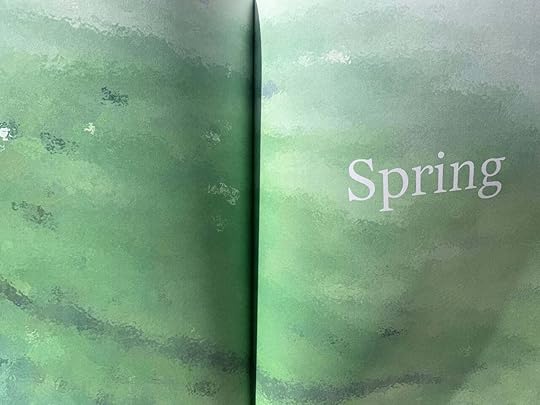
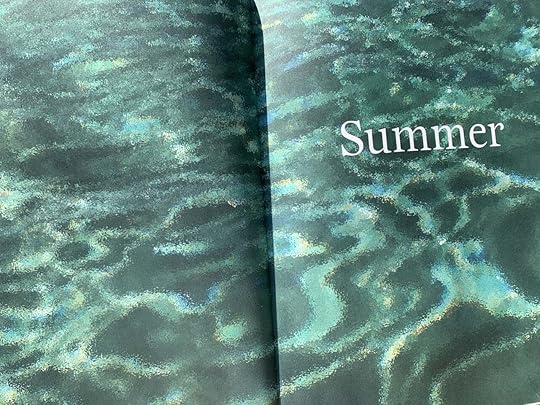
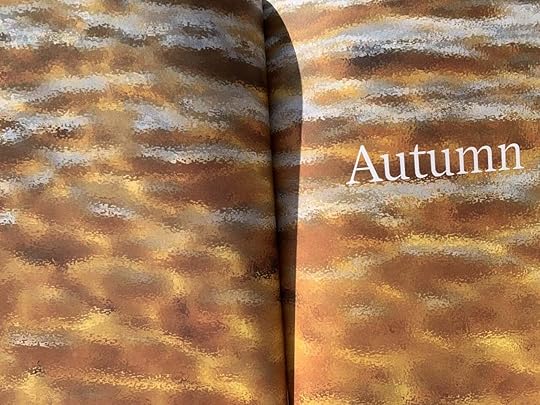
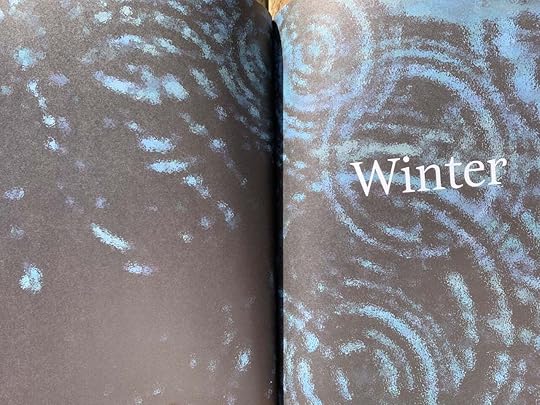
Perhaps the things I loved most about this book, other than the effusive joy of swimming, are the seasonal full page spread images, which I've reproduced below. I don't know how Floor van Lierop managed to get images which so clearly expressed water in each season. But she did.
Outdoor swimming: spontaneous, unorganised, free. The British call it wild swimming. ‘At the most, you need some togs and a towel; at the least, nothing at all,’ writes swimmer and author Annette Lees. ‘This is a book about New Zealanders, the water and the old and deep connection between the two – swimming.’ After walking, it’s our most popular form of recreation, perhaps unsurprisingly given nearly everyone lives near a creek, bay or lake. Swimming is an obvious subject for a book – so obvious that no one has written one before.
As a girl Lees was, like most Kiwi kids, a keen swimmer, and vowed never to become a ‘dusty adult’ who wouldn’t leap in. Then, somehow, she did. She forgot the simple, profound joy of wild swimming. So, in 2017, she decided to swim every day of summer. Water temperatures peak in late summer, so she swam through autumn too. Then winter came, and she just kept swimming. For an entire year. Every day, every temperature, any place she could find a river, creek, bay or plunge pool. She swam in gales, in rain, alone, at night. She immersed herself in ‘biologically scented, cool natural water, with background music of tūī, or gulls.’
'Swim' has an elegant cover with a delightful illustration by Floor van Lierop, which perfectly sets the tone for a book that celebrates all aspects of outdoor swimming. Interspersing stories, facts and history are Lees’ own diary entries. Of one swim in Otago’s Greenstone River, she writes: ‘The shock of the dive is immediate, the temperature hits plank-like, the water a cold smooth silk. We walk fast after the swim to warm up.’ Many a tramper knows the sensation of such a cold river plunge, and the glorious warm feeling afterwards. Lees explains that the body has more cold receptors than warm ones, and these fire immediately after cold water immersion, releasing hormones, including a shot of adrenaline. Warm blood retreats to your core. Then, when you’re out, ‘warm blood returns to your skin, and to your hands and feet, bringing a rushing tide of fiery tingling and euphoria.’ Winter swimming, some researchers have concluded, can provide an anti-depressive effect. And not just in winter. Science supports the idea that swimming has many mental and physical benefits, both for exercise and relaxation.
In the water you might just see something of scientific interest too; New Zealand has the world’s only phosphorescent freshwater limpet, a Gondawan species over 80 million years old, which, after being disturbed, releases a glowing slime. Phosphorescence of a different sort once betrayed a fleeing Ngāti Whanaunga chief, who swam from Tataweka Island to escape those who planned to kill him. The glowing trail revealed him to his enemies, who speared him when he reached the mainland.
Lees also infuses the narrative with quotes from some of our most accomplished authors, including Katherine Mansfield and Maurice Gee. In one of her stories, Janet Frame wrote: ‘We knew the jumping places, the mossy stones with their dangers, limitations, and advantages; the sparkling places where the sun trickled beside the water, upon the stones...’
Other swimmers tell their own stories, like Scott Nicol’s tale of plunging in to Lake Angelus, mid-winter, through a hole hacked in the frozen surface. ‘The top of the lake was a polished white ice but underneath were hanging all these stalactites of ice. They were smooth and fluty like thick green glass and they went on beneath the ice as far as I could see.’
Inspiring tales of endurance swimming surface too. Māori woman Hinepoupou undertook perhaps the greatest feat of open water swimming in our history when she swam from Kāpiti Island to Rangitoto (D’Urville) island in the mid-1700s, covering the 56 nautical miles in just three days. A team of six that recreated her swim in 1990 took four days. More recently, German-born swimmer Arno Marten made an astonishing attempt to swim Fiordland’s coastline, towing a packraft. Despite a brave start, storms defeated him, but he plans to try again.
'Swim' also offers, in a very readable and subtle way, a social commentary about New Zealand, including issues of gender. During colonial times, it was frowned upon for Pākehā women to swim in a wild setting. Swimming naked has muddied the moral waters at times too, but it was the more pressing issue of drowning that led to a concerted effort to teach more New Zealanders to swim during the 1930s. Now, we have extraordinarily accomplished swimmers like Kimberley Chambers who is one of only 10 people to have swum the ‘seven ocean straits’ which includes the English Channel, California’s Catalina Channel, Cook Strait, Tsugaru Strait (Japan), the North Channel (between Ireland and Scotland) and the Moloka’i Channel (Hawai’i). Chambers also dared the stingingly salt-laden waters of the Dead Sea, and the shark-infested waters of San Francisco harbour, leading to Outside magazine naming her ‘the World’s Most Badass Swimmer.’
Lees’ diary entries (her ‘waterbiography’) are lovely, liquid poems, the flowing prose reflecting her joy of water. While wearing the depth of her research lightly, Lees provides a thorough exploration of the importance of swimming to New Zealanders. Good illustrations enliven and complement the fascinating text. Lack of an index is its only deficiency.
In many ways, 'Swim' is New Zealand's equivalent of Roger Deakin’s 'Waterlog' (1999), an acclaimed and influential book about wild swimming in Great Britain. Praise doesn’t come much higher than that.
Five stars for this gem of a book. It dips and dives between bits of Aotearoa swimming history, daily swimming delights and guest swimmers sharing their watery passion. It has rekindled my love of the water and made me think back about my "water biography" (lots of treasured memories swimming with my sister). Plus I'm determined not to be a dusty old adult and give myself the gift of swimming.
The book tried to be too many things at once. At times I really enjoyed it and at times it dragged on so it wasn’t a consistent read.
The author’s swims became a bit repetitive. I could’ve done without the historical quotes which departed from the writing style. I did enjoy the interviews with other swimmers.