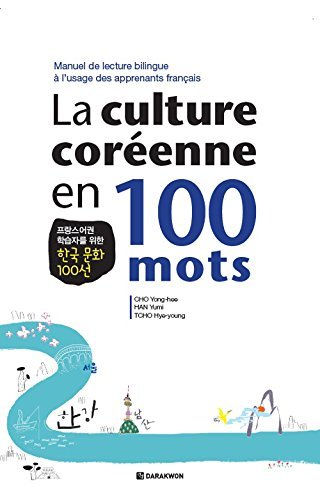
Apprendre une langue, c'est partir à la découverte d'une culture. Ce manuel se donne donc pour objectif spécifique de guider l'apprenant, débutant ou plus avancé, dans la langue coréenne à travers 100 mots qui en balisent la culture. Il pourra ainsi, à travers des textes brefs et vivants classés en trois niveaux de difficultés, en explorer tous les aspects toujours si présents aujourd'hui, et découvrir les courants profonds qui unissent dramas et dolmens, pansori et k-pop, vague coréenne et confucianisme, moines bouddhistes et nouvelles technologies, etc. ! L'assimilation du vocabulaire et de la grammaire se fera ainsi de manière active, plaçant l'apprenant en immersion culturelle, grâce en particulier à de remarquables photos en couleur.
Toute la Corée autour de 100 mots clés ! - Apprendre la langue en découvrant la culture - Du débutant au confirmé, une progression sur trois niveaux - Un ouvrage d'experts, richement documenté et illustré
This is a bilingual book on Korean Culture, presented as chapters of a keyword or words in the Korean alphabet, Hangeul. These chapters were grouped into broader categories like: history, religion, important places, etc. Each of these chapters has a paragraph in Korean and English, includes vocabulary terms in Hangeul, and questions about what was presented in each chapter. There are 1 to 3 stars for each chapter that relate to the difficulty of the Korean paragraph.
I read this slowly throughout the year and thought it was a great introduction into Korean culture. I originally planned to just read the English portion but since I was taking Korean lessons I thought to challenge myself by reading each paragraph and interpreting what was written. This was extremely challenging, not only because I know a very limited amount of Korean words, but learning to recognize more Korean post-position markers, and the order of words in each sentence. Where English is usually Subject-Verb-Object, Korean doesn’t follow that order, and tends to be Subject (if included)-Object-Verb. Not only was it extremely challenging, but it was also rewarding. My vocabulary has grown since reading this and has been useful during my time here in Korea. I recommend anyone studying Korean to try their hand at this and hopefully you see some improvement.
If you just want to read the English portion I think you will also enjoy the book and gain some knowledge on Korea as a country and culture.
I would have given the book 5 stars but some of the English sentences were a little awkward, and even had sentences omitted that were found in the Korean paragraphs. This didn’t happen often, but enough to be noticeable.