1995, the Swiss Alps. Patricia Highsmith, the queen of the thriller, now ageing and ailing, hides away in her study, surrounded by her collection of books and antique weaponry, finding solace in her seclusion, her cats and her cigarettes.
A polished young man turns up, sent by her New York publisher to persuade her to write one final instalment of her best-selling series featuring the master manipulator, Tom Ripley.
But as day breaks over the mountains, it becomes clear that the charming stranger is set on a far more sinister mission.
Joanna Murray-Smith's play Switzerland is a gripping psychological thriller, filled with razor-sharp dialogue. It was first performed at the Sydney Opera House in 2014. The play received its UK premiere at the Ustinov Studio, Theatre Royal Bath, in 2018, before transferring to the Ambassadors Theatre in London's West End.
A Talent for Murder A review of the Nick Hern Books paperback (December 6, 2018)
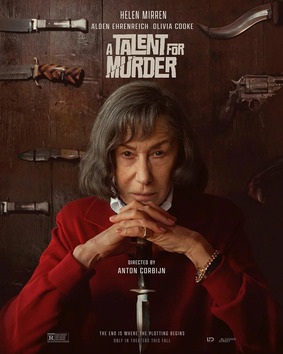
I had not heard of the play Switzerland until I saw it mentioned in the end credits of the new film A Talent for Murder as being its source material. Australian playwright Joanna Murray-Smith adapted her own work for the screenplay. Of course, I immediately wanted to read the original.
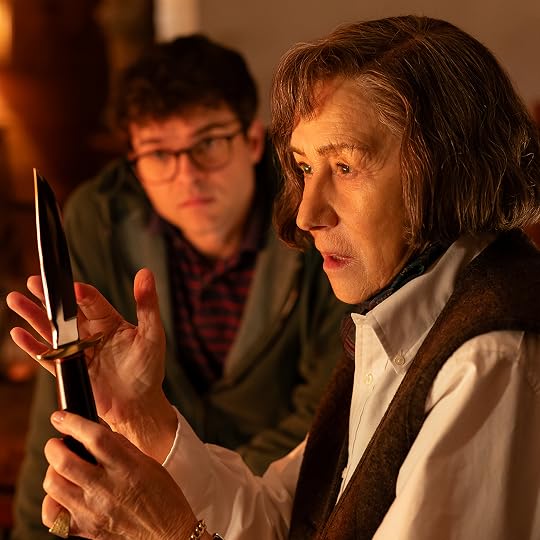
Helen Mirren as Patricia Highsmith and Alden Ehrenreich as Edward Ridgeway in a still photo from "A Talent for Murder," the film adaptation of the original play "Switzerland." Image sourced from a review at The Daily Beast.
The play sticks to being a two-hander which takes place in author Patricia Highsmith's study at her isolated brutalist bunker home in Tegna, Switzerland. Young editorial assistant Edward Ridgeway has been sent from the publisher in New York to induce the cantankerous author to write yet one more book for the Thomas Ripley series. Highsmith is not interested until Ridgeway starts providing her plot ideas. The play proceeds with the ideas coming to a bizarre fruition. No further spoilers from me.
Both the play and the film are a complete historical fiction, but both capture the often bizarre side of the reclusive author e.g. an obsession with snails, with the dark side of human nature, etc. The film expands the cast by having the plot of the imaginary book itself being enacted in several intercut scenes. The play has a more surrealistic ending whereas the film provides a framing device which makes the viewer question what they have seen.
Helen Mirren was outstanding in the Patricia Highsmith film role. I rather hope she gets some award recognition for it after the film sees its general release in October 2026.
Soundtrack Incongruously, the play uses the music of the song Happy Talk from the Rodgers & Hammerstein musical South Pacific (1949) at several points. Either Highsmith or Ridgeway are seen listening or singing along to it at various times. You can listen to it on YouTube here or on Spotify here. NOTE: The clip from the 1958 film version is too cringe to post here.
Trivia and Links The film adaptation premiered at the 2026 Toronto International Film Festival (TIFF). See the TIFF page for the film here.
Watch the trailer for the film adaptation on YouTube here.
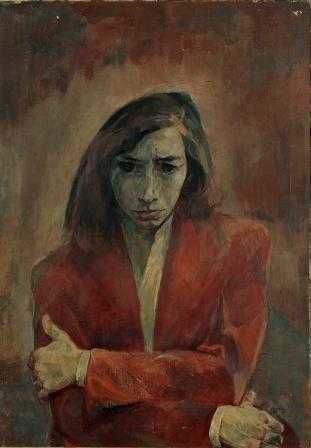
The original portrait of Patricia Highsmith as painted by Allela Cornell in 1943. Patricia Highsmith kept the painting with her for her entire life. A reproduction of the painting is seen in Patricia Highsmith's study in the film "A Talent for Murder." The original is now in the Patricia Highsmith archives in Bern, Switzerland. Image sourced from Pinterest.