To tell the truth, I got into this play because of Hugh Evans. And my theater friends.
Basically what happened was—I was surfing the Shakespeare internet when suddenly I came across a page on how Shakespeare writes accents. There was one on Welsh accents, which intrigued me. After all, Fluellen (the Welsh soldier from Henry V) is quite possibly my favorite character in Shakespeare, and I’m pretty interested in Welsh culture, thanks to him. (And I played him when I was in Henry V!) However, I was under the impression that Fluellen and Glendower (and that one random Welsh soldier dude from Richard II) were the only Welsh people in Shakespeare. Turns out I was wrong—Sir Hugh Evans is a Welsh parson from Merry Wives. And, then to my utter astonishment, it turns out he has more lines than Fluellen or Glendower!
So of course I was very interested in finding out just who this Evans guy was. Originally I didn’t plan on reading the entire play—just looking through a couple summaries, maybe. However, the factor that fully convinced me was that some of my theater friends (who were in Henry V with me) were currently in a production of Merry Wives. I had a good conversation with them about it, as well as talking with some of my other Shakespeare-obsessed friends, and decided—this play sounds interesting; I’m gonna read it, why the hell not.
…Anyway, all that goes to show that I read the play (in three days actually), and quite thoroughly enjoyed it.
I feel like I should primarily address Evans, since he got me into this whole thing. He’s great. Arguably extraneous, but eh, I love him. He gets mocked for his accent and Welsh-ness a couple times, though, which is… unfortunate. Lots of references to stereotypically Welsh things, like cheese or flannels. Especially cheese. (also, perhaps he and Fluellen could be brothers?) My favorite scene of his is certainly the one where he’s quizzing William on Latin verb conjugations and Nell Quickly entirely misinterprets it… that was pretty hilarious. And he sings to himself when he’s scared?! Aww.
Also the best line in the entire play: “Heavens defend me from that Welsh fairy, lest he transform me to a piece of cheese!”
I feel like I’ve spent way too much time discussing Evans. He is in no way the most important character in the play. Here, let me speak to some of the others.
Mistess Ford & Page? The badass women Windsor deserves. 10/10 love these women. They take no shit from Falstaff nor their husbands, and are pretty much the driving forces of the play. Honestly, what more can I say? And Ford’s line about them is pretty great: "I think, if your husbands were dead, you two would marry.”
Even the play is named after them—they are the Merry Wives: "We'll leave a proof, by that which we will do, / Wives may be merry, and yet honest too: / We do not act that often jest and laugh; / 'Tis old, but true, still swine eat all the draff."
However, in all honesty, I think that Ford is the most interesting character in the play. At the beginning, he’s just kind of your standard jealous husband. It’s all fun and games. But then Falstaff calls him a cuckold about five times in one speech, and suddenly this happens…
"Would any man have thought this? See the hell of having a false woman! My bed shall be abused, my coffers ransacked, my reputation gnawn at … Terms! names! Amaimon sounds well; Lucifer, well; Barbason, well; yet they are devils' additions, the names of fiends: but cuckold! Wittol! —Cuckold! the devil himself hath not such a name. … I will rather trust a Fleming with my butter, Parson Hugh the Welshman with my cheese … than my wife with herself; then she plots, then she ruminates, then she devises…"
This soliloquy of Ford’s really struck me because it’s so intense. He’s essentially saying that being called a cuckold is worse than being called a devil: I would certainly liken it to some of Othello’s or Leontes’ speeches. Though of course, Ford is different from Othello or Leontes (or Claudio from Much Ado) because he actually has pretty good reason to suggest his wife is unfaithful. And yet… he’s actually a lot more humane about it? Yes, he has this intense speech (which really speaks to his anxieties)—but he doesn’t slander or kill *cough* Othello *cough* his wife. And he apologizes to her afterwards. Which is great!
Of course, since Merry Wives is a comedy, it doesn’t explore these darker themes as much as a play like Othello or Winter’s Tale would. However, I would still argue that there are elements of darkness in the play. One is the theme of cuckoldry. Another is the treatment of Falstaff.
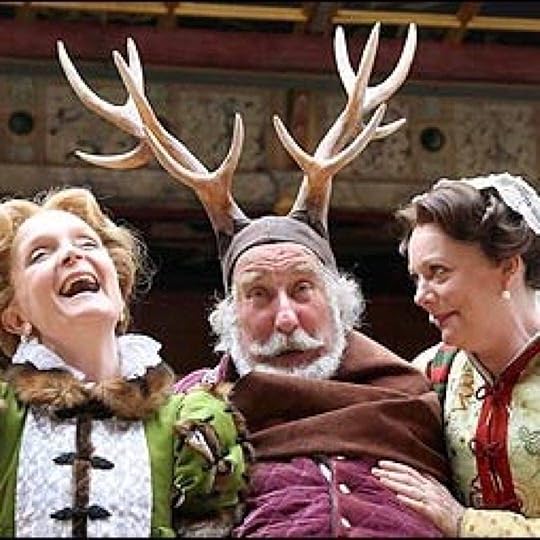
For the most part, Falstaff’s humiliation is hilarious. He deserves a lot of it. The whole laundry-basket thing is fantastic. But… it seems to me that they almost go too far? “We cannot misuse him enough,” says Mistress Page. The last scene is pretty great, in my opinion, but still—they burn him with candles! I’m not sure how I feel about that! It seems to parallel the treatment of Malvolio in Twelfth Night, almost...
Some more thoughts!
- Poor Quickly, working for all those different people. Also, she’s not as badass in this play as she was in Henry IV—but, well.
- I wonder when this play is set, in regards to Henry IV? The only mention of characters in H4 looks to be this offhand line of Page’s regarding Fenton: "The gentleman is of no having: he kept company with the wild prince and Poins; he is of too high a region; he knows too much."
- I find it kind of hilarious that Slender and Caius ended up accidentally marrying boys.
- Re. Caius… wtf dude?? He is a little Too Obsessed with Anne Page. And then when he hears that Evans encouraged Slender to woo Anne, all of a sudden he’s like I WILL KILL YOU EVANS and it’s actually really intense and disturbing. Dude. Chill. Please. Evans deserves 0% of this and tbh neither does Anne nor Simple.
- I don’t really understand how Caius and Evans got revenge on the Host…? Did that ever happen? Was it connected to that random horse-stealing incident? idk.
- Re. the whole subplot with Anne Page and her suitors—I’m glad she got to marry who she wanted in the end! That was really great.
- There was so much horn imagery… obviously relating to cuckoldry, but still interesting.
- Most of the play is in prose! It was interesting to note the rare places where they switch to verse (most notably, when talking about magic, Herne the hunter, etc)
Bottom line? Merry Wives is a fun play. It is in no way as deep as some of Shakespeare’s other comedies—but hey, it’s a comedy. It’s fun. It’s got a good story. Lots of laughs. And even some little hints at a darker nature. Not for people unfamiliar with Shakespeare—but for those who are, I would recommend it!