

What do you think?
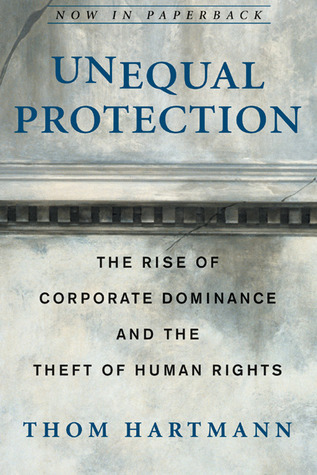
Unequal Protection: The Rise of Corporate Dominance and the Theft of Human Rights
Unequal Protection: The Rise of Corporate Dominance and the Theft of Human Rights
Was the Boston Tea Party the first WTO-style protest against transnational corporations? Did Supreme Court sell out America's citizens in the nineteenth century, with consequences lasting to this day? Is there a way for American citizens to recover democracy of, by, and for the people?
Thom Hartmann takes on these most difficult questions and tells a startling story that will forever change your understanding of American history. He begins by uncovering an original eyewitness account of the Boston Tea Party and demonstrates that it was provoked not by "taxation without representation" as is commonly suggested but by the specific actions of the East India Company, which represented the commericial interests of the British elite.
Hartmann then describes the history of the Fourteenth Amendment--created at the end of the Civil War to grant basic rights to freed slaves--and how it has been used by lawyers representing corporate interests to extend additional rights to businesses far more frequently than to freed slaves. Prior to 1886, corporations were referred to in U.S. law as "artificial persons." but in 1886, after a series of cases brought by lawyers representing the expanding railroad interests, the Supreme Court ruled that corporations were "persons" and entitled to the same rights granted to people under the Bill of Rights. Since this ruling, America has lost the legal structures that allowed for people to control corporate behavior.
As a result, the largest transnational corporations fill a role today that has historically been filled by kings. They control most of the world's wealth and exert power over the lives of most of the world's citizens. Their CEOs are unapproachable and live lives of nearly unimaginable wealth and luxury. They've become the rudder that steers the ship of much human experience, and they're steering it by their prime value--growth and profit and any expense--a value that has become destructive for life on Earth. This new feudalism was not what our Founders--Federalists and Democratic Republicans alike--envisioned for America.
It's time for "we, the people" to take back our lives. Hartmann proposes specific legal remedies that could truly save the world from political, economic, and ecological disaster.
Was the Boston Tea Party the first WTO-style protest against transnational corporations? Did Supreme Court sell out America's citizens in the nineteenth century, with consequences lasting to this day? Is there a way for American citizens to recover democracy of, by, and for the people?
Thom Hartmann takes on these most difficult questions and tells a startling story that will forever change your understanding of American history. He begins by uncovering an original eyewitness account of the Boston Tea Party and demonstrates that it was provoked not by "taxation without representation" as is commonly suggested but by the specific actions of the East India Company, which represented the commericial interests of the British elite.
Hartmann then describes the history of the Fourteenth Amendment--created at the end of the Civil War to grant basic rights to freed slaves--and how it has been used by lawyers representing corporate interests to extend additional rights to businesses far more frequently than to freed slaves. Prior to 1886, corporations were referred to in U.S. law as "artificial persons." but in 1886, after a series of cases brought by lawyers representing the expanding railroad interests, the Supreme Court ruled that corporations were "persons" and entitled to the same rights granted to people under the Bill of Rights. Since this ruling, America has lost the legal structures that allowed for people to control corporate behavior.
As a result, the largest transnational corporations fill a role today that has historically been filled by kings. They control most of the world's wealth and exert power over the lives of most of the world's citizens. Their CEOs are unapproachable and live lives of nearly unimaginable wealth and luxury. They've become the rudder that steers the ship of much human experience, and they're steering it by their prime value--growth and profit and any expense--a value that has become destructive for life on Earth. This new feudalism was not what our Founders--Federalists and Democratic Republicans alike--envisioned for America.
It's time for "we, the people" to take back our lives. Hartmann proposes specific legal remedies that could truly save the world from political, economic, and ecological disaster.
368 pages, Paperback
First published January 1, 2002
About the author
Thom Hartmann
83 books391 followersThomas Carl Hartmann is an American radio personality, author, businessman, and progressive political commentator. Hartmann has been hosting a nationally syndicated radio show, The Thom Hartmann Program, since 2003 and hosted a nightly television show, The Big Picture, between 2010 and 2017.
Ratings & Reviews
Friends & Following
Create a free account to discover what your friends think of this book!
Community Reviews
Displaying 1 - 30 of 72 reviews

March 30, 2011
This is a new one! I have never had a book up and cause me to perform a complete one eight zero on my opinion of it like this one did. Apparently this book is the exception that tells the rule to piss off and not get so full of itself. So I ended up giving this 4 stars. 4 stars despite the fact that for the first half to two-thirds of the book I HATED it…HATED it….HATED it with a Shakespeareanesque passion that would have made Titus Andronicus feel a wee uncomfortable. In fact, I had already price-lined this book a ticket on a midnight flight to OneStarVille.
My dislike for the author and the book actually had me thinking (and AT TIMES YELLING) phrases like: “Oh, you are a moron”…and…“That statement is so far away from the truth that you would need a passport to get there”…and… “Someone needs to remove the stupid gene from your DNA before you are granted mating privileges.” Let’s just say I was not happy with the book as I discuss below.
UNTIL…….***[Please be prepared for the very large BUTT that is about to make an appearance]***

Then...when all seemed darkest...suddenly...out of the blue...the Hills came alive with the Sound of Music, the birds started chirping...and the author FINALLY got around to discussing his central premise. This was a strange turn of events.
When this happened, I found myself very intrigued and seriously interested in hearing more. In fact, I found it so thought-provoking that I again became angry at the author for doing his central premise such a HUGE DISSERVICE by the way he approached topics earlier in the book...but a little wine and some hardy waves from the Von Trapp family calmed me down.
WHAT I LIKED ABOUT THIS BOOK
Here is my takeaway from this book. Corporate Personhood (CP)(i.e., the concept that corporations should be entitled to all of the same rights and privileges as natural persons, which evolved out of the 1886 Supreme Court case, Santa Clara County v. Southern Pacific Railroad ) has allowed corporations to use their “First Amendment” right of free speech to gain an unhealthy control over the political landscape. YES, YES…now I am fully engaged and would like to hear more. Now, it is important to distinguish between (a) corporations as limited liability entities (which I think is very necessary to the fabric of our economic existence) and (b) corporations as “people” having all of the rights and privileges guaranteed by the U.S. Constitution, including the right to free speech (e.g., making political contributions). It is only the latter aspect of corporations as people that I am referring to when I say Corporate Personhood or CP.
According to the author, by removing the concept of personhood from corporations, laws could be passed that prevent corporations from engaging in certain activities that currently they are permitted to perform because they can claim the same rights of free expression as you and me. So right now, a law preventing IBM from lobbying or making political contributions would be found un constitutional because it violates the First Amendment right of a PERSON to free expression. Thus, if you remove corporations from the definition of PERSON, you can restrict their activities without violating the First Amendment. Thus, a law could be passed to remove from corporations the right to contribute to political campaigns and thus eliminate, or at least drastically reduce, the ability of corporations to influence policy through lobbying and political contributions.
As the author writes near the end of the book:
On that one VERY IMPORTANT AND CRITICAL ISSUE I think the author has something incredibly valuable to say and made this a definite “MUST READ” as far as I am concerned. For that reason and that reason alone, I am giving this book 4 stars and highly recommending that people read it.
This despite everything else I say below about my disagreements with the author and my less than positive view on most of his discussion of ancillary topics. I think the author allowed his political bias to color the narrative too often and I found it very disagreeable. More importantly, I think it clouded the real issue under discussion and made his argument less effective. By mentioning these “irritants” I hope that others who may feel the same way about some of the author’s viewpoints will decide to stick with it in order to get to the valuable wheat amidst the chaff.
THINGS I DISLIKED, HATED OR THOUGHT WERE JUST WRONG
1. Rich people bashing: I know bashing the rich is pretty much par for the course these days but it still drives me insane. I find it to be nothing but platitudes and hate-mongering with no true purpose other than to be divisive which I find to be the lowest form of political rhetoric. Personal wealth has no bearing on whether CP should be scaled back and being successful or rich is not a morality indicator.
2. Political Pot Shots In a book like this that holds as one of its fundamental tenets that corporations, more specifically, large multinational corporations have too much influence over the ENTIRE political system, it seems counter-productive and nonsensical to go out of your way to bash one party (i.e., the republicans) and then throw in as an afterthought…oh, BTW the democrats are just as bad. The issue at hand is large corporations funding (and thus influencing) campaigns of both major parties and controlling the political process. It is not a red state/blue state issue.
3. Characterizing the American Revolution as an “anti-corporate” action . This was just stupid and really got my blood boiling. In fact, it almost made me lose interest in what the author had to say. At the end of Chapter 4, the author writes of the revolution,
4. Accountability for Corporate Wrongdoing The concept of limited liability for shareholders and of insulating individual employees when acting on behalf of a corporation are very important aspects of the corporate structure and can not be lightly set aside. Do these attributes sometimes lead to bad people getting away with bad things and not having to suffer an adequate penalty. YES, YES and YES…but I don’t know what a workable alternative is and don’t buy into the simplistic notion that corporations (or their employees) can be prosecuted in the same fashion as individuals for corporate actions.
Sounds right, but just doesn’t work. I hate that a company can get away with recklessly conducting activities that end up taking lives. However, the corporate “shield” is too critical an aspect of the corporate to be removed. I think changes in this area may be worth discussing but in the context of this book, this issue is just too tough to navigate and I think to clouds the central issue of CP revocation as it relates to Constitutional Rights and so does more harm than good in the book.
5. Implying that Large corporations are inherently evil. NO, large corporations are inherently POWERFUL and so it makes some sense to try and remove their ability to effect policy at a National level. Discussions of corporations as evil again just clouds the issue.
FINAL THOUGHTS AND A BIG THANK YOU
I am very glad I stuck with it because by the end of the book, through all the crap and “red herrings” and “unnecessary tangents” I thought what the author was really after merits some serious thought and is certainly worth further discussion. The ideas he raises are so compelling that he actually took a hostile, angry reader (i.e. ME) and brought him around not necessarily with the strength of his argument (which at times was very poor), but with the strength of the IDEA behind the argument.
Finally, I want to send out a sincere and heartfelt thank you to BRIAN for so strongly recommending this book. While I had issues with some of the “noise” and finger pointing, the central thesis of the book is one I am very glad to have read. 4.0 stars. HIGHLY RECOMMENDED!!
My dislike for the author and the book actually had me thinking (and AT TIMES YELLING) phrases like: “Oh, you are a moron”…and…“That statement is so far away from the truth that you would need a passport to get there”…and… “Someone needs to remove the stupid gene from your DNA before you are granted mating privileges.” Let’s just say I was not happy with the book as I discuss below.
UNTIL…….***[Please be prepared for the very large BUT

Then...when all seemed darkest...suddenly...out of the blue...the Hills came alive with the Sound of Music, the birds started chirping...and the author FINALLY got around to discussing his central premise. This was a strange turn of events.
When this happened, I found myself very intrigued and seriously interested in hearing more. In fact, I found it so thought-provoking that I again became angry at the author for doing his central premise such a HUGE DISSERVICE by the way he approached topics earlier in the book...but a little wine and some hardy waves from the Von Trapp family calmed me down.
WHAT I LIKED ABOUT THIS BOOK
Here is my takeaway from this book. Corporate Personhood (CP)(i.e., the concept that corporations should be entitled to all of the same rights and privileges as natural persons, which evolved out of the 1886 Supreme Court case, Santa Clara County v. Southern Pacific Railroad ) has allowed corporations to use their “First Amendment” right of free speech to gain an unhealthy control over the political landscape. YES, YES…now I am fully engaged and would like to hear more. Now, it is important to distinguish between (a) corporations as limited liability entities (which I think is very necessary to the fabric of our economic existence) and (b) corporations as “people” having all of the rights and privileges guaranteed by the U.S. Constitution, including the right to free speech (e.g., making political contributions). It is only the latter aspect of corporations as people that I am referring to when I say Corporate Personhood or CP.
According to the author, by removing the concept of personhood from corporations, laws could be passed that prevent corporations from engaging in certain activities that currently they are permitted to perform because they can claim the same rights of free expression as you and me. So right now, a law preventing IBM from lobbying or making political contributions would be found un constitutional because it violates the First Amendment right of a PERSON to free expression. Thus, if you remove corporations from the definition of PERSON, you can restrict their activities without violating the First Amendment. Thus, a law could be passed to remove from corporations the right to contribute to political campaigns and thus eliminate, or at least drastically reduce, the ability of corporations to influence policy through lobbying and political contributions.
As the author writes near the end of the book:
Denying [CP]…will allow the passage of laws getting them out of undue influence in politics…Federal, State and local governments will be able to enforce laws, if the citizens want, that require corporations to operate to the benefit of the states and the communities in which they are incorporated and do business.Not sure of every aspect of that but it is certainly an intriguing concept and one that I think warrants further discussion. It certainly seems like it might be very worthwhile as long as it applies equally to trade unions and other associations.
On that one VERY IMPORTANT AND CRITICAL ISSUE I think the author has something incredibly valuable to say and made this a definite “MUST READ” as far as I am concerned. For that reason and that reason alone, I am giving this book 4 stars and highly recommending that people read it.
This despite everything else I say below about my disagreements with the author and my less than positive view on most of his discussion of ancillary topics. I think the author allowed his political bias to color the narrative too often and I found it very disagreeable. More importantly, I think it clouded the real issue under discussion and made his argument less effective. By mentioning these “irritants” I hope that others who may feel the same way about some of the author’s viewpoints will decide to stick with it in order to get to the valuable wheat amidst the chaff.
THINGS I DISLIKED, HATED OR THOUGHT WERE JUST WRONG
1. Rich people bashing: I know bashing the rich is pretty much par for the course these days but it still drives me insane. I find it to be nothing but platitudes and hate-mongering with no true purpose other than to be divisive which I find to be the lowest form of political rhetoric. Personal wealth has no bearing on whether CP should be scaled back and being successful or rich is not a morality indicator.
2. Political Pot Shots In a book like this that holds as one of its fundamental tenets that corporations, more specifically, large multinational corporations have too much influence over the ENTIRE political system, it seems counter-productive and nonsensical to go out of your way to bash one party (i.e., the republicans) and then throw in as an afterthought…oh, BTW the democrats are just as bad. The issue at hand is large corporations funding (and thus influencing) campaigns of both major parties and controlling the political process. It is not a red state/blue state issue.
3. Characterizing the American Revolution as an “anti-corporate” action . This was just stupid and really got my blood boiling. In fact, it almost made me lose interest in what the author had to say. At the end of Chapter 4, the author writes of the revolution,
That war- finally triggered by a transnational corporation and its government patrons trying to deny American colonists a fair and competitive local marketplace-would last until 1783This is a ridiculous statement. The East India Trading Company WAS the British Government. This was not a company using its influence to get the British Government to make decisions on its behalf. It was the British Government making decisions that benefited itself and using the East India Trading Company as a vehicle because the King and almost every member of Parliament was a shareholder in the company.
4. Accountability for Corporate Wrongdoing The concept of limited liability for shareholders and of insulating individual employees when acting on behalf of a corporation are very important aspects of the corporate structure and can not be lightly set aside. Do these attributes sometimes lead to bad people getting away with bad things and not having to suffer an adequate penalty. YES, YES and YES…but I don’t know what a workable alternative is and don’t buy into the simplistic notion that corporations (or their employees) can be prosecuted in the same fashion as individuals for corporate actions.
Sounds right, but just doesn’t work. I hate that a company can get away with recklessly conducting activities that end up taking lives. However, the corporate “shield” is too critical an aspect of the corporate to be removed. I think changes in this area may be worth discussing but in the context of this book, this issue is just too tough to navigate and I think to clouds the central issue of CP revocation as it relates to Constitutional Rights and so does more harm than good in the book.
5. Implying that Large corporations are inherently evil. NO, large corporations are inherently POWERFUL and so it makes some sense to try and remove their ability to effect policy at a National level. Discussions of corporations as evil again just clouds the issue.
FINAL THOUGHTS AND A BIG THANK YOU
I am very glad I stuck with it because by the end of the book, through all the crap and “red herrings” and “unnecessary tangents” I thought what the author was really after merits some serious thought and is certainly worth further discussion. The ideas he raises are so compelling that he actually took a hostile, angry reader (i.e. ME) and brought him around not necessarily with the strength of his argument (which at times was very poor), but with the strength of the IDEA behind the argument.
Finally, I want to send out a sincere and heartfelt thank you to BRIAN for so strongly recommending this book. While I had issues with some of the “noise” and finger pointing, the central thesis of the book is one I am very glad to have read. 4.0 stars. HIGHLY RECOMMENDED!!

May 18, 2011
Maybe I should wait to write this review until blood stops pouring out of my eyes, but where’s the fun in that? Skimping on exclamation points never helped anyone. I’m not going to tell you that big corporate conglomerates are the good guys; I’m not even going to tell you that I totally agree with the Supreme Court’s interpretation of the Fourteenth Amendment during the Lochner era (though the reasoning from those interpretations has resulted in a lot of what I consider good outcomes - like how the government can't arrest people for using contraception or being gay). But, I am going to tell you that Thom Hartman makes so many basic (wrong) assumptions about the Constitution in Unequal Protection that it makes the book completely irrelevant to any discussion of actually limiting corporate influence over Amernican government. It might be my loathing of historical fiction talking, but this book totally sucks.
There are parts of it that don’t suck, but where it doesn’t suck, more recent legal developments have made it obsolete, or sucky assumptions have infested the non-sucky-parts. Sorry, Mr. Hartman, I mean this with all due respect, and you are obviously a much more influential person than me, so I hope that instead of taking offense, you will invest in a constitutional law class.
The basic assumptions I see causing so much confusion in this book are the following:
1. That the Constitution guaranties any blanket rights;
2. That including corporations in the Fourteenth Amendment makes their treatment under the Constitution similar to humans; and
3. That it is possible to limit corporate rights without increasing government rights.
There are many, many other assumptions and errors in this book, but those seem like the ones that are most fundamental to the premise of the book and that most make this book irrelevant to any real solution. I’m going to discuss those assumptions in the order I listed them.
First, it’s important to be clear that the Constitution doesn’t guaranty any blanket rights. It doesn’t guaranty that you can say anything you want to say, carry guns, be free from searches or slavery, have a jury trial, or vote. What the Constitution does is limit the government. Congress can’t pass a law that infringes on speech; Congress can’t pass a law that infringes on your right to carry guns; the federal government can’t unreasonably search your stuff. The Constitution formed the federal government; it didn’t form anything else, so it doesn’t govern anything else.
States gave up some rights when they signed on to the Constitution, so in some ways it applies to states. Through the Fourteenth Amendment, the Supreme Court has applied the other amendments to the states, so they are an exception to the rule that the Constitution only governs the federal government. Like the federal government, state governments can’t infringe on certain rights. While the Constitution identifies rights, it doesn’t guaranty that people always have those rights. I can infringe on someone’s speech, and, unless there is a statute prohibiting my infringement, get away with it without punishment. My boss can infringe on my speech, with a few limited exceptions. Goodreads, as another example, can take down my reviews if it wants to, and I have no recourse other than getting really, really mad and talking shit about it.
So, my point is that you’re a Supreme Court Justice, and you’ve got this case in front of you. Some doofuses (Congress) wrote a statute, and it says, “Any person who dumps more than five teaspoons of toxic waste into the Mississippi River has to pay the neighbors one-hundred jelly beans per teaspoon of toxic waste.” So, now BP has dumped six teaspoons of toxic waste into the Mississippi, and it’s claiming that the statute doesn’t apply to it because it’s not a person. Do you think Congress meant to include BP when it said “any person,” or not? Was Congress thinking about who was doing the dumping, or was it just thinking about punishing anyone (or thing) that dumped?
It is the same with including corporations under the Fourteenth Amendment. The focus of the Amendment is to restrict states from infringing on certain rights. So, then, are states not restricted as long as the rights they’re infringing are the rights of corporations? Maybe. But, then what if states decide than only corporations can buy property? So, you form a corporation, buy property, and the state can search it any time it wants to. Or, don’t worry, if you already own property, you’ll be granted a free corporation in your name by the state, and your property ownership automatically transfers to that new corporation, but the Fourteenth Amendment doesn’t apply to your property. I’m not saying that would necessarily happen, but if a state can perform warrantless searches just because the land it is searching is owned by a corporation, that seems like undermining the basic purpose of the Fourteenth Amendment to me. Its purpose is to restrict state power, not to grant rights to anybody.
Second, including corporations under the Constitution doesn’t guaranty that the government treats them the same as humans. Maybe that is just self-explanatory. All it means is that states and the federal government don’t get a free pass in whatever the limits on their power is, just because they are dealing with a corporation. The criticisms Hartman makes of the Santa Clara decision are true in many points (specifically, in his pointing out that it doesn't actually do what the basic premise of this book is claiming it does), but I completely disagree that a solution to corporate abuses is to allow states and the federal government to have complete freedom in governing corporations. Saying that states can’t deprive corporations of property without due process does not mean that corporations are similar to humans. I won’t go into the equal protection clause now, but it would, likewise, be weird to me if it didn’t apply to corporations. And neither of those clauses make corporations similar to humans, they only restrict state power.
Third, the way to limit corporate rights is to increase government regulation of corporations. Somehow, that idea gets glossed-over in this book. The reason I feel this avoidance from the book is because he references Jefferson a lot and the idea that Jefferson would have wanted to replace corporate rule with agency rule is totally outrageous to me. I mean, Jefferson was like a Clarence Thomas-style nut about anti-regulation, as far as I have ever read. To me, you can't be proposing government regulation and citing Jefferson as your founding-father backup. That's the way to get a zombie Jefferson stalking your home, looking for blood.
Anyway, maybe Hartman is assuming that applying the Fourteenth Amendment to only humans would increase regulation, but that seems far from correct to me. This year, I accidentally organized a panel at a conference that turned into recruitment for a militia hoping to destroy American infrastructure. I’m not kidding – at one point a speaker put up a slide on U.S. military strategies for fighting asymmetrical warfare. It was very troubling. Flannery was there, she’ll tell you. When people asked the speaker what her plans were for rebuilding society after she’s destroyed it, she carefully avoided saying that she wants to return to a hunter-gatherer society (which is what she wants to do, I believe). This review does an excellent job of discussing how unrealistic that idea is. There is a similar dissonance in Unequal Protection, where Hartman carefully avoids telling you that his solution to the evils of big business is to create big government.
Don’t get me wrong, I think that’s a good solution. I have been saying for years that we live in a feudal society, in which corporations are our feudal lords, and I completely agree with Hartman on that point. I do not, however, agree that the alternative is democracy. Hartman sets up the dichotomy that we could live in a democratic society, but a feudal society has supplanted it. I think that is false, and that feudalism and democracy are not mutually exclusive. I think you can have a democratic feudal society, and that is probably what we have. I think the alternative to Hartmann's feudal society is a socialist society. Personally, socialism, which I would argue is just another variety of feudalism in which government officials act as feudal lords, sounds way better to me than Hartmann's feudalism, but it is not very popular with real Americans, so I can see why Hartman sidestepped the issue. I think that when a stronger government supplants strong business interests, the nominal purpose, at least, is the public good. When business interests rule, that is not even a nominal purpose.
The real problem Hartman flatly (and wrongly) denies is in corruption. When regulators are giving BJs to corporations, there is a problem. And, I think it’s pretty clear that regulators are, for the most part, giving BJs to corporations in America, but also in other countries. The solution to this isn’t allowing more government abuse (as in, giving states the right to bypass the restrictions of the Fourteenth Amendment), it is to give the government more regulatory power over corporations. It is to require rich people to pay enough taxes that the agencies that catch corporate crimes can actually do their jobs.
Sorry, Brian. This book practically killed me. There is a sentence towards the end of this book that I can’t find now about a constitutional-law scholar who said he practically passed out when he read what Hartman’s ridiculous proposals were. That guy. I feel like that guy. I LOLed. I could go on about the errors relating to equal-protection analysis, and the founding fathers, and the restrictions on international treaties and tribunals, but you’ve probably already left the review by now. I’ll just tell you that this is a completely unreliable source of information about constitutional law. It is incorrect in ways that are both fundamental to the nature of the Constitution and ways that are trivial, but misleading. Completely exasperating.
There are parts of it that don’t suck, but where it doesn’t suck, more recent legal developments have made it obsolete, or sucky assumptions have infested the non-sucky-parts. Sorry, Mr. Hartman, I mean this with all due respect, and you are obviously a much more influential person than me, so I hope that instead of taking offense, you will invest in a constitutional law class.
The basic assumptions I see causing so much confusion in this book are the following:
1. That the Constitution guaranties any blanket rights;
2. That including corporations in the Fourteenth Amendment makes their treatment under the Constitution similar to humans; and
3. That it is possible to limit corporate rights without increasing government rights.
There are many, many other assumptions and errors in this book, but those seem like the ones that are most fundamental to the premise of the book and that most make this book irrelevant to any real solution. I’m going to discuss those assumptions in the order I listed them.
First, it’s important to be clear that the Constitution doesn’t guaranty any blanket rights. It doesn’t guaranty that you can say anything you want to say, carry guns, be free from searches or slavery, have a jury trial, or vote. What the Constitution does is limit the government. Congress can’t pass a law that infringes on speech; Congress can’t pass a law that infringes on your right to carry guns; the federal government can’t unreasonably search your stuff. The Constitution formed the federal government; it didn’t form anything else, so it doesn’t govern anything else.
States gave up some rights when they signed on to the Constitution, so in some ways it applies to states. Through the Fourteenth Amendment, the Supreme Court has applied the other amendments to the states, so they are an exception to the rule that the Constitution only governs the federal government. Like the federal government, state governments can’t infringe on certain rights. While the Constitution identifies rights, it doesn’t guaranty that people always have those rights. I can infringe on someone’s speech, and, unless there is a statute prohibiting my infringement, get away with it without punishment. My boss can infringe on my speech, with a few limited exceptions. Goodreads, as another example, can take down my reviews if it wants to, and I have no recourse other than getting really, really mad and talking shit about it.
So, my point is that you’re a Supreme Court Justice, and you’ve got this case in front of you. Some doofuses (Congress) wrote a statute, and it says, “Any person who dumps more than five teaspoons of toxic waste into the Mississippi River has to pay the neighbors one-hundred jelly beans per teaspoon of toxic waste.” So, now BP has dumped six teaspoons of toxic waste into the Mississippi, and it’s claiming that the statute doesn’t apply to it because it’s not a person. Do you think Congress meant to include BP when it said “any person,” or not? Was Congress thinking about who was doing the dumping, or was it just thinking about punishing anyone (or thing) that dumped?
It is the same with including corporations under the Fourteenth Amendment. The focus of the Amendment is to restrict states from infringing on certain rights. So, then, are states not restricted as long as the rights they’re infringing are the rights of corporations? Maybe. But, then what if states decide than only corporations can buy property? So, you form a corporation, buy property, and the state can search it any time it wants to. Or, don’t worry, if you already own property, you’ll be granted a free corporation in your name by the state, and your property ownership automatically transfers to that new corporation, but the Fourteenth Amendment doesn’t apply to your property. I’m not saying that would necessarily happen, but if a state can perform warrantless searches just because the land it is searching is owned by a corporation, that seems like undermining the basic purpose of the Fourteenth Amendment to me. Its purpose is to restrict state power, not to grant rights to anybody.
Second, including corporations under the Constitution doesn’t guaranty that the government treats them the same as humans. Maybe that is just self-explanatory. All it means is that states and the federal government don’t get a free pass in whatever the limits on their power is, just because they are dealing with a corporation. The criticisms Hartman makes of the Santa Clara decision are true in many points (specifically, in his pointing out that it doesn't actually do what the basic premise of this book is claiming it does), but I completely disagree that a solution to corporate abuses is to allow states and the federal government to have complete freedom in governing corporations. Saying that states can’t deprive corporations of property without due process does not mean that corporations are similar to humans. I won’t go into the equal protection clause now, but it would, likewise, be weird to me if it didn’t apply to corporations. And neither of those clauses make corporations similar to humans, they only restrict state power.
Third, the way to limit corporate rights is to increase government regulation of corporations. Somehow, that idea gets glossed-over in this book. The reason I feel this avoidance from the book is because he references Jefferson a lot and the idea that Jefferson would have wanted to replace corporate rule with agency rule is totally outrageous to me. I mean, Jefferson was like a Clarence Thomas-style nut about anti-regulation, as far as I have ever read. To me, you can't be proposing government regulation and citing Jefferson as your founding-father backup. That's the way to get a zombie Jefferson stalking your home, looking for blood.
Anyway, maybe Hartman is assuming that applying the Fourteenth Amendment to only humans would increase regulation, but that seems far from correct to me. This year, I accidentally organized a panel at a conference that turned into recruitment for a militia hoping to destroy American infrastructure. I’m not kidding – at one point a speaker put up a slide on U.S. military strategies for fighting asymmetrical warfare. It was very troubling. Flannery was there, she’ll tell you. When people asked the speaker what her plans were for rebuilding society after she’s destroyed it, she carefully avoided saying that she wants to return to a hunter-gatherer society (which is what she wants to do, I believe). This review does an excellent job of discussing how unrealistic that idea is. There is a similar dissonance in Unequal Protection, where Hartman carefully avoids telling you that his solution to the evils of big business is to create big government.
Don’t get me wrong, I think that’s a good solution. I have been saying for years that we live in a feudal society, in which corporations are our feudal lords, and I completely agree with Hartman on that point. I do not, however, agree that the alternative is democracy. Hartman sets up the dichotomy that we could live in a democratic society, but a feudal society has supplanted it. I think that is false, and that feudalism and democracy are not mutually exclusive. I think you can have a democratic feudal society, and that is probably what we have. I think the alternative to Hartmann's feudal society is a socialist society. Personally, socialism, which I would argue is just another variety of feudalism in which government officials act as feudal lords, sounds way better to me than Hartmann's feudalism, but it is not very popular with real Americans, so I can see why Hartman sidestepped the issue. I think that when a stronger government supplants strong business interests, the nominal purpose, at least, is the public good. When business interests rule, that is not even a nominal purpose.
The real problem Hartman flatly (and wrongly) denies is in corruption. When regulators are giving BJs to corporations, there is a problem. And, I think it’s pretty clear that regulators are, for the most part, giving BJs to corporations in America, but also in other countries. The solution to this isn’t allowing more government abuse (as in, giving states the right to bypass the restrictions of the Fourteenth Amendment), it is to give the government more regulatory power over corporations. It is to require rich people to pay enough taxes that the agencies that catch corporate crimes can actually do their jobs.
Sorry, Brian. This book practically killed me. There is a sentence towards the end of this book that I can’t find now about a constitutional-law scholar who said he practically passed out when he read what Hartman’s ridiculous proposals were. That guy. I feel like that guy. I LOLed. I could go on about the errors relating to equal-protection analysis, and the founding fathers, and the restrictions on international treaties and tribunals, but you’ve probably already left the review by now. I’ll just tell you that this is a completely unreliable source of information about constitutional law. It is incorrect in ways that are both fundamental to the nature of the Constitution and ways that are trivial, but misleading. Completely exasperating.

May 5, 2011

While I was reading Unequal Protection, I would often hear two voices. In the foreground, there was the Tim Robbins puppet from Team America: World Police:
Let me explain to you how this works: you see, the corporations finance Team America, and then Team America goes out... and the corporations sit there in their... in their corporation buildings, and... and, and see, they're all corporation-y... and they make money.Much of it does indeed come across as the kind of crude anti-right, anti-corporate propaganda cleverly satirized by Trey Parker and Matt Stone. In the background, though, I could hear the young Joan Baez singing a verse from All My Trials:
If living were a thing that money could buyThe book may be unsubtle anti-corporate propaganda; but most of it, I fear, is true.
You know the rich would live, and the poor would die.
Brian has already done a brilliant job of telling you what it's about in his review, so let me continue with my reactions. The basic theme, in a sentence, is how corporations are rapidly acquiring all political and economic power, and how a major tool they are using is the doctrine of "corporate personhood": at least in the US, corporations have the legal rights of people.
[image error]
Brian likes the analogy of a zombie plague. My mental picture is a little different. I don't see corporations as zombies. Zombies are slow, stupid creatures, and corporations are neither slow nor stupid. To me, they're closer to the Machines from the Terminator series. As that insightful thinker Herb Simon once said, large organizations are the first true artificial intelligences; like the Machines, we created them to do our bidding, but they have become powerful and autonomous. Hartmann keeps pointing this out. Corporations are potentially immortal, can exist in many places at once, and are able to command far greater resources than almost any human.
As this book shows, corporations, again like the Machines, can in effect travel backwards in time; they do this by retroactively changing the interpretation of legal language. The most interesting and compelling section describes how the notion of corporate personhood got started. Hartmann provides a mountain of evidence to demonstrate that the people who drafted the Constitution and the Bill of Rights were anything but well-disposed towards corporations. Indeed, the American Revolution was more a revolution against the British East India Company than one against Britain itself. Well aware of the potential dangers, they did their best to safeguard the young republic from the menace of overly powerful corporations.
Unfortunately, a legal document like a constitution is in essence a piece of software, and even the most carefully written software generally contains a few security holes. Creative lawyers working for the railroad companies tried to hack into the system. After numerous failed attempts, they succeeded in changing the meaning of a key passage in the Fourteenth Amendment, so that language originally intended to grant rights to slaves ended up granting the same rights to corporations. Once the precedent had been created, it could be exploited in many ways, which Hartmann describes.

Evidently, this is far from being the only trick that corporations have used to increase their power, but I'm startled to see how effective it's been. I'm also struck by how powerless we are to fight it. A case-based legal system, it seems to me, is a bit like the hero of Memento. Once he's tattooed one of those cryptic messages on his body, he can no longer remember where it came from; he just acts on what he reads, no matter how little sense it makes.

The book tries to end on a positive note, describing ways that ordinary citizens can try to fight corporate power. I would like to believe this, but it's not easy. As a chess player, I know, more than most people, what it's like to fight a machine. I have played many games against them, and I am familiar with the dreadful feeling that all modern chess players will recognize. You think you've cornered it, but it just continues to defend, waiting for the smallest lapse in concentration. If you once relax your guard, it will immediately exploit your mistake. The manufacturers actually have a written warning on the box, telling you to be careful about playing Fritz in "unleashed" mode: doing this for too long can be severely depressing.
Well, perhaps there's a John Connor out there, and if so he may be spurred into action by this thought-provoking book. Brian, thank you so much for sending me a copy! I'm immediately passing it on to some other people who'd like to read it.

May 11, 2011
Added 20 June 2011
I thought this article by the Washington Post was a nice addendum to my views.
Entitled, “With executive pay, rich pull away from rest of America”, it notes that of the 152,000 people that make up the top 0.1% of American earners (i.e., those that earned at least $1.7 million and $5.6 million in 2008), 41% of these were executives, supervisors and managers:
![]()
This graphic, in “(Not) spreading the wealth”, was particularly interesting:
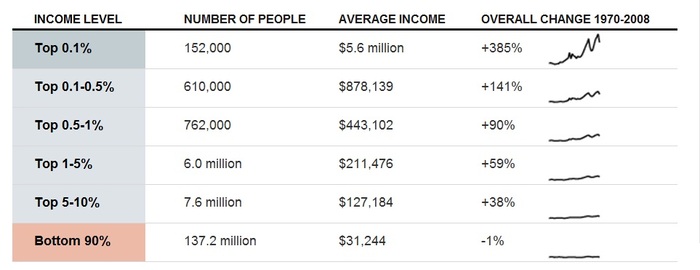
Note that 99% of Americans have seen their pay more or less stagnate over the 38 year period from 1970-2008. This occurred despite the American economic engine growing massively during that period. A rising tide, as it turns out, did NOT lift all boats.
The other statistic I found particularly interesting is that only 5% of American earners make more than $200,000. This means that proposed tax increases targeted at income earners of $200,000 and above would affect only this 5% of Americans, but oddly, a tax increase on this small group has no traction at all with the American voters. I can only conclude that to reduce the budget deficit it is apparently considered better to cut aid to the struggling bottom 90% of lower income families thereby sinking them deeper into destitution than to tax 5% of Americans a little more.
Juicy quotes from the article:
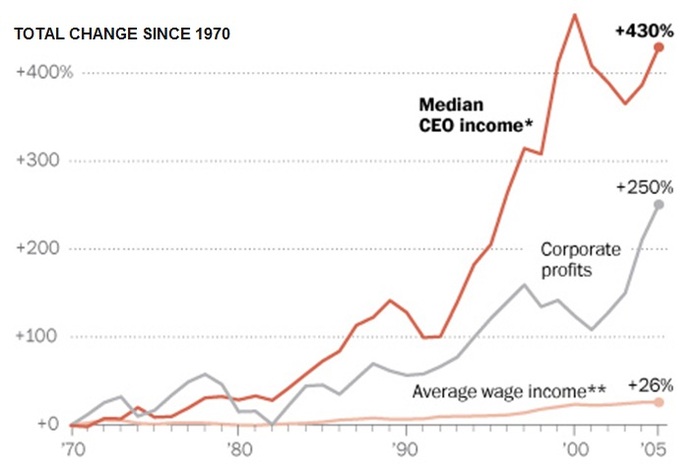
This increase has ceased to have any relation to corporate profits, and essentially represents a larger and larger percentage of corporate profits going into the pockets of the one or two people that run the company. Behind this form of compensation is the notion of the leader as saviour. In the same way as Superman saves the earth, we think of CEOs as lone ranger supermen, single-handedly doing all the work of making the company profitable. Think of that next time you get told in a management meeting that it’s all about teamwork. Not according to the pay structure.
And what relation do you think this pay structure has in comparison to what the company spends on marketing, R&D, and other such drivers of corporate profit? That’s a question I think we should all be asking.
--------------------------------------------------------------------------
First of all, this review is dedicated to Brian whose zeal for this book is just amazingly cool. Check out his review here if you haven’t already done so. Thanks, Brian, for sending me the book (even if I’m less enamoured of it than you are).
Okay, I promised a review and here it is.
Honestly, I really don’t know what to say. Hartmann is coming from a good place, one that I generally agree with. I think that there is much more that needs to be done in the world to regulate corporate misfeasance. I don’t agree that corporate personhood is the problem. I think it’s ared herringmisdirection or sleight of hand, a Trojan horse to get a foothold into the real bastion of power, and I think he has to do so because he can’t say, “Down with the rich!!”.
Now, when I say “rich”, I don’t mean people who are well-off, who make a few hundred thousand a year. I don’t even mean people who have a net worth of a few million. That’s literally loose change for the kind of rich people I refer to. I mean people like:
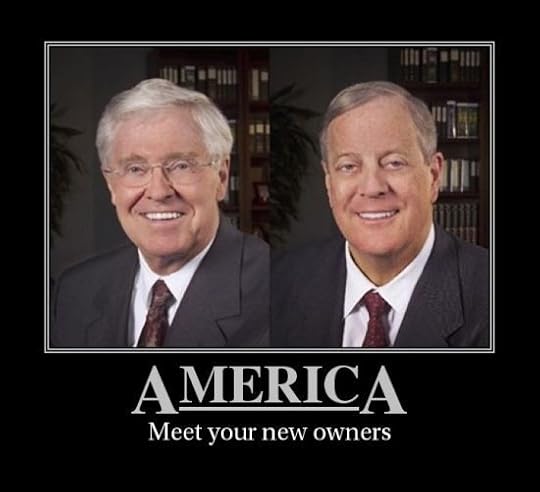
The Koch brothers: Net worth of US$21.5 billion each
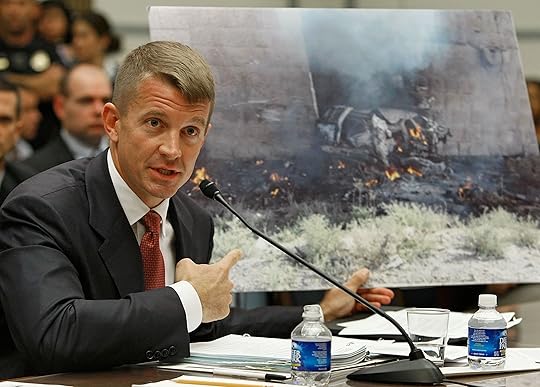
Erik Prince: Net worth of US$2.4 billion
[image error]
Lloyd Blankfein: Net worth of $9 billion
I think what he really thinks is that these people are the problem. You get hints of this from time to time:
● Page 120: And the men who had amassed these fortunes through creating mega-corporations were shameless in their brazenness… It had become an open secret that the very wealthy had brought under their control Congress itself.
● Page 146: Both Adam Smith and history tell us that such privatization schemes and the invisible hand work only to place more and more wealth into the pockets of the corporations and their stockholders.
● Page 170: He had worked most of his life in the interest of the rich and powerful and was chomping at the bit for a chance to turn more of America over to his friends.
● Page 237: The past thirty years has, in fact, seen the largest transfer of wealth from working people to the rich and the very rich in the history of both this nation and any nation on earth.
● Page 254: As multinational corporate wealth increases, stock prices go up and the top few percent of the socioeconomic pyramid become wealthier.
But this would only get him accused of being a commie, and get him discredited. So he has to dress it up as an attack against big corporations because that strand of thinking has some popular support. But corporations per se are not the problem, and I think he’s quite aware of this. As he himself notes, 99 per cent of all American companies are small businesses (page 306). It’s the concentration of wealth and power in the hands of a few people or families that is a problem:
● Page 127: All forms of organized business activity where there is money or power at stake, it seems, are equally susceptible to these corrupting forces…
● Page 244: Whether the wealth and power agent that takes the place of government is a local baron, lord, king, or corporation, if it has greater power in the lives of individuals than does a representative government, the culture has dissolved into feudalism.
● Page 304: The financial wealth of the top 1 percent now exceeds the combined household financial wealth of the bottom 95 percent.
The whole notion of limiting the power of government has such tenacity that we forget that power hates a vacuum. Weakening one power merely strengthens other existing powers. In the past, it used to be local warlords or barons. In our age, it’s wealthy business people and their families. Corporations are merely a tool used by the rich and powerful like the Koch brothers. The whole “personhood” notion is irrelevant to that power. It’s a very localised phenomenon situated only in the US. In no other country do you have a constitution that has been interpreted as granting corporations the same rights as humans but the problem of big, abusive corporations exists in all countries. Check this list out:
● Carlos Slim Helu (Brazil, US$74 billion)
● Bernard Arnault (France, US$41 billion)
● Lakshmi Mittal (India, US$31 billion)
● Vladimir Lisin (Russia, US$15.8 billion)
● Gina Rinehart (Australia, US$9 billion)
● Zong Qinghou (China, US$8 billion)
● Dhanin Chearavanont (Thailand, US$7 billion)
For more puke worthy information: http://www.forbes.com/wealth/billiona...
The law is merely one of the many means by which rich people seek to ensure that they concentrate more and more wealth and power in their hands.
I think using the courts to attack rich people might well work in the US as an effective Trojan horse. I don’t know because I don’t know the US system very well. I have serious doubts, but I’m not in a position to say anything intelligent about it.
So… I agree with his general thrust. However, I think he’s forced to wrap up the idea in a format that is more palatable to the American public, but which unfortunately rests on a bed of what I feel to be illogical thinking and inaccurate facts. I can’t honestly defend his logic and argument but I also don’t want to tear his ideas down.
I thought this article by the Washington Post was a nice addendum to my views.
Entitled, “With executive pay, rich pull away from rest of America”, it notes that of the 152,000 people that make up the top 0.1% of American earners (i.e., those that earned at least $1.7 million and $5.6 million in 2008), 41% of these were executives, supervisors and managers:
This graphic, in “(Not) spreading the wealth”, was particularly interesting:
Note that 99% of Americans have seen their pay more or less stagnate over the 38 year period from 1970-2008. This occurred despite the American economic engine growing massively during that period. A rising tide, as it turns out, did NOT lift all boats.
The other statistic I found particularly interesting is that only 5% of American earners make more than $200,000. This means that proposed tax increases targeted at income earners of $200,000 and above would affect only this 5% of Americans, but oddly, a tax increase on this small group has no traction at all with the American voters. I can only conclude that to reduce the budget deficit it is apparently considered better to cut aid to the struggling bottom 90% of lower income families thereby sinking them deeper into destitution than to tax 5% of Americans a little more.
Juicy quotes from the article:
…extremes of wealth can unfairly reduce the economic opportunities and political rights of everyone else, according to sociologists. The wealthy, for example, can afford better private schools for their children or acquire political might by purchasing campaign advertising or making campaign donations.Now, you might want to say that, yeah, these people are smart, they work hard yadda yadda yadda. So, they deserve what they make. Fair enough. But do they deserve to see their salaries go up by 4 times when corporate profits have only gone up by 2.5 times?
…
In world rankings of income inequality, the United States now falls among some of the world’s less-developed economies.… According to the CIA’s World Factbook, which uses the so-called “Gini coefficient,” a common economic indicator of inequality, the United States ranks as far more unequal than the European Union and the United Kingdom. The United States is in the company of developing countries—just behind Cameroon and Ivory Coast and just ahead of Uganda and Jamaica.
…
…late last year, economists Bakija, Cole and Heim completed their massive analysis of income tax returns. Little noticed outside academic circles, their research focused on the top 0.1 percent of earners. From those tax returns, they could glean a taxpayer’s occupation, which is self-reported. Using the employer’s tax identification number, the researchers found the industry they were employed in.
…
“Basically, executives represent a much bigger share of the top incomes than a lot of people had thought,” said Bakija, a professor at Williams College, who with his co-authors is continuing the research. “Before, we just didn’t know who these people were.”
This increase has ceased to have any relation to corporate profits, and essentially represents a larger and larger percentage of corporate profits going into the pockets of the one or two people that run the company. Behind this form of compensation is the notion of the leader as saviour. In the same way as Superman saves the earth, we think of CEOs as lone ranger supermen, single-handedly doing all the work of making the company profitable. Think of that next time you get told in a management meeting that it’s all about teamwork. Not according to the pay structure.
And what relation do you think this pay structure has in comparison to what the company spends on marketing, R&D, and other such drivers of corporate profit? That’s a question I think we should all be asking.
--------------------------------------------------------------------------
First of all, this review is dedicated to Brian whose zeal for this book is just amazingly cool. Check out his review here if you haven’t already done so. Thanks, Brian, for sending me the book (even if I’m less enamoured of it than you are).
Okay, I promised a review and here it is.
Honestly, I really don’t know what to say. Hartmann is coming from a good place, one that I generally agree with. I think that there is much more that needs to be done in the world to regulate corporate misfeasance. I don’t agree that corporate personhood is the problem. I think it’s a
Now, when I say “rich”, I don’t mean people who are well-off, who make a few hundred thousand a year. I don’t even mean people who have a net worth of a few million. That’s literally loose change for the kind of rich people I refer to. I mean people like:
The Koch brothers: Net worth of US$21.5 billion each
Erik Prince: Net worth of US$2.4 billion
[image error]
Lloyd Blankfein: Net worth of $9 billion
I think what he really thinks is that these people are the problem. You get hints of this from time to time:
● Page 120: And the men who had amassed these fortunes through creating mega-corporations were shameless in their brazenness… It had become an open secret that the very wealthy had brought under their control Congress itself.
● Page 146: Both Adam Smith and history tell us that such privatization schemes and the invisible hand work only to place more and more wealth into the pockets of the corporations and their stockholders.
● Page 170: He had worked most of his life in the interest of the rich and powerful and was chomping at the bit for a chance to turn more of America over to his friends.
● Page 237: The past thirty years has, in fact, seen the largest transfer of wealth from working people to the rich and the very rich in the history of both this nation and any nation on earth.
● Page 254: As multinational corporate wealth increases, stock prices go up and the top few percent of the socioeconomic pyramid become wealthier.
But this would only get him accused of being a commie, and get him discredited. So he has to dress it up as an attack against big corporations because that strand of thinking has some popular support. But corporations per se are not the problem, and I think he’s quite aware of this. As he himself notes, 99 per cent of all American companies are small businesses (page 306). It’s the concentration of wealth and power in the hands of a few people or families that is a problem:
● Page 127: All forms of organized business activity where there is money or power at stake, it seems, are equally susceptible to these corrupting forces…
● Page 244: Whether the wealth and power agent that takes the place of government is a local baron, lord, king, or corporation, if it has greater power in the lives of individuals than does a representative government, the culture has dissolved into feudalism.
● Page 304: The financial wealth of the top 1 percent now exceeds the combined household financial wealth of the bottom 95 percent.
The whole notion of limiting the power of government has such tenacity that we forget that power hates a vacuum. Weakening one power merely strengthens other existing powers. In the past, it used to be local warlords or barons. In our age, it’s wealthy business people and their families. Corporations are merely a tool used by the rich and powerful like the Koch brothers. The whole “personhood” notion is irrelevant to that power. It’s a very localised phenomenon situated only in the US. In no other country do you have a constitution that has been interpreted as granting corporations the same rights as humans but the problem of big, abusive corporations exists in all countries. Check this list out:
● Carlos Slim Helu (Brazil, US$74 billion)
● Bernard Arnault (France, US$41 billion)
● Lakshmi Mittal (India, US$31 billion)
● Vladimir Lisin (Russia, US$15.8 billion)
● Gina Rinehart (Australia, US$9 billion)
● Zong Qinghou (China, US$8 billion)
● Dhanin Chearavanont (Thailand, US$7 billion)
For more puke worthy information: http://www.forbes.com/wealth/billiona...
The law is merely one of the many means by which rich people seek to ensure that they concentrate more and more wealth and power in their hands.
I think using the courts to attack rich people might well work in the US as an effective Trojan horse. I don’t know because I don’t know the US system very well. I have serious doubts, but I’m not in a position to say anything intelligent about it.
So… I agree with his general thrust. However, I think he’s forced to wrap up the idea in a format that is more palatable to the American public, but which unfortunately rests on a bed of what I feel to be illogical thinking and inaccurate facts. I can’t honestly defend his logic and argument but I also don’t want to tear his ideas down.

April 2, 2011
Note, Aug. 29, 2015 --I just edited this review slightly, to correct a misspelled word.
Thom Hartmann is a liberal (he prefers to avoid the l-word, with "progressive") talk-radio host and writer of popular-level books on current issues. (To his credit, he's also quite active, along with his wife, in philanthropy for children in need, and relief work abroad.) His core subject here is one of the most crucially important and timely ones imaginable: the ongoing drastic deformation of society, the economy, government, and law in America and around the world, at the hands of profit-driven mega-corporations intent on concentrating all the world's wealth and power into their few hands. He lays this deformation bare under a piercing searchlight, and what he reveals is appalling; before I read this, I already considered myself relatively knowledgeable about the problem, but he exposed information that even shocked me. And he makes it clear that the principal legal weapon of these corporations is a warped interpretation of corporate "personhood."
While Hartmann isn't an historian (and it often shows), he's researched some themes and key events in American history thoroughly enough to be on sure ground. As he documents, abuses of power by multinational corporations working hand in glove with bought politicians to create monopolies and exploit the masses are nothing new; they were rife in the 18th century, with the East India Company one of the biggest players. The Boston Tea Party, and the boiling unrest it symbolized, wasn't solely about a tax on tea; the tea dumped into Boston harbor was tax-free tea, brought in by the East India Company in a sweetheart deal with Parliament, which would allow them to undersell and bankrupt all of their small American competitors who were selling taxed tea. America's founders were familiar with these abuses and didn't appreciate them; most were opposed to monopoly and supportive of small business and healthily competitive free enterprise (in the actual, lexical sense of the term). The legal and political climate they created in early America was one in which active Federal and especially state regulation of corporations and their business practices and political activities, for the common good, was taken for granted.
In English/American common law, however, corporations traditionally were reckoned as "artificial persons," a legal fiction that allowed them to do some of the same things a natural person can, such as own property and be a party to a lawsuit. At this point, it was not argued by anybody that corporations did or should possess all the rights of "natural persons" (that is, flesh-and-blood human beings). After the passage of the 14th Amendment to the U.S. Constitution, aimed at protecting the rights of freed slaves, however, this amendment was highjacked by corporate lawyers who now argued exactly that, in a barrage of lawsuits aimed at striking down any regulation of corporate actions. Their crucial victory is usually supposed to be the 1886 Santa Clara County vs. Southern Pacific Railroad case, in which most historians tell us that the Supreme Court ruled that corporations are "persons" for 14th Amendment purposes. In fact, as Hartmann amply documents, the Court's actual opinion explicitly refused to rule on that claim; the subsequent misrepresentation of the ruling rests entirely on a headnote by the court clerk (despite two explicit Supreme Court rulings that headnotes have no legal force), probably written with a deliberately disingenuous intention. Since 1886, corporations have repeatedly used the courts to assert their "rights" as "persons" not to be "unequally" taxed vis a vis individuals; to be protected from health and safety inspections; and even to falsely advertise, on the grounds that this is constitutionally-protected "free speech." A major milestone in this campaign was the 2010 U.S. Supreme Court decision in Citizens United vs. Federal Election Commission, which ruled that any restriction on corporate expenditures for political advertising are an unconstitutional violation of their "free speech" rights as "persons."
Besides a veritable chamber of horrors of actual U.S. court rulings in favor of corporate abuses, the book provides a wealth of statistics on the accelerating concentration of national and global wealth into a relatively few hands, and the attendant actual decline of wages (if the figures are adjusted for inflation) of most Americans. Hartmann also documents a disturbing trend towards state laws criminalizing any "whistle-blowing" of corporate secrets, and perverted use of the concept of "libel" to criminalize criticism of corporate actions and policies, such as the laws in 13 states that make it a crime to "disparage the food supply" by suggesting that it's contaminated by corporation-caused pollutions or unsanitary practices. And he gives attention to the corporate-caused systematic destruction of small business and of human-scaled community. He also documents the increasing monopoly domination of the news (and other) media by mega-corporations, and their willingness to use this dominance to silence criticism and promote their own agendas.
To remedy this death threat posed to our democracy and economy, the author proposes a two-pronged approach. On one track, he favors the enactment of local (city, town, county or township) regulations of corporate behavior, creating more opportunity for litigation that may give the court system a chance to correct its past misinterpretation of the Constitution (as, say, Brown vs. the Board of Education corrected Plessy vs. Ferguson). On another track, he favors a push for a constitutional amendment making it explicit that the rights of persons extend only to natural, not artificial, persons (though I don't share his optimism that the Supreme Court would change its rulings in that event, given a legal culture that denies the normative significance of the written text of the Constitution anyway.)
In all of the above, I found Hartmann's analysis sound, timely and educational. (For instance, it convinced me that the Citizens United decision was not only incorrectly decided, but bad policy; I was previously inclined to oppose restrictions on political ads run by bona fide non-profit issue-oriented groups that are incorporated, but there's no legal way to separate the bona fide ones from the fronts for for-profit corporations. The McCain-Feingold Act didn't prevent individuals, or candidates, from exercising their free speech rights.) The core message of the book is one everybody should be made aware of, and would, considered by itself, have merited a 4 or 5-star rating. So, why did it only get three? The answer could be summed up as flawed presentation, and gratuitous ideological posturing.
As a talk-radio host, Hartmann can probably get by with being rather disorganized and repetitive in his comments; the medium doesn't lend itself to sustained, well-organized presentation of developed arguments. In a book, though, you need the latter, and here it's too often lacking. His ignorance of history, outside of the narrow areas where he's really researched, makes his attempts at broad historical analysis so cringe-inducingly oversimplified, distorted and actually erroneous that they're essentially waste of paper. He also has more than occasional misuses of terms here. But more importantly, even though he recognizes at one point that the traditional Democrats vs. Republicans and Tories vs. Labor party distinctions are less relevant than the fundamental distinction between the politicians working for corporations and those working for ordinary citizens (and explicitly demonstrates that "Third Way" politicos like Clinton, Blair, and Obama are tools, not opponents, of the corporations), he's still a highly partisan child of the hard Left, for whom the Democratic Party is his old school tie and Republicans are essentially incarnations of evil. This colors his writing repeatedly, and demonstrates that although there are coalescent possibilities galore in his core program (and it stands no chance of being enacted without a coalescent realignment of political allegiances!), ever getting those possibilities realized is going to be an uphill battle. When he's forced to recognize that some Republicans/conservatives agree with aspects of his case, his response is sometimes to disparage them anyway, as when the fact that Chief Justice Rehnquist felt that the Santa Clara "precedent" was wrongly decided and that corporations do NOT have human rights is met with a completely gratuitous and poorly-reasoned "racism" smear. And he goes out of his way to drag in every irrelevant liberal shibboleth he can think of; his enthusiasm for Roe vs. Wade, for instance, grates like long fingernails scraping over a blackboard, and demonstrates that his enthusiasm for faithful constitutional interpretation is confined to cases where he'd like the result. (In fairness, though, his only chapter-long excursion into irrelevant ideological territory, his attack on the 2000 Supreme Court ruling in the Bush-Gore Florida electoral vote battle, does provide factual information that the more superficial media accounts did not, and convinces me that the Supreme Court intervened in the case improperly.) His examples of horrible behavior are invariably drawn from the Right, as with the revelation (which he conclusively proves) that right-wing organizations and campaigns are hiring people to post pre-supplied talking points on the Internet, wherever sites allow people to comment --a phenomenon I find as alarming as any he describes here. (But if the Right is doing this --and they are-- does anyone seriously imagine that the Left is not?)
In summary, then, this is a flawed presentation of a serious (make that vitally-important!) wake-up call about a serious threat to our basic foundation as a nation. Even with its flaws, I think it would be a worthwhile eye-opener for many people to read, because it presents facts and arguments in one place that aren't often met with, and might not be as compactly assembled in very many other books. If you "take the meat, and throw away the bone," you can still find a lot of meat here!
Thom Hartmann is a liberal (he prefers to avoid the l-word, with "progressive") talk-radio host and writer of popular-level books on current issues. (To his credit, he's also quite active, along with his wife, in philanthropy for children in need, and relief work abroad.) His core subject here is one of the most crucially important and timely ones imaginable: the ongoing drastic deformation of society, the economy, government, and law in America and around the world, at the hands of profit-driven mega-corporations intent on concentrating all the world's wealth and power into their few hands. He lays this deformation bare under a piercing searchlight, and what he reveals is appalling; before I read this, I already considered myself relatively knowledgeable about the problem, but he exposed information that even shocked me. And he makes it clear that the principal legal weapon of these corporations is a warped interpretation of corporate "personhood."
While Hartmann isn't an historian (and it often shows), he's researched some themes and key events in American history thoroughly enough to be on sure ground. As he documents, abuses of power by multinational corporations working hand in glove with bought politicians to create monopolies and exploit the masses are nothing new; they were rife in the 18th century, with the East India Company one of the biggest players. The Boston Tea Party, and the boiling unrest it symbolized, wasn't solely about a tax on tea; the tea dumped into Boston harbor was tax-free tea, brought in by the East India Company in a sweetheart deal with Parliament, which would allow them to undersell and bankrupt all of their small American competitors who were selling taxed tea. America's founders were familiar with these abuses and didn't appreciate them; most were opposed to monopoly and supportive of small business and healthily competitive free enterprise (in the actual, lexical sense of the term). The legal and political climate they created in early America was one in which active Federal and especially state regulation of corporations and their business practices and political activities, for the common good, was taken for granted.
In English/American common law, however, corporations traditionally were reckoned as "artificial persons," a legal fiction that allowed them to do some of the same things a natural person can, such as own property and be a party to a lawsuit. At this point, it was not argued by anybody that corporations did or should possess all the rights of "natural persons" (that is, flesh-and-blood human beings). After the passage of the 14th Amendment to the U.S. Constitution, aimed at protecting the rights of freed slaves, however, this amendment was highjacked by corporate lawyers who now argued exactly that, in a barrage of lawsuits aimed at striking down any regulation of corporate actions. Their crucial victory is usually supposed to be the 1886 Santa Clara County vs. Southern Pacific Railroad case, in which most historians tell us that the Supreme Court ruled that corporations are "persons" for 14th Amendment purposes. In fact, as Hartmann amply documents, the Court's actual opinion explicitly refused to rule on that claim; the subsequent misrepresentation of the ruling rests entirely on a headnote by the court clerk (despite two explicit Supreme Court rulings that headnotes have no legal force), probably written with a deliberately disingenuous intention. Since 1886, corporations have repeatedly used the courts to assert their "rights" as "persons" not to be "unequally" taxed vis a vis individuals; to be protected from health and safety inspections; and even to falsely advertise, on the grounds that this is constitutionally-protected "free speech." A major milestone in this campaign was the 2010 U.S. Supreme Court decision in Citizens United vs. Federal Election Commission, which ruled that any restriction on corporate expenditures for political advertising are an unconstitutional violation of their "free speech" rights as "persons."
Besides a veritable chamber of horrors of actual U.S. court rulings in favor of corporate abuses, the book provides a wealth of statistics on the accelerating concentration of national and global wealth into a relatively few hands, and the attendant actual decline of wages (if the figures are adjusted for inflation) of most Americans. Hartmann also documents a disturbing trend towards state laws criminalizing any "whistle-blowing" of corporate secrets, and perverted use of the concept of "libel" to criminalize criticism of corporate actions and policies, such as the laws in 13 states that make it a crime to "disparage the food supply" by suggesting that it's contaminated by corporation-caused pollutions or unsanitary practices. And he gives attention to the corporate-caused systematic destruction of small business and of human-scaled community. He also documents the increasing monopoly domination of the news (and other) media by mega-corporations, and their willingness to use this dominance to silence criticism and promote their own agendas.
To remedy this death threat posed to our democracy and economy, the author proposes a two-pronged approach. On one track, he favors the enactment of local (city, town, county or township) regulations of corporate behavior, creating more opportunity for litigation that may give the court system a chance to correct its past misinterpretation of the Constitution (as, say, Brown vs. the Board of Education corrected Plessy vs. Ferguson). On another track, he favors a push for a constitutional amendment making it explicit that the rights of persons extend only to natural, not artificial, persons (though I don't share his optimism that the Supreme Court would change its rulings in that event, given a legal culture that denies the normative significance of the written text of the Constitution anyway.)
In all of the above, I found Hartmann's analysis sound, timely and educational. (For instance, it convinced me that the Citizens United decision was not only incorrectly decided, but bad policy; I was previously inclined to oppose restrictions on political ads run by bona fide non-profit issue-oriented groups that are incorporated, but there's no legal way to separate the bona fide ones from the fronts for for-profit corporations. The McCain-Feingold Act didn't prevent individuals, or candidates, from exercising their free speech rights.) The core message of the book is one everybody should be made aware of, and would, considered by itself, have merited a 4 or 5-star rating. So, why did it only get three? The answer could be summed up as flawed presentation, and gratuitous ideological posturing.
As a talk-radio host, Hartmann can probably get by with being rather disorganized and repetitive in his comments; the medium doesn't lend itself to sustained, well-organized presentation of developed arguments. In a book, though, you need the latter, and here it's too often lacking. His ignorance of history, outside of the narrow areas where he's really researched, makes his attempts at broad historical analysis so cringe-inducingly oversimplified, distorted and actually erroneous that they're essentially waste of paper. He also has more than occasional misuses of terms here. But more importantly, even though he recognizes at one point that the traditional Democrats vs. Republicans and Tories vs. Labor party distinctions are less relevant than the fundamental distinction between the politicians working for corporations and those working for ordinary citizens (and explicitly demonstrates that "Third Way" politicos like Clinton, Blair, and Obama are tools, not opponents, of the corporations), he's still a highly partisan child of the hard Left, for whom the Democratic Party is his old school tie and Republicans are essentially incarnations of evil. This colors his writing repeatedly, and demonstrates that although there are coalescent possibilities galore in his core program (and it stands no chance of being enacted without a coalescent realignment of political allegiances!), ever getting those possibilities realized is going to be an uphill battle. When he's forced to recognize that some Republicans/conservatives agree with aspects of his case, his response is sometimes to disparage them anyway, as when the fact that Chief Justice Rehnquist felt that the Santa Clara "precedent" was wrongly decided and that corporations do NOT have human rights is met with a completely gratuitous and poorly-reasoned "racism" smear. And he goes out of his way to drag in every irrelevant liberal shibboleth he can think of; his enthusiasm for Roe vs. Wade, for instance, grates like long fingernails scraping over a blackboard, and demonstrates that his enthusiasm for faithful constitutional interpretation is confined to cases where he'd like the result. (In fairness, though, his only chapter-long excursion into irrelevant ideological territory, his attack on the 2000 Supreme Court ruling in the Bush-Gore Florida electoral vote battle, does provide factual information that the more superficial media accounts did not, and convinces me that the Supreme Court intervened in the case improperly.) His examples of horrible behavior are invariably drawn from the Right, as with the revelation (which he conclusively proves) that right-wing organizations and campaigns are hiring people to post pre-supplied talking points on the Internet, wherever sites allow people to comment --a phenomenon I find as alarming as any he describes here. (But if the Right is doing this --and they are-- does anyone seriously imagine that the Left is not?)
In summary, then, this is a flawed presentation of a serious (make that vitally-important!) wake-up call about a serious threat to our basic foundation as a nation. Even with its flaws, I think it would be a worthwhile eye-opener for many people to read, because it presents facts and arguments in one place that aren't often met with, and might not be as compactly assembled in very many other books. If you "take the meat, and throw away the bone," you can still find a lot of meat here!

March 30, 2011
This may be the most important book you will read in the 21st century.
Thom Hartmann makes a devastatingly powerful case that corporations, mainly through establishing the status of a natural person through the court since the passage of the 14th amendment and subsequent legal cases, are now in the position of subverting democracy and becoming, no...became... the primacy controlling body in the country and the world. Personally, just from observation, I think this is obvious. However Hartmann does some incredible research from the American Revolution through the first case establishing, erroneously from Hartmann's perspective, human rights for corporations and up to our current supreme court allowing corporations to have unlimited spending in public campaigns, effectively drowning out the average citizens' voice while squashing same citizens' attempt to protest or control corporate abuses. Hartmann makes a very effective case for the current corporate system as Neo-Feudalism and something that is far from the democratic system, or for that matter any capitalist system, envisioned by the founding fathers. The author also includes reasonable steps the reader and organizations can do to reverse this trend. Read this before it is too late. It may already be too late.
Thom Hartmann makes a devastatingly powerful case that corporations, mainly through establishing the status of a natural person through the court since the passage of the 14th amendment and subsequent legal cases, are now in the position of subverting democracy and becoming, no...became... the primacy controlling body in the country and the world. Personally, just from observation, I think this is obvious. However Hartmann does some incredible research from the American Revolution through the first case establishing, erroneously from Hartmann's perspective, human rights for corporations and up to our current supreme court allowing corporations to have unlimited spending in public campaigns, effectively drowning out the average citizens' voice while squashing same citizens' attempt to protest or control corporate abuses. Hartmann makes a very effective case for the current corporate system as Neo-Feudalism and something that is far from the democratic system, or for that matter any capitalist system, envisioned by the founding fathers. The author also includes reasonable steps the reader and organizations can do to reverse this trend. Read this before it is too late. It may already be too late.

Want to Read
May 26, 2011Introduction
This is not a review of the book, because I have not (and might never) read it.
This might be unfair to the author.
However, the ideas in the book have been clearly enunciated in reviews by Brian and Whitaker and the supportive comments that their reviews have elicited.
I want to state in one place my arguments that companies in their own right are not the problem.
Attacking the Underlying Behaviour
The real problem is the behavior of the companies that humans make them engage in.
If any behavior of a company is regarded as harmful or evil, then the answer is to address that behaviour directly by appropriate laws, rather than to change the laws that enable humans to form companies.
If there is anything harmful or evil about the underlying behavior, it is likely that the same behavior would be equally harmful or evil if it was engaged in by natural persons (as opposed to a company).
I do not agree with the argument that some conduct is acceptable if engaged in by a natural person, but unacceptable if engaged in by a company.
Therefore, the law needs to address the behavior at a more general level, regardless of who (or what entity) has engaged in the behavior.
Vicarious Liability
In the case of a company, this might include extending any liability of the company to people associated with it like shareholders, directors, executives (such as management) and employees who were responsible (or should be regarded as responsible) for the behaviour.
The Merits of the Book
I don’t wish to attack the book or its concerns.
It has created a healthy and vital debate.
I just feel that the view that “corporate personality” is the problem is misguided and distracts people from the real, underlying harm or evil.
It is like saying that, because people commit crimes, you could prevent all crime by banning people.
We need and deserve a more subtle or sophisticated approach to the harm or evil.
Abusing the Legislative Process
When people start using the wrong tool (especially a very blunt one) to address a harm or evil, they create a political and legal precedent that can be abused in other situations.
All of us might want to prevent or punish the evil, but we have to play the ball, not the man (or the corporation).
There isn't anything wrong with "rich". There is something wrong with misappropriation of someone else's wealth.
There isn't anything wrong with power. There is something wrong with the abuse of power.
Legal Personalities and Entities
Modern corporations owe their existence to the British East India Company, which was “incorporated” on 31 December, 1600.
The word “incorporation” is derived from the word “corpus”, which means “body”.
The process of “incorporation” gives the company a legal “body”.
The “incorporation” of the company creates a legal entity separate from its investors or shareholders.
It gives the company an artificial “legal personality” or “legal personhood” (Latin: “persona ficta”).
The company is not a material thing that exists in objective reality.
It is a “legal fiction”.
The law treats it “as if” (or to use the German philosophical term, “als ob”) it exists and as if it has the same status as a human or "natural person".
This allows the legal person to have the rights and obligations of a natural person.
However, overall, legal and natural persons are both examples or subsets of "legal entities".
Partnerships
Before the concept of a "corporation", if an association of persons got together to carry out a business or a business venture, they effectively formed a “partnership”.
If the partnership owed you money, you would have to sue all of the partners, so if there were 300 partners, you would have to sue 300 individuals.
This would be administratively difficult, time-consuming and expensive.
Limited Liability Companies
This was one of the reasons that the idea of limited liability companies was created.
The investors in the British East India Company wanted to engage in a business venture that involved travelling to the East Indies and bringing back enormous wealth.
However, the project was expensive and risky.
Their ships might sink, there might be no wealth at the other end, and the wealth might be stolen by pirates on the way back.
If the venture failed, the investors were concerned that all of their personal wealth would be available to satisfy debts and liabilities of the venture itself.
The investors wanted to be sheltered against this risk.
They wanted to know that, if they each put in, say, $100,000, that would be the limit of their liability to people who traded with the venture.
The government decided that the potential benefit of the venture for the nation was sufficient to justify inserting a new “entity” or “body” between the investors and the creditors, which was the company.
Instead of dealing directly with the investors, the creditors could (and only had to) deal with the company.
The company could sue and be sued for any debts or liabilities.
However, the shareholders could not be sued for the debts or liabilities of the company, except their promise to invest their original $100,000 in the capital of the company.
This allowed the investors or shareholders to hide "behind the corporate veil" of the company.
Their liability was limited.
The creditor could only sue the company, it couldn't sue the shareholders.
If anyone was worried about the ability of the company to pay its debts, the answer was that they shouldn’t deal with the company at all.
How a Company Operates
No matter how big or small the company:
* the shareholders own the company (and their wealth is increased by their proportionate share of the company);
* the shareholders appoint the directors to manage the company at the macro level;
* the directors appoint an executive management team to manage the company at the next level down;
* the executive management team employs the staff.
Reasons People Use Companies Today
If you look at why most small business people use companies today, it probably boils down to two reasons:
* it protects the shareholders from claims by creditors of the business;
* the tax rate is lower for companies than it is for individuals.
The lower tax rate means that companies can keep their after tax-profit in the company and use it as working capital to grow the business and its wealth, and the only tax they have had to pay is the corporate rate.
However, if they reversed the tax rates (so that individuals paid a lower tax rate), the only small business people who would use companies would be people who were in risky industries who wanted to protect personal assets from the claims of business creditors.
Small business people probably wouldn't use a company if they had to pay a higher tax rate.
The limited liability justification mightn’t be enough to justify the additional tax liability.
Sole Liability or Dual Liability?
The flipside of the law is the liability that it imposes.
Just as a law can grant rights, it can impose liabilities.
Corporate personality is a double edged sword.
The company does not have a legal excuse if someone else (a person or persons) caused it to engage in harmful or evil behaviour.
The company will still be on the hook.
However, there is an additional question as to whether the other person is also liable (“vicarious liability”).
This could be important if a company gets sued for damages or compensation, but can't pay its debt.
The plaintiff misses out on their compensation.
Can the plaintiff go beyond the company to get its compensation?
In many cases, people can hide behind a company's impoverished financial status.
Like any person, there is no point in suing a company, if it hasn't got any money.
It's just that companies seem to get up to more mischief than individuals do in their own name.
Removing the Corporate Veil
There are already a number of situations in which the shareholders or directors of a company can be liable for the actions of the company.
It is possible to “remove the corporate veil”.
This happens with respect to company loans, if the creditor obtains personal guarantees from the shareholders (like a bank would do).
The creditor can go around the company.
Similarly, if the State wants to stop shareholders hiding behind the corporate veil, then it has to make them an entity subject to the law in their own right.
An example is where a director or shareholder could be held to be liable if the company they managed or owned was trading while they knew it to be insolvent.
Similarly, if they used the company to perpetrate fraud, they could be personally liable.
This is what the law currently thinks is appropriate.
It may be that the law needs to be tightened up.
In other words, there may be a case for making the liability less limited.
And punishing the actual people who ought to be punished.
How Do You Do What You Do to Me?
Part of the rationale for punishing the person as well is that a company can't “know” that it is insolvent or perpetrating a fraud.
Only the people can know. And it's the people who make the company do what it does.
In these situations, the law can make the people liable for inappropriate things they made the company do.
I don't think there is anything wrong with legal personality or "corporate personhood" in its own right.
The great achievement of corporations has been to encourage economic risk-taking in the expectation of greater wealth for the nation.
That doesn't mean companies can't be abused or used to abuse others.
However, it's the people who do it.
So What Laws Should Apply to Companies?
Laws can create both rights and obligations.
Therefore, the question is: what rights and obligations should companies have?
It's the failure to develop a logical public policy about what rights and obligations should apply to companies (and what liabilities the shareholders should have) that is the real problem.
Should a Company Get All of the Rights and Benefits of a Natural Person?
If a company is intended to have the same rights and benefits as a natural person, then the State should spell it out in the law.
It's up to the State to determine what “entities” any particular law applies to.
Normally, you would expect the law to be specific about this.
Interpretation of US Constitution
In some cases, there might be an ambiguity in a law like the US Constitution.
This might occur for historical reasons (e.g., because it uses the word "person" when it means "natural person" or “citizen”).
In these cases, it's a matter of statutory interpretation of words like "person" and "citizen" in the actual section and whether they do or are intended to extend to non-natural persons.
Statutory interpretation takes into account the context of the words.
Sometimes the context will say no, a company is not included in the term "person", but in others it will dictate that it is (e.g., due process, equality before the law).
In contrast, the German Basic Law declares that "the basic rights shall also apply to domestic artificial persons to the extent that the nature of such rights permits.”
You Can't Have Sex with a Company
The German law makes it clear that not every right would be logically applicable to a company.
For example, can a company be a citizen?
Can a company vote in an election?
An example of where it wouldn't make sense to treat a company the same as a natural person is a criminal offence for deliberately transmitting a sexually transmitted disease to another natural person.
It doesn't really make sense that a company could have an STD, could form the intention to transmit it to someone else and could then do so by way of sexual intercourse.
Similarly, you couldn't have sex with a company, let alone an underage company.
I can’t imagine someone saying (to paraphrase Bill Clinton), "I did not have sexual relations with that corporation."
The Morality of Companies
Companies are actually an amazing invention.
There is one morally suspect aspect of companies though.
The duty of a company is to maximise the interests of shareholders.
Apart from statutory duties, a company has no moral or social compulsion to do good in a community sense (unless there might be a benefit in a marketing sense).
This means that the people who run companies get into conflicts between their overriding duty to shareholders and any moral or social duties that arguably should have influenced their judgements and actions.
Management often has recourse to this overriding duty as if it were a Nuremberg Defence.
Framing the Law
We need to establish:
* what is the harm or evil or mischief that we are trying to prevent?
* what is the appropriate law or method of preventing the harm or evil or mischief?
Until we start discussing the issue in terms of the “harm” or "evil" done by the company, we won't be able to design the laws that are necessary.
Freedom From and Against the Law
My starting point is that everything in society should be permitted, unless there is a law that prohibits it.
If some activity is not prohibited by the law, then it should be permitted.
I apologise if this all sounds very old-fashioned.
But it is as old-fashioned as the Romans, though I can only find the French maxim at the moment:
“Tout ce que la loi ne defend pas est permis. (Everything is permitted, which is not forbidden by law.)”
What is the Harm or Evil We Want to Prevent or Punish?
The question is: is there some evil or harm that warrants prohibition by the law.
I am using the word "evil" as a term to describe something that is regarded by the community or Congress as bad enough to justify the passage of a law prohibiting it.
The word "evil" might be and sound like an old-fashioned term, but it has been widely used in political and legal philosophy.
It is used a lot in Jeremy Bentham’s "An Introduction to the Principles of Morals and Legislation"
He also used the word "mischief".
Bentham was trying to codify the basis upon which it would be appropriate to limit freedom and make some action a crime against society and the state that was punishable by the law.
He had a utilitarian approach to the law:
"All punishment is mischief: all punishment in itself is evil.
"Upon the principle of utility, if it (punishment - ed.) ought at all to be admitted, it ought only to be admitted in as far as it promises to exclude some greater evil."
Rights that Companies Shouldn’t Have
Some readers have argued that companies shouldn’t have:
• The right to participate in the political process; or
• A right of privacy.
I will make some comments on each right.
Participation in the Political Process
Participation in the political process cannot be an evil in its own right.
Obviously, if a citizen participates, that participation is not intrinsically an evil.
So the question is whether, when a company participates, its participation is an evil.
Is there something inherent in a company that makes its participation an evil?
I don't understand what that characteristic could be.
If a natural person had that same, precise characteristic, would it be an evil?
If not, then the argument must be that the participation is evil, precisely because it was by a corporation.
In other words, something that is not intrinsically an evil in its own right becomes evil because it is done by a corporation?
If this is the argument, then it is effectively saying that the identity of the "legal person" can make an activity or behavior an evil.
This could become a dangerous argument in the hands of other people.
Could it justify something being treated as evil if it was done by a person of one colour or race or gender, but not another?
This argument starts to offend the principle that everybody should be equal before the law.
Regardless of the interpretation of the US Constitution, I think that any person (whether natural or legal) should have the same right to be treated fairly and equally by a court.
I do not accept the argument that corporations are an evil full stop and that any activity by a corporation is evil.
Privacy
Similarly, privacy in its own right is not an evil.
Yet the argument seems to be that, if a company were to have a right of privacy, then its privacy would be an evil.
I don't understand this argument.
I can understand the concern that a company might be able to use its right of privacy to avoid inspections and audits by regulators.
Could an individual assert the same right of privacy to avoid the same inspections and audits?
If so, it's not the privacy of corporations that is the problem, it seems to be the manner in which any type of person must submit to inspection and audit that is flawed.
Something in the general drafting of the law must offend the general right of privacy.
The Challenge
My ultimate concern in both cases is the assumption that a company and its activities are intrinsically evil, therefore you have to ban companies.
In other words, if a natural person did the exact same thing, it would be OK.
But if a company did it, there's something wrong.
If that is indeed the case that Hartmann is making, I think he’s going to have trouble getting anyone in Congress to take notice.
Which means that the underlying harm or evil will go unchecked.
This is not a review of the book, because I have not (and might never) read it.
This might be unfair to the author.
However, the ideas in the book have been clearly enunciated in reviews by Brian and Whitaker and the supportive comments that their reviews have elicited.
I want to state in one place my arguments that companies in their own right are not the problem.
Attacking the Underlying Behaviour
The real problem is the behavior of the companies that humans make them engage in.
If any behavior of a company is regarded as harmful or evil, then the answer is to address that behaviour directly by appropriate laws, rather than to change the laws that enable humans to form companies.
If there is anything harmful or evil about the underlying behavior, it is likely that the same behavior would be equally harmful or evil if it was engaged in by natural persons (as opposed to a company).
I do not agree with the argument that some conduct is acceptable if engaged in by a natural person, but unacceptable if engaged in by a company.
Therefore, the law needs to address the behavior at a more general level, regardless of who (or what entity) has engaged in the behavior.
Vicarious Liability
In the case of a company, this might include extending any liability of the company to people associated with it like shareholders, directors, executives (such as management) and employees who were responsible (or should be regarded as responsible) for the behaviour.
The Merits of the Book
I don’t wish to attack the book or its concerns.
It has created a healthy and vital debate.
I just feel that the view that “corporate personality” is the problem is misguided and distracts people from the real, underlying harm or evil.
It is like saying that, because people commit crimes, you could prevent all crime by banning people.
We need and deserve a more subtle or sophisticated approach to the harm or evil.
Abusing the Legislative Process
When people start using the wrong tool (especially a very blunt one) to address a harm or evil, they create a political and legal precedent that can be abused in other situations.
All of us might want to prevent or punish the evil, but we have to play the ball, not the man (or the corporation).
There isn't anything wrong with "rich". There is something wrong with misappropriation of someone else's wealth.
There isn't anything wrong with power. There is something wrong with the abuse of power.
Legal Personalities and Entities
Modern corporations owe their existence to the British East India Company, which was “incorporated” on 31 December, 1600.
The word “incorporation” is derived from the word “corpus”, which means “body”.
The process of “incorporation” gives the company a legal “body”.
The “incorporation” of the company creates a legal entity separate from its investors or shareholders.
It gives the company an artificial “legal personality” or “legal personhood” (Latin: “persona ficta”).
The company is not a material thing that exists in objective reality.
It is a “legal fiction”.
The law treats it “as if” (or to use the German philosophical term, “als ob”) it exists and as if it has the same status as a human or "natural person".
This allows the legal person to have the rights and obligations of a natural person.
However, overall, legal and natural persons are both examples or subsets of "legal entities".
Partnerships
Before the concept of a "corporation", if an association of persons got together to carry out a business or a business venture, they effectively formed a “partnership”.
If the partnership owed you money, you would have to sue all of the partners, so if there were 300 partners, you would have to sue 300 individuals.
This would be administratively difficult, time-consuming and expensive.
Limited Liability Companies
This was one of the reasons that the idea of limited liability companies was created.
The investors in the British East India Company wanted to engage in a business venture that involved travelling to the East Indies and bringing back enormous wealth.
However, the project was expensive and risky.
Their ships might sink, there might be no wealth at the other end, and the wealth might be stolen by pirates on the way back.
If the venture failed, the investors were concerned that all of their personal wealth would be available to satisfy debts and liabilities of the venture itself.
The investors wanted to be sheltered against this risk.
They wanted to know that, if they each put in, say, $100,000, that would be the limit of their liability to people who traded with the venture.
The government decided that the potential benefit of the venture for the nation was sufficient to justify inserting a new “entity” or “body” between the investors and the creditors, which was the company.
Instead of dealing directly with the investors, the creditors could (and only had to) deal with the company.
The company could sue and be sued for any debts or liabilities.
However, the shareholders could not be sued for the debts or liabilities of the company, except their promise to invest their original $100,000 in the capital of the company.
This allowed the investors or shareholders to hide "behind the corporate veil" of the company.
Their liability was limited.
The creditor could only sue the company, it couldn't sue the shareholders.
If anyone was worried about the ability of the company to pay its debts, the answer was that they shouldn’t deal with the company at all.
How a Company Operates
No matter how big or small the company:
* the shareholders own the company (and their wealth is increased by their proportionate share of the company);
* the shareholders appoint the directors to manage the company at the macro level;
* the directors appoint an executive management team to manage the company at the next level down;
* the executive management team employs the staff.
Reasons People Use Companies Today
If you look at why most small business people use companies today, it probably boils down to two reasons:
* it protects the shareholders from claims by creditors of the business;
* the tax rate is lower for companies than it is for individuals.
The lower tax rate means that companies can keep their after tax-profit in the company and use it as working capital to grow the business and its wealth, and the only tax they have had to pay is the corporate rate.
However, if they reversed the tax rates (so that individuals paid a lower tax rate), the only small business people who would use companies would be people who were in risky industries who wanted to protect personal assets from the claims of business creditors.
Small business people probably wouldn't use a company if they had to pay a higher tax rate.
The limited liability justification mightn’t be enough to justify the additional tax liability.
Sole Liability or Dual Liability?
The flipside of the law is the liability that it imposes.
Just as a law can grant rights, it can impose liabilities.
Corporate personality is a double edged sword.
The company does not have a legal excuse if someone else (a person or persons) caused it to engage in harmful or evil behaviour.
The company will still be on the hook.
However, there is an additional question as to whether the other person is also liable (“vicarious liability”).
This could be important if a company gets sued for damages or compensation, but can't pay its debt.
The plaintiff misses out on their compensation.
Can the plaintiff go beyond the company to get its compensation?
In many cases, people can hide behind a company's impoverished financial status.
Like any person, there is no point in suing a company, if it hasn't got any money.
It's just that companies seem to get up to more mischief than individuals do in their own name.
Removing the Corporate Veil
There are already a number of situations in which the shareholders or directors of a company can be liable for the actions of the company.
It is possible to “remove the corporate veil”.
This happens with respect to company loans, if the creditor obtains personal guarantees from the shareholders (like a bank would do).
The creditor can go around the company.
Similarly, if the State wants to stop shareholders hiding behind the corporate veil, then it has to make them an entity subject to the law in their own right.
An example is where a director or shareholder could be held to be liable if the company they managed or owned was trading while they knew it to be insolvent.
Similarly, if they used the company to perpetrate fraud, they could be personally liable.
This is what the law currently thinks is appropriate.
It may be that the law needs to be tightened up.
In other words, there may be a case for making the liability less limited.
And punishing the actual people who ought to be punished.
How Do You Do What You Do to Me?
Part of the rationale for punishing the person as well is that a company can't “know” that it is insolvent or perpetrating a fraud.
Only the people can know. And it's the people who make the company do what it does.
In these situations, the law can make the people liable for inappropriate things they made the company do.
I don't think there is anything wrong with legal personality or "corporate personhood" in its own right.
The great achievement of corporations has been to encourage economic risk-taking in the expectation of greater wealth for the nation.
That doesn't mean companies can't be abused or used to abuse others.
However, it's the people who do it.
So What Laws Should Apply to Companies?
Laws can create both rights and obligations.
Therefore, the question is: what rights and obligations should companies have?
It's the failure to develop a logical public policy about what rights and obligations should apply to companies (and what liabilities the shareholders should have) that is the real problem.
Should a Company Get All of the Rights and Benefits of a Natural Person?
If a company is intended to have the same rights and benefits as a natural person, then the State should spell it out in the law.
It's up to the State to determine what “entities” any particular law applies to.
Normally, you would expect the law to be specific about this.
Interpretation of US Constitution
In some cases, there might be an ambiguity in a law like the US Constitution.
This might occur for historical reasons (e.g., because it uses the word "person" when it means "natural person" or “citizen”).
In these cases, it's a matter of statutory interpretation of words like "person" and "citizen" in the actual section and whether they do or are intended to extend to non-natural persons.
Statutory interpretation takes into account the context of the words.
Sometimes the context will say no, a company is not included in the term "person", but in others it will dictate that it is (e.g., due process, equality before the law).
In contrast, the German Basic Law declares that "the basic rights shall also apply to domestic artificial persons to the extent that the nature of such rights permits.”
You Can't Have Sex with a Company
The German law makes it clear that not every right would be logically applicable to a company.
For example, can a company be a citizen?
Can a company vote in an election?
An example of where it wouldn't make sense to treat a company the same as a natural person is a criminal offence for deliberately transmitting a sexually transmitted disease to another natural person.
It doesn't really make sense that a company could have an STD, could form the intention to transmit it to someone else and could then do so by way of sexual intercourse.
Similarly, you couldn't have sex with a company, let alone an underage company.
I can’t imagine someone saying (to paraphrase Bill Clinton), "I did not have sexual relations with that corporation."
The Morality of Companies
Companies are actually an amazing invention.
There is one morally suspect aspect of companies though.
The duty of a company is to maximise the interests of shareholders.
Apart from statutory duties, a company has no moral or social compulsion to do good in a community sense (unless there might be a benefit in a marketing sense).
This means that the people who run companies get into conflicts between their overriding duty to shareholders and any moral or social duties that arguably should have influenced their judgements and actions.
Management often has recourse to this overriding duty as if it were a Nuremberg Defence.
Framing the Law
We need to establish:
* what is the harm or evil or mischief that we are trying to prevent?
* what is the appropriate law or method of preventing the harm or evil or mischief?
Until we start discussing the issue in terms of the “harm” or "evil" done by the company, we won't be able to design the laws that are necessary.
Freedom From and Against the Law
My starting point is that everything in society should be permitted, unless there is a law that prohibits it.
If some activity is not prohibited by the law, then it should be permitted.
I apologise if this all sounds very old-fashioned.
But it is as old-fashioned as the Romans, though I can only find the French maxim at the moment:
“Tout ce que la loi ne defend pas est permis. (Everything is permitted, which is not forbidden by law.)”
What is the Harm or Evil We Want to Prevent or Punish?
The question is: is there some evil or harm that warrants prohibition by the law.
I am using the word "evil" as a term to describe something that is regarded by the community or Congress as bad enough to justify the passage of a law prohibiting it.
The word "evil" might be and sound like an old-fashioned term, but it has been widely used in political and legal philosophy.
It is used a lot in Jeremy Bentham’s "An Introduction to the Principles of Morals and Legislation"
He also used the word "mischief".
Bentham was trying to codify the basis upon which it would be appropriate to limit freedom and make some action a crime against society and the state that was punishable by the law.
He had a utilitarian approach to the law:
"All punishment is mischief: all punishment in itself is evil.
"Upon the principle of utility, if it (punishment - ed.) ought at all to be admitted, it ought only to be admitted in as far as it promises to exclude some greater evil."
Rights that Companies Shouldn’t Have
Some readers have argued that companies shouldn’t have:
• The right to participate in the political process; or
• A right of privacy.
I will make some comments on each right.
Participation in the Political Process
Participation in the political process cannot be an evil in its own right.
Obviously, if a citizen participates, that participation is not intrinsically an evil.
So the question is whether, when a company participates, its participation is an evil.
Is there something inherent in a company that makes its participation an evil?
I don't understand what that characteristic could be.
If a natural person had that same, precise characteristic, would it be an evil?
If not, then the argument must be that the participation is evil, precisely because it was by a corporation.
In other words, something that is not intrinsically an evil in its own right becomes evil because it is done by a corporation?
If this is the argument, then it is effectively saying that the identity of the "legal person" can make an activity or behavior an evil.
This could become a dangerous argument in the hands of other people.
Could it justify something being treated as evil if it was done by a person of one colour or race or gender, but not another?
This argument starts to offend the principle that everybody should be equal before the law.
Regardless of the interpretation of the US Constitution, I think that any person (whether natural or legal) should have the same right to be treated fairly and equally by a court.
I do not accept the argument that corporations are an evil full stop and that any activity by a corporation is evil.
Privacy
Similarly, privacy in its own right is not an evil.
Yet the argument seems to be that, if a company were to have a right of privacy, then its privacy would be an evil.
I don't understand this argument.
I can understand the concern that a company might be able to use its right of privacy to avoid inspections and audits by regulators.
Could an individual assert the same right of privacy to avoid the same inspections and audits?
If so, it's not the privacy of corporations that is the problem, it seems to be the manner in which any type of person must submit to inspection and audit that is flawed.
Something in the general drafting of the law must offend the general right of privacy.
The Challenge
My ultimate concern in both cases is the assumption that a company and its activities are intrinsically evil, therefore you have to ban companies.
In other words, if a natural person did the exact same thing, it would be OK.
But if a company did it, there's something wrong.
If that is indeed the case that Hartmann is making, I think he’s going to have trouble getting anyone in Congress to take notice.
Which means that the underlying harm or evil will go unchecked.
June 10, 2011
Reading this book was painful. While it was well researched and well written, it was difficult to see all the blocks stacked together so neatly and so clearly spelling out "Yep, we're fucked." Mr. Hartmann does a very nice job of making what could have been impossibly dry quite interesting as he details the history of coporate personhood and the resulting fallout over the last 100 years.
It is Citizens United v. the FEC that galls me the most. Ruling that corporations' 1st Amendment rights preclude any limitations on independent polical broadcasts during elections, the Supreme Court has basically said "He who sells out best wins most."
My one beef with this book (and the reason for my four, rather than five, star rating) is that the writing style is not remotely unbiased. It borders on screed at times. I passed it on to my son (who will hopefully review it for GR when he finishes). I know it will work him up into a foaming frenzy. But, I wish I could get my pro-business to the nth degree brother to read it. Given the opinionated writing style, I doubt he would get past page 10 (and believe me, he NEEDS to read this).
Thank you, Brian, for sending it to me. I will encourage my son to pass it on when he finishes and, if my brother ever ends up in traction, I solemnly promise to read it aloud to him.
It is Citizens United v. the FEC that galls me the most. Ruling that corporations' 1st Amendment rights preclude any limitations on independent polical broadcasts during elections, the Supreme Court has basically said "He who sells out best wins most."
My one beef with this book (and the reason for my four, rather than five, star rating) is that the writing style is not remotely unbiased. It borders on screed at times. I passed it on to my son (who will hopefully review it for GR when he finishes). I know it will work him up into a foaming frenzy. But, I wish I could get my pro-business to the nth degree brother to read it. Given the opinionated writing style, I doubt he would get past page 10 (and believe me, he NEEDS to read this).
Thank you, Brian, for sending it to me. I will encourage my son to pass it on when he finishes and, if my brother ever ends up in traction, I solemnly promise to read it aloud to him.

Currently Reading
May 1, 2011reading this upon brian's demand and sponsorship. i'm suspicious of rabble-rousing agitprop ever since being taken in by stuff like Ambush at Ruby Ridge and Every Knee Shall Bow when i was 14 or so, culminating in special-ordering and reading The Turner Diaries, which has caused no end of raised eyebrows over the years (though it has had its own uses, as well...). besides, in the words of tool's hooker with a penis:
well I've some sad advice for you, little buddy:
before you point your finger, you should know that *I'm* the man,
and if I'm the man, then you're the man, and
he's the man as well.
so you can point that fuckin' finger up your ass.
i mean, even though i might, in Robert Anton Wilson's immortal words, "hang up a diagram of a Molotov cocktail clipped from the new york review of books and jerk off to it every night", i'm pretty much a soldier proudly marching in the army of industrialization, globalization, and the deliciously efficient corporate dominance that goes along. so i look forward to reading this, but in the meantime remind you to buy more GPU's, and write your representatives about raising the number of H-1B visas!
update hahahaha once again the goodreads booklink function has pissed on our dreams. the "every knee shall bow" to which i reference is subtitled HOW FEDERAL AGENTS SET RANDY WEAVER UP AND TOOK HIS FAMILY DOWN hahaha.
well I've some sad advice for you, little buddy:
before you point your finger, you should know that *I'm* the man,
and if I'm the man, then you're the man, and
he's the man as well.
so you can point that fuckin' finger up your ass.
i mean, even though i might, in Robert Anton Wilson's immortal words, "hang up a diagram of a Molotov cocktail clipped from the new york review of books and jerk off to it every night", i'm pretty much a soldier proudly marching in the army of industrialization, globalization, and the deliciously efficient corporate dominance that goes along. so i look forward to reading this, but in the meantime remind you to buy more GPU's, and write your representatives about raising the number of H-1B visas!
update hahahaha once again the goodreads booklink function has pissed on our dreams. the "every knee shall bow" to which i reference is subtitled HOW FEDERAL AGENTS SET RANDY WEAVER UP AND TOOK HIS FAMILY DOWN hahaha.

April 15, 2011
Our economy over time is like a Monopoly game where everyone starts out with nothing and with a little luck and some money, players pick up some small properties. Gradually all of the properties are bought up and some idiot allows one of the players to gain a monopoly. That lucky player puts everything into his monopoly until each property is loaded with hotels; then he sits back and enjoys each moment he is able to extract huge sums from his unhappy competitors.
OK, maybe that is too simplistic.
Thom Hartman does a good job of presenting facts in a matter of fact way and drawing inferences regarding our economy that will give conservatives and liberals something to think about. On p. 22 Hartman states: "My purpose in this book is not to identify "culprits"--it's to point out a flaw in our social system, and propose a solution." It has taken me a long to time to read (yes, I had to read the actual book--not the audio book) because it is not a light fun read and because I have a tendency to fall asleep when I am not moving. It is definitely worth reading and discussing because our country and our economy is not working the way it should.
Let me first state that I am pro-business because businesses create and sell things people need, they provide jobs, and they create wealth. Of course I am against some things they do, such as pollute and not clean it up and not pay plaintiffs when courts rule against them, but appeal and drag the case out until the plaintiff dies or accepts a pittance.
This book seeks to explain the way large transnational corporations have been able to gain most of the wealth in the world and how/why this is destructive for the earth and the rest of us. Much of this power was gained by the manipulation of the 14th Amendment (you know the one that gave blacks citizenship--shortly after freeing the slaves in the 13th Amendment--and also offers equal protection under the law.)
I do not believe that wealth is a finite and fixed commodity; you can start your own business, create something of value, and sell it. However, giant corporations have bought influence through political donations that allows them great input into the writing of laws and regulations. This book came out in 2002 and it has only gotten worse.
This happens with both Republicans and Democrats; although the Democrats are generally better at blaming it all on the Republicans. I was so mad when this happened:
OBAMA: Just Another Crooked Washington Insider
On Tuesday, July 7, 2009, Barack Obama sold
his soul to Monsanto while America’s media were
busy covering one of history’s major news events:
the funeral of the century. (http://www.healingtalks.com/activism/...)
When I saw that Monsanto (food giant) supported Obama's Food Safety law, I knew there had to be something wrong with it. It is filled with regulations that will cost the big boys little, and what little there is will be passed on in pennies per item sold. Many of the little guys, who sell fewer items, will find the amount that must be added to the price of their goods is insurmountable.
Hartmann does state that both parties have sold out (p. 221). Since the publication of his book in 2002, the flood gates of money to politicians have poured open. McCain-Feingold was supposed to reform campaign financing, but instead blew it wide open. (http://reason.com/archives/2004/10/07...) The Supreme Court ruled “No sufficient governmental interest justifies limits on the political speech of nonprofit or for-profit corporation,” as stated by Justice Anthony Kennedy(http://www.politico.com/news/stories/...)
If all you care about is the party, this is great; however, this is all bad for the people whether you are a D or R. Frankly all of this has bothered me for a long time and it drives me crazy that the majority of American people are oblivious.
As a country we need to take money out of the equation concerning our politicians, but I don't know how. Term limits would help, but what politician would vote for that? What we really need is a re-set button that would allow us to keep the good while eradicating the bad. Hartmann puts forth his ideas on this in the last 50+ pages of his book (see Part 4 Restoring Democracy as the Founding Father's Imagined It.) Too bad we have dug ourselves in even deeper since 2002.
Most Americans have a tendency not to think too deeply about the system that runs our country. If you have a decent place to live, food on the table, and some money to spend then there is no need to question too deeply how all the juggled balls are able to stay up. If you are the ball that bounces hard on the ground, you find few to listen to your complaints. On p. 215-217 (please read these pages) Hartman lists a series of events beginning with the loss of jobs (including manufacturing) to the offshore market. I remember that happening--it was just a couple of years ago. At the time I thought that it was unfortunate that these people lost their jobs, but they can retrain and we will all get cheaper goods. But wait, there's more. Unfortunately, it's not so good.
I was beginning to see the results and connect it to the loss of manufacturing before reading this book. I was recently asked by my all volunteer church congregation to be the employment specialist. In our congregation we have a very large number of members that are in medical, dental, graduate school, or are in residencies (almost half of the families) and they always are employed when they graduate and move on and are replaced by more students. We have a large chunk of people that do IT and they have jobs. We also have a group of people who have always been able to find less skilled jobs (including some professional middle managers) until recently. Companies are making cuts and if they think they can get by without you, you will be cut. These people are left scrambling. I could see it trickling up when my neighbor, a mechanical engineer, lost his job with a company that manufactured molds for making metal parts for machines. When the company lays off engineers, you can be sure office personnel have already been cut. That means more people competing for less jobs and companies can pay lower salaries and give smaller benefits while expecting more work spread out among less people. Eventually this will effect the masses, some to a bigger extent than others.
Chapter 18 is devoted to the "Unequal Media" which immediately had me thinking about how much the media loved and praised Obama. While this chapter doesn't so much go in that direction, it does raise several interesting points. Most of this is supposed to be taught in 12th grade government, but it does not stick. Just watch this video (please, I'm begging you) to see how easily people can be manipulated into signing a petition to repeal the 1st Amendment:
http://www.youtube.com/watch?v=tznR4w...
Part 4 Restoring Democracy as the Founding Father's Imagined It (I love that title!) puts forth ideas to fix the problem. It's too bad we couldn't have started fixing the problems in 2002; we've only made them worse. I admit, I was busy with life. I do have hope that with networking on the internet, these problems will be brought to light and we will find leaders that will put the ideas of the Founding Fathers into action. Hopefully we will not have to become Greece first.
http://www.youtube.com/watch?v=PGETcc...
OK, maybe that is too simplistic.
Thom Hartman does a good job of presenting facts in a matter of fact way and drawing inferences regarding our economy that will give conservatives and liberals something to think about. On p. 22 Hartman states: "My purpose in this book is not to identify "culprits"--it's to point out a flaw in our social system, and propose a solution." It has taken me a long to time to read (yes, I had to read the actual book--not the audio book) because it is not a light fun read and because I have a tendency to fall asleep when I am not moving. It is definitely worth reading and discussing because our country and our economy is not working the way it should.
Let me first state that I am pro-business because businesses create and sell things people need, they provide jobs, and they create wealth. Of course I am against some things they do, such as pollute and not clean it up and not pay plaintiffs when courts rule against them, but appeal and drag the case out until the plaintiff dies or accepts a pittance.
This book seeks to explain the way large transnational corporations have been able to gain most of the wealth in the world and how/why this is destructive for the earth and the rest of us. Much of this power was gained by the manipulation of the 14th Amendment (you know the one that gave blacks citizenship--shortly after freeing the slaves in the 13th Amendment--and also offers equal protection under the law.)
I do not believe that wealth is a finite and fixed commodity; you can start your own business, create something of value, and sell it. However, giant corporations have bought influence through political donations that allows them great input into the writing of laws and regulations. This book came out in 2002 and it has only gotten worse.
This happens with both Republicans and Democrats; although the Democrats are generally better at blaming it all on the Republicans. I was so mad when this happened:
OBAMA: Just Another Crooked Washington Insider
On Tuesday, July 7, 2009, Barack Obama sold
his soul to Monsanto while America’s media were
busy covering one of history’s major news events:
the funeral of the century. (http://www.healingtalks.com/activism/...)
When I saw that Monsanto (food giant) supported Obama's Food Safety law, I knew there had to be something wrong with it. It is filled with regulations that will cost the big boys little, and what little there is will be passed on in pennies per item sold. Many of the little guys, who sell fewer items, will find the amount that must be added to the price of their goods is insurmountable.
Hartmann does state that both parties have sold out (p. 221). Since the publication of his book in 2002, the flood gates of money to politicians have poured open. McCain-Feingold was supposed to reform campaign financing, but instead blew it wide open. (http://reason.com/archives/2004/10/07...) The Supreme Court ruled “No sufficient governmental interest justifies limits on the political speech of nonprofit or for-profit corporation,” as stated by Justice Anthony Kennedy(http://www.politico.com/news/stories/...)
If all you care about is the party, this is great; however, this is all bad for the people whether you are a D or R. Frankly all of this has bothered me for a long time and it drives me crazy that the majority of American people are oblivious.
As a country we need to take money out of the equation concerning our politicians, but I don't know how. Term limits would help, but what politician would vote for that? What we really need is a re-set button that would allow us to keep the good while eradicating the bad. Hartmann puts forth his ideas on this in the last 50+ pages of his book (see Part 4 Restoring Democracy as the Founding Father's Imagined It.) Too bad we have dug ourselves in even deeper since 2002.
Most Americans have a tendency not to think too deeply about the system that runs our country. If you have a decent place to live, food on the table, and some money to spend then there is no need to question too deeply how all the juggled balls are able to stay up. If you are the ball that bounces hard on the ground, you find few to listen to your complaints. On p. 215-217 (please read these pages) Hartman lists a series of events beginning with the loss of jobs (including manufacturing) to the offshore market. I remember that happening--it was just a couple of years ago. At the time I thought that it was unfortunate that these people lost their jobs, but they can retrain and we will all get cheaper goods. But wait, there's more. Unfortunately, it's not so good.
I was beginning to see the results and connect it to the loss of manufacturing before reading this book. I was recently asked by my all volunteer church congregation to be the employment specialist. In our congregation we have a very large number of members that are in medical, dental, graduate school, or are in residencies (almost half of the families) and they always are employed when they graduate and move on and are replaced by more students. We have a large chunk of people that do IT and they have jobs. We also have a group of people who have always been able to find less skilled jobs (including some professional middle managers) until recently. Companies are making cuts and if they think they can get by without you, you will be cut. These people are left scrambling. I could see it trickling up when my neighbor, a mechanical engineer, lost his job with a company that manufactured molds for making metal parts for machines. When the company lays off engineers, you can be sure office personnel have already been cut. That means more people competing for less jobs and companies can pay lower salaries and give smaller benefits while expecting more work spread out among less people. Eventually this will effect the masses, some to a bigger extent than others.
Chapter 18 is devoted to the "Unequal Media" which immediately had me thinking about how much the media loved and praised Obama. While this chapter doesn't so much go in that direction, it does raise several interesting points. Most of this is supposed to be taught in 12th grade government, but it does not stick. Just watch this video (please, I'm begging you) to see how easily people can be manipulated into signing a petition to repeal the 1st Amendment:
http://www.youtube.com/watch?v=tznR4w...
Part 4 Restoring Democracy as the Founding Father's Imagined It (I love that title!) puts forth ideas to fix the problem. It's too bad we couldn't have started fixing the problems in 2002; we've only made them worse. I admit, I was busy with life. I do have hope that with networking on the internet, these problems will be brought to light and we will find leaders that will put the ideas of the Founding Fathers into action. Hopefully we will not have to become Greece first.
http://www.youtube.com/watch?v=PGETcc...

March 25, 2026
It took me awhile to get through this, but there's some mind-blowing U.S. history in here that they don't breathe a word about in schools. Most notably, the infamous Santa Clara v. Southern Pacific Railroad case did NOT establish corporate personhood. Mention of it doing so was actually just a hand-scrawled note from an opinionated court clerk. I'm convinced that there's a greater strategy to keeping the Left and Right so polarized; if we start working together, we could bring down these corrupt structures. And clearly, they don't want that.

April 8, 2017
It’s probably unnecessary to note that, for at least the last decade, we US residents no longer live in a democratic republic. Thanks to a series of business-friendly Supreme Court decisions, our representative government is now filled with employees of a plutocratic oligarchy. And, as of November 2016, the political party their employers co-opted completely in 2009 own all three branches of government. The checks and balances established by those who wrote the Constitution to ensure We the People remain free and independent are the victim of corporate raiders.
Thom Hartmann’s book, first in 2004, emerged at a time when the above was a threat observed mostly by independent journalists and those who were awake to the danger. The second edition, updated in 2009 when Charles and David Koch held the first of their semi-annual “conferences” that gave birth to the Tea Party and consolidated the GOP into their weapon of choice for the destruction of government as we know it. That the government hadn’t been what most people believed for at least 30 years and probably longer is a testament to what happens when people’s traditional source of information—the mainstream media—has been debased into a corporate propaganda.
Mr. Hartmann’s book traces the history of the corporate takeover of the US government from the triggering event, the 1886 SCOTUS decision Santa Clara County v. Southern Pacific Railroad, to the pivotal 2010 Citizens United decision that opened the previously controlled floodgates of cash from billionaires and corporations into our election process. On the way, he discusses the relationship of the country to corporations, making clear the Founding Fathers were, with some exceptions, opposed to their having any hand in the government process. Ironically, one of those who thought otherwise is the protagonist of a current musical much beloved by the Democratic liberal establishment—Alexander Hamilton. That Hamilton firmly believed the rich and powerful should be in charge of the US government tends to get lost in translation.
This isn’t an easy book to read, which is as it should be when you’re trying to educate people unaware of the subject in a way that will enable them to both understand the problem and begin what has become an increasingly difficult fight to correct it. I don’t recommend trying to read it quickly, even if you’re one like me who can do so if need be. This is important information anyone willing to pick up the gauntlet and take back the country needs to not just understand but know well enough to persuade those who still don’t understand. My copy is studded with pink Post-It flags so I can find the bits I consider most telling, and that might be the best way to read it.
Eight years ago, the situation was bad; it has since become dire. There is no question the only way to bring down the neo-feudalism taking over the country is to amend the Constitution so corporations are once again reduced to the artificial constructs they are. There is another irony that isn’t addressed in the book, since it’s of recent birth, which is that the same billionaires responsible for the corporate takeover are now paying to convene a Constitutional Convention of the states for the alleged purpose of passing a balanced budget amendment but which will actually be open to becoming a Wild West aggregation of right-wing zealots whose actual goal is likely to gut the document entirely.
Unequal Protection is an important book for those who refuse to sit still in the face of a financial revolution to overthrow the republic. It needs to be on bookshelves right next to Mayer’s Dark Money and Klein’s Shock Doctrine.
Thom Hartmann’s book, first in 2004, emerged at a time when the above was a threat observed mostly by independent journalists and those who were awake to the danger. The second edition, updated in 2009 when Charles and David Koch held the first of their semi-annual “conferences” that gave birth to the Tea Party and consolidated the GOP into their weapon of choice for the destruction of government as we know it. That the government hadn’t been what most people believed for at least 30 years and probably longer is a testament to what happens when people’s traditional source of information—the mainstream media—has been debased into a corporate propaganda.
Mr. Hartmann’s book traces the history of the corporate takeover of the US government from the triggering event, the 1886 SCOTUS decision Santa Clara County v. Southern Pacific Railroad, to the pivotal 2010 Citizens United decision that opened the previously controlled floodgates of cash from billionaires and corporations into our election process. On the way, he discusses the relationship of the country to corporations, making clear the Founding Fathers were, with some exceptions, opposed to their having any hand in the government process. Ironically, one of those who thought otherwise is the protagonist of a current musical much beloved by the Democratic liberal establishment—Alexander Hamilton. That Hamilton firmly believed the rich and powerful should be in charge of the US government tends to get lost in translation.
This isn’t an easy book to read, which is as it should be when you’re trying to educate people unaware of the subject in a way that will enable them to both understand the problem and begin what has become an increasingly difficult fight to correct it. I don’t recommend trying to read it quickly, even if you’re one like me who can do so if need be. This is important information anyone willing to pick up the gauntlet and take back the country needs to not just understand but know well enough to persuade those who still don’t understand. My copy is studded with pink Post-It flags so I can find the bits I consider most telling, and that might be the best way to read it.
Eight years ago, the situation was bad; it has since become dire. There is no question the only way to bring down the neo-feudalism taking over the country is to amend the Constitution so corporations are once again reduced to the artificial constructs they are. There is another irony that isn’t addressed in the book, since it’s of recent birth, which is that the same billionaires responsible for the corporate takeover are now paying to convene a Constitutional Convention of the states for the alleged purpose of passing a balanced budget amendment but which will actually be open to becoming a Wild West aggregation of right-wing zealots whose actual goal is likely to gut the document entirely.
Unequal Protection is an important book for those who refuse to sit still in the face of a financial revolution to overthrow the republic. It needs to be on bookshelves right next to Mayer’s Dark Money and Klein’s Shock Doctrine.

May 2, 2011
The purpose of this book is to show how Corporations sneakily got themselves the same legal rights as human beings, how they use and abuse this to their advantage and the biggest "first step" to straighten this out is to deny the Corporats their right to personhood.
Most people do not know that Corporations have the right to lie and make false claims and are not criminally liable because since Corporations have legal personhood it is protected by their first amendment right to free speech. They also used fourth amendment rights to privacy to block health and safety inspections at their plants. These are just a few examples of how they have used the Bill of Rights in a very wormy treacherous way.
Overall Unequal Protection is very good left wing stuff but I have criticisms. For one he buys into a lot of the false mythology of the so called founding Fathers, the American revolution and the Boston tea party. He tries to frame the American revolution in a way that portrays it as the founding Fathers were anti-Capitalists battling the evil wicked East India Company. This is utterly laughable. While they may have had some admirable qualities overall the founding Fathers were rich Capitalist pig slave owning freemason scumbags whose main concern was money grubbing and stealing Indian land so they could turn it over and sell it to the white settlers. And lest I remind you of what they did once they got in power. Ever heard of the Whiskey Rebellion or Shays Rebellion? These are good examples of what happened to anybody outside the small circle of rich elites that tried to exercise any of that so called new found freedom that the founding fathers talked about.
Also Hartmann goes on about and praises Democracy a bit much for my taste. For one America was supposed to be a Republic not a Democracy. But instead of looking at it like Plato did and acknowledging that Democracy always erodes, gets twisted and perverted into the monstrosity that it is now Hartmann still worships Democracy like its some sort of holy unquestionable system. I mean seriously at this point Democracy is nothing but a code word for exploitive Capitalism and Globalist monoculture.
Criticisms aside, like I said this very good left wing stuff that I agree with most of his observations and many of his solutions.
Most people do not know that Corporations have the right to lie and make false claims and are not criminally liable because since Corporations have legal personhood it is protected by their first amendment right to free speech. They also used fourth amendment rights to privacy to block health and safety inspections at their plants. These are just a few examples of how they have used the Bill of Rights in a very wormy treacherous way.
Overall Unequal Protection is very good left wing stuff but I have criticisms. For one he buys into a lot of the false mythology of the so called founding Fathers, the American revolution and the Boston tea party. He tries to frame the American revolution in a way that portrays it as the founding Fathers were anti-Capitalists battling the evil wicked East India Company. This is utterly laughable. While they may have had some admirable qualities overall the founding Fathers were rich Capitalist pig slave owning freemason scumbags whose main concern was money grubbing and stealing Indian land so they could turn it over and sell it to the white settlers. And lest I remind you of what they did once they got in power. Ever heard of the Whiskey Rebellion or Shays Rebellion? These are good examples of what happened to anybody outside the small circle of rich elites that tried to exercise any of that so called new found freedom that the founding fathers talked about.
Also Hartmann goes on about and praises Democracy a bit much for my taste. For one America was supposed to be a Republic not a Democracy. But instead of looking at it like Plato did and acknowledging that Democracy always erodes, gets twisted and perverted into the monstrosity that it is now Hartmann still worships Democracy like its some sort of holy unquestionable system. I mean seriously at this point Democracy is nothing but a code word for exploitive Capitalism and Globalist monoculture.
Criticisms aside, like I said this very good left wing stuff that I agree with most of his observations and many of his solutions.

March 15, 2014
It's commonly understood that the reason corporations are held to have enforceable rights such as free speech is because they are considered under the law to be "persons" with all the Constitutional protections due any living, breathing human being.
This was not true for the first hundred years of our country's existence; as Hartmann demonstrates, the Founders were deeply suspicious of corporations, and strove to sharply limit their powers. In fact, he argues that the War for Independence was basically a revolt against the East India Company, which had been chartered by the Crown to dominate and exploit colonial economies. Thomas Jefferson wanted the Bill of Rights to include a clause that would protect the people against such monopolies-- not to mention, by the way, another clause that would forbid the government from maintaining a standing army!
For decades after the Revolution, corporations pushed the courts to declare that "artificial persons" (entities which could enter into contracts) are absolutely equal under the law with natural persons (human beings). Their persistence paid off in the Santa Clara County vs. Southern Pacific Railroad decision of 1886.
Since that time, corporations have dramatically expanded in power and influence, becoming in many cases more powerful than democratically-elected governments. Corporate personhood has been a major tool in their arsenal, both here and abroad. Just to take one example, corporations have successfully sued whistleblowers who exposed their misdeeds, by arguing that a company, just like any other "person," has a right to privacy.
Upon close examination, though, it turns out that there is a fatal flaw to the doctrine of corporate personhood: the Santa Clara decision did not, in fact, find that artificial persons are legally equivalent to natural persons. That finding exists nowhere in the decision; it is stated ONLY in the "headnotes" or summation of the decision, which was written by a clerk, and has absolutely no standing as law.
How did this occur, and why has this error-- whose results have been earthshaking-- been allowed to languish, unremarked and uncorrected, for so long? Therein lies a tale...
This was not true for the first hundred years of our country's existence; as Hartmann demonstrates, the Founders were deeply suspicious of corporations, and strove to sharply limit their powers. In fact, he argues that the War for Independence was basically a revolt against the East India Company, which had been chartered by the Crown to dominate and exploit colonial economies. Thomas Jefferson wanted the Bill of Rights to include a clause that would protect the people against such monopolies-- not to mention, by the way, another clause that would forbid the government from maintaining a standing army!
For decades after the Revolution, corporations pushed the courts to declare that "artificial persons" (entities which could enter into contracts) are absolutely equal under the law with natural persons (human beings). Their persistence paid off in the Santa Clara County vs. Southern Pacific Railroad decision of 1886.
Since that time, corporations have dramatically expanded in power and influence, becoming in many cases more powerful than democratically-elected governments. Corporate personhood has been a major tool in their arsenal, both here and abroad. Just to take one example, corporations have successfully sued whistleblowers who exposed their misdeeds, by arguing that a company, just like any other "person," has a right to privacy.
Upon close examination, though, it turns out that there is a fatal flaw to the doctrine of corporate personhood: the Santa Clara decision did not, in fact, find that artificial persons are legally equivalent to natural persons. That finding exists nowhere in the decision; it is stated ONLY in the "headnotes" or summation of the decision, which was written by a clerk, and has absolutely no standing as law.
How did this occur, and why has this error-- whose results have been earthshaking-- been allowed to languish, unremarked and uncorrected, for so long? Therein lies a tale...

April 3, 2012
A couple of years ago I asked a friend who works with a progressive evangelical magazine whether they had anything in the hopper about corporate personhood. I had become intrigued by the term and a little wigged out by the concept, and I was looking for something to read (and, frankly, something to write) about it. My friends quickly (and wryly conspiratorially) responded, "No, but that's a good idea. You should write it." I smiled and inwardly leaped with joy over the opening, and then I went home and promptly forgot about it.
Not before adding a book to my wish-list, though. I had heard Thom Hartmann mention his book Unequal Protection on his radio show, and I thought it would be good research for my fantasy article. Because the people around me are not slackers like me, I got the book a couple of months later for my birthday. And then I let it sit around for a couple of years--until now, when I included it on my must-read list for my self-imposed Year of Overdue Books.
One of the reasons it took me so long to start Unequal Protection--and, quite frankly, one of the reasons it took me so long to finish it--is that it's crazy long. Clocking in at twenty-seven chapters and 330 pages (plus acknowledgments, plus notes), the book is almost as big as the multinationals it confronts. The length is only partly justified by the scope of the issue and the depth of research, which is admittedly impressive: I learned a heap ton about the issues surrounding corporate personhood, the world and national history behind it, and the breadth of implications from it. But much of the length is not so much daunting as it is frustrating: Hartmann narrates in great detail the way in which he acquired some of his information; he makes repeated passing reference to right-wing corporate-stooge conspiracies such as scrubbing the Internet of the facts surrounding corporate bad behavior; he gives the first forty-eight pages (about a seventh of the book) to the clerical error that lies at the foundation of the principle of full human rights to corporations. I'm an armchair historian; I dig this stuff, and I got worn out by it. I blame the editor, who should have pushed Hartmann to keep the book under 300 pages and winnowed the storytelling and politicizing much more aggressively. The kind of laissez faire editing on display in Hartmann's book doesn't serve the author or the reader.
Sorry. I had to get that off my chest. Given that rant you might be surprised by how enamored I am by the book, but I am enamored by it. Hartmann knows this issue inside and out, and he knows it (and articulates it) in really critical ways. We see, thanks to Hartmann, the concern for governmental safeguards against (and tension with) corporate power among the American Founding Fathers, who revolted against England at least partly because of the economic tyranny of the East India Trading Company. We read Jefferson and Paine and Adams and Madison in their own words attacking the problem of corporae hubris from their own distinct angles but never legitimizing the free market rampages so prevalent in our world today. We see the logic of corporations pursuing full human rights even as we see the absurdity of human beings giving it to them. We see the very real negative impact of corporations privileging profits over basic human values--again, as is logical for an organization that exists to make money and minimize risk for its investors, but is inherently against the best interests of every human being in its path. We see corporations acting in ways that are illegal and even physically impossible for humans to act--hopping from country to country without the burden of changing citizenship, existing in multiple places at one time, that sort of thing--and all the while we watch them continue to appeal to human rights to continue to do so. We see, by looking first into the past, what may very well be our near future thanks to the unrelenting, systematic global human rights grab of these fundamentally nonhuman entities: the decline of democracy and the return to feudalism.
Feudalism was the economic system that dominated the world prior to the Enlightenment. Political power was a calculus of military might and economic strength: some people owned the land or controlled the seas; the rest of us worked the land and stayed put. Human rights were a minority concern; might made right, and the weak dealt with it. Democracy's long history, as much as anything, is an ever-expanding acknowledgment that justice and human dignity, while not a priority for feudal lords, are natural rights and even essential to the divine order of things. Those that take the privilege of determining the destinies of people "derive their just powers from the consent of the governed," Jefferson wrote in the Declaration of Independence, and the people retain the right to change things when prudence, justice and human dignity demand it. It was the collusion of British government and the corporations it chartered that whittled away at the dignity and rights of early American society, and it was the assertion of democracy that put government and business in their rightful place. As Hartmann ably demonstrates in his book, the task of business ever since has been to get its power back, which it can only achieve by weakening the duly elected government of the people, thereby disenfranchising them and relocating power in boardrooms and tax havens all over the world.
I sound like a conspiracy theorist, I know. And the book certainly does make one look askance at every poor innocent business one comes across. But it's hard to come out of this book not thinking that Hartmann is right, that we are near the end of a long, sustained erosion of democratic government, and that to not reassert the "rights of man" (Thomas Paine) over against the rights of corporations is to acquiesce to multinational, disembodied overlords.
Here's what I would have liked to see more of in Hartmann's book. I would have liked to see a more robust discussion of feudalism--its historical context and its essential elements. I would have liked to see Hartmann line up "human" values against "corporate" values for a straightforward compare-contrast. I would have liked, most of all, to see some very plain-spoken, incremental and concrete steps for mere human beings like me to take to strengthen democratic governments in their interactions with multinational corporations, to hold those governments more accountable for those ways in which they collude with or acquiesce to the corporations they ought to be protecting us from. Corporate personhood is a daunting concept, made more overwhelming by the 330-page expose Hartmann has written. I'm just wee little me; what can I do to turn this thing around?
It's entirely possible that Hartmann has written a shorter, more focused, more constructive book. If you know of it or something like it, I'd love to hear about it. But even though I wish this book did somethings a little differently, I'm very glad I read it, and I'm glad Hartmann wrote it. Forewarned, they say, is forearmed, and knowledge, they say, is power--and power is what we need, what we have, and what's at stake.
Not before adding a book to my wish-list, though. I had heard Thom Hartmann mention his book Unequal Protection on his radio show, and I thought it would be good research for my fantasy article. Because the people around me are not slackers like me, I got the book a couple of months later for my birthday. And then I let it sit around for a couple of years--until now, when I included it on my must-read list for my self-imposed Year of Overdue Books.
One of the reasons it took me so long to start Unequal Protection--and, quite frankly, one of the reasons it took me so long to finish it--is that it's crazy long. Clocking in at twenty-seven chapters and 330 pages (plus acknowledgments, plus notes), the book is almost as big as the multinationals it confronts. The length is only partly justified by the scope of the issue and the depth of research, which is admittedly impressive: I learned a heap ton about the issues surrounding corporate personhood, the world and national history behind it, and the breadth of implications from it. But much of the length is not so much daunting as it is frustrating: Hartmann narrates in great detail the way in which he acquired some of his information; he makes repeated passing reference to right-wing corporate-stooge conspiracies such as scrubbing the Internet of the facts surrounding corporate bad behavior; he gives the first forty-eight pages (about a seventh of the book) to the clerical error that lies at the foundation of the principle of full human rights to corporations. I'm an armchair historian; I dig this stuff, and I got worn out by it. I blame the editor, who should have pushed Hartmann to keep the book under 300 pages and winnowed the storytelling and politicizing much more aggressively. The kind of laissez faire editing on display in Hartmann's book doesn't serve the author or the reader.
Sorry. I had to get that off my chest. Given that rant you might be surprised by how enamored I am by the book, but I am enamored by it. Hartmann knows this issue inside and out, and he knows it (and articulates it) in really critical ways. We see, thanks to Hartmann, the concern for governmental safeguards against (and tension with) corporate power among the American Founding Fathers, who revolted against England at least partly because of the economic tyranny of the East India Trading Company. We read Jefferson and Paine and Adams and Madison in their own words attacking the problem of corporae hubris from their own distinct angles but never legitimizing the free market rampages so prevalent in our world today. We see the logic of corporations pursuing full human rights even as we see the absurdity of human beings giving it to them. We see the very real negative impact of corporations privileging profits over basic human values--again, as is logical for an organization that exists to make money and minimize risk for its investors, but is inherently against the best interests of every human being in its path. We see corporations acting in ways that are illegal and even physically impossible for humans to act--hopping from country to country without the burden of changing citizenship, existing in multiple places at one time, that sort of thing--and all the while we watch them continue to appeal to human rights to continue to do so. We see, by looking first into the past, what may very well be our near future thanks to the unrelenting, systematic global human rights grab of these fundamentally nonhuman entities: the decline of democracy and the return to feudalism.
Feudalism was the economic system that dominated the world prior to the Enlightenment. Political power was a calculus of military might and economic strength: some people owned the land or controlled the seas; the rest of us worked the land and stayed put. Human rights were a minority concern; might made right, and the weak dealt with it. Democracy's long history, as much as anything, is an ever-expanding acknowledgment that justice and human dignity, while not a priority for feudal lords, are natural rights and even essential to the divine order of things. Those that take the privilege of determining the destinies of people "derive their just powers from the consent of the governed," Jefferson wrote in the Declaration of Independence, and the people retain the right to change things when prudence, justice and human dignity demand it. It was the collusion of British government and the corporations it chartered that whittled away at the dignity and rights of early American society, and it was the assertion of democracy that put government and business in their rightful place. As Hartmann ably demonstrates in his book, the task of business ever since has been to get its power back, which it can only achieve by weakening the duly elected government of the people, thereby disenfranchising them and relocating power in boardrooms and tax havens all over the world.
I sound like a conspiracy theorist, I know. And the book certainly does make one look askance at every poor innocent business one comes across. But it's hard to come out of this book not thinking that Hartmann is right, that we are near the end of a long, sustained erosion of democratic government, and that to not reassert the "rights of man" (Thomas Paine) over against the rights of corporations is to acquiesce to multinational, disembodied overlords.
Here's what I would have liked to see more of in Hartmann's book. I would have liked to see a more robust discussion of feudalism--its historical context and its essential elements. I would have liked to see Hartmann line up "human" values against "corporate" values for a straightforward compare-contrast. I would have liked, most of all, to see some very plain-spoken, incremental and concrete steps for mere human beings like me to take to strengthen democratic governments in their interactions with multinational corporations, to hold those governments more accountable for those ways in which they collude with or acquiesce to the corporations they ought to be protecting us from. Corporate personhood is a daunting concept, made more overwhelming by the 330-page expose Hartmann has written. I'm just wee little me; what can I do to turn this thing around?
It's entirely possible that Hartmann has written a shorter, more focused, more constructive book. If you know of it or something like it, I'd love to hear about it. But even though I wish this book did somethings a little differently, I'm very glad I read it, and I'm glad Hartmann wrote it. Forewarned, they say, is forearmed, and knowledge, they say, is power--and power is what we need, what we have, and what's at stake.
October 5, 2020
This book. It's elucidating and infuriating. It's got me not just asking "What can I do?" but creating plans to actually doing something to contribute, in whatever small way, to a positive change. It's well written, in that it's easy to read, and things, for the most part, are well explained. I now want to read more of Hartmann's books. I've given it 4 stars rather than 5 because his citation methodology is a bit sloppy and I've been unable to confirm at least one statement, despite assiduous online searching.
I wish he'd update it to reflect the current state of affairs, but I still highly recommended it for the history and the understanding of the system which we're living in today.
I wish he'd update it to reflect the current state of affairs, but I still highly recommended it for the history and the understanding of the system which we're living in today.

February 24, 2024
End Corporate Personhood Now
I'm not a fan of Thom Hartmann and his politics, but I agree with him on this one. We need to eliminate the legal fiction that corporations are actual persons if we want capitalism to remain viable.
I'm not a fan of Thom Hartmann and his politics, but I agree with him on this one. We need to eliminate the legal fiction that corporations are actual persons if we want capitalism to remain viable.

April 1, 2011
I have been remiss in submitting my review for this outstanding book by Thom Hartmann. First of all, I want to thank my Goodreads friend Brian for sending me a copy of it. Without his interest and dedication, I would not have picked up this book to read.
This is a book right up my alley, as it deals with the ways in which corporations have assumed control over much of our lives. It is a particularly chilling book to read in the wake of the Citizens United decision by the Roberts Supreme Court. As everyone knows, this decision opened the floodgates for corporate money to pollute our political system even further than it already has. The emphasis now has to be on overturning this egregious decision and returning free elections to the citizens of the United States.
Thom Hartmann's book chronicles judicial history regarding the rights of corporations. It was a shocking and disturbing book to read, especially considering the circumstances under which this initially occurred. The early chapters of Hartmann's book trace the history of the 1886 case, Santa Clara County vs. Southern Pacific Railroad, which forms the basis of all future decisions regarding corporate personhood. What is truly shocking is something I had no knowledge of, namely that there never was a Supreme Court decision in favor of corporate personhood with this case. It was addressed in a headnote added to the written record of the case by a court reporter named J. C. Bancroft Davis. Technically, this is meaningless because it's not a part of the legal decision. However, as Hartmann and I soon learned, once it has been cited in subsequent cases, this becomes law, even if it's a mistake. Making it even worse, SCOTUS has twice ruled that headnotes have no legal standing, however this precedent too has been ignored.
And so it goes on and on and on, with each new case piling on and contributing to the legal standing of corporate personhood. Hartmann's book then takes us through the rest of the history of this sorry turn of events, disclosing how corporations have gained more and more rights, many of which average citizens don't even have. I'll leave it to others to read the book and learn this for themselves. It's long, complicated, and really the heart of the book.
One thing of interest that I did learn is that John Roberts, our current Chief Justice, was prominent in stealing the 2000 Election for George W. Bush, being one of those assigned to argue the case in Florida. I'd say he was amply rewarded for his efforts on W's behalf. And we are all paying the price for W's largesse toward this scoundrel. IMHO, John Roberts should be impeached and removed from office.
The end of the book provides some action steps for those of us wishing to do everything we can to overturn this egregious decision in Citizens United. I note with interest that since this book has been written, and the decision rendered, there have been numerous citizens groups that have surfaced to work for legislative relief and overturn Citizens United. Bernie Sanders has introduced a constitutional amendment declaring corporate contributions in elections illegal. Three states have begun the legislative process to outlaw such contributions in their elections. There is general outrage that I think will only be cemented after the latest election cycle.
I urge everyone to read this book for themselves and learn how the law has been used against us, and what we can do to change our circumstances.
This is a book right up my alley, as it deals with the ways in which corporations have assumed control over much of our lives. It is a particularly chilling book to read in the wake of the Citizens United decision by the Roberts Supreme Court. As everyone knows, this decision opened the floodgates for corporate money to pollute our political system even further than it already has. The emphasis now has to be on overturning this egregious decision and returning free elections to the citizens of the United States.
Thom Hartmann's book chronicles judicial history regarding the rights of corporations. It was a shocking and disturbing book to read, especially considering the circumstances under which this initially occurred. The early chapters of Hartmann's book trace the history of the 1886 case, Santa Clara County vs. Southern Pacific Railroad, which forms the basis of all future decisions regarding corporate personhood. What is truly shocking is something I had no knowledge of, namely that there never was a Supreme Court decision in favor of corporate personhood with this case. It was addressed in a headnote added to the written record of the case by a court reporter named J. C. Bancroft Davis. Technically, this is meaningless because it's not a part of the legal decision. However, as Hartmann and I soon learned, once it has been cited in subsequent cases, this becomes law, even if it's a mistake. Making it even worse, SCOTUS has twice ruled that headnotes have no legal standing, however this precedent too has been ignored.
And so it goes on and on and on, with each new case piling on and contributing to the legal standing of corporate personhood. Hartmann's book then takes us through the rest of the history of this sorry turn of events, disclosing how corporations have gained more and more rights, many of which average citizens don't even have. I'll leave it to others to read the book and learn this for themselves. It's long, complicated, and really the heart of the book.
One thing of interest that I did learn is that John Roberts, our current Chief Justice, was prominent in stealing the 2000 Election for George W. Bush, being one of those assigned to argue the case in Florida. I'd say he was amply rewarded for his efforts on W's behalf. And we are all paying the price for W's largesse toward this scoundrel. IMHO, John Roberts should be impeached and removed from office.
The end of the book provides some action steps for those of us wishing to do everything we can to overturn this egregious decision in Citizens United. I note with interest that since this book has been written, and the decision rendered, there have been numerous citizens groups that have surfaced to work for legislative relief and overturn Citizens United. Bernie Sanders has introduced a constitutional amendment declaring corporate contributions in elections illegal. Three states have begun the legislative process to outlaw such contributions in their elections. There is general outrage that I think will only be cemented after the latest election cycle.
I urge everyone to read this book for themselves and learn how the law has been used against us, and what we can do to change our circumstances.

November 9, 2011
"Can we reclaim the dream of freedom and individual liberty in the land of its birth?"
That's the question Hartmann poses in the final chapter of this book. The rest of the volume is a description of one of the main problems to individual liberty in our current era: the massive power imbalance that exists between corporations and human persons and their communities. The corporate concentration of wealth, combined with the legal advantages currently enjoyed by corporations, has made genuine self-rule close to impossible. What does it mean when a corporation can bankrupt a local community by consistently suing those communities when they attempt to define how they wish to live? When they can in fact get the courts to make those communities pay them for potential (not actual) future loss of earnings from regulations?
I think this book is more timely than ever, given the concerns of those participating in the Occupy movements, where concerns about corporate rule and corporate personhood are abundant. If you've been following Occupy in the news and are curious but unfamiliar with the issue, this is the best book you can read to get up to speed. However, I read the revised and updated edition that came out in 2010 after the Citizens United case. It sounds like much of what was in the first edition has been revised, some of the legal points refined, etc. My guess is that one should really read the second edition. Especially because it has updated information on groups working on the issue, like Move to Amend: http://movetoamend.org/.
(Though already familiar with most of the information in this book, I read it because in conversations with other folks on the topic of corporate personhood, it gets referenced more than any other and I thought it would be wise to know what information people are working with, especially the stories and theories that Hartmann sets out about the headnote for 1886 Santa Clara case, whose history some folks are really obsessed with.)
(An additional note to some of the critiques in reviews of this book: I think there's a lot of misunderstanding of what Hartmann is arguing for. He's not arguing for a regulatory fix. Many regulations only exacerbate the problems. I think - and this comes from having participated in many of the groups that he recommends in the book's final chapter - that he would in fact argue that government could be effectively much smaller and more decentralized if government were not so wedded to the corporate structure, because many federal agencies at this point are essentially accessories to corporations, and not genuine sources of legal oversight.)
That's the question Hartmann poses in the final chapter of this book. The rest of the volume is a description of one of the main problems to individual liberty in our current era: the massive power imbalance that exists between corporations and human persons and their communities. The corporate concentration of wealth, combined with the legal advantages currently enjoyed by corporations, has made genuine self-rule close to impossible. What does it mean when a corporation can bankrupt a local community by consistently suing those communities when they attempt to define how they wish to live? When they can in fact get the courts to make those communities pay them for potential (not actual) future loss of earnings from regulations?
I think this book is more timely than ever, given the concerns of those participating in the Occupy movements, where concerns about corporate rule and corporate personhood are abundant. If you've been following Occupy in the news and are curious but unfamiliar with the issue, this is the best book you can read to get up to speed. However, I read the revised and updated edition that came out in 2010 after the Citizens United case. It sounds like much of what was in the first edition has been revised, some of the legal points refined, etc. My guess is that one should really read the second edition. Especially because it has updated information on groups working on the issue, like Move to Amend: http://movetoamend.org/.
(Though already familiar with most of the information in this book, I read it because in conversations with other folks on the topic of corporate personhood, it gets referenced more than any other and I thought it would be wise to know what information people are working with, especially the stories and theories that Hartmann sets out about the headnote for 1886 Santa Clara case, whose history some folks are really obsessed with.)
(An additional note to some of the critiques in reviews of this book: I think there's a lot of misunderstanding of what Hartmann is arguing for. He's not arguing for a regulatory fix. Many regulations only exacerbate the problems. I think - and this comes from having participated in many of the groups that he recommends in the book's final chapter - that he would in fact argue that government could be effectively much smaller and more decentralized if government were not so wedded to the corporate structure, because many federal agencies at this point are essentially accessories to corporations, and not genuine sources of legal oversight.)

September 6, 2011
Now is a good time to read
Unequal Protection: How Corporations Became People and How You Can Fight Back
in light of the Occupy Wall Street movement and growing nationwide dissatisfaction with corporations and moneyed interests domination of politics and the public sphere.
In the book, Thom Hartmann documents the sordid history of corporate personhood and how the First and Fourteenth Amendments to the Constitution (protecting freedom of speech and equal protection under the law) were perverted by the Supreme Court to apply to corporations. Hartmann also documents how this interpretation conflicted with the founders original intent.
For those that don’t know, the 14th Amendment was written to give freed slaves equal protection under the law. While the US founders issued charters to corporations under the condition that they served a public good, intending strict governmental control over their power and influence.
As “people” under the law, corporations are now free to spend unlimited sums of money influence politicians, purchase media time to advertise their policies, file lawsuits against people and institutions who lack the financial resources to fight back, enact legislation, and distort public perception of issues all is ways that serve their needs, often in ways antithetical to public well being and the proper functioning of a democratic society. This makes itself felt in many of the most severe problems facing the country today:
· Rising income disparity
· Environmental degradation, including a failure to enact legislation to combat global warming
· Media consolidation, which limits dissenting and alternative viewpoints
· Shifting of the tax burden from corporations and the rich to the lower and middle classes
· A suppression of entrepreneurs as large corporations erect barriers to entry for small businesses
· A subversion of the democratic process (most the time the candidate who spends the most money wins)
· And others
Near the end of the book Hartmann discusses actions that can be taken to help restore the balance of power to actual (as opposed to artificial) people. We can certainly expect an uphill battle to overturn more than 100 years of legal decisions based on the interpretation that the supreme court declared corporations to be people in 1886. The Occupy Wall Street movement and the fact that a majority of US citizens agree with their message is certainly a hopeful sign that the country is ready to take steps in this direction.
In the book, Thom Hartmann documents the sordid history of corporate personhood and how the First and Fourteenth Amendments to the Constitution (protecting freedom of speech and equal protection under the law) were perverted by the Supreme Court to apply to corporations. Hartmann also documents how this interpretation conflicted with the founders original intent.
For those that don’t know, the 14th Amendment was written to give freed slaves equal protection under the law. While the US founders issued charters to corporations under the condition that they served a public good, intending strict governmental control over their power and influence.
As “people” under the law, corporations are now free to spend unlimited sums of money influence politicians, purchase media time to advertise their policies, file lawsuits against people and institutions who lack the financial resources to fight back, enact legislation, and distort public perception of issues all is ways that serve their needs, often in ways antithetical to public well being and the proper functioning of a democratic society. This makes itself felt in many of the most severe problems facing the country today:
· Rising income disparity
· Environmental degradation, including a failure to enact legislation to combat global warming
· Media consolidation, which limits dissenting and alternative viewpoints
· Shifting of the tax burden from corporations and the rich to the lower and middle classes
· A suppression of entrepreneurs as large corporations erect barriers to entry for small businesses
· A subversion of the democratic process (most the time the candidate who spends the most money wins)
· And others
Near the end of the book Hartmann discusses actions that can be taken to help restore the balance of power to actual (as opposed to artificial) people. We can certainly expect an uphill battle to overturn more than 100 years of legal decisions based on the interpretation that the supreme court declared corporations to be people in 1886. The Occupy Wall Street movement and the fact that a majority of US citizens agree with their message is certainly a hopeful sign that the country is ready to take steps in this direction.

March 17, 2011
I've listened to his radio show and think he is a very articulate and well-educated man. This is the first book of his I have skimmed through and he writes even more clearly in prose. ( I heavily skimmed it because some of the info I was familiar with having watched the documentary "The Corporation") However, this is one of those must reads for understanding what is happening to our country because it is so well documented. And if you are not shocked by what you read in here, I would be surprised. His grasp of history and his research are without measure. He fills his books with references from documents from our past, yet the presentation is not dry, but reads like a thriller. For instance, he researched the history of the original Boston tea party by purchasing a memoir from an actual participant who reported first hand on the events and recounted them in a book published 60 years later in 1834. We think the revolt was because the citizens did not want to pay taxes when the real reason was because the East India Company was made exempt from taxes by Britain and hence could undercut the prices of the small business entrepreneurs in the colonies. "This infuriated the independence minded colonists, who were, by and large, unappreciative of their colonies being used as a profit center for the multinational East India Company corporation." (p. 52)
This book is filled with gems like this- a really good read. It ends with legislative suggestions of how to get "we the people" on more equal footing with large corporations. If you want to get your history straight, then read this book.
This book is filled with gems like this- a really good read. It ends with legislative suggestions of how to get "we the people" on more equal footing with large corporations. If you want to get your history straight, then read this book.

April 7, 2008
For me, the appalling thing about the author's topic was not that corporations are in some cases regulated as if they are individual people. One of the big book club ideas was that problems with monopolies and irresponsible corporate behavior have more to do with lack of regulation and enforcement, and not that because a corporation is legally a person. Rather, it was the shocking and insulting misuse of the 14th amendement (all persons should receive equal protection under the law...). In theory (though who can say what the 19th century Congressmen who authored it thought) this was indended to provide equal treatment to all races, particularly newly freed slaves - and yet in the 50 years after its ratification the majority of the cases brought to the Supreme Court (and I think a greater percentage of the ones that won) were corporations arguing that they, as "persons," deserved equal treatment.
Wasn't crazy about the style of writing. I think a bit more editing would have done some good. One peeve (but some in book club liked it) was that every time he went and looked something up, he had to describe it - how the book was so old, what bookstore he found it in, how many cents he paid for the photocopies...felt like he was trying to validate his arguement by describing the actual process of research. On the other hand, though, he probably just really likes old books.
Wasn't crazy about the style of writing. I think a bit more editing would have done some good. One peeve (but some in book club liked it) was that every time he went and looked something up, he had to describe it - how the book was so old, what bookstore he found it in, how many cents he paid for the photocopies...felt like he was trying to validate his arguement by describing the actual process of research. On the other hand, though, he probably just really likes old books.

May 11, 2011
This books tells the story about how one note by a court reporter, abused by corporate lawyers was abused to change constitutional rights to make them apply to corporations.
To give constitutional rights to artificial beings like corporations making them equal to people is disastrous for society. That way cooperations are allowed to do things as misrepresenting facts ( aka Lying ) without it being a crime.
Corporations will do everything to have as many as rights as possible without willing to have the duties. And if the corporations don't like the laws of the land they simply change "nationality" and move to a foreign country which is more lenient to their demands.
Natural persons don't have the privileges which corporations have like change nationality only through paperwork.
To give constitutional rights to artificial beings like corporations making them equal to people is disastrous for society. That way cooperations are allowed to do things as misrepresenting facts ( aka Lying ) without it being a crime.
Corporations will do everything to have as many as rights as possible without willing to have the duties. And if the corporations don't like the laws of the land they simply change "nationality" and move to a foreign country which is more lenient to their demands.
Natural persons don't have the privileges which corporations have like change nationality only through paperwork.

April 19, 2008
An overview of how corporations came to be the force they are today. When the 14th Amendment was passed soon after the end of the Civil War (1868), the clear intent was to protect (however inadequately) the rights of newly freed slaves. Following a mistaken headnote in 1886 claiming the Supreme Court had declared corporations to be persons, over the next 24 years 307 14th amendment cases were brought before the Supreme Court. Of those, only 19 dealt with the rights of African Americans. The rest were corporations suing for personhood status. They eventually got it. And the rest of us poor schmucks got screwed.

March 16, 2011
Corporations have been using "personhood" as a right for over 130 years. Accordingly they have continued to grow with all sorts of government protection and little oversight. Thom Hartmann has done extensive research into this developing the history of this "mistake" in the past and how corporations have gradually squezzed out small businesses, reduced the middle class to near distinction, and developed huge profits. One can examine the content page and see how this mistake has created unequal protection for most of us. It should be required reading in our colleges and anyone who wants a broader view of the history of corporations and their affect on all of us.

September 18, 2019
This is a wonderful and powerful book which explains how corporations have had the rights of "persons" since the late 1800's. It was written before the Citizens United case, so it is more optimistic about the situation than we can be. It tells how this situation evolved, and what we can/must do about it, to get democracy back, worldwide.

June 25, 2025
Rating: 4* of five
The Publisher Says: Was the Boston Tea Party the first WTO-style protest against transnational corporations? Did Supreme Court sell out America's citizens in the nineteenth century, with consequences lasting to this day? Is there a way for American citizens to recover democracy of, by, and for the people?
Thom Hartmann takes on these most difficult questions and tells a startling story that will forever change your understanding of American history. He begins by uncovering an original eyewitness account of the Boston Tea Party and demonstrates that it was provoked not by "taxation without representation" as is commonly suggested but by the specific actions of the East India Company, which represented the commercial interests of the British elite.
Hartmann then describes the history of the Fourteenth Amendment—created at the end of the Civil War to grant basic rights to freed slaves—and how it has been used by lawyers representing corporate interests to extend additional rights to businesses far more frequently than to freed slaves. Prior to 1886, corporations were referred to in U.S. law as "artificial persons." but in 1886, after a series of cases brought by lawyers representing the expanding railroad interests, the Supreme Court ruled that corporations were "persons" and entitled to the same rights granted to people under the Bill of Rights. Since this ruling, America has lost the legal structures that allowed for people to control corporate behavior.
As a result, the largest transnational corporations fill a role today that has historically been filled by kings. They control most of the world's wealth and exert power over the lives of most of the world's citizens. Their CEOs are unapproachable and live lives of nearly unimaginable wealth and luxury. They've become the rudder that steers the ship of much human experience, and they're steering it by their prime value—growth and profit and any expense—a value that has become destructive for life on Earth. This new feudalism was not what our Founders—Federalists and Democratic Republicans alike—envisioned for America.
It's time for "we, the people" to take back our lives. Hartmann proposes specific legal remedies that could truly save the world from political, economic, and ecological disaster.
I CHECKED THIS BOOK OUT FROM THE PRIME LENDING SERVICE. USE THEM OFTEN, THEY PAY AUTHORS FOR OUR USE.
My Review: If I need to spell out why this book's subject, fifteen years on, is still relevant...nay, even moreso, please accept my congratulations for your recent recovery from the coma.
Citizens United v. FEC is one of the most direct causes of the horrible politiscape of 2025. It is an outgrowth of the central argument of this book, that "corporate personhood" is the legal equal of natural personhood (ie being a human being, though even that isn't enough anymore) and therefore endows corporations with broad civil rights including First Amendment rights to free speech.
The lawyers are, of course, thrilled because this means their clients need hugely profitable PAC-running, fee-generating help. The rest of us? Totally screwed, you can have the justice you can pay for... Hartmann, to the political left in the US, argues this is absurd. It is. He goes on to ramble about stuff from history that isn't really well-supported by facts, and his anti-corporate bias goes a lot further than the nonsensical "personhood". It's a shame on some levels because the problems and abuses he rails against are real. Distracting from them by arguing the Boston Tea Party (of 1773!) was the first salvo of resistance to multinational corporations screwing over We-the-People is fanciful at best.
Had he stopped with noting that the notion of "corporate personhood" is explicitly NOT INCLUDED in the decision of Santa Clara County v. Southern Pacific Railroad Co. but is present only in a headnote written by a clerk. Headnotes do not form part of the judgment in Supreme Court decisions; this was ruled on in separate decisions on other cases, and acknowledged in this decision.
There is no Constitutional basis for "corporate personhood" as now constituted. I wish Hartmann had played less to his audience and stuck more closely to what I perceive to be his strong, central thesis. I'd rate this tendentious mash-up of political grievance (which I share!) with historical research into legal history higher had he done so.
Still it's a hugely important topic and a book whose emotional register will propel most who really don't care much for argument and prefer conclusions to finish the read.
The Publisher Says: Was the Boston Tea Party the first WTO-style protest against transnational corporations? Did Supreme Court sell out America's citizens in the nineteenth century, with consequences lasting to this day? Is there a way for American citizens to recover democracy of, by, and for the people?
Thom Hartmann takes on these most difficult questions and tells a startling story that will forever change your understanding of American history. He begins by uncovering an original eyewitness account of the Boston Tea Party and demonstrates that it was provoked not by "taxation without representation" as is commonly suggested but by the specific actions of the East India Company, which represented the commercial interests of the British elite.
Hartmann then describes the history of the Fourteenth Amendment—created at the end of the Civil War to grant basic rights to freed slaves—and how it has been used by lawyers representing corporate interests to extend additional rights to businesses far more frequently than to freed slaves. Prior to 1886, corporations were referred to in U.S. law as "artificial persons." but in 1886, after a series of cases brought by lawyers representing the expanding railroad interests, the Supreme Court ruled that corporations were "persons" and entitled to the same rights granted to people under the Bill of Rights. Since this ruling, America has lost the legal structures that allowed for people to control corporate behavior.
As a result, the largest transnational corporations fill a role today that has historically been filled by kings. They control most of the world's wealth and exert power over the lives of most of the world's citizens. Their CEOs are unapproachable and live lives of nearly unimaginable wealth and luxury. They've become the rudder that steers the ship of much human experience, and they're steering it by their prime value—growth and profit and any expense—a value that has become destructive for life on Earth. This new feudalism was not what our Founders—Federalists and Democratic Republicans alike—envisioned for America.
It's time for "we, the people" to take back our lives. Hartmann proposes specific legal remedies that could truly save the world from political, economic, and ecological disaster.
I CHECKED THIS BOOK OUT FROM THE PRIME LENDING SERVICE. USE THEM OFTEN, THEY PAY AUTHORS FOR OUR USE.
My Review: If I need to spell out why this book's subject, fifteen years on, is still relevant...nay, even moreso, please accept my congratulations for your recent recovery from the coma.
Citizens United v. FEC is one of the most direct causes of the horrible politiscape of 2025. It is an outgrowth of the central argument of this book, that "corporate personhood" is the legal equal of natural personhood (ie being a human being, though even that isn't enough anymore) and therefore endows corporations with broad civil rights including First Amendment rights to free speech.
The lawyers are, of course, thrilled because this means their clients need hugely profitable PAC-running, fee-generating help. The rest of us? Totally screwed, you can have the justice you can pay for... Hartmann, to the political left in the US, argues this is absurd. It is. He goes on to ramble about stuff from history that isn't really well-supported by facts, and his anti-corporate bias goes a lot further than the nonsensical "personhood". It's a shame on some levels because the problems and abuses he rails against are real. Distracting from them by arguing the Boston Tea Party (of 1773!) was the first salvo of resistance to multinational corporations screwing over We-the-People is fanciful at best.
Had he stopped with noting that the notion of "corporate personhood" is explicitly NOT INCLUDED in the decision of Santa Clara County v. Southern Pacific Railroad Co. but is present only in a headnote written by a clerk. Headnotes do not form part of the judgment in Supreme Court decisions; this was ruled on in separate decisions on other cases, and acknowledged in this decision.
There is no Constitutional basis for "corporate personhood" as now constituted. I wish Hartmann had played less to his audience and stuck more closely to what I perceive to be his strong, central thesis. I'd rate this tendentious mash-up of political grievance (which I share!) with historical research into legal history higher had he done so.
Still it's a hugely important topic and a book whose emotional register will propel most who really don't care much for argument and prefer conclusions to finish the read.

December 10, 2025
In the popular imagination of American civics, corporations glide through the story almost as scenery – backdrop figures in pinstripes and glass, lining the avenues of democracy but never quite stepping into the role of protagonist. Thom Hartmann’s “Unequal Protection” is an attempt to drag those figures to center stage and leave them there under unforgiving lights. The book is part courtroom drama, part political history, part polemic, and it sets itself an ambitious task: to show how an obscure nineteenth–century misunderstanding helped turn corporations from chartered instruments of public purpose into constitutional “persons” whose rights routinely overwhelm those of the flesh–and–blood citizens the Constitution was meant to protect.
Hartmann opens with a move that is both clever and disarming. He begins not in the modern era of “Citizens United” and super PACs, but in the nineteenth century with “Santa Clara County v. Southern Pacific Railroad”. This is the case he returns to again and again, a kind of original sin in the jurisprudence of corporate rights. The twist, and the narrative hook, is that the sin itself did not occur in the Court’s opinion, but in a headnote drafted by the Court’s Reporter, J. C. Bancroft Davis, who took it upon himself to record that the justices had agreed corporations were protected by the Fourteenth Amendment. Hartmann carefully walks the reader through what the Court actually said – and, more importantly, what it did not say – and how that mistaken headnote nonetheless became gospel in subsequent decisions.
It is the book’s most memorable set piece: a legal ghost story about a sentence that never should have had the power it came to wield. Hartmann is at his best in these expository passages, recreating the texture of late nineteenth–century railroad baronies and the pressures that made judges, lawyers, and legislators amenable to expanding corporate privilege. He is less interested in doctrinal hair–splitting than in tracing a through–line from that ghost sentence to the world we inhabit, in which corporations invoke the First, Fourth, Fifth, and Fourteenth Amendments to resist regulation, shape elections, and shield their internal workings from public view.
Around this fulcrum he builds a sprawling, often compelling narrative about what happens when the legal fiction of corporate personhood hardens into political fact. The middle sections of “Unequal Protection” are organized around a series of “unequals” – unequal risk, unequal taxes, unequal responsibility for crime, unequal privacy, unequal citizenship, unequal wealth, unequal trade, unequal media, unequal influence. Each chapter takes a domain of modern life and asks: what does it look like when corporations are treated as persons with rights, but are spared most of the vulnerabilities and responsibilities that come with human personhood?
Sometimes the answer is clarifying. In the chapter on unequal responsibility for crime, Hartmann juxtaposes the FBI’s Uniform Crime Reports – the familiar portrait of street crime – with statistics on corporate crime and corporate–caused harms. It is a simple move, but an effective one. Billions of dollars lost in fraudulent billing schemes, securities violations, and consumer scams; tens of thousands of deaths from unsafe workplaces, polluted air and water, defective products. None of those appear in the canonical crime index, he notes, because the index counts only human offenders. Corporations are “persons” when they wish to protect their assets or speech, but nowhere to be found when we tally who is doing the stealing and killing.
In another chapter, on unequal privacy, Hartmann contrasts the Fourth Amendment’s protections for “persons, houses, papers, and effects” with the reality of networked life: internet service providers, software vendors, phone companies, and data brokers with the capacity to build intimate dossiers on individuals, while corporations themselves enjoy an expanding penumbra of trade–secret and Fourth Amendment protections that limit government inspections and shield proprietary information from public disclosure. The effect is an inversion of the framers’ intent: ordinary citizens grow increasingly transparent to corporate and state power; corporations, though fictive, enjoy more meaningful privacy.
Hartmann’s method in these sections is to stack example upon example until a pattern emerges. Large corporations underpay taxes or avoid them altogether; localities, desperate for jobs, strip their own tax bases to lure or retain firms with subsidies that sometimes amount to hundreds of thousands of dollars per promised job. Private prison companies turn incarceration rates into a revenue stream, lobbying for harsher sentencing laws while governments quietly guarantee occupancy levels. Water systems and other elements of the commons, from Cochabamba to American city councils, are privatized under pressure from international financial institutions, only to be reclaimed through protest when prices soar and service deteriorates. Intellectual property law, reshaped to accommodate patents on life forms, allows companies to enclose plant varieties and traditional medicines that were once part of shared cultural inheritance.
These are not new themes in progressive writing, and Hartmann is generous in acknowledging his intellectual allies. What he offers, and what will likely make the book continue to circulate in activist circles, is the way he threads them through a single organizing device: corporate personhood. Again and again he insists that these outcomes are not simply the result of greed or globalization, but of a legal architecture that has placed corporations inside the circle of constitutional protection and thereby insulated them from democratic discipline. When transnational firms challenge environmental regulations before World Trade Organization panels, he argues, they are doing abroad what American corporations learned to do at home once they were treated as rights–bearing persons: using law to undercut the ability of communities to say no.
The book is at its most persuasive where Hartmann’s storytelling instincts and his sense of outrage converge on concrete institutional strategies. The late chapters on local resistance – Pennsylvania townships enacting ordinances that bar corporate–owned factory farms, the Community Environmental Legal Defense Fund’s Democracy Schools, attempts to write “rights of nature” into municipal and even national constitutions – are valuable precisely because they take the reader past diagnosis toward experimentation. He is candid that these are early, fragile efforts, and that they invite lawsuit and pushback. But he insists, credibly, that they represent one plausible path toward confronting corporate power in venues where ordinary citizens still have some leverage.
Similarly, his endorsement of a constitutional amendment clarifying that rights belong to human beings alone, and that corporations have no inherent claim to constitutional personhood, is clear enough to serve as a rallying point without pretending to settle every doctrinal question. The amendment language he quotes is sweeping – it would bar corporate campaign expenditures, insulate elections and policy–making from aggregated corporate wealth, and empower Congress to enforce those boundaries – yet it is framed as a restoration of the original understanding that corporations are creatures of law, subordinate to the sovereign people, not coequal persons.
There is, throughout, an underlying faith that the American experiment can be repaired by returning to the logic of its founding documents. Hartmann’s summary of early corporate law – charters tied to specific public purposes, strict limits on duration and size, prohibitions on owning stock in other corporations or engaging in activities beyond the chartered purpose, the routine revocation of charters when companies violated the public trust – can sometimes feel idealized, but it provides a useful counterweight to the assumption that the current order was inevitable or natural. It is bracing to remember that there was a time when states revoked corporate charters with some regularity, and that the idea of a corporation as a permanent, rights–bearing person would have seemed bizarre.
If there is a weakness in “Unequal Protection”, it lies in the same impulse that makes the book powerful. Hartmann is an advocate, not a disinterested historian, and he often writes as though one legal misunderstanding in 1886 can shoulder more causal weight than it can bear. To be sure, the Santa Clara headnote and subsequent decisions matter. But the rise of corporate power, the erosion of antitrust enforcement, the globalization of capital, the weakening of unions, the consolidation of media, the design of trade agreements – these also have roots in technological change, political choices, and social transformations that cannot be wholly reduced to a misphrased sentence and a line of eager corporate lawyers.
At times he gestures toward these other currents – citing mergers and acquisitions, the changing ideology of regulators, the role of conservative think tanks in shaping public debate – but the gravitational pull of the Santa Clara story is strong enough that some readers may feel the narrative flatten a richly complex history into a morality tale of judicial overreach and corporate cunning. Likewise, his prose, while admirably direct, can become repetitive in its cataloguing of harms. Long stretches read like a closing argument in which the prosecutor cannot resist adding one more exhibit, one more statistic, one more cautionary tale. The result is that certain chapters blur into each other, and the reader may wish for more pruning and a tighter thematic focus.
There are also moments when Hartmann’s apocalyptic rhetoric works against him. References to corporate control as a kind of creeping fascism, to impending “new feudalism”, to a coming corporate reich if citizens do not act, may resonate emotionally, but they are not always accompanied by careful distinctions between different kinds of corporate influence or varying degrees of democratic resilience. A reader sympathetic to his basic thesis may nonetheless find themselves wishing for a greater willingness to acknowledge zones of contestation within the system he condemns, or to analyze differences among corporations rather than treating “corporate power” as a monolith.
Yet even these excesses can be read as a measure of the stakes Hartmann feels. He is writing for an American audience that has largely naturalized corporate dominance – accepted that private firms will write trade rules, underwrite campaigns, shape media narratives, and enjoy de facto impunity for large–scale harms. Against that backdrop, his insistence that none of this was foreordained, that corporations were once small and strictly governed tools of public policy, and that they could be again subordinated to democratic control if citizens chose to fight for that outcome, amounts to an invitation to reimagine the basic terms of political life.
Importantly, he does not limit his argument to the United States. Chapters dealing with structural adjustment, water privatization in Bolivia, and the enclosures of biological commons in India, Brazil, and elsewhere insist that corporate personhood, while rooted in U.S. constitutional developments, has become a global regime embedded in trade agreements and international financial institutions. That perspective helps correct the parochial tendency of some American political writing, though it sometimes elides the agency of local elites and the specific histories of those countries.
Stylistically, “Unequal Protection” is an accessible book, closer in tone to a well–researched public radio monologue than to a law review article. Hartmann favors plain language, concrete stories, and the occasional anecdote from his own experience as a business owner and activist. He is not shy about telling the reader how to feel, and he frequently closes chapters with a call to action, whether in the form of supporting particular organizations, pushing for local ordinances, or reconsidering the mythologies that make corporate power seem natural. That combination of narrative and exhortation is likely to appeal to readers already inclined toward political engagement; those seeking a drier, more detached analysis may find it less congenial.
Still, the central contribution of the book remains: it makes visible a legal fiction that most citizens rarely think about, and it shows how that fiction has material consequences in everything from media consolidation to environmental regulation to campaign finance. In doing so, it helps bridge a gap between constitutional law and everyday politics, inviting readers to see corporate personhood not as an abstract doctrinal quirk but as one of the organizing principles of contemporary power.
On balance, then, “Unequal Protection” is a flawed but important work, more valuable as a provocation and a frame–setter than as the final word on corporate rights. It will likely continue to serve as a primer for activists and citizens trying to understand how corporations acquired the ability to claim constitutional protections, and why efforts to regulate them so often run aground in the courts. In that role it succeeds more often than it falters, and I would rate it 82 out of 100.
Hartmann opens with a move that is both clever and disarming. He begins not in the modern era of “Citizens United” and super PACs, but in the nineteenth century with “Santa Clara County v. Southern Pacific Railroad”. This is the case he returns to again and again, a kind of original sin in the jurisprudence of corporate rights. The twist, and the narrative hook, is that the sin itself did not occur in the Court’s opinion, but in a headnote drafted by the Court’s Reporter, J. C. Bancroft Davis, who took it upon himself to record that the justices had agreed corporations were protected by the Fourteenth Amendment. Hartmann carefully walks the reader through what the Court actually said – and, more importantly, what it did not say – and how that mistaken headnote nonetheless became gospel in subsequent decisions.
It is the book’s most memorable set piece: a legal ghost story about a sentence that never should have had the power it came to wield. Hartmann is at his best in these expository passages, recreating the texture of late nineteenth–century railroad baronies and the pressures that made judges, lawyers, and legislators amenable to expanding corporate privilege. He is less interested in doctrinal hair–splitting than in tracing a through–line from that ghost sentence to the world we inhabit, in which corporations invoke the First, Fourth, Fifth, and Fourteenth Amendments to resist regulation, shape elections, and shield their internal workings from public view.
Around this fulcrum he builds a sprawling, often compelling narrative about what happens when the legal fiction of corporate personhood hardens into political fact. The middle sections of “Unequal Protection” are organized around a series of “unequals” – unequal risk, unequal taxes, unequal responsibility for crime, unequal privacy, unequal citizenship, unequal wealth, unequal trade, unequal media, unequal influence. Each chapter takes a domain of modern life and asks: what does it look like when corporations are treated as persons with rights, but are spared most of the vulnerabilities and responsibilities that come with human personhood?
Sometimes the answer is clarifying. In the chapter on unequal responsibility for crime, Hartmann juxtaposes the FBI’s Uniform Crime Reports – the familiar portrait of street crime – with statistics on corporate crime and corporate–caused harms. It is a simple move, but an effective one. Billions of dollars lost in fraudulent billing schemes, securities violations, and consumer scams; tens of thousands of deaths from unsafe workplaces, polluted air and water, defective products. None of those appear in the canonical crime index, he notes, because the index counts only human offenders. Corporations are “persons” when they wish to protect their assets or speech, but nowhere to be found when we tally who is doing the stealing and killing.
In another chapter, on unequal privacy, Hartmann contrasts the Fourth Amendment’s protections for “persons, houses, papers, and effects” with the reality of networked life: internet service providers, software vendors, phone companies, and data brokers with the capacity to build intimate dossiers on individuals, while corporations themselves enjoy an expanding penumbra of trade–secret and Fourth Amendment protections that limit government inspections and shield proprietary information from public disclosure. The effect is an inversion of the framers’ intent: ordinary citizens grow increasingly transparent to corporate and state power; corporations, though fictive, enjoy more meaningful privacy.
Hartmann’s method in these sections is to stack example upon example until a pattern emerges. Large corporations underpay taxes or avoid them altogether; localities, desperate for jobs, strip their own tax bases to lure or retain firms with subsidies that sometimes amount to hundreds of thousands of dollars per promised job. Private prison companies turn incarceration rates into a revenue stream, lobbying for harsher sentencing laws while governments quietly guarantee occupancy levels. Water systems and other elements of the commons, from Cochabamba to American city councils, are privatized under pressure from international financial institutions, only to be reclaimed through protest when prices soar and service deteriorates. Intellectual property law, reshaped to accommodate patents on life forms, allows companies to enclose plant varieties and traditional medicines that were once part of shared cultural inheritance.
These are not new themes in progressive writing, and Hartmann is generous in acknowledging his intellectual allies. What he offers, and what will likely make the book continue to circulate in activist circles, is the way he threads them through a single organizing device: corporate personhood. Again and again he insists that these outcomes are not simply the result of greed or globalization, but of a legal architecture that has placed corporations inside the circle of constitutional protection and thereby insulated them from democratic discipline. When transnational firms challenge environmental regulations before World Trade Organization panels, he argues, they are doing abroad what American corporations learned to do at home once they were treated as rights–bearing persons: using law to undercut the ability of communities to say no.
The book is at its most persuasive where Hartmann’s storytelling instincts and his sense of outrage converge on concrete institutional strategies. The late chapters on local resistance – Pennsylvania townships enacting ordinances that bar corporate–owned factory farms, the Community Environmental Legal Defense Fund’s Democracy Schools, attempts to write “rights of nature” into municipal and even national constitutions – are valuable precisely because they take the reader past diagnosis toward experimentation. He is candid that these are early, fragile efforts, and that they invite lawsuit and pushback. But he insists, credibly, that they represent one plausible path toward confronting corporate power in venues where ordinary citizens still have some leverage.
Similarly, his endorsement of a constitutional amendment clarifying that rights belong to human beings alone, and that corporations have no inherent claim to constitutional personhood, is clear enough to serve as a rallying point without pretending to settle every doctrinal question. The amendment language he quotes is sweeping – it would bar corporate campaign expenditures, insulate elections and policy–making from aggregated corporate wealth, and empower Congress to enforce those boundaries – yet it is framed as a restoration of the original understanding that corporations are creatures of law, subordinate to the sovereign people, not coequal persons.
There is, throughout, an underlying faith that the American experiment can be repaired by returning to the logic of its founding documents. Hartmann’s summary of early corporate law – charters tied to specific public purposes, strict limits on duration and size, prohibitions on owning stock in other corporations or engaging in activities beyond the chartered purpose, the routine revocation of charters when companies violated the public trust – can sometimes feel idealized, but it provides a useful counterweight to the assumption that the current order was inevitable or natural. It is bracing to remember that there was a time when states revoked corporate charters with some regularity, and that the idea of a corporation as a permanent, rights–bearing person would have seemed bizarre.
If there is a weakness in “Unequal Protection”, it lies in the same impulse that makes the book powerful. Hartmann is an advocate, not a disinterested historian, and he often writes as though one legal misunderstanding in 1886 can shoulder more causal weight than it can bear. To be sure, the Santa Clara headnote and subsequent decisions matter. But the rise of corporate power, the erosion of antitrust enforcement, the globalization of capital, the weakening of unions, the consolidation of media, the design of trade agreements – these also have roots in technological change, political choices, and social transformations that cannot be wholly reduced to a misphrased sentence and a line of eager corporate lawyers.
At times he gestures toward these other currents – citing mergers and acquisitions, the changing ideology of regulators, the role of conservative think tanks in shaping public debate – but the gravitational pull of the Santa Clara story is strong enough that some readers may feel the narrative flatten a richly complex history into a morality tale of judicial overreach and corporate cunning. Likewise, his prose, while admirably direct, can become repetitive in its cataloguing of harms. Long stretches read like a closing argument in which the prosecutor cannot resist adding one more exhibit, one more statistic, one more cautionary tale. The result is that certain chapters blur into each other, and the reader may wish for more pruning and a tighter thematic focus.
There are also moments when Hartmann’s apocalyptic rhetoric works against him. References to corporate control as a kind of creeping fascism, to impending “new feudalism”, to a coming corporate reich if citizens do not act, may resonate emotionally, but they are not always accompanied by careful distinctions between different kinds of corporate influence or varying degrees of democratic resilience. A reader sympathetic to his basic thesis may nonetheless find themselves wishing for a greater willingness to acknowledge zones of contestation within the system he condemns, or to analyze differences among corporations rather than treating “corporate power” as a monolith.
Yet even these excesses can be read as a measure of the stakes Hartmann feels. He is writing for an American audience that has largely naturalized corporate dominance – accepted that private firms will write trade rules, underwrite campaigns, shape media narratives, and enjoy de facto impunity for large–scale harms. Against that backdrop, his insistence that none of this was foreordained, that corporations were once small and strictly governed tools of public policy, and that they could be again subordinated to democratic control if citizens chose to fight for that outcome, amounts to an invitation to reimagine the basic terms of political life.
Importantly, he does not limit his argument to the United States. Chapters dealing with structural adjustment, water privatization in Bolivia, and the enclosures of biological commons in India, Brazil, and elsewhere insist that corporate personhood, while rooted in U.S. constitutional developments, has become a global regime embedded in trade agreements and international financial institutions. That perspective helps correct the parochial tendency of some American political writing, though it sometimes elides the agency of local elites and the specific histories of those countries.
Stylistically, “Unequal Protection” is an accessible book, closer in tone to a well–researched public radio monologue than to a law review article. Hartmann favors plain language, concrete stories, and the occasional anecdote from his own experience as a business owner and activist. He is not shy about telling the reader how to feel, and he frequently closes chapters with a call to action, whether in the form of supporting particular organizations, pushing for local ordinances, or reconsidering the mythologies that make corporate power seem natural. That combination of narrative and exhortation is likely to appeal to readers already inclined toward political engagement; those seeking a drier, more detached analysis may find it less congenial.
Still, the central contribution of the book remains: it makes visible a legal fiction that most citizens rarely think about, and it shows how that fiction has material consequences in everything from media consolidation to environmental regulation to campaign finance. In doing so, it helps bridge a gap between constitutional law and everyday politics, inviting readers to see corporate personhood not as an abstract doctrinal quirk but as one of the organizing principles of contemporary power.
On balance, then, “Unequal Protection” is a flawed but important work, more valuable as a provocation and a frame–setter than as the final word on corporate rights. It will likely continue to serve as a primer for activists and citizens trying to understand how corporations acquired the ability to claim constitutional protections, and why efforts to regulate them so often run aground in the courts. In that role it succeeds more often than it falters, and I would rate it 82 out of 100.

January 29, 2013
This is really a 2.5er, given the deeply unengaging writing style that Hartmann employs, but I rounded up given the importance of the topic. The content is surprisingly boring most of the time, and only infrequently great. Highlights are the discussion of the history of the 1886 Santa Clara decision and its implications, the background of how the Founders felt about corporations and the great lengths they went to in order to restrict their power, the chapter on the 2000 election, and the brief discussion at the end about changing local laws.
Unfortunately, much of the rest of the book was tedious, including endless documentation of corporate abuse, liberal block quotes of dozens of sources that gave the impression at times that Hartmann was using others' words more than his own, and a lot of repetition of the ways our democracy is suffering and how we need to remake a government "of the people" and "for the people." Perhaps a lot of this information seemed facile to me just because I've already read a lot on the subject (although I don't really believe that I'm necessarily better-read than the average anti-corporate crusader). But regardless, here I encountered a lot of tedious cataloguing of facts rather than the concrete action steps I had hoped to find.
For instance, after the ground-breaking revelation that the 1886 Supreme Court decision in no way, shape or form granted corporations personhood and protection under the 14th amendment, it would have been very useful to engage in a deep exploration of how this information might be used to overturn decades of court rulings. Instead, Hartmann cites a couple of lawyer acquaintances over the course of 2-3 pages and then moves on to documenting the history of our statesmen's attitudes toward corporations. Perhaps I'm misunderstanding or overestimating the importance of this information, but it does seem to be a rather significant point that should drastically color the entire debate over corporate rights, does it not?
Why isn't anyone doing anything about this? Why isn't Hartmann discussing why nobody is doing anything about it? In the course of writing this book, why didn't Hartmann try to contact important people who could explain why nothing was being done about it? Or if he did contact them, why didn't he write about it? Basically, it seems like Hartmann, after performing an impressive piece of investigative journalism, sort of stops right when he gets to the big reveal. It makes me think one of two things: either he's not telling us everything about this revelation and it's not as truly impressive and earth-shattering as he implies just pages before, or. . . I don't know, he's incompetent? I mean what's going on here?
Then again, at the end, the section on "Restoring Personhood to People" consists of only one solid, concrete idea (imploring local government to pass anti-corporate legislation with the hopes of taking a challenge up the judiciary chain). The rest of the nearly-50 pages is just daydreaming and repetition, to put it bluntly. People who are reading this book are ready to act, but Hartmann gives us precious little idea of what to do. I hesitate to bring it up because it's quite antagonistic in tone, but something like Derrick Jensen's Endgame, Vol. 2: Resistance is much more satisfying on this level.
Those are the major issues I have with it. A minor complaint concerns Hartmann's organization, which seems sort of slipshod. Not only did he continue to bring up issues in later sections that he seemed to have already touched on, say, in the part about our Founders, but neither could I detect a coherent order within the chapters themselves, or at least nothing intuitive. I don't remember encountering this problem with Hartmann when I read The Last Hours of Ancient Sunlight, but it was long ago so maybe I just wasn't aware at the time.
Ultimately, the book is pertinent and contains some very important information. It just seems a little superficial, at least in the places that count (i.e., it's definitely not superficial in the amount of corporate abuse that it catalogues, or the multiple sources that it quotes). I think it would be best appreciated by people who have not been exposed to a lot of literature on the topic, because then the whole thing would be sort of mind-blowing. For a more jaded reader it's only about a quarter to a third mind-blowing.
Ironically, my favorite single passage in the book was written by someone else and serves as the epigraph to Ch. 26 (a 1933 dissent by S.C. Justice Brandeis). It summarizes rather poetically not only the book's theme, but my own feelings on the matter:
And that fear has undoubtedly been realized.
Not Bad Reviews
@pointblaek
Unfortunately, much of the rest of the book was tedious, including endless documentation of corporate abuse, liberal block quotes of dozens of sources that gave the impression at times that Hartmann was using others' words more than his own, and a lot of repetition of the ways our democracy is suffering and how we need to remake a government "of the people" and "for the people." Perhaps a lot of this information seemed facile to me just because I've already read a lot on the subject (although I don't really believe that I'm necessarily better-read than the average anti-corporate crusader). But regardless, here I encountered a lot of tedious cataloguing of facts rather than the concrete action steps I had hoped to find.
For instance, after the ground-breaking revelation that the 1886 Supreme Court decision in no way, shape or form granted corporations personhood and protection under the 14th amendment, it would have been very useful to engage in a deep exploration of how this information might be used to overturn decades of court rulings. Instead, Hartmann cites a couple of lawyer acquaintances over the course of 2-3 pages and then moves on to documenting the history of our statesmen's attitudes toward corporations. Perhaps I'm misunderstanding or overestimating the importance of this information, but it does seem to be a rather significant point that should drastically color the entire debate over corporate rights, does it not?
Why isn't anyone doing anything about this? Why isn't Hartmann discussing why nobody is doing anything about it? In the course of writing this book, why didn't Hartmann try to contact important people who could explain why nothing was being done about it? Or if he did contact them, why didn't he write about it? Basically, it seems like Hartmann, after performing an impressive piece of investigative journalism, sort of stops right when he gets to the big reveal. It makes me think one of two things: either he's not telling us everything about this revelation and it's not as truly impressive and earth-shattering as he implies just pages before, or. . . I don't know, he's incompetent? I mean what's going on here?
Then again, at the end, the section on "Restoring Personhood to People" consists of only one solid, concrete idea (imploring local government to pass anti-corporate legislation with the hopes of taking a challenge up the judiciary chain). The rest of the nearly-50 pages is just daydreaming and repetition, to put it bluntly. People who are reading this book are ready to act, but Hartmann gives us precious little idea of what to do. I hesitate to bring it up because it's quite antagonistic in tone, but something like Derrick Jensen's Endgame, Vol. 2: Resistance is much more satisfying on this level.
Those are the major issues I have with it. A minor complaint concerns Hartmann's organization, which seems sort of slipshod. Not only did he continue to bring up issues in later sections that he seemed to have already touched on, say, in the part about our Founders, but neither could I detect a coherent order within the chapters themselves, or at least nothing intuitive. I don't remember encountering this problem with Hartmann when I read The Last Hours of Ancient Sunlight, but it was long ago so maybe I just wasn't aware at the time.
Ultimately, the book is pertinent and contains some very important information. It just seems a little superficial, at least in the places that count (i.e., it's definitely not superficial in the amount of corporate abuse that it catalogues, or the multiple sources that it quotes). I think it would be best appreciated by people who have not been exposed to a lot of literature on the topic, because then the whole thing would be sort of mind-blowing. For a more jaded reader it's only about a quarter to a third mind-blowing.
Ironically, my favorite single passage in the book was written by someone else and serves as the epigraph to Ch. 26 (a 1933 dissent by S.C. Justice Brandeis). It summarizes rather poetically not only the book's theme, but my own feelings on the matter:
The prevalence of the corporation in America has led men of this generation to act, at times, as if the privilege of doing business in corporate form were inherent in the citizen; and has led them to accept the evils attendant upon the free and unrestricted use of the corporate mechanism as if these evils were the inescapable price of civilized life, and, hence, to be borne with resignation.
Throughout the greater part of our history a different view prevailed.
Although the value of this instrumentality in commerce and industry was fully recognized, incorporation for business was commonly denied long after it had been freely granted for religious, educational, and charitable purposes.
It was denied because of fear. Fear of encroachment upon the liberties and opportunities of the individual. Fear of the subjection of labor to capital. Fear of monopoly. Fear that the absorption of capital by corporations, and their perpetual life, might bring evils similar to those which attended [immortality]. There was a sense of some insidious menace inherent in large aggregations of capital, particularly when held by corporations. 309
And that fear has undoubtedly been realized.
Not Bad Reviews
@pointblaek

February 14, 2026
This book starts with excerpts from the history of the United States revolution, proceeds to history of the 14th amendment to the US constitution, and examines closely how US corporations sucessfully applied that amendment's equal protection clause to corporations as well as humans. Hartmann examines closely the US Supreme Court case Santa Clara County vs Southern Pacific Railroad Company, concluding that the Court never explicitly equated corporations with natural persons.
Hartman then provides a litany of corporate misconduct resulting from their self-proclaimed status as persons. And the last part of the book he attempts to start a grassroots movement at the city, county and state levels, to specifically assert that corporations are NOT covered by the 14th amendment.
His prose is clear and lucid and his points are well researched. As well as being a thorough researcher and persuasive polemicist, Hartmann is quite the optimist.
Hartman then provides a litany of corporate misconduct resulting from their self-proclaimed status as persons. And the last part of the book he attempts to start a grassroots movement at the city, county and state levels, to specifically assert that corporations are NOT covered by the 14th amendment.
His prose is clear and lucid and his points are well researched. As well as being a thorough researcher and persuasive polemicist, Hartmann is quite the optimist.
Displaying 1 - 30 of 72 reviews