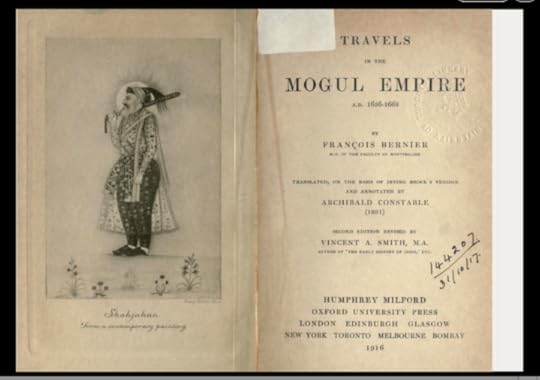
The Book Travels In The Mogul Empire A. D. 1656-68 By Francois Bernier Continues To Remain As Impor?Tant And Popular As It Was In 1671, When Its English Edition Was Published. John Dryden, The Famous Poet And Dramatist, Drew His Inspiration For His Last And Perfect Tragedy Aurang-Zebe From The Same Book.Francois Bernier, Being A Physician, Had An Unlimited Access. In Mughal India, He Could Go Anywhere From South To North. This Freedom Of Movement Combined With His Powers Of Observation Adds Authority To His Narrative. His Account Of Various Events During Mughal Regime Is Inte?Resting, Because It Not Only Deals With Shah Jahan And His Children, Their Intrigues And Battles For The Throne But It Also Deals With Subjects Like Reception Of Ambassadors; Upbringing Of Princes ; Bravery Of Uzbec Women; Beauty Of Kashmiri Women; Fishes In The Verinag Pool ; Price Of Wine ; Living Conditions In The Cities Of Agra, Delhi And Lahore; Flattery In Mughal Court; Corrupt Officials ; Wealth Of The Mughals And Condition Of The Pea?Sants, Etc.The Translation By Archibald Con?Stable Is Revised By The Famous Histo?Rian Vincent A. Smith. As A Source Book For The Condition In India During The Days Of The Mughal Rule, This Book Has No Rival.
it is honestly appalling that this masterpiece of a work isn't read more despite so many contemporary books trying to talk about the same period francois lived and wrote about in this piece of text, seriously, 600 pages of pure kino, page after page after page.
on francois bernier, it's pretty clear based on the things he talks about, the way he talks and interact with things around, traveling and writing about a period with such a good eye for argument, adventure, depth and detail that this book was going to be amazing. he was a brave adventurer and a skilled physician. he traveled through most of mughal north india and wrote in detail the way the people lived and giving considerable intelligent insight to us about those times.
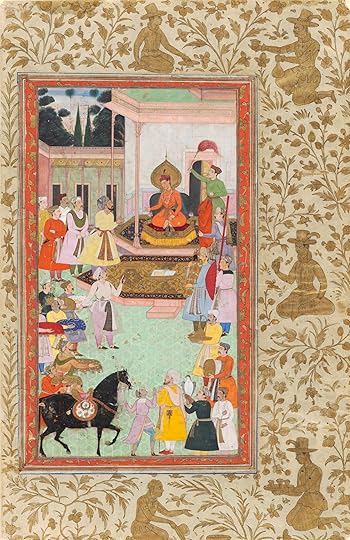
the first part of the book deals with the mughal civil war between the four princes (sons of the guy who built the taj mahal btw :) ) who believe in the doctrine of "either the throne or the grave", it is a thrilling tale and dara (the oldest) and aurangzeb (the winner of the war) shine the most in it, every other interaction with them is like a scene from a poetic tale of how the mighty fell or just plain war. the things that bernier wrote about aurangzeb in his way of life and thought is really interesting, a guy who can lock up his own father and behead his brothers yet never miss a single prayer. a guy who is a scholar of a caliber as good and as strong in his arguments as any, yet when he meets his childhood teacher who taught him when he was young instead of bowing in submission like most did in those times he stood his ground and disowned his orthodox teacher for being a midwit who made a fool of his valuable youth and the things he was recorded to have said on real learning, on life, on skills in those parts were as good as any. similarly, very touching was the part in which his letter is mentioned that has a correspondence aurangzeb did with his imprisoned father after winning the throne that bernier came across, and how beautifully it had him saying to him that he can't let ego get to him mentioning the meeting of timur (his ancestor) and bayezid according to memoirs he read from his family, mentioning the talk between them of when timur laughed at the latter in a cage and the latter humiliated told him it is god who lowers or raises men, and then timur saying he is not dishonorable enough to laugh at a fallen foe, but that he was lauging at fate, and how it reduces the best of men unfairly yet makes even cripples like them kings (both timur and bayezid were crippled), the way Aurangzeb wrote on that and everything that was said of him reeked of pure philosopher-king vibes. the courts, the royal culture, the richness, all are well described.
[image error]
now onto the other part, Bernier in detail and depth goes on and on about how the average person lived in those times, how wretchedly, how meekly they survived and how less they had to survive under, if lucky escaping sudden death or fear of torture from superiors, if unlucky - perishing, and oh how much of a agony filled event even to them perishing was! at times they taking in their wife or ruining chances of survival for many others indirectly like that, not even letting them perish in peace with the priests and the local rulers trying to take advantage of them till death comes which hangs for them at every step of the way in their wretched pre-determined. so bad was their wretched fate that if contemplated upon it would fill any man fill with disgust, and it did disgust a lot of people - the muslims, the europeans present and anyone not completely a part of that total subjugation by society then who could afford seeing it from a distance. it is sad seeing how well one group lived, and how horrible the other lived, crushed at every step and the only hope for the vast majority of them being to be able to live and die in semi-peace, living like a powerless and blind bug and dying like one. gives insight into the modern culture of the modern day country too if you think deep enough about it.
the rest of the book is about the description of the cities and countryside of north india (agra, delhi, lahore, kashmir and bengal) (no cameras in those times sadly to capture them in 4k to trim down these parts)
an amazing book and a amazing read, anyone with curiosity about those times should read it. trust me guys, this is amazing. highly recommended.
I can’t believe that many haven’t read this book. Travels in the Mogul empire is a history lesson albeit with so much depth. The book begins with Bernier’s arrival in India at the time of the war of succession with Aurangazeb overthrowing Dara Shikoh and his other brothers. Further essays delve into the life of the monarch and the Omrahs, the exorbitant lifestyles they led and how that led to slavery and famine across the country. It touches upon how slavery system was the economic backbone of the time and how and why large parts of the country remained poor!! The most important question for me was how I do I contextualize it to the present times. It’s funny how history repeats itself- the cyclical waves that we are all guilty to be part of. The book is a top read for anyone who wants to understand the Mughal empire without any adulteration. Note: One needs a reading form to get going. If you are someone who has taken a break from reading, this can seem as a drag.
It's the year 1658, a young French physician sets sail from Egypt with the goal of reaching the kingdom of Abyssinia (modern-day Ethiopia) via the Red Sea. Monsieur Bernier soon abandons his plan and ends up at the port in Surat in India, the subcontinent where he'd make rather influential acquaintances.
Bernier meticulously narrates the events of the power struggle amongst princes of the Mughal empire after the emperor Shah Jahan has been maimed with illness. And as he travels through the empire, he through a series of letters addressed home richly describes the various echelons of the empire, the customs of the royal court and its courtiers, matters of trade, myths and traditions of the gentile masses, and even the events of nature which he sets forth to explain with great scientific temper.
Apart from the writings of Bernier and the translation, the book has been smartly edited, and avid readers would for hours find themselves fondly rummaging through the footnotes and the appendices.