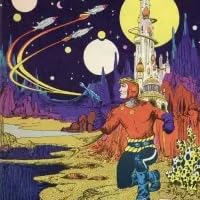
Have you ever stopped to wonder why the world is eternally torn by war? Why men of goodwill, seeking only peace, are driven relentlessly to further disaster? In a future society, where India rules the globe and everyone chases the mighty rupee, the First Atomic War has just ended. Already the Second is clearly building. People shrug. War is man’s nature, they think. And that’s what newspaper reporter Dake Lorin thinks, too . . . until he becomes aware of the aliens living among us and discovers their sinister purpose—as well as the strange and monstrous explanation for humankind’s seemingly limitless capacity for violence and destruction.
John D. MacDonald was born in Sharon, Pennsylvania, and educated at the Universities of Pennsylvania, Syracuse and Harvard, where he took an MBA in 1939. During WW2, he rose to the rank of Colonel, and while serving in the Army and in the Far East, sent a short story to his wife for sale, successfully. He served in the Office of Strategic Services (O.S.S.) in the China-Burma-India Theater of Operations. After the war, he decided to try writing for a year, to see if he could make a living. Over 500 short stories and 70 novels resulted, including 21 Travis McGee novels.
Following complications of an earlier heart bypass operation, MacDonald slipped into a coma on December 10 and died at age 70, on December 28, 1986, in St. Mary's Hospital in Milwaukee, Wisconsin. He was survived by his wife Dorothy (1911-1989) and a son, Maynard.
In the years since his death MacDonald has been praised by authors as diverse as Stephen King, Spider Robinson, Jimmy Buffett, Kingsley Amis and Kurt Vonnegut, Jr.. Thirty-three years after his passing the Travis McGee novels are still in print.
Ballroom of the Skies is MacDonald’s second science fiction novel, following on the heels of Wine of the Dreamers. This novel, written in 1951 and published in 1952 early in MacDonald’s career is a companion piece to Dreamers. It does not continue the same story, but explores the same themes such as how to account for the long history of wars and conflict, and the idea that space aliens with telepathic And telekinetic powers walk amongst us, often manipulating us for their own ends.
In the end, this turned out to be a brilliant, thoughtful novel. It was, however, a struggle to get into as a reader with this first part being a bit stiff and disjointed and the story not really exciting for a while. This one is worth sticking with though.
There are sequences in it that are horrific and filled with as much psychological turmoil as anything. Some of the ideas that are played out here were certainly further developed by later authors.
It’s odd that MacDonald gave up on science fiction because he seemed to have so many interesting ideas to explore, but it appears his interests lay elsewhere.
Being a genre author in the pulp era had a bit of a different meaning. While we think of Tony Boucher as a godfather of mystery and crime fiction, his impact on SF was almost as intense. In the case of Boucher, it is my opinion that he was a better SF writer. John D. Macdonald, on the other hand, was hugely successful as a crime writer with the Travis McGee books and most famously the novel that inspired Cape Fear. Writing in balmy Sarasota, his Florida novels drip humidity and tension. He wrote three works of Science fiction in the early 50s, and it seems that he was chasing the market; had they sold better, it is possible he would be remembered for SF. The reality is many serious JDM fans have no idea he wrote in this field. In fact, recently Brian Evenson, who wrote for the Cape Fear series on Apple TV, told me he didn't know that John D. MacDonald SF existed.
I didn't either before I happened upon this book at Footnote Books here in Hillcrest, judging from the low price inside the cover (1.95) the annoyed shop owner thinks he priced it 25 or more years ago, and there it sat. Today he would price a rare JDM SF novel higher. Too late. It was mine now. For three years it sat on my TBR.
Ballroom of the Skies comes with a very helpful afterword by the author who gives some origin on the work. Already in 1968, he thought that his SF writing was lost to time, and he himself didn’t remember much of writing it eighteen years earlier. He found himself wondering what would happen next as he read the proofs for the 1968 paperbacks of both I have. “I confess to being particularly jolted by finding in Wine of the Dreamers that the Paris peace talks were still going on in 1975, that the Asians were quarreling with Russia about the orbits for snooper satellites, and that a substance was being advertised and sold to millions of Americans as a non-alcoholic, non habit forming beverage that would heighten the sensory response to such stimuli as a kiss for a sunset. I wish I could have equivalent prescience in personal matters.”
Wine of the Dreamers is the other SF novel reprinted at the same time. I am not sure if they are connected story-wise, but I saw in the wold the other day a hardcover that includes both novels and a third novella.
The reality of Ballroom of the Skies is that it starts slow, real slow. The first six chapters I was a little bored and lost. Now, having finished looking back at it, it makes a bit more sense. But the first time through I was bit lost. We follow a group of journalists in a post-atomic-war Philadelphia, and the dominant political force is Pak-India. I am not sure that alliance made sense in 1952, but today doesn’t. Everyone is chasing rupees.
There are little details showing that some of the characters have ESP powers.
“30,000 rupees, girl, let's see the illusion.
Jake took the money Karen handed him. He handed it to Miguel. “Here's 30,000 rupees, Mr. larner I wonder if you could use it to get me a spot where the article will get decent readership.” If he's latent, wouldn’t that help?”
The journalist characters are chasing a story that another war is brewing, and it seems these folks with intense mental abilities are going to be important to the future. Knowing what is coming as I looked over the novel with an understanding of where it was going it felt stronger. I admit I didn’t get hooked on the book until page 68.
Chapter seven is when it gets weird, and the alien invaders arrive. It is not just that this out-there alien invasion concept is introduced; the writing and world-building are well done and interesting. “Ten parsecs beyond the outermost star system, the great ship rested; it had been built in space. No planet crust could withstand its weight, and thus it had never felt the tug of gravity at close range. It was the flagship for a full division. On the master control cube, a three-dimensional diagram of our galaxy, tiny red spheres showed the placement of each ship in the division. In this hour, it was a nervous ship. Quick flick of eyes. Lick of tongue tip across dry lips. Silence. The launch had arrived an hour ago. And at last the bell called all officers; they hurried to central assembly and stood in formation at attention.
After five minutes the Earthling arrived with his cold and bitter eyes, a flat iron slab of his face, wearing his symbols of command. The prisoner was taken to the vast open space in the middle of the hollow square of the formation.
They said he could give you a rising agony with a mere glance, read your most secret thoughts, turn you into a mindless thing; the officer stood like statues.” Look at some of the details of how this is written. I love the description of the huge ship built in space and has never felt the tug of gravity. The “Master control cube and a three-dimensional map. The way he describes the nervous ship with short sentences Quick flick of eyes, licking dry lips. Just great stuff here.
The best idea in the novel came in the back half. “This room is so constructed that it aids the projection and reception of thought. When you have learned to give your thoughts to each other you will find that together you can open the door.” I thought it was a very PKD-like (although this novel pre-dates him, a room that won’t open until the people inside can receive each other’s thoughts. So how did JDM feel about it after 18 years? His afterword lays it out.
“My most signal satisfaction in rereading these two novels and in authorizing their reappearance was to discover that I had not, as I suspected, sacrificed story to message. They move right along. It had been so long since I have written them that my recall was fogged by fifty intervening novels. And so I had much ironic amusement in finding myself for the first time reading my own work with considerable curiosity as to what would happen next.”
After a rough start, the back of the half of the story was much more interesting. Ballroom of The Skies is not a classic work of SF, but as an artifact it is valuable. It is really fun to see a novel by a man famous for his crime novels play with ESP-soldiers, alien invaders, global conflict, atomic wars, and the like. Also, his commentary on future TV written as it was just being born in 1952, is very interesting, but I am saving that for a separate essay.
If you are a Macdonald fan, I think you should read this. If you are just interested in 1950s SF that weird pocket between the golden age and the new wave that is dominated by Cold War fears, then yeah, I recommend it as well. However, there are about two dozen fifties novels from PKD, Leigh Brackett, and Moore/Kuttner I think are better.
I'm most familiar with John D. MacDonald's Travis McGee mystery series. I was surprised to find that he had also written a few Science Fiction (or as he calls them, science fantasy) stories. Ballroom of the Skies was originally written in 1951. It's an interesting story and takes a bit of time to get into the flow of what is happening. We find the Earth working through the First Atomic War and being threatened with the 2nd. The US is no longer a powerhouse, instead it is the PacIndia that is the power. Dake Lorin, a journalist, has been working for a year with an idol of his, Darwin Branson, to try and stop this imminent threat. But what happens will turn his life upside down. There are powers that monitor everything taking place on Earth and who can impact changes they perceive that will threaten this power. Where they are from and why they are doing this will become apparent as you delve more into the story. I did find it confusing at time, but it is supposed to be. There are illusions, mind tricks, etc. that throw your image of what is real and what isn't into a tail spin. I don't think it is a perfect Science Fiction story by any means, but it is well worth reading, for the time period when it was written, for the author who wrote it (to gain a different perspective on his writing) and just for the interesting concept. (3 stars)
I'm a big fan of John D. MacDonald, and have at least started the ambitious goal of trying to read his entire published oeuvre, in chronological order no less.
As many readers no doubt know, John D. is best known for his pulpy crime fiction, and most notably his Travis McGee series. It is those books that really caught my attention and ingratiated him and his writing to me.
Of course I was surprised to learn that John D. did dabble in science-fiction, with a grand total of three novels. I'm in general not especially a sci-fi fan beyond the most mainstream: original and even prequel Star Wars and original Star Trek. Phillip K. Dick's Blade Runner is as "edgy" as my sci-fi tastes tend to go, and even then I strongly prefer the movie to his original book. All that being said, I did read John D.'s first sci-fi novel, Wine of the Dreamers and it was alright. It was at least tolerable.
I know that later on, John D. ventured into sci-fi with The Girl, the Gold Watch & Everything and with fond memories of the early 1980's TV movie, I look forward to reading it!
Perhaps all of that is why Ballroom of the Skies was such a disappointment. I had great difficulty getting into it, and even getting through it. Please forgive me for being brutally honest: after trying to get through the first half off the book, I skimmed through the rest of it. It just didn't catch (let alone hold) my interest. Perhaps if it had been anyone other than John D., I would have given up on the book altogether and simply abandoned it. However, I do have a loyalty to John D. and the ambitious goal of trying to read his entire output, even if that means just skimming through part of this book in order to "finish" it.
So, I continue to heartily endorse John D. MacDonald and the vast majority of his books that I have read. I look forward to continuing my way through his catalog and reading the next in line, The Damned. I view this foray of his into science-fiction (or, as he says in the afterward of the book, "science-fantasy") as one big exception.
Stumbled upon this book while looking for a Dean Koontz to read. Interesting and fun book. I can’t remember the last science fiction book I read. This was a good one. Written in 1952 about the year 1978 of why we humans are the way we are on good old planet Earth.
This 1952 novel is John D. MacDonald's second science fiction entry of the three he wrote in his long career. AT this point, he had been writing novel length fiction for two years and was still learning his craft.
SciFi - After WWIII, the United States has been reduced to a second rate country, tensions in the world are high, and Dake Lorin has taken a year to help Darwin Branson work out a peace accords with all the nations. He witnesses Branson accept watered down conciliations from Irania and knows that will cause the other nations to start waffling. What caused this aboutface?
Wasn't sure where this one was going for a while, but the plot turn at the end really made this book for me. I'm really starting to appreciate and enjoy 50's science fiction far more than contemporary. Maybe the ideas were just newer, fresher, more bizarre. Not a "classic" in the most rigid sense, but a great and rewarding read, nonetheless.
The story bored me a bit at first, but not too much. Then it got really interesting. Our hero, a modern Don Quixote, gets knocked around from one end of the planet to the other. But he perseveres.
I've read this before and forgotten a bit of it. I thought the ending was a bit different.
In a career as prolific as MacDonald's, there's bound to be some clunkers, especially early on.
And this is one.
MacDonald is mostly known as a mystery writer, but he had an itch to write some science fiction toward the beginning of his career, and turned out this one and the earlier Wine of the Dreamers, both on the same theme. Judging by the afterword of these edition, MacDonald wasn't exactly familiar with the genre--thinking science fiction necessarily included either bug-eyed monsters, space opera, or mad scientists, possibly also robots--and what he was after was a way of working out a question: why, smart as humans are, do they keep effing up the world.
Here he offers a solution very similar to the one put forth by Eric Frank Russell more than a decade earlier: because it's in the best interest of aliens. (That's from Russell's Sinister Barrier, but there's also hints of his Dreadful Sanctuary: that sanity means ignoring the alien forces at work on humanity.) The whole story builds to a long lecture at the end. If you're worried about spoilers for a book some 66 years old, skip the next bit:
The rest of the galaxy, we learn, is controlled by an empire, advised by supercomputers. The imperials realize that their bringing peace to the galaxy means that they are no longer growing, working, and competing, making them prey to aliens beyond the galaxy or simply at risk of fizzling away. And so the earth is kept unpeaceful, meaning people have to struggle and compete--only through this process can the greatest minds be found, abducted, and brought to lead the empire, making it always better. Further increasing the empire's strength is that there are various factions within it, meaning even the leaders of it need to continually struggle.
With this as the ending, it is no surprise that our hero, who starts out working for world peace, will instead come to be one of the great potential leaders of the galactic empire.
The rest of the book is mostly set up. There are some nice grace notes: the man we think will be the main character is killed off quickly. MacDonald tries for some structural razzle dazzle, but mostly to no effect. The problem is that the first 2/3 of the book is really exposition heavy. The setting is the 1970s, after another world war, this time atomic, and just as a fourth is being prepared, India is now the leader of the world, which is otherwise divided into three blocs. America is a fringe, decadent place (except for the strong heartland!) MacDonald spends a lot of time simply stating all of this, rather than showing it.
The dialogue tends to be very on-the-nose with a lot of -as-you-knows. MacDonald seems to think stilted dialogue is another necessary component of the genre. Everyone is very earnest, even those with seemingly nefarious plots. Conversations are often heavy-handed bits of more exposition.
MacDonald also tries to keep the reader off balance by monkeying with reality. The aliens have mental powers that allow them to alter perceptions. (Buried deep in this book is an early version of cyberpunk, with drugs and decadence and altered consensual reality, but MacDonald never brings it out.) This technique has a few striking pay-offs, but other times the fact that someone's perception will be altered is told, then the perception altered, and the narrative goes on to describe the person's actions--these amount to extended dream pieces that fluff an already short novel to no real purpose.
Can't really recommend it to anyone but a MacDonald completist.
The world is in conflict and approaching war, but there is hope: a political meeting is going to take place that will steer the world in a positive direction. Then, a mysterious duo expertly kills the political pacifist before he can make peace agreement. The duo replaces the man with an exact, more evil clone who then makes a decision leading to further conflict and war. Our main character Darwin, a friend of the first, soon finds out that something is very wrong — he knows his friend was altered in some sick way. Darwin attempts to broadcast this to the world, ignoring the legal repercussions of political betrayal. Darwin is then given illusions and controlled by a force which deters him from publicizing his story. He is then kidnapped into another planet and where he is taught supernatural powers. This makes him feel lonely and separated from humanity. The tale ends with Darwin learning that that the world is held in a perpetual state of conflict by supernatural force because it breeds competition, progress, and perpetual life. The ending also bends into romance as he finds acceptance in his new gifts and extra-human love. Although I struggled to finish the story (for personal reasons; “reading block”) I did like the story. The beginning was strong. It held my attention for most of the book, and I truly did feel for Darwin in his journey. I was surprised the reception online was not favorable. I can understand, as it is almost a 70 year old book, there was some phrasing and sections that were a bit … odd. And the story was hard to get a hold onto at parts. But I thought his story concept was solid and the execution wasn’t bad! I didn’t love it, but I did enjoy it moderately. It was interesting. I would reread it, especially because it would be easier when you know what is happening and can better appreciate it. I wouldn’t necessarily recommend it generally, but it is good for someone wants some vintage, unique ‘science fantasy’, as Mc.Donald terms it.
This entire review has been hidden because of spoilers.
Better than I expected! I read and enjoyed MacDonald's Wine of the Dreamers in high school. For years I'd been trying to figure out which writer better known for hard-boiled detective fiction had written a pretty solid SF novel. Mickey Spillane? Nope. I finally found the answer and had to come back to these two. The novel moves along briskly, introducing pretty intriguing ideas along the way. My main beef is that the grand secret to it all is revealed all too quickly in the last few pages without enough hints for the reader to have the slightest chance at figuring it out. It does all come together in consistent and thought provoking package. Can you ask more from at 178 page paperback?
The story takes place in the 2000s, after a devastating atomic conflict that killed millions. The United States is no longer a dominant power. Journalist Dake Lorin discovers that his mentor, Darwin Branson, might be an infiltrating alien. This revelation threatens the world’s fragile balance... and sends ripples across the cosmos.
I just couldn’t get into it. I pushed myself to keep reading, hoping the story would draw me in over time. Sadly, it never happened. 😔😔
This was a surprising little gem. It starts out a little slow with some political intrigue in a post world war 3 world. The main character Larkin is a journalist or something trying to write a piece that might get him in trouble with political leaders. He gets the attention of some special people who whisk him away to be trained with mind control and other tricks. It ends much better than it starts. Asimov's "Foundation" had recently been finished shortly before this novel came out and I feel are some pretty close parallels to those ideas.
This is one of only two excursions into sci-fi by JDM, or science fantasy, as he called it. Written in the early 50s, it was an "exercise" to try to explain why the world was so messed up. While it starts a bit slowly and strangely, I'm willing to bet the ending "explanation" will surprise you as much as it did me. As usual for this fantastic author, he'll give you a lot to think about.
Initially, I found the book highly enjoyable. However, the pacing in the opening chapters, and perhaps the narrative style, created a sense of unevenness, hindering the initial engagement for approximately fifty pages. Furthermore, the introduction of the science fiction elements felt underdeveloped within this slow-paced, non-action-oriented plot structure.
1⭐️ DNF or Forced myself to Finish 2⭐️ It's Just a book 3⭐️ A Good Book 4⭐️ On My Reread List 5⭐️ god mode
Hard to pin down my feelings on this. The thought experiment present in the novel, bookending the "action" of the middle of the book, is fascinating and well-considered by MacDonald. But the middle 90 pages can't be described more charitably than "plodding." After really hooking me early, I'd lost almost all hope of the book recovering until the story wrapped up neatly near the end. Would have been better as an essay containing this hypothetical scenario, heavily abridged.
MacDonald expressed some interesting and thought provoking ideas about war and peace and progress. What was disappointing for me was the story as a story; I have read roughly a dozen or more books by MacDonald, not just Travis McGee tales, and the storytelling here is the weakest I have read by him.
Many reflections of ideas and philosophies that were outgrowths of WW II. While a contemporary writer would write a different story, it will no doubt be retold. Perhaps in a way stories like the Matrix reflect a similar idea - or Elon Musk’s idea that our lives and civilization are really an elaborate simulaton.
Something very different from John D. MacDonald, a scientific fantasy as he calls it. Very dated and with a bit of an odd feel, this story seems to bounce all over the place without getting anywhere. I think John D. had too much too drink while channeling his inner Ayn Rand. It's only worth reading if you're a John D. MacDonald completist.
Fascinating premise for a book - and very different in style and substance from the first few John MacDonald books that I have read. As MacDonald himself said with the intro to the re-release after 20 years, the topic of why the human race is continuing to strive and to struggle and be constantly on the brink of war or other catastrophe makes this book timeless and relevant
2.5 maybe? Randomly grabbed some old books from up at the cabin and this was one of them. The plot was original I guess, but it wasn't particularly fun/exciting/interesting. Just kind of a weird 1950s novel with aliens in it, and mind reading, I think.
I’m not sure what I think about this book. A definite departure from his Travis McGee stories. I nearly put it down twice but soldiered forth. I’m still not sure WHY he wrote it…what point he was attempting to get across.
Que livro estranho, no início eu não estava entendendo nada, acho que foi o início de livro mais confuso que já vi, depois vai ficando melhor mas realmente não surpreende muito até o final