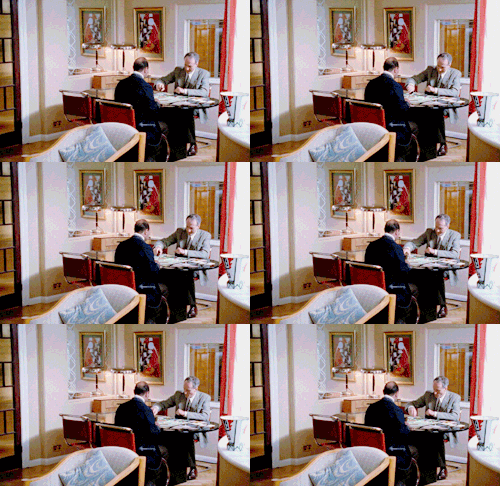
In Agatha Christie’s short story, “The Lost Mine,” Poirot investigates the suspicious disappearance of a Chinese businessman in London. Suspicion is focused on two Englishman, one of whom has an alibi and another who was in an opium den the night of the disappearance. A clear-cut case for Poirot soon becomes murky however. This short story originally appeared in the November 21, 1923 issue of The Sketch magazine.
Dame Agatha Mary Clarissa Christie, Lady Mallowan, DBE (née Miller) was an English writer known for her 66 detective novels and 14 short story collections, particularly those revolving around fictional detectives Hercule Poirot and Miss Marple. She also wrote the world's longest-running play, the murder mystery The Mousetrap, which has been performed in the West End of London since 1952. A writer during the "Golden Age of Detective Fiction", Christie has been called the "Queen of Crime". She also wrote six novels under the pseudonym Mary Westmacott. In 1971, she was made a Dame (DBE) by Queen Elizabeth II for her contributions to literature. Guinness World Records lists Christie as the best-selling fiction writer of all time, her novels having sold more than two billion copies.
This best-selling author of all time wrote 66 crime novels and story collections, fourteen plays, and six novels under a pseudonym in romance. Her books sold more than a billion copies in the English language and a billion in translation. According to Index Translationum, people translated her works into 103 languages at least, the most for an individual author. Of the most enduring figures in crime literature, she created Hercule Poirot and Miss Jane Marple. She atuhored The Mousetrap, the longest-running play in the history of modern theater.
Poirot visits an opium den. So that shouldn't be boring, right? But it is. I've read and listened to this story multiple times over the years, and it's never managed to keep my interest.
The gist is that Hastings is thinking of buying into some scheme or other that he's read about, and Hercule tells him that he needs to stop speculating and go with safe bets. In fact, the only stock he owns, Burma Mines Ltd., was given to him by a grateful client. Then he proceeds to tell the story of how he solved the murder of a representative of the silver mines.
I don't know what it is about this story, but it definitely isn't a favorite.
This early Hercule Poirot story was first published in the UK (The Sketch magazine) on November 21, 1923. Publication in the US followed in The Blue Book magazine in April 1925.
Poirot relates to Captain Hastings how a murder investigation earned him 14,000 shares in a mine in Burma. Poirot uses the story to not only toot his own horn about his fabulous grey cells...but also to caution Hastings about speculative investments.
I enjoyed this story. Not only was it an interesting short mystery, but it gave some cute insight into Poirot's personality. His bank balance is.... 444 pounds, four, and fourpence. Symmetrical. :) I love reading stories about Poirot's investigations, but I think if I ever met anybody so strangely fastidious I would dislike them immensely. :)
Agatha Christie's Poirot adapted this story for television (Season 2, episode 4). Some major changes were made to the characters, but the basic plot follows the original story. David Suchet does a wonderful job playing Poirot as usual. I think Agatha Christie would have enjoyed his portrayal of her detective....he really seems to fit her descriptions.
I'm enjoying reading all of these early Poirot short stories. For some reason, I always concentrated on Christie's novels, and never read any of her shorter mysteries. Fun to read them now! Always fun to discover a new story by a favorite author!
The theme is somehow similar to that from the The Big Four: Chinese bad guys, mysteries, opium, disappeareances. Only that this novel is (at least I think so) one of Agatha's poorest ones, along with The Blue Train...
Well that was a splendid little treat. I enjoyed it's storytelling method once again - with Hastings having this mystery recounted to him by our beloved Belgian. As always, I felt like I was right there with them. Poirot, and Agatha Christie sure do know how to tell a tale :) <3
3 Stars. "The Lost Mine" is a short story in a 1925 collection of fourteen published in the US under the name, "Poirot Investigates." It had three more than the 1924 UK edition. The 11 page story first came out early in 1925 in "Blue Book." Captain Hastings is talking about his investment interests; he falls on the more speculative side! One never seems to know where he gets his spending money; does Poirot pay him a retainer? In "The Lost Mine," he proffers an investment opportunity to Poirot in the Porcupine Oil Fields with a dividend return of 100% in one year! Poirot wisely turns him down but adds that he owns 14,000 shares in Burma Mines Ltd. He was given the shares in gratitude by the Board for saving them from an embarrassing scandal. A Chinese businessman, Wu Ling, had come to London to discuss opportunities concerning the mine, but disappeared. He failed to keep an appointment with one of the directors, Mr. Pearson. Was chicanery involved? Drugs? The ending is somewhat abrupt but here we find Poirot offering good advice, "When investing money, keep strictly to the conservative." (July 2020)
I didn’t care for this one as it is Poirot simply telling Hastings about a case he once solved, which was a storytelling choice that I found a little lacklustre
"The Lost Mine" is included in the 1925 US edition of "Poirot Investigates" yet excluded from the 1924 UK edition, despite having originally been published in 1923 - and frankly, the US edition isn't the better for it. Chronologically, this is the first poorly written case I've encountered. It can also be found in Poirot's Early Cases: 18 Hercule Poirot Mysteries and Hercule Poirot: The Complete Short Stories, the latter being where I read it.
Without spoilers, the reason this mystery doesn't work is that the culprit's actions and motivations don't make sense. Instead, the story tries to pull a twist on you that is only unexpected because it's illogical. Since it was published in late November, maybe this can be chalked up to Aggie being busy with her xmas shopping so she just pulled an all-nighter and cranked this one out. We've all been there. But that doesn't make it worth reading.
With spoilers,
Spoilers for a comparison with The Incredible Theft - a Hercule Poirot Short Story/"The Submarine Plans", which comes earlier in the complete collection and highlights how illogical this story is by way of contrast:
Agatha Christie is a brilliant author whose works are typically intricately crafted technical marvels. But even a master of their craft can pop out a dud now and again. I guess then we all shouldn't be too hard on ourselves.
(Oh and Poirot's bank balance being £444.44? What then when rent comes due, hm? Simply far too neurotic.)
1 - the mystery is “eh”. And the solution too quick, with no detecting at all. Because,
2 - it’s really just a racist trope dressed in a mystery. “Pigeon” English and racist language galore, and yes, I know it’s
3 - racism of it’s time, so maybe I should be less harsh only
4 - it’s incredibly anachronistic. Opium dens didn’t exist in London in the inter-war period. They *barely* existed in London in the late 1800s. The Victorian opium den trope that is soooo beloved by mystery writers is almost completely fictional. Christie is reaching here are letting her “white savior” flag fly.
Hastings talks of investments and Poirot regales him with a story about how he came to have shares in a Burmese mine. A company director Pearson, hired him to investigate the disappearance of a Chinese landowner, Wu Ling, who was bringing the land titles to London.
Mr Pearson insists Poirot dress up and go with him to the Opium den one of the suspects visited. Poirot draws the line at shaving off his moustache.
Yes, rien que ça! I pointed out to him that that was an idea ridiculous and absurd. One destroys not a thing of beauty wantonly.