Jump to ratings and reviews
Rate this book

McSweeney’s Quarterly Concern #19

McSweeney's Issue 19: Old Facts, New Fiction

Rate this book
Our first issue of 2006 turns toward earlier and equally uncertain years, traveling back by way of pamphlets, info-cards, and letters addressing bygone conflicts and still-constant concerns.

Expect, among other recovered works, carefree strategies for insurgencies in Nicaragua, astrological advice for the Nixon/Agnew campaigner, sanguine guidance for the soldier stationed in the Middle East at mid-century, and commonsense reinforcement for the doughboy drifting toward a gonorrhea infection. Also: T.C. Boyle's feral child novella and additional quasi-historical work by new writers.

Contributing writers: T. Coraghessan Boyle, Sean Casey, Brendan Connell, Adam Golaski, Christopher Howard.

250 pages, Hardcover

First published March 30, 2006

2 people are currently reading
179 people want to read

About the author

Dave Eggers

342 books9,522 followers
Dave Eggers is an American writer, editor, and publisher. He is best known for his 2000 memoir, A Heartbreaking Work of Staggering Genius, which became a bestseller and was a finalist for the Pulitzer Prize for General Nonfiction. Eggers is also the founder of several notable literary and philanthropic ventures, including the literary journal Timothy McSweeney's Quarterly Concern, the literacy project 826 Valencia, and the human rights nonprofit Voice of Witness. Additionally, he founded ScholarMatch, a program that connects donors with students needing funds for college tuition. His writing has appeared in numerous prestigious publications, including The New Yorker, Esquire, and The New York Times Magazine.

Ratings & Reviews

What do you think?
Rate this book

Friends & Following

Create a free account to discover what your friends think of this book!

Community Reviews

5 stars
73 (23%)
4 stars
118 (37%)
3 stars
100 (32%)
2 stars
16 (5%)
1 star
4 (1%)
Displaying 1 - 18 of 18 reviews
Profile Image for Sam Quixote.
4,821 reviews13.5k followers
September 19, 2011
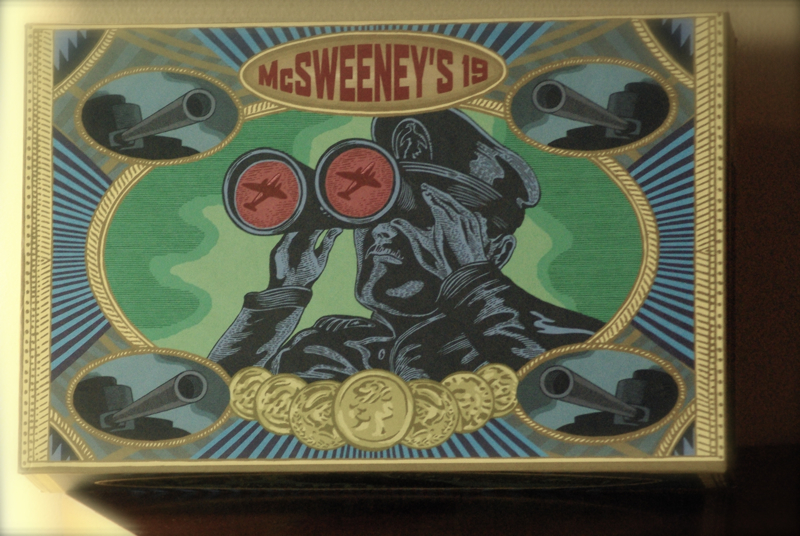
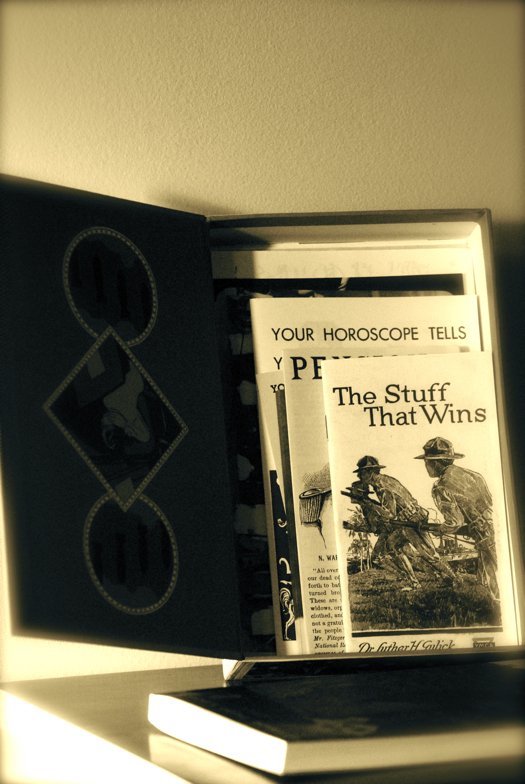
This is the wonderfully designed cigar box issue where a 144 page paperback and several reproduced old pamphlets, booklets, letters, and photographs from the late 19th and early 20th century armies of the west are inside a large paperback sized cigar box.

The paraphernalia cover pension booklets from the 19th century, a civil defence booklet from 1939, letters between two brothers, one of whom was arrested for sleeping with a black woman, dating from 1918, George W Bush's dental records, photographs of hundreds of kids sleeping in hammocks in the woods, a 2002 memo from the CIA to Donald Rumsfeld - well you get it, it's a mish mash of military-related stuff. Well designed and presented, it fits in well with the military motif of the cigar box.

The real treasure as always with McSweeney's is the fiction. Christopher Howard provides a melancholy story of an orphaned black boy making his way in 19th century America where he meets a mercenary Indian and a wolf in "Prince of the World". Brendan Connell writes about a bloodthirsty British hunter in "The Life of Captain Gareth Caernarvon" while Adam Golaski writes mini stories about 3 Degas paintings reproduced on the inside covers which are all excellent.

TC Boyle edited this issue and supplies the best contribution of the lot - a novella called "Wild Child". It tells the story of a feral orphan boy in 18th century France and his life from bare beginnings to becoming the focus of national curiosity. It's a brilliantly written and imagined story from a master short story writer and is worth buying the issue for alone.

McSweeney's 19 is full of great stories and is an imaginatively designed issue - this is McSweeney's at it's best.
Profile Image for Adam.
5 reviews1 follower
December 7, 2008
This somewhat gloomy issue of McSweeney's Quarterly Concern (of 2006) contains two main sections.

The first is a collection of reproduced "found" material-- pamphlets, memos, and the like-- stretching over the last century. Most of the leaflets deal with the related issues of war. Some of the papers are government-produced information that share a buoyant and self-assured attitude about what were potentially serious, deadly, or shameful subjects. (An upbeat "Pocket Guide to the Middle East" ca. 1957, or the futile 1961 "Fallout Protection" guide, for example.)

The second section provides several fictional works, a large portion of which is a novella about a feral child, and almost all sharing some kind of setting in the 19th Century and the authors' particular presentation of it. The themes are often violent and generally melancholy.

All this seems to invite some reflection on the past (including past wars) given the possible perspectives of a reader today. And given the context in which McSweeney's 19 was written -- during some of the worst, convulsive throes of the Iraq war, we may do well to recognize where its mood and theme may have been.
Profile Image for Emily.
172 reviews272 followers
Read
December 10, 2009
mcsweeneysout.jpg

After a couple of disappointing reads I was in dire need of a palate-cleanser, something light and distracting and candy-like that would be fun to breeze through. I've had this delightful collection of historical ephemera, otherwise known as McSweeney's #19, hanging around the to-be-read shelf for quite some time, and figured it was just what the doctor ordered. Those folks at McSweeney's sure know how to put together an appealing package: housed within this vintage-inspired "cigar box" is not only the standard paperback literary periodical one would expect, but a whole collection of pamphlets, photographs, battle plans and informational circulars associated with wartime and politics throughout American and British history.

mcsweeneysin.jpg

These are reproductions of actual pamphlets, letters, and so on, which make give them that special "artifact" feel. I find it's hard to resist a curated exhibition of primary-source documents - especially ones so hilarious and heartbreaking. One of my favorites is a pamphlet, apparently circulated by the Nixon/Agnew campaign to their female supporters, entitled "Your Horoscope Tells You How You Can Help Republican Party WIN!" In addition to the Cro-Magnon-esque syntax of that title, it features stunning pieces of advice like this one (to the Cancer lady):


You can turn chaos into order, especially in the filing drawers. You'll be effective on the telephone, too...


Or this, to the Leo Nixon supporter:


Try to invade the camp of the opposition and go after the opposite sex in the crowd; they'll buy Nixon/Agnew all the way! One word of warning: the most important feature of this campaign is teamwork. It may kill you, but COOPERATE.

Awesome. So, what's your poison: secretary or prostitute? Either way, Nixon/Agnew wants YOU on board this November.

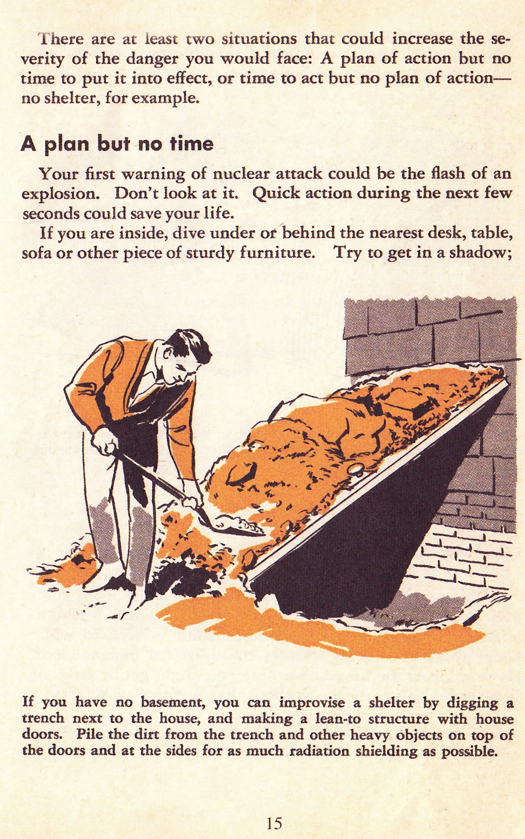
Also included in the menagerie of political detritus is an incredibly jingoistic WWI-era pamphlet that tries to prove "scientifically" why soldiers shouldn't drink, gamble, or sleep around ("The other nations say that our boys win because we make a business of it, that we go at it hard and drop everything that interferes. I guess they are right."); a pamphlet by a Civil War-era ambulance chaser working to extend veterans' pensions; a 1957 pocket guidebook distributed by the US Marine Corps to servicemen stationed in the Middle East ("As an American you will not be a stranger in the Middle East. Even though you may occasionally find some antagonism, a reservoir of good will toward us has been developed over the years."). And check out this amazing illustration, part of a brochure distributed by the Department of Defense in 1961 on what to do in the event of nuclear war. Dude's gonna weather the fallout from a 5-megaton blast under a FRONT DOOR PILED WITH DIRT, tipped against his house. The mind reels.

mcsweeneysdetail.jpg

Imagine having seen photos of the nuclear wreckage at Hiroshima, and then receiving this brochure in the mail and reading advice like "Farm machinery, troughs, wells, and any produce you cannot get into barns should be covered with tarpaulins." Tarps. Excellent.

I found the stories in the actual bound-and-printed portion of #19 less remarkable than the fascinating first-hand flotsam that accompanied it. The high point, by far, was the T.C. Boyle novella Wild Child - a fictionalized (although very true to history) account of the relationship between the 18th-century Wild Boy of Aveyron and his would-be mentor and civilizer, Jean Marc Gasapard Itard. Coincidentally, I just read about Victor of Aveyron last February, as part of a nonfiction study of feral children and their discoverers. Interestingly, Boyle's novella was effective for the very reason I felt the nonfiction book fell flat: in most cases, there is no direct evidence of the subjective experience of these feral children, because most of them never acquire language (sadly, most of them die within a few years of being "discovered"). So Michael Newton's nonfiction treatment ended up being, in actuality, a history of the people who worked with these children, who tried, usually unsuccessfully, to break them of their "uncivilized" ways and make them into "productive members of society." Newton examines the struggles and motivations these scientists and social workers faced. Which is kind of interesting, but not nearly as interesting as the question of what the experience is like for the children themselves: something Boyle, because he's working with fiction and his imagination, can explore.


Did he somehow come to understand that people were his tribe in a way that a bear instinctually consorts with other bears rather than foxes or wolves or goats? Did he know he was human? He must have. He had no words to form the proposition, no way of thinking beyond the present moment, but as he grew he became less a creature of the forest and more of the pasture, the garden, the dim margin where the tress and the maquis give way to cultivation.

This was actually my first exposure to Boyle (I know; where have I been? chock it up to my resistance to the authors "everyone's reading"), and I quite liked him. Apparently, "Wild Child" is an excerpt from his 2006 novel Talk, Talk, which is intriguing to me since I hear the primary plot concerns credit card fraud - not exactly what you expect to see paired with 18th-century France. Do any Boyle fans out there have a recommendation for my first full-length novel by him? I'm a little resistant to reading The Women, despite its beautiful cover, but other than that I'm open.

In any case, a romp through wartime McSweeney's-land was exactly what I needed to get my reading back on track.
Profile Image for Nicola.
90 reviews1 follower
February 6, 2023
This edition is featured as part of the 'Literature in a Digital Age' futurelearn course and having studied it virtually I was intrigued enough to track it down to read. It doesn't disappoint, and really is an example of
"McSweeney’s meets the challenge of new media by creating beautiful, tangible literary objects. These material haptic qualities are well-nigh impossible to reproduce on the computer screen. McSweeney’s takes up the glove and competes in the medial arena, following its own maxim to create ’little, heavy, papery, beautiful things’." https://www.futurelearn.com/courses/r...
Profile Image for Sammy Williams.
251 reviews2 followers
May 21, 2025
This is an interesting box. The majority is filled with reprints of old government documents, guide books, safety guides, and other stuff. All interesting stuff, but not interesting reads. The book of fiction has some great short stories, just not very many of them. The book closes with a T.C. Boyle novella that is a little long and repetitive.
Profile Image for Cassie.
242 reviews9 followers
February 13, 2022
The pieces in this collection were hit or miss for me but McSweeney's presentation never fails to impret
Profile Image for David Markwell.
299 reviews11 followers
February 8, 2016
McSweeney's # 19 comes to you as a cigar box full of crap. All be it incredibly interesting crap. The box itself is beautiful and contains a plethora of pamphlets and PSA type one sheets from the cold war era. The actual journal at the back contains some great stories including a series of works based on Debussy paintings, and a novella by T.C. Boyle called Wild Child which is one of the best things I've read by Boyle.
Profile Image for sophie.
19 reviews20 followers
December 17, 2008
I loved the loose materials and was excited for the book, but it turned out to be all, um, Wild Westy. At least, the first story read like a remix of Blood Meridian, which I never finished because it grossed me out too much. I'll give it (the McSweeney's) another try in a bit, maybe.
Profile Image for Nicole.
44 reviews2 followers
Want to read
October 15, 2007
I bought this at Powell's City of Books (a must see for any book nerd) in Portland. I originally spotted it last summer in SF and I've been meaning to pick up an issue of McSweeney's ever since. I'll let you know how it goes.
Profile Image for Finn.
75 reviews22 followers
January 2, 2015
The short stories were a little hit and miss, I liked the Color Plates fine but the others all in one way or another ended up irking me. I liked the T.C. Boyle novella, Wild Child, a lot on its own though. That would be like a 4/5 considered separately.
16 reviews2 followers
May 15, 2007
Cigar-box presentation with mullings on war; nuclear preparedness manual quite funny.
Profile Image for Katie McCleary.
60 reviews14 followers
August 28, 2007
gotta love mcsweeney's in a cigar box with little books and toys and stories. a treasure. TC Boyle is in this one!
Profile Image for Cody.
77 reviews19 followers
January 4, 2008
The time-traveling ephemera and the novella by T.C. Boyle were wonderfully engaging. The rest of the stories were not so much so...
Profile Image for Ben Bush.
Author 5 books41 followers
Read
March 10, 2010
Kind of the historical fiction edition. All of the pieces were pretty interesting and although I remember hating T.C. Boyle's Tortilla Curtain I liked his novella in here.
144 reviews2 followers
February 23, 2016
I love this one even though I haven't read it yet because it comes in a faux cigar book and every time you open it your charmed by its contents.
Profile Image for Mike.
806 reviews7 followers
October 26, 2015
I really enjoyed the TC Boyle novella, but as a collection, this one was just so-so.
Displaying 1 - 18 of 18 reviews

Can't find what you're looking for?

Get help and learn more about the design.