As we got closer I could see behind the sandstone a curved concrete building: a purpose-built structure. But still no fence, no wire. Not a bar in sight. For this, I’d been told that morning, I should be grateful. This was a ‘lifeline…a last chance’. That is what the judge said.
Daniel is a sixteen-year-old drug dealer and he’s going to jail.
Then, suddenly, he’s not.
A courtroom intervention. A long car ride to a big country house. Other ‘gifted delinquents’: the elusive, devastating Rachel, and Alex, so tightly wound he seems about to shatter.
So where are they? It’s not a school, despite the ‘lessons’ with the headsets and changing images. It’s not a psych unit—not if the absence of medication means anything. It’s not a jail, because Daniel’s free to leave. Or that’s what they tell him.
He knows he and the others are part of an experiment.
But he doesn’t know who’s running it or what they’re trying to prove. And he has no idea what they’re doing to him.
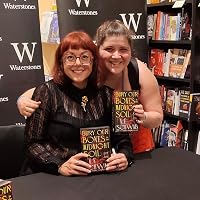
Sarah Hopkins is a criminal lawyer, the wife of Matt Moran and the mother of two young children. She is the author of two novels, The Crimes of Billy Fish, which was highly commended in the inaugural ABC Fiction Awards, and Speak to Me.
My thanks to Netgalley, Text publishing and the author for an e-copy. I am providing my honest review. This novel was released August 2020.
I am sharply surprised that this Australian YA novel was as superb as it was. I would classify this as a dramatic mystery (with sci-fi elements). The novel is written in realistic and elegant prose that draws you into the minds, hearts and souls of delinquent youths who are sent to a rehabilitation program as an alternative to penal sentencing. The novel deftly explores the ethics of psychotherapy, medication and the roles of trauma, personality functioning and social upbringing bring to the table in both youth criminal behavior and psychopathology. Behind this lies more murky waters on the roles of corporations and private/government enterprise in the subjugation of those living on the fringe, or in poverty or as racial underclasses.
This is an extremely well written, thought inducing and emotionally provocative book that will keep you at the edge of your seat in a mindful rather than diversional manner.
The following reviews are shared by Text Publishing - publisher of The Subjects
‘The Subjects is energetic and compelling from the opening pages. And in Daniel we find a voice that I was worried was disappearing from Australian fiction: unpretentious, smart and lacking in all mawkishness. It’s a joy to hear him, and it is a joy to read a book of such complex ideas that is also alert to the art of storytelling.’ Christos Tsiolkas
‘A vivid, human (and humane) novel with an irresistible dark pull. The Subjects explores the utopian madness of social engineering in a similar way to Charlotte Wood’s The Natural Way of Things’ Malcolm Knox
‘The Subjects is a novel with an agenda, enticing us to engage with what is wrong but also to imagine something better…[T]imely, thought-provoking and inspirational.’ Saturday Paper
'Hopkins crafts a compelling story driven by Daniel’s authentic voice, a slow burn of a novel about systemic prejudice, incarceration, and the deep and paralyzing damage done by capitalism’s impact on the pharmaceutical industry and its approach to solving problems…[C]areful, well-paced and multi-layered storytelling.’ Booklist
‘Fantastic. I just think it’s the most interesting book, beautifully written, simply written but complex…Compelling and really, really important.’ Suzanne Leal, RN Bookshelf
Sarah Hopkins has written a very unique book. Unique in it's style, subjects and questioning of how we look at each other. There's a lot in this book and although it's not perfect and at times swamped with science, it's one of my favs of 2019. 16 year old Daniel is a drug dealer with a temper. In lieu of a jail sentence he is whisked off to a remote facility where a dozen other highly intelligent but different teenagers reside. They each negotiate a contract with the facility's Dr J, attend classes and tutorials that are challenging and way out of normal classroom curriculums. Daniel relates the story from 30 years hence and discusses some sort of commission into the facility, that he (and others) became quite high achievers and his discovery of what the institution was about. The book has many levels - social engineering, the dangers of linking an individual with a tag, the influence of drug companies, the failure of institutions to assist those who are "different", the dangers of being in institutions, the complexity of each individual and of the troubled Alec who tries to identify all of the problems of the world caused by man. A challenging but rewarding experience to read.
Many thanks to Text Publishing for sending me a copy in exchange for an honest review
Hey, I forgot to say this but I DNF-ed this back in Oct. 2019. It just wasn't holding my attention and it was too similar to another book I was reading. That said, I think sci-fi fans will enjoy this one! Happy reading!
Daniel is a drug dealer. He's been caught but he's not going to jail, he's going to a different facility. He believes they are running tests on them. The Subjects examine a way of treating people drug free.
This is an Australian novel about young people who have been diagnosed with some type of disorder. They find themselves in the juvenile system. Some of the jargon confused me. It did take me a while to get into this story. Daniel narrates this story and I could really believe the subject matter to happen. I was ot keen on Daniel's character, he was too cocky for my liking. But, I suppose if he was a ice boy, he wouldn't be in the book.
I would like to thank NetGalley, Text Publishing Company and the author Sarah Hopkins for my ARC in exchange for an honest review.
I was interested in the premise, but it was really hard to follow from the beginning. I didn't know what was happening at all. I didn't like the main character and none of the other characters had a personality.
Interesting premise with a good serving of quality writing but the protagonist’s voice didn’t ring true (adult, masquerading as a teenager) and the author’s view was a little too present in places.
Thank you to NetGalley and Text Publishing for an Advanced Reader Copy in exchange for an honest review
I didn't really know what to expect going into this. Maybe something like a weird "school" that was also a therapy session for troubled youth? And that is sort of what this was in a sense... yet at the same time it felt like this story didn't have a point beyond that.
I understand (kind of) that Daniel and the rest of the characters were subjects in this school of troubled youth instead of them being sent to juvie or somewhere not conducive to their growth as young people. I didn't understand the purpose or the outcome of them being there. it seemed as if they were studying things while being studied themselves, but nothing really happened with that. I also understand that the Doctor was in court, along with the other teachers, probably in defense of the School but it was never disclosed why they were in court in the first place.
At first I liked, not really knowing what was happening because I expected some sort of explanation later on but that never happened. I liked learning the backstories and quirks of Daniel and his friends at the School. I thought the mini-crush Daniel had on Rachel played an interesting element, and it seems to have gone beyond their time at the school or it was hinted that it did at least.
One of the confusing things that I didn't enjoy about this book were the subtle jumps between Daniel at the school and Daniel talking about the school in the future. There wasn't enough explanation from Daniel in the future for it to fully make sense or be connected to the minimal plot. It seemed like a cop-out to make the story move forward or to maybe try to make it make more sense, yet it didn't. However, when it was easy to distinguish between Daniel at the school and future Daniel, it was interesting hearing his future thoughts about what he and the others experienced at the school.
This novel is both intriguing and chilling in its depiction of a "school" that is offered as an alternative to juvenile detention. Sixteen-year-old Daniel has ADHD but instead of taking his medication, he's made a business of hoarding his pills and selling them to classmates who need an "edge" for studying. When he's caught he is offered classes at this institute where there are very few students, and shockingly, very few rules. They are encouraged to play video games and the "lessons" are very odd and not at all conventional. As Daniel gets to know the other kids, he realizes they all have underlying issues that are so deep-seated that they manifest themselves in ways that none of them understand. It's not until the end that we see the real purpose behind the school as Daniel is now an adult and uncovers the experimental nature of what was being attempted. It will certainly make you question everything you know (or think you know) about medication for many conditions. Perhaps it resonated with me so much as I taught high school for almost 40 years and saw more than my share of students--some for whom medication was clearly working--and some for whom medication wasn't the only answer. In any case, be prepared to ponder as it's an intoxicating read! Thanks to NetGalley for this ARC!
Fascinating, provocative. The book details in the first person the experience of a teenagers experience in an experiment. It touches on big pharma, the ethics of treatment for conduct disorders and the experience of trauma in youths.
‘Anyhow, 176; 63; 16: they were my numbers and here I was.’
Daniel, our narrator, is now 47. He was diagnosed with PTSD at 10, and at age 16 was convicted of selling prescription drugs to his classmates. In court, where a gaol sentence seems inevitable, an intervention results in Daniel being taken to a remote facility where a small group of other gifted (but delinquent) teenagers reside.
‘Light-filled corridors and a jug of lemon water were our introduction to the concept of a benevolent universe.’
But what is this place? The facility is beautiful, the teenagers are treated with respect, and receive an individually tailored education. Each of the teenagers has to negotiate a contract with Dr J, each has their own room, each may be free to leave. But why would they?
We know that Daniel has overcome his past from the outset. We learn more about that past as the novel unfolds. Daniel learns how to manage without the pharmaceutical assistance he had previously been prescribed to deal with a plethora of mental health diagnoses.
‘My decision to follow came not from an instinct to explore, but an instinct not to be left behind.’
But what is this place? Daniel is sure that they are part of an experiment. He learns more about himself, and more about some of the others. He gains some valuable insights into the complexity of humanity.
‘The same strategy, I thought, just a different target. His enemy was the world around him; mine was within.’
This is a challenging novel to read. There are several different issues covered and layers of complex issues to negotiate. How well can science explain difference? How do labels affect perceptions? What influence do pharmaceutical companies have over treatments and why, when we know the limits of institutions, do we still rely on them so heavily?
I found it hard to put this novel down: it took me into an uncomfortable, complex world where thought experiment could replace what could be described as our current pharmaceutical dystopia. Or could it?
I was totally here for some new Australian sci-fi, but this wasn't it for me. The main character was insufferably dull and his narrative voice vacillated between what I think the author thought a sixteen year old boy should sound like (lots of thinking about sex and generally being an asshole) and a pretentious adult. None of the side characters really stood out either - at the point I abandoned this book, the love interest still didn't even have a personality.
Also, apart from a few Aussie turns of phrase, this book could have been set in any generic outback anywhere in the world. A shame, because I think there is a lot that this novel could have said about drug use in regional Australia, and particularly its impact on indigenous Australians, but there was nothing to indicate where this was really set (not even a kangaroo or a brown snake on their first trip outdoors, instead of a fucking goat).
I will be interested to see if international readers look upon this more favourably without the expectation of a relatable Australian read, but this wasn't the book for me unfortunately.
I received a free copy from Netgalley ahead of this book's international release.
A fascinating concept, but one which left me with far more questions than it answered and which was - ultimately - rather frustrating. Our story focuses on teenage Daniel. He manages to avoid jail for selling drugs by agreeing to enter a facility. Like Daniel, we learn about the facility and those inside as he experiences it. Ultimately, however, the intriguing idea of exploring social engineering and the behaviour of pharmaceutical companies didn’t fully pay off. I’m grateful to NetGalley for granting me access to this and it was a fascinating idea. Unfortunately, we never really get the answers we want and the children themselves feel as if information is being withheld. Knowing that Daniel was an adult looking back on this incident meant we had a suspicion how things might go.
I received this book from NetGalley in exchange of an honest review.
Daniel is a young drug dealer, he's 16 years old and to prevent him from going into a juvenile detention in the courtroom appears a Doctor Daniel never met before. He's Doctor J and he decides to bring Daniel to his School. There Daniel lives with other eleven kids, all of them delinquents, for months, taking peculiar classes, using headsets and tablets, playing video games, talking to the Doctor about his life with his mother Mary and her abusive partners. The book, narrated from Daniel's POV swings from his time in the School, the inquiry about it and his life after, his carrier, his family and friends. Interesting are the characters in the School. Rachel is the quiet and peculiar young woman, sleepwalker, traumatized by something in her past and detached from all of them. Tod is the young man obsessed with his weight and diet, Daniel's first friend, talkative and extrovert. Imogen and Grace are the sisters, music talented. The most interesting character is, for me, Alex, a clinical depressed young man, obsessed with his study on the suffering in the world. For his project he's interested in studying and collecting data about child slavery, prostitutions, analfabetism and so on, creating a map, statistics about the world's sufferings. He's an intense character, who feels and understand too much for his own good. In this School, surrounded by people that become friends and crush (Rachel), Daniel has to understand why he's there, how to talk with the Doctor about his life with his mother, the abuses and so on.
I was interested in this book because the idea of a group of kids rescued from prison and put in a peculiar school, where the lessons are weird and, apparently, without much sense. But I'm a bit disappointed by the outcome. During most of the book nothing happens. Daniel goes to lesson, he takes tutorials with his mathematics professor, he learns about his brain waves, that the school is a project, that they are subjects of an experiment, but the experiment is explained only in the last few pages. Basically they live there, making friends, studying, talking about their pasts and...nothing else. I was expecting something more complex, more interesting that simple observation and monitoring kids. The story fell flat for me. The whole idea of incarceration, they live in a rural place, away from everything, fall short too, because neither of them feel forced to be there. They are kinda "forced" to live there because they don't know where to go, don't want to come back into the social system, but, weirdly enough, Daniel feels free in this place. He doesn't want to go home, face his mother and his life before.
I was expecting more exciting experiments, but I was impressed reading about how they were observed. How the Doctor and the others refused drugs, for their own reason, to help Alex, leading him to kill himself. I guess , thinking about Alex, I could understand the cruelty of their treatment and the passivity of observing and monitoring. Still I wished for something more complex and I honestly found the book slow and a bit boring (I appreciated Alex's and Rachel's story).
* I was provided with an electronic ARC by the publisher through NetGalley in exchange for an honest review.*
DNF @20% The Subjects has a unique concept but I could not understand the way the story was constructed and because of that I was very confused, frustrated and bored. I also did not connect with the characters as I didn’t think they had depth. This was just a personal preference because I think most people will enjoy this story because of the concept.
There are a couple of points of view in this story - one is Daniel, as a 16 yo teen with a history of complex trauma, in trouble with the law for selling drugs and transported to a school of sorts for other "troubled" youth. Daniel is able to leave The School at any time according to the elusive Doctor who runs the school and he is able to "negotiate" a contract for the duration of his stay. What follows is Daniel's observations and his relationships with his peers, all behaviourally challenging and unique individuals. The other perspective in this story is a retrospective judicial inquiry or inquest which took a bit of a shift to alternate to. The inquiry would look at the scene Daniel had experienced with narrative from other parties. So, there was an end point being the inquiry, you just weren't to know why but Daniel is present. What did I enjoy with this book? A couple of the characters were really intriguing (Daniel, proof for me that you don't have a character & Alex). I liked the author's portrayal of Daniel's complexities, his potential and capacity. I liked when there was intensity. I also liked the themes of the influence of big pharma, social engineering, and the societal propensity of labelling individuals. I liked that this is something different by a female Australian author. What I struggled with? Some of the science in this book was a little too detailed for mind and whilst I thought I understood the intent there were points where it was just too much and I felt some readers might lose focus. If I felt I was doing this I consciously took a break. I also (probably unfairly) drew comparisons with the Institute. I thought the outcome could have been a bit more punchy and sometimes Daniel's voice was too reasoned and adult-like (I know he was supposed to be gifted) for my liking and perhaps reflected the author's view.
This book was a bit slow for me. Once I made it 2/3 of the way through, I really began to understand the premise and hunkered down for the long haul.
We meet Daniel. He is an intelligent young man. An intelligent young man with an entrepreneurs heart. Mr. Daniel decides to become a drug dealer, and lo and behold, he gets caught. Rather than juvenile detention/jail, he is sent to a facility that builds a specialized therapeutic and learning environment specifically tailored to him.
While there, he forms friendships, so to speak, with others like him. Each child his/her own brand of trauma, by their hand, another's, or both.
Relationships emerge between student and teacher, student and therapist, student and student. Every relationship becoming more convoluted. Personal boundaries disappear only to be reinvented.
As time goes on, you begin to ask yourself, is this facility for troubled youth, or is it much more than that? Why such alternative/obscured teaching methods? Who is/are the entity/entities behind the facility? What is the cost and to what end?
A big thank you to Netgalley, Text Publishing, and Sarah Hopkins for the ARC in return for an honest review.
I was drawn to this book by an interesting premise and an intriguing cover. The outline described an experimental programme for young offenders that took them out of the prison system and instead sent them to a special institution where they would be monitored and hopefully rehabilitated. It sounded like an idea with a lot of potential but unfortunately , in my opinion the book did not live up to its promise. I did finish the book, but it felt like a chore rather than something I was enjoying. The story is told by Daniel , as an adult looking back on his time at the school , where he was sent when he was sixteen. There is a lack of focus and the narration moves from past to present without clear delineation. I found it difficult to care about what was happening to Daniel or any of the other residents even once it was made clear that they were the subjects of some sort of an experiment. The revelation at the end of the book was pretty underwhelming, especially given the effort it took to get to that point. Unfortunately I think this book just was not for me. I read and reviewed an ARC courtesy of NetGalley and the publisher, all opinions are my own.
The blurb on the back refers to The Natural Way of Things, which may not be a good idea as both are examples of where the concept and theme are better than the book itself. The significance of the theme is what gets discussed in reviews, not the book itself. This is better than The Natural Way and the author's experience as a criminal lawyer shines through. Revealing early on that the narrator had survived 30 years after the events of the book ruined some of the necessary mystery about what was going on and how it would end. The narrator's tone also varied inconsistently - was he a teenager or a mature adult?
I did like the surprisingly optimistic overall tone about how we should treat young people who need help - it is certainly not "dystopian" which was one word I saw used about the book.
While the premise for this book had me immediately interested, unfortunately the book itself did not. The concept behind the book was very intriguing and could have been developed into something fantastic however I found this book to be quite jumbled and very slow-paced. I did want to find out what happened to the subjects in the end so did find myself skim reading to finish it. A good twist at the ending but sadly not enough to bring it above 2 stars for me.
Social engineering is at the back of this story, which starts off well, with considerable tension, but tends to bog down (for me) in stretches of analysing the behaviours of the main characters.
The concept of this book is amazing, but the execution, not so much. This book follows the journey of a teenage delinquent and his arrival at a mysterious new facility that takes a different approach to rehabilitation than most. However, this book left me with a lot of unanswered questions, and in a speculative fiction novel, there is little worst than that. I found myself not satisfied regarding anything the school did as the context was omitted, and the main character’s narrative voice was so self absorbed it didn’t answer what I needed it to.
I also didn’t really connect very well with the characters or even what happened- the ending didn’t come as much of a shock. While it can be a delight to tantalise your readership and keep things just hidden from view, this book went for that a little too hard and was, ultimately, disappointing.
Thank you Sarah Hopkins, Text Publishing and NetGalley for the ARC.
The premise of this book is that the main character Daniel is a juvenile who had been selling drugs to peers, to save him from a detention centre a mysterious Dr suggests instead he goes to a 'School'. Whilst at the School Daniel meets other characters and forms bonds with the other students.
I found the cover art and the blurb very intriguing. I found the concept of the book provocative and enjoyed learning some of the scientific concepts that were introduced to Daniel during his lessons.
Overall, however, I struggled with this book as the opportunity to explore real issues such as the questionable morals of pharmaceutical companies and over prescribing medication for children with mental health needs could have been covered in a much more interesting debate. However the story is headed by a rather unlikely character that strongly reminded me of Holden Caulfield from the Catcher in the Rye. The issues are not thoroughly explored and nothing of much seems to happen in main bulk of the book. The ending is guessable and the language used throughout the book does not reflect that of a 16 year old boy making it difficult to be believable.