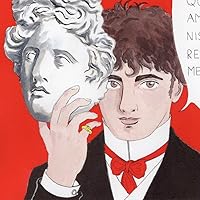
The Poe Clan is a classic shoujo series about the lives of a family of vampires. There are six chapters in this first volume, ranging from 20 pages greater than 100, skipping through time and location. Although two characters grace the cover, the devilish Edgar is the lead, and is the only character who appears throughout the book.
Although people will draw comparisons from the Poe Clan to Twilight series, as both are geared to teenage girls, this saga has much more in common with Anne Rice's Vampire Chronicles. So much so I have to wonder whether Moto Hagio read Interview With A Vampire before beginning this series. Both sagas brim with male homosexuality, vampires trapped in existential despair, eternal children, and are interested in warped family relationships and loss.
The reader is slowly introduced to the Poe Clan, through the eyes young men who are drawn the beautiful and eternally youthful Marybelle, and by the journals of wayfarers who stumble upon the Village of Poe surrounded by fields of roses. It isn't until Chapter 4 that the vampires take center stage, and it's more more than half way through before the reader gets an origin story for the main character. But these slow reveals and jumps in time give a depth and mystery to this story that I deeply appreciate. I even enjoy the slightly episodic nature of the chapters, giving Moto Hagio a chance to showcase different scenarios and eras for her characters.
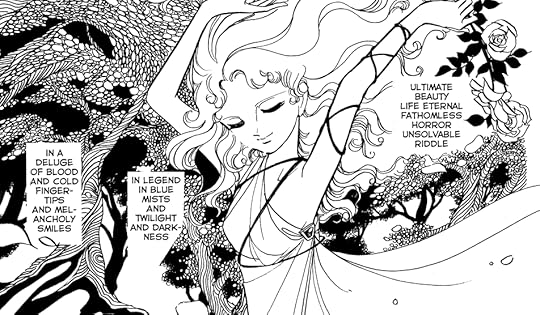
The 'Vampirenella' of the Poe Clan drink the essences of both roses and humans, and seem to be able to draw energy from humans by the tips of their undead fingers as well as the occasional neck bite. I am unclear as to the exact nature of this Clan. Edgar can appear as a young man, a winged demon, or a satyr. Does he need blood, or can he survive on roses? No matter. He's too busy seducing young men. Eternity is "too much to bear alone."
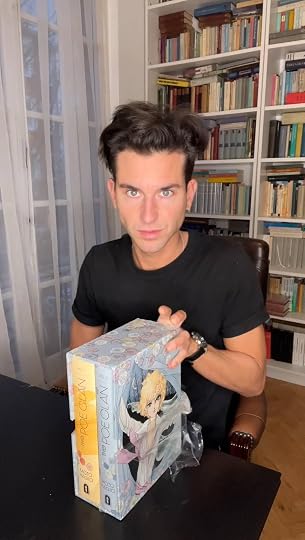
The artwork here is definitely of the 70's manga, which will be dated to some viewers. I mind it less, although the last chapter felt rushed. Sequentially I was lost across a few pages and it was easy to confuse characters. The translation flows well and these edition is heavy and beautiful. I'm so glad Rachel Thorn has found Fantagraphics to publish Hagio's work, and I look forward to Volume Two.