

What do you think?

Ms. Marvel Epic Collection
Ms. Marvel Epic Collection, Vol. 1: This Woman, This Warrior
Collects Ms. Marvel (1977) #1-14, Marvel Team-Up (1972) #61-62, Defenders (1972) #57.
Before she was Captain Marvel, she was Ms. Marvel! NASA Security Chief Carol Danvers' life had long been intertwined with the alien Kree and their Earthbound soldier Mar-Vell, and soon she gained incredible powers of her own — and a colorful persona to go with it! Now, as editor of Woman magazine, Danvers must contend with Marvel's biggest blowhard, J. Jonah Jameson, while coming to terms with her brand-new life as a super hero! As Ms. Marvel, Carol faces down threats including the Scorpion, the Doomsday Man, Grotesk and M.O.D.O.K. — but her deadliest foe of all may be the dynamic Deathbird! Plus: Ms. Marvel fights alongside Spider-Man in battle with the Super-Skrull! And will she join the dynamic Defenders? Relive the early days of your favorite hero!
Before she was Captain Marvel, she was Ms. Marvel! NASA Security Chief Carol Danvers' life had long been intertwined with the alien Kree and their Earthbound soldier Mar-Vell, and soon she gained incredible powers of her own — and a colorful persona to go with it! Now, as editor of Woman magazine, Danvers must contend with Marvel's biggest blowhard, J. Jonah Jameson, while coming to terms with her brand-new life as a super hero! As Ms. Marvel, Carol faces down threats including the Scorpion, the Doomsday Man, Grotesk and M.O.D.O.K. — but her deadliest foe of all may be the dynamic Deathbird! Plus: Ms. Marvel fights alongside Spider-Man in battle with the Super-Skrull! And will she join the dynamic Defenders? Relive the early days of your favorite hero!
322 pages, Kindle Edition
First published January 9, 2019
About the author
Chris Claremont
3,334 books930 followersChris Claremont is a writer of American comic books, best known for his 16-year (1975-1991) stint on Uncanny X-Men, during which the series became one of the comic book industry's most successful properties.
Claremont has written many stories for other publishers including the Star Trek Debt of Honor graphic novel, his creator-owned Sovereign Seven for DC Comics and Aliens vs Predator for Dark Horse Comics. He also wrote a few issues of the series WildC.A.T.s (volume 1, issues #10-13) at Image Comics, which introduced his creator-owned character, Huntsman.
Outside of comics, Claremont co-wrote the Chronicles of the Shadow War trilogy, Shadow Moon (1995), Shadow Dawn (1996), and Shadow Star (1999), with George Lucas. This trilogy continues the story of Elora Danan from the movie Willow. In the 1980s, he also wrote a science fiction trilogy about female starship pilot Nicole Shea, consisting of First Flight (1987), Grounded! (1991), and Sundowner (1994). Claremont was also a contributor to the Wild Cards anthology series.
Claremont has written many stories for other publishers including the Star Trek Debt of Honor graphic novel, his creator-owned Sovereign Seven for DC Comics and Aliens vs Predator for Dark Horse Comics. He also wrote a few issues of the series WildC.A.T.s (volume 1, issues #10-13) at Image Comics, which introduced his creator-owned character, Huntsman.
Outside of comics, Claremont co-wrote the Chronicles of the Shadow War trilogy, Shadow Moon (1995), Shadow Dawn (1996), and Shadow Star (1999), with George Lucas. This trilogy continues the story of Elora Danan from the movie Willow. In the 1980s, he also wrote a science fiction trilogy about female starship pilot Nicole Shea, consisting of First Flight (1987), Grounded! (1991), and Sundowner (1994). Claremont was also a contributor to the Wild Cards anthology series.
Ratings & Reviews
Friends & Following
Create a free account to discover what your friends think of this book!
Community Reviews
Displaying 1 - 26 of 26 reviews

August 20, 2020
Look, this comes from a bunch of probably well-meaning white dudes in the late 70s trying to be socially conscious, which leads to some awkwardness (not the least of which is Carol Danvers/Ms. Marvel constantly calling herself “Woman!” when she’s trying to get herself focused; also, J. Jonah Jameson is a RAGING misogynist). But, points for this observation, which could just as easily have been made in 2020: when Danvers interviews a bigwig executive, he points out that female employees are treated the same as everyone else in terms of hiring, firing, and advancement, regardless of race, sex, or creed; Danvers astutely responds, “Yet you have only one female plant manager at a minor facility.” SUCK ON THAT!
But, yeah—40+ years and we haven’t come all that far, have we?
Overall, this is a generally fun, slightly campy collection that is very much a product of its time. Nostalgically delicious.
But, yeah—40+ years and we haven’t come all that far, have we?
Overall, this is a generally fun, slightly campy collection that is very much a product of its time. Nostalgically delicious.
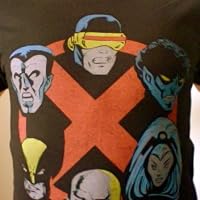
February 16, 2025
A very mixed bag and an at-times jarring experience watching this title and character go through a number of growing pangs.
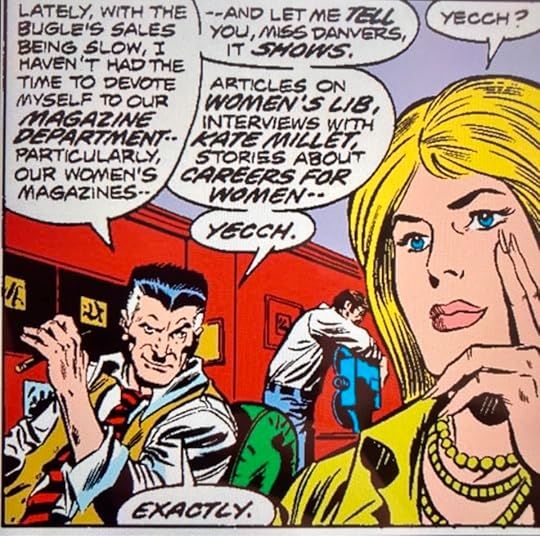
J. Jonah, Boss of the Century.
What starts out as a "two people inhabiting the same body/life" story pretty rapidly shifts to a "this is who I've always been!" story, and her power set and where those powers even come from get tinkered with a fair bit. Some of the middle issues are pretty dreadful slugfests with absolute D-Lister villains like "Grotesk" but, thank Hala, by issue 11 or so things start to get a little more coherent.
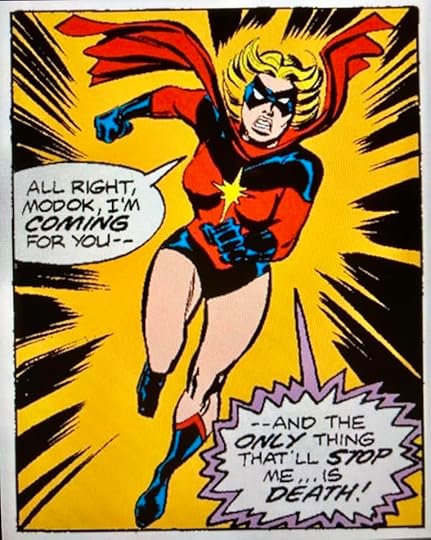
Yep, people talk (to themselves) like that all the time, right?
Others more knowledgeable and interested than me have spent much time writing about how Chris Claremont handles dialogue and descriptive prose so all I'll add is that it sure seems to predate his famous 1980s run on Uncanny X-Men.
All told this was an interesting read in terms of comics history but not a great story in and of itself. Only recommend for fans or researchers.
J. Jonah, Boss of the Century.
What starts out as a "two people inhabiting the same body/life" story pretty rapidly shifts to a "this is who I've always been!" story, and her power set and where those powers even come from get tinkered with a fair bit. Some of the middle issues are pretty dreadful slugfests with absolute D-Lister villains like "Grotesk" but, thank Hala, by issue 11 or so things start to get a little more coherent.
Yep, people talk (to themselves) like that all the time, right?
Others more knowledgeable and interested than me have spent much time writing about how Chris Claremont handles dialogue and descriptive prose so all I'll add is that it sure seems to predate his famous 1980s run on Uncanny X-Men.
All told this was an interesting read in terms of comics history but not a great story in and of itself. Only recommend for fans or researchers.

February 10, 2019
With the arrival of the Captain Marvel movie only weeks away, the release of Carol Danvers material ratchets up with the collection Ms. Marvel: This Woman, This Warrior, collecting her earliest costumed adventures.
Some time after absorbing a blast of alien radiation, former NASA security chief Carol Danvers discovers she’s acquired both powers similar to her old ally Captain Marvel (Mar-Vell) and extensive knowledge of the militaristic Kree. Carol’s new powers manifest in an alternate personality, the forceful heroine Ms. Marvel. She also acquires a “Seventh Sense” that warns her of danger and occasionally assails her with a physically painful vision of the future. Now a successful writer, Carol accepts an offer from Daily Bugle publisher J. Jonah Jameson to become editor of the new “Woman” magazine. Carol struggles with her debilitating precognition flashes, lack of control over her transformations into Ms. Marvel and the demands of her new role. The criminal scientists A.I.M. are eager to capture Ms. Marvel and unlock the secrets of her human/Kree hybrid physiology. Ms. Marvel comes up against a variety of other enemies, from the familiar to the brand new, including Scorpion, MODOK, the Destructor, the Doomsday Man, Grotesk, Deathbird, Super Skrull and Steeplejack. Over the course of these adventures, Carol struggles to reconcile her two warring personas, while beginning to make a name for herself as a costumed hero, teaming up along the way with the Vision, Spider-Man and the Defenders.
At the time of Ms. Marvel’s mid-70s debut, Carol Danvers had been kicking around the Marvel Universe for several years. She’d been a key part of the supporting cast for the first couple of years of Captain Marvel’s original run, but had fallen from prominence once Mar-Vell’s adventures shifted away from the NASA setting. Marvel in the ‘70s eagerly mined a variety of sub-cultures and movements for new character ideas, and Ms. Marvel represented a deliberate intention to reflect the feminist movement of the era. Writer Gerry Conway and artist John Buscema (with design input from the legendary John Romita, Sr.) made use of the climax of Carol’s Captain Marvel run to craft her new persona.
As was standard practice at the time, new female characters were often based on existing male heroes. So Ms. Marvel was closely related to Captain Marvel, with similar powers that literally came from him (the radiation filtered through his body as he tried to shield Carol), a costume derived from his, and even an echo on the situation where he was forced to “share” a body with another character. The Carol/Ms. Marvel dichotomy also famously tracked a key element of one of Marvel’s marquee characters, the Hulk (especially Carol’s lack of control over her transformations and a somewhat antagonistic attitude toward her alter ego). Marvel went a step further, borrowing the Spider-Man set-up of Carol working for Jonah, who had a grudge against her heroic alter ego (Peter Parker and Mary Jane Watson turned up early on, with MJ being an initial part of the supporting cast).
It was a solid set-up, though Conway dropped out fairly early on and turned the reins over to Chris Claremont, then the writer of Marvel’s hottest book, Uncanny X-Men. Claremont did a nice job of developing Carol and dramatizing her struggle to understand and cope with her heroic alter ego. Her Ms. Marvel powers were as often a hindrance to Carol’s life as they were an asset and Carol’s struggle to integrate her two halves was a key part of the first year of stories.
Claremont wisely moved away from the borrowed Spider-Man characters (MJ disappeared without comment after a couple of issues and Jonah transitioned into an often-unseen background presence), in favor of developing Carol’s own supporting cast. That included her co-workers and an array of friends, former colleagues and relatives, as well as a problematic love interest in her psychiatrist. The debut of Deathbird should be of significant interest to long-time fans, as Claremont would later successfully transplant her to Uncanny X-Men and develop her into a major villain. Claremont did an effective job with Carol, making her strong-willed, but also flawed. She was interesting, imperfect and actually went through a learning curve of figuring out how to be an effective hero.
The art side boasted a cadre of familiar Marvel Bullpen names that ensured that Ms. Marvel was done very much in the company’s well-known “house” style. John & Sal Buscema, Joe Sinnott, Jim Mooney, Keith Pollard, Carmine Infantino, Dave Cockrum, Steve Leialoha and others contributed to the usual set-up, with a dramatic splash page followed by tightly-packed panels that kept the action moving briskly throughout. With Claremont’s imaginative plotting and strong characterization, it was a state of the art Marvel book for its time, boasting all the usual tics (copious flashbacks, recaps and expository dialogue) that current fans often find charming and frustrating in equal doses. Of note, superstar artist John Byrne handled the pencils for the Spider-Man/Ms. Marvel team-up, bringing to the mix his well-known fluidity, creativity and way of pushing the limits of the page layouts typical of the time.
As an exploration of feminism, these early Ms. Marvel stories were a mixed bag. The series was on firmer ground when they showed instead of told, so that both Carol and Ms. Marvel were strong, intelligent women who were succeeding in male-dominated arenas. Just presenting a successful woman as though it were normal was the best aspect of the book’s exploration of feminism. Unfortunately, a lot of the rest of the time, the book’s handling of the topic could be rather shallow, when it remembered to tackle it at all. That could range from simplistic Women’s Studies 101 moments, like Carol instructing someone to call her “Ms.” instead of “Miss,” or overly broad situations like random extras goggling that the fights Ms. Marvel tackled weren’t appropriate “for a girl.” Jonah was an overly obvious strawman, demanding the magazine run articles on fashion, recipes and diets, while Carol fought for articles of substance. Potentially more interesting was Carol’s relationship with her chauvinistic construction worker father, introduced near the end of the run collected here. Claremont teased at that tension, but it would be left to writers many years down the road to more fully explore Carol’s problematic relationship with her father. Tellingly, for a series with a female lead that intended to explore feminist ideas, the book had only three female creators involved, all as colorists (including the legendary Marie Severin, who would have made an excellent primary artist for the series, had anyone at the time bothered to think about it).
The biggest problem that Ms. Marvel faced in establishing its feminist bonafides was the character’s visual presentation. Because leave it to a bunch of ‘70s comic book men to produce a “feminist” book that presented its lead wearing hot pants, with bare legs and a top that was both backless and midriff-baring. That overly sexualized early look was moderated after a few issues, with Ms. Marvel at least getting a full shirt.
Despite a few missteps, Ms. Marvel: This Woman, This Warrior is an enjoyable collection with involving stories and good character work that showcase the early costumed adventures of a character that has in recent years developed into one of Marvel’s A-list properties.
Some time after absorbing a blast of alien radiation, former NASA security chief Carol Danvers discovers she’s acquired both powers similar to her old ally Captain Marvel (Mar-Vell) and extensive knowledge of the militaristic Kree. Carol’s new powers manifest in an alternate personality, the forceful heroine Ms. Marvel. She also acquires a “Seventh Sense” that warns her of danger and occasionally assails her with a physically painful vision of the future. Now a successful writer, Carol accepts an offer from Daily Bugle publisher J. Jonah Jameson to become editor of the new “Woman” magazine. Carol struggles with her debilitating precognition flashes, lack of control over her transformations into Ms. Marvel and the demands of her new role. The criminal scientists A.I.M. are eager to capture Ms. Marvel and unlock the secrets of her human/Kree hybrid physiology. Ms. Marvel comes up against a variety of other enemies, from the familiar to the brand new, including Scorpion, MODOK, the Destructor, the Doomsday Man, Grotesk, Deathbird, Super Skrull and Steeplejack. Over the course of these adventures, Carol struggles to reconcile her two warring personas, while beginning to make a name for herself as a costumed hero, teaming up along the way with the Vision, Spider-Man and the Defenders.
At the time of Ms. Marvel’s mid-70s debut, Carol Danvers had been kicking around the Marvel Universe for several years. She’d been a key part of the supporting cast for the first couple of years of Captain Marvel’s original run, but had fallen from prominence once Mar-Vell’s adventures shifted away from the NASA setting. Marvel in the ‘70s eagerly mined a variety of sub-cultures and movements for new character ideas, and Ms. Marvel represented a deliberate intention to reflect the feminist movement of the era. Writer Gerry Conway and artist John Buscema (with design input from the legendary John Romita, Sr.) made use of the climax of Carol’s Captain Marvel run to craft her new persona.
As was standard practice at the time, new female characters were often based on existing male heroes. So Ms. Marvel was closely related to Captain Marvel, with similar powers that literally came from him (the radiation filtered through his body as he tried to shield Carol), a costume derived from his, and even an echo on the situation where he was forced to “share” a body with another character. The Carol/Ms. Marvel dichotomy also famously tracked a key element of one of Marvel’s marquee characters, the Hulk (especially Carol’s lack of control over her transformations and a somewhat antagonistic attitude toward her alter ego). Marvel went a step further, borrowing the Spider-Man set-up of Carol working for Jonah, who had a grudge against her heroic alter ego (Peter Parker and Mary Jane Watson turned up early on, with MJ being an initial part of the supporting cast).
It was a solid set-up, though Conway dropped out fairly early on and turned the reins over to Chris Claremont, then the writer of Marvel’s hottest book, Uncanny X-Men. Claremont did a nice job of developing Carol and dramatizing her struggle to understand and cope with her heroic alter ego. Her Ms. Marvel powers were as often a hindrance to Carol’s life as they were an asset and Carol’s struggle to integrate her two halves was a key part of the first year of stories.
Claremont wisely moved away from the borrowed Spider-Man characters (MJ disappeared without comment after a couple of issues and Jonah transitioned into an often-unseen background presence), in favor of developing Carol’s own supporting cast. That included her co-workers and an array of friends, former colleagues and relatives, as well as a problematic love interest in her psychiatrist. The debut of Deathbird should be of significant interest to long-time fans, as Claremont would later successfully transplant her to Uncanny X-Men and develop her into a major villain. Claremont did an effective job with Carol, making her strong-willed, but also flawed. She was interesting, imperfect and actually went through a learning curve of figuring out how to be an effective hero.
The art side boasted a cadre of familiar Marvel Bullpen names that ensured that Ms. Marvel was done very much in the company’s well-known “house” style. John & Sal Buscema, Joe Sinnott, Jim Mooney, Keith Pollard, Carmine Infantino, Dave Cockrum, Steve Leialoha and others contributed to the usual set-up, with a dramatic splash page followed by tightly-packed panels that kept the action moving briskly throughout. With Claremont’s imaginative plotting and strong characterization, it was a state of the art Marvel book for its time, boasting all the usual tics (copious flashbacks, recaps and expository dialogue) that current fans often find charming and frustrating in equal doses. Of note, superstar artist John Byrne handled the pencils for the Spider-Man/Ms. Marvel team-up, bringing to the mix his well-known fluidity, creativity and way of pushing the limits of the page layouts typical of the time.
As an exploration of feminism, these early Ms. Marvel stories were a mixed bag. The series was on firmer ground when they showed instead of told, so that both Carol and Ms. Marvel were strong, intelligent women who were succeeding in male-dominated arenas. Just presenting a successful woman as though it were normal was the best aspect of the book’s exploration of feminism. Unfortunately, a lot of the rest of the time, the book’s handling of the topic could be rather shallow, when it remembered to tackle it at all. That could range from simplistic Women’s Studies 101 moments, like Carol instructing someone to call her “Ms.” instead of “Miss,” or overly broad situations like random extras goggling that the fights Ms. Marvel tackled weren’t appropriate “for a girl.” Jonah was an overly obvious strawman, demanding the magazine run articles on fashion, recipes and diets, while Carol fought for articles of substance. Potentially more interesting was Carol’s relationship with her chauvinistic construction worker father, introduced near the end of the run collected here. Claremont teased at that tension, but it would be left to writers many years down the road to more fully explore Carol’s problematic relationship with her father. Tellingly, for a series with a female lead that intended to explore feminist ideas, the book had only three female creators involved, all as colorists (including the legendary Marie Severin, who would have made an excellent primary artist for the series, had anyone at the time bothered to think about it).
The biggest problem that Ms. Marvel faced in establishing its feminist bonafides was the character’s visual presentation. Because leave it to a bunch of ‘70s comic book men to produce a “feminist” book that presented its lead wearing hot pants, with bare legs and a top that was both backless and midriff-baring. That overly sexualized early look was moderated after a few issues, with Ms. Marvel at least getting a full shirt.
Despite a few missteps, Ms. Marvel: This Woman, This Warrior is an enjoyable collection with involving stories and good character work that showcase the early costumed adventures of a character that has in recent years developed into one of Marvel’s A-list properties.

March 20, 2019
So much to unpack here but here it goes. Ms. Marvel was a giant f*ck you to toxic masculinity from the beginning. The very first thing Carol Danvers does is take J. Jonah Jameson to task, something that should not be taken lightly. Once Claremont takes the reigns however the title takes it to a whole new level.
The relationship between Carol and her alter ego is strained from the beginning at first being a metaphor for female body image. Ms. Marvel is everything that a Carol isn't, the idealized version of herself...how could she possibly hope to live up to her other half? This impossible standard? As it goes on, Claremont slowly starts phasing this out recognizing that it has limited potential in and of itself. He starts making Carol his own, and giving the character so much more life and power.
She becomes a true Marvel hero in that she is given flaws and somewhat resents her own power. She has a nasty temper, doesn't tend to think things through all that much, and often isn't given much of a choice as to what she wants to do and what she is forced to do. Yes, she is the editor of WOMAN magazine, but like Spider-man, her job and personal life often suffer from her heroics.
While these issues haven't aged well in some aspects, it's a great look back at the character's origins and another prime example at just how much Chris Claremont changed the face of comics.
The relationship between Carol and her alter ego is strained from the beginning at first being a metaphor for female body image. Ms. Marvel is everything that a Carol isn't, the idealized version of herself...how could she possibly hope to live up to her other half? This impossible standard? As it goes on, Claremont slowly starts phasing this out recognizing that it has limited potential in and of itself. He starts making Carol his own, and giving the character so much more life and power.
She becomes a true Marvel hero in that she is given flaws and somewhat resents her own power. She has a nasty temper, doesn't tend to think things through all that much, and often isn't given much of a choice as to what she wants to do and what she is forced to do. Yes, she is the editor of WOMAN magazine, but like Spider-man, her job and personal life often suffer from her heroics.
While these issues haven't aged well in some aspects, it's a great look back at the character's origins and another prime example at just how much Chris Claremont changed the face of comics.

February 13, 2019
It's ok, but it's missing a few things. First off, Carol doesn't have a good supporting cast. She has J. Jonah Jameson, it looks like Mary Jane, and a few others, but it's not really fleshed out. It's kind of a problem with the whole book, just part of an idea is there. There is definitely some potential there but I really wish they would have gone deeper.
There is an interesting part where Carol and Ms. Marvel are two different beings that occupy the same body, but I think even the creators saw what a mistake this was as it just gets explained away. You kind of get the impression they wanted to have a female lead superhero book, and put it out before it was fully formed. They even go back on Carol's powers. At first, she needs her costume to fly, but that is undone later when it turns out she actually didn't, she only thought she did.
Overall, it's a good book. The part's where Carol is taking on A.I.M. is pretty fun. Volume two is set to come out later and I'll probably get it.
There is an interesting part where Carol and Ms. Marvel are two different beings that occupy the same body, but I think even the creators saw what a mistake this was as it just gets explained away. You kind of get the impression they wanted to have a female lead superhero book, and put it out before it was fully formed. They even go back on Carol's powers. At first, she needs her costume to fly, but that is undone later when it turns out she actually didn't, she only thought she did.
Overall, it's a good book. The part's where Carol is taking on A.I.M. is pretty fun. Volume two is set to come out later and I'll probably get it.
March 3, 2019
A fun read. Nice to see the beginnings of this character. Definitely of its time, which may inform your enjoyment. It’s been said that it feels like she is guest starring in a Spider-Man book at the beginning, and that’s true, but by the end of this volume that has clearly changed and Carol is moving in her own direction.

April 12, 2023
This is outright terrible but not entertaingly so.
When Carol Danvers debuted as Captain Marvel I didn’t recognize the character. She was a complete biatch. Beyond unlikeable. And it only got worse. I’d really only followed her over the years as a periphery X-Men character and in her early 2000s series, but I liked that Carol. She had an interesting history, she’d evolved, she’d been Binary, she had some great looks, she had a love life, friends, some alcoholism, etc. She had real problems, sure, but she did her best and tried to improve herself. I cared about her and she felt real.
But I’d never read this book or her Avengers appearances, though. Well, now I’ve read this book. Apparently when Carol Danvers became Captain Marvel her personality was just taken back to basics. Here you see that same unlikeable character. She’s absolutely full of herself, overconfident, God’s gift to the world. I think we’re supposed to be in awe of her amazingness but instead the awe is reserved for her awfulness.
For one, Carol is flat out rude. She gets a job as editor of a magazine but the only time she’s shown working is when she’s berating her staff. She leaves them to do all the work while she’s off superheroing. People try to reach out to her and she constantly blows them off. For some reason Mary Jane Watson desperately wants to be Carol’s punching bag. No matter how many times Carol blows her off, shes always ready to take more of Carol’s crap. All of her relationships are one-sided: Carol-sided.
Allegedly these issues are a mess because Claremont was preoccupied trying to fix the character conceptually. I don’t see why that fix needed to be so drawn out and I’m not sure he had a handle on what her problems were to begin with. I have not yet read the second volume so I don’t even know if he “fixed” her before the book was cancelled. That costume, which accounts for most of the criticism, is the least of her problems, and by issue 9 that’s mostly fixed anyhow (her belly window is gone then.)
At issue 9, bigger problems persist: what’s up with her contradictory relationship with her psychologist? Is she schizo? Are Carol and Ms. Marvel two separate entities and if so, what is Ms. Marvel’s civilian identity? Is she Kree? Or is she human? Does she actually have Kree memories or is all that stuff, like the way she speaks, just an STD she picked up from (The Real) Captain Marvel?
If Claremont wanted to fix the character he could have stopped the schizo stuff right away, and clarified she didn’t have a Shazam problem. He also could have this genius warrior say to herself, “Gee, every single time I get into a fight the baddie strangled me with my own scarf. Do I need the scarf?” Or justify it! “Gee, I know the scarf’s a potentially fatal problem but I really don’t want MODOK to see my eczema! Plus, it really pulls the whole ensemble together.”
The best issues are the Team-Up ones with Spider-Man, hands down. In her own book, Carol is an insufferable idiot in a confused mess of stories. Read at your own risk. But you’re better off sticking to online summaries if you desperately want to know what happens here (a lot of AIM and MODOK.) There really is no origin story here. And that’s kind of Carol’s biggest problem. We’re led to believe she’s the first and last word on female superheroes but her origin is more She-Hulk than Wonder Woman. You can’t explain Carol without explaining (The Real) Captain Marvel. And this book never even got around to doing any of that right! What a mess.
It’s kind of a shame that Marvel went so “all-in” with Carol taking on the Captain title. They have forever chained the character to identity politics and Feminism, Inc., so now matter how much proof they have that the concept has failed, they can’t just stick the character in limbo for a few years and bring her back as Ms. Marvel—in the black lightning suit, of course, one of the best superhero designs ever.
An historical curiosity, interesting in only this: how Claremont drops Carol’s dual identity disorder only to bring it back for Rogue years later. The Byrne issues look good, too.
When Carol Danvers debuted as Captain Marvel I didn’t recognize the character. She was a complete biatch. Beyond unlikeable. And it only got worse. I’d really only followed her over the years as a periphery X-Men character and in her early 2000s series, but I liked that Carol. She had an interesting history, she’d evolved, she’d been Binary, she had some great looks, she had a love life, friends, some alcoholism, etc. She had real problems, sure, but she did her best and tried to improve herself. I cared about her and she felt real.
But I’d never read this book or her Avengers appearances, though. Well, now I’ve read this book. Apparently when Carol Danvers became Captain Marvel her personality was just taken back to basics. Here you see that same unlikeable character. She’s absolutely full of herself, overconfident, God’s gift to the world. I think we’re supposed to be in awe of her amazingness but instead the awe is reserved for her awfulness.
For one, Carol is flat out rude. She gets a job as editor of a magazine but the only time she’s shown working is when she’s berating her staff. She leaves them to do all the work while she’s off superheroing. People try to reach out to her and she constantly blows them off. For some reason Mary Jane Watson desperately wants to be Carol’s punching bag. No matter how many times Carol blows her off, shes always ready to take more of Carol’s crap. All of her relationships are one-sided: Carol-sided.
Allegedly these issues are a mess because Claremont was preoccupied trying to fix the character conceptually. I don’t see why that fix needed to be so drawn out and I’m not sure he had a handle on what her problems were to begin with. I have not yet read the second volume so I don’t even know if he “fixed” her before the book was cancelled. That costume, which accounts for most of the criticism, is the least of her problems, and by issue 9 that’s mostly fixed anyhow (her belly window is gone then.)
At issue 9, bigger problems persist: what’s up with her contradictory relationship with her psychologist? Is she schizo? Are Carol and Ms. Marvel two separate entities and if so, what is Ms. Marvel’s civilian identity? Is she Kree? Or is she human? Does she actually have Kree memories or is all that stuff, like the way she speaks, just an STD she picked up from (The Real) Captain Marvel?
If Claremont wanted to fix the character he could have stopped the schizo stuff right away, and clarified she didn’t have a Shazam problem. He also could have this genius warrior say to herself, “Gee, every single time I get into a fight the baddie strangled me with my own scarf. Do I need the scarf?” Or justify it! “Gee, I know the scarf’s a potentially fatal problem but I really don’t want MODOK to see my eczema! Plus, it really pulls the whole ensemble together.”
The best issues are the Team-Up ones with Spider-Man, hands down. In her own book, Carol is an insufferable idiot in a confused mess of stories. Read at your own risk. But you’re better off sticking to online summaries if you desperately want to know what happens here (a lot of AIM and MODOK.) There really is no origin story here. And that’s kind of Carol’s biggest problem. We’re led to believe she’s the first and last word on female superheroes but her origin is more She-Hulk than Wonder Woman. You can’t explain Carol without explaining (The Real) Captain Marvel. And this book never even got around to doing any of that right! What a mess.
It’s kind of a shame that Marvel went so “all-in” with Carol taking on the Captain title. They have forever chained the character to identity politics and Feminism, Inc., so now matter how much proof they have that the concept has failed, they can’t just stick the character in limbo for a few years and bring her back as Ms. Marvel—in the black lightning suit, of course, one of the best superhero designs ever.
An historical curiosity, interesting in only this: how Claremont drops Carol’s dual identity disorder only to bring it back for Rogue years later. The Byrne issues look good, too.

March 29, 2022
While I did pick up the first couple issues of Ms. Marvel back in the 1970s, I can’t say I was a fan. The character just felt like a lame gimmick, it wasn’t until her appearances in Marvel Team-Up, Defenders and Avengers that I found her interesting. I did eventually get around to reading these early issues when Essential Ms. Marvel, Vol. 1 was published. And I wasn’t really impressed. This time around, I did find myself enjoying the stories much more than I had originally. But still not enough to give it more than 3-stars.

June 15, 2025
Marvel has been trying to make Carol Danvers (now known as Captain Marvel) an A-list character for years now, but she just doesn't have it in her. Created as a token feminist when such things were trendy, she is as dull and didactic as you'd expect. Even Chris Claremont, the patron saint of strong female characters, can't do anything with her. There are a few decent stories here, elevated by the art, but most of it is a waste. It's no wonder she was literally consigned to limbo a few years later.

January 21, 2026
About what you'd expect from a comic book capitalizing on the rise of feminism in the late 70s, elevated to a degree by later issues' author Claremont and his penchant for action and melodrama. The central conceit of a superhero who's unaware of her own alter ego and transitions back and forth from brassy magazine editor to militaristic, Kree-powered hero against her will is an interesting one, a slight variation on the Banner/Hulk relationship made more interesting by both sides of the persona having rational, intellectual reasons for wanting and needing to stay in control at any given moment. At its worst, though, it feels like it ascribes mental instability to this woman trying to make it with independence in a man's world - an instability that would continue to haunt the character of Carol Danvers, for better or worse, in different iterations through much of her publication history. The art, primarily by John and later Sal Buscema, is the top notch kind of stuff that caliber of guy delivers, and it doesn't go unnoticed that Marvel's costume goes from scanty and midriff-bearing to more covered up and functional somewhere near the midpoint of this run. That kind of change - along with the appearance and disappearance of taglines like "This female fights back!" - betrays what I can only imagine was a sort of creative floundering behind the scenes in the extremely male-dominated Marvel offices. "How do we write a dame as a lead?!" I can imagine being bellowed about the bullpen. Lest we give them too much of a benefit of the doubt, the two letters page editorials from the initial issues reproduced here give the game away, with Gerry Conway's piece demonstrating his defensive posturing about his place as the creator and writer of a female superhero - "Feminism means equality, therefore I get to do this (plus there were no qualified frails around, you dig?" he says, almost (but not strictly) verbatim - and the second piece, by a writer who admits to having nothing to do with the title, blathering on about literally nothing for a column and a half before vaguely tying his musings back to the title and character at hand. They couldn't have handed the editorial pen to Noted Female Comic Person (and regular Marvel denizen) Marie Severin to write something about the impact of a female lead in a superhero comic? They couldn't have reached out to a female comics fan through the already burgeoning fan network? It's tone deaf, and while the content of the comic itself is pretty solid - Carol is never a damsel in distress, her love life is never center stage, she holds her own with supervillains and blowhards alike - the uncertainty and tenuousness of these men can be felt all over it. As I said, Chris Claremont improves matters to a degree, with a temporary resolution to Carol's identity crisis, but the run still ends with an uncomfortable moment between Carol and her misogynistic dad that reads as "That's just the way he is, and that's ok because he works hard!" It's an interesting start to Carol Danvers' superheroic career and a fascinating time capsule about gender politics.

April 4, 2026
This is 1970s "liberal attempts at feminism" bottled up in a pure time capsule of the times.
Props to Marvel for trying to portray the "strong, independent, hip, young woman" as the lead character, ready to hang with the Big Super Boys. And, I kept reminding myself of that: that one cannot read this with a modern lens because it becomes so cringe. 😄 Villains really loved to utter some variation of "wretched female" a lot.
As an X-men fan, and a Claremont run enthusiast, it was fascinating to see Claremont writing here. So many ideas, characters, plots start here and carry over into his lengthy, seminal X-Men run. While most famously Mystique pops up in the issues right after this collection, here we still have the premiere of Deathbird and the genesis of the attitude of Ms. Marvel's later identity of Binary. Claremont loves a strong lady and writes a compelling female lead. This might not be as strong as his Storm work later, but it's a very good laboratory for his (not too distant) later work.
I also never realized how tied to Spider-Man's line early Ms. Marvel was! She works at "Woman" magazine (I know, I know), an offshoot of the Daily Bugle. We've got JJ Jameson, we've got Mary Jane, we've got the Scorpion as her first supervillain battle, we even have a tiny bit of Peter Parker. It makes sense, as Spider-Man was Marvel's juggernaut flagship at the time.
The subplot of dual identities (because Marvel insisted on secret identities) was tedious, and quite frankly, dumb. You can even feel that Claremont didn't care for it, as he even resolves it basically in a flashback panel that was as close to off-panel as you can get.
Art-wise, this was fine. Very house style. You have some Buscema, some Infantino, some Cockrum. Very house Marvel of the age.
All in all, this was a fun artifact, but not really something I'd ever need to revisit.
Props to Marvel for trying to portray the "strong, independent, hip, young woman" as the lead character, ready to hang with the Big Super Boys. And, I kept reminding myself of that: that one cannot read this with a modern lens because it becomes so cringe. 😄 Villains really loved to utter some variation of "wretched female" a lot.
As an X-men fan, and a Claremont run enthusiast, it was fascinating to see Claremont writing here. So many ideas, characters, plots start here and carry over into his lengthy, seminal X-Men run. While most famously Mystique pops up in the issues right after this collection, here we still have the premiere of Deathbird and the genesis of the attitude of Ms. Marvel's later identity of Binary. Claremont loves a strong lady and writes a compelling female lead. This might not be as strong as his Storm work later, but it's a very good laboratory for his (not too distant) later work.
I also never realized how tied to Spider-Man's line early Ms. Marvel was! She works at "Woman" magazine (I know, I know), an offshoot of the Daily Bugle. We've got JJ Jameson, we've got Mary Jane, we've got the Scorpion as her first supervillain battle, we even have a tiny bit of Peter Parker. It makes sense, as Spider-Man was Marvel's juggernaut flagship at the time.
The subplot of dual identities (because Marvel insisted on secret identities) was tedious, and quite frankly, dumb. You can even feel that Claremont didn't care for it, as he even resolves it basically in a flashback panel that was as close to off-panel as you can get.
Art-wise, this was fine. Very house style. You have some Buscema, some Infantino, some Cockrum. Very house Marvel of the age.
All in all, this was a fun artifact, but not really something I'd ever need to revisit.

August 29, 2019
I'm reading this after reading all of the Captain Marvel issues and these are my thoughts:
Pros:
For 1977, I was surprised at just how strong of a character Ms. Marvel/ Carol Danvers is. She demands a high salary (and gets it) from Jameson at the Daily Bugle. She also gets to start and edit a new magazine for women. She lives on her own, has had a slew of high powered jobs with loads of connections, and takes nice vacations. As Ms. Marvel, she fights mostly powerful, male characters, which is awesome. She even jumps in to help out Spider-man at one point. It's nice to see that the writers didn't feel like they needed to make up weaker characters for her or that she needed the male super heroes to come in and help her out.
Cons:
Her costume starts out like a bikini, then slowly grows extra fabric and becomes more of a high-necked, long-sleeved, leotard. She won't get pants until she gets the captain title, but at least it ends up better than it started. The writers also don't seem to know where/why/how as far as her origin story goes and they haphazardly make it up as they go along- which leads to some seemingly contradictory info which is then sorta explained away. As far as the basic plots go, most issues are as follows: big bad guy does something bad, Ms. Marvel goes to stop him, they fight, Ms. Marvel wins, big bad guy swears revenge, sometimes returns for followup issue. So all in all, very little character development.
Overall, I liked seeing the first iterations of this character.
Pros:
For 1977, I was surprised at just how strong of a character Ms. Marvel/ Carol Danvers is. She demands a high salary (and gets it) from Jameson at the Daily Bugle. She also gets to start and edit a new magazine for women. She lives on her own, has had a slew of high powered jobs with loads of connections, and takes nice vacations. As Ms. Marvel, she fights mostly powerful, male characters, which is awesome. She even jumps in to help out Spider-man at one point. It's nice to see that the writers didn't feel like they needed to make up weaker characters for her or that she needed the male super heroes to come in and help her out.
Cons:
Her costume starts out like a bikini, then slowly grows extra fabric and becomes more of a high-necked, long-sleeved, leotard. She won't get pants until she gets the captain title, but at least it ends up better than it started. The writers also don't seem to know where/why/how as far as her origin story goes and they haphazardly make it up as they go along- which leads to some seemingly contradictory info which is then sorta explained away. As far as the basic plots go, most issues are as follows: big bad guy does something bad, Ms. Marvel goes to stop him, they fight, Ms. Marvel wins, big bad guy swears revenge, sometimes returns for followup issue. So all in all, very little character development.
Overall, I liked seeing the first iterations of this character.

April 18, 2020
I only really bought this because I saw it ridiculously cheap for an Epic Collection (not realising it’s only 2/3 the usual length of an EC). I was expecting it to be a bit of a mess. One of those comics that exists to serve a trademark filing rather than a creative desire, that gets handed around the Bullpen with no-one having a clear idea for it.
But actually, it’s pretty good. Chris Claremont takes over from issue 3 and while it never reaches the heights of his X-Men run, it’s pretty solid. It’s not the painful attempt of a man to write what he thinks second wave feminism is, certainly (maybe a little under initial writer Gerry Conway). You do get a few of Claremont’s narration quirks here (I’ve never got why he writes “scene cut” and suchlike into captions), but on the other hand there’s a really interesting take on Carol’s secret identity in terms of Dissociative Personality Disorder.
Artwise it is more unstable, but again competently done. Jim Mooney does some good work and there’s an interesting issue by Carmine Infantino at the back.
Overall, it’s a reminder of how interesting and varies Chris Claremont could be before he got entirely wrapped up in his X-books.
But actually, it’s pretty good. Chris Claremont takes over from issue 3 and while it never reaches the heights of his X-Men run, it’s pretty solid. It’s not the painful attempt of a man to write what he thinks second wave feminism is, certainly (maybe a little under initial writer Gerry Conway). You do get a few of Claremont’s narration quirks here (I’ve never got why he writes “scene cut” and suchlike into captions), but on the other hand there’s a really interesting take on Carol’s secret identity in terms of Dissociative Personality Disorder.
Artwise it is more unstable, but again competently done. Jim Mooney does some good work and there’s an interesting issue by Carmine Infantino at the back.
Overall, it’s a reminder of how interesting and varies Chris Claremont could be before he got entirely wrapped up in his X-books.

March 10, 2020
3.5, as this Bronze Age series improves as Chris Claremont (who took over from Gerry Conway) finds his feet. Still well below Marvel's A-list of the era, but it does introduce the first female Marvel superhero to get her own book.
Ms. Marvel is Carol Danvers, former supporting character to the company's Captain Marvel. Now she has super-powers herself, but at first isn't even aware of her superpowered identity. We have super-villain battles, encounters with J. Jonah Jameson (Carol's editing a magazine for him) but surprisingly little supporting cast that's not tied to Spider-Man (Conway used to write Spidey, hence the borrowing). The schizoid aspect gets tiresome but Claremont eventually resolves it (for X-fans, this is where Death-Bird and Mystique debut).
Everything's competent and entertaining but it lacks the spark Claremont brought to X-Men.
Ms. Marvel is Carol Danvers, former supporting character to the company's Captain Marvel. Now she has super-powers herself, but at first isn't even aware of her superpowered identity. We have super-villain battles, encounters with J. Jonah Jameson (Carol's editing a magazine for him) but surprisingly little supporting cast that's not tied to Spider-Man (Conway used to write Spidey, hence the borrowing). The schizoid aspect gets tiresome but Claremont eventually resolves it (for X-fans, this is where Death-Bird and Mystique debut).
Everything's competent and entertaining but it lacks the spark Claremont brought to X-Men.
May 15, 2025
While a lot of this book showcases the worst of the 70s - generic high-tech or alien or fantasy villains, conspiracy subplots that never go anywhere, characters having five minutes of dialogue in a frame with a single punch, and a book exploring feminism where the only female creator is a colorist on a few of the later issues - I can't deny it's charming, getting to see the creators explore aspects of this character like a psychic sense or a split personality that never really stuck and then finding ways to gently offload them. The running subplot of MODOK and Deathbird fighting science terrorists in a department store? Actually a hoot.

October 4, 2019
Gerry Conway is sexist and probably misogynistic, so I hate that he had anything to do with creating Ms. Marvel. The fact that they chose to include his awful letter from the 70s says a lot about Marvel. They are slightly better to female creators these days, but it doesn't appear to be by very much.

May 12, 2026
I bought some of these issues off the spinner rack at my local Piggly Wiggly and enjoyed them. I wanted to see how they held up.
Obviously, they are a product of their time (the late 70s) and followed the conventions of the day (a lot of panels per page and tons of dialogue), but they hold up better than expected. I enjoyed them and got that nostalgic glow at the same time.
Obviously, they are a product of their time (the late 70s) and followed the conventions of the day (a lot of panels per page and tons of dialogue), but they hold up better than expected. I enjoyed them and got that nostalgic glow at the same time.

May 19, 2022
Enjoyable enough for its time. I loved that they made Danvers a former NASA employee, and I enjoyed the references to KSC, the VAB, etc. There seemed to be a bit of uncertainty with regard to her power and origin, but I kind of expected that in this first run of issues.

September 23, 2023
The original series has held up really well, less damsel in distress and more strong independent career woman determined to make it, both as an editor of a magazine and as a superhero.
I was pleasantly surprised to see how forward thinking the writing was, but with Chris Claremont in charge for most of the book I should have known better. Claremont was ahead of his time in more ways than one. The artwork is good, solid Bronze Age fun done by the usual journeymen of the day. I really enjoyed reading this book.
I was pleasantly surprised to see how forward thinking the writing was, but with Chris Claremont in charge for most of the book I should have known better. Claremont was ahead of his time in more ways than one. The artwork is good, solid Bronze Age fun done by the usual journeymen of the day. I really enjoyed reading this book.

March 13, 2019
A fun collection that I hadn't read before. My only complaint is that it was too short in comparison to other Epic Collections. I'm sure there was other stuff they could have padded this out with.

October 18, 2021
I enjoyed this so much more than I expected to considering the pub date.

June 9, 2023
So glad the split personality thing doesn't last too long. Such a weird plot device. Good art though. Nice to see some Infantino in there

September 15, 2023
Finally getting to this short run for the X-Men 60th. In some ways better than expected, but ultimately unremarkable except for a couple key appearances.

January 13, 2026
Awesome!

August 24, 2026
A product of its time J Jonah Jameson says some wild shit to Carol but other than that a mostly ok run of forgettable villains and art. 1977-1978. 6/10

March 29, 2019
Another one in Marvel's Epic Collection, this time collecting Ms. Marvel #1-14, Marvel Team-Up #61-62 and Defenders #57, we get the first issues of Carol Danvers, aka Ms. Marvel, in her days long before she became Captain Marvel.
As in the movie, she is wrestling with amnesia, unlike in the movies, however, this amnesia arises from a split-personality. When she's Carol she remembers her life as Carol but blacks out when she becomes Ms. Marvel. The set-up owes quite a bit to the Hulk, who is also a dual character with Banner not necessarily approving of what Hulk does.
This is an interesting concept, however, as you get over the concept the book starts to lag after a few issues. The stories are quite repetitive, Danvers gets into danger, Marvel takes over her body and saves the day and then Carol is back not remembering what happened and resenting Marvel more and more. Only towards the last few issues of the book does this dynamic change as Danvers and Marvel integrate further into one personality, able to change at will and less conflicted. This was really needed in the story, the whole conflicting personalities thing was taking over everything and stopping Carol from having or developing any meaningful relationships with other characters. Fortunately further issues should be over this, unfortunately this collects most of the issues where Claremont is clearly trying to get a grip on the character. The art is ok but nothing to write home about, but I am excited for other volumes, however.
As in the movie, she is wrestling with amnesia, unlike in the movies, however, this amnesia arises from a split-personality. When she's Carol she remembers her life as Carol but blacks out when she becomes Ms. Marvel. The set-up owes quite a bit to the Hulk, who is also a dual character with Banner not necessarily approving of what Hulk does.
This is an interesting concept, however, as you get over the concept the book starts to lag after a few issues. The stories are quite repetitive, Danvers gets into danger, Marvel takes over her body and saves the day and then Carol is back not remembering what happened and resenting Marvel more and more. Only towards the last few issues of the book does this dynamic change as Danvers and Marvel integrate further into one personality, able to change at will and less conflicted. This was really needed in the story, the whole conflicting personalities thing was taking over everything and stopping Carol from having or developing any meaningful relationships with other characters. Fortunately further issues should be over this, unfortunately this collects most of the issues where Claremont is clearly trying to get a grip on the character. The art is ok but nothing to write home about, but I am excited for other volumes, however.
Displaying 1 - 26 of 26 reviews