

What do you think?

Random House (India) [ THE WARRIOR STATE: PAKISTAN IN THE CONTEMPORARY WORLD ] By Paul, T. V. ( Author ) Feb - 2014 [ Hardcover ]
Seemingly from its birth, pakistan has been struggling to build a proper democracy and a secure state. Today it ranks 133rd out of 148 countries in global competitiveness. Its economy is as dysfunctional as its political system is corrupt; both rely heavily on international aid for their existence. Taliban forces occupy many key areas of the country and engage in random violence. It possesses over a hundred nuclear weapons that could fall into terrorists' hands. Why, in an era when countries across the developing world are experiencing impressive economic growth and building democratic institutions, has pakistan been such a conspicuously weak state? in the warrior state, noted international relations and south asia scholar t. V. Paul untangles this fascinating riddle. Paul argues that the "geostrategic curse" - akin to the "resource curse" that plagues oil-rich autocracies - is at the root of pakistan's unique inability to progress. Since its founding in 1947, pakistan has been at the center of major geopolitical the us-soviet rivalry, the conflict with india and most recently the post 9/11 wars. No matter how ineffective the regime is, massive foreign aid keeps pouring in from major powers, their allies and global financial institutions with a stake in the region. The reliability of such aid defuses any pressure on political elites to launch the far-reaching domestic reforms necessary to promote sustained growth, higher standards of living and more stable democratic institutions. Paul shows that excessive war-making efforts have drained pakistan's limited economic resources without making the country safer or more stable. Indeed, despite the regime's emphasis on security, the country continues to be beset by widespread violence and terrorism.
Hardcover
First published January 1, 2013
About the author
T.V. Paul
31 books12 followersT.V. Paul is James McGill Professor of International Relations in the department of Political Science at McGill University. Paul specializes and teaches courses in international relations, especially international security, regional security and South Asia. He is the author or editor of 18 books (all published through major university presses) and nearly 60 journal articles or book chapters.
T.V. Paul was elected as the 56th President of International Studies Association and on March 17, 2016 he took charge as ISA President for 2016-17. He delivered the presidential address on the theme: “Recasting Statecraft: International Relations and the Strategies of Peaceful Change.” In the presentation, he called for the International Relations discipline and its theoretical paradigms to devote more attention to strategies for achieving enduring peace among states.
As ISA president, he spearheaded the Global South Task Force whose report and recommendations were adopted by the ISA Governing Council in San Francisco in March 2018.
Paul was born in the Indian state of Kerala (Mevellor, Kottayam District) on November 10, 1956 and his early education was at institutions in Kerala. He completed his Masters in Political Science from Maharajas College, Ernakulum (affiliated to Kerala University) in 1980 and then worked as a journalist for the Press Trust of India (PTI) news agency in New Delhi from 1980 till 1985. During this period, he completed his MPhil from the School of International Studies (SIS), Jawaharlal Nehru University. From July 1985 till July 1986 he spent a year at the University of Queensland, Australia, as a research scholar. In July 1986 he was admitted to graduate studies at the University of California, Los Angeles (UCLA) from where he completed his PhD in Political Science in June 1991. In September 1991, he began his teaching career at McGill University where he was appointed as an assistant professor, promoted and tenured to associate professor in 1995, and full professor in 2000. In 2003, he was awarded the prestigious James McGill chair, instituted in the name of the university’s founder. He has been a visiting professor of National Security Affairs at the Naval Postgraduate School, Monterey, California (2002-03), visiting scholar at the APEC Study Center, University of California, Berkeley (2013), East-West Center, Honolulu (2013), Center for International Affairs (CFIA) and the Olin Institute for Strategic Studies, Harvard University (1997-98), and James Martin Center for Nonproliferation Studies, Monterey (2002-2003). He was the founding Director (2009-12) of the McGill-University of Montreal Center for International Peace and Security Studies (CIPSS), which originated from the Research Group in International Security (REGIS) which he co-directed for over a decade. Between 2009 and 2011 he served as the Chair of the International Security Studies Section (ISSS) of the International Studies Association (ISA) and during 2013-14 as ISA’s Vice-President. Currently, he serves as the editor of Georgetown University Press’ South Asia in World Affairs book series and on the editorial boards of many scholarly journals. He has travelled widely and given scores of seminars at leading academic institutions worldwide.
Paul has made a number of contributions to the study of international relations, especially broader international security and South Asia. He is especially known for rigorous puzzle-driven scholarship utilizing case studies as opposed to paradigms. He has been a proponent of eclectic modeling which he uses in several of his works. He is also a conceptual innovator and has made contributions to topics such as asymmetric conflicts, soft balancing, tradition of nuclear non-use, and status accommodation of rising powers. His first major book: Asymmetric Conflicts: War Initiation by Weaker Powers (Cambridge University Press, 1994) was pioneering as it addresses a neglected question of materially weake
T.V. Paul was elected as the 56th President of International Studies Association and on March 17, 2016 he took charge as ISA President for 2016-17. He delivered the presidential address on the theme: “Recasting Statecraft: International Relations and the Strategies of Peaceful Change.” In the presentation, he called for the International Relations discipline and its theoretical paradigms to devote more attention to strategies for achieving enduring peace among states.
As ISA president, he spearheaded the Global South Task Force whose report and recommendations were adopted by the ISA Governing Council in San Francisco in March 2018.
Paul was born in the Indian state of Kerala (Mevellor, Kottayam District) on November 10, 1956 and his early education was at institutions in Kerala. He completed his Masters in Political Science from Maharajas College, Ernakulum (affiliated to Kerala University) in 1980 and then worked as a journalist for the Press Trust of India (PTI) news agency in New Delhi from 1980 till 1985. During this period, he completed his MPhil from the School of International Studies (SIS), Jawaharlal Nehru University. From July 1985 till July 1986 he spent a year at the University of Queensland, Australia, as a research scholar. In July 1986 he was admitted to graduate studies at the University of California, Los Angeles (UCLA) from where he completed his PhD in Political Science in June 1991. In September 1991, he began his teaching career at McGill University where he was appointed as an assistant professor, promoted and tenured to associate professor in 1995, and full professor in 2000. In 2003, he was awarded the prestigious James McGill chair, instituted in the name of the university’s founder. He has been a visiting professor of National Security Affairs at the Naval Postgraduate School, Monterey, California (2002-03), visiting scholar at the APEC Study Center, University of California, Berkeley (2013), East-West Center, Honolulu (2013), Center for International Affairs (CFIA) and the Olin Institute for Strategic Studies, Harvard University (1997-98), and James Martin Center for Nonproliferation Studies, Monterey (2002-2003). He was the founding Director (2009-12) of the McGill-University of Montreal Center for International Peace and Security Studies (CIPSS), which originated from the Research Group in International Security (REGIS) which he co-directed for over a decade. Between 2009 and 2011 he served as the Chair of the International Security Studies Section (ISSS) of the International Studies Association (ISA) and during 2013-14 as ISA’s Vice-President. Currently, he serves as the editor of Georgetown University Press’ South Asia in World Affairs book series and on the editorial boards of many scholarly journals. He has travelled widely and given scores of seminars at leading academic institutions worldwide.
Paul has made a number of contributions to the study of international relations, especially broader international security and South Asia. He is especially known for rigorous puzzle-driven scholarship utilizing case studies as opposed to paradigms. He has been a proponent of eclectic modeling which he uses in several of his works. He is also a conceptual innovator and has made contributions to topics such as asymmetric conflicts, soft balancing, tradition of nuclear non-use, and status accommodation of rising powers. His first major book: Asymmetric Conflicts: War Initiation by Weaker Powers (Cambridge University Press, 1994) was pioneering as it addresses a neglected question of materially weake
Ratings & Reviews
Friends & Following
Create a free account to discover what your friends think of this book!
Community Reviews
Displaying 1 - 16 of 16 reviews
June 17, 2014
The Warrior State: Pakistan in the Contemporary World by Canada's McGill University Professor Thazha Varkey Paul, a graduate of India's Jawaharlal Nehru University, describes Pakistan as a "warrior state" and a "conspicuous failure". It is among a slew of recently published anti-Pakistan books by mainly Indian and western authors which paint Pakistan as a rogue state which deserves to be condemned, isolated and sanctioned by the international community.
As Pakistanis celebrate 74th anniversary of the 1940 Lahore Resolution calling for the partition of India, it is important to examine TV Paul's narrative about Pakistan and fact-check the assertions underlying his narrative.
Here's a point-by-point response to Paul's narrative:
1. Paul argues: Seemingly from its birth, Pakistan has teetered on the brink of becoming a failed state.
In 1947 at the time of independence, Pakistan was described as a "Nissen hut or a tent"by British Viceroy of India Lord Mountbatten in a conversation with Jawarhar Lal Nehru. However, Pakistan defied this expectation that it would not survive as an independent nation and the partition of India would be quickly reversed. Pakistan not only survived but thrived with its economic growth rate easily exceeding the "Hindu growth rate" in India for most of its history.
[IMG]
Agriculture Value Added Per Capita in 2000 US $. Source: World Bank
Even now when the economic growth rate has considerably slowed, Pakistan has lower levels of poverty and hunger than its neighbor India, according UNDP and IFPRI. The key reason for lower poverty in Pakistan is its per capita value added in agriculture which is twice that of India. Agriculture employs 40% of Pakistanis and 60% of Indians. The poor state of rural India can be gauged by the fact that an Indian farmer commits suicide every 30 minutes.
2. Paul: Its economy is as dysfunctional as its political system is corrupt; both rely heavily on international aid for their existence.
The fact is that foreign to aid to Pakistan has been declining as a percentage of its GDP since 1960s when it reached a peak of 11% of GDP in 1963. Today, foreign aid makes up less than 2% of its GDP of $240 billion.
[IMG]
Foreign Aid as Percentage of Pakistan GDP. Source: World Bank
3. Paul: Taliban forces occupy 30 percent of the country.
The Taliban "occupy" a small part of FATA called North Waziristan which is about 4,700 sq kilometers, about 0.5% of its 796,000 sq kilometers area. Talking about insurgents "occupying" territory, about 40% of Indian territory is held by Maoist insurgents in the "red corridor" in Central India, according to Indian security analyst Bharat Verma.
4. Paul: It possesses over a hundred nuclear weapons that could easily fall into terrorists' hands.
A recent assessment by Nuclear Threat Initiative ranked Pakistan above India on "Nuclear Materials Security Index".
5. Paul: Why, in an era when countries across the developing world are experiencing impressive economic growth and building democratic institutions, has Pakistan been such a conspicuous failure?
Pakistan's nominal GDP has quadrupled from $60 billion in 2000 to $240 billion now. Along with total GDP, Pakistan's GDP per capita has also grown significantly over the years, from about $500 in Year 2000 to $1000 per person in 2007 on President Musharraf's watch, elevating it from a low-income to a middle-income country in the last decade.I wouldn't call that a failure.
[IMG]
Pakistan Per Capita GDP 1960-2012. Source: World Bank
Goldman Sachs' Jim O'Neill, the economist who coined BRIC, has put Pakistan among the Next 11 group in terms of growth in the next several decades.
6. Paul argues that the "geostrategic curse"--akin to the "resource curse" that plagues oil-rich autocracies--is at the root of Pakistan's unique inability to progress. Since its founding in 1947, Pakistan has been at the center of major geopolitical struggles: the US-Soviet rivalry, the conflict with India, and most recently the post 9/11 wars.
Pakistan is no more a warrior state that many others in the world. It spends no more than 3% of its GDP on defense, lower than most of the nations of the world.
7. Paul says: No matter how ineffective the regime is, massive foreign aid keeps pouring in from major powers and their allies with a stake in the region.The reliability of such aid defuses any pressure on political elites to launch the far-reaching domestic reforms necessary to promote sustained growth, higher standards of living, and more stable democratic institutions.
"Massive foreign aid" adds up to less than 1% of Pakistan's GDP. Pakistan's diaspora sends it over 5% of Pakistan's GDP in remittances.
8. Paul: Excessive war-making efforts have drained Pakistan's limited economic resources without making the country safer or more stable. Indeed, despite the regime's emphasis on security, the country continues to be beset by widespread violence and terrorism.
In spite of spending just 3% of its GDP which is average for its size, Pakistan has achieved strategic parity with India by developing nuclear weapons. It has since prevented India from invading Pakistan as it did in 1971 to break up the country. Pakistani military has shown in Swat in 2009 that it is quite capable of dealing with insurgents when ordered to do so by the civilian govt.
[IMG]
Growth in Asia's Middle Class. Source: Asian Development Bank
While it is true that Pakistan has not lived up to its potential when compared with other US Cold War allies in East and Southeast Asia, it is wrong to describe it as "conspicuous failure". Pakistan should be compared with other countries in South Asia region, not East Asia or Southeast Asia. Comparison with its South Asian neighbors India and Bangladesh shows that an average Pakistani is less poor, less hungry and more upwardly mobile, according to credible data from multiple independent sources.
Pakistan is neither a "warrior state" nor a "conspicuous failure" as argued by Professor TV Paul. To the contrary, it has been the victim of the invading Indian Army in 1971 which cut off its eastern wing. Pakistan has built a minimum nuclear deterrent in response to India's development of a nuclear arsenal. Pakistan has responded to the 1971 trauma by ensuring that such a tragedy does not happen again, particularly through a foreign invasion.
Today, Pakistan faces some of the toughest challenges of its existence. It has to deal with the Taliban insurgency and a weak economy. It has to solve its deepening energy crisis. It has to address growing water scarcity. While I believe Pakistanis are a very resilient and determined people, the difficult challenges they face will test them, particularly their leaders who have been falling short of their expectations in recent years.
As Pakistanis celebrate 74th anniversary of the 1940 Lahore Resolution calling for the partition of India, it is important to examine TV Paul's narrative about Pakistan and fact-check the assertions underlying his narrative.
Here's a point-by-point response to Paul's narrative:
1. Paul argues: Seemingly from its birth, Pakistan has teetered on the brink of becoming a failed state.
In 1947 at the time of independence, Pakistan was described as a "Nissen hut or a tent"by British Viceroy of India Lord Mountbatten in a conversation with Jawarhar Lal Nehru. However, Pakistan defied this expectation that it would not survive as an independent nation and the partition of India would be quickly reversed. Pakistan not only survived but thrived with its economic growth rate easily exceeding the "Hindu growth rate" in India for most of its history.
[IMG]
Agriculture Value Added Per Capita in 2000 US $. Source: World Bank
Even now when the economic growth rate has considerably slowed, Pakistan has lower levels of poverty and hunger than its neighbor India, according UNDP and IFPRI. The key reason for lower poverty in Pakistan is its per capita value added in agriculture which is twice that of India. Agriculture employs 40% of Pakistanis and 60% of Indians. The poor state of rural India can be gauged by the fact that an Indian farmer commits suicide every 30 minutes.
2. Paul: Its economy is as dysfunctional as its political system is corrupt; both rely heavily on international aid for their existence.
The fact is that foreign to aid to Pakistan has been declining as a percentage of its GDP since 1960s when it reached a peak of 11% of GDP in 1963. Today, foreign aid makes up less than 2% of its GDP of $240 billion.
[IMG]
Foreign Aid as Percentage of Pakistan GDP. Source: World Bank
3. Paul: Taliban forces occupy 30 percent of the country.
The Taliban "occupy" a small part of FATA called North Waziristan which is about 4,700 sq kilometers, about 0.5% of its 796,000 sq kilometers area. Talking about insurgents "occupying" territory, about 40% of Indian territory is held by Maoist insurgents in the "red corridor" in Central India, according to Indian security analyst Bharat Verma.
4. Paul: It possesses over a hundred nuclear weapons that could easily fall into terrorists' hands.
A recent assessment by Nuclear Threat Initiative ranked Pakistan above India on "Nuclear Materials Security Index".
5. Paul: Why, in an era when countries across the developing world are experiencing impressive economic growth and building democratic institutions, has Pakistan been such a conspicuous failure?
Pakistan's nominal GDP has quadrupled from $60 billion in 2000 to $240 billion now. Along with total GDP, Pakistan's GDP per capita has also grown significantly over the years, from about $500 in Year 2000 to $1000 per person in 2007 on President Musharraf's watch, elevating it from a low-income to a middle-income country in the last decade.I wouldn't call that a failure.
[IMG]
Pakistan Per Capita GDP 1960-2012. Source: World Bank
Goldman Sachs' Jim O'Neill, the economist who coined BRIC, has put Pakistan among the Next 11 group in terms of growth in the next several decades.
6. Paul argues that the "geostrategic curse"--akin to the "resource curse" that plagues oil-rich autocracies--is at the root of Pakistan's unique inability to progress. Since its founding in 1947, Pakistan has been at the center of major geopolitical struggles: the US-Soviet rivalry, the conflict with India, and most recently the post 9/11 wars.
Pakistan is no more a warrior state that many others in the world. It spends no more than 3% of its GDP on defense, lower than most of the nations of the world.
7. Paul says: No matter how ineffective the regime is, massive foreign aid keeps pouring in from major powers and their allies with a stake in the region.The reliability of such aid defuses any pressure on political elites to launch the far-reaching domestic reforms necessary to promote sustained growth, higher standards of living, and more stable democratic institutions.
"Massive foreign aid" adds up to less than 1% of Pakistan's GDP. Pakistan's diaspora sends it over 5% of Pakistan's GDP in remittances.
8. Paul: Excessive war-making efforts have drained Pakistan's limited economic resources without making the country safer or more stable. Indeed, despite the regime's emphasis on security, the country continues to be beset by widespread violence and terrorism.
In spite of spending just 3% of its GDP which is average for its size, Pakistan has achieved strategic parity with India by developing nuclear weapons. It has since prevented India from invading Pakistan as it did in 1971 to break up the country. Pakistani military has shown in Swat in 2009 that it is quite capable of dealing with insurgents when ordered to do so by the civilian govt.
[IMG]
Growth in Asia's Middle Class. Source: Asian Development Bank
While it is true that Pakistan has not lived up to its potential when compared with other US Cold War allies in East and Southeast Asia, it is wrong to describe it as "conspicuous failure". Pakistan should be compared with other countries in South Asia region, not East Asia or Southeast Asia. Comparison with its South Asian neighbors India and Bangladesh shows that an average Pakistani is less poor, less hungry and more upwardly mobile, according to credible data from multiple independent sources.
Pakistan is neither a "warrior state" nor a "conspicuous failure" as argued by Professor TV Paul. To the contrary, it has been the victim of the invading Indian Army in 1971 which cut off its eastern wing. Pakistan has built a minimum nuclear deterrent in response to India's development of a nuclear arsenal. Pakistan has responded to the 1971 trauma by ensuring that such a tragedy does not happen again, particularly through a foreign invasion.
Today, Pakistan faces some of the toughest challenges of its existence. It has to deal with the Taliban insurgency and a weak economy. It has to solve its deepening energy crisis. It has to address growing water scarcity. While I believe Pakistanis are a very resilient and determined people, the difficult challenges they face will test them, particularly their leaders who have been falling short of their expectations in recent years.

April 7, 2015
Pakistan has attracted a lot of attention over the past two decades from strategic analysts, economists, South Asia experts and Islamic scholars. Unfortunately, most of it have been for negative reasons of why the country is becoming a failing state. Today, it is almost accepted wisdom that Pakistan is a failing state, except perhaps for the proud Pakistani elite and middle class. The author of this book, a scholar on International Relations, tries to explain the core causes behind this decline. Most of the reasons he gives such as its geo-strategic location, its rivalry with India etc are well-known and nothing new. What I found interesting was his theoretical discussion on war-making as a way of national development and why Pakistan failed in this endeavour unlike many European societies of the past or some Asian societies in the 20th century.
Dr.Paul's arguments for Pakistan's failure revolve around three themes.
The first one is what he calls the 'geo-strategic curse' whereby Pakistan chose to be rather a rentier state using its strategic location at the crossroads of Russia/Central Asia and Southern Asia/China. During the Cold War years and later post 9/11, the Pakistani civilian and military elite collected rent from the US in providing various services to keep the USSR and Al-Qaeda in check. China recognised Pakistan's importance in its relations with India and the Pak elite used China to obtain benefits in return for being a thorn in India's security calculus. Saudi Arabia is also a benefactor as they use the Pakistani army for helping it in checking the advance of Iran-backed Shia dominance in the Persian Gulf region. Unfortunately, very little of all this largesse has gone towards improving the lives of poor Pakistanis.
The second theme is Pakistan's obsession to see itself as India's equal in the international arena, in spite of the size differences. A major reason for this is Pakistan's creation as a state for Indian Muslims and the notion that they, as descendants of the Central Asian Muslims, are the rightful rulers of India, now that the British have left. The Pakistani elite has internalised this superiority over Hindus and so the need to have strategic parity with India has assumed proportions beyond rational reasons. With an economy that is just 12% that of India's, this quest for parity is obviously unsustainable, thereby debilitating the civilian economy.
The third theme is what Dr.Paul calls the `hyper-real politik' view of Pakistan's situation where the dangers to its existence are hyped way beyond reality. The idea that India is unreconciled to partition and will want to militarily overrun Pakistan and re-incorporate it into a `Greater India' is something the Pakistani elite consider a real possibility, however fanciful it looks to Indians and the rest of the world. As a result, this also contributes to resources being taken away from the people towards militarization.
All this is quite well known and nothing new. Then, Dr.Paul goes on to discuss Pakistan's failure in nation-building as a comparative study to what happened with nations like Turkey, South Korea, Taiwan and Israel, all of which were also nations where a war-making psychology dominated their consciousness since the end of the Second World War. However, these countries successfully used their security vulnerability to integrate into the global economy and become developmental states, instituting land reforms, investing in education, health care and advancing democracy. Brazil is cited as another example to make a similar transition from military dictatorship to a developmental state, even though its security situation was much more benign. It is for the Pakistani elite to ponder over why they did not do the same and become an economic powerhouse and thereby challenge India. Looking at the current state of affairs in Pakistan, where sectarian strife, economic stagnation and massive unemployment among its young dominate life while the military is still pre-occupied with securing a `friendly regime' in Afghanistan, it seems unlikely in the near future for the country to focus on becoming a `developmental state'.
I can't help recalling in this context something I read elsewhere on the Indian Islamic scholar Maulana Azad, who made some significant predictions about Pakistan in interviews to Shorish Kashmiri, editor of a Lahore magazine, back in 1946. He had said,
"the moment the creative warmth of Pakistan cools down, the contradictions will emerge and will acquire assertive overtones. These will be fuelled by the clash of interests of international powers and consequently both wings will separate.....after the separation of East Pakistan, whenever it happens, West Pakistan will become the battleground of regional contradictions and disputes,"
Maulana Azad also had warned that the "evil consequences of Partition" will not affect India alone. He said, "Pakistan will be equally haunted by them... We must remember that an entity conceived in hatred shall last only as long as that hatred lasts. This hatred shall overwhelm relations between India and Pakistan. In this situation it will not be possible for India and Pakistan to become friends and live amicably unless some catastrophic event takes place."
It is such a prescient observation and we can only hope that this catastrophe event, if it happens, is not nuclear in nature.
I found the book educational reading mainly for its theories on war making and development. Those who are not much familiar with the Indo-Pak dynamic, would find it very interesting, productive and informative. Every time I read a book on this subject, I wonder why India and Pakistan cannot emulate the great example of Germany, France and UK, all of whom buried the aftermath of a bitter war and within a short span of 20 years after 1945, established a healthy. productive and friendly relationship.
Dr.Paul's arguments for Pakistan's failure revolve around three themes.
The first one is what he calls the 'geo-strategic curse' whereby Pakistan chose to be rather a rentier state using its strategic location at the crossroads of Russia/Central Asia and Southern Asia/China. During the Cold War years and later post 9/11, the Pakistani civilian and military elite collected rent from the US in providing various services to keep the USSR and Al-Qaeda in check. China recognised Pakistan's importance in its relations with India and the Pak elite used China to obtain benefits in return for being a thorn in India's security calculus. Saudi Arabia is also a benefactor as they use the Pakistani army for helping it in checking the advance of Iran-backed Shia dominance in the Persian Gulf region. Unfortunately, very little of all this largesse has gone towards improving the lives of poor Pakistanis.
The second theme is Pakistan's obsession to see itself as India's equal in the international arena, in spite of the size differences. A major reason for this is Pakistan's creation as a state for Indian Muslims and the notion that they, as descendants of the Central Asian Muslims, are the rightful rulers of India, now that the British have left. The Pakistani elite has internalised this superiority over Hindus and so the need to have strategic parity with India has assumed proportions beyond rational reasons. With an economy that is just 12% that of India's, this quest for parity is obviously unsustainable, thereby debilitating the civilian economy.
The third theme is what Dr.Paul calls the `hyper-real politik' view of Pakistan's situation where the dangers to its existence are hyped way beyond reality. The idea that India is unreconciled to partition and will want to militarily overrun Pakistan and re-incorporate it into a `Greater India' is something the Pakistani elite consider a real possibility, however fanciful it looks to Indians and the rest of the world. As a result, this also contributes to resources being taken away from the people towards militarization.
All this is quite well known and nothing new. Then, Dr.Paul goes on to discuss Pakistan's failure in nation-building as a comparative study to what happened with nations like Turkey, South Korea, Taiwan and Israel, all of which were also nations where a war-making psychology dominated their consciousness since the end of the Second World War. However, these countries successfully used their security vulnerability to integrate into the global economy and become developmental states, instituting land reforms, investing in education, health care and advancing democracy. Brazil is cited as another example to make a similar transition from military dictatorship to a developmental state, even though its security situation was much more benign. It is for the Pakistani elite to ponder over why they did not do the same and become an economic powerhouse and thereby challenge India. Looking at the current state of affairs in Pakistan, where sectarian strife, economic stagnation and massive unemployment among its young dominate life while the military is still pre-occupied with securing a `friendly regime' in Afghanistan, it seems unlikely in the near future for the country to focus on becoming a `developmental state'.
I can't help recalling in this context something I read elsewhere on the Indian Islamic scholar Maulana Azad, who made some significant predictions about Pakistan in interviews to Shorish Kashmiri, editor of a Lahore magazine, back in 1946. He had said,
"the moment the creative warmth of Pakistan cools down, the contradictions will emerge and will acquire assertive overtones. These will be fuelled by the clash of interests of international powers and consequently both wings will separate.....after the separation of East Pakistan, whenever it happens, West Pakistan will become the battleground of regional contradictions and disputes,"
Maulana Azad also had warned that the "evil consequences of Partition" will not affect India alone. He said, "Pakistan will be equally haunted by them... We must remember that an entity conceived in hatred shall last only as long as that hatred lasts. This hatred shall overwhelm relations between India and Pakistan. In this situation it will not be possible for India and Pakistan to become friends and live amicably unless some catastrophic event takes place."
It is such a prescient observation and we can only hope that this catastrophe event, if it happens, is not nuclear in nature.
I found the book educational reading mainly for its theories on war making and development. Those who are not much familiar with the Indo-Pak dynamic, would find it very interesting, productive and informative. Every time I read a book on this subject, I wonder why India and Pakistan cannot emulate the great example of Germany, France and UK, all of whom buried the aftermath of a bitter war and within a short span of 20 years after 1945, established a healthy. productive and friendly relationship.

August 21, 2015
The resource curse is one of the most common reasons given for lack of development among countries in the global south, along with geographic isolation, a colonial legacy of legal and bureaucratic obstacles to economic and political competition and unchecked corruption of political elites. Pakistan doesn’t have (or isn’t cursed with) exploitable natural resources; you can look all you want and will not find vast pools of oil, endless seams of copper or forests stretching to the horizon. However in “The Warrior State” T.V. Paul finds that Pakistan has many of the characteristics of a nation whose economy is dependent on extracting and exporting non-renewable resources with little or no processing. Oil in Nigeria or copper in Zambia are examples of a single resource that overshadows the entire economy.
So while not having the “resource” part of the resource curse, Pakistan suffers from what the author calls a geostrategic curse. It has made use of its pivotal position in South Asia to attract billions of dollars of aid money which it has funneled to its military and intelligence sectors, which led to continuous armed conflict, autocratic leaders with no accountability, endemic corruption, weak civil society and no real demand for the institutional reforms necessary to challenge the dreadful status quo. No matter how ineffective the regime, massive foreign aid keeps pouring in from major powers and their allies with a stake in South Asia. From the time of the “Great Game” when Great Britain and Russia confronted each other over control of Central Asia and the gateway to India to the Cold War to the post-9/11 “War on Terror”, Pakistan’s strategic position insured that the United States and, more recently, the People’s Republic of China will keep the payments flowing. The reliability of such aid defuses any pressure on political elites to launch the far-reaching domestic reforms necessary to promote sustained growth, higher standards of living, and more stable democratic institutions.
Paul is a political scientist with knowledge both wide and deep of states with many of the same opportunities and challenges faced by Pakistan. He examines Turkey, Egypt, Indonesia, Taiwan, and South Korea and demonstrates how the presence of entrenched military and civilian elites, a divisive national narrative rooted in a narrow interpretation of Islam, and an inability to link national security to economic development, have prevented Pakistan from emulating successful developmental states as well as those that have, in recent years, managed to rein in powerful militaries.
“The Warrior State” is not without some significant flaws particularly Paul’s description of the economy as “semi-feudal” without defining what this means. It is inaccurate since Pakistan is thoroughly capitalist and is no longer dominated by a landlord-tenant economic relationship. Urban interests have been and continue to merge with an increasingly capitalist agrarian economy, making fundamental changes in modes of production if not in ownership of the means of production. Quibbles aside, this an important book from a brilliant analyst, one that can be read by anyone with an interest in South Asia and that should be read by policymakers for that volatile area.
So while not having the “resource” part of the resource curse, Pakistan suffers from what the author calls a geostrategic curse. It has made use of its pivotal position in South Asia to attract billions of dollars of aid money which it has funneled to its military and intelligence sectors, which led to continuous armed conflict, autocratic leaders with no accountability, endemic corruption, weak civil society and no real demand for the institutional reforms necessary to challenge the dreadful status quo. No matter how ineffective the regime, massive foreign aid keeps pouring in from major powers and their allies with a stake in South Asia. From the time of the “Great Game” when Great Britain and Russia confronted each other over control of Central Asia and the gateway to India to the Cold War to the post-9/11 “War on Terror”, Pakistan’s strategic position insured that the United States and, more recently, the People’s Republic of China will keep the payments flowing. The reliability of such aid defuses any pressure on political elites to launch the far-reaching domestic reforms necessary to promote sustained growth, higher standards of living, and more stable democratic institutions.
Paul is a political scientist with knowledge both wide and deep of states with many of the same opportunities and challenges faced by Pakistan. He examines Turkey, Egypt, Indonesia, Taiwan, and South Korea and demonstrates how the presence of entrenched military and civilian elites, a divisive national narrative rooted in a narrow interpretation of Islam, and an inability to link national security to economic development, have prevented Pakistan from emulating successful developmental states as well as those that have, in recent years, managed to rein in powerful militaries.
“The Warrior State” is not without some significant flaws particularly Paul’s description of the economy as “semi-feudal” without defining what this means. It is inaccurate since Pakistan is thoroughly capitalist and is no longer dominated by a landlord-tenant economic relationship. Urban interests have been and continue to merge with an increasingly capitalist agrarian economy, making fundamental changes in modes of production if not in ownership of the means of production. Quibbles aside, this an important book from a brilliant analyst, one that can be read by anyone with an interest in South Asia and that should be read by policymakers for that volatile area.

August 12, 2015
Professor Paul's concisely written review of Pakistan's geo-strategic situation is both comparative and investigative. Along with Pakistan's somewhat unique history as a developing nation (and its relative retardation as far as its development itself is concerned), the country suffers from what he call the "geostrategic curse." This means that Pakistan has always managed to find foreign donors that will pay the bills to make up for a lack of investment in education, health, infrastructure, and economic advancement. This has a similarity to the Gulf Arab states' "resource curse."

February 21, 2014
As the U.S. concludes its withdrawal from Afghanistan, Pakistan will once again assume a prominent role in the power struggles of Central and South Asia. Thus Mr. Paul's short but insightful book on Pakistan is a much needed addition to our knowledge of such crucial country and the many challenges it faces (and created). Mr. Paul argues that, like oil-rich countries facing a "natural resources curse," Pakistan faces a "Geostrategic Curse" that prevents Pakistan from focusing on democracy and economic development. Because of Pakistan's hyper-realpolitik views, it seeks some sort of military parity with its lifelong rival, India, by building nuclear weapons and aligning itself with radical Islamic groups, both of which have backfired on Pakistan. Although Mr. Paul's thoughts on Pakistan aren't necessarily new for anyone who has read Descent into Chaos: The United States & the Failure of Nation Building in Pakistan, Afghanistan & Central Asia or Pakistan on the Brink: The Future of America, Pakistan, and Afghanistan, he does do a marvelous job of examining Pakistan's challenges and weaving them into a discussion of Pakistan's history, focus on Islam as a unifying force, and all-consuming rivalry with India. The fact that his book is so insightful in such a short space (a little less than 200 pages) and such a readable way is an achievement in and of itself. The one downside to this book was chapter 7, where Mr. Paul compares Pakistan to other countries that have faced similar problems, but come out stronger. Although interesting, it felt a a little bit superfluous. Still, for anyone who is interested in Central/South Asia or Pakistan specifically this is a must read.

November 1, 2016
A harsh, clear-eyed analysis of the many factors that have kept Pakistan in a state of tragicomic dysfunction from its origins to the present day.
The argument goes, roughly: The military and other elites, spared from having to carry out major reforms thanks to US, Chinese and Saudi aid, has consistently learned the wrong lessons from both its victories and its defeats. While other national security states have overcome arguably even more dangerous geostrategic circumstances to achieve prosperity and transition to democracy (however imperfect), Pakistan has been in thrall to overzealously interpreted security imperatives that have stood in the way of development. This has spawned a poorly secured, recklessly implemented nuclear program, as well as an alphabet soup of militant groups meant to destabilize Kashmir, Afghanistan and India, but ultimately tearing Pakistan itself apart.
It's a sobering read, with little in the way of silver linings, but definitely worthwhile.
The argument goes, roughly: The military and other elites, spared from having to carry out major reforms thanks to US, Chinese and Saudi aid, has consistently learned the wrong lessons from both its victories and its defeats. While other national security states have overcome arguably even more dangerous geostrategic circumstances to achieve prosperity and transition to democracy (however imperfect), Pakistan has been in thrall to overzealously interpreted security imperatives that have stood in the way of development. This has spawned a poorly secured, recklessly implemented nuclear program, as well as an alphabet soup of militant groups meant to destabilize Kashmir, Afghanistan and India, but ultimately tearing Pakistan itself apart.
It's a sobering read, with little in the way of silver linings, but definitely worthwhile.

January 20, 2021
The counterintuitive idea behind T.V. Paul's decidedly unbalanced book on Pakistan is that the country has been cursed by its favourable geopolitical situation. Almost since its birth in 1947, external powers have used the country to further their own geopolitical interests. They have primarily done this using carrots not sticks. That Pakistan is in a position to extract rents from wealthier countries might at first blush appear to be a blessing rather than a curse. If you are among the 500 or so elites that run the country, indeed it might be. For the other 200 million Pakistanis the only benefit would seem to be that you don't have to pay your taxes. (A 2019 report by Pakistan's Federal Board of Revenue estimates that less than one percent do.) The end result, however, is a common one: an intolerant state with poor security, limited development, and almost no innovation.
An unbalanced or one-sided book, it's worth pointing out, is not necessarily an inaccurate book. Even reading The Warrior State with a determinedly critical eye, there's a certain force of logic to Paul's geostrategic curse, one that I found hard to resist. Did I like it that every quote was a damning one, or that every comparator country seems to have been selected to shame his subject? Certainly not. When the line separating scholarship and propaganda begins to resemble those dotted lines that separate Indian-controlled Kashmir from Pakistani-controlled Kashmir, it's a problem. But Paul's writing is for the most part clear-headed and the organization of his book is sound. I will see the world a bit differently for having read it.
There are, regrettably, several limitations that do not have to do with the book's bias. The first is the remove from which it's written. The analysis is that done from 30,000 feet and there's no evidence that Paul's plane has ever landed in Pakistan itself. His acknowledgement that he was able "to interact with several Pakistani...scholars and several former key officials" while at the U.S. Naval Post Graduate School in Monterey, and that those meetings "opened up windows on how the elite in Pakistan thinks" is hardly reassuring. There are a few thinkers that have the erudition to pull off such high-flying feats of socio-psychological analysis. Paul's argumentation is more akin to that found in a peer-reviewed journal like International Organization or Political Sociology than it is with the arguments that might be found in a book by, say, Robert Kagan or Edward Luttwak.
Another issue I took with the book is its entanglement with the academic ideas of the American sociologist Charles Tilly. Given that Paul is a professor of political science, it is not surprising that he should want to contribute to a larger academic literature--in this case, a literature on Tilly's axiom "wars make states and states make war." That analysis, however, was centered on European states, and more specifically on their experience, in some cases, centuries ago. When Paul ventures into these very specific and scholarly arguments, he strays from that content which I found to be of greatest professional and intellectual interest; namely, Pakistan's contemporary geopolitical situation.
In addition to those larger issues--and the fact that Islam comes in for the kind of harsh treatment that one came to expect from conservative-minded scholars in the decade after 9/11--there's some minor technical (repetitive content pads the middle chapters of the book) and editorial (did Richard Barlow's motorhome in Nevada really merit mention?) issues that one would have expected a respected publishing house like the Oxford University Press to have ironed out, and that would have made the book an even better reading experience than it was.
All that said, I wouldn't shy away from recommending The Warrior State to someone interested in the region, whether that be a green-thumbed aid contractor dipping her toes into the Indus for the first time or a long-time SCA policy hand pulling from the shelves of the Saeed Book Bank. (I certainly would have benefited from reading it prior to my own involvement in a series of failed negotiations in Islamabad in 2015 on the implementation of the Af-Pak Transit Trade Agreement.) I would simply note to both that it would be best read in conversation with 1) a more Pakistan friendly account (the next book on Pakistan I read will probably be Assad Durrani's 2018 book Pakistan Adrift: Navigating Troubled Waters ), and 2) a more human account. (For the latter I would highly recommend Steve Inskeep's magnificent book Instant City: Life and Death in Karachi ). (c) Jeffrey L. Otto, January 19, 2021
An unbalanced or one-sided book, it's worth pointing out, is not necessarily an inaccurate book. Even reading The Warrior State with a determinedly critical eye, there's a certain force of logic to Paul's geostrategic curse, one that I found hard to resist. Did I like it that every quote was a damning one, or that every comparator country seems to have been selected to shame his subject? Certainly not. When the line separating scholarship and propaganda begins to resemble those dotted lines that separate Indian-controlled Kashmir from Pakistani-controlled Kashmir, it's a problem. But Paul's writing is for the most part clear-headed and the organization of his book is sound. I will see the world a bit differently for having read it.
There are, regrettably, several limitations that do not have to do with the book's bias. The first is the remove from which it's written. The analysis is that done from 30,000 feet and there's no evidence that Paul's plane has ever landed in Pakistan itself. His acknowledgement that he was able "to interact with several Pakistani...scholars and several former key officials" while at the U.S. Naval Post Graduate School in Monterey, and that those meetings "opened up windows on how the elite in Pakistan thinks" is hardly reassuring. There are a few thinkers that have the erudition to pull off such high-flying feats of socio-psychological analysis. Paul's argumentation is more akin to that found in a peer-reviewed journal like International Organization or Political Sociology than it is with the arguments that might be found in a book by, say, Robert Kagan or Edward Luttwak.
Another issue I took with the book is its entanglement with the academic ideas of the American sociologist Charles Tilly. Given that Paul is a professor of political science, it is not surprising that he should want to contribute to a larger academic literature--in this case, a literature on Tilly's axiom "wars make states and states make war." That analysis, however, was centered on European states, and more specifically on their experience, in some cases, centuries ago. When Paul ventures into these very specific and scholarly arguments, he strays from that content which I found to be of greatest professional and intellectual interest; namely, Pakistan's contemporary geopolitical situation.
In addition to those larger issues--and the fact that Islam comes in for the kind of harsh treatment that one came to expect from conservative-minded scholars in the decade after 9/11--there's some minor technical (repetitive content pads the middle chapters of the book) and editorial (did Richard Barlow's motorhome in Nevada really merit mention?) issues that one would have expected a respected publishing house like the Oxford University Press to have ironed out, and that would have made the book an even better reading experience than it was.
All that said, I wouldn't shy away from recommending The Warrior State to someone interested in the region, whether that be a green-thumbed aid contractor dipping her toes into the Indus for the first time or a long-time SCA policy hand pulling from the shelves of the Saeed Book Bank. (I certainly would have benefited from reading it prior to my own involvement in a series of failed negotiations in Islamabad in 2015 on the implementation of the Af-Pak Transit Trade Agreement.) I would simply note to both that it would be best read in conversation with 1) a more Pakistan friendly account (the next book on Pakistan I read will probably be Assad Durrani's 2018 book Pakistan Adrift: Navigating Troubled Waters ), and 2) a more human account. (For the latter I would highly recommend Steve Inskeep's magnificent book Instant City: Life and Death in Karachi ). (c) Jeffrey L. Otto, January 19, 2021
July 22, 2020
Yet another book from Indian and Pakistan writers who seek to malign and "expose" the other in front of the international community. Utterly one-sided like some of the books written by Pakistani writers about India. Unfortunately, academics are not exempt from the pure joy of exaggeration and fact twisting. This fued will never end. Dont waste your time on this book.
January 24, 2022
The warrior state provides a brilliant insight into the inner workings of the Pakistani state and military. It accurately describes the reasons for why Pakistan is the way it is and why Pakistan's elites act in ways that harm the country in the long term. A must read for anyone interested in foreign policy or realpolitik.

October 14, 2017
Insights about geostrategic curse (drawing parallel from resource curse of oil producing nations)
Comparisons to similar countries provokes thought on why isn't Pakistan doing anything for it's current condition
But after a while the book becomes repetitive
Comparisons to similar countries provokes thought on why isn't Pakistan doing anything for it's current condition
But after a while the book becomes repetitive

July 12, 2014
T.V Paul has done a tremendous job in highlighting the issues faced by Pakistan. This book is in my view a bit misleading. The author has painted a wrong picture of Pakistan. I am in complete agreement that Pakistan is warrior state and has engaged in wars with India from time to time.
The solution to Pakistan's problem is to become an industrial state no doubt. However, the only bulwarks for such status attainment are India, West and International donors. Mr. Paul has solicited that Pakistan should invest less in defence expenditure and allocate these funds on education & health sectors. For this Pakistan must forget the animosity nurtured against India since independence. Well it takes two hands to clap. This can only be done if India relinquishes the malevolent attitude towards Pakistan. India still does not recognise Pakistan as a separate country and continues to dream about "united India". RAW incessantly concocts plans to destabilize Pakistan. Recent examples are Kashmir Singh and Sarabjit Singh who were trained assassins of RAW and killed innocent Pakistani nationals. As goodwill gesture Pakistan released Kashmir Singh and he repaid his gratitude by confessing to terrorist and spying activities soon after setting foot on Indian soil. Sarabjit Singh expired while in prison awaiting his release.
Muhammad Ali Jinnah is claimed to be secular by Mr. Paul. I would like to recommend "Secular Jinnah & Pakistan" by Saleena Karim for him as well as others. This book explains all misconceptions regarding Jinnah.
India played dirty to fuel hatred among Bengalis and abetted Mukti Bhani in East Pakistan's succession. When there is civil war like situation crimes are committed and humanity suffers. I would not disavow that Pakistan Army personal were involved in crimes against fellow countrymen. There were accounts of rape but the magnitude is blown out of proportion. Opportunists were active on both sides to grab any available chance and that they did. An unbiased account is given by Sarmila Bose in “Dead Reckoning”.
America employed Pakistan in the war against Soviet Union and the nation is paying the price till today. All the logistics and funds were rendered by US and Saudi Arabia. Lawlessness flourished soon after Soviet Invasion. Drugs & Kalashnikov culture spread like epidemic. After the collapse of USSR the freedom fighters were viewed as terrorists. US is now engaged against its creation and Pakistan is paying a heavy price. Taliban who are striking in Pakistan are disowned by Taliban leadership in Afghanistan. Fazlullah who is most wanted by Pakistan law enforcing agencies is living a snug life in Afghanistan. He is not handed over to Pakistan despite incessant demands. Prophet Muhammad May Peace Be Upon Him said that education is the right of every human being regardless of gender and age. The Taliban destroyed many schools in Pakistan. Discouraging women education can be attributed to Pashtun culture but linking it to Islamic values is ignominious.
Balouchs who are fighting for independence are kept illiterate and deprived of basic living needs by the tribal lords. The tribal heads charge Government of Pakistan heavily and live like kings both in Pakistan and in exile. At present rebel leadership is either in Afghanistan or Switzerland fighting for their people’s rights.
I must say the author has not researched for this book as he should have (in my view). He has only highlighting the negatives while just projecting a few positives. I would still recommend this book to anyone.
The solution to Pakistan's problem is to become an industrial state no doubt. However, the only bulwarks for such status attainment are India, West and International donors. Mr. Paul has solicited that Pakistan should invest less in defence expenditure and allocate these funds on education & health sectors. For this Pakistan must forget the animosity nurtured against India since independence. Well it takes two hands to clap. This can only be done if India relinquishes the malevolent attitude towards Pakistan. India still does not recognise Pakistan as a separate country and continues to dream about "united India". RAW incessantly concocts plans to destabilize Pakistan. Recent examples are Kashmir Singh and Sarabjit Singh who were trained assassins of RAW and killed innocent Pakistani nationals. As goodwill gesture Pakistan released Kashmir Singh and he repaid his gratitude by confessing to terrorist and spying activities soon after setting foot on Indian soil. Sarabjit Singh expired while in prison awaiting his release.
Muhammad Ali Jinnah is claimed to be secular by Mr. Paul. I would like to recommend "Secular Jinnah & Pakistan" by Saleena Karim for him as well as others. This book explains all misconceptions regarding Jinnah.
India played dirty to fuel hatred among Bengalis and abetted Mukti Bhani in East Pakistan's succession. When there is civil war like situation crimes are committed and humanity suffers. I would not disavow that Pakistan Army personal were involved in crimes against fellow countrymen. There were accounts of rape but the magnitude is blown out of proportion. Opportunists were active on both sides to grab any available chance and that they did. An unbiased account is given by Sarmila Bose in “Dead Reckoning”.
America employed Pakistan in the war against Soviet Union and the nation is paying the price till today. All the logistics and funds were rendered by US and Saudi Arabia. Lawlessness flourished soon after Soviet Invasion. Drugs & Kalashnikov culture spread like epidemic. After the collapse of USSR the freedom fighters were viewed as terrorists. US is now engaged against its creation and Pakistan is paying a heavy price. Taliban who are striking in Pakistan are disowned by Taliban leadership in Afghanistan. Fazlullah who is most wanted by Pakistan law enforcing agencies is living a snug life in Afghanistan. He is not handed over to Pakistan despite incessant demands. Prophet Muhammad May Peace Be Upon Him said that education is the right of every human being regardless of gender and age. The Taliban destroyed many schools in Pakistan. Discouraging women education can be attributed to Pashtun culture but linking it to Islamic values is ignominious.
Balouchs who are fighting for independence are kept illiterate and deprived of basic living needs by the tribal lords. The tribal heads charge Government of Pakistan heavily and live like kings both in Pakistan and in exile. At present rebel leadership is either in Afghanistan or Switzerland fighting for their people’s rights.
I must say the author has not researched for this book as he should have (in my view). He has only highlighting the negatives while just projecting a few positives. I would still recommend this book to anyone.

September 24, 2019
Pakistan : A Garrison-Cum-Hybrid-Democratic State
------------------------------------------------------------------
" To say that without a resolution to the Kashmir - issue Pakistan cannot prosper is to say that India has a veto power over the future of Pakistan, that India must give permission before Pakistan can launch its projects of development. "
- Walter Russell Mead
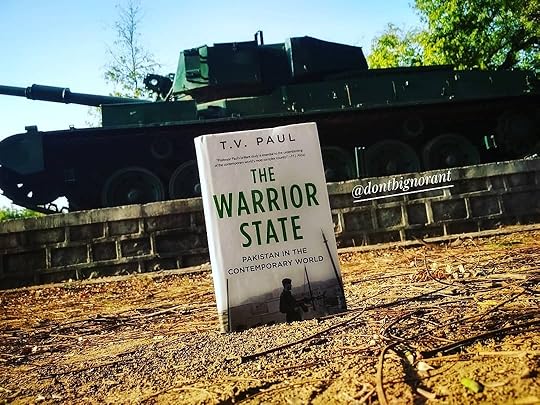
The warrior state, Pakistan in the contemporary world is a different kind of a book, and here the author talks about the notions and the ideas which the ruling class of Pakistan has had been feeding its people since its inception.
But before we start discussing about this book, I wanna tell you that if you haven't read the history of Pakistan and the Af-Pak region, then read about it first, after that you can try this book.
So, let's begin by asking some important questions about Pakistan.
What is Pakistan? What is a Garrison state? And why Pakistan is called as a Garrison nation?
Pakistan is an islamic state. It was created in 1947 by partitioning India. It's located at the North-West corner of the Indian subcontinent. Pakistan is the world's second largest muslim populated country. And also the world's fifth largest- nuclear-weapon-state.
A state which is in a perpetual conflict with its neighbours, and suffering from internal rebellion(s) is termed as the 'Garrison State'.
Another defination of a garrison state can be defined as, A state where the armed forces or those who have the 'specialization in violence' controls the levers of power either directly or indirectly.
Pakistan is called as a Garrison state because half of its existence as an independent country, it has been ruled by the military. The latter in Pakistan dominates the social, economic and all the other important aspects of the life.
And we can gauge the impact of the institution of military in Pakistan that since its creation in 1947, not even a single Prime Minister has ever completed a five-year term.
I will end with these lines :-
'Living in a 'La La land' is not going to help Pakistan and its people, it would be better if they accept the reality and start working on it otherwise the consequences will be disastrous'.
My Ratings : ⭐⭐⭐⭐ (4/5)
I hope you like this, Thanks for reading, Jai Hind.
For more information You can visit - https://dontbignorant.in/
------------------------------------------------------------------
" To say that without a resolution to the Kashmir - issue Pakistan cannot prosper is to say that India has a veto power over the future of Pakistan, that India must give permission before Pakistan can launch its projects of development. "
- Walter Russell Mead
The warrior state, Pakistan in the contemporary world is a different kind of a book, and here the author talks about the notions and the ideas which the ruling class of Pakistan has had been feeding its people since its inception.
But before we start discussing about this book, I wanna tell you that if you haven't read the history of Pakistan and the Af-Pak region, then read about it first, after that you can try this book.
So, let's begin by asking some important questions about Pakistan.
What is Pakistan? What is a Garrison state? And why Pakistan is called as a Garrison nation?
Pakistan is an islamic state. It was created in 1947 by partitioning India. It's located at the North-West corner of the Indian subcontinent. Pakistan is the world's second largest muslim populated country. And also the world's fifth largest- nuclear-weapon-state.
A state which is in a perpetual conflict with its neighbours, and suffering from internal rebellion(s) is termed as the 'Garrison State'.
Another defination of a garrison state can be defined as, A state where the armed forces or those who have the 'specialization in violence' controls the levers of power either directly or indirectly.
Pakistan is called as a Garrison state because half of its existence as an independent country, it has been ruled by the military. The latter in Pakistan dominates the social, economic and all the other important aspects of the life.
And we can gauge the impact of the institution of military in Pakistan that since its creation in 1947, not even a single Prime Minister has ever completed a five-year term.
I will end with these lines :-
'Living in a 'La La land' is not going to help Pakistan and its people, it would be better if they accept the reality and start working on it otherwise the consequences will be disastrous'.
My Ratings : ⭐⭐⭐⭐ (4/5)
I hope you like this, Thanks for reading, Jai Hind.
For more information You can visit - https://dontbignorant.in/
April 1, 2016
The book is well written book on Pakistan and describes all the points elaborately. Also giving details on what might be the future and impact on the neighbouring countries.
After few chapters, there is repetitive points described in different context. You overall understand the history, reasons within first few chapter.
The comparison with other countries give real insight on how can a good leader can make or break the country.
After few chapters, there is repetitive points described in different context. You overall understand the history, reasons within first few chapter.
The comparison with other countries give real insight on how can a good leader can make or break the country.
April 20, 2014
Generally useful application of theory of Tilly/state-making to Pakistan. But suffers from lack of original research, misinterprets Pakistan's formative history, draws ineffective comparisons with other cases, such as South Korea and Turkey, and mischaracterizes Pakistan's political development by putting all the emphasis on the so-called geopolitics.

November 30, 2016
This text provides excellent information on Pakistan and its failure to democratize. I appreciated how Paul was able to elaborate on the role a geostrategic curse plays in hindering reform in Pakistan. It was illuminating to read. However, at times the text was tedious and dry. I felt lost at several sections. Overall, though, educational and I am glad to have read it.

June 11, 2014
Very well researched. Does look at various factors and dwells well on them. Quite repetitive though.
Displaying 1 - 16 of 16 reviews