

What do you think?

The Zulus of New York
Drawing on the true history of ‘Farini’s Friendly Zulus’, a group of men who were taken to Britain and then to America as performing curiosities, the novel opens in 1885 in wintry New York City.
The protagonist, Mpiyezintombi, simply called Em-Pee by the English-speakers, loses more than his name in this far-off foreign country; he is seen as little more than a freak-show act – though he is not kept in a cage like the beautiful Dinka Princess, with her gold-painted papier-mâché crown and fur cape. For EmPee, it is love at first sight, but the caged woman is not free to love anyone back: she is the property of Monsieur Duval, proprietor of Duval Ethnological Expositions. And so begins one of Zakes Mda’s most striking stories, one that depicts terrible historical injustices and indignities, while at the same time celebrating the vigour and ingenuity of the creative spirit, and the transformative power of love.
In an already-great pantheon of Mda love stories and classic gems, this may be his most powerful work yet.
Fourie Botha, publisher of local fiction for Penguin Random House, says: ‘A new novel by Zakes Mda is always a glorious event. We are honoured that Prof. Mda will publish this wonderful and important book with Umuzi.’
A recipient of the Order of Ikhamanga, Zakes Mda was born in the Eastern Cape in 1948. He is the author of the famous novels Ways of Dying and The Heart of Redness, among many others, and his work has been translated into 20 languages. He spent his early childhood in Soweto, and finished his school education in Lesotho, where he joined his father in exile. Mda has studied and worked in South Africa, Lesotho, the United Kingdom, and the United States, and is a prolific writer, not only of novels, but also of plays, poems, and articles for academic journals and newspapers. His creative work includes paintings, and theatre and film productions. He is based in Athens, Ohio, in the United States, where he spends his time writing and teaching. His memoir, Sometimes There Is a Void, was published in 2011 and his most recent novel, Little Suns, won the Barry Ronge Fiction Prize.
The protagonist, Mpiyezintombi, simply called Em-Pee by the English-speakers, loses more than his name in this far-off foreign country; he is seen as little more than a freak-show act – though he is not kept in a cage like the beautiful Dinka Princess, with her gold-painted papier-mâché crown and fur cape. For EmPee, it is love at first sight, but the caged woman is not free to love anyone back: she is the property of Monsieur Duval, proprietor of Duval Ethnological Expositions. And so begins one of Zakes Mda’s most striking stories, one that depicts terrible historical injustices and indignities, while at the same time celebrating the vigour and ingenuity of the creative spirit, and the transformative power of love.
In an already-great pantheon of Mda love stories and classic gems, this may be his most powerful work yet.
Fourie Botha, publisher of local fiction for Penguin Random House, says: ‘A new novel by Zakes Mda is always a glorious event. We are honoured that Prof. Mda will publish this wonderful and important book with Umuzi.’
A recipient of the Order of Ikhamanga, Zakes Mda was born in the Eastern Cape in 1948. He is the author of the famous novels Ways of Dying and The Heart of Redness, among many others, and his work has been translated into 20 languages. He spent his early childhood in Soweto, and finished his school education in Lesotho, where he joined his father in exile. Mda has studied and worked in South Africa, Lesotho, the United Kingdom, and the United States, and is a prolific writer, not only of novels, but also of plays, poems, and articles for academic journals and newspapers. His creative work includes paintings, and theatre and film productions. He is based in Athens, Ohio, in the United States, where he spends his time writing and teaching. His memoir, Sometimes There Is a Void, was published in 2011 and his most recent novel, Little Suns, won the Barry Ronge Fiction Prize.
208 pages, Paperback
Published February 1, 2019
About the author
Zakes Mda
33 books265 followersZakes Mda is the pen name of Zanemvula Kizito Gatyeni Mda, a novelist, poet and playwright.
Although he spent his early childhood in Soweto (where he knew political figures such as Walter and Albertina Sisulu, Oliver Tambo and Nelson Mandela) he had to finish his education in Lesotho where his father went into exile since 1963. This change of setting also meant a change of language for Mda: from isiXhosa to Sesotho. Consequently Mda preferred to write his first plays in English.
His first play, We Shall Sing for the Fatherland, won the first Amstel Playwright of the Year Award in 1978, a feat he repeated the following year. He worked as a bank clerk, a teacher and in marketing before the publication of We Shall Sing for the Fatherland and Other Plays in 1980 enabled him to be admitted to the Ohio University for a three-year Master's degree in theatre. He completed a Masters Degree in Theatre at Ohio University, after which he obtained a Master of Arts Degree in Mass Communication. By 1984 his plays were performed in the USSR, the USA, and Scotland as well as in various parts of southern Africa.
Mda then returned to Lesotho, first working with the Lesotho National Broadcasting Corporation Television Project and then as a lecturer in the Department of English at the University of Lesotho. Between 1985 and 1992 he was director of the Theatre-For-Development Project at the university and founded the Marotholi Travelling Theatre. Together with his students he travelled to villages in remote mountain regions working with local people in creating theatre around their everyday concerns. This work of writing theatre "from the inside" was the theme of his doctoral thesis, the Ph.D degree being conferred on him by the University of Cape Town in 1989.
In the early nineties Mda spent much of his time overseas, he was writer-in-residence at the University of Durham (1991), research fellow at Yale University. He returned for one year to South Africa as Visiting Professor at the School of Dramatic Art at the University of the Witwatersrand. He is presently Professor of Creative Writing at Ohio University.
Although he spent his early childhood in Soweto (where he knew political figures such as Walter and Albertina Sisulu, Oliver Tambo and Nelson Mandela) he had to finish his education in Lesotho where his father went into exile since 1963. This change of setting also meant a change of language for Mda: from isiXhosa to Sesotho. Consequently Mda preferred to write his first plays in English.
His first play, We Shall Sing for the Fatherland, won the first Amstel Playwright of the Year Award in 1978, a feat he repeated the following year. He worked as a bank clerk, a teacher and in marketing before the publication of We Shall Sing for the Fatherland and Other Plays in 1980 enabled him to be admitted to the Ohio University for a three-year Master's degree in theatre. He completed a Masters Degree in Theatre at Ohio University, after which he obtained a Master of Arts Degree in Mass Communication. By 1984 his plays were performed in the USSR, the USA, and Scotland as well as in various parts of southern Africa.
Mda then returned to Lesotho, first working with the Lesotho National Broadcasting Corporation Television Project and then as a lecturer in the Department of English at the University of Lesotho. Between 1985 and 1992 he was director of the Theatre-For-Development Project at the university and founded the Marotholi Travelling Theatre. Together with his students he travelled to villages in remote mountain regions working with local people in creating theatre around their everyday concerns. This work of writing theatre "from the inside" was the theme of his doctoral thesis, the Ph.D degree being conferred on him by the University of Cape Town in 1989.
In the early nineties Mda spent much of his time overseas, he was writer-in-residence at the University of Durham (1991), research fellow at Yale University. He returned for one year to South Africa as Visiting Professor at the School of Dramatic Art at the University of the Witwatersrand. He is presently Professor of Creative Writing at Ohio University.
Ratings & Reviews
Friends & Following
Create a free account to discover what your friends think of this book!
Community Reviews
Displaying 1 - 28 of 28 reviews
December 31, 2019
Full disclosure: I'm a huge Mda fan. If he published a shopping list I would definitely give it five stars here. This novel brings his usual mix of meticulous research and well fleshed out characters that make the story come alive.

March 19, 2021
This was my first introduction to Zakes Mda and I just am thrown cause he is so revered. But I just couldn’t get into this book and I am a proud Zulu but no just didn’t do it for me. I respect the research put into it interms of the history but sometimes the writing was inconsistent with the books timelines. This book felt so rushed.
But I will still try his other books I have ways of dying and the Madonna of excelsior.
But I will still try his other books I have ways of dying and the Madonna of excelsior.

August 21, 2019
An interesting story and an easy, quick read. Fascinating (and shameful) to be immersed in the Victorian world of freak shows and “Savage Zulu” acts. I find Mda’s writing pretty pedestrian, though, and this book didn’t really evoke any kind of emotion in me, which is remarkable considering the horror of the subject matter.

September 10, 2023
Once you read Zakes Mda’s book, you will want get all his books. I started with Black Diamond and i never looked back.
February 14, 2019
This is the first book by Zakes Mda I've read. I quite enjoyed it, the story is interesting and there's a fair bit of history and authenticity in it. He explores a lot of concepts in this book, racism and classism being two major themes, but also ideas around home, family, and love. I find that love was the weakest part of the story. The representation of love was flawed in many, and I found the main character quite misogynistic (but it was the 1800s) and childish. I also think Mda could have added more depth to his themes. He hints at them, but leaves most of the conceptual work up to the reader. Still, a quick and easy read.

May 23, 2019
This may be Bra Zakes last novel for adults. He indicated that he will now right mainly for children. A huge loss to us and a great win for our children.

December 8, 2019
Zakes Mda tells the story of Mpiyezintombi, an accomplished warrior and intimate of the 19th century Zulu king Cetshwayo. Mpi commits a dangerous indiscretion by flirting with a member of Cetshwayo’s harem, which is a capital crime. He flees the Zulu kingdom and makes his way to Cape Town. An impresario, The Great Farini, recruits him to perform Zulu dances and enact scenes from tribal life at exhibitions and in theatres in London, and, when bookings are scarce, busk in the streets. The more frightening, scary and sexual the troupe’s antics, the greater the thrill and titillation for the Victorian audiences. The famous Zulu victory at Isandlwana on 22 January 1879 and the subsequent British heroics at Rorke’s Drift stimulates keen interest in battle re-enactments (provided, of course, that the plucky British eventually prevail). Em-Pee, as he is now known, makes his way to New York to join PT Barnum’s circus. While voyaging in steerage he forms an unlikely bond with an Irish immigrant woman and fathers a son. The relationship soon fails, and she deserts Em-Pee and their son. Acol, a Sudanese captive exhibited in a cage as ‘Dinkie the Dinka princess’, becomes Em-Pee’s muse and obsession. Acol initially rebuffs him, but eventually she allows Em-Pee to penetrate her protective shell and awaken memories of her Africa home. Acol’s owner forces her into sexual slavery; she contracts syphilis and dies. Em-Pee works his way back to Africa as a stoker on a trans-Atlantic liner with his mulatto son, but we are not told what welcome they receive.
I enjoyed Mda’s insights into the clash of Zulu, English and American cultures in 19th century London and New York. Mpiyezintombi is doomed to play the savage. Whites are unable (or refuse) to accept him as human being with similar hopes, fears and aspirations. The black man’s story is one of continuous humiliation. Mda lived in the UK and USA a century later. I wonder if he has ever found himself cast as the primitive African, but hope that the fact that he has made his base in Ohio means that his humanity has been fully recognised and appreciated.
Mda has addressed cultural clashes in different contexts in other novels such as Heart of Redness, which deals with the tension between traditional/modern in South Africa; and Black Diamond, which describes the costs and conflicts of social mobility. Mda’s work gives me perspectives of worlds that I, as a white South African, inhabit, but from standpoints that I cannot easily access.
I enjoyed Mda’s insights into the clash of Zulu, English and American cultures in 19th century London and New York. Mpiyezintombi is doomed to play the savage. Whites are unable (or refuse) to accept him as human being with similar hopes, fears and aspirations. The black man’s story is one of continuous humiliation. Mda lived in the UK and USA a century later. I wonder if he has ever found himself cast as the primitive African, but hope that the fact that he has made his base in Ohio means that his humanity has been fully recognised and appreciated.
Mda has addressed cultural clashes in different contexts in other novels such as Heart of Redness, which deals with the tension between traditional/modern in South Africa; and Black Diamond, which describes the costs and conflicts of social mobility. Mda’s work gives me perspectives of worlds that I, as a white South African, inhabit, but from standpoints that I cannot easily access.

September 9, 2020
🇿🇦
“She taught him how to externalise memory and make its object part of the present reality. She will therefore only cease to exist when he dies…”
🇿🇦
I don’t know what I was expecting…but this book was definitely not at all what I thought I was going to get. I don’t know if maybe I didn’t properly read the description at the back of the book - to be fair I got this last year and could have just forgotten - but I was genuinely pleasantly surprised at the direction this book took.
🇿🇦
Basic Plot: ‘Mpi’ is a Zulu warrior who runs afoul of the King Cetshwayo and flees KZN, eventually ending up in Cape Town. From there he joins one of those ‘Freak Show’ circus thingies as part of a ‘Zulu Savage’ exhibition that travels from London to New York - basically putting on a show of native savagery for the white masses.
As far as the plot is concerned - some of it worked and some of it didn’t. That wasn’t really what kept me engaged. It’s one of those books where you enjoy it more for the things you learn than for the actual story…if that makes sense?
🇿🇦
This book covers a lot of ground insofar as giving an accurate account the ways in which ‘human exhibitions’ in North America and Europe fetishised the ‘native’ and his culture. I think most South Africans are familiar with Saartjie Baartman and the horrors she lived through as a living exhibition in Europe. What I didn’t actually realise was that this was not an isolated incident but rather a very lucrative industry during the late 1800s.
🇿🇦
One of my favourite things about this book - and Zakes’ Mda’s work in general - is how he focuses on the history of South Africa prior to apartheid. It’s one of the great tragedies of South Africa that our history is taught and discussed in such a way as to almost make it seem like everything prior to 1948 didn’t happen. A great deal of our fictional works are also rooted in apartheid and its legacy. So this book is refreshing in its shifted focus...
🇿🇦
The ‘Zulus of New York’ cemented for me the fact that Zakes Mda is a highly skilled writer of historical fiction. I remember thinking the same thing when I read ‘Heart of Redness’…that here is a writer who displays a deep knowledge of his own history and takes the time to weave that history into every story he tells. He makes a point to utilise historically accurate information as his foundation - which opens up avenues for learning and engaging with history in a deeper way.
🇿🇦
If you’re looking for a quick read that gives a different aspect of South African history - definitely check this book out...
“She taught him how to externalise memory and make its object part of the present reality. She will therefore only cease to exist when he dies…”
🇿🇦
I don’t know what I was expecting…but this book was definitely not at all what I thought I was going to get. I don’t know if maybe I didn’t properly read the description at the back of the book - to be fair I got this last year and could have just forgotten - but I was genuinely pleasantly surprised at the direction this book took.
🇿🇦
Basic Plot: ‘Mpi’ is a Zulu warrior who runs afoul of the King Cetshwayo and flees KZN, eventually ending up in Cape Town. From there he joins one of those ‘Freak Show’ circus thingies as part of a ‘Zulu Savage’ exhibition that travels from London to New York - basically putting on a show of native savagery for the white masses.
As far as the plot is concerned - some of it worked and some of it didn’t. That wasn’t really what kept me engaged. It’s one of those books where you enjoy it more for the things you learn than for the actual story…if that makes sense?
🇿🇦
This book covers a lot of ground insofar as giving an accurate account the ways in which ‘human exhibitions’ in North America and Europe fetishised the ‘native’ and his culture. I think most South Africans are familiar with Saartjie Baartman and the horrors she lived through as a living exhibition in Europe. What I didn’t actually realise was that this was not an isolated incident but rather a very lucrative industry during the late 1800s.
🇿🇦
One of my favourite things about this book - and Zakes’ Mda’s work in general - is how he focuses on the history of South Africa prior to apartheid. It’s one of the great tragedies of South Africa that our history is taught and discussed in such a way as to almost make it seem like everything prior to 1948 didn’t happen. A great deal of our fictional works are also rooted in apartheid and its legacy. So this book is refreshing in its shifted focus...
🇿🇦
The ‘Zulus of New York’ cemented for me the fact that Zakes Mda is a highly skilled writer of historical fiction. I remember thinking the same thing when I read ‘Heart of Redness’…that here is a writer who displays a deep knowledge of his own history and takes the time to weave that history into every story he tells. He makes a point to utilise historically accurate information as his foundation - which opens up avenues for learning and engaging with history in a deeper way.
🇿🇦
If you’re looking for a quick read that gives a different aspect of South African history - definitely check this book out...

May 24, 2019
Rich and multi-layered, this book takes us through the chilling history of dominant groups abusing other human beings as possessions and curiosities, while asking much deeper questions about the endurance of spirit. For me, it's one of the best by a great author.
Mda is equally at home in his lead character's home in precolonial KwaZulu, and in the New York where the refugee ends up doing dumb "savage" dances for white people.
Without ever stamping his authorial foot, Mda makes it crystal clear that the savagery is in the eye of the beholder, contrasting so strongly with the depth and dignity of authentic Zulu life - yet not idolising precolonial life either.
The next layer deals with the double life: the lead character is Mpiyezintombi, who has pride and conscious self worth. And in New York he is called Em-Pee, whose greatest commercial "value" is realised by pretending to be a savage to live out other people's ugly dreams. Even his name is butchered by the white savages of New York.
The story explores his efforts to bring these two selves together. For example, by offering the crowds some real, beautiful and rhythmic Zulu dances, and by insisting on telling the true story of Isandhlwana.
And for me the next deeper layer is more of a spiritual question: if your circumstances condemn you to oppression, what is the most powerful response? Here we get pointers from Mpiyezintombi's greatest love, the brutally-abused woman Acol who manages to elevate her beautiful spiritual life to be as real as her sordid physical condition.
It's not a disconnected spirituality: Mda draws us back to the wider questions from time to time: how does all this relate to the question of liberation from colonial domination? The way he weaves in real-life characters such as the founder of the ANC keeps the reader constantly asking: this is the world we live in. How can we navigate it, and influence it for the better?
Mda is equally at home in his lead character's home in precolonial KwaZulu, and in the New York where the refugee ends up doing dumb "savage" dances for white people.
Without ever stamping his authorial foot, Mda makes it crystal clear that the savagery is in the eye of the beholder, contrasting so strongly with the depth and dignity of authentic Zulu life - yet not idolising precolonial life either.
The next layer deals with the double life: the lead character is Mpiyezintombi, who has pride and conscious self worth. And in New York he is called Em-Pee, whose greatest commercial "value" is realised by pretending to be a savage to live out other people's ugly dreams. Even his name is butchered by the white savages of New York.
The story explores his efforts to bring these two selves together. For example, by offering the crowds some real, beautiful and rhythmic Zulu dances, and by insisting on telling the true story of Isandhlwana.
And for me the next deeper layer is more of a spiritual question: if your circumstances condemn you to oppression, what is the most powerful response? Here we get pointers from Mpiyezintombi's greatest love, the brutally-abused woman Acol who manages to elevate her beautiful spiritual life to be as real as her sordid physical condition.
It's not a disconnected spirituality: Mda draws us back to the wider questions from time to time: how does all this relate to the question of liberation from colonial domination? The way he weaves in real-life characters such as the founder of the ANC keeps the reader constantly asking: this is the world we live in. How can we navigate it, and influence it for the better?

March 17, 2020
#bookreview #📚 ***
⭐⭐⭐⭐⭐
The Zulus of New York by Zakes Mda
.
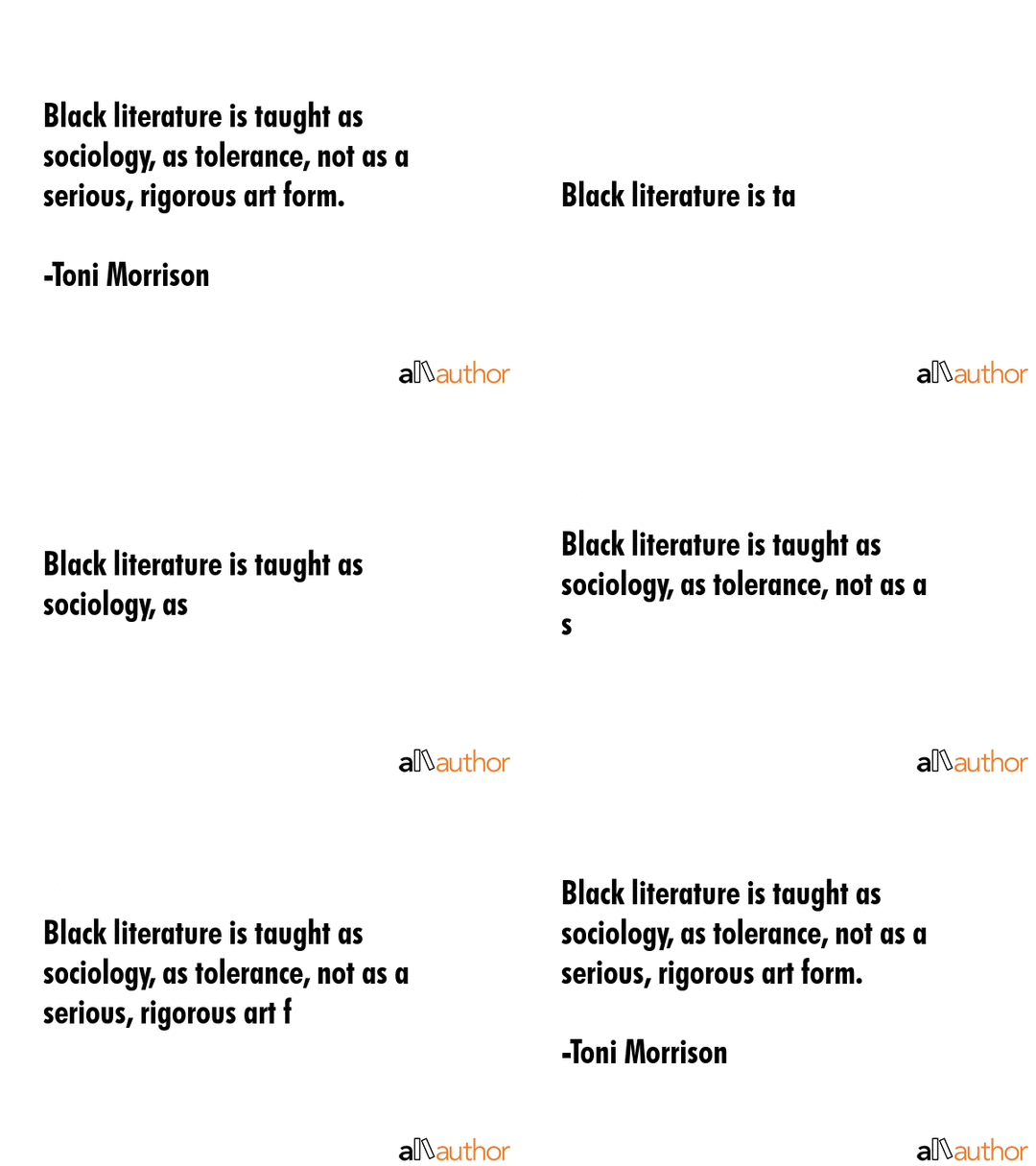
It was Toni Morrison who once said: "black literature is mostly taught as sociology, tolerance rather than a rigorous art form." I thought a lot about this statement while reflecting on this novel because most of the time afrilit comes with this unbearable moral weight resulting from it being an ethnographic work rather than being just a beautiful story with human characters who are interacting either with history or the present but have their own agency and motivation.
.
Zakes Mda's book traces a story of Em-Pee shortened for Mpiyezintombi, a senior warrior of the Zulu empire during the 18th century who runs away after being caught flirting with one of the King's harems. His escape takes him from Natal to Cape Town where he gets recruited to perform in freak shows and circuses organized by 'The Great Farini' in London and later New York. The story takes a different shape in New York when he falls in love with a Dinka woman, a caged exhibit herself who becomes his muse and obsession.
.
The book is historical fiction but beautifully written in a language so present that you sometimes forget the characters were of a different time. They have so much agency and interact with history as independent humans whose fate seems to be of their own choice. The Dinka woman for instance later becomes a photographer. It became her way of dealing with the trauma of being a caged exhibit in the circus by day and gambled for rape at night. Em-pee submitted a play for the Broadway show. Unheard feats for that time.
.
The story is entertaining, with beautiful descriptives of Zulu dance moves, rhythms, meaning and place for them. The sex scene was also interesting...Haha. .
All in all its a great book with a very recognizable voice, flat layout, and no complicated grammar. 🌻
⭐⭐⭐⭐⭐
The Zulus of New York by Zakes Mda
.
It was Toni Morrison who once said: "black literature is mostly taught as sociology, tolerance rather than a rigorous art form." I thought a lot about this statement while reflecting on this novel because most of the time afrilit comes with this unbearable moral weight resulting from it being an ethnographic work rather than being just a beautiful story with human characters who are interacting either with history or the present but have their own agency and motivation.
.
Zakes Mda's book traces a story of Em-Pee shortened for Mpiyezintombi, a senior warrior of the Zulu empire during the 18th century who runs away after being caught flirting with one of the King's harems. His escape takes him from Natal to Cape Town where he gets recruited to perform in freak shows and circuses organized by 'The Great Farini' in London and later New York. The story takes a different shape in New York when he falls in love with a Dinka woman, a caged exhibit herself who becomes his muse and obsession.
.
The book is historical fiction but beautifully written in a language so present that you sometimes forget the characters were of a different time. They have so much agency and interact with history as independent humans whose fate seems to be of their own choice. The Dinka woman for instance later becomes a photographer. It became her way of dealing with the trauma of being a caged exhibit in the circus by day and gambled for rape at night. Em-pee submitted a play for the Broadway show. Unheard feats for that time.
.
The story is entertaining, with beautiful descriptives of Zulu dance moves, rhythms, meaning and place for them. The sex scene was also interesting...Haha. .
All in all its a great book with a very recognizable voice, flat layout, and no complicated grammar. 🌻

June 2, 2019
"Dance is a way of life. It is a way of death too. It is a way of healing, of ancestral veneration, of praying, of working, of making love, of eating and drinking. It is a way of celebration..."
In 1878, Mpiyezintombi Mkhize is a proud young Zulu man during King Cetshwayo's reign. He's a favourite of the monarch but has to flee when he falls in love with one of the royal's isigodlo, a group of girls 'reserved' for the king. He travels to New York City, where Zulus, real or fake, entertain large crowds with their 'savagery'.
Mpiyezintombi becomes Em-Pee, as the Americans can't wrap their lazy tongues around his name. He's horrified to discover that the Zulu dances being performed are nothing more than inventions, created to titillate and present his people as barbarians. Em-Pee forms his own troupe to introduce the New Yorkers to the graceful and hypnotic true dances of his people. It's a difficult and troubling time, with Em-Pee having to swallow the racism and ignorance of Americans and other Europeans.
One day, while walking through Madison Square Park, he sees a woman in a cage: Acol, who's been labelled a Dinka princess. He's completely enamoured and goes to see her as often as possible. When he finally meets her, he knows she's the love of his life. But how can he rescue her from indenture and the horrifying cage?
Mda's story is based on the real one of Zulus who travelled abroad to entertain crowds in the late 1800s. It's one that's mesmerising and moving, taking the reader on a journey spanning continents.
In 1878, Mpiyezintombi Mkhize is a proud young Zulu man during King Cetshwayo's reign. He's a favourite of the monarch but has to flee when he falls in love with one of the royal's isigodlo, a group of girls 'reserved' for the king. He travels to New York City, where Zulus, real or fake, entertain large crowds with their 'savagery'.
Mpiyezintombi becomes Em-Pee, as the Americans can't wrap their lazy tongues around his name. He's horrified to discover that the Zulu dances being performed are nothing more than inventions, created to titillate and present his people as barbarians. Em-Pee forms his own troupe to introduce the New Yorkers to the graceful and hypnotic true dances of his people. It's a difficult and troubling time, with Em-Pee having to swallow the racism and ignorance of Americans and other Europeans.
One day, while walking through Madison Square Park, he sees a woman in a cage: Acol, who's been labelled a Dinka princess. He's completely enamoured and goes to see her as often as possible. When he finally meets her, he knows she's the love of his life. But how can he rescue her from indenture and the horrifying cage?
Mda's story is based on the real one of Zulus who travelled abroad to entertain crowds in the late 1800s. It's one that's mesmerising and moving, taking the reader on a journey spanning continents.

April 3, 2020
The novel follows a young Zulu warrior (Mpiyezintombi or 'Em-Pee') who has to flee the amaZulu after a complication. He ends up in a 'freak show' type thing (think P.T. Barnum) and tries to make his living through that. He is constantly met with the dilemma of either misrepresenting the Zulus in order to make a living or keeping the integrity of the Zulus, but not making a living.
I went through ups and downs with this novel. At times I loved where the plot was going and at other times I felt that it had 'lost the plot' slightly. It was still a great read and I found the world of the Zulus of New York fascinating - the Wild Zulus vs Genuine Zulus vs Genu-Wine Zulus. So many hidden undertones and I am sure I missed so much. It's a novel that made me wish I was studying it at university because I am sure there is so much more to get out of it.
This was my second time attempting to read it. I started reading it last year and for some reason just could not concentrate on following the storyline. This time I was in a better headspace and it took me about three days to finish.
If you love South African history in the 1800s and possibly also some pseudo-science history, then you will really enjoy this novel.
I went through ups and downs with this novel. At times I loved where the plot was going and at other times I felt that it had 'lost the plot' slightly. It was still a great read and I found the world of the Zulus of New York fascinating - the Wild Zulus vs Genuine Zulus vs Genu-Wine Zulus. So many hidden undertones and I am sure I missed so much. It's a novel that made me wish I was studying it at university because I am sure there is so much more to get out of it.
This was my second time attempting to read it. I started reading it last year and for some reason just could not concentrate on following the storyline. This time I was in a better headspace and it took me about three days to finish.
If you love South African history in the 1800s and possibly also some pseudo-science history, then you will really enjoy this novel.

October 24, 2023
This book is set in the 1800 era, between South Africa, England and the USA. It paints a picture of the times, especially what used to be considered entertainment. What I enjoyed most, which formed a very small part of the book, is the love story that resulted in Em-Pee, the protagonist, fleeing his beloved KwaZulu and prime position in King Cetshwayo's council. I had hoped in the end he was going to be reunited with the young lady who stole his heart, but in the end, another love story unfolded. Perhaps it is not even a love story, but newfound love for Em-Pee.
Prof. Zakes Mda is good with historical nuances and this novel is not short of them. It reads lyrically and the story telling cannot be faulted. He even did justice to the language, which reflect the era the book is set in. I do recommend the book for those who love history.
Prof. Zakes Mda is good with historical nuances and this novel is not short of them. It reads lyrically and the story telling cannot be faulted. He even did justice to the language, which reflect the era the book is set in. I do recommend the book for those who love history.

July 6, 2020
2.5 stars
The language and writing style reminded me of Aphra Behn's Oroonoko. Both Benn and Zakes Mda speak of the way black populations are "showcased" and teased by white people. From Benn and Mda's tones, it's clear that they find the treatment disgusting. Mda also does an excellent job painting a picture of New York and the rampant 1800s racism there.
The language and writing style reminded me of Aphra Behn's Oroonoko. Both Benn and Zakes Mda speak of the way black populations are "showcased" and teased by white people. From Benn and Mda's tones, it's clear that they find the treatment disgusting. Mda also does an excellent job painting a picture of New York and the rampant 1800s racism there.

June 23, 2021
I love Zakes Mda's writing style and the historical fiction. This book in particular was an easy and quick read despite the many bombastic words I stumbled upon. The story is quite distasteful and had me cringing and not wanting to read further but I was already hooked for the is some beauty in the story told.
September 30, 2025
it's a good book, it's well researched and a good story. The problem I have is with the main character. Em Pe was so unlikable to me. I really wish they focused more on Acol's story. I really would have loved to follow her journey in greater detail. The ending is predictable and rushed but leaves an opening for the reader to determine they own ending of Em pee story. Overall, it's a good read

November 20, 2020
This is hard to review. As per the blurb, 'Mpiyezintombi loses more than his name in this far-off country...' and I feel so bad for him and his friends.
And then there is what Acol had to keep going back to.
Why are we humans so horrid to each other? Why do we need to control so much ?
And then there is what Acol had to keep going back to.
Why are we humans so horrid to each other? Why do we need to control so much ?

April 24, 2024
South Africans talk about the need to “own” their history. This piece of U.S. and South African history must have been quite a challenge to weave into a story “acceptable” and interesting to readers of today. I applaud the effort but just could not quite “like” the book.

March 27, 2019
An easy and interesting read about Black “performers” in NYC in the late 1800s. Lots of tragedies and triumphs but it took me 2 days to complete and I enjoyed it.
March 29, 2019
I enjoyed the story more than the writing. This was my first Zakes Mda book and I highly recommend it. It reminded me of "The Greatest Showman" meets "12 years a slave".
March 12, 2020
SPOILER:
Felt like a bit of an anticlimax at the end of the book, but the character development is astounding and I love Acol’s ability to rise above and maintain her strength.
Felt like a bit of an anticlimax at the end of the book, but the character development is astounding and I love Acol’s ability to rise above and maintain her strength.
This entire review has been hidden because of spoilers.
April 7, 2021
Informative, entertaining and a real eye opener into the life of performers in London and New York during that time. Slice of life, sad.
April 21, 2021
I've read interesting books by Zakes Mda but this was not one of them, however in my books Zakes is still a very talented and creative writer.

December 12, 2021
It’s a good book but the story is hard to follow sometimes and some parts are boring but overall I liked the story a lot cause I’m South African.
April 15, 2022
Makes you feel the pain of being forced to leave a place you love. A place called home at times.

July 19, 2026
Worth a 2nd read. Worth the question - are we fated for eternal bondage?

March 2, 2020
My heart is broken. The sad reality of the abuse of African bodies. Used as entertainment.
Displaying 1 - 28 of 28 reviews