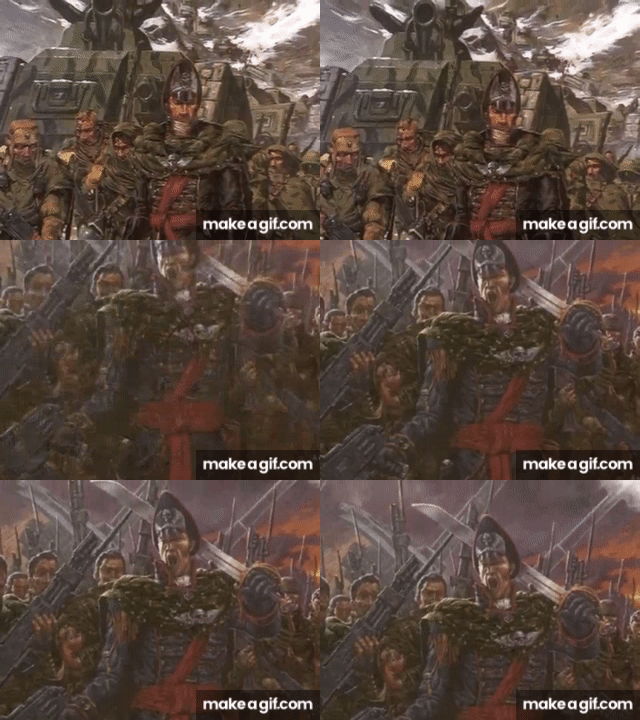
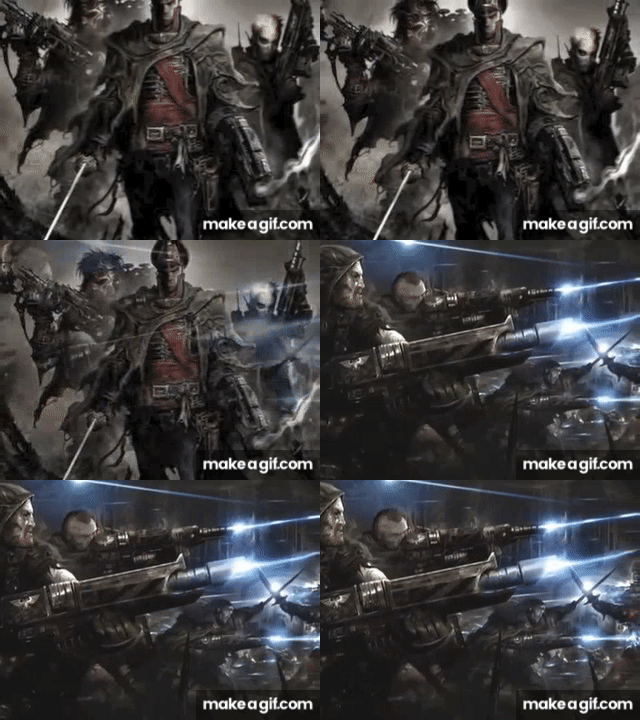
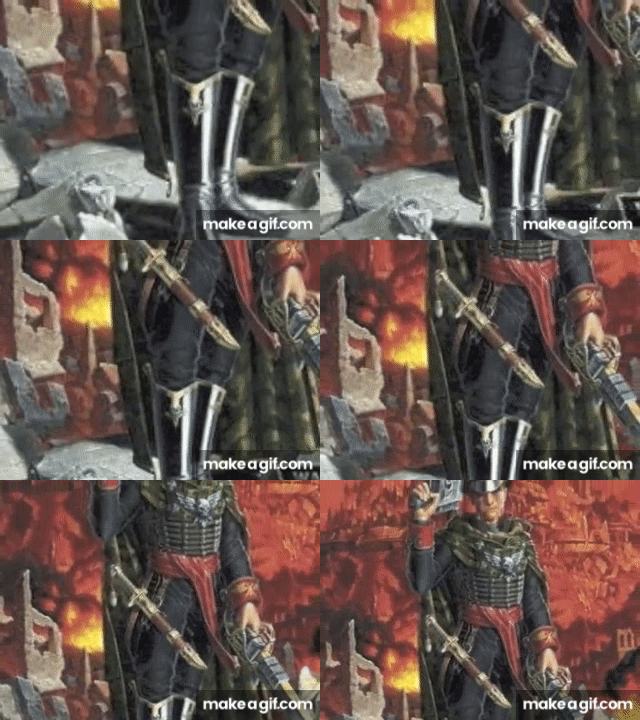
On the forge world of Urdesh, the massed forces of the Imperial Crusade engage in a final bloody battle with the Archenemy commander known as the Anarch, and his elite warriors - the barbaric Sons of Sek. A victory for either side will decide more than just the fate of Urdesh… it will determine the outcome of the entire Sabbat Worlds Crusade. Ibram Gaunt – now serving at the right hand of Warmaster Macaroth – finds himself at the very heart of the struggle. His regiment, the Tanith First “Ghosts”, holds the vital key to ultimate success. But as the forces of the Imperium and Chaos square up for the final, large-scale confrontation, Gaunt discovers that the greatest threat of all may come from inside rather than out.
"By the chapel door, Meryn shrank back against the old wood panels as though he was willing the palace wall to swallow him up. He could hear the killing, the screams. He could smell the blood. There was going to be another slaughter. And it was going to make the first one pale into insignificance. He started to laugh, unable to stop himself, because there was nothing funny left in the world."
More a second half of The Warmaster than a stand-alone novel, this book is a great action/horror packed epic ending to The Victory story-arc of the Gaunt's Ghosts W40k series, ending lots of plot threads Abnett started since Necropolis and more.
Death of some major beloved characters arrived at last as forewarned and scheduled, Abnett started shocking me with those ones lots of years before George R. R. Martin's, but it was so painful and heart-breaking anyway.
Just one of the best stories in the series that was my first step in the Warhammer 40000 universe 20 years ago. The ending was so strong that this could have been a perfect conclusion to the whole saga, but with a xenos artefact that can change the tide of war out there and Archon Urlock Gaur still alive and well, there are still plenty of tales to tell set in Sabbat Worlds Crusade.
Praise to Dan Abnett, Lord of the Dark Millennium.
This is it: the end of a very, very long journey. I've been reading Gaunt's Ghosts novels for about 17 years, since I was sat cross-legged in my school library and definitely too young to be reading extremely gory science fiction. Now, aged 29, I finished book #15 in the series in a hotel room in Seoul, South Korea. After the last page I set the book down and experienced ennui that I've only felt once before in my life: after finishing the final Harry Potter novel. In many ways, Gaunt's Ghosts has been the second Harry Potter of my life - encouraging me to read, expanding my vocabulary, and changing the way I looked at books. Most people would agree that Harry Potter and the Deathly Hallows draws a very satisfying conclusion to its series, but can you say the same about Anarch?
Kind of. It's complicated.
On one level, Anarch is entirely non-satisfying. It finalises a great number of plot threads in such a way that expose gaping plot holes in previous instalments. In particular one character is thrown under the bus in a way that comes out of left field (as far as I remember the crucial scene in Necropolis, though I will have to go back and check - if Abnett has been planning this all along then I retract this criticism and add a star or two to the rating!). The titular villain also only makes an appearance at the very end, continuing a recurring problem of the series that leaves emotional resonance wanting at critical moments. A number of critical plot threads are left dangling at the end of the final chapter.
But at the same time, does that really matter? I read this series as light, pulpy entertainment. I don't pick it apart and analyse it in great detail, and had I not sat back and thought about the revelations of the book for more than a few moments I would never have seen the glaring problems. I would instead have simply revelled in the numerous plot twists, emotional character moments, and shocking character deaths (not a spoiler to say that a great many ghosts don't make it to the finale). The tone of the whole novel is very 40k, very Abnett - lots of broken people picking up the pieces after a messy ending. Which, as Abnett has remarked on before when discussing the Ravenor series, is what real life is like. Stories don't simply stop, their threads all complete, after a book ends. Characters live on and deal with the trauma and the mess of the crusade after their story in the books is complete.
So in many ways the book is a very true-to-life depiction of the finale of a monumental series, full of many of the characteristics that made the books so great. Great use of detail, punch-the-air moments, plot twists and turns, and, naturally, great action. Many of the deficiencies of the series have also been overcome, with the infiltrating elite chaos troops making for effective mid-tier antagonists (my personal bugbear!). However for me the writing itself has become sloppy, and there was too much plot armour in play (you-know-who, love him as I do *kiss*), as well as frankly too many things that didn't quite make sense in retrospect.
It's a fair conclusion to the series, exemplifying the best and the worst of the fifteen novels. Re-reading them all in preparation for the finale has been a really fun experience, and I want to thank Dan Abnett for bringing these characters to life. My second, much, much more violent Harry Potter saga is at an end. All is well.
The Gaunt's Ghosts series has been going on a long time (15 novels) and I have only read a few of them. Anarch is book 15. It is an ending and a beginning of sorts. At least in terms of the Tanith First.
Gaunt has been promoted to Lord Executor, second only to the Warmaster. After his stopping the forces of the Anarch (The Sons of Sek) and recovering the Eagle Stones- Lord Executor Gaunt and the Tanith First earn some rest. But it is not to be. The Sons of Sek, they seem to be a Tzeentch based cult, still have plans. As Mkoll infiltrates the Sek base, the Anarch has infiltrated the Imperium forces with two hidden "woe machines". A woe machine is a Dark Age of Technology weapon that can mimic humans, the identities will indeed be a shocker. On top of all this- the Imperial Saint, the Beati, is coming to visit Gaunt. She seems to be the target for the Woe Machines, as the Sons of Sek coordinate an assault to recover the Eagle Stones using half-daemonic soldiers.
No more spoilers. The reason this book does so well is the look into how the "normal" units of the Imperium deal with the myriad of threats. It is one thing to face the Sons of Sek, their woe machines or their half-daemon soldiers when you are an 8 foot, or more, tall bio-engineered super solider in power armor (as Astartes are) and an entirely different thing when you are just a normal soldier. The interesting change in the perspective is due to the leathlity and danger of the enemy being pretty much the same, but the Guardsmen are only human. Their bravery and their sacrifice is often overlooked. But it must be said- for all their supposed inferiority as "baseline" humans-they do accomplish their missions as great cost. During this entire huge mess-a situation where the outcome could have changed the course of the entire Sabbat Worlds Crusade, there was only one Space Marine in this story (and he as captured by the Sons in a previous novel). So it is cool to see the Imperium at work, without their Astartes. It also drives ome the point that in an Imperium of a million worlds, each world containing hive cities that may have billions, the fact that there are probably only 2 million or slightly more Astartes to cover all that, proves the value of the Imperial Guard. A great, fun read for anyone wanting to see combat through the eyes of the normal humans. I also enjoyed seeing an Imperial Saint. When one is facing supernatural powers of chaos, it's good to have a holy, power-wielding Saint.
If you've been with the Ghosts for a while, this one is going to hurt. It's utterly, fantastically compelling.
I've been tired in work this week because I couldn't put it down. Rolling over again at 2am to pick it up because my mind just won't let it go, needing to find out if the friends of the past couple years of this series make it, some of the scenarios are as tense and heartbreaking as anything else you've known. It's inglorious, a horror story unfolding on Urdesh, has some fantastic, soul destroying twists, and is a grim goodbye to many. Dammit Abnett when is the next one I'll order it right now.
The foremost I'm getting out of this book is - strangely - the concept of death, and its place in the narrative. This book retells what is possibly the single greatest victory the Ghosts have achieved... and the cost is correspondingly huge.
And of those many deaths, several stood to me as particularly unsatisfying. Starting out with the previous book, even. Some dying in the middle of their character development and story arcs; others being killed in such a way as to render previous developments and growth null. Anyone can die, true, but some narrative conventions should still be respected.
I feel like there was a lot more cussing in this one than in the previous installments, too. Maybe it was just something I paid more attention to this time. All "feth", though, and no "gak", which felt a little bit of a shame.
Good action and gory bloodshed. Mostly liked it in the end. It's just that it had these things.
Ok, first off a bit of background. First & Only was the first 40K book I read and that's a good thing because most of Black Library's stuff doesn't even come close to this series. I fell in love with this regiment and the bizzare sub-genre of military-sci-fi-fantasy-horror from the everyman's perspective. Abnett is my favorite writer and I've been with these guys from the beginning. I have the 1st printing of every novel and I probably gave 5 stars to ever book because I'm just so biased about how much I like this series.
However, this is the first book I didn't like and I'm quite shocked at that. There is one major reason but also a few smaller ones. One of the small ones first.
There is a very long section in this that basically deals with people being trapped in a haunted house. Now this is a common trope in 40K. The heroes being stuck on a ghost ship and then fighting denizens of the warp, in this case it was more of a haunted house but same thing. I mainly like 40K novels for the war scenes but I get that sometimes you're gonna get stuck in a ghost ship or haunted house and have to get killed by extradimentional daemons every now and then. That's just life in the Imperial Guard but this storyline goes on for like a third of the book. And the payoff is the main issue I have with the book.
Now Abnett has been setting up the fact that Yoncy is a daemon for quite some time now. So I can accept what happened to her even though she's not a daemon she's....a machine? What? That makes no sense but ok. I can also accept Kolea's death because I was never that big a fan of him. As I see it he indirectly caused the death of one of my favorite characters, Caffran, after pawning off the life and responsibility he should have been taking care of for years even after he found out the truth. So actually I find his fate fitting. What I can't forgive Abnett for here is the fate of Dalin Criid. That is ridiculous!
Most people cite Necropolis as the favorite GG book and certainly it is one of the best but one of my favorites is Armour of Contempt and that's because of Dalin Criid. That's his book and he goes on an amazing story arc in it. Anarch craps all over both these books and a lot more like the entire legacy of Caffran and Tona Criid.
Everything those two did and everything that family went through and it's the only family really in the, now 15 book long series, was for nothing. Worse than nothing actually. The scene in Armour of Contempt were Dalin is scaling a wall of corpses and cursing the insanity of it all and curses the Emperor himself but realizes that he's microsecond away from falling to Chaos and pulls back from the brink is one of the best scenes in all of Black Library....well I guess that whole thing means nothing...because he was a robot the whole time!
Everything that Caffran sacrificed while he was alive including his life itself for his children was pointless and for nothing. Less than nothing because the children he and Tona loved and raised for like a decade were evil robots the whole time! Wow, like what a book this is for Tona Criid. Turns out she was a massive moron the entire time! What an idiot! She gets one paragraph in this book to acknowledge the fact the her entire family has been destroyed and her entire life was a lie. A beloved character like Tona deserves better than this. And they didn't die noble deaths, I can accept that and we all have many times they died for a dumb retcon. Abnett, was it really necessary to throw all these characters under the bus to cover up the fact you simply didn't check your notes on Yoncy's gender one time? You covered up a plot hole by driving a bus through it.
Finally, and this is going to seem random, what's with the use of the word "shit" all of a sudden? Fans know in the Tanith 1st that's pronounced "gak". Nobody says gak anymore. I'm not some prude that doesn't like swearing but Gaunt's lame speech at the end would have been a lot better if he could have at least slipped the Verghast curse in there. That's my larger point, it was just the cherry on top of a book that seems to have no respect for the books that came before it. This book came to wipe out the legacy of the battle of Vervunhive and did it so thoroughly it even took their curse words.
I hope Abnett does one more book to finish it and give the surviving Tanith a home. Whether that be a New Tanith or a retaking of the original. Please don't do another 4 book omnibus. I love this series but there's got to be like ~300 Tanith left. Please don't milk the series until they're all dead.
This entire review has been hidden because of spoilers.
Honestly, I can't think of any other series in the history of everything that has affected me quite so much as the fifteen (FIFTEEN) Gaunt's Ghosts books. And now they're finished. This is the last one. THE LAST ONE. And it's really very good, a nice return to form after the slightly meh WARMASTER. It's a fitting ending to a wonderful epic. Just, y'know... brace yourself.
After finishing the last Novel of "Gaunt's Ghosts" I am left with a bitter sweet taste. It had all begun almost 15 novels and around 20 years ago. All I can say is WOW! What a journey! I loved all the books and short stories equally. My only hope is that some time in the future, we will have the chance to enjoy another Gaunt story. Thank you Mr. Abnett!
Wow. what an incredibly tense, terrifying and heartbreaking book. Possible the best Warhammer story I've read. Could not put it down until I finished it at 4:30am 😭
A fantastic ending to the Victory arc of the Ghosts. More like a horror novel than a war novel and yet all the better for it. It's nice to see the Ghosts up against the full horrors of Chaos, which they often aren't as they mostly fight fellow soldiers. The tragedy of Dalin, Yoncy, and Merrit is just a great story all round.
Contender for the best of the long-running "Gaunt's Ghosts" series.
If you got this far, you're no doubt a fan, but its worth saying that by most standards this particular volume would qualify as a great blend of military sci-fi and horror on its own merits. This isn't to say its without fault-I can't decide if the big "twist" was clever or just a bit hammy- but if the series ends with this one, it ends on a particularly high, and compelling note.
As I'd mentioned with my review of the warmaster, its been interesting to see Mr. Abnett evolve as an author. The early novels were fun, but mostly simple "battle of the week" set in the warhammer universe. And then fast forward to now with a complex narrative and characters that, even if not the most dynamic, were memorable and cherished or reviled to where each death (and its not giving anything away) was felt. The battles and fights went from mildly tedious gore exercises, to compelling and exciting. It seems that he found that even in a war book, a fight is often best presented as an accent or an explanation point, rather than as the entire story.
Anywho, the tl;dr; here is it was great, and if this is the end of the Gaunt's Ghosts saga, I'm both sad it's over, but also satisfied with how it drew to a close. That said, there's room for it to continue....
What would you have me say? It's Dan Abnett. He is easily in my top three favorite authors of all time and likely occupies the number 1 spot.
This is one more part in the continuing story of the Tanith First and Only, also known as Gaunt's Ghosts. Lives are lost in great number. Some few of them hurt me as they were characters I had marched beside for years. I'll not say who lives and who dies but the regiment is brutalized in this book, both from within and without. It remains to be seen if the heart of the regiment will recover or if perhaps something has been lost forever.
My understanding is that this book is the final entry in what is called The Victory arc. It's unclear to me if this is the last we will hear of Ibram Gaunt and his Ghosts or if, perhaps, there is more to come. Personally, for me, I believe there are many more stories to be told but if not then so be it. In the immortal words of Ibram Gaunt himself, "Men of Tanith, do you want to live forever?"
And so the journey ends. The Gaunt series is the perfect blend of Sci-fi, Fantasy, and Horror I've come to expect and love--with the simple, yet masterful prose of Abnett elevating the experience.
This final book is a perfect conclusion to the Gaunt series. It has all of the tension, emotional weight, and conclusion a good book could offer--with a few surprises that left me floored.
I highly recommend this series to fans of Fantasy/Sci-fi, and military fiction. Also, if you are new to the 40K universe, Gaunt's Ghosts or the Eisenhorn Trilogy is/are THE place to start.
Having read all fifteen novels and sundry short stories, I cannot say that the last arc is a firm landing. If I could go back in time to the point where I had just finished #12, I would instruct previous me to stop there. Salvation's Reach onward is a mess of characters and plotlines tangling into a snarl of nonsense. The warning signs were all there. Mysterious, super important mission that has no real build up or stakes followed by a magical ten year time skip, which has never once in the history of fiction felt warranted, earned, or paid off.
Salvation's Reach being the throwing open of the barn door, Anarch is the futile attempt to lasso and rein back all the escaped horses. I actually thought Warmaster was fine if a little quiet. It may be possible that if 13-15 were read in isolation, everything would make sense. However, as part of the larger set, not a damn bit of it does.
Do yourself a favour, stop at Only in Death and consider the series done. Don't put yourself through Blood Pact and beyond. Just avoid this terrible story arc. It's garbage.
Maybe its because I've listened to the books one after another after another, but the inconsistencies are so pronounced. You can tell Abnett had a lengthy period away from the series (no doubt because he thought Only in Death was the end) because the return isn't to form.
We now have the Astra Militarum instead of the Imperial Guard, and all the wonky extra labels on things. Clearly however that change in language has come with other requests by Games Workshop. Gak is gone, and -everyone- now uses Feth (or Shit). Characters personas and motivations are twisted to fulfil particular story beats, and various elements of past stories are either forgotten or completely thrown away.
There's super soldiers on the Chaos side now, but are 'better' than Space Marines, and are integral to the Anarchs forces... Yet have never been mentioned before... What?!
Abnett employs warp related nonsense as a means to 'clean up' the character bloat that he introduced in this story arc, but it feels meaningless as it detracts from established characters and in some cases leaves others on the side line, only being mentioned as if he remembered they existed later.
There's some proper shit character redemptions that feel hollow and whole heaps of retconning to make other things work.
Here's what I think happened - Abnett was pushed to make more Gaunts Ghost books for the Black Library. He didn't want to, probably had other ideas in mind, so he threw those ideas into the existing series, forgetting what he had already established. After all, it had been like 10ish years since Only in Death, whose going to know.
Mixed feelings on this one - on the one hand, taken alone, it was a very good "horror" entry in this series (I've found from a general perspective, the books in the series tend to fall into 3 or 4 main types of story - horror; war; action & adventure - with obviously a great deal of overlap between them), although I tend to enjoy the ensemble stories with a more straightforwardly military focus; but on the other hand, the way some of the key narrative arcs played out was disappointing.
The Yoncy twist was absolutely fine, no issues with that, it had been heavily sign-posted for some time. To do Dalin like that as well though seemed completely unnecessary and undermined one of the best preceding books in the series, the Armour of Contempt, to the point where as good as that book is, it would be tough to re-read it, knowing this was the final outcome for the character.
To a lesser extent, it seemed a waste of Gol's character and left Tona in a weird, limbo state. I think there was much more potential at least in the future development of Tona and Dalin's relationship that has sadly been cast aside.
Similarly I wasn't that happy with the way in which Eszrah was so summarily dispensed with.
I'm assuming this wasn't the last book in series as it didn't have a last book feel to it - presumably the real ending has to have Gaunt either dying or finally triumphing against all the odds - and there was certainly a great deal of clearing the decks, but I think it remains to be seen if some of the newer characters can replace the likes of Brostin, Banda, Meryn, Gol etc
This entire review has been hidden because of spoilers.
This was excellent, in the top tier of Gaunt's Ghosts novels. A fitting end to the Victory quadrilogy; part horror novel, part war novel, part philosophical introspection and discourse, I thoroughly enjoyed this one. A long lost character returns, and yet the reunion is offset by a death toll that, to my knowledge, hasn't been equalled in the series. As per Dan's usual, one death in particular hit me, all the more so as it was a heartbreaking one. I really thought this was perhaps the end of the Tanith 1st's story, but it isn't. And I admit I am looking forward to see where else in the Sabbat Worlds, in the Grand Crusade against the legions of hell itself, Dan takes the men and women of the Tanith 1st and Only.
The Gaunt's Ghosts series has come to be known for its excellent development of such a wide range of characters, outrageous 'wow' moments including character deaths and a gritty, often horrifying portrayal of the forces of chaos. Anarch features all of these things and it typically does it better than previous books. The first chapter is especially noteworthy and is perhaps the best first chapter of the series.
With Anarch, the story arc relating to the Sons of Sek ends in spectacular fashion, plot threats being tied up to satisfaction. With genuine hope though, this isn't the end of the series - the fans need more of the characters they've come to cherish - in some cases - as if they're close friends.
A masterpiece. This latest installment in the Ghosts saga is fraught with real danger and powerful feels. The characters are compelling and the action and plot are awesome. Herein is a real sense of progress in the Sabbat Crusade and the Warhammer version of Game of Thrones is, of course, bloody. Many beloved characters meet their often grisly end.
With the initial attempt to kill Warmaster Macaroth thwarted, Ibram Gaunt is pushed into fulfilling both his new duties and commanding the defense of the Imperial lines at Urdesh. With the Tanith First and Only stretched thin and other regiments pressed hard in various regions, the world has become a flashpoint for a battle which could reshape the entire crusade. Yet even as the Ghosts attempt to gain the other hand, Chaos elects to destroy them from within. As they combat a massed force of elite assassins, a terrifying mistake from their past comes back to haunt them. A mistake none of them even realised that they had ever made.
The Good
Anarch treats itself as an ending above all else, and it does everything it can to bring back as many past elements as possible. Everything from Straight Silver onward shows up in some way, or is reflected upon and referred back to in every way. This comes in the form of character reflections, motivations or even referring back to how events have changed the regiment's leadership over the years. That and more than a few people show up. This helps the book to feel like a definitive ending to this chapter of the story, and to solidify its placement for future arcs. That or, should anyone wish for it to be that, their ending for the Ghosts' story.
However, Anarch is less its own book than it is Warmaster: Part 2, or arguably even Salvation's Reach: Part 3. The trio of books are so tightly interconnected that it has brought about more major shifts to characters than the past six combined. This is especially true of Gaunt, as we see him trying to adapt to a very different role within the military. It would be easy for Abnett to brush this promotion under the rug, but the issue of his sudden rise is directly addressed time and time again. In fact, it's the crux of many of his scenes, and even plays a major role within the finale. At the same, the secrets within the Ghosts' darkest elements crop up and factor into the development of three major figures within the book. How, however, might be a little surprising. Perhaps the character who benefits the most from this direction is Mabbon Etogaurm as we are given a few answers to long-standing questions. The book ultimately fulfills his character arc and offers a great deal of closure to one of the series' most interesting characters.
After the action of Warmaster's finale, the scale of Anarch's events shifts drastically once again. While readers might have expected something which was going to be Necropolis taken to the Nth degree, what we end up with is something equal parts Only In Death and Blood Pact. There is a substantial amount of character-driven desperation which is core to the story, and much of it takes place behind allied lines with no small amount of horror. Horror itself has always been one of Abnett's most underrated talents as a writer, so to have entire scenes with him showing off this skill is a welcome return once again. The book is easily at its strongest when it allows these moments to play out, and the creativity behind these descriptions works in its favour. It's not what Abnett shows the reader in half of them, but what he doesn't in many cases, creating a total sense of the unknown and utter bleakness filled with brief horrific segments.
Even with its focus on events in relatively safe environments, there are no small number of firefights to fall back on. This is executed thanks to the presence of multiple assassins which are thrown at the Ghosts from unexpected vectors, none of who go down easily. Also, before you think that this might be a rehash of the Nine, it instead goes off in a very different direction. If anything, the actual choice of assassins here are far more interesting than those sent to decapitate the Saint several books back. The firefights are extremely well described as you might expect, but the variety of environments and sudden shifts in threats keeps it engaging. There isn't the clear divide between one fight and the next you might expect as - especially in the case of the Suicide Kings - a few minor plotlines turn into running battles against multiple half-seen opponents. It's the kind of entertaining mix of melees which is notoriously hard to pull off, but it keeps things very interesting.
The book also balances one story against the other, as while Gaunt is following through with his new duties and the regiment continues its role, another his carrying out his own task. The issues and reasoning behind this are covered in more detail below, but while it has its problems it does lead to a very strong ending. In fact, two of the story's best scenes (and a genuinely hilarious moment) stems from how things play out there. Interestingly, the book also offers a bit more of a chance to see the inner workings of Chaos thanks to this, especially in terms of its officers. While prior stories did offer glimpses into their lives, this further cements their status within the Sabbat Worlds and the oddly more "civilized" nature compared with more overt examples elsewhere.
Most importantly, however, Anarch also offers a rare take on corruption which other series have rarely accomplished. It's not executed in an overt manner, nor even in the form of failing in one's duties, but by overlooking something so simple. This leads back into something from the series' earliest books, and while reading it you could easily see this as a story involving secondary characters elsewhere. You know the kind, the sort where self-assured figures overlook the something obvious to the plot, requiring the actual heroes to get involved. It's a good example of just how insidious Chaos truly is, and how it can infiltrate others' lives even while they guard against its every act. If anything, it is far more terrifying than those which feature daemonic possession.
The Bad
The story is notably bloated. There's no way around this, as Anarch sees the return of more or less every living character who could show up in the series. While it certainly skips a few - and there are others who only get a passing mention - it tries to give every character possible a glory moment or chance to close out their arc. As a result of this, the narrative is rather clunky in the second act, and it relies on a few questionable turns to accomplish its goals. Even then, there are a multitude of characters who end up being heavily underutilized in the story. Gaunt himself is largely kept out of events - something which might be excusable given his new position - but others aren't quite so justifiable. While Warmaster sets up a few massive turns for Blenner, he ultimately contributes little to the plot and does not undergo any major character shifts. Equally, while Felyx does benefit from more time in the spotlight, he feels as if he is being pulled along rather than at the helm of his own story.
Another issue is how the tale is split into two segments, and this alone undermine's a major surprise from the last book.
Early chapter spoilers in 3... 2... 1...
Mkoll is alive. Not only was he taken captive, but he was taken captive by the Sons of Sek, but he was taken to exactly the place he needed to inflict the most damage possible. The opening chapter features him single-handedly fighting his way clear of a bunch of the Sons, and then turning the entire situation to his advantage. As such, the entire B plot of the book might as well be titled Metal Mkoll Solid given how it shapes up, and it seriously stretches credulity at times. Yes, admittedly, if anyone in the Ghosts would pull his stunts off it would be him, but even with some surprising assistance it passes "Okay, that was awesome" into "Oh come the hell on" fairly quickly. It's a shame, as it's more or less a grander version of his story in Guns of Tanith, which accomplished the same thing but did so far more effectively. That said, it does somewhat bounce back, and the finale does help to warrant this particular turn of events.
A further problem is how the book seems to rely on certain requirements to pull off key events. Perhaps the single greatest one is how it utilises an irritating pet peeve which might as well be titled "The Mechanicus Have Never Invented Firewalls" where a MacGuffin is used against their coding. Most books can do this and pull this off, with Graham McNeill's Chapter's Due and Mechanicus being the big examples, but this example cuts so many corners that it is irritating. This is an already overused trope within M41 and for it to show up yet again - even with a Dark Age of Technology excuse attached - is simply tedious. This might have been forgivable if there was some greater direction being it or a possible plot element, but it simply exists to make things more dangerous for the heroes.
Early chapter spoilers end in 3... 2... 1...
Yet perhaps what fans will have the greatest trouble getting to grips with is a major plot twist involving two background characters. While it cannot be fully discussed for those who have yet to read Warmaster or Anarch itself, the story utilises a retcon to create a new threat within the Ghosts' ranks. The problem is, depending upon how you view it, it will either make the forces of Chaos seem extremely intelligent, or quite possibly borderline insane in the worst way. No, not in the glorious gribbly Chaos way, in the stupidly evil way. The sort which goes past having plans within plans, and right into questioning how in the hell anyone thought that this would work.
When the twist does take place it leads to some of the book's best moments, but the choices made in getting there are still highly questionable. Part of it certainly works fine, but the other half crosses over into feeling as if it cheated the reader with little to no foreshadowing. It's less an intelligent and well-delivered surprise moment than it is an abrupt edit and new direction for a well-established character. The events surrounding it work, but the moment itself fails to properly work with the narrative structure of the story.
The Verdict
While it doesn't reach the heights of some past stories, Anarch is a great read overall. With a good mix of action, horror, quiet drama scenes and major narrative developments, it's an installment no fan should miss. While its weaknesses do lie in two key areas above all others, Black Library has published works with far more dubious developments in the past, and they are flaws rather than outright failings. Given the scale of what Anarch required, you might even be willing to completely overlook them.
So, should you get this book? Not if you have yet to catch up with events. At the very least, you should read Only In Death or Salvation's Reach and move on from there to avoid losing context for events. However, if you are up to date as a Ghosts fan, this is a must buy.
I finished the book months ago but simply couldn't bring myself to write a review because I was emotionally devastated that the series has ended (for now). Objectively speaking, the book was an absolute 10/10; it was so gripping I could barely sleep. One negative aspect, however, was the "plot twist" regarding Dalin and Yonky. While it makes sense within the book's canon, it feels unexplained to me. I specifically went back and checked Book 3, and it doesn't add up, as there is no clear indication of when the children were "swapped." Unfortunately, it appears more like a spur of the moment idea the author had, without regard for the established canon of his own books. That said, it is also possible that we’ll get an explanation in a future book (if there is one). Despite this plot hole, I’m not deducting a star. I truly love this series, and every single character has become incredibly dear to me. I really hope it continues soon...
This entire review has been hidden because of spoilers.
The fifteenth (!) Gaunt’s Ghosts novel, and the fourth and final instalment in the long-running The Victory arc, this picks up almost immediately after the conclusion to The Warmaster, on Urdesh. In the aftermath of Sek’s aborted assault on Eltath, most of the Ghosts are still dug in around the Tulkar Batteries, though some are in uneasy residence in makeshift billets beneath the Urdeshic Palace, while Gaunt wrestles with the realities of his new role. Neither Gaunt nor Rawne believe Sek was truly defeated, but nor do they yet understand the parts they have to play in coming events.
As the conclusion to a 4-book arc and not just a standalone story, Anarch has to do a lot – provide an exciting, action-packed story in its own right, sure, but also tie up a whole load of different character arcs and subplots. Abnett’s great success here is in seeing through so many characters’ journeys to their logical, (largely) satisfying conclusions…whether that means death or new beginnings. There’s a sense of bittersweet satisfaction reading this and finally learning what happens; it provides a powerful conclusion to the arc, but it feels strange to have got to the end at last.
An absolute triumph. If we never get another GG novel this is such a perfect ending. I’m excited to see where the series may go next, but it’ll take a few years to get there. 10/10