Jump to ratings and reviews
Rate this book

Vysoká hra

Rate this book
This book collects the writings of a radical group of writers close to Paris Surrealism--principally René Daumal and Roger Gilbert-Lecomte--as published in their now legendary magazine, "Le Grand Jeu" (The Great Game). "Le Grand Jeu" ran to three issues between 1928 and 1930, before collapsing due to its editors' infighting, drug use and vehemently unreasonable aspirations for both art and life. The Grand Jeu is often associated with Surrealism (they were invited to join the group), but their ideas were far more extreme. The magazine was the public face of a group of artists and writers who systematically attacked their perceptions of reality through narcotics, anaesthesia and near-death experiences."Le Grand Jeu" describes a politico-mystical outlook which combined a critique of the apathy and repression of contemporary Western society with a quest to take leave of the individual ego and to reconnect with a collective Universal Mind. The group's esoteric program united narcotic and parapsychological practices with asceticism, revolutionary politics (the Russian Revolution was barely a decade old) and a prophetic mode of poetry which they identified in antecedents such as Rimbaud and Mallarmé. In this definitive collection, the theories of the Grand Jeu are presented in the group's own words for the first time, through the essays and articles which formed the bulk of their magazine.

424 pages, Hardcover

First published June 1, 1928

Loading...
Loading...

About the author

Roger Gilbert-Lecomte

25 books29 followers
Poet and co-founder (with René Daumal, Roger Vailland and Josef Šíma) of the artistic group and magazine Le Grand Jeu. The group, associated with surrealists, was "excommunicated" from the movement by André Breton. Gilbert-Lecomte experimented with drugs, in particular morphine, for both artistic and sociological reasons. As was predicted in his poetry, the writer's death was the result of an infection caused from dirty hypodermic needles.

(http://en.wikipedia.org/wiki/Roger_Gi...)

Ratings & Reviews

What do you think?
Rate this book

Friends & Following

Create a free account to discover what your friends think of this book!

Community Reviews

5 stars
30 (44%)
4 stars
26 (38%)
3 stars
10 (14%)
2 stars
1 (1%)
1 star
0 (0%)
Displaying 1 - 10 of 10 reviews
Profile Image for S̶e̶a̶n̶.
995 reviews593 followers
November 18, 2019
Roger Gilbert-Lecomte, René Daumal, Robert Meyrat, and Roger Vailland met in school as teenagers. From the start they had a shared vision: transcending the mundane and rejecting the distinctions taken for granted as social constructs, such as dream vs. reality and visible vs. invisible. Their tight-knit group grew even tighter as they united themselves through secret signs and language, and by taking part in rites of shared voluntary torture (e.g., auto-asphyxiation), experimentation with a wide range of controlled substances, and in one case even a game of Russian roulette. They began as the Simplists and grew into the Grand Jeu, adding associates along the way, eventually becoming aligned, though decidedly not integrated with, the burgeoning Surrealists.

Though on the surface there appears to be a significant number of commonalities between the two groups, Le Grand Jeu and the Surrealists did not quite see eye to eye. First, there was André Breton's general dickishness toward anyone who differed with him. But more specifically, he objected to the (admittedly inexplicable, though likely intended as inflammatory) references to God in the Grand Jeu publications. Then there was the issue of Roger Vailland's pseudonymous support for the far-right Paris police chief Jean Chiappe (which led to Vailland's split with Grand Jeu) and the group's association with certain Surrealists excommunicated by Breton, including Artaud. For their part, the Grand Jeu perceived a lack of rigor in the Surrealist approach. Though prone to heavy drug use and recreational oxygen deprivation, the Grand Jeu was remarkably coherent and consistent in their messaging throughout the three published issues and one unfinished issue of their magazine, also known as Le Grand Jeu. They were a much tighter, more uniform group than the Surrealists, and they intended to maintain their independence as such.

The Grand Jeu chose the mystical over the rational, rejecting most Western philosophy in favor of that of the East. They sought to maintain the 'great primitive human spirit', so often stifled during the passage into adulthood. As adolescents, the core membership had actively continued to cultivate the 'immemorial riches of childhood—oneiric, metaphysical, poetic' so that they would not be lost. It is this preservation of the childlike state that lay at the core of their philosophy.
Our prophets are among us, revealed by mythical signs. The primitive soul is not yet dead in the West so long as the bloody nourishment of dreams remains. Brutally repressed for centuries, enslaved by religions which seek to divert their furious impulses to the benefit of the most disgusting of social organisations, dreams will have their revenge on the death throes of those cults. (Gilbert-Lecomte)
In format, the magazine Le Grand Jeu typically included three sections: (1) theoretical essays, (2) literary texts including fiction and both lined and prose poetry, and (3) 'chroniques' which ranged from book reviews to commentary on current events and responses to Le Grand Jeu surveys. Of the latter, two of the more interesting were the following: a response from Carlo Suarès (translator of Krishnamurti into French) to the survey about personal pacts with the Devil (of which he claimed to have made one); and a response from Michel Leiris to the survey on Infant Sexuality (quite revealing!).
The lifespan of the journal was comparatively short—running only from 1928 to 1930. One could argue, though, that Le Grand Jeu, both as a publication and a group, still served its purpose. Their platform was built as a studied wake-up call to society. Did they hold out much hope of succeeding? Probably not, but their legacy still lives on and it is no less worthy of consideration than Breton's manifestos (I would argue in fact that it might even be more worthy).

In the end the group's members went their separate ways. Gilbert-Lecomte tragically succumbed to his self-destructive lifestyle. Daumal later took the spiritual path, eventually following Gurdjieff's teachings. The seeds of this search can already be seen in his Le Grand Jeu writings, such as the essay 'Freedom Without Hope'. Other members joined the Surrealists and/or went on to write in various capacities. Roger Meyrat alone took a different route: becoming a doctor in the group's hometown of Reims, where he made weekly visits to Gilbert-Lecomte's grave.

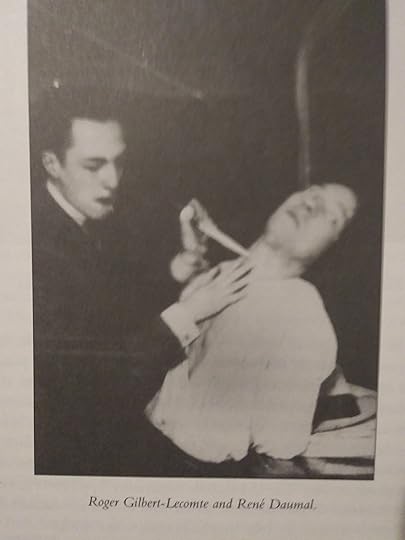
Roger Gilbert-Lecomte & René Daumal
Profile Image for Tosh.
Author 14 books785 followers
July 25, 2015
The complete four issues of the journal "Le Grand Jeu" (The Great Game). A publication edited and published in the years 1928 to 1930 by René Daumal, Roger Gilbert-Lecomte and Roger Vailland. Surrealists by nature, but not part of the band of outsiders. Mostly had an interest in the spiritual life of drug taking, almost dying, and the difference between the awaken and dream/sleep life. The beauty of this publication is the dynamic relationship between Daumal, Gilbert-Leconte and Valland. Basically they were teenagers - super bright teenagers, but nevertheless very young and adventuresome. The first thing that occurs to me is the photographs of this editorial group. All of them are bordering on beautiful, and at the very least, very handsome. As they get older, and as drug addiction takes place, their look becomes more decadent looking. I love that. As for the writing, it is truly awesome. There is a tight collection of writers/thinkers who contribute to the publication, and this is a superb edition by Atlas Press - who specialize in European avant-garde movements and their journals. A super important publication then and now, as well a remarkable introduction by Dennis Duncan, who provides us with the sense of time and adventure that took place in Paris in the late 20s. Buy it!
Profile Image for Lori.
1,412 reviews60 followers
July 13, 2023
And if we still want to describe an image torn from the hurricane of the void as "beautiful", its beauty will be twice as objective as what we customarily dress up in that name. Firstly because it comes from a world closer to reality and more universal than celebrated 'nature'. And also because whoever translates it into the human cannot transpose it. For it is saved from the inevitable coefficient of individual deformation by the sole fact that it cannot be the work of an individual who, in its creation, was merely its movement. Whoever has voided his consciousness of all images of our false world, which is not a closed system, can attract other images to himself which are seized by the suction of the void, but which come from outside the space where we breathe and the time in which our hearts beat, immemorial recollections or dazzling prophecies, and these he will attain by a cold flush of anguish. In an instant the universe of his flesh is dead to him: I have never been able to believe that when I close my eyes, everything would stay where it was. I close my eyes. It is the end of the world. He opens his eyes. And when everything was destroyed, everything was still where it was, but the light had changed. And what a silence. Good God, what a silence.
-From "The Death of Art After Rimbaud" by Roger Gilbert-Lecomte in Issue #2

Le Grand Jeu was a philosophical journal published between 1928 and 1930 by a small group of radical neo-Surrealists who sought mystical enlightenment through altered mental states. Unfortunately a combination of narcotics abuse and the proverbial leftist in-fighting killed their movement before it got off the ground, leaving only these three issues behind. But Le Grand Jeu is more than simply a literary oddity: it provides a window into the psychology of the Lost Generation and the search for meaning beyond the desolation wrought by the Great War. I liked this passage in particular because it reminds me of one of my favorite selections from T.S. Eliot's "The Waste Land":
—Yet when we came back, late, from the Hyacinth garden,
Your arms full, and your hair wet, I could not
Speak, and my eyes failed, I was neither
Living nor dead, and I knew nothing,
Looking into the heart of light, the silence.
Oed’ und leer das Meer.
Also provides a sort of bridge between the Symbolists and Decadents of fin de siècle and the politics of drugs and revolution that fascinated artists, writers, and thinkers well into the 1970s. Very worth a read.
Profile Image for B..
166 reviews82 followers
November 20, 2023
Simplists >>>>> Surrealists.

This book simultaneously makes me feel more connected and yet more alone, for I don't know any other artists like this right now. I'm still struggling to find my own Daumal and Gilbert-Lecomte, independently continuing where they left off, hoping one day my work will find similar, like-minded artists I can build a community with, just as the members of Le Grand Jeu did.

If you're reading this, and if you can relate to the following quote and all that's been said, if you, too, are tired of fiction and every kind of illusory addiction being used as a means of escape, if all you really want in art is insight, ontological relevance, and emotional vulnerability, to face life at every moment instead of running away, then, please, get in touch.

"With a few very rare but enormous exceptions, I renounce art as much in its highest forms as in its basest, that virtually all the world's literature, painting, sculpture, [cinema], and music has always caused me to slap my thighs in bestial laughter as if confronted by an enormous faux pas.
The genre-pieces produced by geniuses and real talents, the technical perfection acquired by the systematic exploitation of recognised or unrecognised methods, the assiduous practice of imitating 'nature', the 'long patience' of the salaried academician, all these kinds of activity have always scandalised me by their complete uselessness. Uselessness. It is art for art's sake. Otherwise known as populism. A hygienic distraction to make us forget hard-to-grasp reality."


4.5 stars
Profile Image for aauroracognigni.
9 reviews
March 5, 2026
Ha fatto viaggiare la mia anima.

“L'angoscia dei fantasmi inespressi sale e si diffonde e sputa al cielo dell'essere. Stigmatizza i propri eletti. Quelli la cui coscienza è il luogo del fatto lirico. L'umorismo funebre e sinistro della parola « poeta» incredibilmente prostituita non impedisce a pochi in ogni secolo di portare al di sopra della collet-tivita che insultano il vatico sacerdozio dello spirito.
L'ispirazione poetica - esattamente creatrice - è la forma occidentale della Veggenza. Il poeta, così definito il più lontano possibile dalla sua usuale accezione, è il debole ma autentico riflesso dello stregone negro e del mago orientale. I sensi dell'animismo, della partecipazione, della magia e delle metamorfosi descrivono il procedimento poetico limi-
tandolo. L'ambiente sociale del poeta lo caratterizza dolorosamente con Tantinomia d'uno spirito conforme in ogni punto alla mentalità primitiva ma il cui senso dell'invisibile, ahimè, è ereditariamente atrofizzato. Caratteristica propria sia all'ispirazione sia all'emozione poetiche - aspetti attivo e passivo del medesimo fenomeno - è la paramnesia. Ogni occidentale sconvolto dalla rivelazione del sogno è irrimediabilmente votato alla disperazione, al supplizio senza nome dell'immagine intravista nel bagliore di un lampo, perpetuamente in fuga proprio al di qua, o al di là del campo dell'attenzione. “
Profile Image for Nick.
76 reviews5 followers
January 13, 2023
This is great for a historical introduction to the grand jeu and their writings, which I thought were for the most part funny and enjoyable and even a little exciting. I liked especially:

All of Grand Jeu 4
On the origin of monsters
How to combat the cost of living
Puericulture
The seductiveness of voltage
The introduction

And others! Can’t remember which
Profile Image for Jess.
110 reviews
April 5, 2025
Plenty of interesting--and not infrequently remarkable--material here for anyone interested in French avant-gardist movements and/or notions of liberation via annihilation of the self.
Profile Image for Juan Jiménez García.
243 reviews38 followers
April 15, 2016
El Gran Juego. La búsqueda de la revelación

Hubo un tiempo para las revoluciones. No para lanzarse a las calles, sino para lanzarse a las ideas, para recuperar un espacio mental, encontrar un tono, un espíritu, o, simplemente, la revelación. Nada que ver con ideas religiosas ni, tampoco (en un principio), políticas. Entre una guerra y otra, los hombres pensaron. Entre baile y baile, entre el temblor de unas batallas y otras, había una necesidad de ser. Y de contar. También de reunirse, de encontrarse. Y eso podía ocurrir en Suiza, en el Cabaret Voltaire y alrededor del dadaísmo, como podía ser en el París de los surrealistas. O en  Reims, una ciudad que no nos dice nada especialmente, más que la guerra pasó por allí. Como por tantos sitios. En 1922, cuatro estudiantes, Roger Gilbert-Lecomte, René Daumal , Roger Vailland y Robert Meyrat forman el grupo de los simplistas. Tienen quince, dieciséis años, y eso ya da una idea de la época y de su voracidad. Eran poetas como ya no se ha vuelto a ser poetas (las revoluciones de otro tiempo las hacían los poetas), y creían en viejas cosas, como la ebriedad de las drogas o los arrebatos místicos, y en otras nuevas, como los sueños. París estaba tan lejos para ellos que ni tan siquiera sabían de la existencia del surrealismo. Lo supieron tres años después y pensaron que no estaban solos. No en todo, no siempre.

Pese a todo, no se trata de un grupo literario, sino de personas embarcadas en una misma búsqueda, hasta el punto de considerarse uno solo, lejos de las individualidades y personalismos de los otros. De ahí que escojan ese “hermandad” que precede al “simplista”. Aunque habían decidido suicidarse a los dieciocho años, nada sucede. Pasado ese momento, sus ideas de siguen desarrollando y los caminos se multiplican. Roger Gilbert-Lecomte es el más maldito de ellos, el más entregado a la autodestrucción por las drogas o el que más lejos quiere llevar esa búsqueda que solo pasa por alcanzar los extremos y los lugares donde nadie ha estado. Su texto Señor Morfeo, envenenador público, es su testimonio y testamento. Pero también es el más brillante, aquel que arrastra a los otros, y la Declaración preliminar de El Gran Juego es suya.

El Gran Juego aparece en 1928. Muchos de ellos ya han partido hacia París y allí se han encontrado con Andrè Breton y su banda, que no duda en cortejarles (y luego en recurrir a los golpes bajos). La revista reúne  buena parte de las inquietudes y el pensamiento del grupo, que se ha ido construyendo en esos años, que también son los de su madurez como personas. No tardan en aparecer nombres como el de Arthur Rimbaud y tres números después todo está acabado (aunque se ha llegado a reconstruir el cuarto número, que nunca se llegó a publicar). Tan solo el título de los textos ya es capaz de dibujar el mapa de sus inquietudes: Discurso del rebelde, El poder de la renuncia, Libertad sin esperanza, La experiencia inenarrable,…  Junto a Gilbert-Lecomte destaca René Daumal, como él aficionado a las experiencias más extremas. Los dos morirán a la misma edad: treinta y seis años.

Pepitas de calabaza reúne precisamente una selección de textos de los cuatro números de la revista más aquel Señor Morfeo, envenenador público, a cargo de Julio Monteverde. Y es precisamente él quién escribe uno de los momentos esenciales de esta edición: el prólogo. Rara vez encontramos un prólogo tan parte de la obra como este mismo, como si Monteverde se uniera a esa hermandad simplista para instalarse en su trayecto, en sus búsquedas, traérnoslas e iluminar cada uno de los instantes de ese trayecto, veloz y suicida, atravesado de ideas, acertadas o no, y de contradicciones, como cualquier pensamiento válido.

Escrito para Détour.
Displaying 1 - 10 of 10 reviews