

What do you think?

The History of Now: A New Kind of History
In the History of Now, historian Scott Powell makes the case for a radical reinterpretation of history. Instead of being thought of as “the study of past,” history must be integrated into a revelation and explanation of the world we live in. In remarkably short order the reader is guided through a synopsis of world cultures and their origins, which anchors a wide-ranging and penetrating analysis of each culture’s own trajectory and, ultimately, its contribution to the flow of human events today. The outcome is a seamless construct of striking explanatory power and relevance. The History of Now is indeed a new kind of history!
- GenresHistoryNonfiction
247 pages, Kindle Edition
Published January 13, 2019
Ratings & Reviews
Friends & Following
Create a free account to discover what your friends think of this book!
Community Reviews
Displaying 1 - 3 of 3 reviews

January 27, 2020
The History of Now is like no history I have ever read before. 3 reasons why this is the case:
Motivation
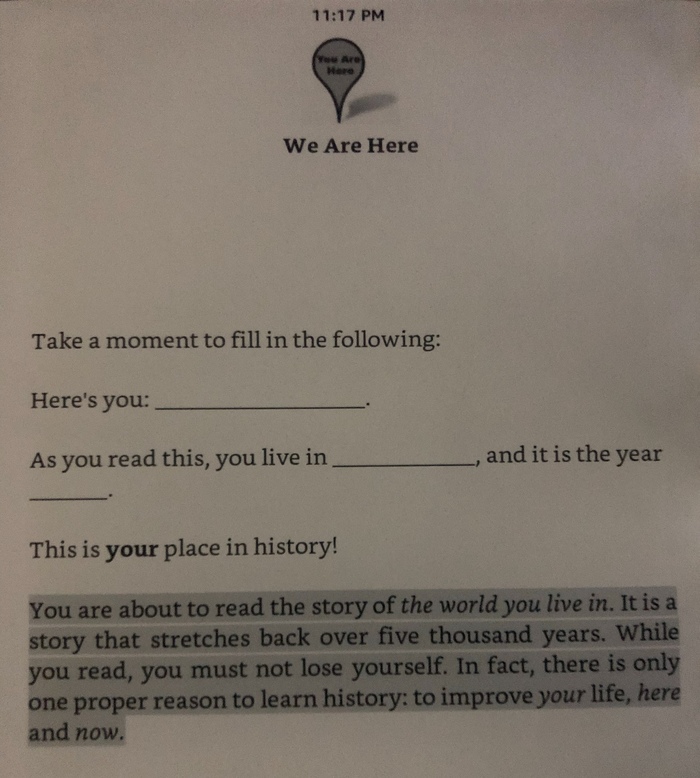
I was immediately excited to read it after the first few pages. Too much of the history I read comes with a caveat that you need to bring your own motivation for the knowledge. The author’s educator background comes through here...he knows how to motivate. A bit corny, but motivating nonetheless, check out the intro page:
Integration
The author guides you through integration of historical facts, i.e. helps you place facts within a larger context of knowledge, as a main focus of the work (with the aid of diagrams as a perk). The result is the ability to easily recall the story/outline of what you read, and in turn the events that drive it. This is super critical in a book that covers the entire history of the people. It also has the effect of making every sentence and every fact important to you, because you are constantly checking it against the over arching narrative, re-enforcing your learning. Good historians I've read weave integrations in throughout their works, but this is the first history book I've read that champions integration throughout the entire work.
The third:
The history is written with a "present centric" focus. You'll have to read the book to understand exactly what this means, but in short: the author focuses on how historical events led to and help us understand the present more so than any other book I have read. Just like the second point, other good historians do this to some extent, but not as the focal point of the work, like Powell does. Within the intro above: "In fact, there is only one proper reason to learn history: to improve your life, here and now". Every explanation of the past is logically linked to the present day.
Now, about the content and coverage, as that is pretty important in a history book that spans the entire history of people. The book starts off by setting up an argument that the 5 cultures to study are: American, Chinese, Russian, Islamic and European (this is based on his present centric theme). The argument is pretty persuasive. He explains at a high level how the cultures interact with each other and how they impact the world today and then looks at each in a dedicated section. Each section crafts a story on how the culture came to be, by highlighting key events and their impacts toward the culture. Through this method, he ends up covering cultures from the ancient Chinese, Egyptian, and Greek ages up to the present day (Trump administration).
There is one open item I have after reading...The book focuses on the impact of cultures on each other (their interactions), and therefore foreign policies, especially those of America (given his thesis). I can clearly understand why it is important to my life now, but focusing on the foreign policy of a culture leads to a specific selection of key events that drive that narrative, while skipping over other events that aren't obviously linked. In the end, it seems there are a lot of super important historical moments that don't get highlighted or mentioned, which makes one question the thesis to some extent. I think the author's method could be applied to different aspects of a cultures, but there isn't really any hint that the author thinks this (at least I didn't see any). For example, if the state of politics in economics was highlighted (fiscal policy) as the important present day phenomenon I wanted to understand to improve my life today, it seems like different events would be chosen (e.g. instead of the Truman doctrine, the New Deal). A lot of important events not directly highlighted ARE obviously linked to important events he does highlight, so I assume a deeper dive into the anchor events would shed light on these, but other events are not so obviously link. As an example, the American Civil War is not covered and there isn't an obvious reason why it should be or would be given his thesis. This book obviously can't cover everything, so I guess I'll have to wait for his future books to understand more of his thought on this.
One small gripe: In the afterword, he mentions he cannot recommend any history reads. I understand his approach is unique and maybe he thinks it’s the most effective way to write history, but one must learn history somehow. There must be value in the work of historians, as they are needed to create an approach like the one he has created, and some historians are so much better than others (in terms of bias, topic selection, selection of facts to include within a topic, integration and creating interest). If both of these statements are true, then I think there is great value in recommending history reads, even if you don't agree with a historian completely. So this was a bit of a turn off for me.
But I definitely recommend this book, as it is one of the few, short, “history of everything” books I have found to be great.
Motivation
I was immediately excited to read it after the first few pages. Too much of the history I read comes with a caveat that you need to bring your own motivation for the knowledge. The author’s educator background comes through here...he knows how to motivate. A bit corny, but motivating nonetheless, check out the intro page:
Integration
The author guides you through integration of historical facts, i.e. helps you place facts within a larger context of knowledge, as a main focus of the work (with the aid of diagrams as a perk). The result is the ability to easily recall the story/outline of what you read, and in turn the events that drive it. This is super critical in a book that covers the entire history of the people. It also has the effect of making every sentence and every fact important to you, because you are constantly checking it against the over arching narrative, re-enforcing your learning. Good historians I've read weave integrations in throughout their works, but this is the first history book I've read that champions integration throughout the entire work.
The third:
The history is written with a "present centric" focus. You'll have to read the book to understand exactly what this means, but in short: the author focuses on how historical events led to and help us understand the present more so than any other book I have read. Just like the second point, other good historians do this to some extent, but not as the focal point of the work, like Powell does. Within the intro above: "In fact, there is only one proper reason to learn history: to improve your life, here and now". Every explanation of the past is logically linked to the present day.
Now, about the content and coverage, as that is pretty important in a history book that spans the entire history of people. The book starts off by setting up an argument that the 5 cultures to study are: American, Chinese, Russian, Islamic and European (this is based on his present centric theme). The argument is pretty persuasive. He explains at a high level how the cultures interact with each other and how they impact the world today and then looks at each in a dedicated section. Each section crafts a story on how the culture came to be, by highlighting key events and their impacts toward the culture. Through this method, he ends up covering cultures from the ancient Chinese, Egyptian, and Greek ages up to the present day (Trump administration).
There is one open item I have after reading...The book focuses on the impact of cultures on each other (their interactions), and therefore foreign policies, especially those of America (given his thesis). I can clearly understand why it is important to my life now, but focusing on the foreign policy of a culture leads to a specific selection of key events that drive that narrative, while skipping over other events that aren't obviously linked. In the end, it seems there are a lot of super important historical moments that don't get highlighted or mentioned, which makes one question the thesis to some extent. I think the author's method could be applied to different aspects of a cultures, but there isn't really any hint that the author thinks this (at least I didn't see any). For example, if the state of politics in economics was highlighted (fiscal policy) as the important present day phenomenon I wanted to understand to improve my life today, it seems like different events would be chosen (e.g. instead of the Truman doctrine, the New Deal). A lot of important events not directly highlighted ARE obviously linked to important events he does highlight, so I assume a deeper dive into the anchor events would shed light on these, but other events are not so obviously link. As an example, the American Civil War is not covered and there isn't an obvious reason why it should be or would be given his thesis. This book obviously can't cover everything, so I guess I'll have to wait for his future books to understand more of his thought on this.
One small gripe: In the afterword, he mentions he cannot recommend any history reads. I understand his approach is unique and maybe he thinks it’s the most effective way to write history, but one must learn history somehow. There must be value in the work of historians, as they are needed to create an approach like the one he has created, and some historians are so much better than others (in terms of bias, topic selection, selection of facts to include within a topic, integration and creating interest). If both of these statements are true, then I think there is great value in recommending history reads, even if you don't agree with a historian completely. So this was a bit of a turn off for me.
But I definitely recommend this book, as it is one of the few, short, “history of everything” books I have found to be great.

July 10, 2021
Summarizing world history into a 250-page book is not an easy feat, yet that's what Scott Powell tries to do in his book “The history of Now”. He approaches the subject through a "present-centric" method, meaning that he starts with what the world looks like today and then tries to map out the major world events that have lead to this current moment (the book was published in 2018). The book fits into the category of so-called "big history". It's a different take on the subject, and I think it's a useful and interesting approach. Compared to more narrow history books, its lessons enable you to shine a new light on current world events and their deeper causes.
Starting with how the world looks like today means starting with the fact of the supremacy of the United States of America in world affairs. So how did the world come to be this way? What caused America to take this position and what's now causing it to recede more and more from its "Americanistic" style of world policing, and perhaps more pertinently, what will the be consequences of this?
In order to paint a picture of our history - literally - Powell uses various line diagrams that visualize key events in world history starting from a few thousand years BC until the present. To avoid getting bogged down in largely insignificant events or inconsequential tracks of history, he's chosen to outline the progression of the major world powers or regions: the US, Europe, Russia, Middle East, and China. That's really all that matters in terms of world history if you're trying to understand why the world looks like it does today. The timelines look something like this:
Although he builds a larger and more complex map of our shared history throughout the book, connecting various regions and countries together over time as their histories intertwine, the starting point has a few key dates for each of the historical tracks:
The founding of the United States in 1776, which is a result of the "discovery" of the Americas in 1492 by Columbus. Columbus, of course, was a European.
The birth of Europe (and its collection of disjointed nation-states) happened in 476 AD with the invasion of Rome by the Germanic ruler Odavacar, deposing the last Roman emperor Romulus Agustus.
But European and western history has its roots in Ancient Greece starting in ~508 BC with the birth of democracy in Athens by a legislator called Cleisthenes.
Modern Russian history can be said to have started in ~862 AD with the founding of a nation called the Kievan Rus, by a Viking conqueror named Rurik, whose descendants merged with the Slavs. Russia is partly European but also quite distinct from it, most notably due to its long isolation from other European peoples until just a few hundred years ago.
The "modern" Middle East had its start after the founding of Islam by the prophet Muhammed in ~622 AD and spread aggressively throughout the region, all the way to eastern Europe and Southeast Asia during the next decades to hundreds of years.
Yet the Middle East and the pre-Islamic nations sometimes called the "cradle of civilizations" can be traced back to the birth of Ancient Egypt by a semi-mythical emperor called Menes (or Narmer) ~3000 BC.
Tying all these four major blocks of the world together, of course, is the birth of Jesus Christ and Christianity in 4 AD (he probably wasn't born in year 1).
Separate from the rest of the world but still very consequential is Chinese history, which as you can see from the thick line in the diagram, has a long united history of emperors and dynasties starting ~2200BC with the Xia dynasty (or perhaps even earlier).
With these starting points, he then tries to explain the various regions' current predicament. The rise of the West and America, and the rest of the world's "subordinacy to the West" and the natural opposition to this subordinacy. "Post-communist Russia"; why did Russia not integrate with the rest of the world/the West after the fall of the Soviet Union? "Post-Maoist China"; how is it that China has reemerged as a strong power after decades of poverty and even centuries of relative obscurity? "Supranationalist Europe"; why did Europe with its long history of inter-national warfare and conflict manage to come together under a common union (which had been attempted and failed many times since the fall of the Roman Empire)? "Islamic Culture in the America-centric age"; how is it that these two cultures collided so violently in the past few decades? (Hint: it's not because the US tried to "take all their oil.")
So where do South America, India, and other cultures/nations of the world fit into this picture? It's not that they are uninteresting or unimportant, but that when you're trying to understand the current state of the world (and America's supremacy in it), these other histories are just not very consequential. In other words, the history of these nations as separate tracks of history don't have a lot of explanatory power or don't add enough detail to the overall history of the 5 major power or blocks, that isn't already accounted for.
Nevertheless, I doubt a Chinese historian would ever write a book on world history like this. And I can't help but assume that there's some sort of natural bias that creeps in throughout Powell's analysis. Perhaps this is more of an American-centric history than a present-centric history? In any case, I find his general arguments convincing and helpful in understanding the larger trends of world history. Another reviewer of the book said that this is like the 80/20 approach to history, which is exactly right. There are so many different kinds of stories, events, and narratives that make up human history from the past ~5000 years, but in reality, only a handful of cultures have made a really broad and consistent impact on the history leading up to the present. Understanding these broad trends and memorizing a few key anchor dates of history (2200BC, 508BC, 476 AD, 622 AD, 1492 AD, 1776 AD, etc) is a very useful way of making sense of the world.
Starting with how the world looks like today means starting with the fact of the supremacy of the United States of America in world affairs. So how did the world come to be this way? What caused America to take this position and what's now causing it to recede more and more from its "Americanistic" style of world policing, and perhaps more pertinently, what will the be consequences of this?
In order to paint a picture of our history - literally - Powell uses various line diagrams that visualize key events in world history starting from a few thousand years BC until the present. To avoid getting bogged down in largely insignificant events or inconsequential tracks of history, he's chosen to outline the progression of the major world powers or regions: the US, Europe, Russia, Middle East, and China. That's really all that matters in terms of world history if you're trying to understand why the world looks like it does today. The timelines look something like this:
Although he builds a larger and more complex map of our shared history throughout the book, connecting various regions and countries together over time as their histories intertwine, the starting point has a few key dates for each of the historical tracks:
The founding of the United States in 1776, which is a result of the "discovery" of the Americas in 1492 by Columbus. Columbus, of course, was a European.
The birth of Europe (and its collection of disjointed nation-states) happened in 476 AD with the invasion of Rome by the Germanic ruler Odavacar, deposing the last Roman emperor Romulus Agustus.
But European and western history has its roots in Ancient Greece starting in ~508 BC with the birth of democracy in Athens by a legislator called Cleisthenes.
Modern Russian history can be said to have started in ~862 AD with the founding of a nation called the Kievan Rus, by a Viking conqueror named Rurik, whose descendants merged with the Slavs. Russia is partly European but also quite distinct from it, most notably due to its long isolation from other European peoples until just a few hundred years ago.
The "modern" Middle East had its start after the founding of Islam by the prophet Muhammed in ~622 AD and spread aggressively throughout the region, all the way to eastern Europe and Southeast Asia during the next decades to hundreds of years.
Yet the Middle East and the pre-Islamic nations sometimes called the "cradle of civilizations" can be traced back to the birth of Ancient Egypt by a semi-mythical emperor called Menes (or Narmer) ~3000 BC.
Tying all these four major blocks of the world together, of course, is the birth of Jesus Christ and Christianity in 4 AD (he probably wasn't born in year 1).
Separate from the rest of the world but still very consequential is Chinese history, which as you can see from the thick line in the diagram, has a long united history of emperors and dynasties starting ~2200BC with the Xia dynasty (or perhaps even earlier).
With these starting points, he then tries to explain the various regions' current predicament. The rise of the West and America, and the rest of the world's "subordinacy to the West" and the natural opposition to this subordinacy. "Post-communist Russia"; why did Russia not integrate with the rest of the world/the West after the fall of the Soviet Union? "Post-Maoist China"; how is it that China has reemerged as a strong power after decades of poverty and even centuries of relative obscurity? "Supranationalist Europe"; why did Europe with its long history of inter-national warfare and conflict manage to come together under a common union (which had been attempted and failed many times since the fall of the Roman Empire)? "Islamic Culture in the America-centric age"; how is it that these two cultures collided so violently in the past few decades? (Hint: it's not because the US tried to "take all their oil.")
So where do South America, India, and other cultures/nations of the world fit into this picture? It's not that they are uninteresting or unimportant, but that when you're trying to understand the current state of the world (and America's supremacy in it), these other histories are just not very consequential. In other words, the history of these nations as separate tracks of history don't have a lot of explanatory power or don't add enough detail to the overall history of the 5 major power or blocks, that isn't already accounted for.
Nevertheless, I doubt a Chinese historian would ever write a book on world history like this. And I can't help but assume that there's some sort of natural bias that creeps in throughout Powell's analysis. Perhaps this is more of an American-centric history than a present-centric history? In any case, I find his general arguments convincing and helpful in understanding the larger trends of world history. Another reviewer of the book said that this is like the 80/20 approach to history, which is exactly right. There are so many different kinds of stories, events, and narratives that make up human history from the past ~5000 years, but in reality, only a handful of cultures have made a really broad and consistent impact on the history leading up to the present. Understanding these broad trends and memorizing a few key anchor dates of history (2200BC, 508BC, 476 AD, 622 AD, 1492 AD, 1776 AD, etc) is a very useful way of making sense of the world.
November 25, 2020
A unique and interesting way of learning history. Reminds of the Pareto Principle (8020) in which 20% of countries/cultures have shaped 80% of the world's history. Look forward to additional books from author.
Displaying 1 - 3 of 3 reviews