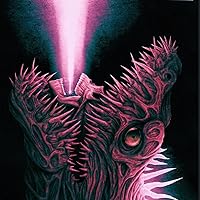
Amidst disillusioned saints hiding in wrestling rings, mothers burnt by glowing halos, and a Baby Nostradamus who sees only blackness, a gang of flower pickers heads off to war, led by a lonely man who cannot help but wet his bed in sadness. Part memoir, part lies, this is a book about the wounds inflicted by first love and sharp objects.
Salvador Plascencia the author of the cult favorite The People of Paper, named a best book of the year by the San Francisco Chronicle, Los Angeles Times and Financial Times. The People of Paper has been translated into a dozen languages and widely anthologized and adopted in Chicanx, postmodern, creative writing and design courses throughout the country. His writing has appeared in McSweeney’s, Lucky Peach, Tin House and the Los Angeles Times. He holds a B.A. in English (Whittier College), an MFA in creative writing (Syracuse University), and an M.A. in English (USC). He is the recipient of the Bard Fiction Prize and a Moseley Fellowship.
tl;dr review: High on style and imagination, low on substance.
Salvador Plascencia wanted the People of Paper (PoP) to make a smashing impression at the party. He went to great lengths to pick a dazzling dress, right accessories, make-up and all that. While this made for an eye-catching presence, he forgot to hook PoP up with cue cards listing some interesting things to talk about that could have kept the guests enthralled.
The People of Paper suffers from being the author's first novel. Plascencia has this bag full of tricks which he is too eager to show off. In a novel that is a marriage of magical realism and meta-fiction, he fails to deliver a focused work.
My favorite thing about this book would be the imaginary world Plascencia had conjured up. The novel is full of strange and fascinating images. There are so many tiny bits - little girl's lime addiction, monk fifty-three, origami surgeon, baby Nostradamus - that are going to stay with me for a while. In terms of fantastical imagery, the closest comparison that I can think of - among the books I have read - would be Lanark.
Plascencia plays around quite a bit with form and structure. The characters wage a war against the tyranny of the omniscient narrator who wouldn't leave their private thoughts alone. Some characters walk out of the novel to meet the author. There is multiple viewpoint narration, multiple columns laid out on some pages, some completely blacked out sections, a few diagrams, some rectangular holes in the pages because the author didn't want a certain name in his novel. This meta-fictive finery lends a unique touch to the book. Most of all, Plascencia keeps it from looking like just an annoying gimmick.
All is fine and dandy so far. But the core premise of the novel is too flimsy to shoulder the whole book. Innovative style and all aside, I am one of those readers who are also interested in 'what the hell is this book about' aspect. If you want your book to be about loss and sadness, you have got to let us stay with a character for more than half a page at a time and connect with them. Drowning the already thin emotions in the shiny surface doesn't help.
One of the back cover blurbs says, "Calvino, Borges and Garcia Marquez will come to mind." Well sure, when you think Latin-American magical realist, you immediately think of Marquez. You think of meta-fiction, you think of Calvino. But those names are really difficult for anyone to live up to. Please don't go in expecting something at the same level, you will only be setting yourselves up for disappointment.
I don't know what to write about this book. Anything I say feels like a spoiler, even if it's not exactly one. The novel unfolds at the pace of the author and giving away anything feels like I'm making a decision about what you should or shouldn't know before the author thinks you should know something. TC Boyle gives a fairly good idea for the novel when he compares it to Calvino and Borges. Those names get thrown around a lot and most of the time they are big flags for a book being flashy without substance, but in this case the book does live up to the comparison.
Someone named Natalie, who is friends with thirteen people I'm friends with, but not one of my friends made a comment on my rating for the book (I say rating because there was no review there yet, obviously, since I'm typing the review right now....) saying "What a gem this book was." And I think that is a very good description of the book too. If you're going to read this book I'd recommend reading it without reading any of the other reviews here, they are liable to give away anything about the book. Don't read the back of the book either, I didn't. And I couldn't read the back of the book I got from the library because of all the tape and stickers and libris shit that was affixed to it. I could basically only read the the TC Boyle comparison I mentioned above. I'd also recommend getting a copy of the original hardcover because it's nicer looking and there are words cut out of it and it's nice having the words cut out instead of just scribbled out as in the paperback. But reading the paperback won't diminish your enjoyment too much, and there are only a couple of words cut out so it's not too much of a gimmick.
But that isn't much of a review, or a recommendation. How will you know if the book is for you? I don't know, maybe if you like people like Borges and Calvino. Or maybe because you want to try reading a book that Natalie from Australia nicely describes as a gem.
This 'review' says very little about the book. Maybe I should try to say something constructive? It might be a five star book? How is that. There were parts of the book that I didn't think exactly worked, but I think it might have been my fault that I didn't get quite what the author was aiming to do, but those failings of mine didn't do very much to diminish my enjoyment of the book, it just made me give it four instead of five stars. If there were half-stars I would have given it four and a half. I'd given out too many five stars lately and I felt like I was giving them out too liberally, so I didn't bump this book up. Sorry Mr. Author.
In the Cohen’s film Barton Fink, Barton (John Turturro) says he believes “that writing comes from a great inner pain.” Plascencia seems to also subscribe to this belief In The People of Paper, as the “great inner pain” felt by the author and all his creations is the impetus for their lives and actions. This novel pushes metafiction to new boundaries and does really unique things with form, however, the novel does have its share of pitfalls as Plascencia’s obsession with the “inner pain” begins to chafe on the reader after so long.
The Good The story of The People of Paper follows Federico, his daughter and EMF, a Mexican gang of carnation pickers, as they wage war on Saturn for spying on their every move. As the story unfolds, countless strange characters pop up, from a women made of paper who sleeps around, a baby Nostradamus who sees all, and lead turtles just to name a few. Saying anything more about the plot, even the smallest detail, would give too much away as this novel employs a highly creative story and it would be a shame to ruin it. There really are a lot of good things going for this novel, as Plascencia wields some rather innovative tricks, literally cutting names out of the pages (actual holes where names should be), blackening out hidden thoughts, and allowing the author and characters to comingle with each other in a way that was very fresh and new to me. It was similar to O’Brian’s At Swim Two Birds, but taken to the next level with Plascencia actually being rebelled against by his own characters. Also, the form of the book changes with many chapters having Saturn’s part in one column on the left page while two different characters have the story told from their perspective in two separate columns on the right page. Pretty cool, eh? He also uses this technique wisely, using varying perspectives to gain further insight into situations and having the reader observe events in a jumbled fashion, often learning the end of an event before the beginning of it, while making sure not to let different perspectives overlap over the same anecdote. The book reads as highly surreal and magical, and the final scene is exciting and fascinating. All in all, this book is expertly written and thankfully the gimmick does not tire or wear too thin.
The (overwhelming) Bad Plascencia tries his best to dazzle you with all his metafictional finery because the actual substance of his work is where the magic of the book really begins waning. As stated earlier, the inner pain felt by all the characters, and Plascencia himself, is what drives this novel. In its opening chapter, he crafts a quirky little metaphor of the book, showing art being brought about from pain and loss. Basically, a death drives a young boy to create magnificent art that literally takes on a life of its own, akin to Plascencia’s own goal with The People of Paper. The novel then takes the reader down rough winding roads of break-up stories and heartbreaks, one after the other repetitively to the point of obnoxious, showing how love cuts deep and drives us to commit many strange and depraved acts just to rid ourselves of its heavy burden. It reminded me of that friend at the end of high school who had a savage break-up and it was all fine to hear them out and console them and support them, but as time went on and they didn’t pick themselves up and move on, instead spinning the same forlornly tirade over and over, it begins to be irritating. That’s how this novel comes across after awhile; you may find yourself wanting to shake Plascencia by the neck and tell him to ‘get over it’ because you don’t need to hear about how sad his unnamed girlfriend leaving him makes him. Every character is a sack of tears slogging across the desert trying to free themselves from their inner pain, and maybe it’s just that I’ve reached a point in my life where I don’t bemoan past heartache, but it really detracted from the book for me. Also, Plascencia finds it imperative to tell you about how his new girlfriend, who is more of a person to sex the pain of his ex away with, has a massive bush. He brings it up constantly. All these supposed ‘negatives’ I have brought up all do have their place in the novel and are part of what makes it good, but there is just a bit too much of it. The book left me wanting in a few other ways as well since this is a very surface novel. There is not much lying in wait beneath the words to be untapped and I felt there was so much emphasis on the flair of the book that the subtleties and depth was greatly sacrificed. This novel could have benefited from more editing and polishing, but it is important to keep in mind that this book is very experimental, so when parts don't seem to run smoothly or things fall apart slightly to give him some credit for being original.
Verdict With this novel, you must take the good with the bad. There really are a lot of good aspects, from the stunning metafictional plot, the unique forms, and outrageous cast, but the novel never really rises out from the pit of love's despair. There is hope, but there is a near endless trail of incessant wailing to get there. If you are at a point in your life where it feels good to embrace heartache, and admittedly we all go through this phase, then this book is a perfect choice for you. Had I read this a few years ago it probably would have made a larger impact on me. It should also be noted that if you pick this up, try and find the hardcover published by McSweeny’s as it is a masterpiece of art on its own. This book is worth getting through for its metafictional form, but I would suggest At Swim Two Birds or, of course, Calvino’s If On A Winter’s Night A Traveler… as more fruitful options. While some may argue good writing comes from this “inner pain”, it should be noted that the William Faulkner-based character of the film Barton Fink responds to this statement by laughing in his face, relieving himself on the ground, and sauntering off down the road singing drunkenly. I do not wish to draw any conclusion from that myself, so take that as you will. 2.5/5
I am literally obsessed with this book. It was one of three books I included in my thesis on the response of contemporary experimental print literature to the digital threat. It is a beautiful, moving exploration of the place of the author; the transience of paper, narrative and relationships; and so, so many more things. This book made me cry by cutting a whole in a page. That shouldn't even be possible. I cannot say enough wonderful things about this incredible book. Admittedly, I've also spent more time studying it than is really healthy, and a lot of the brilliance I ascribe to it is on a secondary or tertiary theoretical level that a lot of people might not want to dig into, but if you're the sort of person who wants to go there (or just enjoy an intricate, moving story with one of the most unique concepts and some of the best descriptions of agriculture I've ever encountered [weird, yes, but seriously? He makes carnation farming mindbendingly interesting and beautiful. How? I cannot tell you. But he does it])
Please read this book. Please. And then tell me, so we can talk about it together. Because I'm in love.
By far the best book I've read in 2012. It's outrageously comic, dark, whimsical and heartbreaking. It's about love: it's joys, its ups, downs, and painful moments.
Pangs of love and its baggage pervade every page with such anger and joy that its almost I am reliving every relationship that I've experienced; that reading this book followed my exact life story at this moment that I am experiencing.
Gritty and sardonic, comic and whimsical- and as bittersweet and lonesome as a Carson McCullers novel, I absolutely recommend this novel.
An updated review, June 2016:
I rediscovered that this novel is about one man's insecurity of not being white enough for his white girlfriend, Cameroon, who leaves him for a bearded white man, probably a hipster.
It is a meditation of grief and the demise of a relationship that at the heart is about one man's insecurity- Saturn, aka Salvador Plascenia's own loathing of being Hispanic, and perhaps an insecure artist.
It is also a criticism of whiteness- of its power to cause self loathing and self destructive behavior, and of passing in society, ala Rita Hayworth, who appears in the novel as a symbol for passing and the sexual fetishization of Latinix women. But it is indeed a beautiful novel, at heart a meditation of grief.
Beware the blurb! Whichever wily marketeer decided to compare Plascencia with Gabriel Garcia Marquez and Italo Calvino did the writer no favours. A cloying mix of magic realism and metafiction, which suggests in turn the name-checked writers at their worst, the result is strangely soulless and the first 100 pages feel something of a chore.
The author has talent but as a first novel 'The People of Paper' tries hard to impress and the addition of the kitchen sink- one full of washing water- leads to the ickle cut-outs turning to mush. So many voices compete and yet they all sound the same. And the number of gimmicks in the book made me shudder remembering that 'Extremely Loud and Incredibly Close' debacle.
Thankfully I stuck around and when the meta-fiction really kicks in there is some heart delivered into the proceedings- the transplant The People of Paper needs.
I'd like to read a later and more mature work but this seems to be the only thing Plascencia has come up with, solus. Papercuts?
I got to meet Sal at a reading he gave at Skylight Books. He was touring the country with Eli Horowitz from McSweeney's (publisher). Sal is from El Monte and a bunch of his family and friends were at the reading. A lot of people were carrying heads of lettuce, which I didn't quite get. It was totally packed and even though I got there a little early, I had to stand way in the back. Sal read the selected excerpt, and then at a certain predetermined moment, members of the audience (the ones with the lettuce) read aloud passages from the book. Different people read different characters. It was a little like a play, but actually reminded me more of being in church on Good Friday, the words themselves carrying a greater weight, almost immediately divorcing themselves from the voices which had spoken them. Sal had studied in Syracuse with George Saunders; after the reading I mentioned I'd also been a student of his and we talked about George for a while.
The same spirit of oddity and adventure that characterized the reading is apparent in the book also. He plays with ideas of authorship, creating a brilliant sub-story where the characters in the novel stage a coup against Plascencia, the writer. He writes from the perspective of no fewer than 20 characters, yet the story never loses its focus. Pages are sometimes broken into columns, to create the effect of two characters narrating simultaneously. There are sections that are blacked over. There are words that are literally cut out. And it's not all for show, the way he goes about these innovations is really clever. If you're one of these people who thinks that the novel form has, like a shark, long-since evolved into a perfect and unchangable state, then I suggest you read this book.
I guess everybody has a total boner for this one? I just thought it was fine, like it was everything that's good and bad and exciting and annoying about the McSweeney's scene. Like, does your mouth water at the prospect of a traditional (I say traditional like I'm talking about centuries of history, but really what I mean is that this reminds me a lot of 100 Years of Solitude), Latin American magical realist novel crossed with a more modern United States metafictional meditation on a failed relationship? If that totally pumps your nads, then this is the book for you.
For me, I don't know. It went on and on, it felt kind of precious, and it used the expression 'lost love' a bunch of times. Which, I'm sorry, I wanted to get that tattooed on my knuckles when I was fourteen, but nowadays it's maybe the phrase more than any other that makes me think of- well- naive teenage romance. In the bad way. And I hate it when authors show up in their own books. It was annoying with Paul Auster, it remains annoying with Stephen King, and now I just don't care with Salvador Plascencia. Maybe one day I'll be super stoked about something metafictional, but I am not holding my breath.
At the same time though, there's really good stuff in there: the mechanical turtles, Merced de Papel, the girl who eats limes til her mouth rots, I love all that. I like the part where the real-life author kills his real-life ex in a few ways, just 'cause he can.
And I wanted to finish the book because I wanted to know what happened; but since I started reading Dean Koontz in fifth grade, I've felt pretty annoyed when an author hooks you with a good story, and then drags it out with annoying (or boring or pretentious) stuff for a hundred and fifty extra pages til you can get the payoff. Alex can just read the last page first and be done with it, but I don't have that in me.
Also: there are tricks of typography, razored out words, boxes of blacked-out ink over some passages, and other pomo meh whatever. My tolerance for that stuff varies depending on the day.
So... yeah. Compelling and annoying. Three stars. Next.
Wait, edit. I've been thinking about this all day. Ultimately I think what didn't work for me is, here is the premise of this book: 'a girl broke my heart, so I made a big ol' opus about my pain. Aren't I smart/great?' Whatever.
This entire review has been hidden because of spoilers.
"Bilgisinin ağırlığı kaslarını zayıf düşürüyor, kehanetleri uzuvlarını hırpalıyor ve onu bereli kollarını kaldıracak güçten aciz bırakıyordu. Her şeyi bilmek Bebek Nostradamus'un sinir dokusunu tahrip ediyordu, gelecek elli yıldan ilerisine baktığında migren ağrısı beyninin içine işliyordu. Ama yıpranan sadece bedeni değildi; katı ve talepkar ahlaki kurallar da vicdanına eziyet ediyordu..." (sayfa 146)
"Kağıt İnsanlar yayımlandı ve kısa sürede baskısı tükenerek sahafların ucuz kitapları arasına karıştı. Ve orada sararmış kağıt kokusu ve kataloglanmamış macera ve aşk romanları arasında, , Kamerun romanı açıp köpekbalıkları tarafından yendiğini öğrendi. O okurken tepesinde vızıldayan evcil arı sürüleri sessizliğe gömüldü; konup kanatlarını kapattılar, kitapların sırtlarında ve kapaklarında, sayfalarında ve ciltlerinde gezinmeye başladılar. Bölümlerin içine gömülüp paragrafların arasında gezinerek, tam da bu cümlenin üzerinde dolanıp bu kelimenin üstünü kapatarak, sonra satır sonlarına bal bırakarak..." (sf. 200)
The more realistic bits about the author and his lady friends jump off these pages, especially when they rip the story so far. The rest -- the revolt against omniscient narration and the commodification of sadness -- while consistently clever and carefully composed, had me back on my readerly heels. I respect the experiment in theory (inventive multi-POV meta cleverness sounds good, right?) but in practice it seems like I'm more conservative these days and less wooable by format than I may have been in my youth? My bad. Maybe sadness can't be stated for a reader to feel it? Not sure how I feel about "sadness" lurking like a black hole in the middle of the inventive PoMo novel (see DFW's claim that he wanted IJ to be "really sad"). Also not sure if doggie style is the saddest sexual position, as asserted herein. The suddenness/cutesiness of Cami's fate (not to mention repeated comment regarding her "muff") undermined my affection for this a bit? Reminded me at times of that Will Ferrell movie, "Stranger Than Fiction," that came out a year after this was published. Here's a list of the same "characters rebel against author" trope in books, TV, movies, comics, wrestling, etc. Anyway, glad this exists in the world. Glad to have finally read it. Looking forward to the author's next one.
The People of Paper is a novel about writing a novel. It follows, at the beginning, two separate storylines that are in fact inseparable. Salvador "Saturn" Plascencia is an aspiring novelist whose girlfriend leaves him when it becomes apparent that he cannot balance the novel and his relationship with her. The second storyline involves the novel's characters, Froggy, Little Merced, Sandra, Federico de la Fe, etc. Living in El Monte, Federico de la Fe decides he can no longer stand the omnipresence of Saturn, and creates EMF--an organization that declares war on omniscient narration. No longer do the members of EMF want Saturn watching all that they do. The two storylines eventually collide, as Saturn attempts to make sense of his novel and the decisions he must face in writing a fictional/autobiographical novel.
The first thing I thought of when I flipped open the book was Tristram Shandy. This isn't formatted, for one thing, like your "normal" novel--large chunks are blacked out, some pages are blank, one of the characters speaks in images. The People of Paper, not unlike TS, is a story utterly about narration. Narration switches from character to character, with pages generally divided into two columns, each column with a new narrator. So, for example, on page 29, sections of the story are narrated by Little Merced and a Glue Sniffer.
This novel is unlike anything else I have ever read, for what that is worth. I can't say what the novel is "about"--it is about, above all, the act of creating a literary work or literary subjects. It is also about mechanical turtles, a baby who forsees the future, past and present, a Catholic saint who is also a Mexican wrestler, a woman who purposefully infects her own body with bee poison, and a couple who spend their time breaking down the aphorisms of Napoleon Bonaparte.
An excerpt from the prologue:
Antonio split the spines of books, spilling leaves of Austen and Cervantes, sheets from Leviticus and Judges, all mixing with the pages of The Book of Incandescent Light. Then Antonio unrolled the wrapping paper and construction paper and began to cut at the cardboard and then fold.
She was the first to be created: cardboard legs, cellophane appendix, and paper breasts. Created not from the rib of a man but from paper scraps. There was no all-powerful god who could part the rivers of Pison and Gihon, but instead a twice-retired old man with cuts across his fingers.
Antonio was passed out on the floor, flakes of paper stuck to the sweat of his face and arms, unable to hear the sound of expanding paper as she rose. His hands were bloody, pooling the ink of his body on the floor, staining his pants. She stepped over her creator, spreading his blood across the polished floor, and then walked out of the factory and into the storm. The print of her arms smeared; her soaked feet tattered as they scrapped against wet pavement and turned her toes to pulp.
My favorite read of the semester. One of the most affecting books I've read in recent memory. This is what I want out of literature: for the pain to be on the page. For the content to necessitate the form. Hard to believe it's his first novel, as it feels like such an accomplished work. The metatextual modality of storytelling might not be for everyone, but I found it brilliant. In the hands of a lesser writer, this book would not have been possible, I don't think. The whole concept has "doomed to fail" written all over it, and yet here it is, stunning and smart and heartfelt and brutal and working.
What does it mean, the notion that we are all of paper? That we are, essentially, material, I think. That we are always subject to being someone else's material. That we, against our will, might become blank canvases onto which someone else narrativizes us. That we don't own our stories as much as we'd like to think. That no life is so private as to be immune to colonization by another. To investigate all this in both a very personal way—the emergence of the nonfictional elements that arise in the middle of the novel—alongside a fictional world itself being colonized-- I just think it's a wondrous thing, this book.
The first three sentences of this book are as follows: "She was made after the time of ribs and mud. By papal decree there were to be no more people born of the ground or from the marrow of bones. All would be created from the propulsions and mounts performed underneath bedsheets -- rare exception granted for immaculate conceptions."
And the rest of the book is just as delightful. I fell in love. If you're allergic to gimmicks and plot devices you might not like it -- or you might, like me, think Plascencia writes so well he can gimmick all day and you'll hardly notice.
(Note: his grief over being left by a lover turns misogynistic in Chapter 12. I forgive page 134 because all the other pages are full of extraordinary female characters. You might feel differently if you're sensitive to the c-word.)
Kitabın formatı değişik, ki böyle formatlara en azından biz Türk okurlar pek sık rastlamıyoruz; bu nedenle okurken keyif alınabilir lakin magical realism? Not cup of my tea.
перший розділ «паперових людей» – це обіцянка читацького блаженства: католицька церква, яка забороняє робити людей, крім як із крові й плоті; орден, який замикає фабрику з робіння людей і вирушає в покутне паломництво; хлопчик, який рятує свою кицю, склавши її з паперу, а потім виростає в геніального трансплантолога, що виготовляє органи для пересадки з орігамі; жінка, яку він урешті-решт творить із паперу, знайшовши замкнену фабрику з робіння людей.
але в автора, на жаль, був не тільки цей сюжет, а ще приблизно вісім, які він спробував засунути в одну книжку (у єдину свою, варто зазначити, книжку; а не треба бути таким марнотратним), зверху акуратно прицвяхувавши метанаративом, щоб якось трималися купи. тому на паперову жінку лишилося сторінок зо п'ятнадцять, добра половина з яких, щоправда, присвячена чоловікам, що різалися об неї в процесі кунілінгусу; утім, паперовій жінці зі сторінковим часом пощастило більше, ніж покутному ордену, геніальному трансплантологові чи самій ідеї про людей, зроблених із будь-чого, крім крові й плоті.
sanırım hepimizin kederi alt etme yöntemleri farklı, yanıklar,kağıt kesikleri, arılar; ama bir yandan da "kederden besleniyoruz". bir arkadaşım aşık olduğu zamanlar-platonik olarak diyelim- acıkmadığından bahsetmişti. bunlar hep keder
not:keder piramidi ve daha fazlası için yayınevinin blogundan
oh what? I wanted to read this book already over a year ago, and three of my bookfriends say great things about it, and now it's re-recommended by Adam Levin? why am I so slow and stupid and haven't read this yet goddammit??
I read this at the insistence of a friend, who after reading the first four pages, emphatically enlisted others of us to read it as well. It's an engaging story that plays with the structure and process of literature, incorporating visual elements to good effect. The People of Paper is the meeting place of Magic Realism and Postmodernism. Avoid reading the back of the book — I think the experience of this one is enhanced by growing with the book.
Below are the notes I wrote in the margins along the way as I was trying to figure out the meaning of this, that, and the other...
*** Spoiler Alert ***
I'll add these notes later — I want a break from the internet right now.... Okay, I'm back. These are the unedited notes from my margins. They might show me to be insightful, or less than that. I haven't reviewed them so I don't know yet. Either way, this is just a haphazard history of my thoughts going through the book.
PAGE 56 Impression from Prologue: rejection of god — mythological telling of atheism Ch 1 + 2: treatment of the body + experience through the body. Intimate vulnerabilities presented w/ the accepting/detached familiarity. Display of emotion w/ economic use of words. More is said by saying less. by allowing room for varied experiences/emotions simultaneously (ie end of ch. 2) Rejection of Saturn — another god. Class consciousness. To be happy — to be free
PAGE 112 Saturn/Author/God = grandson of Federico whom Saturn sees + whose mind he sees, except when concealed by lead (like x-ray vision) a story of pain (glue sniffers, skin burners, lovers) a story of love a story of family creation (paper people) lineage Where the supernatural (Saturn) meets the super/extremely natural (Saturn) — and bed wetting
Page 113 Whether it's true or not, I like to think of this book as a memoir (about a break up/or love)told as a myth — or in the magic realism style. Part I is like the biographical/family history/growing up part of the memoir. But in telling the story, the author struggles with the role of "auteur" + so it comes out only at the end of the section that Saturn (the only narrative voice) is indeed the author. And Federico's resistance to being watched by Saturn is an expression of the author's self-aware state. Intentionally the mythological design of the story telling distances the author from the role of protagonist. Rather, if this is a memoir, the choice to distance himself from the role of protagonist had to be intentional, although the motivation might be unknown. blood as bodily, as lineage, as family, as history, as la historia/las cuentas — su historia y su cuenta como están la misma. la cuenta suya y la cuenta de su familia como están la misma, blood as ink, as writing. The paper woman steps over her origami-surgeon-creator and drags his blood. ::pointing to the section Ralph and Elisa Landin:: Well, I guess this + the inset inventories below + on the next page are some evidence to build on everything else I wrote here.
PAGE 116 heartbreaking The telling of Merced leaving Federico, and his bed wetting, was also heartbreaking.
PAGE 119 Family Tree — Don Victoriano is great-grandfather of Saturn (author) p. 107 Ch. 9 gives family tree
1. I really like this book. The making of reality/family biographhy into fiction/mythology back into reality of the author's life experiences while in the process of writing something from which he has separated himself. 2. Is Saturn/Salvador related to Federico? No. He is the biographer of Federico + the other El Monte gang members + he owes them their own voice, not the domination of a biographer's so-called authoritative voice authoritative author 3. Wrong again ::arrow pointing to #2::
PAGE 137 tu cuenta, tu historia (p. 113)
PAGE 138
PAGE 155 authority/all-seeing, controlling power author/authority thecnological advances + (cultural) heritage mechanical tractor greatest invention since Galileo's teslescope (in can see Saturn) What of the chemical sprays from the planes?
PAGE 156 <3 stars/*** in corner>
PAGE 164 Who, or what, is Merced de Papel? does "papel"double in meaning w/"role"? It doesn't have a connection to "Papal" does it? Different root words?
PAGE 166 Is EMF fighting Saturn/Salvador? Are they fighting different things at different times? Sadness? Love (lost)? Lives + homes given up? I will not read the last sentence til I'm there like Pickle
PAGE 176 and 177 stars next to: 3rd and 6th indented lines of p. 176 and 2nd indented line of p. 177
PAGE 182 people of paper: immigration?
PAGE 186 As in the first moment when his bed-wetting was revealed. Showing his vulnerability, weaved in fluidly with rest, not as focus/subplot, but one part of his character. It felt exposing of the sadness/vulnerability at one's core.
PAGE 202 Merced, Little Merced, Merced de Papel > Trinity
PAGE 210
PAGE 214
PAGE 216 Merced de Papel = Emodiment/Perpetrator of love Saturn = Proponent of love Natalia & Quinones = Proponent of love Rita (Hayworth) abandons lettuce pickers for Hollywood Merced leaves de la Fe for a tall white European Elizabeth (named in the acknowledgment) leaves Salvador for a white man <"Ethe end of Saturn was imminent. His role in the story had diminished. What was once a powerful planet was now shedding its mass, disintegrating into a trail of dust."> And so he gets less space on the page, as he disintegrates Merced de Papel disintegrated, she burned. She saved her voice/history by writing her story on fallen off layers of skin/paper, the way others wrote their (family) stories w/ blood/ink <"No master pushed us forward or held us back."> Rejection of (rel.) authority as in prolog
PAGE 217 <"I stayed inside, watering the flowerpots and watching as Monte was slowly destroyed. Liberated from Saturn, from the order that for years had kept us in line, our narrative organized and mindful of the conventions of story. Now the order had been upset, lost in a melee of voice that for years wanted their freedom."> [Emphasis added by me.:] — identity politics, emancipatory theory, self-agency, postmodernism, anti-modernism, plurality (of voices) instead of meta-narratives, no masters (p. 216), but love <"But Froggy remained brave and confident. 'don't worry, Julieta. This is how war is won,' he said, flakes of sky in his hair, mud on his shoes, smelling of incense. 'And after the war? What is left?' I asked. 'Reconstruction,' Froggy said. 'We sweep the streets, reseed the fields, and patch our roofs. We rebuild and live how we always wanted, with hammocks swinging from our backyards and cloth curtains hanging from our windows, only thin draperies between us and the world.'"> — to have a voice, a known identity.
PAGE 226-7
Here's what I said in an email, when I was near the end of the book: I'm nearing the end of People of Paper. It's banal during moments of deep sadness, which makes it even sadder because it's more human, that underlying sadness that people carry around with them. [Omission of a real-life example, out of respect of others' privacy.:] At the beginning of the book, when it's first revealed that de la Fe wets the bed, it reminded me of that sadness [from said private experience:]. Where I'm at now, Little Merced has resurrected and people are joining en masse with their thoughts and voices. I wonder if Merced, Little Merced, and Merced de Papel are an intentional trinity. I've had these different ideas of what/who Saturn is. Saturn is Salvador. But de la Fe began feeling the weight of Saturn before there was a Salvador (an implicit Salvador) didn't he? I've been trying to figure out what makes Saturn multiple things at once (or maybe he's nothing more than the author and the authority represented by authorship). What is that thing that unites the different entities or forces Saturn represents — the way string theory represents the pulling together of determined gravitational force with the chaos of sub-atomic and electromagnetic forces! [I had watched a documentary on String Theory the night before.:]
In a follow-up text to the message above, I wrote: Along with trying to fig out the meaning of saturn, i'm also trying to fig meaning of the title. Of a few ideas, my newest is that it means the people of love b/c mcd de papel embodies love.
To which she replied: Interesting proposition! And the story of the author and the writing process is only about love as well...it was about his love story." — I agree.
This entire review has been hidden because of spoilers.
I love experimental fiction, I really do, with all my heart. I love when writers break with traditional narrative, embark on bold modernist missions, play with form and the book-as-object, subvert structural demands... but if you do it wrong, it's far, far worse than it would have been as a classic, linear novel.
People of Paper is less House of Leaves than it is Extremely Loud and Incredibly Close, which is pretty much my benchmark for how not to do experimental fiction. Salvador Plascencia has a paucity of ideas that are worth much on their own, so he jizzes all over it with level-one magical realism, typographical novelty, and metabullshit that was kinda lame even in Flann O'Brien's day (never could get into At Swim-Two-Birds...). McSweeney's published this, which should tell me everything I need to know – I found their humor pieces to be witty in my teens and grating just a few years later, and well... you can probably guess my feelings about Dave Eggers in general.
"This book is SO good. Very reminiscent of Borges and Calvino, if Borges and Calvino had written about pachuco gangs, maquiladoras and Rita Hayworth's ersatz Mexican origins. Do not read this book if magical realism makes you gag." This is what I wrote about halfway into this book, and while I stand behind the neato-neatness of the ideas here, I also put this down and read other stuff, even though I was only about thirty pages from the end. Why, you ask? Because, my dear, Plascencia went all Marquez on me and started in with the whole "cunt this, cunt that" thing, and while he was very self-aware and pomo about his heartbreak-driven misogyny, going so far as to have the objects of his ire crack on him in their own little chapterlets, I'm just tired of having to wade through this stupid invective every time I try to read this kind of magical realism. It's unfortunate that a book this inventive and well-written gets bogged down by faux-macho name-calling; while I did push through and finish, and I'm glad I did, my overall impression of this novel was completely soured.
Metafiction can be offputting; its reflective trickery can read as self-absorbed and altogether too precious. But Plascencia somehow skirts this effect, developing characters--literal and figurative "people of paper"--that a reader can become absorbed in while remaining aware and appreciative of the craft behind their construction. It's study and fiction and memoir and book art rolled into one.
But here's the brain fuck: What's the significance if one knows--as I've been told is true by a personal friend of the author--that he got back together with the object of his affection after the book was published???
Well, I would say it was a wonderful book! If it just hadn't been so hard to read it..! In my edition of the book, some parts are written on the side, some chapters are blank, and I understood that this is how the author wanted it to be, but it made reading it a bit harder. The story was great, and I really love how the author writes, it gives you a feeling of a different reality when you read it, because it seems so serious! Anyways, great book!
There were a bunch of things I liked here (the mechanical turtles, the lemons, the descriptions of rot and decay) but I got a little over halfway through and realized it was a story about the author being mad his girlfriend left him dressed up with irritating-at-best formal design tricks and couldn't bring myself to finish it.
Çok özgün bir fikir ve güzel bir kurgu; ancak içerik bunların yanında gölgede kalmış gibi. Karakterler yazardan kaçıyor. Peki, yazar kimden (veya neden) kaçıyor? Biraz daha cesur olabilirdin Satürn.
I make a soft moaning sound when I heard about this novel; it's like when you feel a tingling touch by the soft warm fingertips I'm so aroused by this book I can't even
I think this has to have some kudos simply through how innovatively it's constructed, making use of columns and holes in the pages, but also being ordered and clever enough with the innovations to be perfectly readable and make complete sense, especially considering the subject matter of the nature of words and character and the power of imagination and written language. Tonally it feels like a cross between a Kauffmann film and Amelie, so very meta and a little bit twee.




![Profile Image for s.penkevich [hiatus-will return-miss you all].](https://i.gr-assets.com/images/S/compressed.photo.goodreads.com/users/1735525095i/6431467._UX200_CR0,11,200,200_.jpg)